Becerra ramps up public campaign in governor’s race
While Republican Steve Hilton has spent months jackrabbiting around California during his long-shot bid for governor, Democratic front runner Xavier Becerra just recently emerged from quasi hibernation and stepped into political daylight.
Hilton has blasted Becerra as taking the state’s voters for granted, failing to hold public campaign events to explain his detailed plans to address California’s many ills. Despite pledging to participate in multiple debates, Becerra brushed aside several invitations, agreeing to just a solitary one-hour face-off against Hilton on CNN in late September.
That month, Hilton held 14 public events, a dozen more than Becerra, but the Democrat’s spokesperson said he appeared at multiple functions sponsored by other groups. Hilton wasn’t buying it.
“He is a useless nothing, a totally unaccomplished pipsqueak who is so smug, so arrogant, so entitled, that he somehow thinks he’s owed this job just because he was picked as a useful puppet by the Sacramento machine,” Hilton, a former Fox News commentator and British political strategist, said last week in West Sacramento.
On Oct. 10, Becerra, a longtime member of Congress and Biden’s secretary of the U.S. Department of Health and Human Services, scoffed at his GOP rival.
“Uh, hello?” Becerra said sarcastically to reporters in Sacramento after being asked about his absence from the campaign trail.
“That Steve Hilton doesn’t see me on Fox News is his problem, not mine. I am gonna talk to voters,” Becerra said, rattling off a list of his recent campaign events. “I will talk to them until November the 3rd, and then I’ll be ready to talk to voters and taxpayers and the people of California when I’m the next governor.”
On Thursday, Becerra held a news conference in downtown Los Angeles with Latino leaders and famed Mexican actor Eugenio Derbez urging voters to turn out despite alleged intimidation efforts by the Trump administration.
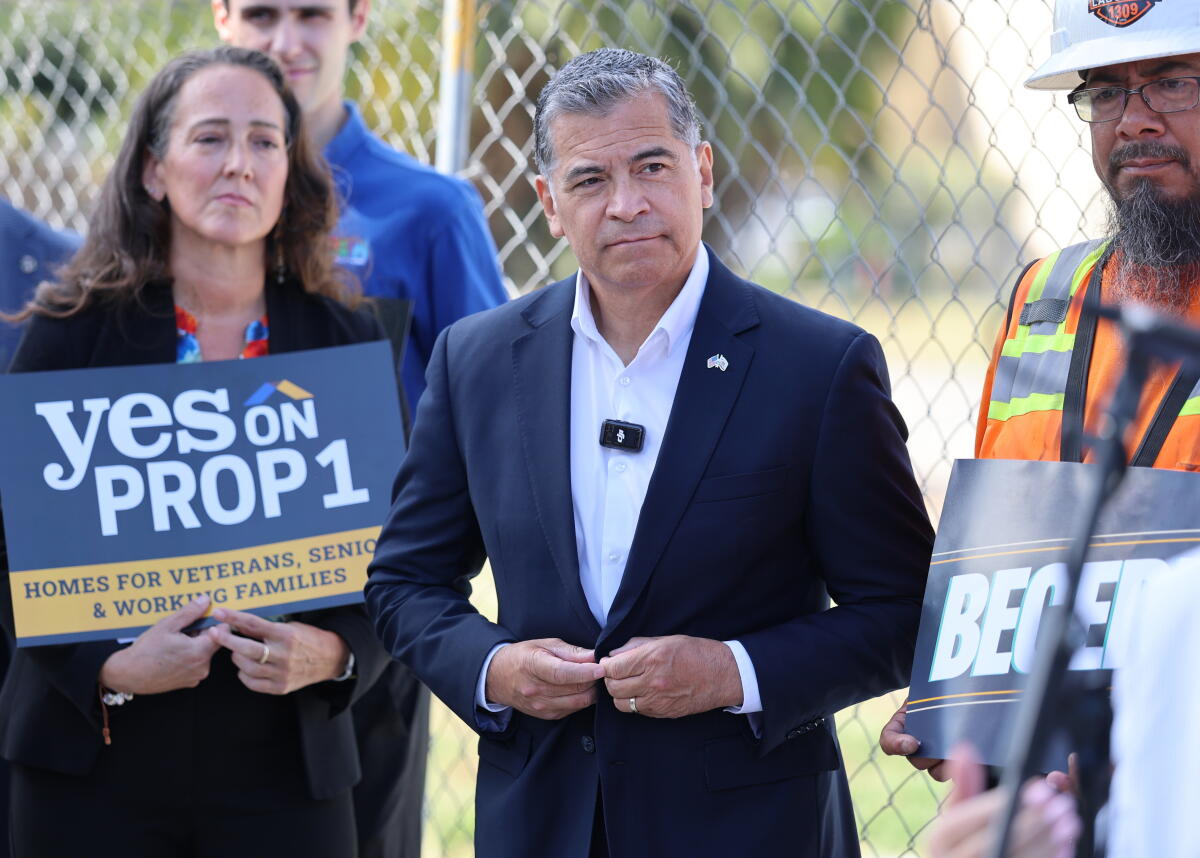
On Monday, he held get-out-the-vote events in Santa Clarita and Glendale, shortly after he campaigned for former state Sen. Richard Pan, a congressional candidate, in Sacramento, and urged voters to cast their ballots early at an event in Santa Rosa. In September, Becerra promoted Proposition 1, a proposal on the November ballot that would allow the state to sell nearly $11.3 billion in bonds to fund affordable housing.
“We know we can get these men and women who are wearing these orange vests to work and keep them working, so they can afford to buy a house if we pass Proposition 1,” Becerra said, standing alongside union members in front of a chain-link fence encircling a vacant lot in North Long Beach.

Gubernatorial candidate Xavier Becerra held a news conference in Long Beach on Sept. 4 to highlight his housing agenda.
(Allen J. Schaben / Los Angeles Times)
Long Beach Mayor Rex Richardson, who endorsed Becerra in April and appeared at the housing event, pushed back on the notion that Becerra is taking the election for granted after winning a top spot in the primary, positioning him to be the first Mexican American elected governor of California.
“I’ve seen firsthand the work that has taken place under the radar that may not be explicitly, openly political or openly be seen as campaigning, but it is the kind of thing you want to see,” Richardson said in an interview on Thursday, adding that he saw Becerra meeting with elected officials of both parties, the mayors of the state’s largest cities and labor leaders. “I’ve seen a very active candidate that has been making sure that real time was put into building relationships that will ultimately translate to a successful governorship, because that’s the goal. I mean, ultimately, what we want is a leader who has the relationships to lead our state.”
Becerra’s campaign said that the candidate has frequently met with voters since the primary without press coverage to hear from Californians, and that he would be a frequent public presence in the weeks before the election, when “voters really get engaged, when ballots land in their mailbox,” said spokesman Jonathan Underland.
“People have incredibly busy lives. They are worried about affording their healthcare, putting food on the table, paying for gas to fill their tank,” Underland said. “What is at the forefront of Secretary Becerra’s mind is the very real problems that Californians are facing every day.”
In contrast, Hilton has been publicly barnstorming California since the June primary.
Becerra’s schedule is not surprising given Democratic dominance in California, where the party’s registered voters outnumber Republicans nearly 2 to 1. While appearing at parades, pancake breakfasts and in voters’ living rooms can be effective for candidates running in local campaigns, the most effective way for candidates to reach voters in a state as vast as California is through sustained advertising buys, which can cost tens of millions of dollars.
“If you’re the Democrat running in California, the operating theme of your campaign is do no harm and measure the drapes and figure out how you’re going to put an administration together and what is the tone that you’re going to set for that administration,” said Tim Rosales, a veteran GOP consultant who led businessman John Cox’s unsuccessful 2018 gubernatorial campaign and previously worked on Arnold Schwarzenegger’s successful effort to replace Gov. Gray Davis in the 2003 recall campaign.
Newsom was more active in the 2018 general election campaign against Cox than Becerra has been this year, but Rosales argued that could be because Becerra views it as the final chapter of his political career, which also may have been the case with former Gov. Jerry Brown in his 2014 reelection campaign. Newsom, however, is pondering a 2028 run for the White House.
“This is potentially more of a swan song for Xavier Becerra, the icing on the cake for a long and distinguished political career, and for Gavin Newsom, it was a stepping stone,” Rosales said.
Becerra has raised $40.5 million, as of Friday, while Hilton has raised $29 million, according to the fundraising disclosure reports filed with the state. Those figures do not include the exponential advantage that Becerra had in independent expenditure committees’ spending over Hilton in the primary.
Veteran Republican strategist Rob Stutzman, an advisor to Schwarzenegger, said that while Becerra will almost certainly be the state’s next governor, he should be cautious about his approach weeks before the November election.
“What he needs to be careful of is a big Democratic night across the United States that looks muted in California, and if that happens, the analysis will be that it’s his fault,” Stutzman said. “He should want to optimize his political capital as the clear leader of his party now in California. So he has to be a little careful of leaving some political capital on the table by not creating a stronger brand over the next three weeks.”
The last gubernatorial race that was viewed as competitive took place in 2010 between Brown and former eBay chief Meg Whitman, then a Republican who spent $144 million of her personal wealth on her campaign.
That contest drew national attention, but Brown beat Whitman by nearly 13 percentage points. Every gubernatorial election since that race has been sleepy and ignored in national politics, with Democratic candidates coasting to victory. The state has seen contentious gubernatorial primaries, notably in 2018, and this year, when the Democratic field was so crowded that party leaders urged low-polling candidates, including Becerra, to drop out.
He won the top spot in the primary after then-Rep. Eric Swalwell (D-Dublin) dropped out amid rape and sexual assault allegations.
Mason Harrison, who worked for Republicans Carly Fiorina in a 2010 Senate bid and Neel Kashkari in a 2014 gubernatorial campaign, and worked with Hilton on business ventures but is not affiliated with his campaign, noted that while Brown was well-known by Californians because of decades in the public eye, Becerra is not. However, given Democrats’ edge in the state’s voter registration, as well as current headwinds against the GOP in California and across the nation, it’s unsurprising that Becerra has been less visible than Hilton. Harrison compared Becerra’s campaign to Biden’s in 2024 before the then-president bowed out of the race.
“The calculus seems to be, the more he gets out on the campaign trail, the greater the potential of him having a misstep in an interview or getting some tough question that he’s going to have to answer, and what’s the advantage of that in a year when you’re running against a party that, by historical standards, stands to lose significantly,” Harrison said. “Why make it more competitive by making yourself more vulnerable?”
Indeed, Becerra previously committed to multiple debates, but has participated in one so far and appears unlikely to agree to another. Still, he has repeatedly disputed the notion that he is taking the race for granted.
“If I were trying to coast, I’d be out on the coast right now instead of here with you all,” he told reporters one sweltering August afternoon in Little Tokyo in downtown Los Angeles, an area he represented in Congress.

Xavier Becerra, center, walks with Helen Ota, left, president of the 2026 Nisei Week Foundation, while touring businesses and meeting with business community leaders at Japanese Village Plaza in Little Tokyo in Los Angeles on Aug. 18.
(Genaro Molina / Los Angeles Times)
While there, he met with local business and community leaders. And he bought merchandise and delicacies, including a sweet mango mochi wrapped in a thin, fluffy pancake at a 123-year-old Japanese confectionery.
Times staff writer Nicole Nixon contributed to this report from Sacramento.