Ramadan is in full swing in Los Angeles, where a community of hundreds of thousands of Muslims is observing a month dedicated to fasting, prayer, reflection and service. With the unfolding war in the Middle East, the holiday holds even more significance for locals with ties to the region.
The Islamic holiday began Feb. 17 and ends March 19, during which observers fast from dawn to sunset to foster discipline, self-control and gratitude. Observers break their daily fast with an iftar, a festive meal shared with loved ones after sunset. Many also rise before dawn for a suhoor meal.
Halal, which translates to “permissible” in Arabic, pertains to the type of meat and the way it’s prepared. Pork and its byproducts are not allowed, and a Muslim must slaughter the animal while invoking the name of Allah. The animal must also be healthy and blood should be completely drained after slaughter.
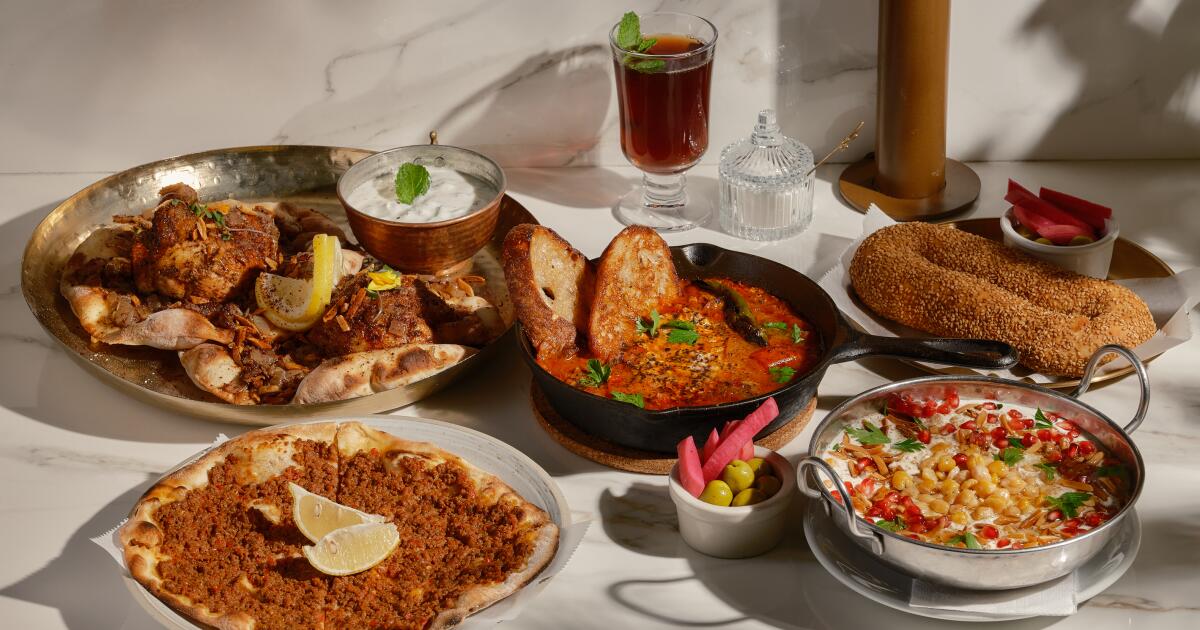
This Ramadan season, several L.A. restaurants are offering late-night hours, special iftar menus and discounts for the holiday.
“The demand for iftar and halal food is skyrocketing,” said Assad Shalhoub, a member of MENA Creator Club, a community group for Middle Eastern and North African content creators that organized an iftar gathering at West Adams’ Maydan Market. “I think a lot of people are becoming more proud of their culture and their heritage, and with that comes a lot of people seeking things like this.”
Here are eight halal restaurants to break fast and share a meal with loved ones during Ramadan.
Many of us go into the mountains to think and practice gratitude.
For the hundreds of thousands of Muslims across Los Angeles County observing Ramadan this month, spending time in nature can offer an opportunity for quiet reflection and growth.
“This sacred month provides an opportunity to merge the spiritual with the physical, finding solace and inspiration in nature,” nonprofit Muslim Outdoor Adventures notes. “Through mindful hiking, we aim to embrace the challenges of staying active during Ramadan, using the trails as a space for reflection and collective growth.”
You are reading The Wild newsletter
Sign up to get expert tips on the best of Southern California’s beaches, trails, parks, deserts, forests and mountains in your inbox every Thursday
Ramadan is considered the holiest month of the Islamic calendar. The holiday typically lasts 29 or 30 days, and during that time, Muslims will fast from sunup to sundown, including not drinking water. This excludes those who are exempt from fasting or not observing the holiday.
This year’s Ramadan started in mid-February and will end around March 19. (The Islamic calendar is based on lunar events, so Ramadan’s start and end dates vary from year to year.)
For fasting hikers, it’s important to ensure you plan accordingly, given your limited daily water and food intake.
Nadiim Domun, materials engineer at INOV8, said in a blog post that fasting hikers should plan ahead, and if they feel up to it, plan to break their fast at the top of a hill, taking their time to arrive at sunset. “On some days you’ll feel better than others. Be kind to yourself and only go hiking on days when your body feels up to it,” Domun said.
Below you’ll find three hikes and walks in places open after sunset. If observing the holiday, may your fasting be easy. Happy Ramadan!
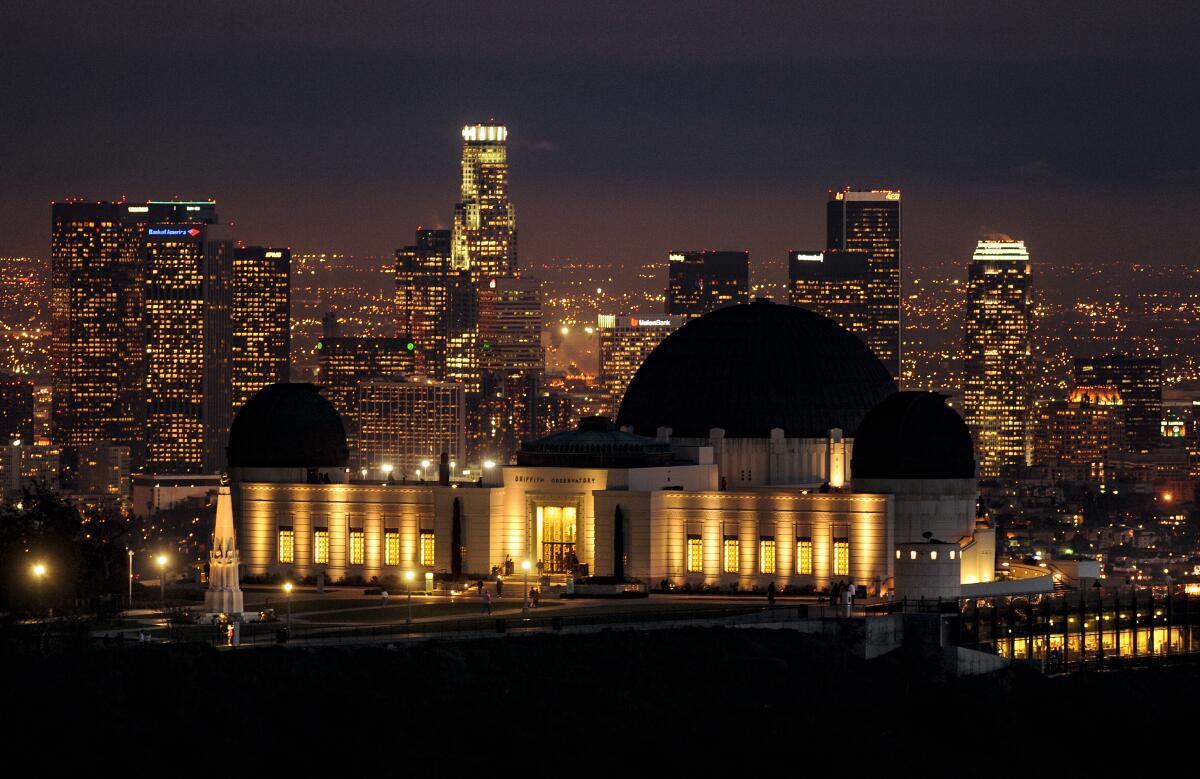
A view of the Griffith Observatory with downtown Los Angeles in the background.
(Wally Skalij / Los Angeles Times)
1. Crystal Springs – Atwater Park in Griffith Park
Distance: 2.7 miles Elevation gained: 130 feet Difficulty: Easy Dogs allowed? Yes Accessible alternative:Los Angeles River Bike Path
The Crystal Springs – Atwater Park route is a 2.7-mile easy stroll through the southeast side of Griffith Park that includes a quick side trip over the L.A. River.
Griffith Park is open from 5 a.m. to 10:30 p.m., although you’ll want to mind where you park, as some areas are open only until sunset.
To begin, you’ll take the wide dirt Main Trail north for just over half a mile before reaching a tunnel. Congrats! You’ve just completed the hilliest portion of this hike. It’s time to turn on that headlamp as you take the tunnel beneath the 5 Freeway, marveling at the wonders of human ingenuity.
Next, you’ll head over to the North Atwater Bridge, or La Kretz Bridge, an impressive modern design you’ve probably noticed from your car in gridlock traffic.
The North Atwater Bridge, or La Kretz Bridge, over the L.A. River.
(Emil Ravelo / For The Times)
The route next takes you to North Atwater Park. This area was separated from the rest of the park when the 5 Freeway was built in the late 1950s, resulting in 200 “prime acres of parkland” being destroyed, according to Friends of Griffith Park. Perhaps you’ll notice the squawk or chirp of birds settling in for the night.
From here, the path loops around the area for about a third of a mile before taking you back to the bridge. You’ll pass a corral and interpretive signs, among other things.
After crossing back over the bridge and under the tunnel (headlamp!), you’ll have a clear view of Beacon Hill, another great hiking destination in the park that offers stunning views of downtown L.A. You will head north again on the Main Trail, walking parallel to the 5. Hopefully the sound of the freeway is blocked by the lush trees that line the path.
You’ll take the Main Trail for about a third of a mile. At 1½ miles in your hike, you’ll bear left (or west), passing the Anza Trail Native Garden, planted by volunteers using seeds harvested from the park.
You’ll loop southwest around the path, passing the golf course and a baseball field before arriving at the newly renovated Griffith Park Visitor Center, open daily from 8 a.m. to 7 p.m. (It also has restrooms!)
From the visitor center, you’ll head east along a dirt path before looping back up with the Main Trail, which you’ll take south back to your car.
And if you’d like to go with a group, L.A. City Department of Recreation and Parks’ junior ecologist Ryan Kinzel and Emerson College professor Jacob Lang are hosting a free night hike through Griffith Park this Thursday.
So grab your headlamp, and have a great time!
Louisa McHugh, of San Pedro, jogs at Cabrillo Beach.
(Carolyn Cole / Los Angeles Times)
2. Beach path at Cabrillo Beach
Distance: 1.6 miles Elevation gained: Minimal Difficulty: Easy Dogs allowed? No Accessible alternative: The route below is a paved flat path.
This 1.6-mile beach walk is a gentle stroll along the mile-long Cabrillo Beach, where during the day you might spot kite surfers, barges and Catalina Island in the near distance.
To begin, start your walk in the northeast corner of the parking lot where the sidewalk begins. Walk south down the sidewalk, unless you’d like to walk on the sandy beach instead. Near the Cabrillo Beach Bath House, the path will curve east. You’ll continue east along the jetty until you reach the Cabrillo Beach Pier, where you might spot people fishing. You can pause to take in the views for as long as you’d like before heading back.
Although there are many beach walk options in Southern California, the reason I’m recommending Cabrillo Beach is because it’s a great place to observe grunion runs. At night, these small silvery fish come completely out of the water to lay their eggs in the wet sand, according to the California Department of Fish and Wildlife.
Beachgoers witness an unusual fish spawning ritual known as a grunion run on Cabrillo Beach in San Pedro.
(Luis Sinco / Los Angeles Times)
“Grunion make these excursions only on particular nights and with such regularity that the time of their arrival on the beach can be predicted a year in advance,” according to the agency.
Depending on how late you’d like to stay up, you can take a beach walk and stay for the grunions, which are expected to arrive at 10:25 p.m. Thursday and 10:50 p.m. Friday.
Hikers walk down a path at Kenneth Hahn State Recreation Area.
(Kayla Bartkowski / Los Angeles Times)
3. Gwen Moore Lake to Western Ridgeline in Kenneth Hahn State Recreation Area
Distance: Around 2½ miles Elevation gained: About 300 feet Difficulty: Moderate Dogs allowed? Yes Accessible alternative: Gwen Moore Lake path
This 2½-mile journey through Kenneth Hahn State Recreation Area will take you past a charming lake and will gain just enough elevation to provide you with striking views of the city. It is more challenging than the other two paths, so please plan accordingly. (And pack that headlamp!)
Kenneth Hahn State Recreation Area is open from 6 a.m. to 8 p.m. Wednesday through Sunday. The park is around 330 acres and includes the stunning Baldwin Hills Scenic Overlook, which thousands access every year via a straight staircase with 282 steps.
Upon arriving at the park, you’ll pay $10 to park. Ask the staff member at the toll booth whether they have a map, as it’s great to have one on hand as you hike. For this hike, I’d recommend parking near the Gwen Moore Lake if you can.
To begin the hike, you’ll start at Gwen Moore Lake. You can either take the paved path that takes you along the western side of the lake or the straight paved path on the eastern side of the lake. It will take you due south.
About a third of a mile in, you’ll walk east past the Kenneth Hahn Visitor Center before quickly joining with the Park to Playa Regional Trail, a 13-mile path that guides hikers from near Windsor Hills to the ocean (near Ballona Creek). That’s an adventure for another day!
You’ll take Park to Playa, a short jaunt, bearing left (northwest) toward a large green space to join the Bowl Loop Trail, or on some maps, Park to Playa Alternate. Follow this path in the northerly direction until it jags left where you’ll join the Western Ridgeline Trail (or Park to Playa Alternate, depending on your map). From here, say hello to beautiful views of the city!
You will next take Diane’s Trail (who is she?) just over half a mile before heading down via the Forest Trail. Pause along the way to appreciate more gorgeous views of the city, including of downtown L.A.
Head south past the Japanese garden, and then take the paved road from the Japanese garden back to where you parked, hopefully near the lake.
3 things to do
During a previous Dana Point Festival of Whales, guests attend a sacred ceremony given by the Acjachemen Nation and observe the Dana Point Surf Club as their members paddle out to welcome the whales to Dana Point’s shores.
(Dana Point Harbor)
1. Whale-come the cetaceans in Dana Point The 55th Annual Dana Point Festival of the Whales, which celebrates gray whale migration, is scheduled for Friday through Sunday in Dana Point Harbor. Visitors can attend the “Welcoming of the Whales” ceremony at 4:30 p.m. Friday at the Ocean Institute, or on Saturday, observe the cardboard boat race, learn at the marine mammal lecture series or chow down at the clam chowder cookout. On Sunday, attendees will pick up trash at 9 a.m. near at the Richard Henry Dana Jr. statue before attending a concert from noon to 5 p.m. performed from a floating dock. Learn more at festivalofwhales.com.
2. Stand up for public lands in Ventura Environmental advocacy groups Los Padres ForestWatch and Climate First: Replacing Oil & Gas will host a hike at 11 a.m. Sunday through the Harmon Canyon Preserve in Ventura. Group leaders will educate hikers on the Trump administration’s proposal to open 850,000 acres, including about 400,000 acres across Central California, to oil and gas drilling. After the hike, participants are invited to make posters to spread awareness of the threat to public lands. Register at eventbrite.com.
3. Kick back with a kite in Redondo Beach The 52nd Annual Redondo Pier Kite Festival will take place from noon to 5 p.m. Sunday at the Redondo Beach Pier (100 Fishermans Wharf). This free community event will feature live music, face painting and a kite flying contest. Kites will be available for purchase on the pier while supplies last. Guests can also bring their own kites. Learn more at redondopier.com.
The must-read
Visitors take the chair lifts at the Mt. Baldy Resort.
(Christina House / Los Angeles Times)
The ski world is becoming increasingly owned by large corporate chains, but small shops like the Mt. Baldy Resort continue to hang on. Times staff writer Jack Dolan wrote about how Mt. Baldy Resort, just over an hour from downtown L.A., works hard to remain competitive. The resort offers a quick escape for Angelenos who want to ski and appreciate “the wide expanse of the Inland Empire stretched to the Pacific Ocean nearly two vertical miles below,” Dolan wrote. Many of its guests find its old-school style more welcoming than the ritzy lodges in Taos and Tahoe. “There’s big conglomerates trying to buy everybody up, and I don’t want that,” said Chris Caron, a 65-year-old retiree who lives 20 minutes down the road from Mt. Baldy Resort. “That’s what I love about here. It’s not so commercialized.”
Happy adventuring,
P.S.
Porkchop is free! A month ago, I featured a story by Times staff writer Lila Seidman, introducing Wild readers to Porkchop, a three-flippered sea turtle who was being rehabilitated by the Aquarium of the Pacific in Long Beach. “Many Angelenos don’t know Eastern Pacific green sea turtles are swimming in their proverbial backyard, but they are — and they’re thriving,” Seidman wrote. “It’s estimated that about 100 of the hulking-yet-graceful animals live in the lower stretch of the San Gabriel River, where salt and freshwater commingle.” And thankfully, it’s now about 101, as Porkchop was released back into the wild on Friday. I’m not crying, you’re crying!
For more insider tips on Southern California’s beaches, trails and parks, check out past editions of The Wild. And to view this newsletter in your browser, click here.
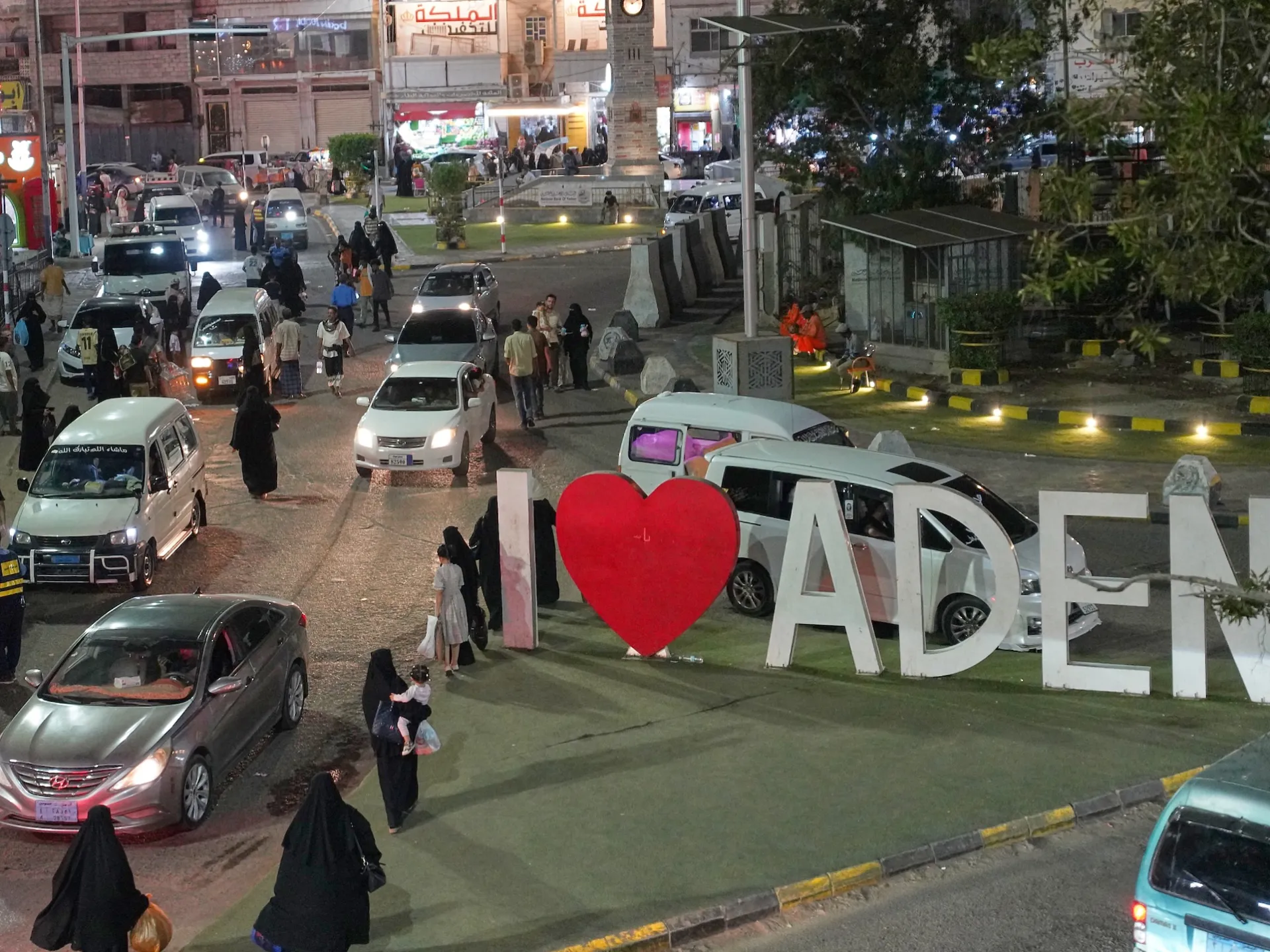
Aden, Yemen – Abu Amjad was shopping with his two children last week, finally able to take them out and buy them new clothes – a cherished Ramadan tradition in Yemen.
The 35-year-old is a teacher, and he had just received his salary. That payment was a sign things are improving in Aden – the salaries are funded by Saudi Arabia as a way of backing the Yemeni government, which has recently arrived to take control of Aden after the defeat of secessionist forces.
Recommended Stories
list of 3 itemsend of list
But problems and instability are never far away in Yemen.
Just as soon as the children, Amjad, 10, and Mona, 7, began trying on their outfits, the sound of gunfire erupted. Shoppers froze. Amjad and Mona clutched their father, asking to leave.
About 3km (2 miles) away, security forces had opened fire on protesters who attempted to breach the gates of al-Maashiq Palace, where members of the Yemeni government have been based since they arrived from Riyadh a week ago.
The gunfire shattered the family’s moment of joy.
“It ruins your joy when you see a person bleed and robs you of peace when you hear prolonged gunfire,” Abu Amjad told Al Jazeera.
After years of operating from exile, Yemen’s Saudi-backed, UN-recognised cabinet is spending Ramadan in Aden, a move that has coincided with improvements in basic services and a renewed sense of relief. Yet that relief was overshadowed by the deadly confrontation between security forces and antigovernment protesters, in which at least one person was killed.
“That was the first clash after the return of the government to Aden. Our concern is that it may not be the last,” said Abu Amjad.
Government wins
Yemen’s new Prime Minister Shaya al-Zindani has said that stabilising Aden and other areas under government control was among the new government’s main priorities.
The Yemeni government is currently in its strongest position for years. An advance by the separatist Southern Transitional Council (STC) at the end of last year in eastern Yemen ultimately was a step too far for the United Arab Emirates-backed group.
Saudi Arabia considered the STC advance the crossing of a red line, and lent its full military backing to the Yemeni government, allowing it to take territory it had not controlled for years.
Now, the Yemeni government and Saudi Arabia are focused on attempting to improve conditions in the southern and eastern areas of Yemen under government control, to attract more public support. That would in turn weaken support for both the STC and the Houthi rebels, who have controlled northwestern Yemen, including the capital, Sanaa, since the country’s war began in 2014.
Lit city and busy markets
Abdulrahman Mansour, a bus driver and resident of Khormaksar in Aden, said Ramadan this year feels different.
“When I see the lights on and the markets busy on Ramadan nights in Aden, it feels like a different city. The improvement is undeniable,” Mansour, 42, told Al Jazeera.
He noted that one distinct difference this Ramadan is the stable provision of electricity. “This reminds me of the pre-war time. We used to take that service for granted,” said Mansour.
“When the city is dark at night, it appears gloomy, and families prefer to stay home. The movement of people brings life to the city and helps small businesses keep afloat, especially in Ramadan,” Mansour added.
Yemeni Electricity Minister Adnan al-Kaf said last week that efforts to improve electricity services in Aden and other provinces continue, noting that Saudi support had contributed to improved service over the past two months.
Wafiq Saleh, a Yemeni economic researcher, said the improvement in the living standards of citizens in Aden and southern Yemen, in general, was obvious, particularly after Saudi Arabia’s payment of public sector salaries and the supply of basic services such as water and electricity.
Saleh told Al Jazeera, “The recent Saudi financial support has been very generous, and it can help the government during this period by enabling it to work on reactivating dormant resources, resuming oil exports, combating corruption, and improving the efficiency of revenue collection with transparency and good governance.”
But Saleh emphasised that the progress achieved so far is not the result of economic reforms by the Yemeni government, but rather because of Saudi support.
Therefore, according to the economist, the improvement in the living situation and the currency’s value may not be sustainable, even if it is a positive indicator and may be the first step towards promised economic reforms in the country.
“There must be a comprehensive vision for developing revenue collection so that the government can implement sustainable economic reforms,” Saleh said.
Search for cooking gas
While the distribution of electricity has improved in Aden, other essential services remain strained. Cooking gas shortages remain a major concern. The search for it remains a daily struggle for families in the port city, and the crisis has intensified in Ramadan.
Lines of vehicles queue at stations, while residents wait with cylinders for a few litres (quarts) of gas.
“Going from one station to another in search of cooking gas while fasting is exhausting,” said Fawaz Ahmed, a 42-year resident of Khormaksar district.
Fawaz describes the shortage of cooking gas as a cause of hunger in the city. “If I stay in [my home] village, I would resort to firewood. But in the city, that option is not available, and if we find firewood in the market, it is expensive.”
Gas distributors say the quantity of cooking gas supplied to them is not adequate, citing this as the root cause of the crisis. Supplies are transported from Marib province in northern Yemen.
Tensions to continue
The cooking gas shortage is a sign that it will not be plain sailing for the Yemeni government in Aden.
And opponents will likely seize on any ongoing problems to foment more unrest.
Majed al-Daari, editor-in-chief of the independent Yemeni news site Maraqiboun Press, described the situation in Aden as “very worrying”.
“What happened to the demonstrators at the start of Ramadan underscores the fragility of the political and security situation. Tensions are set to continue,” al-Daari said.
“The STC will continue mobilising its supporters against the government. This is its last card that it will use to restore lost political interests,” al-Daari added.
The STC said in a statement last week that raids and arbitrary arrests had targeted people who had participated in the recent protests. These attacks, the statement emphasised, would only increase the determination of the southerner secessionists.
For Abu Amjad, demonstrations in Aden give space to chaos, which he resents.
“At least, Ramadan should pass without protests. Political actors should spare us this month so we can fast and share some joy with our children,” he said.
Thousands of worshippers attend prayers at Al-Aqsa Mosque, with others turned away despite carrying required permits.
Published On 27 Feb 202627 Feb 2026
Share
About 100,000 Palestinian worshippers have prayed at the Al-Aqsa Mosque compound in occupied East Jerusalem for the second Friday of the Muslim holy month of Ramadan, despite Israel imposing severe restrictions on access to the holy site.
Worshippers were subjected to thorough security screening on Friday as they made their way through the Qalandiya checkpoint in the occupied West Bank north of Jerusalem to pray, an Al Jazeera team reported, amid a heavy deployment of Israeli forces around the city.
Recommended Stories
list of 4 itemsend of list
Israeli authorities imposed rules at the start of Ramadan to limit entry for Friday prayers to just 10,000 Palestinian worshippers with daily permits – a small fraction of the hundreds of thousands who would attend in normal years.
Under the Israeli rules, only men over 55, women 50 years or older, and children under 12, accompanied by a relative, are permitted to enter.
Visitors are also required to complete digital verification procedures at crossings when returning to the West Bank.
Muslim worshippers make their way to the Al-Aqsa Mosque to attend the second Friday noon prayers of the holy month of Ramadan [Hazem Bader/AFP]
Bans on individuals
As well as the restrictions, Israeli authorities recently announced bans on 280 Jerusalem residents, including religious figures, journalists, and released prisoners, from attending prayers at Al-Aqsa Mosque.
The push to limit Palestinians’ access to the holy site during Ramadan is widely seen as part of an effort to pressure Palestinian communities and erase the Palestinian cultural identity of occupied East Jerusalem, which Palestinians view as the capital of their future state.
The restrictions have further increased since the genocidal war on Gaza began in October 2023.
Muslims perform Friday noon prayers at the Al-Aqsa Mosque compound [Ahmad Gharabli/AFP]
Turned away despite permits
Despite the restrictions, attendance at the mosque was considerably higher than the supposed cap of 10,000 visitors, as it was the previous week, when Jerusalem’s Islamic Waqf, the religious authority that administers the compound, said 80,000 people attended the first Friday prayers of Ramadan.
Yet many Palestinians who attempted to attend, including some who said they had the necessary permits, found themselves turned away by Israeli authorities.
Najati Oweida, who travelled from Hebron, told Anadolu that Israeli soldiers turned him back despite presenting a permit.
“The occupation claims it has provided facilitation, but the procedures are strict,” he said. “I only want to pray at Al-Aqsa. Why am I being prevented?”
Another man, Ali Nawas, 58, told the news agency that he and his wife had travelled for more than an hour from Nablus in the occupied West Bank, only for his wife to be turned back at the Qalandiya checkpoint, despite her having a permit.
“I was forced to return with her. How could she go back to Nablus alone?” he said.
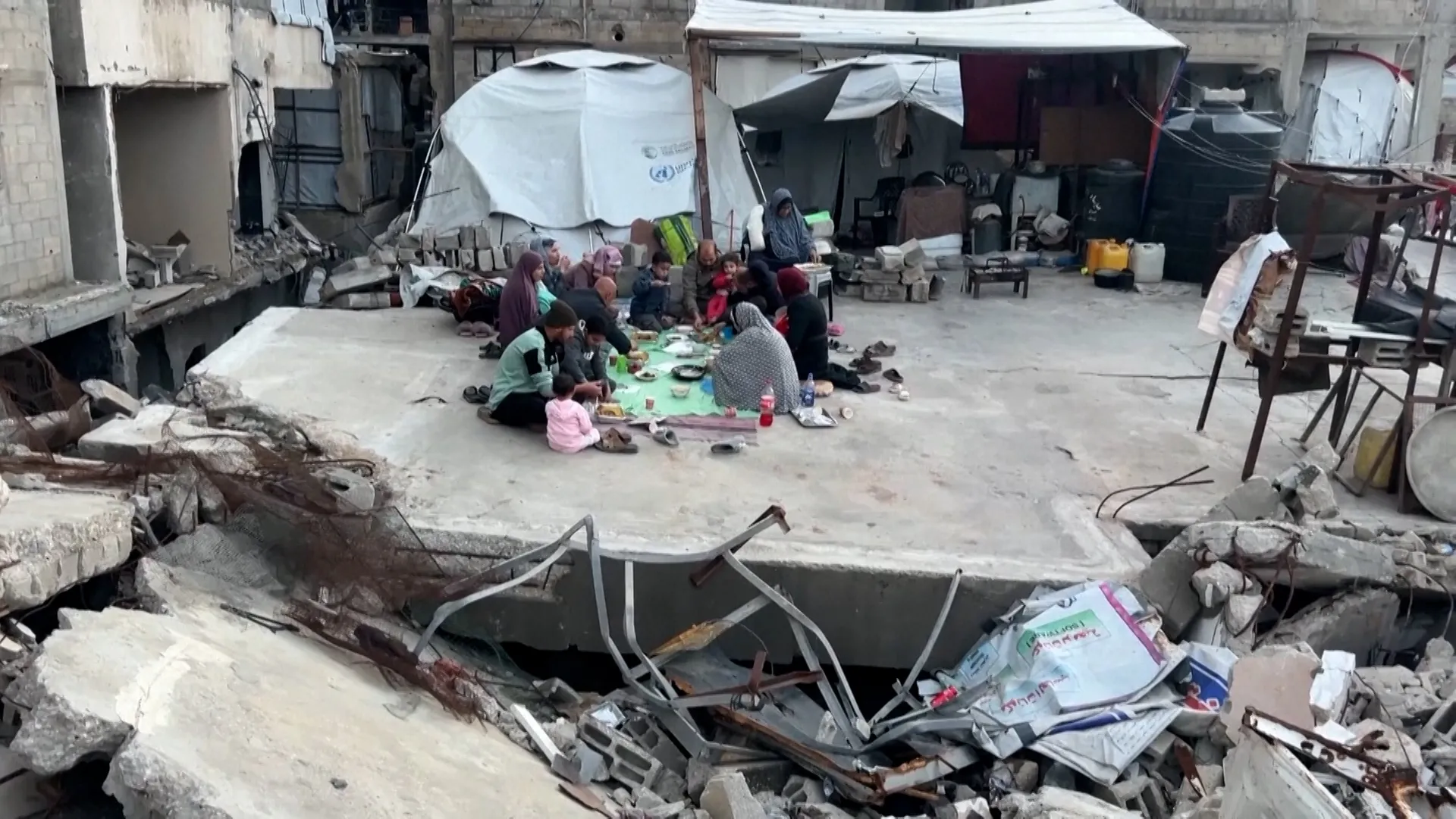
Ahmed Abu Naji is one of millions of Palestinians in Gaza who are clinging onto the traditions of Ramadan, despite the destruction from Israel’s war. Many are breaking their fast amid the rubble of their homes – and some have their iftar meals in graveyards as they mourn loved ones.
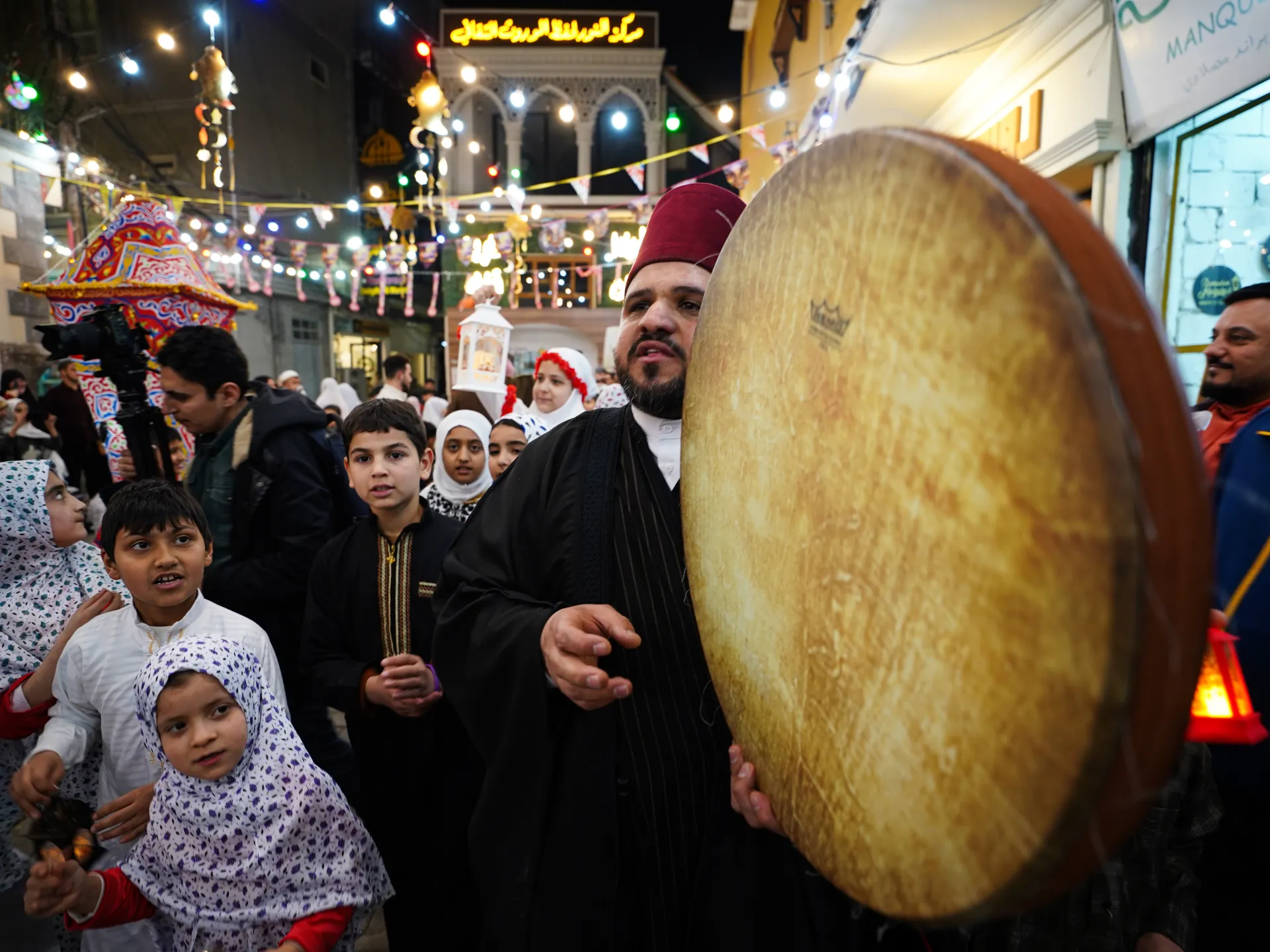
As the Muslim holy month of Ramadan began last week, the Iraqi city of Mosul regained its spiritual and cultural vibrancy, with religious rituals blending with cultural activities that reflect the city’s heritage, identity and collective memory after years of war and devastation.
On the first night of Ramadan, immediately after the Maghrib call to prayer, the chant “Majina ya Majina”, a traditional Ramadan song, echoes through the old neighbourhoods. Children in traditional clothing roam the streets singing Ramadan songs, in a scene that revives longstanding customs.
“This gathering of children revives Mosuli and Iraqi heritage and teaches them the values of sharing and celebrating the holy month,” said Yasser Goyani, 31, a member of the Bytna Foundation for Culture, Arts and Heritage
Tarawih prayers, performed at night during Ramadan, have also returned to the Grand al-Nuri Mosque and its iconic leaning minaret, al-Hadba, for the first time in nearly nine years, just before the bombing of the mosque in 2017 by ISIL (ISIS) fighters at the peak of an Iraqi government campaign against the group that had taken control of the city.
“I feel great joy performing prayers again in the mosque after its restoration and reopening, which reflects its spiritual and historical importance,” adds Goyani.
The traditional storyteller, or hakawati, has also re-emerged during Ramadan evenings, recounting stories from Mosul’s past.
“The hakawati represents a link between the past and the present. We narrate stories about how life in Mosul used to be, especially during the holy month of Ramadan. Despite technological development, people still love returning to their old memories,” explained Abeer al-Ghanem, 52, who plays the storyteller.
Meanwhile, the musaharati – the traditional predawn caller who wakes people up for a small meal to help them cope with the daylong fast – still walks through neighbourhoods in the Old City of Mosul before dawn.
Ghufran Thamer, 34, who performs the role, says, “The musaharati reminds people of authentic Ramadan rituals and keeps the nights of Ramadan alive, despite the changes in modern life.”
Traditional games remain a key part of the Ramadan atmosphere.
“We have been playing the siniya game since the 1980s. It is closely associated with Ramadan and creates a warm and joyful atmosphere among participants during the nights,” said Fahad Mohammed Kashmoula, 55.
Mosul’s markets, particularly the historic Bab al-Saray, come alive during Ramadan as residents flock to buy seasonal staples. Dates are especially in demand, providing a quick source of energy for those fasting. Khalil Mahmoud, 65, who has been selling dates in Bab al-Saray for nearly 40 years, says date sales increase significantly during Ramadan, especially in this market.
“Dates are highly sought after by those fasting, because they help compensate for the sugar lost during the day,” he said
Raisin juice, another Ramadan drink, is also popular across the city.
“The juice is prepared from high-quality raisins and fresh mint from the mountains of Kurdistan. The raisins are soaked, strained, crushed and strained again before being poured into bags for sale. Shops become crowded as people seek to replenish their energy after fasting,” said Hussein Muwaffaq, a raisin juice maker.
Alongside religious and cultural activities, the city also sees growing humanitarian initiatives during Ramadan, including paying off the debts of people in need, distributing food baskets, setting up free iftar meals, and promoting the values of social solidarity.
Attack on Nablus-area mosque is latest in surge of Israeli settler and military violence targeting Palestinians.
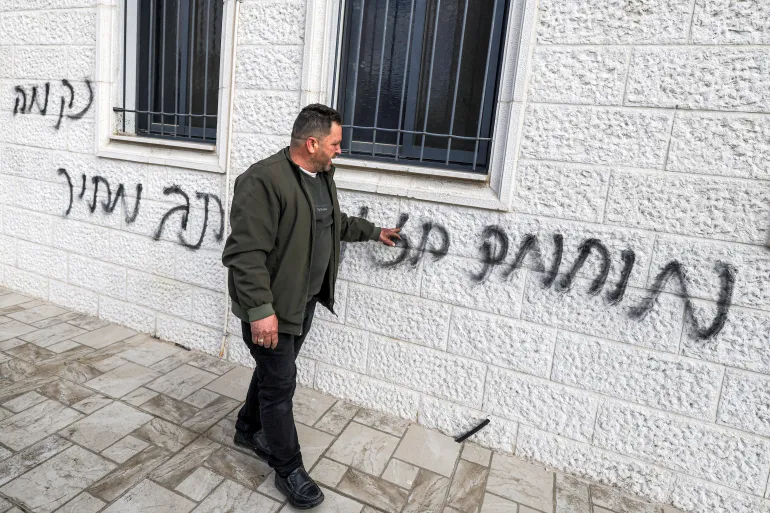
Israeli settlers have defaced and set fire to a mosque in the occupied West Bank during the Muslim holy month of Ramadan, marking the latest incident in a wave of Israeli violence against Palestinians in the territory.
The Wafa news agency reported on Monday that settlers graffitied racist slogans on the walls of Abu Bakr as-Siddiq Mosque, located between the towns of Sarra and Tal, near Nablus in the north of the West Bank.
Recommended Stories
list of 3 itemsend of list
Worshippers arriving for the day’s first prayers found the damage and a smouldering fire that spewed black smoke across the mosque’s entrance and stained the ornate doorway, The Associated Press reported.
“I was shocked when I opened the door,” Munir Ramdan, who lives nearby, told the news agency. “The fire had been burning here in the area, the glass was broken here and the door was broken.”
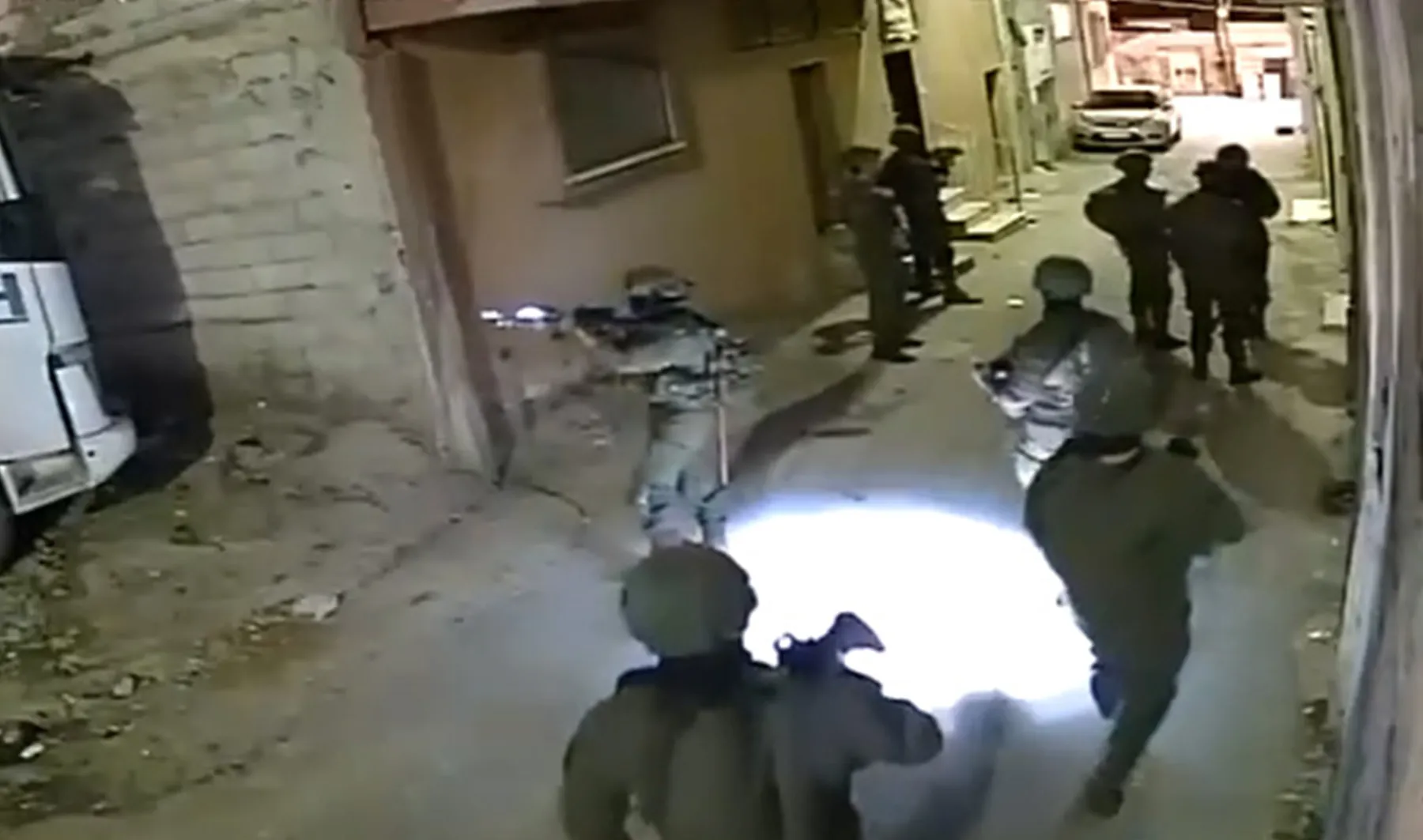
Ramdan told AP that security camera footage showed two people walking towards the mosque carrying gasoline or petrol and a can of spray paint, and running away a few minutes later.
The attackers spray-painted graffiti denigrating the Prophet Muhammad, as well as the words “revenge” and “price tag” – a term used to describe attacks by Israeli settlers against Palestinians and their property.
A man inspects Hebrew graffiti on the walls outside the Abu Bakr as-Siddiq Mosque after the attack [AFP]
The assault comes amid a wave of intensified Israeli settler and military violence across the West Bank in the shadow of Israel’s genocidal war against Palestinians in the nearby Gaza Strip.
At least 1,094 Palestinians have been killed by Israeli troops and settlers in the West Bank since the Gaza war began in October 2023, according to the latest United Nations figures.
Last week, the UN Human Rights Council warned in a new report (PDF) that Israeli policies in the West Bank – including “the systematic unlawful use of force by Israeli security forces” and unlawful demolitions of Palestinian homes – aim to uproot Palestinian communities.
“These violations, together with pervasive and growing settler violence committed with impunity, are fundamental to the coercive environment that induces forced displacement and forcible transfer, which is a war crime,” the report said.
It added that these policies are aimed at “altering the character, status and demographic composition of the occupied West Bank, raising serious concerns of ethnic cleansing”.
Back in the West Bank village of Tal on Monday, resident Salem Ishtayeh told AP that the Israeli settlers’ assault on the local mosque was “directed especially” at Palestinians who are fasting during Ramadan.
“So they like to provoke you with words. It’s not that they are attacking you personally, they are attacking your religion, the Islamic faith,” Ishtayeh said.
A Palestinian man inspects the debris at the mosque that was attacked by Israeli settlers [Mohamad Torokman/Reuters]
According to the Palestinian Authority’s Ministry of Religious Affairs, settlers vandalised or attacked 45 mosques in the West Bank last year.
The Israeli military and police said they responded to the latest incident and were searching for suspects.
But human rights groups say the Israeli authorities have allowed the settlers to operate with total impunity in their attacks against Palestinians.
Israeli organisation B’Tselem has accused Israel of actively aiding the settlers’ violence “as part of a strategy to cement the takeover of Palestinian land”.
The UN also warned last year that settler attacks were being carried out “with the acquiescence, support, and in some cases participation, of Israeli security forces”.
After two years of a grinding war, Palestinians in the Gaza Strip are observing the holy month of Ramadan during an unabating economic catastrophe as Israel continues to impose restrictions on the entry of food and other supplies despite a “ceasefire” reached in October.
For most families, the daily struggle to secure a mere loaf of bread has replaced the traditional festive atmosphere before the war. An analysis by Al Jazeera, based on official data, reveals that skyrocketing prices for basic commodities have made a complete iftar meal to break the daily fast a distant dream for the vast majority of the population.
Skyrocketing costs
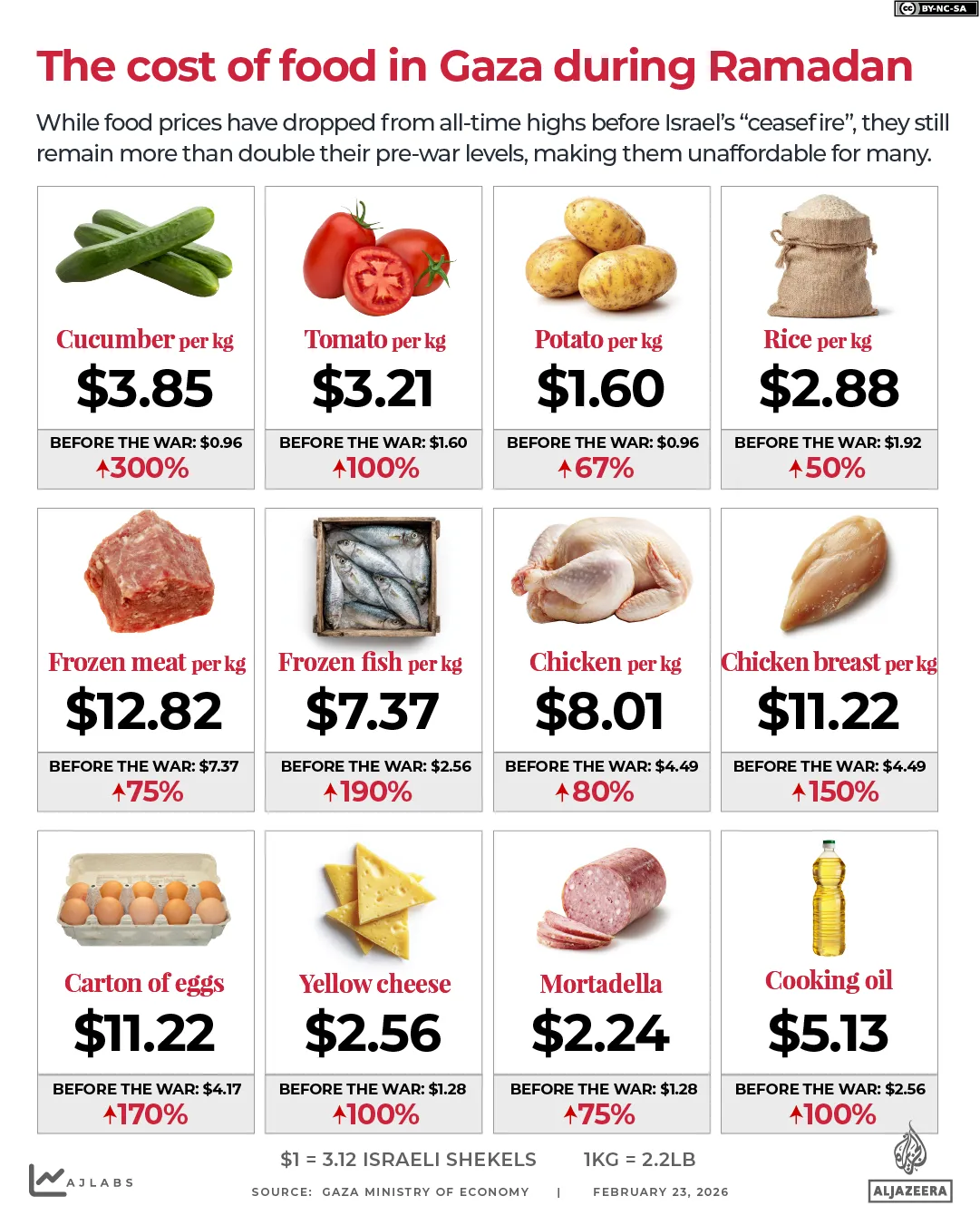
During periods when Israel tightened its siege or completely closed the crossings into Gaza, food prices spiked by more than 700 percent. While prices have retreated slightly since the “ceasefire” began in October, they remain significantly higher than pre-war levels.
According to Mohammed Barbakh, director general of policy and planning at the Ministry of Economy in Gaza, official data tracking prices from before the war began on October 7, 2023, to the first days of this Ramadan show staggering increases.
Al Jazeera’s analysis of the ministry’s price data reveals the following hikes:
Chicken: Prices rose from 14 shekels ($4.49) to 25 shekels ($8.01) per kilogramme (2.2lb), an 80 percent increase.
Frozen fish: Prices jumped from 8 shekels ($2.56) to 23 shekels ($7.37) per kilo, a 190 percent increase.
Frozen red meat: Prices rose from 23 shekels ($7.37) to 40 shekels ($12.82) per kilo, a 75 percent difference.
Eggs: A tray of 30 eggs now costs 35 shekels ($11.22) compared with 13 shekels ($4.17), a 170 percent increase.
Vegetables, a staple of the Palestinian diet, have also seen dramatic surges. Tomatoes have doubled in price while cucumbers have jumped by 300 percent, rising from 3 shekels ($0.96) per kilo to 12 shekels ($3.85). Cheese prices have increased by up to 110 percent, directly impacting the cost of suhoor, the predawn meal before the daily fasting during Ramadan begins.
(Al Jazeera)
The cost of a meal
Based on data from the Palestinian Central Bureau of Statistics, Al Jazeera estimated the cost of a basic iftar for a family of six. The meal includes two chickens, rice, salad, appetisers, a soft drink, cooking gas and oil.
The price of the meal has risen to about 150 shekels ($48), up from 79 shekels ($25.32) before the war, an increase of 90 percent.
For suhoor, a simple meal of cheese, hummus, falafel and bread now costs 31.5 shekels ($10.10), compared with 18.6 shekels ($5.96) previously.
The combined daily cost to feed a medium-sized family now stands at 181.5 shekels ($58.17), an 88 percent jump from pre-war figures.
Economic obliteration
These price hikes coincide with a collapse in purchasing power. A United Nations report released in late 2025 indicated that the annual per capita income in Gaza plummeted to $161 (503 shekels) in 2024, down from $1,250 (3,900 shekels) in 2022.
The labour market has essentially vanished. In a statement issued in October, Sami al-Amsi, head of the General Federation of Palestinian Trade Unions, said unemployment stood then at more than 95 percent as workshops, farmland and fishing fleets were destroyed.
“The worker is no longer looking for a job because there is no work at all,” al-Amsi said. “Today, the Palestinian worker is looking for a food parcel to survive.”
Blockade and monopoly
Economic researcher Ahmed Abu Qamar attributed the inflation to Israel’s restrictive entry policies and “coordination fees” imposed on trucks.
“The humanitarian protocol stipulates the entry of 600 trucks daily, yet the Israeli occupation effectively allows only between 200 and 250 trucks,” Abu Qamar told Al Jazeera, noting that the Strip actually requires 1,000 trucks daily to meet minimum demand.
He also highlighted a monopoly system under which only about 10 merchants are authorised to import goods through four Israeli companies, restricting competition and keeping prices artificially high. He called for a return to a free market system and the full opening of crossings to alleviate the burden on a population already crushed by conflict.
Latest Israeli attacks bring total death toll in Gaza since October ‘ceasefire’ to 614.
Published On 21 Feb 202621 Feb 2026
Share
Israeli air strikes killed at least two Palestinians in Gaza on the third day of Ramadan in the latest breach of the truce deal signed with Hamas more than four months ago.
The attacks on Saturday occurred in northern Gaza’s Jabalia camp and the Qizan an-Najjar area in southern Gaza.
Recommended Stories
list of 4 itemsend of list
The total death toll from Israel’s attacks since the “ceasefire” came into effect has risen to 614, with 1,640 more Palestinians wounded, according to the Palestinian news agency Wafa.
Israel’s military appeared to acknowledge one of the attacks in a post on X, claiming its forces killed a fighter who crossed onto Israel’s side of the demarcation line in northern Gaza and approached its troops “in a manner that posed an immediate threat”.
The army said it would “continue to act to remove any immediate threat”.
‘Board of Peace’ deliberations
Saturday’s attacks come two days after US President Donald Trump’s Board of Peace held its first-ever meeting addressing reconstruction, security, and governance in the war-battered Strip.
Trump announced at the gathering that nine countries committed $7bn for Gaza reconstruction efforts, on top of a $10bn contribution from the United States. While significant, the total is far short of the estimated $70bn needed to rebuild the devastated Palestinian territory.
Trump also said five countries pledged to send troops to participate in an eventual 20,000-strong International Stabilization Force (ISF), which is to take over security from Hamas. But the task of disarming Hamas – called for in the next stage of the deal – is still unresolved, threatening to delay or derail the entire process.
Israeli Prime Minister Benjamin Netanyahu has insisted Hamas must disarm before any reconstruction begins. Last week, a top Netanyahu aide said Israel planned to give Hamas a 60-day deadline to comply before resuming its war, an ultimatum the group rejected.
Hamas has said it will not relinquish its weapons as long as Israel continues occupying the Strip and discussions on any political process in Gaza “must start with the total halt of aggression”.
The group has said it is open to a peacekeeping force, but with caveats.
“We want peacekeeping forces that monitor the ceasefire, ensure its implementation, and act as a buffer between the occupation army and our people in the Gaza Strip, without interfering in Gaza’s internal affairs,” said Hamas spokesperson Hazem Qassem on Friday.
‘Unclear in vision’
Along with Hamas’s disarmament, the next stage of Trump’s plan for Gaza calls for the gradual withdrawal of the Israeli military and the ISF’s deployment, with a transitional Palestinian technocratic committee overseeing day-to-day governance.
Many Palestinians told Al Jazeera they are deeply sceptical about the plan’s prospects for success, citing Israel’s continued deadly attacks and lingering aid shortages.
“Israel kills, bombs, violates the ceasefire agreement daily and expands the buffer zone without anyone stopping it,” said Awad al-Ghoul, 70, a Palestinian displaced from Tal as-Sultan in southern Rafah and who now lives in a tent in the town of az-Zawayda.
“So this project is a failure from the start and unclear in vision.”
Nisreen Nassar and her family, like many other Palestinians, continue to live in schools and makeshift shelters.
Published On 20 Feb 202620 Feb 2026
Share
Just before sunset on Thursday, Nisreen Nassar crouched over her makeshift oven, burning wood and scraps of plastic to bake bread for her family so they could break their fast.
Four months after the United States-brokered “ceasefire” came into effect in October, and as US President Donald Trump convened the first meeting of his Board of Peace on Thursday, she wasn’t expecting to be sheltering with her family in an abandoned school and cooking on an open fire during the Muslim holy month of Ramadan.
Recommended Stories
list of 3 itemsend of list
“Our preparations and expectations for Ramadan this month were that it would be better than previous ones during the war. Unfortunately, it is worse,” Nassar told Al Jazeera’s Hani Mahmoud, reporting from Gaza City.
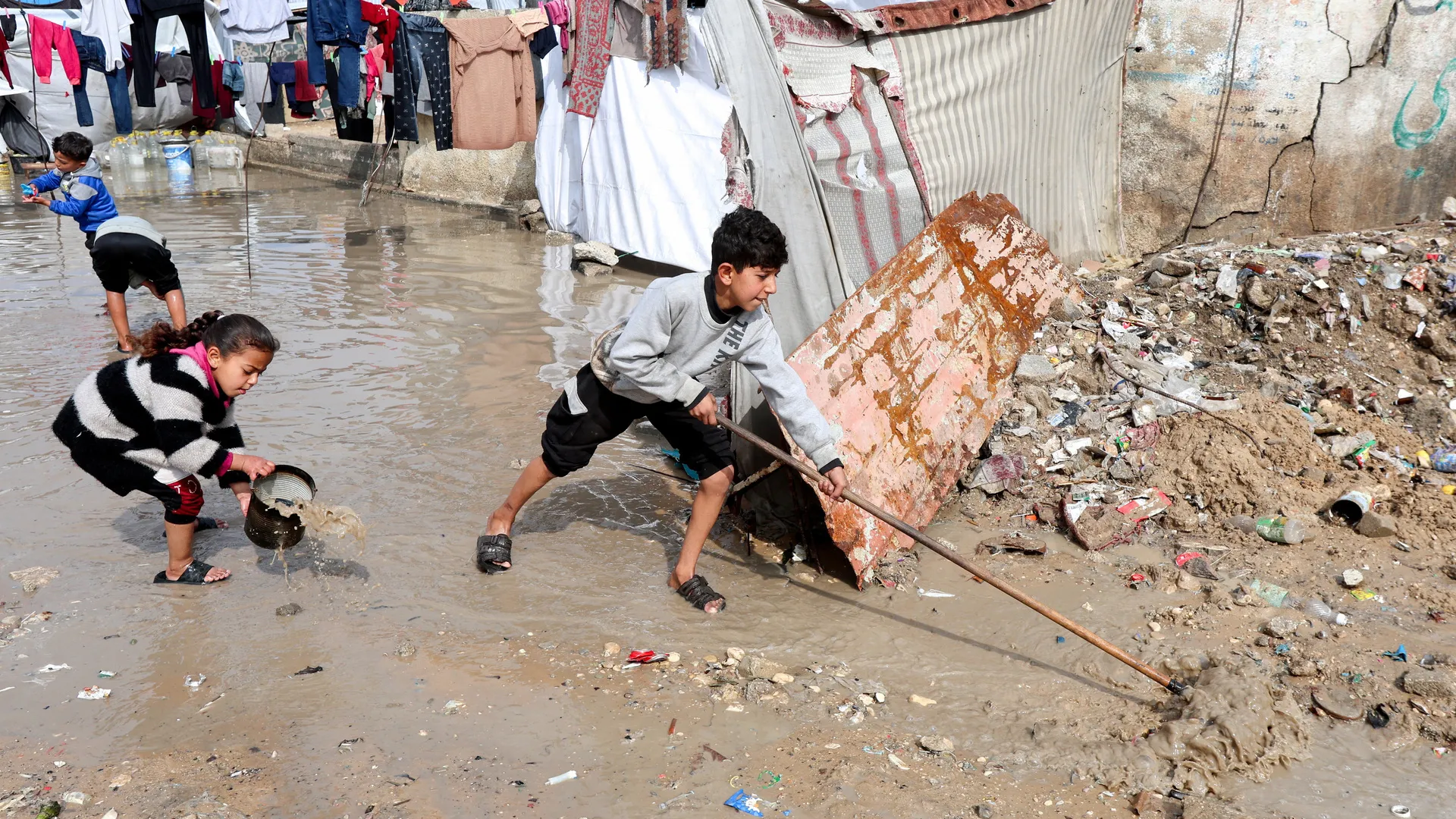
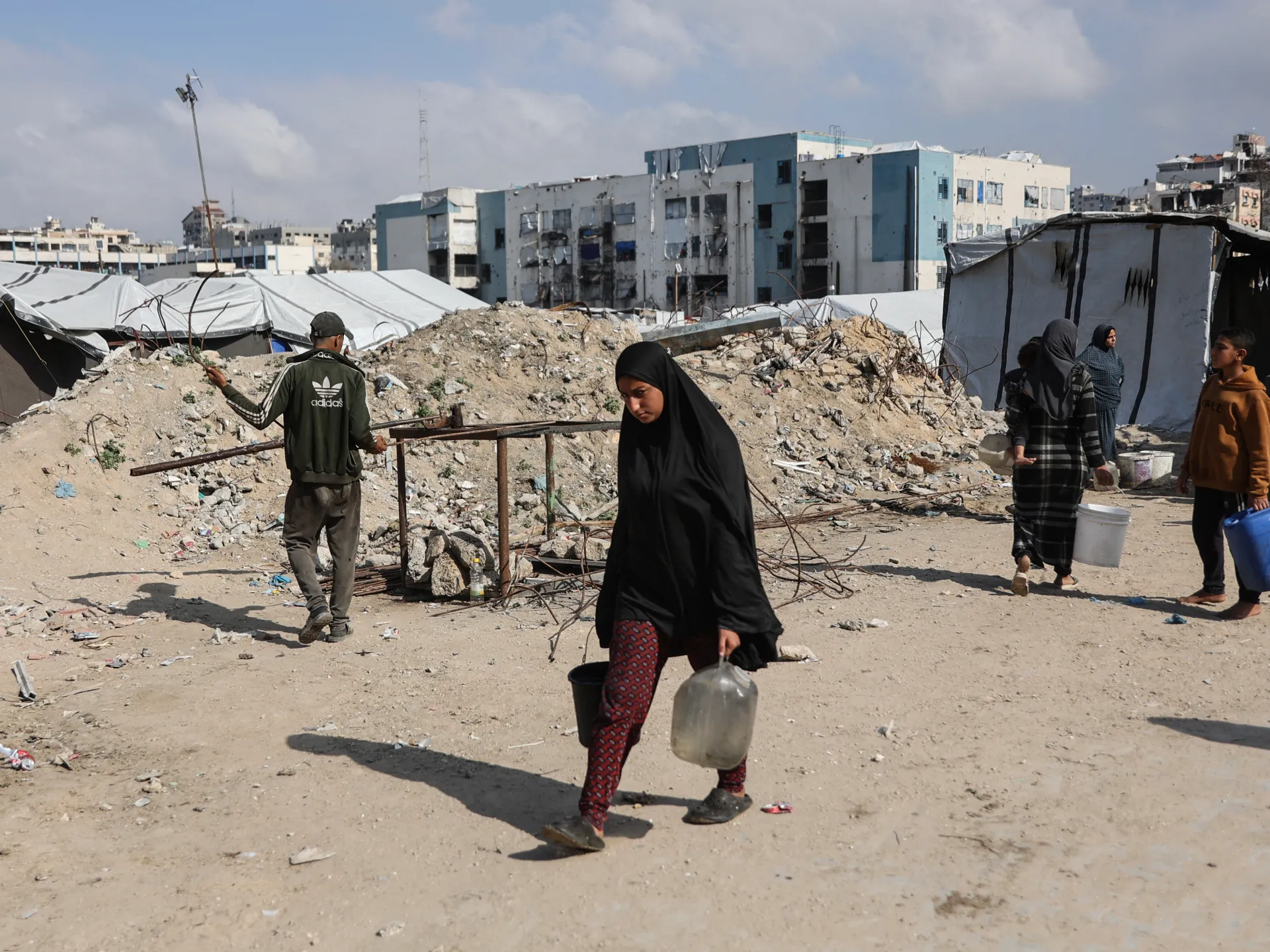
Nassar’s family is one of many still living in schools and makeshift shelters throughout northern Gaza, relying on humanitarian aid for their basic needs and barely able to prepare a meal to break their fast, known as Iftar, due to gas shortages.
Nassar, her husband Thaer, and their seven children lived in Beit Hanoon, in the northeast, before Israel’s genocidal war on Gaza began in October 2023, which has killed more than 72,000 people, according to Gaza’s Ministry of Health statistics.
They have since been displaced several times, from Beit Hanoon to Rafah and Khan Younis in the south.
The Nassar family is still waiting for a decision that would allow them to return home – or to what remains of it. This marks the third Ramadan that they have been living in a school, which, apart from the concrete walls, offers little shelter.
The children sleep not in beds, but directly on a classroom floor. The Nassar family’s only possessions comprise a few bags of clothes and some thin blankets.
Thaer said his children are afraid to go outside due to Israeli gunfire, in violation of the “ceasefire” agreement.
“My children live in fear, whether they go out into the street or stay here in the shelter. In the past, in better days, they had better times, playing ball, going to school, and then returning home.”
According to Gaza’s Ministry of Health, more than 600 Palestinians have been killed in Israeli attacks since the “ceasefire” came into effect.
While Palestinians have had little respite this Ramadan, Mahmoud said Palestinians remain steadfast.
“For many of the Palestinians sheltering inside this school, Iftar is a celebration of spiritual resilience, unbroken by Israel’s genocide and a future that is far from certain.”
Israeli forces carried out violent raids across the occupied West Bank, detaining Palestinians and demolishing homes. A young man was killed by settlers in Mukhmas, Jerusalem, while restrictions on West Bank worshippers at Al-Aqsa added to tensions during Ramadan.
Sanaa, Yemen – Ahmed Abdu, 28, parked his motorbike near a hall under construction in the al-Jiraf neighbourhood of Sanaa. He walked some metres to deliver a food parcel to a customer.
Nearly a minute later, an air strike hit the hall, setting off a thunderous explosion.
Recommended Stories
list of 3 itemsend of list
Fire erupted, and smoke rose on the dark street at night. Passersby screamed and fled in panic. The attack happened last Ramadan, on March 19, 2025, in the Yemeni capital.
Ahmed, who survived, said he will never forget that moment of horror. He escaped unscathed, but his motorbike was charred, and nine civilians sustained injuries.
As Yemen enters this new Ramadan, memories of last year’s United States-led aerial campaign, Operation Rough Rider, are resurfacing in Sanaa.
The two-month operation, which Washington said targeted Houthi military infrastructure, killed at least 224 civilians, many of them in Ramadan last year.
Today, the country remains in tumult amid rising tensions in the region. Ahmed and thousands of people like him fear a repeat of the violence that shattered the holiest month of the year.
“I do not know whether this calm will continue in this Ramadan, or we will relive the intimidating war surprises we endured last year. Such an uncertainty is worrisome,” Ahmed told Al Jazeera.
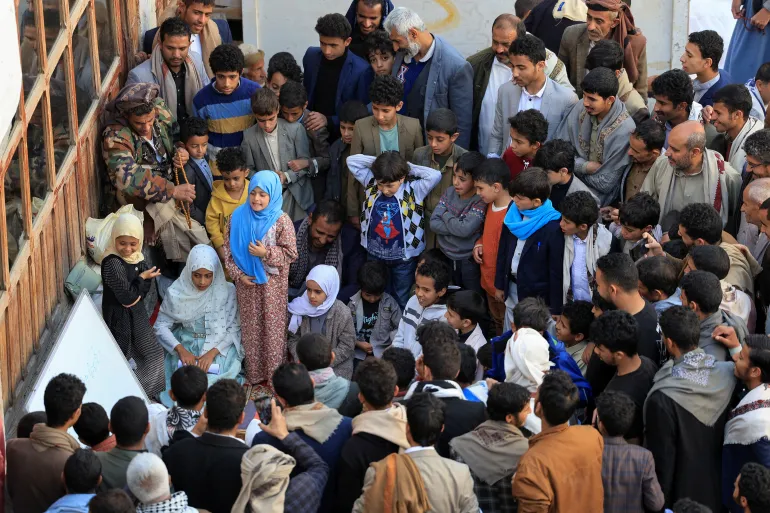
People gather around girls learning to recite the Quran at the Grand Mosque in Sanaa, Yemen [File: Khaled Abdullah/Reuters]
Ready for the second round
About 10 days before this Ramadan, the Houthis, who control northwest Yemen, including Sanaa, staged a mass protest in the capital under the slogan “Steadfast and ready for the next round”, referring to a possible confrontation with local or foreign adversaries.
The protest expressed solidarity with and support for Houthi allies, Iran and Lebanon’s Hezbollah, against the US and Israel. Houthi leaders said their hands were on the trigger and that any US attacks on Iran would prompt them to intervene.
Mohammed al-Bukhaiti, a member of the political bureau of the Houthi movement, warned the US against launching any “military aggression” against Iran, saying that attacking Iran would amount to a full-scale war in the region.
“We are men of action, not words,” al-Bukhaiti told Iranian television.
With the Houthi threats to support Iran militarily against Washington, the fear for many regular Yemenis is that their country could soon find itself a target of US warplanes once again.
People walk through a market ahead of the fasting month of Ramadan in Sanaa, Yemen, February 17, 2026 [Yahya Arhab/EPA]
The missile in the kitchen
The scars from previous US-Houthi attack exchanges still linger in war-ravaged Yemen.
The US said the strikes last year were carried out in retaliation for Houthi attacks on Israeli-linked vessels passing through the Red Sea, in solidarity with Gaza.
Construction worker Faisal Abdulkareem, 35, welcomes the arrival of Ramadan, but memories of the last one remain painful. He prays this month will pass peacefully without the horror of warplanes, missiles, and explosions.
“On a Ramadan night last year, I was lying in my room, facing the street. I heard the roar of a warplane. I was worried but did not panic. I reassured myself: This is a residential area with no military facilities, and it would not be targeted,” Faisal recalled.
About a minute later, an explosion rocked the area. The aluminium window frames were blown outwards, and shards of glass flew into Faisal’s room.
“The glass fragments struck parts of my body, including my head and hands. I wiped the blood away with a tissue as I tried to process happened. It was terrifying,” he said.
Faisal went outside to see exactly where the rocket had hit. “The missile landed in my neighbour’s kitchen. His house is about 20 metres [66 feet] away from my first-floor apartment. That spiritual Ramadan night turned into a moment of terror,” he told Al Jazeera.
Fortunately, no one was killed or seriously injured. But Faisal’s neighbour’s house sustained damage.
“People in the neighbourhood rushed to the house. Some said it was an American missile. Others suggested the Houthis launched the missile to intercept the US plane over Sanaa, but it fell on the house accidentally.”
Faisal said his neighbour had to bear the financial burden of repairing the damage to his house alone.
“We fasted from food and drink last Ramadan, but not from fear and grief,” Faisal said.
Peace vs solidarity
In a speech on preparations for Ramadan on February 13, Houthi chief Abdel-Malik al-Houthi said Israel and the US have sought to dominate the Middle East.
“This is why [the US and Israel] focus on removing [Iran], because they consider it to be at the forefront of the major obstacles that stand in the way of achieving that goal,” he added.
Such a goal is unacceptable, he said. “This is something that no human being with even a shred of humanity or human dignity left can accept.”
While the Houthi leader views engaging in the war as a duty, others consider it “unfair” to risk peace in Sanaa for the sake of solidarity with Iran.
Ammar Ahmed, a law student in Sanaa, keeps abreast of the regional news and views the US-Iran military clash as catastrophic for northern Yemen.
“The Houthi leadership is defiant, and it will not hesitate to hit American military assets in the region. So, we [civilians in northern Yemen] will again face US strikes,” said Ammar.
He argued that peace in Yemen should be prioritised over solidarity with Iran.
“Iran is a powerful country, and it can defend its interests. Even if the Houthis intervened, their missiles or drones would not cripple the US military. They will only bring us trouble,” Ammar told Al Jazeera.
Legitimate concerns
The future of Yemen’s Houthis is tied to Iran, and civilian worry over what lies ahead during Ramadan and in the months following is legitimate, Abulsalam Mohammed, the head of the Yemeni Abaad Studies and Research Center, told Al Jazeera.
“A war against the Houthis in northern Yemen remains an option [for anti-Houthi forces]. This option will be scrapped should the group come to talks and recognise the legitimacy of the UN-recognised Yemeni government,” said Mohammed.
He indicated that Houthi involvement in any US-Iran military conflict would only accelerate the launch of anti-Houthi operations by Saudi Arabia and the Yemeni government in Yemen’s north.
The Yemeni government has been emboldened by a recent campaign against the separatist Southern Transitional Council, forcing them out of much of southern Yemen with the backing of Saudi Arabia.
“The coming military operations against the rebel group, in my view, will not be limited to air strikes. There will be advances by local ground forces, coupled with foreign aerial cover. We witnessed how the separatists collapsed in the north, and the fall of the Houthis in the north is also possible,” Mohammed said.
The United Nations’s special envoy to Yemen, Hans Grundberg, warned that stabilisation in any part of the country will not be durable if the broader conflict in Yemen is not addressed comprehensively.
“It is high time to take decisive steps in this regard. Without a wider negotiated political settlement to the conflict, gains will continue to remain vulnerable to reversal,” said Grundberg in a briefing delivered to the UN Security Council on February 12.
For Sanaa resident Ahmed Abdu, it does not matter who wins any future conflict in the country. His priority is staying safe from the direct consequences of hostilities.
“During Ramadan last year, I lost my source of income, the motorbike, in an air strike. That loss could be replaced. I only wish a peaceful Ramadan this year and a lasting end to the war,” said Ahmed.
Palestinians are marking the start of the holy month of Ramadan in Gaza where the impact of Israel’s genocidal war continues to be felt, despite a ceasefire in place since October.
Here is how to wish someone during the holy month of Ramadan in different languages around the world.
Published On 17 Feb 202617 Feb 2026
Share
Following the sighting of the crescent by the moon-sighting committee on Tuesday, Saudi Arabia has announced that the first day of fasting will be Wednesday, February 18.
There are nearly two billion Muslims globally, accounting for almost one-fourth of the world’s population. Indonesia has the largest Muslim population, approximately 242 million, followed by Pakistan (230 million), India (210 million), Bangladesh (160 million), and Nigeria (120 million).
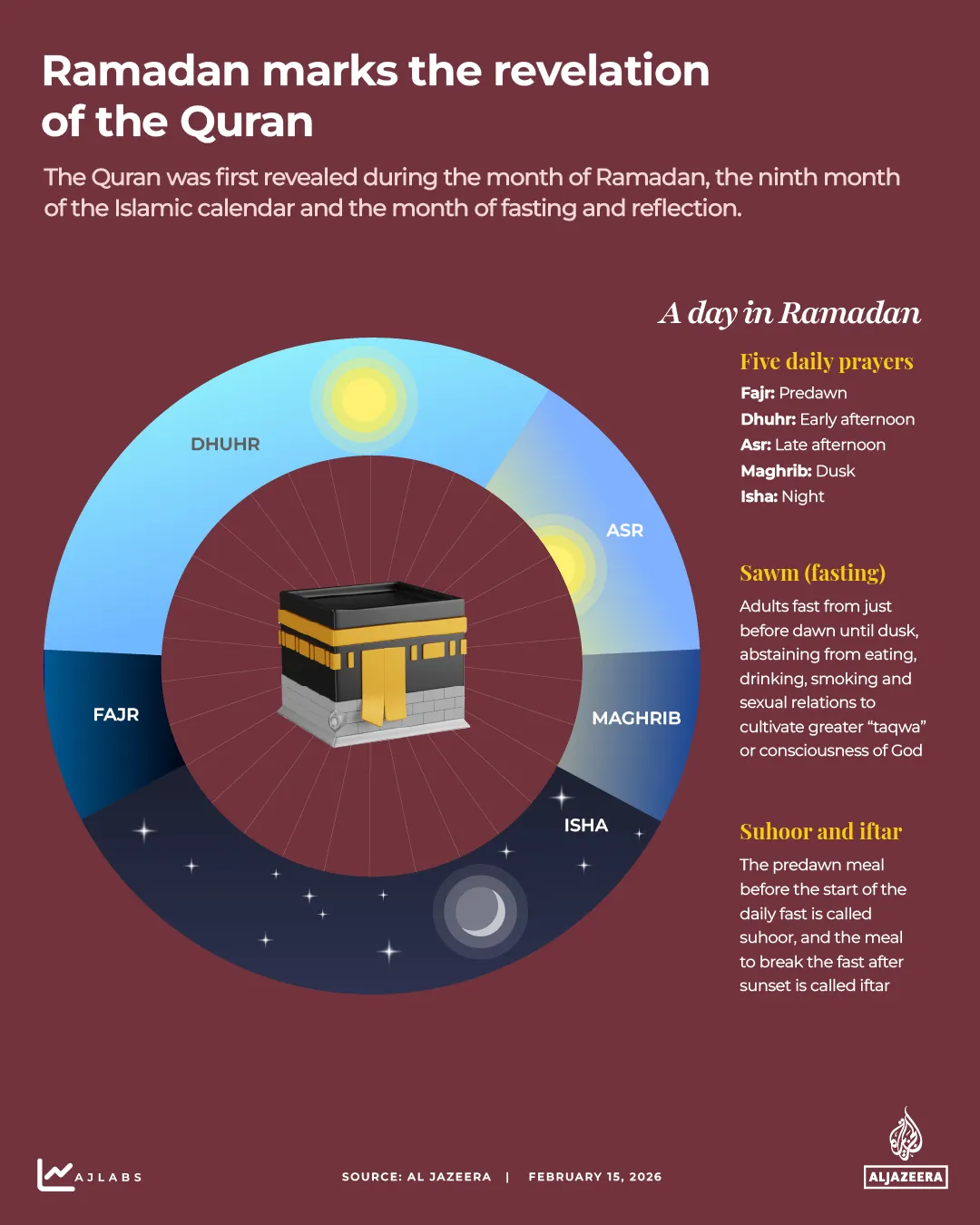
As the holy month begins, many Muslims have been preparing for a period of fasting, reflection, and community. Those observing the fast start their day with a predawn meal, suhoor, and break their fast at sunset with iftar.
Why is Ramadan holy?
Muslims believe that Ramadan is the month when the first verses of the Quran were revealed to the Prophet Muhammad more than 1,400 years ago.
Fasting is one of the five pillars of Islam, along with the Muslim declaration of faith, daily prayers, charity, and performing the Hajj pilgrimage to Mecca if physically and financially capable.
Ramadan sayings in different languages
The month begins with the sighting of the new moon, often accompanied by an outpouring of greetings to mark the occasion. Many Muslim-majority countries have their own traditional greetings in their native languages.
Among the most common sayings are “Ramadan Mubarak” and “Ramadan Kareem”. These are Arabic sayings that translate to “blessed Ramadan” and “generous Ramadan”, respectively.
Greetings are not limited to the spoken language. They also extend to sign language and Braille. Some countries have their version of sign language, but placing one hand horizontally across the mouth is common among most to represent fasting.
Below is a collection of Ramadan greeting cards that you can download and share.
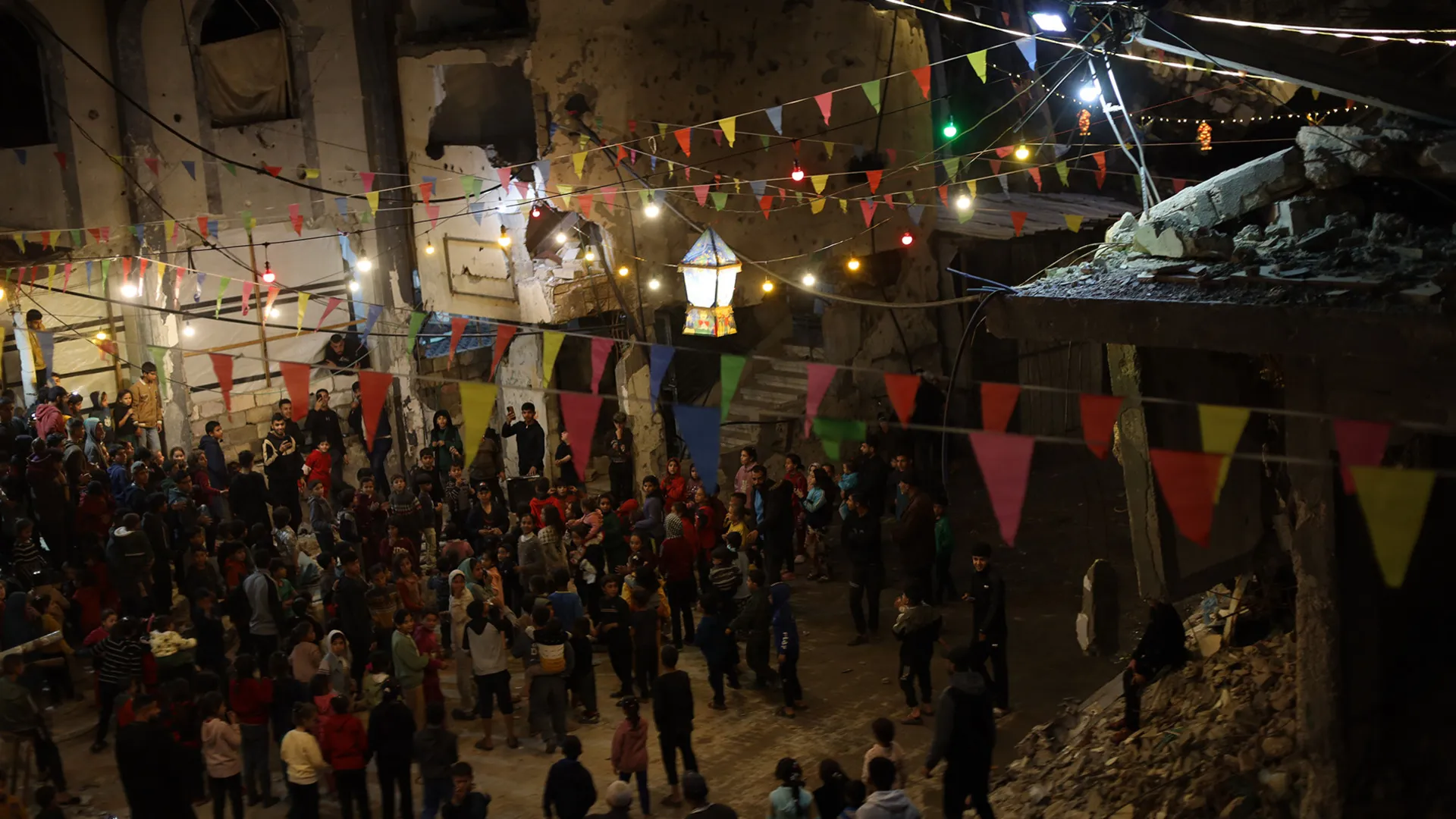
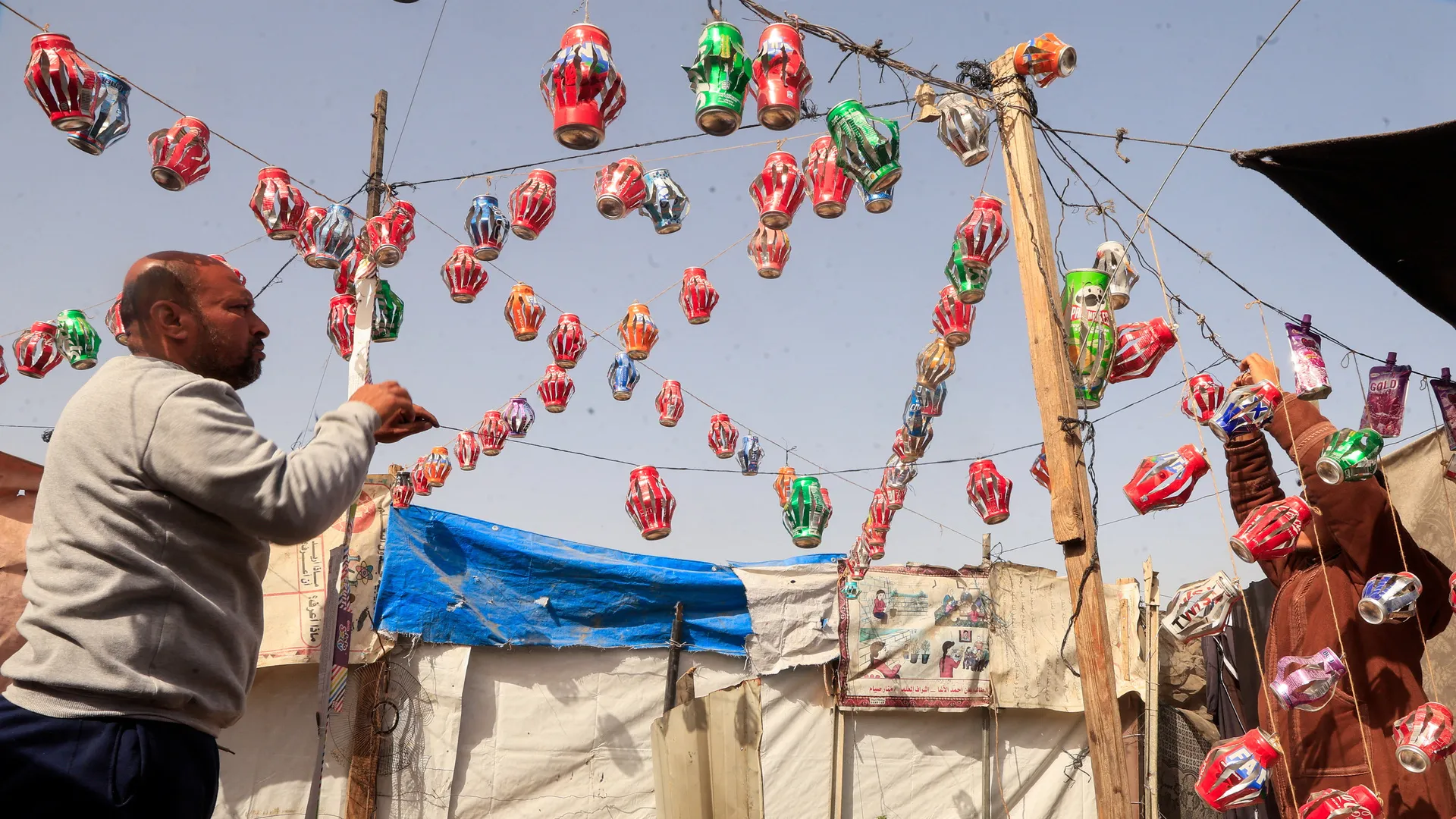
“Decorations and lanterns from cola cans.” Despite Israel’s restrictions on materials, many Palestinians are using creative ways to decorate Gaza for the holy month of Ramadan.
The first day of fasting for the Muslim holy month of Ramadan in Mecca, Saudi Arabia will be either Wednesday, February 18 or Thursday, February 19, depending on the sighting of the new moon.
Other countries follow their own moon sightings. Some use astronomical calculations for lunar phases, while others rely on traditional local sightings to confirm the start of the new month.
Recommended Stories
list of 3 itemsend of list
Ramadan is determined by the Islamic lunar calendar, which begins with the sighting of the crescent moon. Saudi Arabia and other Muslim-majority countries rely on the testimonies of moon sighters to determine the start of the month.
How is the Ramadan moon sighted?
For the moon to be visible, the crescent must set after the sun. This allows the sky to be dark enough to spot the small sliver of the new moon.
After the sun sets on the night of February 17, the 29th day of the month of Shaban in the Hijri calendar, moon sighters face west with a clear view of the horizon for a first glimpse of the crescent moon.
If the moon is sighted, the month of Ramadan begins, with the first day of fasting being February 18. Otherwise, Shaban will complete 30 days, and the first fasting day will be February 19.
In Saudi Arabia, testimonies of people who have spotted the moon are recorded, and the Supreme Court makes a decision on when Ramadan should begin.
(Al Jazeera)
In order to view the moon at sunset time, there are three important factors astronomers look for:
Elongation: The moon needs to be far enough from the sun to ensure its light is not drowned out. For a reliable naked-eye sighting, the moon must be 10-12 degrees away from the sun. If it is closer than 7 degrees, then the crescent may be physically too thin to reflect enough light for the human eye to see.
Altitude: The higher the moon is at sunset, the less it has to compete with the thick, hazy atmosphere and the glow of the sky near the horizon. An altitude of 10 degrees is typically sufficient for clear naked-eye visibility, while lower altitudes of 3 to 5 degrees may be adequate with the help of optical aids.
Lag time: This is the time between sunset and moonset. For reliable naked-eye viewing, there usually needs to be at least 45 minutes for the sky to darken enough to see the moon. Longer durations are even better.
When does Ramadan begin in different countries?
According to Crescent Moon Watch, a moon tracker run by the United Kingdom’s Nautical Almanac Office, Ramadan’s new moon will begin on February 17 at 3:01pm Mecca time (12:01 GMT).
On that night in Mecca, the sun will set at 6:19pm (15:19 GMT), and the moon will be visible for only three minutes, setting at 6:22pm (15:22 GMT). With the new moon only three hours and 18 minutes old, it is very unlikely that anyone across the globe will see the crescent moon that evening, meaning the first day of Ramadan will begin on February 19.
(Al Jazeera)
On the evening of February 18, the new moon should be visible in most parts of the world. By that time, the moon will be nearly 26 hours old. It will be higher in the sky and remain visible for much longer after sunset, making it easily observable to the public.
North America
The Fiqh Council of North America (FCNA) and the Islamic Society of North America (ISNA), both of which follow astronomical calculations, have officially announced that Ramadan will begin on February 18, 2026. Their calculations state that, at sunset somewhere on the globe, the elongation of the moon should be at least 8 degrees, and the moon must be at least 5 degrees above the horizon for it to be visible.
Europe
The European Council for Fatwa and Research (ECFR) has declared that Thursday, February 19, will be the first day of Ramadan. ECFR notes that while the astronomical birth of the moon occurs on Tuesday, it will be impossible to see that evening either with the naked eye or through telescopes and observational instruments. Turkiye has also declared February 19 as the first day of the holy month of Ramadan, for the same reasons.
Middle East
Most Middle Eastern nations, led by Saudi Arabia, will not make a final announcement until the evening of Tuesday, February 17. If the Saudi Supreme Court receives a testimony of a sighting on Tuesday night, it may declare Wednesday as the first day of Ramadan. But this is very unlikely for the reasons mentioned above.
Asia
Across Asia, the start of Ramadan 2026 will most likely be Thursday, February 19, as the moon will set before the sun in that part of the world on Tuesday night.
Singapore has officially confirmed the start of Ramadan to be on Thursday, while countries in South Asia including India and Pakistan have forecast Thursday, February 19 as the first day of fasting.
Africa
In Africa, the start of Ramadan follows a similar pattern to the rest of the world, with most countries anticipating it to begin on Thursday, February 19.
Oceania
The Australian National Imams Council have announced that Ramadan will commence on February 19.
(Al Jazeera)
Why is Ramadan holy for Muslims, and what is the significance?
Muslims believe that Ramadan is the month when the first verses of the Quran were revealed to the Prophet Muhammad nearly 1,450 years ago.
Throughout the month, observing Muslims fast from just before the sunrise prayer, Fajr, to the sunset prayer, Maghrib.
The fast entails abstinence from eating, drinking, smoking, and sexual relations to achieve greater “taqwa”, or consciousness of God.
Fasting is one of the five pillars of Islam, along with the Muslim declaration of faith, daily prayers, charity, and performing the Hajj pilgrimage to Mecca if physically and financially capable.
In many Muslim-majority countries, working hours are reduced, and most restaurants are closed during the fasting hours.
(Al Jazeera)
Ramadan greetings in different languages
Various Muslim-majority nations have a personalised greeting in their native languages. “Ramadan Mubarak” and “Ramadan Kareem” are common greetings exchanged over the month, wishing the recipient a blessed and generous month, respectively.
The dawn-to-dusk fast lasts anywhere from 11.5 to 15.5 hours, depending on where in the world you are.
Published On 15 Feb 202615 Feb 2026
Share
The Muslim holy month of Ramadan is set to begin on February 18 or 19, depending on the sighting of the crescent moon.
During the month, which lasts 29 or 30 days, Muslims observing the fast will refrain from eating and drinking from dawn to dusk, typically for a period of 12 to 15 hours, depending on their location.
Muslims believe Ramadan is the month when the first verses of the Quran were revealed to the Prophet Muhammad more than 1,400 years ago.
The fast entails abstinence from eating, drinking, smoking and sexual relations during daylight hours to achieve greater “taqwa”, or consciousness of God.
Why does Ramadan start on different dates every year?
Ramadan begins 10 to 12 days earlier each year. This is because the Islamic calendar is based on the lunar Hijri calendar, with months that are 29 or 30 days long.
For nearly 90 percent of the world’s population living in the Northern Hemisphere, the number of fasting hours will be a bit shorter this year and will continue to decrease until 2031, when Ramadan will encompass the winter solstice, the shortest day of the year.
For fasting Muslims living south of the equator, the number of fasting hours will be longer than last year.
Because the lunar year is shorter than the solar year by 11 days, Ramadan will be observed twice in the year 2030 – first beginning on January 5 and then starting on December 26.
(Al Jazeera)
Fasting hours around the world
The number of daylight hours varies across the world.
Since it is winter in the Northern Hemisphere, this Ramadan, people living there will have the shortest fasts, lasting about 12 to 13 hours on the first day, with the duration increasing throughout the month.
People in southern countries like Chile, New Zealand, and South Africa will have the longest fasts, lasting about 14 to 15 hours on the first day. However, the number of fasting hours will decrease throughout the month.
(Al Jazeera)
Fasting times around the world
The table below shows the number of fasting hours, suhoor and iftar times on the first and last days of Ramadan 2026. Use the arrows or search box to find your city.
Ramadan greetings in different languages
Muslim-majority nations have various greetings in their native languages for Ramadan.
“Ramadan Mubarak” and “Ramadan Kareem” are the most common greetings exchanged in this period, wishing the recipient a blessed or generous month, respectively.