Global Salon: Building the Rails for a $3.5 Trillion Empire
Apex Group’s Peter Hughes on AI hype, tokenization, private credit and what Jeff Bezos got wrong.
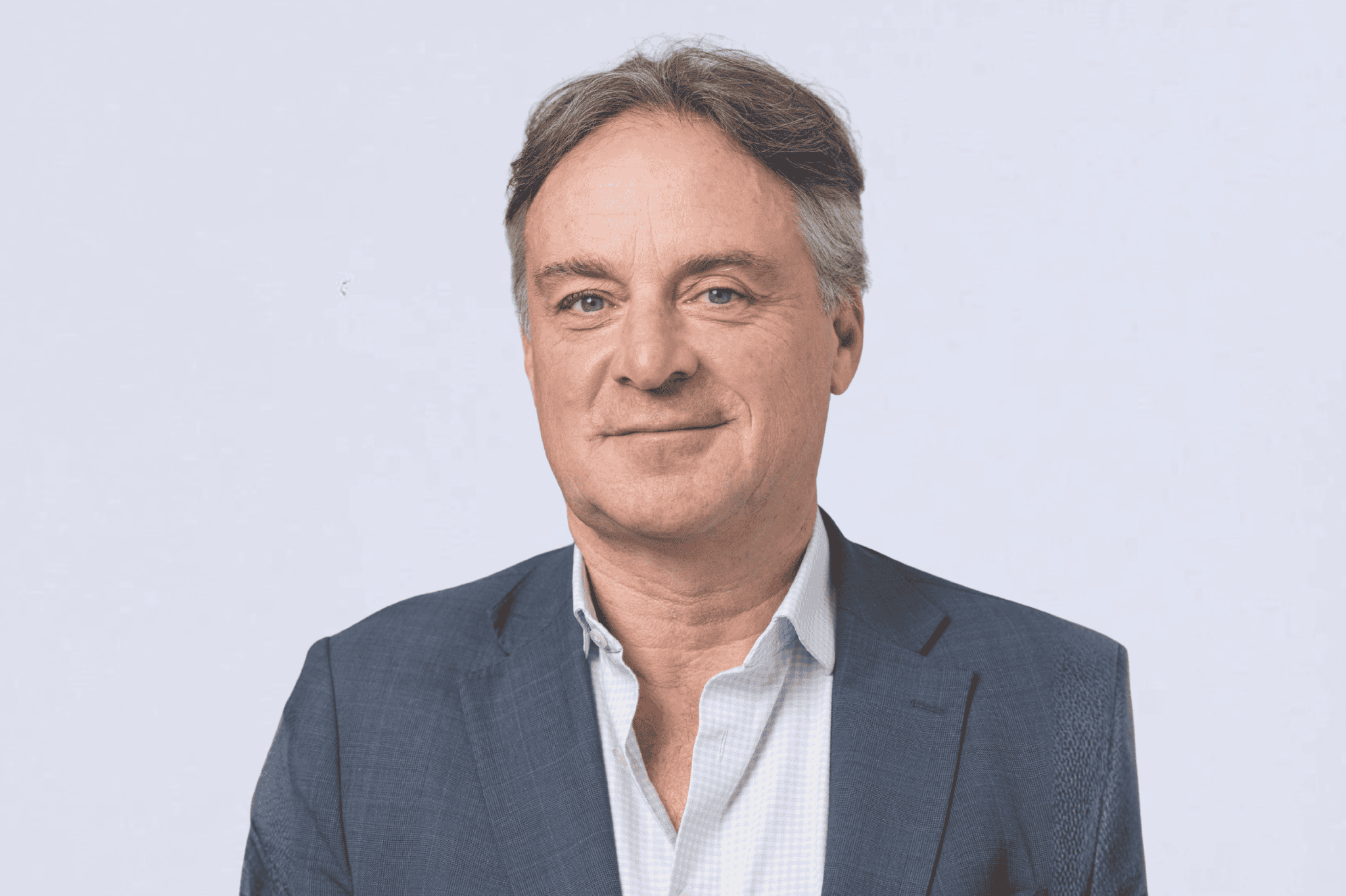
Peter Hughes founded Apex Group Ltd. in Bermuda in 2003. Today, it manages more than $3.5 trillion in assets across 52 countries, with 100-plus offices, 13,000 employees, and 90 regulatory licenses—growth built on more than 50 acquisitions over eight years and a bet Hughes made roughly five years ago that traditional finance and decentralized finance, or DeFi, were headed for convergence, not collision.
In this conversation with Global Finance, Hughes—who spent time at KPMG and Hemisphere Management before founding Apex—traces that bet from BlackRock Inc.’s decision to add bitcoin to its balance sheet to Apex’s enabling the development of the compliance-focused Layer 2 blockchain initiative, T-Rex. He pushes back on Jeff Bezos’s prediction of an artificial intelligence-driven labor shortage, defends private credit against claims that it’s a broken asset class, and argues that traditional exchanges and crypto-native platforms are racing toward the same end state.
Global Finance: Was there a critical moment or aha moment that sparked a major change in your firm?
Peter Hughes: Absolutely. Bridging traditional finance and DeFi has been my focus for five years. Before that, we serviced crypto funds investing in bitcoin, working strictly with regulated partners to manage risk. I wasn’t sure if crypto would go mainstream, but seeing BlackRock put bitcoin on its balance sheet five years ago proved it was here to stay. That was the turning point.
We later ran a project with a client, lowering a fund’s subscription minimum in Luxembourg from 1 million Swiss francs to 1,000 so more people could access it. That was great, but our real value proposition lay in our scale—we operate across 50 countries under 35 regulators.
So you take something that’s high risk, like crypto, and then you say, “Well, actually, if it’s regulated and you’ve got clean AML around it, it’s a digital asset, and then it becomes accessible for everyone.” From there, I focused on building the distribution rails. We are now approved in 20 jurisdictions for on-chain transfer agency, enabling seamless settlement of digital securities. Our target by next year is a platform giving funds access to 50 new distribution channels across wealth, retirement, retail, and crypto-native channels. As tokenized money market funds transition to a 24/7/365 operational model, the broader asset world will inevitably follow. Building these locked-in distribution rails today ensures a highly valuable position for the future.
GF: Has blockchain changed the way your business operates, and do you see it likely becoming more integral in the future?
Hughes: Blockchain is the end state for how everything ends up; crypto is just a small piece of what we service. We focus on the regulated side—digital assets backed by clean AML.
My view is that everything will move on-chain, creating cheaper fund structures and frictionless finance. But that only works in a regulated environment. We favor public, permissioned chains because you know where the money is coming from, where it’s going, and that it’s clean. We supported the launch of the Layer 2 compliance initiative, T-Rex, which is operated by an independent foundation, to validate that every transaction moving across chains is fully verified.
I’m looking toward a world where custody, administration, transfer agency, and distribution all sit on-chain and interlink seamlessly—yielding faster speeds, higher volumes, and lower costs. So we’re all-in on blockchain. Crypto is part of it, but the core focus is digital assets: regulated securities that trade 24/7/365 like crypto, but with the institutional guardrails built in.
GF: Do you expect any relaxation for crypto in China?
Hughes: It’s difficult to tell, but stablecoins will eventually replace fiat on corporate balance sheets because they function as both payment tools and yield-bearing instruments. Their growth is currently limited by regulation—like MiCA in Europe and the Genius Act and Clarity Act in the US—designed to protect traditional bank deposits. But tokenized money market funds already offer the same yield without the payment functionality. It’s only a matter of time before yield- bearing stablecoins gain widespread adoption.
GF: Will Apex pursue any more acquisitions in the near future?
Hughes: We don’t need any new acquisitions. I bought 50 businesses over an eight-year period, each designed to add a new technology, open a new geography, or add a new product set. Every one is handpicked to complement what’s already there, so you can cross-sell both ways. People look at that from the out- side and say we just buy businesses—but for the last three years, it’s really been distribution businesses and technology businesses, aimed at building the technology rails to be the distribution leg for asset managers globally. That’s the direction I’ve always been moving in not just being good infrastructure and doing a good job for clients like other asset servicers but layering in and distributing their products to help them get bigger. That’s when you go from being a vendor to a real partner—when you’re shifting their P&L upwards. In September, I announced we’ve brought in a head of product from Revolut, because I want us building products and releasing them in eight-week sprints. If you’re not moving that fast in a tech evolution like this, you get left behind. So now it’s about building the technology of the future ourselves, rather than buying it in. We’re already servicing tokenized money market funds that run 24/7/365, fully on our own tech stack—and we want to keep enhancing that.
GF: Will there be fewer workers in the future due to AI or tech innovation?
Hughes: I hosted a conference for our clients in London and told them people are running an AI race that ends in a trap—you embed AI across everything, decide you don’t need people any- more, and suddenly your AI costs go up tenfold. That kills businesses. I’m not rushing into that trap. I’m adding AI thoughtfully, so data flows seamlessly end to end instead of being pushed and pulled by people, and I’m using it to build incremental products that add value for clients. I don’t think we’ll have fewer people, and I don’t think our salary costs go down—I think the same people will service more revenue. What it does change is who we hire. Instead of people doing manual work in Excel, we can bring in people who add real thought leadership, PhDs who help us think about how to value funds for the future. It doesn’t get cheaper for us. We just get better talent.
GF: Jeff Bezos insists AI will cause a labor shortage.
Hughes: I don’t see how it leads to a shortage. In places like India, where 18 million people enter the workforce every month, it’s exactly those keying-into-dashboards, keying-into-keyboards jobs that a lot of that workforce would traditionally have done—and a lot of people there see AI as a real threat because of it. So no, I don’t agree. When the manual layer goes, even my son—he’s at university in the UK—asks me, well, what job is he going to do when he leaves? He’s not going to start as an accountant, not going to start as a lawyer, because the bottom rungs of the ladder are being taken out. Firms are only hiring the top 10% into those entry positions now, whether that’s investment banking or what- ever else. So I don’t see it. Bezos is obviously very successful, but I don’t see how he’s right on this.
GF: What’s your view of the turbulent private credit space?
Hughes: The turbulence comes from growth—the volume of investor capital coming in but coming into a format that doesn’t work: a mismatch in liquidity. If you want to get out, you can’t, and that’s a structuring problem, not a problem with underly- ing returns. I still think private credit is a great asset class—10% annualized returns with low volatility. The friction came from structuring it into interval funds, which isn’t the right structure for private credit. When people raised concerns, the response was “wait for the next valuation, in four months you’ll see there’s no problem”—but the technology exists for weekly or daily valuation. If that information had come through faster, people wouldn’t have panicked. Instead, redemptions piled up and it became a vicious circle. The asset class itself is as strong as it always was—it was the structure, and the slow information flow, that caused the problem. And there’s no real slow down here: Revolut recently announced that Ares and Apollo are making their private credit funds available on the platform, with a €1 minimum investment. That’s not just a headline—it shows both the confi- dence in the asset class and what’s now possible in terms of democratizing it.
GF: Can we say that there is also an element of democratization of finance in what you do?
Hughes: That’s been a theme for the last three or four years — democratization, giving more access. But I think the way access happens will get more appropriate and more sophisticated going forward. People talk about interval funds in the U.S. as democratizing private markets, but for me that’s the wrong structure — it’s exactly why you saw noise around private credit funds: they were structured for retail, but there was a mismatch in liquidity. I think democratization gets broader and more sophisticated from here. It started with high-net-worth and wealth; as regulators get more comfortable, it’ll extend into wealth, retirement and retail. Think about why a private equity fund is high risk: it’s illiquid, you’re locked in for seven to ten years, it has a big ticket size, and it’s valued infrequently. Take away those three barriers and it trades like a normal equity, with a normal equity’s risk profile — which means it should be accessible to retail. Regulators are starting to understand that, though it’ll take time.
Anthony Noto covers corporate finance and private credit. Contact him at anoto@gfmag.com