quo

After Iran war upheaval, global shipping eyes return to status quo | Shipping

The United States-Israel war on Iran has inflicted the greatest disruption to merchant shipping since the back-to-back shocks of the COVID-19 pandemic and Russia’s invasion of Ukraine.

Since the start of the war in late February, shipping lines have faced attacks on their vessels, lengthy delays and steep rises in operating costs.

Recommended Stories

list of 4 itemsend of list

Yet even after more than four months of turmoil for the industry, the most enduring legacy of the war for shipping may end up being just how little it ultimately changes.

While shipping firms are expected to more explicitly factor risk into their expenses and diversify supply chains where possible in the future, the indispensable nature of seaborne trade means the industry is likely to continue much as before over the long term, analysts say.

That is likely to be especially the case for the container shipping industry, which, unlike the operators of the oil and gas tankers whose dislocation has roiled energy markets, is not heavily reliant on the Strait of Hormuz to transport its cargoes, which range from agricultural produce to apparel and consumer electronics.

While there is no alternative to the strait to access oil-producing Gulf nations by sea, container shipping firms have had the option of redirecting their vessels along longer alternative routes to avoid conflict in the region, including attacks by the Iran-aligned Houthis in the Red Sea.

The global shipping industry has long stood apart for its resilience in the face of crises, bouncing back from major upheaval at remarkable speed.

In 2020, the first year of the COVID pandemic, global container shipping volumes fell by just 1.2 percent compared with the previous year, according to the Baltic and International Maritime Council (BIMCO), one of the world’s largest associations for shipowners.

By January 2021, the volume of cargo handled at ports worldwide had already surpassed pre-pandemic levels, rising 6.4 percent year-on-year, according to data from the Institute of Shipping Economics and Logistics.

By contrast, it took more than four years for global air travel to fully recover from the shock of COVID-19.

While the Iran war and Houthi attacks in the Red Sea since 2023 scrambled regional supply chains, shipping companies have been rapidly adding capacity since Washington and Tehran signed their memorandum of understanding on ending the conflict on June 17.

After plummeting from 3.2 million TEU (Twenty-foot Equivalent Unit of cargo) to 74,000 TEU as of mid-June, container capacity in the region has already rebounded to pre-war levels on some routes, according to Xeneta, an ocean and air freight rate market analytics platform.

Capacity between Asia and the United States’ West Coast last week surpassed its pre-conflict record, hitting 350,000 TEU, according to Xeneta.

On Monday, Maersk and Hapag-Lloyd, the second- and fifth-largest container shipping firms, respectively, announced that they would begin sailing through the Suez Canal again for the first time since February, following an assessment of the security situation in the Red Sea.

m
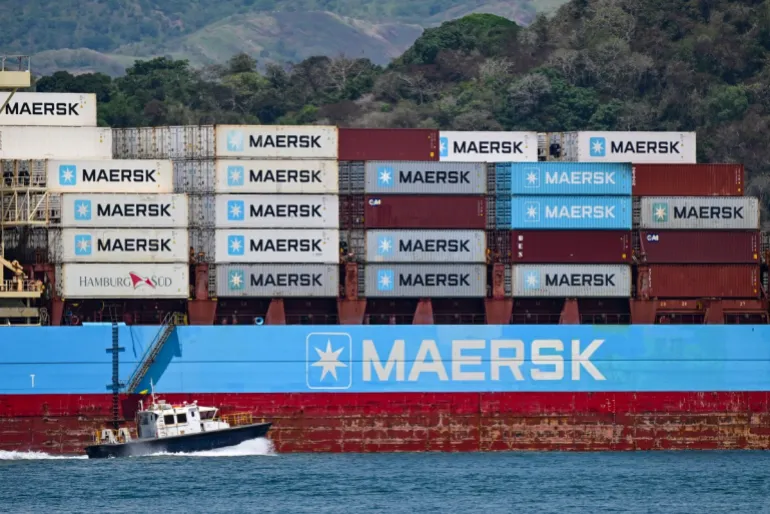
A cargo ship carrying containers from the Danish company Maersk sails into the Pacific entrance of the Panama Canal in Panama City on April 21, 2026 [Martin Bernetti/AFP]

Shipping is indispensable to global trade, in large part because no other mode of transport comes close in terms of capacity and cost-effectiveness.

The world’s largest container ships have capacities exceeding 24,000 TEU – the equivalent of roughly 12,000 trucks, 2,240 cargo planes, or 360 freight trains.

Lacking genuine competition in the transport of goods in huge volumes, shipping facilitates about 90 percent of global trade.

Shipping will look “remarkably familiar” in five years from now because it is an industry driven by demand, said Punit Oza, the head of the consultancy Maritime NXT and the former executive director of the Singapore Chamber of Maritime Arbitration.

Even the most severe conflict cannot change the “physics or the economics” of seaborne trade, he said.

“Ships do not sail because shipowners want them to; they sail because consumers somewhere want grain, iron ore, gas, or televisions,” Oza told Al Jazeera.

“It is the consumers of shipping – the cargo interests, the economies, the households – who ultimately shape the industry, and their demand will endure long after the headlines fade.”

Judah Levine‏, head of research at freight booking company Freightos, said container shipping in the future is likely to look “quite similar” to how it did before the war, with Dubai’s Port of Jebel Ali continuing to serve as the region’s main hub for both Gulf-bound goods and cargoes destined for Asia, Europe, Africa, and the Americas.

But Levine said diversion of cargoes to smaller hubs – such as the UAE’s Port of Fujairah and Khor Fakkan Port, and Port Sultan Qaboos in Oman – during the war offers a preview of the contingencies shipping firms are likely to deploy in future crises.

“All of a sudden, they were handling much larger volumes, and then creating these land bridges, usually to go on to Jebel Ali,” Levine told Al Jazeera.

“Containers find a way,” Levine said.

“It’s kind of like water. They’ll trickle, you know, to where they need to go by other paths.”

imgo
International Maritime Organization Secretary-General Arsenio Dominguez holds a news conference after an Extraordinary Session meeting, in London, UK, on March 19, 2026 [Alberto Pezzali/AP]

Another lasting impact of the war could be greater international cooperation on maritime security and safety.

The International Maritime Organization, the UN body responsible for shipping and seafarers, has listed the protection of shipping lanes as one of its top agenda items for discussion at its biannual meeting taking place from Monday to Friday.

“Seafarers have tragically lost their lives in connection with this conflict, and the impact has been felt well beyond the region, with real consequences for global trade, energy and food security,” IMO Secretary-General Arsenio Dominguez said in opening remarks to the session on Monday.

Ruth Banomyong, a professor of logistics and supply chain management at Thammasat Business School in Bangkok, Thailand, said he expects to see international coordination to strengthen trade routes that integrate both land and sea even as shipping networks remain “largely the same”.

“This means ensuring that maritime transport, ports, inland logistics, customs procedures and alternative land transport options work together as an integrated system when disruptions occur,” Banomyong told Al Jazeera.

“Maritime freedom is no longer just about freedom of navigation. It is about ensuring the continuity of global trade.

“The long-term lesson is not to replace the Strait of Hormuz, but to reduce overdependence on any single transport corridor,” Banomyong added.

Oza, the head of Maritime NXT, said the ad hoc naval coalitions deployed to ensure freedom of navigation during times of conflict could ultimately be succeeded by a multilateral security framework with “regional ownership rather than purely external enforcement”.

“Freedom of navigation is too important to be left to improvisation,” Oza said.

“If there is one consistent lesson from shipping’s long history, it is that human ingenuity always finds a way – pipelines get built, reserves get repositioned, technologies emerge, and trade, like water, finds its path. It will do so again,” Oza added.

“The innovations that follow this war will be a tribute to human resilience; the tragedy is that it took a war to summon them.”

Source link

In deep blue California, frustration with Democratic status quo fuels governor, L.A. mayor race

As primary voters head to the polls Tuesday to determine which candidates will face off in November to become California’s governor and Los Angeles’ mayor, both races are wide open, with a new crop of candidates challenging the Democratic status quo.

For Democrats, little clear consensus has emerged so far on who should lead the city and state into the future.

In California’s crowded gubernatorial race, Democrats have struggled in recent months to settle on a candidate to succeed term-limited Gov. Gavin Newsom.

After former Rep. Eric Swalwell suspended his campaign in April amid allegations of sexual misconduct, Xavier Becerra, a former Biden cabinet member, inched ahead by positioning himself as the safe, experienced Democratic candidate. Another Democrat, billionaire climate activist Tom Steyer, and Republican Steve Hilton, a former Fox News commentator, trail close behind.

In L.A., experience seems to be as much a liability as an advantage.

Mayor Karen Bass finds herself in the extraordinary position, as an incumbent, of fighting to make the runoff as she is assailed from the left and the right. The latest UC Berkeley-L.A. Times poll shows Bass leading with just 26% of the vote, one point ahead of City Councilmember Nithya Raman, a wonkish Democratic socialist, and four points ahead of Republican Spencer Pratt, a former reality TV star.

“There’s a clear sense of frustration with the Democratic Party,” said Sara Sadhwani, a professor of politics at Pomona College. The reason a wave of conservative outsiders like Pratt and Hilton are doing so well in such a solidly liberal city and state, Sadhwani said, is that they’re more willing to spell out the challenges that L.A. and California face.

“Democrats tend to be very concerned about not upsetting one coalition or another, so it’s politics as usual with many of the Democratic candidates,” Sadhwani said. “Spencer Pratt has blown a hole in that by just naming the problems that everyday residents and voters are seeing and feeling on the ground.”

On homelessness, many Angelenos are frustrated Bass hasn’t significantly moved the needle.

“We can point to facts and figures that might suggest that things have changed,” Sadhwani said. “But when you walk down the streets of Los Angeles, it doesn’t feel like it, so she hasn’t passed the field test. That’s the problem.”

A growing segment of Angelenos also chafe at the city’s high cost of living. And many are angry about the Bass administration’s lack of preparation and response to the 2025 Palisades fire.

“The Democrats have to account for those challenges,” Sadhwani said. “They have been in power for all of this time.”

California, of course, remains a Democratic stronghold, and polls show state voters are overwhelmingly opposed to President Trump. His second-term agenda — including a sweeping immigration crackdown, tariffs and the war in Iran — only seems to have cemented California’s status as a resistance state.

But after so many years of Democratic dominance, in Sacramento and at Los Angeles City Hall, leaders have to answer for voter frustrations.

The top two vote-getters in California’s nonpartisan primaries will advance to theNovember runoff, unless one candidate manages to pick up more than 50% of the vote.

Republicans have turned out at higher rates than Democrats in early voting. Paul Mitchell, vice president of the Sacramento-based bipartisan firm Political Data Inc., said that older Democrats who reliably turn in their ballots were slower to vote this year, likely because two Republicans were on the gubernatorial ballot and the Democratic field was fractured.

“That has caused them to dive into a lot more strategic voting,” Mitchell said, noting many seemed to be waiting to cast their ballots for the Democrat who looks to have the best chance of moving on to November.

For the GOP, getting a candidate on the November ballot for governor means more than just demonstrating Republicans are players in California. A GOP candidate would bring out more Republicans to vote in the general election, raising the party’s prospects of winning down-ballot races and passing a GOP-led ballot initiative on voter ID.

For Democrats, the midterm races offer the party its first major chance to chart a new path for the future.

As polls show Trump cratering in popularity, Democrats in California and beyond are struggling a year and a half after Kamala Harris’ bruising 2024 defeat to agree on what went wrong.

The Democratic National Committee’s long-awaited autopsy of that election — which said Harris “wrote off rural America,” wrongly assumed identity politics would win over voters of color and failed to develop “defined or consistent” strategy against Trump — has only generated more hand-wringing.

“There is not a clear vision, there is not a clear policy agenda, and the Donald Trump presidency upended the policy world as we knew it,” Sadhwani said. “It’s unclear how any Democrat, including any of the individuals in these two races, is going to navigate the waters into the future. One thing is for certain: We aren’t going back. So, which of these candidates is going to lead us into an uncertain future?”

Referendum on Bass

In L.A., the election is a referendum on Bass, who pledged in 2022 to solve homelessness, cut crime and make the city more affordable.

“How has L.A. changed in four years?” said Christian Grose, a professor of political science and public policy at USC. “The Bass campaign is saying it has changed for the better and she still needs more time. All the other candidates, from very different perspectives, are saying that it’s much worse than it was four years ago, and it’s time for new leadership.”

Bass told The Times she plans to win in November by demonstrating her administration’s progress in clearing homeless encampments and accelerating the building of affordable housing. She has also noted that data shows homicides in the city are at their lowest since 1966.

Challenging Bass from the left is Raman, who was elected in 2020 as the first DSA-backed L.A. City Council member. Pitching herself as the viable progressive in the race, Raman has accused Bass of not doing enough to make the city affordable and critiqued Bass’ spending on Inside Safe, her program to move unhoused people into stable housing. Although Raman presents herself as an outsider, she is a former Bass ally who has chaired the council’s Housing and Homelessness Committee for more than three years.

“She’s absolutely a part of the establishment,” Sadhwani said. “She’s been in City Hall longer than Karen Bass.”

As Raman tacked to the center during the campaign to appeal to more moderates and distanced herself from past calls to defund the police, she alienated some DSA members who complained they didn’t know what she stood for. Her three fellow DSA City Council members endorsed Bass.

Pratt is challenging Bass and the entire Democratic status quo.

A former star of “The Hills” who lost his home in the Palisades fire, he has surprised many political observers with his success assailing the city’s handling of the 2025 firestorms. He has called unhoused people drug-addled “zombies” and argued that L.A.’s housing crisis requires heavy-handed policing.

Pratt has raised vastly more campaign contributions than Bass and Raman. He has also generated national online buzz by waging an aggressive social media campaign and inspiring supporters to post a stream of viral AI election campaign ads.

Still, most political experts agree that Bass has the most viable path to victory, starting with a solid base of Black voters and a large share of Latino voters, plus support from powerful unions.

“Under normal circumstances, or at least under historic circumstances, that would be plenty to get her over the finish line,“ said Jim Newton, executive director of UCLA Blueprint magazine and a former political journalist for The Times. “What’s problematic for her is that there are people who are angry with her.”

A reset in California

Newsom has emerged in recent years as the national face of Democratic resistance to Trump, bolstering California’s status through a barrage of lawsuits and all-caps trolling against Trump.

Whatever candidate replaces Newsom, things are going to be different.

The emerging front-runner, Becerra, is a safe-bet career politician who has served as California attorney general and U.S. secretary of Health and Human Services. Asked recently why he had climbed in the polls, Bercerra said he thought voters wanted experience, not “glitz and sizzle.”

He has pledged to issue executive orders declaring California’s housing shortage a state of emergency and directing state agencies to maintain coverage for every Californian affected by federal or Medi-Cal cuts. He also touts his record, as the state’s attorney general, of suing Trump 122 times.

Steyer, a hedge-fund billionaire, calls himself “the most progressive candidate on the ballot.” He has pledged to build one million affordable homes, make the wealthy pay more taxes, and defend the environment — stances that are certain to unsettle Sacramento lobbyists and test the limits of California’s progressivism. But his past investments in coal plants and ICE prisons raise questions for some voters.

“His wealth is in one way his Achilles heel in the election,” Grose said. “Voters think of him as a billionaire more than progressive.”

Republicans seem to have rallied around Hilton — a British immigrant and former top strategist forconservative prime minister David Cameron — who has secured Trump’s backing and is campaigning on the message that California is a failed state in need of radical reform.

Hilton has pledged to cut government spending, make housing more affordable and bring gas prices down. But to achieve some of his goals he would scale back public services and environmental regulations and ramp up domestic production of oil and natural gas — strategies that many Californians might hesitate to get behind.

Whichever candidates make it to the runoff, the California Democratic Party will face questions about its strategy and vision. Less than two months ago, the party chair had urged Becerra to drop out of the race to make way for Swalwell.

“Clearly, the party itself has lost its way in California,” Sadhwani said. “I would not be surprised if the California Democratic Party looks for new leadership after this election.”

Can a Republican win?

Because the top two spots in each contest are up for grabs, elections experts warn that the vote results may not be known for days.

If Republicans make it to the runoff, they face steep odds of being elected in November in a state where Democratic registered voters outnumber Republicans by more than 20 percentage points.

Rob Stutzman, a GOP strategist, said neither Hilton nor Pratt was likely to win. But if they made the runoff they could have a huge impact on the political environment by advancing “grievance issues that really put up a spotlight on what I call the blue state incompetence.”

Of all the candidates, Mitchell said, Pratt as an outsider adept at Instagram and TikTok has the greatest opportunity to create a new surge electorate. But he’s also going after the hardest voters to get to turn out: disaffected voters who are upset at the system.

Pratt had more retweets and viral videos than any other candidate, Mitchell said. “But that doesn’t buy him the vote of the disaffected DoorDash driver who believes that the system is broken, and who hasn’t voted in the last five elections.”

If Republicans don’t make it past the primary, Mitchell said, Democrats would likely hit the reset button.

“Pratt running has kind of obfuscated the differences between Raman and Bass,” Mitchell said. “It’s like a WWE match versus a chess match. I think Raman versus Bass would be more of a strategic and nuanced election than Spencer Pratt trying to hit Karen Bass over the head with a chair.”

Source link