pulled

Are the UK, France being pulled into the Saudi-Houthi conflict? | Houthis News

France and the United Kingdom have both moved to deploy military assets to Saudi Arabia, deepening their defence ties with the kingdom as its conflict with the Houthis, an armed group also known as Ansar Allah (Arabic for Supporters of God), in Yemen escalates.

Paris last week said it had begun sending assets to Saudi Arabia as part of a previously announced agreement, after President Emmanuel Macron committed to deploying troops and air defence systems to help protect the Red Sea port city of Yanbu, which has come under attack from the Iran-backed Houthis.

Recommended Stories

list of 2 itemsend of list

The UK, for its part, on Tuesday announced plans to deploy fighter jets to help shield Saudi Arabia from Houthi attacks.

Both countries stressed that their support would be defensive.

Analysts say the European moves serve several geopolitical purposes: protecting Saudi oil exports that are important to European energy markets, shoring up their strategic alliance in the Gulf amid US reluctance to offer direct military assistance to Saudi Arabia, and strengthening deterrence against future Houthi attacks.

But the deployments also carry significant risks, many analysts say, potentially drawing the two European states more directly into the protracted Saudi-Houthi conflict.

“If insufficiently deterred, the Houthis may decide that the moment is ripe to test the resolve and resilience of Saudi Arabia’s defensive posture, and attempt to draw Saudi Arabia’s allies even further into the Yemen-Saudi confrontation,” Burcu Ozcelik, a senior research fellow for Middle East Security at the Royal United Services Institute (RUSI), told Al Jazeera.

‘Support during crisis’

The British and French military support measures come as Saudi Arabia faces a sustained Houthi missile and drone campaign against it, including targeting energy and transport infrastructure.

Houthi attacks targeting Saudi airports in Riyadh and Abha this month have killed 19 people and injured more than 300 others, according to the Saudi-led coalition spokesman Turki al-Maliki.

Addressing the UK’s stepped-up military support for Saudi Arabia, UK Defence Secretary Wes Streeting called recent Houthi attacks in Saudi Arabia “absolutely despicable”, specifically condemning the group’s targeting of Riyadh airport.

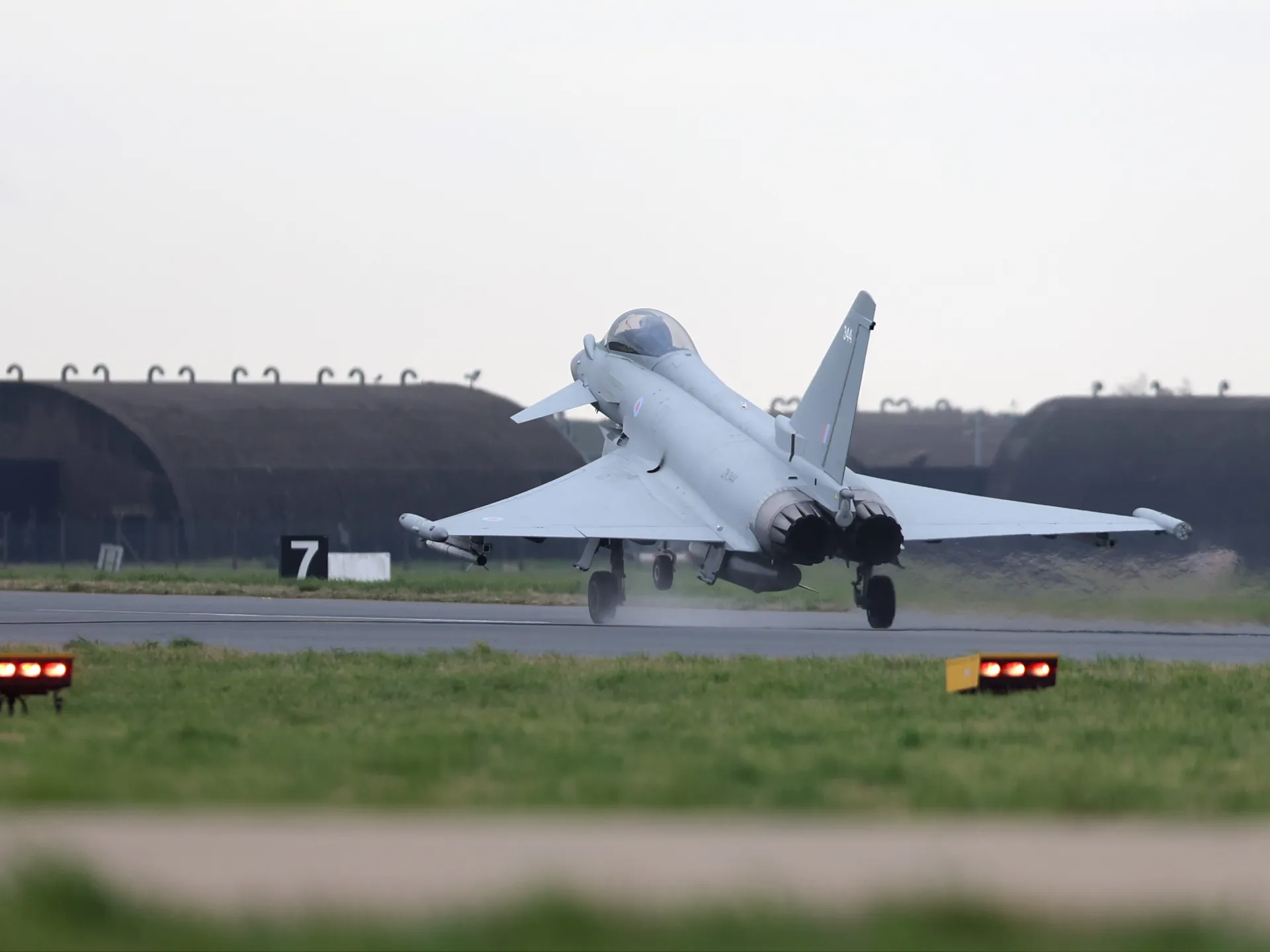
The UK Ministry of Defence said it would deploy Typhoon fighter jets to fly “defensive counter air missions” in Saudi Arabia, send UK military advisers to work with Saudi staff officers and provide an A400M transport aircraft to help move defence material within the kingdom.

French support for Saudi Arabia would include soldiers, radars and defence systems, Macron has said, without detailing the scale of the support.

Urban Coningham, a research fellow at RUSI, noted differences in the British and French roles, with the French mainly limited to protecting Saudi export infrastructure. The British, by contrast, will conduct “defensive patrols where they would shoot down incoming missiles or drones” in Saudi Arabia, as well as provide air-to-air refuelling support for Saudi bombers and jets heading into Yemeni airspace, he said.

Camille Lons, policy fellow and deputy head of the Paris office at the European Council on Foreign Relations, said France is limited in what it can provide to Saudi Arabia, particularly given the demands on European defences amid the war in Ukraine. Still, Paris sees its assistance as a way to “show support [for Saudi Arabia] in times of crisis, and a way to deepen the defence partnership”, Lons told Al Jazeera.

‘Freeing up’ Saudi aircraft

Saudi Arabia will welcome the European deployments, as it has struggled to translate some of its security partnerships into high-level military support.

In September, US President Donald Trump rejected multiple Saudi requests to participate in strikes on the Houthis, agreeing only to provide intelligence and targeting support, the news agency Reuters cited informed sources saying.

Turkiye and Pakistan have committed to “collective deterrence measures”, including potential troop deployments, under the newly signed Mecca defence pact with Saudi Arabia, but the agreement has yet to be ratified in Turkiye.

Egypt’s parliament has also postponed a vote that would authorise its armed forces to support Saudi Arabia.

Nawaf Obaid, a senior fellow at King’s College War Studies Department, called the UK and French deployments “militarily valuable and politically significant”, saying they could help shield the kingdom’s sprawling territory from persistent Houthi air attacks while giving Riyadh more room to focus its own assets on offensive operations.

“The British Typhoons can reinforce Saudi air defences and, crucially, free up Saudi Eurofighters for offensive operations,” Obaid told Al Jazeera. “France’s contribution is particularly important for protecting Yanbu.”

Saudi Arabia “does not need foreign assistance to conduct air strikes”, Obaid added, noting that the kingdom has its own powerful combat aircraft fleet. “What it needs is additional defensive coverage across its enormous territory, particularly for critical energy infrastructure.”

Ozcelik said the recent British move was “not insignificant”, but its deterrent impact was not immediately clear.

“The question remains whether the UK air missions will move the dial in deterring sustained Houthi attacks while Saudi air defences and interceptor stockpiles are stretched,” said Ozcelik. “The difference between deterrence and interdiction is an important one.”

‘Dragged into protracted conflict’

What also remains to be seen is whether the UK and France will maintain a purely defensive posture – and whether the Houthis will recognise that distinction at all.

Coningham said the Houthis could interpret European military involvement, especially the UK’s air-to-air support for Saudi bombers and jets, as “offensive” rather than defensive, leading the group to view those countries as belligerents and their forces as targets.

As a result, Coningham said, the Houthis could strike at British forces stationed in the region – whether in Saudi Arabia or elsewhere, such as Cyprus – or reverse their position on allowing free transit to non-Saudi vessels, including European ships, in the Bab al-Mandeb strait – a key maritime route in the world.

Another potential flashpoint would be a Houthi attack in Saudi Arabia that kills British or French personnel, analysts noted.

“Whether it’s a direct attack planned by the Houthis or collateral damage, if the British or French have any casualties … then there becomes a pointed debate in those countries as to whether they should then retaliate,” said Coningham.

Ozcelik said the UK could face pressure to play a more offensive role in the event of a “mass civilian casualty event” caused by the Houthis or “debilitating attacks on Saudi’s energy infrastructure”, although London would likely view such a scenario as a “last resort”.

“Neither the Mecca signatories nor the UK are inclined to get dragged into deeper and likely protracted conflict inside Yemen,” said Ozcelik.
Source link

How Israel’s genocide in Gaza pulled Britons into the Palestine movement | Israel-Palestine conflict News

London, United Kingdom – Claire, 52, lives in the Scottish countryside, not far from Edinburgh.

She describes her work as “low-level administration” and does not use social media. She lives a quiet life with her dog, reading and baking in her spare time. Until three years ago, she did not consider herself political.

Recommended Stories

list of 4 itemsend of list

Now, she faces 14 years in prison for her suspected show of support for Palestine Action.

Claire, who requested Al Jazeera withhold her surname, is one of the many people in the United Kingdom who, until three years ago, did not consider themselves activists.

But as the genocide in Gaza was livestreamed, many have rallied around the cause of Palestinian solidarity.

Organisations like Defend Our Juries, Artists for Free Palestine, Workers for Free Palestine, and virtually every other insert-profession-here for Palestine have cropped up across the UK.

In the summer of 2023, Claire read I Shall Not Hate by Dr Izzeldin Abuelaish, a Palestinian physician in Gaza who lost his three daughters to Israeli tank fire. Not long after finishing the book, Claire watched the aftermath of October 7 unfold online.

“For me, there wasn’t a delay between ‘Israel has a right to defend itself’ and then lies,” she told Al Jazeera.

She went to a pro-Palestine rally on Armistice Day, calling for a ceasefire, and “was horrified” by then Home Secretary Suella Braverman, who called the protests “hate marches”.

“I was determined not to ignore [Palestine],” she says.

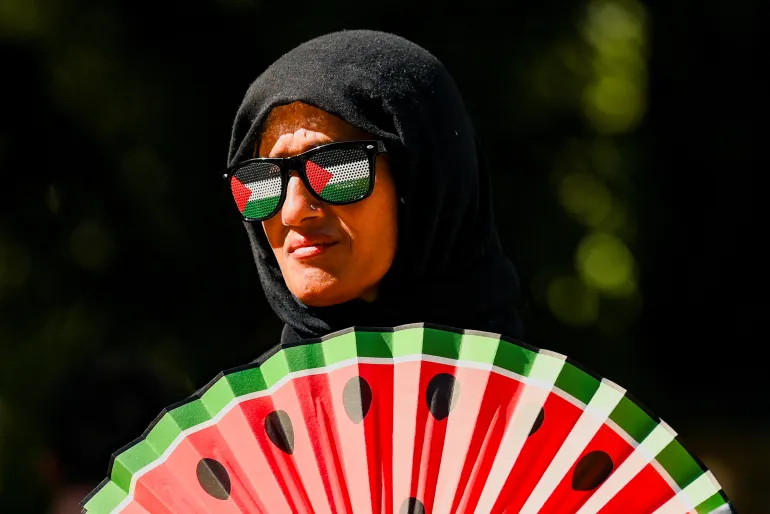
A protester wears eyewear in the colors of the Palestinian flag and holds a fan featuring a watermelon design during a rally organized by Defend Our Juries, challenging the British government's proscription of "Palestine Action" under anti-terrorism laws, in Parliament Square, London, Britain, August 9, 2025. REUTERS/Jaimi Joy TPX IMAGES OF THE DAY
A protester wears eyewear in the colours of the Palestinian flag and holds a fan featuring a watermelon design during a rally organised by Defend Our Juries in Parliament Square, London, Britain, August 9, 2025 [Jaimi Joy/Reuters]

She continued to march, writing letters to lawmakers and fundraising for various Palestinian aid programmes.

In August 2025, she began publicly protesting against the proscription of Palestine Action with Defend Our Juries, the group behind a campaign of civil disobedience aimed at lifting the ban. To date, more than 3,000 people have been arrested for showing support for the pressure group that was banned in 2025.

Earlier this year, police arrived at her door to arrest Claire under Sections 11 and 12 of the Terrorism Act: “Being a member of a proscribed organisation and encouraging others to join a proscribed organisation.”

“I’ve never been in trouble before,” she says. “I’m not backing down.”

A police officer holds a Pro-Palestinian protester on the day of a demonstration outside the Parliament, organised by campaign groups including Palestine Solidarity Campaign, Avaaz and Parents for Palestine, calling for sanctions on Israel over ongoing hunger among Gaza's war-struck population, in London, Britain, June 4, 2025. REUTERS/Isabel Infantes TPX IMAGES OF THE DAY
A police officer holds a pro-Palestinian protester during a demonstration outside the Parliament, organised by campaign groups including Palestine Solidarity Campaign, Avaaz and Parents for Palestine, calling for sanctions on Israel over ongoing hunger among Gaza’s war-struck population, in London, Britain, June 4, 2025 [Isabel Infantes/Reuters]

Marji, 70, lives in Colchester and had a similar feeling after hearing Braverman’s words.

“I had never been to a protest in my life,” she says, until she carried a “Ceasefire Now” sign at an Armistice Day march in 2023.

“I knew it wasn’t a ‘hate march’.”

Marji’s father served in the British Army, and her father-in-law was in the Royal Air Force and taken as a prisoner-of-war in Japan during World War II.

“Our parents’ generation fought fascism,” she says. “Now Britain is breaking British law.”

Marji, who also requested to be identified only by her first name, had a successful career in financial services, while her husband held an executive-level role.

They are now retired grandparents.

In July, they were arrested in Westminster under Section 12 of the Terrorism Act and are now waiting to see if charges will be laid.

“We’ve had to decide … is it safe to have grandchildren here? When the police could come to the door?”

Her children remain supportive.

“I think they’re proud of us, even if there’s been fear on their part.”

People protest on Vauxhall Bridge during a march in solidarity with Palestinians in Gaza, amid the ongoing conflict between Israel and the Palestinian Islamist group Hamas, in London, Britain, November 11, 2023. REUTERS/Kevin Coombs TPX IMAGES OF THE DAY
People protest on Vauxhall Bridge during a march in solidarity with Palestinians in Gaza in London, Britain, November 11, 2023 [Kevin Coombs/Reuters]

Across sectors, from the arts to railways, financial services and administration, Britons have risked professional and legal repercussions for the sake of Palestinian solidarity.

Hundreds of thousands have taken to the streets to protest against Israel’s genocidal campaign in Gaza and what they see as the UK’s role in the conflict. They have urged the UK government to cease all arms sales to Israel and cut diplomatic and trade ties as the genocide goes on in Gaza and violence escalates in the occupied West Bank.

This week, tensions have flared again as the Metropolitan Police warned pro-Palestine protesters against rallying on the three-year anniversary of October 7. The force said on Wednesday that five people were arrested outside the Board of Deputies of British Jews in north London for “inciting racial hatred, involving allegedly shouting or chanting slogans calling for Intifada”.

Israel’s latest war on the Gaza Strip – it has waged several since 1948 – began after Hamas, the group that governs Gaza, attacked southern Israel. About 1,200 people were killed that day, while more than 240 were taken captive, including Israeli soldiers, citizens and some foreign nationals.

Since October 7, 2023, Israel’s relentless bombardment has killed more than 74,000 people and  devastated Gaza, making life for survivors nearly impossible. The small territory is now home to the largest group of child amputees in modern history.

“The narrative that we had grown up with was wrong – that the people who were there and living peacefully have been cast as ‘terrorists’, when they have suffered terrorism,” Marji says.

A demonstrator argues with the police as students take part in an inter-university march organized by the University of London Coalition in support of Palestinians, on the third anniversary of the October 7, 2023 attack on Israel by Hamas from Gaza, in London, Britain, October 7, 2026. REUTERS/Carlos Jasso
A demonstrator argues with the police as students take part in an inter-university march organised by the University of London Coalition in support of Palestinians, on the third anniversary of October 7, 2023 in London, Britain [Carlos Jasso/Reuters]

Both Marji and Claire spoke about their belief that the UK government is “complicit” in the genocide.

“The government participation, complicity, and their lies. Their gaslighting makes people more determined,” says Claire.

As the legal dangers and rhetorical backlash mount against pro-Palestine protesters, Marji, whose maternal grandmother was Jewish, is only more resolved: “We knew that saying ‘stop the genocide’ doesn’t mean you’re an anti-Semite. We’re not stupid, we can differentiate between Jewish people and people who support illegal occupation.”

Workers for Free Palestine, which includes a range of trade unions, formed in late 2023 and soon began holding protests.

“Many people oppose how their labour is used to prop up an apartheid state, but have been told there is nothing they can do as individuals,” a spokesperson told Al Jazeera.

Many workers are nervous to speak out against their workplace’s role in producing weapons, their investments in Israel, or other ways of enabling Israel’s war.

“Many are unfamiliar with their rights as workers and are afraid of the repercussions of speaking up – and these repercussions can be very real,” the spokesperson said.

Still, for some, there is not just resolve but optimism.

“Doing nothing makes us feel sick, angry and powerless,” says Marji. “I hope people will wake up and see how our own civil liberties … are being eroded to protect the interests of Israel.”

INTERACTIVE - THREE YEARS OF GAZA WAR -DEATHS- OCT6, 2026-1791291169
(Al Jazeera)

Source link

BBC star pulled off air mid-show after struggling

A BBC Radio 4 star was pulled off air mid-show yesterday after he appeared to be struggling.

The Today programme host could barely get his words out as he read out the headlines.

Justin has been been presenting the flagship show for 17 years Credit: BBC
Listeners were worried for poor Justin as they begged someone to get him some lemsip Credit: PA

Justin Webb, who co-hosts the flagship show alongside Anna Foster, left fans very worried as he sounded strained on-air.

The sick star was heard clearing his throat on multiple occasions and Anna was forced to take the lead to give him some reprieve.

Justin managed to introduce Simon King’s weather forecast and ask a BBC News journalist questions on Open AI’s breach of Australian government websites.

But it all became a bit too much for Justin, 65, and he was later sent to the Conservative party conference to give his voice a break.

Read more on BBC Radio 4 stars

DIVERSITY RAP

Justin Webb says BBC are overlooking white, working class, older broadcasters


BBC TRAGEDY

BBC star Dame Jenni Murray died smashing into two cars when ‘dazzled by lights’

Anna Foster co-hosts the Today programme alongside Justin Credit: Neil Sherwood
The 65-year-old was sent to the Conservative conference to give his voice a break Credit: Getty

Anna said: “It is 20 to seven now. Jonny Dymond is here, good morning.

“Important to say, if you’ve heard Justin’s voice this morning, he’s at the Conservative Party conference in Birmingham.

“He’s struggling a bit with his throat, so we’re saving him. We’re saving him for that. And Johnny, you’re here with me to continue with everything.”

Jonny, the Beeb’s royal correspondent, added: “Poor man has the conference lurgi that sweeps around these places every year.”

Fans flocked to X after hearing poor Justin’s hoarse voice.

“Crikey that sounds painful – a lorry load of Lemsip please for Justin Webb,” wrote one fan.

Another listener said: “Chip in a tenner to get him a pack of Lemsip.”

A third joked: “Justin Webb bravely presenting the Today programme despite apparently having swallowed a badger.”

“Is he ok?” added a fourth listener.

Justin has been the main presenter on BBC Radio 4 for 17 years.

Before his lengthy stint on the programme he was BBC North America Editor and served as their chief radio correspondent based in Washington D.C.

Source link

Katherine Ryan apologises to Victoria Beckham after BBC upholds complaints over rude slur that was pulled off iPlayer

KATHERINE Ryan has issued a public apology to Victoria Beckham after the BBC upheld complaints over a rude slur that was taken off of iPlayer.

The comedian, 43, made the offensive joke about Posh Spice while hosting an episode of Have I Got News For You last year.

Katherine Ryan has apologised to Victoria Beckham Credit: Getty
Viewers complained about an offensive remark made about Victoria by Katherine on an episode of Have I Got News For You last year Credit: Getty

Speaking in an episode that aired on November 7, Katherine made reference to a 2013 private email sent by David Beckham, where he allegedly used the word ‘c****’.

She said on the show: “I don’t know that we are allowed to broadcast the c-word, but you did reference Victoria Beckham earlier and we’ll allow that.”

The BBC‘s Executive Complaints Unit (ECU) have issued it’s ruling on the matter and have revealed there was no justification for Victoria being labelled with the offensive word.

Now Katherine has taken to Instagram in a new reel to apologise for the comment.

READ MORE ON KATHERINE RYAN

‘MOMS OUT!’

Laura Whitmore and Katherine Ryan let loose at Emily Atack’s wedding


HER TRUTH

Katherine Ryan says ‘traumatised’ Holly Willoughby is ‘blamed for men’s actions’

She began: “Hi I’m comedian Katherine Ryan and today the BBC announced their decision to uphold a complaint made by two very influential viewers about a joke that I tried to make on an episode of Have I Got News For You eleven months ago.

“At that time, though there is no defence, I was suffering from a condition called matrescence.

“I was in that building with a 10-day old baby. Should I have left the house?

“This is gonna be a tough one for the feminists because I was a woman going to work but I did call another woman a c***.

Katherine shared a video after the BBC’s ruling was revealed Credit: Instagram/kathbum
She posted a screengrab of an apology she sent to Victoria Credit: Instagram/kathbum

“Sometimes I forget that celebrities are not my friends. If I had called Jimmy Carr a c***, he wouldn’t have minded.

“Joanne McNally, c***, she wouldn’t have minded but this was described by the BBC as a slur.

“As though c**** are part of a protected group,” Katherine said in her trademark sarcastic way.

“The trouble is now that section’s been taken off iPlayer so the incident only exists in printed media, online media and then you lost the context because on the day, if you watched it, it was clearly a joke and the whole audience went ‘huhhhh’ and I said ‘whoaaaa’.”

She then plugged her new book before adding: “I love Victoria Beckham so much that I actually included her in one of my celebrity firstborn daughter chapters.

“I’d like to read you that now whilst remaining very sorry.”

Katherine went on to read the specific chapter about Victoria as she praised her for her work over the years.

She continued: “Yes, I sort of jokingly called her a c*** in the BBC and she messaged me afterwards.

“I apologised unreservedly because though she is a c***, Victoria Beckham couldn’t be further from a c***.”

Katherine shared a screengrab of the apology she sent to Victoria via an Instagram DM.

The BBC’s Executive Complaints Unit said today: “There was no such justification for a comment which presented Victoria Beckham as equivalent to a particularly offensive word.”

They stated that the word was justified in relation to David’s alleged use of it, but not in reference to his wife.

It added: “The relevant BBC editorial guidelines do not require programmes to avoid giving offence but do require that any offence should be editorially justified.”

According to the ruling, two viewers had complained about the remark, which was “gratuitously offensive”.

Now an edited version of the episode has replaced the original on the BBC’s streaming service.

Source link