How an L.A. election fraud case touted by Trump’s DOJ fizzled
Federal agents in police vests towered over the 5-foot Darwin Rivera Flores as they held him against a truck, his hands cuffed behind his back outside a skilled nursing facility in Ventura where he worked as a caregiver.
“What did I do?” asked Rivera, a Honduran national residing legally in the U.S. with a green card. “Can you tell me what I did?”
Federal prosecutors accused Rivera, now 31, of falsely claiming U.S. citizenship when he registered to vote — a felony — though they acknowledged he never cast a ballot. First Assistant U.S. Atty. Bill Essayli, the top federal prosecutor in Los Angeles, posted a brief video of the arrest on X and touted the case as the “first of many to come” as his office ramped up efforts to prosecute election-related crimes.

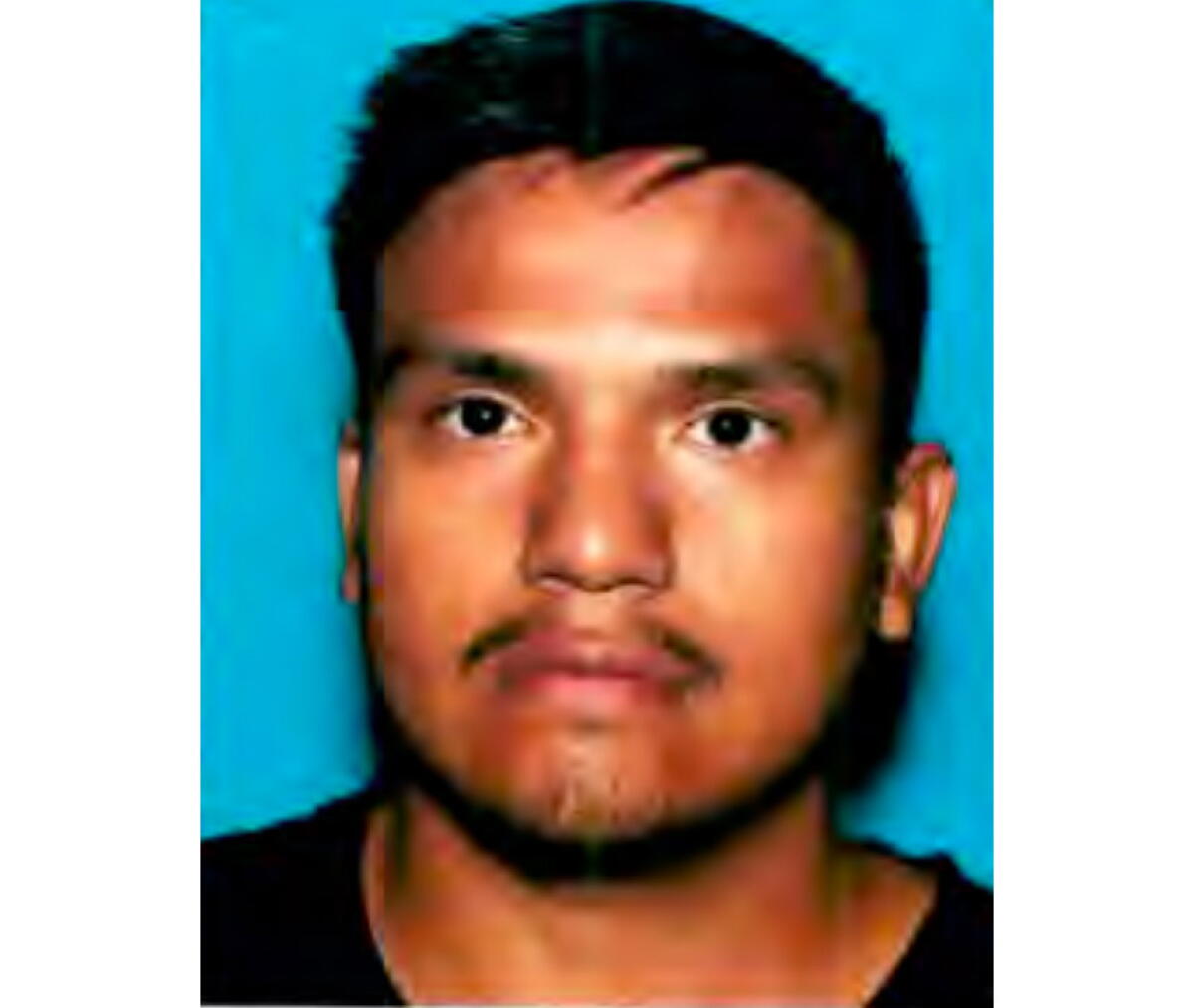
A photo of Darwin Rivera Flores included in the complaint filed against him by federal prosecutors in Los Angeles.
(U.S. District Court )
But the case, scheduled to go to trial this month, ultimately fizzled. On Nov. 9, Rivera pleaded guilty to a misdemeanor, admitting he shouted “vulgar obscenities and profanities” at federal employees in Camarillo 10 months earlier — an offense that has nothing to do with voting — and prosecutors dropped the felony election charge.
It was the latest stumble for the U.S. attorney’s office in L.A., after Essayli promised a crackdown on voter fraud. Last month, Essayli argued in court that the state should set aside about 20,000 ballots until it could be determined whether the voters were citizens. A federal judge and a U.S. 9th Circuit Court of Appeals panel rejected the request and the U.S. Supreme Court declined to intervene.
U.S. District Judge Mark C. Scarsi sentenced Rivera to a year of unsupervised probation. The U.S. attorney’s office, which announced Rivera’s arrest in a news release, did not issue one when his case was resolved.
When asked why prosecutors dropped the election-related charge, Ciaran McEvoy, a spokesperson for the U.S. attorney’s office in L.A., said the office doesn’t comment on such decisions.
Rivera could not be reached for comment and his public defenders did not respond to inquiries from The Times.
Trump administration officials have vowed to continue prosecuting noncitizens on election fraud charges, although a Washington Post review of federal court records found only two new cases since the midterms.

A complaint filed against Darwin Rivera Flores by federal prosecutors in Los Angeles included what was allegedly his signature on a voter registration form.
(U.S. District Court )
Ahead of the election, federal authorities in California charged more than 30 people as part of “Operation Protect the Vote.” But the outcome of Rivera’s prosecution has cast doubt on the strength of those cases — and raised questions about how a high-profile voter fraud allegation shrank into an unrelated misdemeanor.
Laurie Levenson, a professor of law at Loyola Law School and a former federal prosecutor, said Rivera’s case appears to have been resolved with “less than a slap on the wrist.”
“I don’t know what to say other than I think the public should be aware and beware that this push against voter fraud may not have the credibility that the Justice Department wanted you to believe,” Levenson said.
“Why,” she asked, “when they made a big deal about the voter fraud charge, did they back down?”
‘Can’t wait until the midterms’
Rivera was born in Choloma, Honduras, just north of the country’s second-largest city, San Pedro Sula. He has lived in the U.S. since 2002, according to a criminal complaint against him.
This year, authorities accused Rivera of blocking a woman who worked for ICE from accessing a federal building in Camarillo. When Rivera went to renew his green card on Feb. 18, Christopher Kuzma, a Homeland Security Investigations special agent, issued him a misdemeanor citation for the earlier incident, according to an investigative report filed in court.
Kuzma wrote in an affidavit that he told Rivera the citation was meant to “correct [his] bad behavior.” Rivera later pleaded guilty to the offense and was placed on a year of unsupervised probation.
In his affidavit, Kuzma said that on March 27, the same ICE employee reported that Rivera had confronted her near the federal building. The employee said Rivera “threatened to find my neighborhood, find my house.”
Kuzma said he called Rivera in April to discuss what had happened, but Rivera declined to be interviewed, according to the affidavit.
In late April, Kuzma said in the affidavit, he began receiving text messages from unfamiliar numbers criticizing immigration enforcement. Kuzma believed they were from Rivera, according to the affidavit.
“I can’t wait until the mid terms you dont have qualified immunity then we can start and indict all you guys one bye one,” one text read.
Kuzma said in his affidavit that he believed the message showed Rivera “has both an interest in the voting process and an intent to participate in the election process.”
Kuzma wrote that, based on the initial citation and the March confrontation, he “conducted additional investigation,” which led him to a voter registration in Rivera’s name that listed him as a U.S. citizen.
After Rivera’s arrest, Essayli went on Fox News and said Rivera’s text about the midterms “got the agent interested to see whether he was registered to vote or not.”
“That’s how he came on their radar,” Essayli said.
Questions about the investigation
In an Oct. 26 federal filing, Rivera’s public defenders, Howard Shneider and Daniel T. Lee, wrote that records turned over in discovery undercut Kuzma and the government’s account.
The records, they wrote, showed that “Kuzma had already searched Mr. Rivera’s voter-registration status more than two months before that text message arrived.” Among those records was a printout of Rivera’s “My Voter Status” page from the California secretary of state’s website, dated Feb. 25, one week after Kuzma cited him for his encounter with the ICE employee.
According to the discovery records filed in federal court on April 8, nearly three weeks before the text about the midterms, Kuzma served a summons on the Los Angeles County registrar’s office seeking Rivera’s voter records. The next day, the office provided him a voter registration form in Rivera’s name.
Shneider and Lee said in the October court filing that they suspected “Agent Kuzma was prompted to action in the voter registration fraud investigation by orders from DOJ or from HSI leadership.”
If Kuzma acted on such orders, the defense attorneys wrote, that “calls into question the integrity of the investigation.” That a low-level violation prompted a voter registration search “raises many questions,” the attorneys said.
Without more records, Rivera’s attorneys argued, there was no way to know “the extent to which Agent Kuzma’s investigation was influenced by a motive to make cases and satisfy higher-ups.”
Four days after the public defenders’ motion, the government signed off on the misdemeanor plea agreement with Rivera.
In it, Rivera admitted that on Jan. 9, more than a month before Kuzma cited him, he shouted “vulgar obscenities and profanities” at federal employees at the Camarillo building. That incident does not appear in Kuzma’s affidavit or in the investigative reports filed in the case.
A guilty plea — and no jail time
Six days after the midterm elections, Rivera, who had been out on a $10,000 bond, appeared in a downtown federal courtroom to plead guilty to the misdemeanor.
Shneider asked Scarsi to sentence his client that same day, according to a court transcript, noting that Rivera cares for elderly patients and shares custody of his two children.
Rivera had been arrested “to much fanfare” on a voter registration fraud charge and spent a weekend in jail, Shneider told the judge. The attorney asked for a year of unsupervised probation, the same punishment Rivera received for blocking the ICE employee from entering the Camarillo federal building.
The January offense, Shneider said, occurred while Rivera was protesting outside a federal building. He told the judge Rivera came to the U.S. as a child and entered the foster care system after his mother died.
“It was a difficult childhood and a difficult upbringing, and I think that’s where some of the issues come from that might have led him to go a little excessive at the protests in Camarillo,” Shneider said. “Since he was arrested in our case, he has been getting therapy, including with a psychiatrist, and getting medication to help him feel better and to sort of calm him down, and he’s been doing much, much better since then.”
Asked whether he wished to speak, Rivera told the judge, “I would just like to apologize for my actions, Your Honor.”
Assistant U.S. Atty. Minjae Kim requested that Rivera spend at least a week in custody.
Scarsi sentenced Rivera to a year of unsupervised probation, rejecting Kim’s request for jail time.
The judge told Rivera his desire to protest is “laudable,” but said he should be protesting against ideas or for ideas, “but not against people.”
“The way to do that is to kind of divorce the ideas from the people,” Scarsi said. “Does that make sense?”
“Yes, Your Honor,” Rivera replied.