US Agriculture Department says rescinding the 2001 rule will help reduce wildfire risk and return control to local managers.
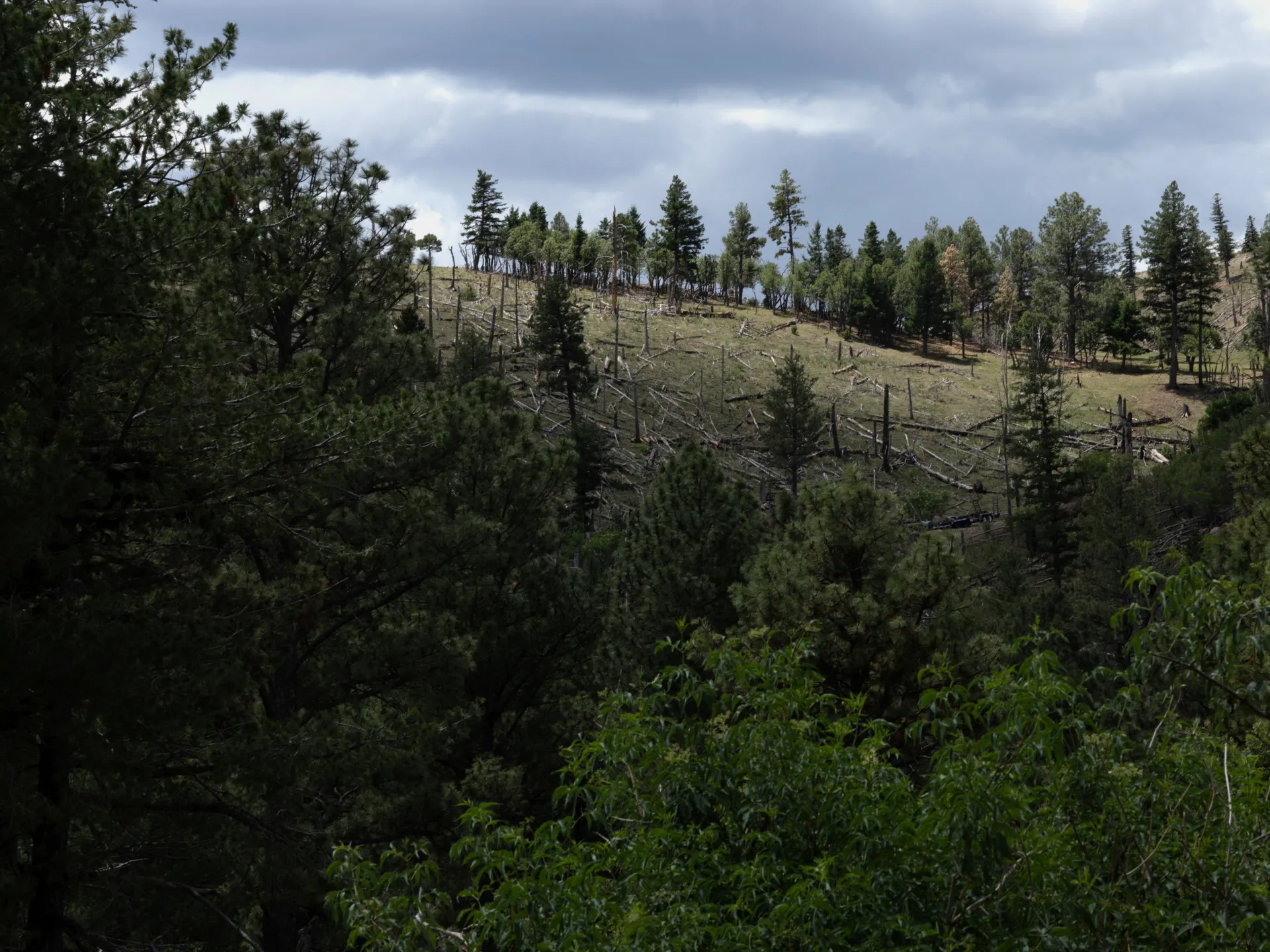
The United States Department of Agriculture (USDA) has filed a proposal to rescind the entirety of the 2001 Roadless Area Conservation Rule, which prohibits road construction and logging on nearly 45 million acres (18 million hectares) of national forest land.
Secretary of Agriculture Brooke Rollins submitted the proposal on Tuesday, saying it will mitigate wildfire risk by returning authority to local forest managers, who “know the land best”.
Recommended Stories
list of 4 itemsend of list
“For too long, outdated restrictions have kept tens of millions of forested acres off-limits to the very treatments that improve forest health and reduce wildfire risk to our communities,” Rollins said in a statement. “It’s time to turn the page on the failed roadless rule and return our forests to health and productivity.”
The Trump administration and Republican lawmakers say building roads in these areas would make it easier for firefighters to access the land if a wildfire breaks out.
“For 25 years, the heavy thumb of Washington, D.C., has hindered Montana’s ability to properly manage wildfire risk and road development on nearly 60 percent of Forest Service land across the Treasure State,” Republican Governor Greg Gianforte of Montana said in a statement.
While the areas are referred to as “roadless”, there are thousands of miles of existing roads within the lands with federal, state, and county ownership. About half of these lands are within 1 mile (1.6km) of a road, and 31 percent are within 0.5 miles (800 metres) of a road, according to the National Forest Service.
The USDA clarified that it is not forcing timber cutting or road construction.
But environmental groups say rescinding the conservation rule will open the door to developments that will increase the risk of wildfire. Fires are four times more likely to start near roads than in roadless forests, according to research from The Wilderness Society.
“Roadless forests are where wildlife live,” Taylor McKinnon, southwest director of the Center for Biological Diversity, said in a statement. “They’re home to jaguars, Mexican spotted owls, and ocelots, some of the most iconic animals on the continent. Plowing roads into their habitat will bring human-caused wildfires and disturbances that they don’t need and can’t afford.”
The US is experiencing one of its worst wildfire years in the last decade, with 7.3 million acres (3 million hectares) burned in about 49,000 fires through August 17, according to the National Interagency Fire Center.
More than 95 percent of the affected areas would be in 10 states: Alaska, Arizona, California, Montana, Nevada, New Mexico, Oregon, Utah, Washington, and Wyoming.
In early August, the state of Washington fought a highly destructive wildfire that burned more than 8,000 acres (3,200 hectares) and forced approximately 65,000 people to evacuate.
Last month, the Trump administration finalised rollbacks of two regulations affecting the Endangered Species Act. One change requires officials to weigh economic and national security considerations when determining whether an area should be designated as “critical habitat”.
The public will have until September 21 to comment on the proposed Roadless Rule.
Los Angeles police Officer Daniel Flores may have broken the law when he secretly recorded his colleagues making ugly, unacceptable comments that were variously racist, homophobic, misogynistic or otherwise gross and unprofessional at best.
So L.A. County Dist. Atty. Nathan Hochman is right to take this, or any, violation of the law by a badge-wearing member of our police force seriously, no matter what Flores’ intent was.
But Monday, Flores was arraigned on 16 felony counts that could lock him up in state prison for 13 years (he pleaded not guilty).
That court hearing was preceded by an unusual and disturbing summary of the case filed with the court by Hochman. It seemed like an inappropriate attempt to smear Flores as a money-grubber with a convoluted plan to sue taxpayers into a sweet retirement (as opposed to intending to expose misconduct), while simultaneously giving an aw-shucks, it-was-all-in-good-fun defense of the ugly commentary of the recorded officers.
Regardless of what Hochman’s intent is in throwing the book at Flores, the result is one that will haunt this city for years to come: a police force in which the officers are clear that if you rat out the cops for misconduct, you get what you get.
“The message to everyone in the police department is keep your mouth shut,” said David A. Harris, a law professor at University of Pittsburgh and an expert on police misconduct. “You cannot stand up for principle or even for the policy of the police department, except at the risk of your own career and your own well-being, and perhaps your freedom.”
Hochman spoke with me for nearly an hour about his reasons for what many, myself included, see as his prosecutorial overreach in this case. Before I tell you the reasons why I think Hochman has it wrong — dangerously wrong — in the decision to charge Flores’ so harshly, I’ll tell you where we agree.
Cops, we concur, should not call women “bitches.” They also should not call women “rapeable,” even if, as Hochman’s filing assures us, “the use of the phrase ‘rape’ was not in a sexual context.”
I am not sure what the nonsexual context of rape is, but OK.
Cops should not make fun of, in no particular order, people with disabilities; candidates applying for jobs; co-workers; Asian people; Hispanic people; or people who may be overweight — as the officers in this case allegedly did.
“These comments are deplorable. They’re despicable. They’re racist. They’re homophobic. They’re sexist,” Hochman told me. “There’s no place in our society for them, and they should be punished.”
So Hochman and I agree that Flores may have broken the law, and that the comments of his fellow officers are unacceptable.
And now the roads diverge.
Because faced with those competing truths, Hochman could have used prosecutorial discretion — the art of tempering the law with the mores and ethics of the community.
He could have used that discretion to cut Flores a break, charge him at a lower misdemeanor level or not at all, and put the focus where it belongs — on the officers who disgraced their badge with their behavior, and what is seemingly a culture of disrespect and degradation within the unit charged with choosing the next generation of officers.
These are the officers charged with recruiting the officers of the future, so the stakes here are high. This is misconduct that the people of L.A. need to know about, because if these officers are so casual in their hateful comments, can we trust their judgment on hiring?
“On one hand, being a whistleblower doesn’t give a person the right to violate the law,” said Erwin Chemerinsky, the dean of UC Berkeley’s law school, who did an investigation on police culture in the LAPD in 2000 in the wake of the Rampart scandal. “On the other hand, I would hope that the district attorney would take context into account. And 16 felony charges seems really excessive.”
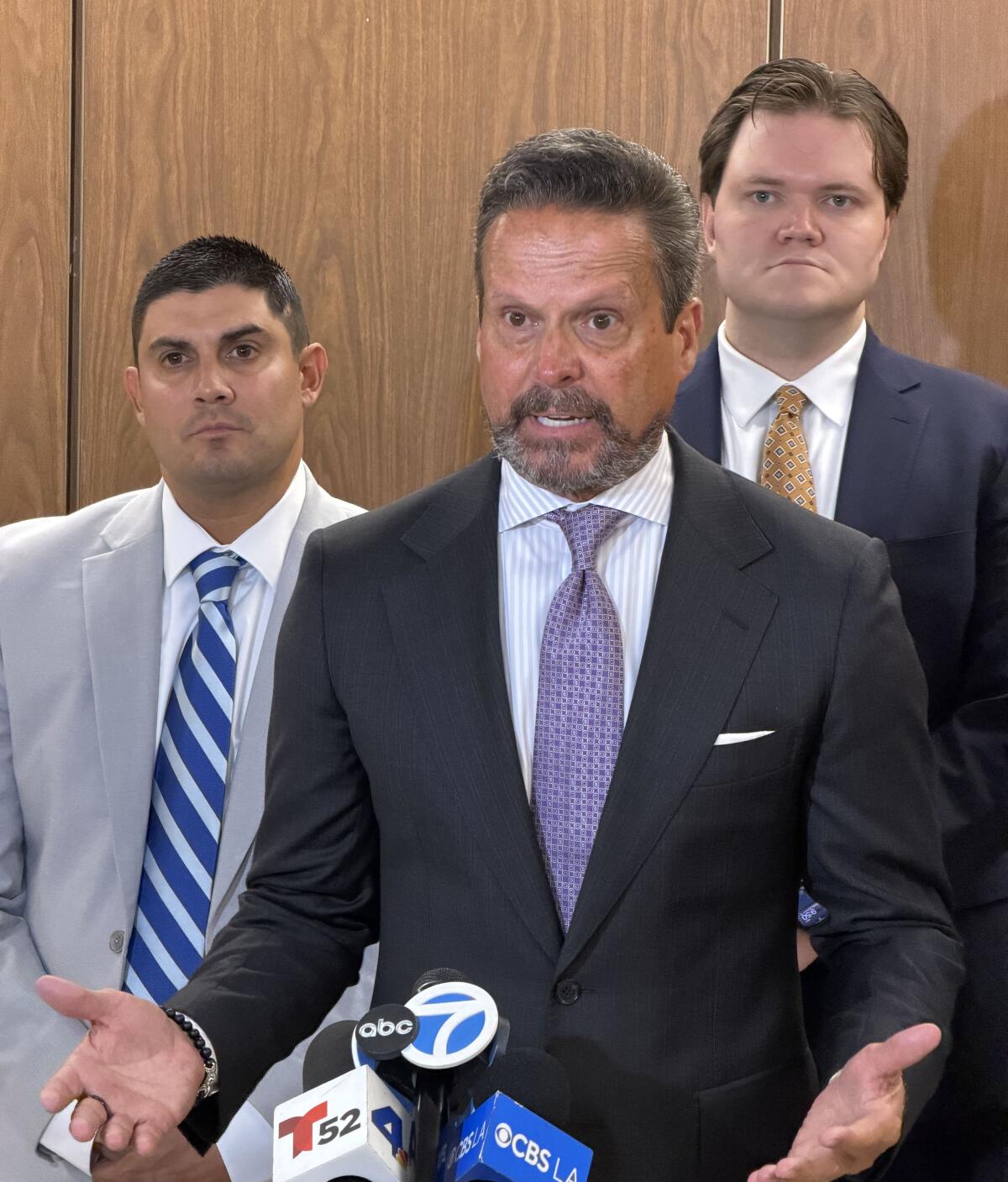
LAPD Officer Daniel Flores, left, listens as his attorney Alan Jackson speaks to reporters Monday.
(Libor Jany / Los Angeles Times)
But Hochman argues that a “message has to be sent” because it’s a police officer who broke the law.
“If you don’t hold police officers accountable, it’s very hard to hold anybody accountable,” Hochman said. “I believe that no, we’re not going to let the ends justify the means, even if the ends may be laudable, like exposing bigotry, because it leads us down a very slippery slope.”
Hochman said Flores simply could have taken notes on the inappropriate comments and turned them in to superiors or the independent inspector general, which strikes me as either sweetly naive or disingenuous.
“The officer would be shunned; his career would be over, and he would probably find himself on the receiving end of some kind of retaliation,” Harris, the law professor, said of the likely outcome of that plan.
Chemerinsky said retaliation against whistleblowers has long been a part of the culture of the department. Make a complaint, his report in 2000 found, and an officer might get “freeway therapy,” transferred to someplace far from where they lived to send a message, or even find themselves without backup in a dangerous situation.
This decision to treat Flores so harshly, Chemerinsky said, comes off as “part of that long history of LAPD trying to very much crack down on whistleblowing.”
Hochman told me that he wants to make it “crystal clear” that “nothing in this prosecution should be read that we are in any way trying to chill whistleblowers.”
He added that he did use discretion.
“I hope you note in your article that the district attorney could have brought 122 felony charges, or 122 misdemeanors, or some combination of felonies and misdemeanors up to 122,” Hochman said.
Flores made 122 total recordings of 16 people. Hochman charged on the number of people recorded, not the number of recordings, he pointed out.
So sure, we can count that as discretion, I guess?
This is where Hochman has his messages dangerously backward. Sure, hold Flores reasonably accountable for taking matters into his own hands, if he broke the law in doing so. Certainly, Flores knew there would be consequences to his actions.
But that Hochman is trying to frame this as a fair and reasonable prosecution, while protecting the officers who made the comments by giving us their weak-sauce excuses about having no ill intent, does not provide this city the justice it expects and deserves.
Hochman, you may recall, replaced George Gascón, a prosecutor who was accused of forcing his own values on the city.
Now, Hochman seems to be doing the same with his heavy-handed approach to Flores.
Hammering on Flores does not reflect the values of the majority of the Los Angeles community that wants a police force in which integrity and respect are fundamental, impunity is the outcast, and whistleblowers aren’t attacked, even if it turns out their motives aren’t pure.
Personally, I don’t care what Flores’ intent was in making the recordings. I don’t care if the officers caught on tape didn’t intend to offend, and I don’t care what Hochman intends the message to be with his vast over-charging of Flores.
I care about the result: a city in which misogyny and racism are just locker room talk, but breaking the blue wall of silence is a serious crime.
Banjul, The Gambia – At dawn, before the heat settles over the coast, Fatou Jarjue waits for the tide to retreat.
She pulls on her gloves and socks, steps into the muddy edge of the Tanbi Wetland and pushes her wooden canoe through narrow channels surrounded by tangled mangrove roots. Inside the canoe sit empty pans waiting to be filled, not with oysters today, but with crabs hiding beneath the surface.
The life of this mother of one is inseparable from the wetland she navigates each day. The mangroves – salt-tolerant coastal trees that protect shorelines from erosion and flooding – provide the oysters, crabs and fish that sustain her family’s livelihood while serving as a natural barrier against erosion and flooding for her coastal community.
Her brother, Musa, trails behind in a smaller canoe whenever he can, keeping watch as she moves deeper into the mangrove channels. On days when he is busy elsewhere, Jarjue ventures into the wetland alone.
For generations, women around the Tanbi Wetland have depended on these waters for survival. Jarjue still does. But unlike previous generations, she also spends part of her time restoring the ecosystem that has sustained her family for decades.
Only months earlier, these waterways were filled with women collecting oysters attached to mangrove roots. With the arrival of The Gambia’s rainy season, oyster harvesting pauses, forcing many women to turn to crabs and fishing until the shellfish season reopens.
For the 34-year-old, the change in her daily catch is temporary. Her commitment to restoring the mangroves is not.
“I have restored more than 5,000 mangroves since last year,” she told Al Jazeera.
Raised in the mangroves
Jarjue grew up in Ndangan, a small settlement of about 300 people located roughly 2km (1.2 miles) from Banjul, the capital of The Gambia. Like many children in the community, she grew up with the rhythms of the wetland.
At just 12 years old, she began following her mother into the mangroves, learning how to harvest oysters and catch crabs and fish.
The forest was both a classroom and a source of income.
Over the years, Jarjue watched the environment around her change. Rising seas, coastal erosion and changing weather patterns began threatening the coastline her community depends on.
Instead of only taking from the wetland, she decided to help rebuild it.
Today, she returns regularly not only to harvest but also to inspect young seedlings, replace damaged plants and monitor areas where restoration is needed.
“The mangroves are part of our lives,” she said.
For Jarjue, conservation is not separate from survival. The healthier the mangroves become, the stronger the future of her community.
A season’s wait
As Jarjue paddles deeper into the wetland, oysters cling to the roots of the mangroves. They are large, growing and ready for harvest in another season. She leaves them untouched.
She points towards them proudly, knowing that protecting them now will mean a better harvest later.
Although crab harvesting provides income during the rainy season, oysters remain the more profitable catch. A milk-can measure of oysters sells for about 100 dalasis ($1.34), and demand at local markets is higher.
“Oysters are difficult to harvest,” Jarjue explained. “But that is where the money is.”
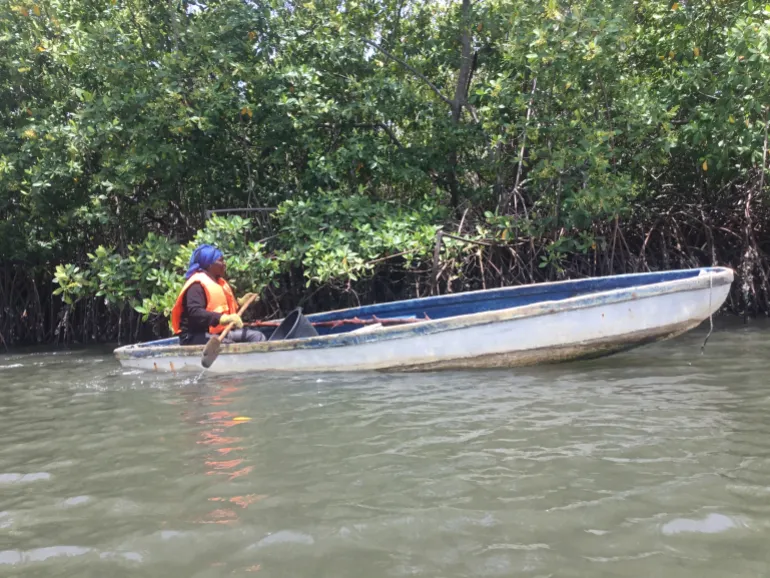
Fatou pushes her canoe into the water, beginning another day of searching for crabs in the mangrove wetlands that sustain her livelihood [Dijah Jawo/Al Jazeera]
The annual closure of oyster harvesting during the rainy season is sometimes misunderstood as a warning that oysters become poisonous at that time of year.
But marine scientist Dawda Saine says the reason is more complex and is rooted in conservation, ecology and food safety.
The closure forms part of The Gambia’s Oyster and Cockle Co-management Plan, which allows oyster stocks time to regenerate, reproduce and grow while reducing pressure on the resource.
“We don’t close the season because oysters are poisonous,” Saine told Al Jazeera. “We close it to protect the resource and because, during the rains, oysters filter everything in the water, including increased run-off, which can affect their quality, taste and safety.”
During the rainy season, increased run-off can carry waste and other materials into waterways where oysters feed by filtering water. Allowing them to remain undisturbed helps protect both the ecosystem and consumers.
For women like Jarjue, respecting the closure is an investment in the future.
Roots of survival
Jarjue is among several women in Ndangan who have become guardians of the ecosystem they depend on.
For 48-year-old Sussan Colley, the difference is visible every time she enters the wetland.
Colley has harvested oysters, fished and collected crabs since she was a teenager. She remembers when declining mangrove cover began affecting the community’s catches.
There were fewer oysters. Harvests became smaller. Families who depended on the wetland faced increasing uncertainty.
As restoration efforts expanded, Colley began noticing changes beneath the roots.
The oysters returned. They grew faster and larger. The wetland became productive again.
“The mangroves are changing our lives for the better,” she told Al Jazeera.
For Colley, restoration is also about preparing the next generation. She is teaching her children the skills she inherited from her parents while passing on another lesson: People must protect the natural systems that sustain them.
“I want them to make a livelihood from this,” she said, “but also understand the importance of the mangroves and the role they play in our lives.”
Jarjue and other women received training in mangrove restoration through a local conservation initiative supporting coastal communities in The Gambia. The programme equipped them with the skills to restore degraded mangroves, protect the ecosystems that support fisheries and strengthen their communities’ resilience to climate change.
For the women of Ndangan, the training changed how they viewed the forest, not only as a place to harvest, but also as something they have a responsibility to protect.
Banjul’s last shield
The work happening in Ndangan carries significance far beyond the settlement.
Banjul, The Gambia’s capital, is a low-lying island city facing growing threats from rising seas, coastal erosion and flooding. Experts have warned that a 1-metre (3ft-4-inch) rise in global sea levels could inundate parts of the city, increasing the urgency of protecting its remaining natural barriers.
Fatou peers through the mangrove branches, monitoring the oysters that depend on the health of the wetland ecosystem [Dijah Jawo/Al Jazeera]
The threat is not only a future concern. In 2022, severe flooding affected thousands of people across The Gambia, exposing the vulnerability of communities living along the coast.
For settlements surrounding the Tanbi Wetland, mangroves are more than an environmental resource. They are a natural defence system.
Rohey Malick Lowe, the mayor of Banjul, says the future of the capital is closely tied to the survival of its mangroves.
“Banjul is an island,” she told Al Jazeera. “If the mangroves disappear, it goes with the city.”
The mayor said the Banjul City Council is working to protect the capital from climate threats but acknowledged that challenges remain, including the degradation of parts of the wetland through human activities.
Supporting women like Jarjue, she said, is not just about protecting their incomes but also strengthening the city’s resilience.
“They are not only protecting their livelihoods,” Lowe said. “They are helping to protect Banjul.”
Roots of resilience
Despite their contribution, women in Ndangan still face challenges. Without reliable electricity, preserving oysters and crabs remains difficult, especially when market demand is low and harvests cannot be sold immediately.
But each day, Jarjue returns to the mangroves.
Sometimes she goes to harvest. Other times, she goes simply to check whether the trees she planted are surviving.
Fatou prepares for a day of crab harvesting, pulling on her gloves before venturing into the mangrove forest [Dijah Jawo/Al Jazeera]
The work is slow. A mangrove seedling does not transform a coastline overnight. But for Jarjue, every new root represents a future she is helping build.
As the tide slowly rises, she guides her canoe back towards shore, leaving behind thousands of young mangroves she helped plant.
Months from now, she will return to harvest oysters from the same roots she is protecting today. Until then, she is content watching the forest grow.
Every new seedling is a quiet act of hope, not only for her family, but also for a city increasingly vulnerable to the rising sea.
Jarjue pauses before stepping onto dry land and looks back at the green canopy stretching across the wetland.
“Every morning I wake up and see the mangroves growing,” she said. “That gives me peace. If the mangroves disappear one day, our lives will disappear with them.”
July 10 (UPI) — The Trump administration on Friday rescinded a key provision of the Endangered Species Act that protected habitat crucial to imperiled wildlife.
For 50 years, the ESA definition of “harm” included not only specific species, but also their habitat from modification or degradation.
But on Friday, the administration said it was reversing the rule to focus on “actions that directly injure or kill listed wildlife.”
“For years, federal agencies abused the ESA to obstruct lawful land use and burden American families and businesses,” Interior Secretary Doug Burgum said in a statement.
“That approach turned routine activity into a regulatory trap, drove up costs that impacted people’s lives, and expanded federal authority beyond what Congress intended,” Burgum said. “This action restores common sense, respects private property, provides much-needed certainty for landowners and follows the statute Congress actually passed.”
Enacted in 1973, the ESA has played a vital role in maintaining biodiversity.
Conservation experts say the act was key in saving many species from extinction, including the whooping crane, bald eagle and gray wolf.
Environmental advocates have vowed to sue over the rule change.
“For the first time ever, a presidential administration now claims that species protected by the Endangered Species Act shouldn’t be safe from habitat modification that destroys where they live, raise their young, or search for food,” Earthjustice attorney Kristen Boyles said in a statement.
“Let’s be clear: there is no support for the Trump administration’s rule — no scientific support, no legal support, no public support,” Boyles added. “We will see the Trump administration in court.”