Proposed

President Donald Trump backs down on proposed added tariffs in pursuit of Greenland

Jan. 21 (UPI) — President Donald Trump said Wednesday that he would not impose new tariffs on eight countries in Europe because they opposed his plan to annex Greenland.

Trump had said Saturday he would add 1% to 25% tariffs on those countries unless they allowed him to take the Danish territory.

“Based upon a very productive meeting that I have had with the Secretary General of NATO, Mark Rutte, we have formed the framework of a future deal with respect to Greenland and, in fact, the entire Arctic Region,” Trump wrote on Truth Social.

“Based upon this understanding, I will not be imposing the Tariffs that were scheduled to go into effect on February 1st,” he said.

Just before his announcement, the European Union’s parliament paused a vote on the trade deal that Trump negotiated with the bloc last summer. EU leaders were planning an emergency summit Thursday to work on a response to the threats.

Trump told the World Economic Forum in Davos, Switzerland, Wednesday that he will not use force to annex Greenland but warned that if he did, the United States could not be stopped.

Trump’s comments on his ongoing pursuit of acquiring Greenland did not completely rule out escalation, though he referred to Iceland instead of Greenland at several points.

“We never asked for anything and we never got anything,” Trump said. “We probably won’t get anything unless I decide to use excessive strength and force where we would be, frankly, unstoppable. But I won’t do that.”

In Trump’s speech and responses during a Q&A with WEF President Borge Brende, he said inflation has been “defeated,” alleged protesters in Minnesota are “paid agitators” and suggested Europe is “not heading in the right direction.”

“People are doing very well,” Trump said. “They’re very happy with me.”

The president referred to the United States as the “economic engine” that all of Europe follows either up or down.

“In recent decades, it became the conventional wisdom in Washington and European capitals that the only way to grow a modern Western economy was through ever-increasing government spending, unchecked mass migration and endless foreign imports,” Trump said. “The consensus was that so-called dirty jobs and heavy industry should be sent elsewhere. That affordable energy should be replaced by the green new scam and that countries could be propped up by importing new and entirely different populations from far-away lands.”

Minnesota and immigration were a particular focus of Trump on Wednesday. He referred to Somalis, which Minnesota has the largest population of in the United States, as “low IQ people.” He used this as an example of the harm he believes immigration brings.

“The situation in Minnesota reminds us that the West cannot mass import foreign cultures,” he said.

European Commission President Ursula von der Leyen addressed the European Parliament in Strasbourg before heading to Davos herself, calling Trump’s threat of tariffs “simply wrong” because Europe agreed with the United States on the need to ensure the security of the Arctic.

Von der Leyen said that while Europe preferred to talk out differences, it was “fully prepared to act, if necessary, with unity, urgency and determination,” adding that leaders of EU nations would meet in Brussels to discuss their response at an emergency session of the European Council on Thursday.

Her comments came as the European Parliament was set to announce Wednesday that it was pausing ratification of a tariffs and trade deal with the United States inked in July because it was unlikely to pass.

Without the deal, $109 billion of U.S. exports to the EU will be subject to tariffs starting Feb. 7.

French President Emmanuel Macron told the forum in Davos on Tuesday that the EU must not fall prey to “the law of the strongest” and that it should hold out against what he said was a new type of colonialism, citing lopsided U.S. trade deals and an “endless accumulation” of new tariffs that become even less acceptable when used as leverage to alter borders.

Macron also levelled similar accusations at China, saying its “massive excess capacity and distortive practices threaten to overwhelm entire industrial and commercial sectors.”

“We prefer respect to bullies, we prefer science to conspiracies, and we prefer the rule of law to brutality,” said Macron, who is among those advocating deployment of a so-called “trade bazooka” that was created with China in mind when it was floated in 2023.

A deterrent against bids by global powers to strongarm the EU or member nations into policy shifts, the Anti-Coercion Instrument allows Europe to respond with counter-tariffs, restrict access to the Single Market, block bids for EU contracts, as well as target intellectual property rights and investment.

German officials told Politico that Berlin would ask the European Commission to look at the ACI option when EU leaders meet Thursday in Brussels, however, the outcome was being seen as dependent on what Trump says in his address Wednesday and the result of talks on the sidelines of the forum.

Speaking before departing Washington at a news conference to mark his first year in office, Trump initially ramped up his rhetoric, warning he was prepared to do whatever it took to acquire Greenland, before switching to diplomacy mode, saying he was confident he would be able to find a solution acceptable to both sides.

“I think something’s going to happen that’s going to be very good for everybody. … I think that we will work something out where NATO is going to be very happy and where we’re going to be very happy. But we need it for security purposes, we need it for national security and even world security. It’s very important,” Trump said.

Source link

In San Francisco, Newsom rails against proposed billionaire tax, vows to protect homeless Californians

With California facing deep budget uncertainty and widening economic divides, Gov. Gavin Newsom on Friday vowed to protect residents on both ends of the income spectrum — from wealthy business leaders he fears could leave the state to unhoused Californians relying on state-funded services.

That balancing act was on display as Newsom sharpened his criticism of a proposed ballot measure to tax billionaires, a measure opponents say may push tech companies and other businesses out of the state and wound California’s economy.

“It’s already had an outsized impact on the state,” said Newsom, speaking to reporters in San Francisco’s Mission District.

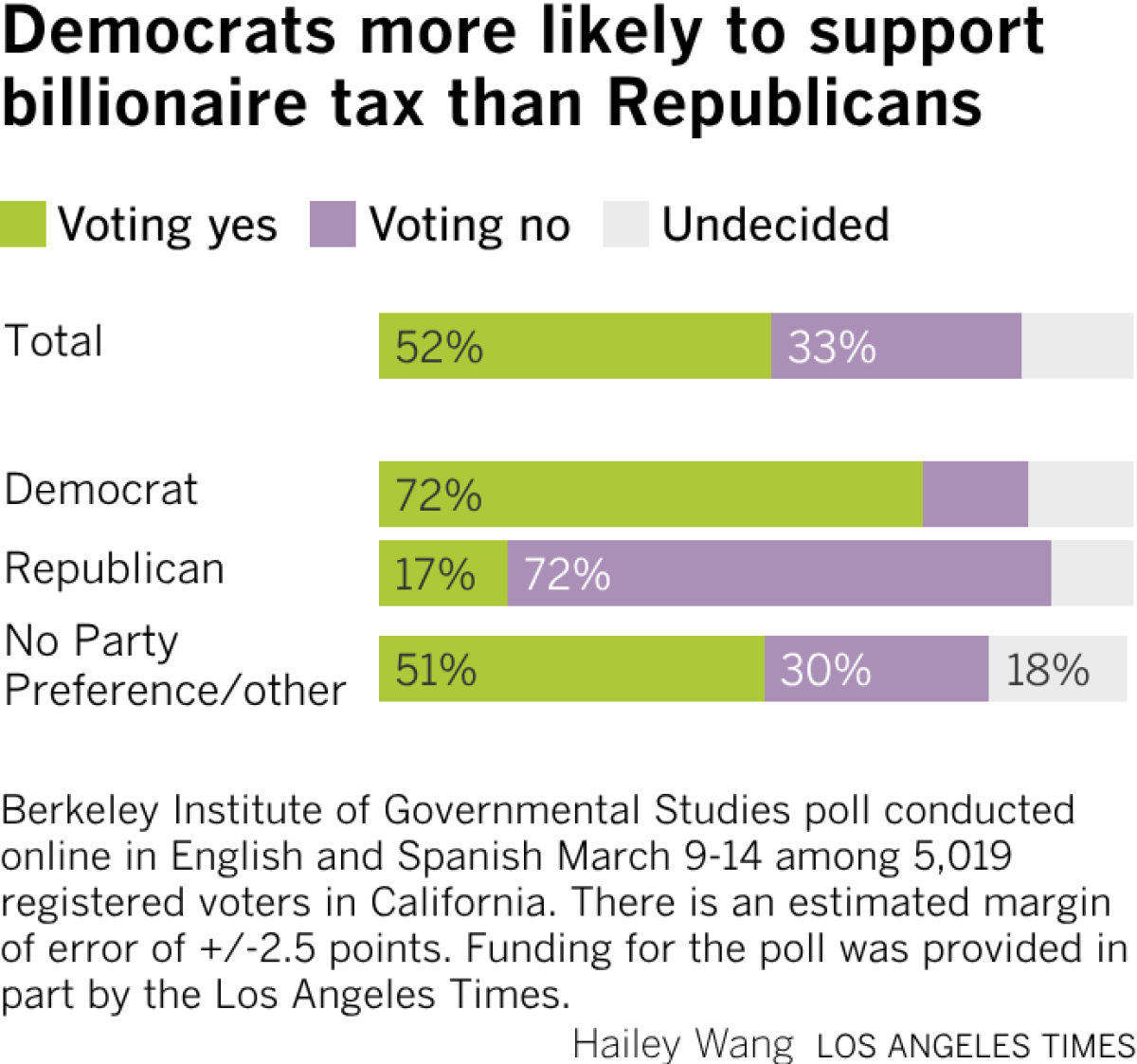
Newsom is trying to head off a union’s plan for a November ballot measure that would put a one-time tax on billionaires. If approved by voters, it would raise $100 billion by imposing a one-time wealth tax of 5% on fortunes.

Service Employees International Union-United Healthcare Workers West, the union behind the proposal, wants to raise money to help millions of Californians affected by widespread healthcare cuts by the Trump administration.

California political leaders, facing a tough budget year, warn that the state does not have the financial capacity to backfill those cuts.

Newsom, who is working behind the scenes with SEIU-UHW in an effort to stop the ballot measure, on Friday appeared doubtful that a deal could be struck with proponents of the measure.

“I don’t know what there is to compromise,” said Newsom, calling the measure “badly drafted” and arguing the money raised wouldn’t be spread among other groups.

“It does not support our public educators. Does not support our teachers and counselors, our librarians. It doesn’t support our first responders and firefighters. Doesn’t support the general fund and parks.”

Two top Newsom advisors, Dan Newman and Brian Brokaw, are raising money and have formed a committee to oppose the measure.

The billionaire tax measure is dividing political leaders in California and the rest of the country, with both Rep. Ro Khanna (D-Fremont) and Sen. Bernie Sanders (I-Vermont) supporting the tax.

“It’s a matter of values,” Khanna said on X. “We believe billionaires can pay a modest wealth tax so working-class Californians have the Medicaid.”

Already, some prominent business leaders are taking steps that appear to be part of a strategy to avoid a potential levy.

On Dec. 31, PayPal co-founder Peter Thiel announced that his firm had opened a new office in Miami, the same day venture capitalist David Sacks said he was opening an office in Austin.

Suzanne Jimenez, chief of staff for SEIU-United Healthcare Workers West, called it a myth that billionaires are leaving the state and criticized Newsom.

“Right now, his priority seems to be protecting roughly 200 ultra-wealthy individuals,” she said. “Healthcare workers are focused on protecting emergency room access and lifesaving care for all 39 million Californians.”

The proposed tax has reverberated throughout the Silicon Valley and Bay Area, home to some of the world’s most lucrative tech companies and financially successful venture capitalists.

Newsom was in San Francisco on Friday, where he served two terms as mayor, to address a separate, more pressing concern for Californians on the opposite end of the economic spectrum — those living in poverty and on the city streets.

Newsom, who is weighing a 2028 presidential run, spoke at Friendship House, a substance-use treatment provider, where the governor said California is turning around the state’s homelessness crisis.

He pointed to a recent 9% statewide drop in unsheltered homelessness as evidence that years of state investment and policy changes are beginning to show results.

That was the first such drop in more than 15 years on an issue that is a political vulnerability for the two-term governor. California still accounts for roughly a quarter of the nation’s homeless population, according to the Public Policy Institute of California.

Newsom said Friday that the decline reflects years of expanded state investment in shelter, housing and behavioral healthcare, combined with stricter expectations for local governments receiving state funds. He said the state’s efforts contrast with what is happening elsewhere, pointing to homelessness continuing to rise nationally.

The governor’s budget proposal, which was released Jan. 9, includes $500 million for California’s Homeless Housing, Assistance and Prevention program, which provides grants to cities, counties and local continuums of care to prevent and reduce homelessness.

That money is paired with investments from Proposition 1, a 2024 ballot measure backed by Newsom and approved by voters. The measure authorized billions in state bonds to expand mental health treatment capacity and housing for people with serious behavioral health needs.

Following Newsom’s budget proposal, legislators, housing advocates and local officials said the funding falls short of the scale of the problem.

That concern is unfolding against a constrained budget backdrop, with the governor’s finance director warning that even as AI-related tax revenues climb, rising costs and federal cuts are expected to leave the state with a projected $3 billion deficit next year.

The nonpartisan Legislative Analyst’s Office said Newsom’s plan leaves California financially exposed, noting that the administration’s higher revenue estimates exclude the risk of a stock market correction that could significantly worsen the state’s budget outlook.

The analyst’s office said those risks are compounded by projected multiyear deficits of $20 billion to $35 billion annually, underscoring what it called a growing structural imbalance.

Newsom on Friday called the LAO’s projections about the budget too pessimistic, but said the office is “absolutely right about structural problems in the state.”

Newsom’s budget does not include significant funding to offset federal cuts to Medicaid and other safety-net programs under President Trump and a Republican-led Congress, reductions that local officials warn could have far-reaching consequences for local governments and low-income residents.

Addressing those broad concerns, the governor defended his budget and suggested the spending plan will change by May, when the state’s financial outlook is more clear.

Times staff writer Seema Mehta and Caroline Petrow-Cohen contributed to this report.

Source link

Lawsuits against ICE agents might be allowed under proposed California bill

A week after a Minnesota woman was fatally shot by a federal immigration officer, California legislators moved forward a bill that would make it easier for people to sue federal agents if they believe their constitutional rights were violated.

A Senate committee passed Senate Bill 747 by Sen. Scott Wiener (D-San Francisco), which would provide Californians with a stronger ability to take legal action against federal law enforcement agents over excessive use of force, unlawful home searches, interfering with a right to protest and other violations.

California law already allows such suits against state and local law enforcement officials.

Successful civil suits against federal officers over constitutional rights are less common.

Wiener, appearing before Tuesday’s Senate Judiciary Committee hearing, said his bill has taken on new urgency in the wake of the death of Renee Nicole Good in Minnesota, the 37-year-old mother of three who was shot while driving on a snowy Minneapolis street.

Good was shot by an agent in self-defense, said Department of Homeland Security Secretary Kristi Noem, who alleged that Good tried to use her car as a weapon to run over the immigration officer.

Good’s death outraged Democratic leaders across the country, who accuse federal officers of flouting laws in their efforts to deport thousands of undocumented immigrants. In New York, legislators are proposing legislation similar to the one proposed by Wiener that would allow state-level civil actions against federal officers.

George Retes Jr., a U.S. citizen and Army veteran who was kept in federal custody for three days in July, described his ordeal at Tuesday’s committee hearing, and how immigration officers swarmed him during a raid in Camarillo.

Retes, a contracted security guard at the farm that was raided, said he was brought to Port Hueneme Naval Base. Officials swabbed his cheek to obtain DNA, and then moved him to Metropolitan Detention Center in Los Angeles. He was not allowed to make a phone call or see an attorney, he said.

“I did not resist, I did not impede or assault any agent,” Retes said.”What happened to me that day was not a misunderstanding. It was a violation of the Constitution by the very people sworn to uphold it.”

He also accused Department of Homeland security spokesperson Tricia McLaughlin of spreading false information about him to justify his detention. DHS said in a statement last year that Retes impeded their operation, which he denies.

Retes has filed a tort claim against the U.S. government, a process that is rarely successful, said his attorney, Anya Bidwell.

Lawsuits can also be brought through the Bivens doctrine, which refers to the 1971 Supreme Court ruling Bivens vs. Six Unknown Federal Agents that established that federal officials can be sued for monetary damages for constitutional violations. But in recent decades, the Supreme Court has repeatedly restricted the ability to sue under Bivens.

Wiener’s bill, if passed by the legislature and signed by Gov. Gavin Newsom, would be retroactive to March 2025.

“We’ve had enough of this terror campaign in our communities by ICE,” said Wiener at a news conference before the hearing. “We need the rule of law and we need accountability.”

Weiner is running for the congressional seat held by former House Speaker Rep. Nancy Pelosi (D-San Francisco).

Representatives for law enforcement agencies appeared at Tuesday’s hearing to ask for amendments to ensure that the bill wouldn’t lead to weakened protections for state and local officials.

“We’re not opposed to the intent of the bill. We’re just concerned about the future and the unintended consequences for your California employees,” said David Mastagni, speaking on behalf of the Peace Officers Research Assn. of California, which represents more than 85,000 public safety members.

Wiener’s bill is the latest effort by the state Legislature to challenge President Trump’s immigration raids. Newsom last year signed legislation authored by Wiener that prohibits law enforcement officials, including federal immigration agents, from wearing masks, with some exceptions.

The U.S. Department of Justice sued last year to block the law, and a hearing in the case is scheduled for Wednesday.

Source link

Israel says Nickolay Mladenov to direct Trump’s proposed Gaza ‘peace board’ | Israel-Palestine conflict News

Israeli PM Benjamin Netanyahu announcemed the Bulgarian diplomat as the ‘designated’ director-general for Trump’s ‘board of peace’.

Israeli Prime Minister Benjamin Netanyahu says that former United Nations Middle East envoy Nickolay Mladenov will direct a proposed United States-led “board of peace” in Gaza.

Netanyahu made the announcement after meeting Mladenov in Jerusalem on Thursday, referring to the Bulgarian diplomat as the “designated” director-general for the proposed board, a key part of US President Donald Trump’s 20-point plan to end Israel’s genocidal war on the Palestinian people of Gaza.

Recommended Stories

list of 3 itemsend of list

Trump’s Gaza plan led to a tenuous ceasefire between Israel and Hamas in October, but Israeli forces have continued to carry out attacks in the territory on a near-daily basis. Since the first full day of the truce on October 11, 2025, Israeli attacks have killed at least 425 Palestinians, according to the Gaza Health Ministry.

In a statement on Thursday, Netanyahu’s office said Mladenov “is slated to serve as Director General of the ‘Peace Council’ in the Gaza Strip”. Israel’s President Isaac Herzog also met Mladenov on Thursday, a spokesperson from his office said, without elaborating.

Under Trump’s plan to end the war, the proposed Board of Peace would supervise a new technocratic Palestinians government, the disarmament of Hamas, the deployment of an international security force, the further pushback of Israeli troops, and the reconstruction of the war-ravaged Gaza Strip.

Trump is expected to announce appointments to the board next week, according to the Axios news outlet, citing US officials and sources familiar with the matter.

“Among the countries expected to join the board are the UK, Germany, France, Italy, Saudi Arabia, Qatar, Egypt and Turkiye,” Axios reported.

Mladenov, a former Bulgarian defence and foreign minister, previously served as the UN envoy to Iraq before being appointed as the UN Middle East peace envoy from 2015 to 2020.

During his time as Middle East envoy, Mladenov had good working relations with Israel and frequently worked to ease tensions between Israel and Hamas.

INTERACTIVE - Where Israeli forces are positioned yellow line gaza map-1761200950
[Al Jazeera]

Source link

Defectors protest proposed new label for North Koreans in South

Rep. Park Chung-kwon of the People Power Party and leaders of North Korean defector groups hold a news conference at the National Assembly Communication Center in Seoul on Dec. 29 to oppose changing the official term “North Korean defectors” to “Bukhyangmin.” Photo by Yonhap News Agency

Dec. 29 (Asia Today) — North Korean defector groups on Monday urged South Korea’s Unification Ministry to halt its push to replace the official term for defectors, warning that one leading alternative could be misunderstood as meaning people who “look toward” North Korea.

Five defector organizations, including the Committee for North Korean Democracy and the North Korea Strategy Center, held a news conference at the National Assembly and issued a joint statement calling for the government to stop reviewing the term change and to release the results of a public opinion survey conducted from late September to early October, organizers said.

The groups objected in particular to “Bukhyangmin,” a term the ministry has weighed as a possible replacement for “North Korean defectors.” They said the word could be confused with similar-sounding phrases that imply sympathy for North Korea, framing it as an attack on defector identity.

The dispute also intensified after Unification Minister Chung Dong-young said during a Dec. 19 work report that “all” defectors strongly reject the current term, a claim critics said overgeneralized defector views. The ministry has said Chung asked roughly 60 residents at Hanawon, a government resettlement and education center in Anseong, Gyeonggi Province, during a private visit on Dec. 5 and that all those present supported a change.

At the news conference, Kang Cheol-hwan, head of the North Korea Strategy Center, questioned whether the new term would make defectors appear to be people who admire North Korean leader Kim Jong Un. Other speakers argued the current term reflects “escape” from the North Korean system and symbolizes resistance to repression.

A broader umbrella group, the National Association of North Korean Defectors, also issued a separate statement demanding a public apology for what it called distorted remarks and urging the government to guarantee public deliberation if it changes terminology tied to defectors, organizers said.

The ministry has said it is reviewing whether to adjust legal terminology and social usage to reduce negative connotations and support settlement and social integration.

Previous surveys have shown mixed views among defectors. A Korea Institute for National Unification survey found about 59% of defector respondents said a change was needed, but preferences among alternatives were split, with “Hanamin,” “Tongilmin” and “Bukhyangmin” drawing similar levels of support, news reports said.

The Unification Ministry has not announced a final decision and has said it is internally reviewing whether to disclose results from its latest survey, according to local reports.

— Reported by Asia Today; translated by UPI

© Asia Today. Unauthorized reproduction or redistribution prohibited.

Source link