proposal

U.S. rescues pilot who ejected after fighter jet was shot down by Iran, officials say

A crew member was rescued after an American aircraft went down Friday in Iran, the Associated Press reported, citing U.S. and Israeli officials.

U.S. forces launched a rescue mission in southwestern Iran after at least one American crew member ejected from a fighter jet downed by Iranian defenses, according to a U.S. official and news outlets.

The downing of the jet, an F-15E, was confirmed to The Times by a U.S. official who was not authorized to speak publicly. That type of jet reportedly carries a standard crew of two, but it was not clear if more than one crew member ejected.

Defense Secretary Pete Hegseth has maintained for weeks that the U.S. has “complete, uncontested control of Iranian airspace” after destroying the country’s air defenses.

“Iran has no air defenses, Iran has no air force,” he said at a March 13 Pentagon news conference. “Today, as we speak, we fly over the top of Iran and Tehran, fighters and bombers all day, picking targets as they choose, as our intelligence gets better and better and more refined.”

But the Islamic Revolutionary Guard Corps claimed that a new type of Iranian air defense system deployed for the first time in recent days had shot down a warplane on Friday.

The statements stirred a flurry of conflicting instructions from Iranian state-affiliated broadcasters. One local television channel initially encouraged viewers to search for the downed pilot and “shoot them as soon as you see them.”

It then changed the instructions, according to the Associated Press, after local police issued a statement asking the public to capture and turn in American pilots alive to security agencies to “receive a precious prize.”

On social media, Iranian accounts posted videos purporting to show helicopters searching for downed pilots in Iran’s western and southern provinces, according to a report from Fars News.

Fars also reported officials in Iran’s southwest were offering a “valuable reward” to anyone “who captures the American pilot alive.”

Images of a tail section posted on social media had markings indicating it was from the 48th Fighter Wing, which is based at RAF Lakenheath in the United Kingdom, according to Peter Layton, a visiting fellow at the Griffith Asia Institute in Australia, in an interview with NBC News.

U.S. and Israel escalate attacks on infrastructure

The development came as U.S. and Israeli forces escalated attacks on civilian sites and key infrastructure across Iran Friday, including strikes on residential buildings, health centers and Iran’s largest bridge, with President Trump warning that the U.S. “hasn’t even started destroying what’s left in Iran.”

On his social media, the president posted dramatic images of the smoldering B1 bridge, a towering cable-suspended viaduct that was severed in U.S.-Israel strikes late Thursday.

“The biggest bridge in Iran comes tumbling down, never to be used again — Much more to follow!” Trump wrote.

Connecting Tehran to the city of Karaj, the $400-million bridge was Iran’s largest, and was often regarded as one of the most prominent, expensive and complex engineering endeavors in the Middle East.

Iranian Foreign Ministry spokesperson Esmail Baghaei labeled the attack a “war crime in the style of ISIS terrorism.” Foreign Minister Seyed Abbas Araghchi called the act a sign of moral collapse by “an enemy in disarray,” stating that such actions will not compel Iranians to surrender.

“Every bridge and building will be built back stronger. What will never recover: damage to America’s standing.”

The attacks come after Trump announced what he described as a two- to three-day “off-ramp” from hostilities, while simultaneously warning he would bring Iran “back to the Stone Ages” if it didn’t cede to U.S. demands.

Reports from Iranian state media and international monitoring groups indicate strikes have also hit homes, religious centers, universities and municipal infrastructure across multiple provinces, raising concerns among humanitarian organizations about the widening scope of targets.

World Health Organization Director-General Tedros Adhanom Ghebreyesus said Friday that the U.S. and Israel have carried out routine attacks on Iranian healthcare facilities since March 1.

“WHO has verified over 20 attacks on health care in Iran, resulting in at least nine deaths, including that of an infectious diseases health worker and a member of the Iranian Red Crescent Society,” Tedros wrote on X.

Iran’s health ministry estimated about 2,076 people have been killed and 26,500 wounded by U.S.-Israeli attacks since fighting broke out Feb. 28. An estimated 1,300 have been killed in Lebanon, according to its health ministry, while more than two dozen people have died in Gulf states and the occupied West Bank.

Thirteen U.S. service members have been killed, and 19 Israeli service members have been reported dead in a five-week-old war that has triggered growing unease stateside.

A recent Pew Research Center survey conducted in late March found that most Americans opposed direct U.S. military involvement in a war with Iran. A separate Gallup poll reported declining approval for the administration’s handling of foreign policy.

Lawmakers in both parties have raised concerns about Israel’s influence in the Trump administration’s decision to enter a lengthy conflict, stoking debates over military aid and executive war powers.

Rep. Alexandria Ocasio-Cortez (D-N.Y.) said Wednesday that she plans to oppose future military aid to Israel, including for its Iron Dome defense systems. She argued that the Israeli government recently funded a $45-billion defense budget and is “well able” to bankroll its war without U.S. help.

“I will not support Congress sending more taxpayer dollars and military aid to a government that consistently ignores international law and U.S. law,” she said on X.

Iran hit desalination plant and oil refinery

Iran returned fire, again aiming at infrastructure targets operated by its Gulf neighbors. A series of airstrikes set Kuwait’s Mina al-Ahmadi oil refinery on fire, the Associated Press reported, as Kuwaiti firefighters were working to knock down several blazes there.

Kuwait also reported that an Iranian attack significantly damaged a desalination plant, which supplies drinking water to the region.

Bahrain, Saudi Arabia and Israel all scrambled to intercept incoming Iranian missiles Friday, according to reports, despite the Pentagon’s assurances that Iran’s military facilities and missile capacity have been largely wiped out.

Meanwhile, the United Arab Emirates shut down a gas field after a missile interception reportedly rained debris on it and started a fire, the Associated Press reported.

The war has pushed Iran to tighten its grip over the Strait of Hormuz, sending oil prices soaring 50%, upending stock markets, and stirring supply chain disruptions that threaten to destabilize global food markets.

Americans felt the oil rally again this week, after Trump’s Wednesday address dashed investors’ hopes of a swift end to the conflict, sending U.S. crude prices up 11% Thursday and another half point on Friday.

Source link

Georgia proposal could take DNA swabs from immigrants in custody for minor offenses

Over the past three decades, the collection of DNA from convicted criminals has become standard in the U.S. justice system, and many states now also swab people arrested for serious crimes.

Legislation awaiting a final vote in Georgia would take that a step further by collecting DNA from people charged with less serious misdemeanors — but only if federal immigration authorities want them detained. That could include immigrants not ultimately deported.

If enacted, Georgia’s measure would make it the third state to single out immigrants believed to be in the U.S. illegally for the collection of genetic material that wouldn’t be taken from others. Florida passed a similar law in 2023. And Oklahoma in 2009 authorized DNA collection from immigrants in the U.S. illegally, though it remains subject to funding.

The new legislation comes as President Trump’s administration seeks to expand its use of DNA and biometrics in immigration enforcement as it carries out a plan to deport millions of people from the U.S.

“It is one example of something we are seeing across the landscape, which is government actors at all levels vacuuming up DNA in all available contexts,” said Stevie Glaberson, director of research and advocacy at the Center on Privacy and Technology at Georgetown University law school.

Immigrant DNA collection has grown in recent years

The FBI launched the National DNA Index System in 1998 to compile DNA samples submitted by federal, state and local authorities. It’s grown in size and scope and now contains more than 26 million DNA profiles, many from people convicted of crimes.

A federal law enacted 20 years ago allowed the attorney general to expand DNA collection to people arrested and to noncitizens detained under federal authority. But because of exceptions authorized by federal officials, few immigrants had their DNA collected.

That changed in 2020, during Trump’s first term, when a new Department of Justice rule took away much of that discretion. Over the next five years, the Department of Homeland Security added the DNA profiles of more than 2.6 million detainees to the national database, according to an analysis by the Center on Privacy and Technology.

The department did not answer questions from the Associated Press about the percentage of detained immigrants whose DNA has been collected during Trump’s second term.

But the department is looking to expand its authority. A proposed rule would allow it to collect DNA, including from U.S. citizens, to determine family relationships in immigrant benefit cases.

States don’t typically collect DNA for misdemeanor arrests

Though many states collect DNA from people arrested for felonies, just 10 states collect it from people arrested for certain misdemeanors, such as sex offenses, and none collect it for all misdemeanor arrests, according to an AP analysis of data compiled by the Boise State University Department of Criminal Justice.

But under the Florida and Oklahoma laws, any arrest could lead to DNA collection for immigrants subject to federal detainer requests. Officials in the Florida Department of Law Enforcement and Oklahoma State Bureau of Investigation did not respond to questions about whether those laws are being used.

The Georgia legislation would require DNA collection from immigrants facing any misdemeanor or felony charges if U.S. Immigration and Customs Enforcement has issued a detainer request but has not picked up the person within 48 hours.

Georgia state Sen. Tim Bearden, a Republican sponsoring the bill, described the measure as a means of solving crimes.

“Technology is changing quickly, and DNA is one of those things that help us tremendously when we’re trying to make sure to bring justice to victims in this state and across this country,” Bearden said at a March hearing.

The Department of Homeland Security said in a statement that “partnerships with law enforcement are critical to having the resources we need to arrest criminal illegal aliens across the country.”

Could a broken tail light lead to a DNA swab?

A 2024 Georgia law mandates that local law enforcement cooperate with federal authorities to identify and detain immigrants in the U.S. illegally, or else lose state funding. This year’s legislation would build upon that.

Some legal experts say it could result in DNA collections from immigrants taken into custody for minor violations. Traffic offenses that are penalized as civil violations in some states are considered misdemeanors in Georgia, making them subject to the new law, said Mazie Lynn Guertin, executive director and policy advocate with the Georgia Assn. of Criminal Defense Lawyers.

“We don’t think that swabbing a person who’s committed a traffic violation is a boon for public safety,” Guertin said. “The correlation between a broken tail light and a crime that’s solvable with DNA is pretty attenuated in most cases.”

People subject to federal immigration detainer requests aren’t necessarily undocumented or deportable, because they may later prove their legal presence, said Kyle Gomez-Leineweber, director of policy for Common Cause Georgia. But such people could have their DNA collected under the Georgia legislation.

“What this really does is it creates a two-tiered system where some of the DNA would be collected based off of the perception of an individual’s immigration status,” said Gomez-Leineweber.

The U.S. Supreme Court in 2013 upheld a Maryland law allowing DNA to be collected from people charged — but not yet convicted — of certain serious crimes. That law allows DNA to be added to a database after it’s determined there is probable cause to detain someone, provided it’s deleted if the person is not ultimately convicted.

The Maryland case often is cited as justification for an expansion of DNA collection. But some immigrant advocates question whether civil immigration detainers meet the probable cause threshold to make DNA collection acceptable under the U.S. Constitution’s Fourth Amendment protection against unreasonable searches and seizures.

“There doesn’t appear to be any kind of meaningful justification for states to step in to require the collection of DNA — of genetic material — from noncitizens in their custody who have merely been accused of a crime, even a low-level crime,” said Jorge Loweree, managing director of the American Immigration Council. “It seems like this is just an effort to increase the surveillance of noncitizens.”

Kramon and Lieb write for the Associated Press. Lieb reported from Jefferson City, Mo.

Source link

Iran: ‘No intention of negotiating’ U.S. peace proposal

March 25 (UPI) — Iran’s foreign minister said Wednesday that Tehran has no plans to negotiate with the United States after the Trump administration offered a 15-point peace plan.

During a televised interview on state-run media, Foreign Minister Abbas Araghchi said U.S. officials had been sending messages through intermediaries for “several days.”

U.S. officials who spoke to The New York Times and USA Today late Tuesday, said the United States sent a peace proposal through Pakistan, which earlier had offered to host talks between the two countries. The peace plan addressed Iran’s ballistic missile and nuclear programs, two of the key threats the administration and Israel cited for their decision to attack Iran.

Egypt has also offered to host peace talks.

Araghchi said passing messages through friendly countries doesn’t constitute “dialogue nor negotiation, nor anything of the sort.”

He added that Iran is focusing on defending itself against attacks and has “no intention of negotiating for now,” the BBC reported.

“This is Israel’s war, and people of the region and people of the U.S. are paying the price for it.”

U.S. officials said the proposed peace plan included lifting economic sanctions, limits on Iran’s missile program, making the Strait of Hormuz safe and winding down Iran’s nuclear program in exchange for cooperation on civilian nuclear energy — monitored by the International Atomic Energy Agency.

Destroying Iran’s ballistic missile arsenal, launcher and production plants has been one of the main objectives of the U.S.-Israeli airborne military campaign, along with 970 pounds of enriched uranium; they are determined to prevent Iran from ever converting into a nuclear weapon.

Iran’s FARS news agency reported that an “informed source” said, “Iran does not accept a cease-fire.”

“Basically, it is not logical to enter into such a process with those who violate the agreement,” the source said.

Notwithstanding the assistance of Pakistan’s army chief, Field Marshall Syded Asim Munir, said to have a direct line of communication to the Islamic Revolutionary Guard Corps., communication with, and within, Iran is highly problematic, complicated by a civilian governance vacuum, damage to communications and officials reluctant to meet each other due to fear of being killed

There was no sign in Washington of any imminent let-up in the conflict on the ground.

“As President Trump and his negotiators explore this newfound possibility of diplomacy, Operation Epic Fury continues unabated to achieve the military objectives laid out by the commander-in-chief and the Pentagon,” White House press secretary Karoline Leavitt said in a statement.

However, the offer to Tehran was being seen as evidence of the White House’s desire for an exit strategy from a costly war, now in its fourth week, with Persian Gulf allies being hit by Iranian missiles and drones round the clock and severe disruption to global energy supplies.

Earlier, reports emerged in U.S. media that at least 2,000 paratroopers from the U.S. Army’s 82nd Airborne Division were being deployed from North Carolina to the Middle East, though it was unclear where, as Trump backs up his diplomatic maneuver with military pressure.

The soldiers from the 82nd’s Immediate Response Force are the only U.S. Army division with the ability to mount an airborne assault operation anywhere in the world within 18 hours of receiving orders.

They will join an amphibious force of thousands of U.S. Marines

House Speaker Mike Johnson said Wednesday that the United States doesn’t have “boots on the ground” in the Middle East, but said Tehran should take heed of the U.S. military buildup.

“I think Iran should watch that buildup, and they need to take note of that,” he told reporters.

President Donald Trump presents the Commander in Chief’s Trophy to the Navy Midshipmen football team during a ceremony in the East Room of the White House on Friday. The award is presented annually to the winner of the football competition between the Navy, Air Force and Army. Navy has won the trophy back to back years and 13 times over the last 23 years. Photo by Bonnie Cash/UPI | License Photo

Source link

Iran calls US proposal to end war ‘maximalist, unreasonable’ | US-Israel war on Iran News

A high-ranking diplomatic source has confirmed that Iran received a 15-point plan from the United States aimed at ending the US-Israeli war on the country.

But the source told Al Jazeera on Wednesday that Tehran described the US proposal as “extremely maximalist and unreasonable”.

“It is not beautiful even on paper,” the source added, calling the plan deceptive and misleading in its presentation.

The comments come as US President Donald Trump has claimed – despite Iranian denials – that negotiations are under way between Washington and Tehran to reach an agreement to end the nearly one-month conflict.

The source explained that Iran has a clear understanding of what conditions it requires for a ceasefire and what it will reject.

The source also stated that there have been no direct Iran-United States talks since the war began – however, messages have been exchanged through a number of mediators.

The response from Iran came hours after sources confirmed to Al Jazeera that Pakistan had shared the US’ ceasefire demands with Iran.

Mediators are pushing for possible in-person talks between the Iranians and the Americans, as early as Friday in Pakistan, Egyptian and Pakistani officials said on Wednesday.

According to Al Jazeera’s Osama Bin Javaid, Pakistan is in a unique position as a mediator because it has a Shia minority, and relatively good ties with Iran including cross-border trade.

It also has a defence agreement with Saudi Arabia, and a Sunni majority that is closely aligned with the Gulf states, he said. Pakistan’s military leader also has a relationship with Trump, Javaid added.

“So, all of this puts Pakistan in a unique position to act between these two sides: it has no US bases on its soil, so Iran cannot accuse it of being used by the United States, and it is a state that has historically tried to mend relations between these actors,” he said.

⁠Egypt’s ⁠Foreign Minister Badr Abdelatty, meanwhile, said Cairo was ready ⁠to host any meetings related to Iran as long as ‌it serves de-escalation.

Abdelatty said in a news conference that Egypt supported ⁠Trump’s initiative to ⁠negotiate with Iran.

On Iran’s response to ⁠the US plan, ⁠he said “we ⁠have to continue our efforts, it’s all about ‌diplomacy and negotiations”.

Turkiye has also been been trying to position itself as a possible mediator, with Harun Armagan, a vice chairman for foreign affairs in Turkiye’s ruling AK Party, telling the Reuters news agency that Ankara has been “playing a role passing messages” between Tehran and Washington.

Iran counters with own conditions to end war

Iranian state television’s English-language broadcaster, Press TV, quoted an anonymous official also stating that Iran rejected the US ceasefire proposal.

“Iran will end the war when it decides to do so and when its own conditions are met,” Press TV quoted the official as saying.

The official offered Iran’s own five-point plan, which included a halt to killings of its officials, means to make sure no other war is waged against it, reparations for the war, the end of hostilities and Iran’s “exercise of sovereignty over the Strait of Hormuz”.

Earlier, two officials from Pakistan described the 15-point US proposal broadly, saying it addressed sanctions relief, a rollback of Iran’s nuclear program, limits on missiles and reopening the Strait of Hormuz, through which a fifth of the world’s oil is shipped.

An Egyptian official involved in the mediation efforts said the proposal also includes restrictions on Iran’s support for armed groups.

Israeli officials, who have been advocating for Trump to continue the war against Iran, were surprised by the submission of a ceasefire plan, the Associated Press news agency reported, citing an anonymous source.

Iran remains highly suspicious of the United States, which twice under the Trump administration has attacked during high-level diplomatic talks, including with the February 28 strikes that started the current war.

Iran’s rejection of the US proposal came as Israel launched air attacks on Tehran and Washington deployed paratroopers and more Marines to the region.

Iran, meanwhile, launched more attacks on Israel and Gulf Arab countries, including an assault that sparked a huge fire at Kuwait International Airport.

Source link

What we know about the US’s 15-point plan Iran proposal | US-Israel war on Iran

NewsFeed

US media is reporting the Trump administration has proposed a temporary ceasefire and a 15-point plan to end the war on Iran. The reports emerge as Trump claims the US is already talking to Iranian officials – a claim Iran has vehemently denied.

Source link

Senators consider deal to fund Homeland Security but not ICE enforcement

Senators raced Tuesday to clinch an emerging proposal to end the Homeland Security shutdown by funding much of the department, including the Transportation Security Administration airport workers going without pay, but excluding ICE enforcement operations that have been core to the dispute.

The sudden sense of urgency comes as U.S. airports are snarled by long security lines, with travelers being told to arrive hours before their flights in Houston, Atlanta and Baltimore Washington International. Routine Homeland Security funding was halted in mid-February ahead of the busy spring travel season. Nearly 11% of TSA workers — more than 3,200 — missed work Monday, and at least 458 have have quit altogether since the shutdown began, according to Homeland Security.

Democrats are refusing to fund the department without restraints on Trump’s immigration and deportation agenda after agents killed two citizens in Minneapolis.

A potential breakthrough came late Monday, after a group of Republican senators met at the White House with President Trump after his decision to deploy federal immigration officers at some airport security checkpoints — a move some lawmakers warned could lead to heightened tensions.

“All I can say is that the discussions have been very positive and productive, and hopefully headed in the right direction,” said Senate Majority Leader John Thune (R-S.D.) late Monday evening.

Senate Democratic Leader Chuck Schumer sounded a similarly hopeful tone: “Both sides are working in a serious way.”

Hopes high for a quick deal

Next steps in Congress could move quickly, if lawmakers can reach a deal, or sputter out just as fast.

The contours of the deal under consideration would fund most of Homeland Security, but not one main part of ICE — the enforcement and removal operations that are core to Trump’s deportation agenda.

Under the proposal being floated, ICE’s Homeland Security Investigations would be funded as well as Customs and Border Protection. But that would come with guardrails — keeping officers from those divisions in their traditional roles, rather than deploying them in urban immigration roundups.

The plan would also include a number of changes in immigration operations that Democrats have demanded, including mandating that officers wear body cameras and identification. The ICE officers manning airports are already going without face-covering masks, another key demand Democrats want as part of any deal.

Since so much of ICE is already funded through Trump’s big tax breaks bill, and immigration officers are still receiving paychecks despite the shutdown, senators said the new restraints would also be imposed on operations that rely on that funding source, as well.

Republican Sen. Katie Britt of Alabama, a chief negotiator, returned from the White House meeting hopeful they had a solution to “land this plane.”

Both chambers of Congress are controlled by the Republican president’s party, and any deal reached in the Senate would also have to be approved by the House.

Political standoff, long airport lines

Key to the standoff appears to have been the senators’ ability to shift the president’s attention off his plan to link any department funding to his push to pass the so-called SAVE America Act, a strict proof-of-citizenship and voter ID bill that has stalled in the Senate ahead of the midterm elections.

Over the weekend Trump injected his demand for the voting bill as a condition for ending the funding standoff. Some GOP senators have pitched the idea of tackling it in the months ahead as part of a broader legislative package the party could pass on its own, similar to last year’s big tax cuts bill.

Sen. Chris Coons (D-Del.) who was not part of the group at the White House, said his understanding was that there was a “sense of urgency” coming from the talks as the airport disruptions worsen.

Senators are expected to discuss the proposals during their private caucus lunches Tuesday afternoon. “First step is to get the proposal in writing,” said Sen. Angus King, an Independent from Maine. “I want to see exactly what that means.”

Changes at Homeland Security

The deal could provide a political exit from the standoff over the embattled Homeland Security department, which was stood up in the aftermath of the Sept. 11, 2001, attacks but has come to symbolize Trump’s aggressive mass deportation agenda, with its goal of removing 1 million immigrants this year.

Under mounting political pressure, Trump ousted Homeland Security Secretary Kristi Noem amid the public outcry over the immigration operations, and senators late Monday confirmed one of their own, Markwayne Mullin, as the president’s handpicked replacement.

Mullin, an Oklahoma senator who aligns with Trump’s agenda, provides a potentially new face for the department. During his confirmation hearing, Mullin touched on another key demand of Democrats — ensuring a judge has signed off on warrants that immigration officers use to search people’s homes, rather than simply relying on administrative warrants issued by the department.

“This is significant,” Sen. Peter Welch (D-Vt.) said about the progress toward changes. “Noem is gone. That’s a big deal.”

ICE’s budget nearly tripled under last year’s bill, to $75 billion, which has been untouched by the shutdown. Rather its routine annual funding, some $10 billion, would be cut almost in half under the proposal.

After weeks of missed paychecks, many TSA agents have called in sick or even quit their jobs as financial strains pile up. Union leaders representing the workers have pushed Congress to reach a deal.

Mascaro and Cappelletti write for the Associated Press. AP writers Rio Yamat, Wyatte Grantham-Philips, Kevin Freking and Seung Min Kim contributed to this report.

Source link

California governor candidate Matt Mahan unveils government reform plan

When he entered the race for California governor, San José Mayor Matt Mahan pitched himself as a pragmatic Democrat who would prioritize improving residents’ quality of life and government efficiency.

He unveiled a key part of that promise on Tuesday with an expansive plan to reform state government, including tying pay raises for elected officials and other top leaders to improvements on key issues, and pledging not to approve any tax increase until the state proves “that we can deliver better outcomes with the dollars we already have.”

Mahan also delivered a blistering rebuke of ballooning state spending — which, as he often points out on the campaign trail, has increased nearly 75% over the last six years. In 2020, amid the COVID-19 pandemic and accompanying economic uncertainty, California lawmakers approved a no-frills state budget that came in at $202 billion. Gov. Gavin Newsom’s latest spending proposal is nearly $349 billion.

“We have fallen into this lazy, reflexive mindset of always going back to voters and telling them that the only solution to every problem is a tax increase or a new bond or a new rule coming down from Sacramento,” Mahan said in an interview. “We need to step back and take a really hard look at our existing spending and increase the level of transparency and accountability in government.”

His eight-page plan includes ways to measure and track accountability, some of which are drawn from policies in other states. They include lobbying reforms, following up on audit recommendations and overhauling the state’s digital infrastructure and its procurement process — services Mahan described as “clunky and cumbersome.”

He also proposed a “California Performance Review,” inspired by a similar effort in Texas throughout the 1990s, that would review state agencies and solicit input from employees to eliminate waste and inefficiencies.

But near the top of the list is a proposal to tie pay raises for state officials including the governor, lawmakers and thousands of gubernatorial appointees to “measurable outcomes” in areas such as reducing homelessness and unemployment.

“People in the real world don’t get raises if they don’t do a good job,” Mahan said, “and I think it should be the same for the politicians and senior administrators who are allocating budgets, leading projects, making the big decisions on behalf of the people of California.”

Though the benchmarks would be created with input from the state Legislature, Mahan floated one example: reducing unsheltered homelessness by 5% to 10% within one year, something he said he’s accomplished three years in a row in San José.

It’s a solution one might expect from a former entrepreneur and mayor of a city in the heart of Silicon Valley. Mahan made a similar proposal at the local level last year, but it was rejected by the City Council.

“Tying pay to performance is nothing short of revolutionary in government. It’s a private-sector model that is overdue,” said former state Sen. Steve Glazer (D-Orinda), a Mahan supporter who sponsored several bills aiming to increase transparency in government.

Dozens of tech company executives are backing Mahan in the race for governor and have collectively donated millions to his campaign, as well as two independent expenditure committees supporting him.

That has raised concerns from some voters, and criticism from some of Mahan’s opponents, that he would be beholden to their interests and veto future regulations on tech or artificial intelligence companies.

Mahan has sought to dispel those concerns, arguing that he believes AI and social media platforms should be regulated. Of his plan to overhaul state information technology systems and infrastructure, he said that “whenever we spend public dollars, we have to run open, transparent and competitive procurement processes that ensure best value for the taxpayers.”

Though Mahan did not specify how he would link government outcomes to pay raises, state lawmakers have largely panned his campaign and are unlikely to get on board. The change probably would also require voter approval.

Currently, annual raises for elected officials are determined by a citizen commission that was added to the California Constitution in 1990. Changing how that panel works or imposing limits on when it can approve raises would require a constitutional amendment, which requires voter sign-off.

But Mahan contended it would be one of the fastest ways to fix a system that he says works for special interests at the expense of working people.

“I’m under no illusion that this will be easy, but I think it’s a necessary realignment of incentives,” he said. “We have to make ourselves as accountable to the people as we possibly can be.”

Source link

Kelly Osbourne ‘splits from Slipknot star fiance months after his romantic proposal’ as she struggles with grief

KELLY Osbourne has “split” from her Slipknot star fiance – just seven months after his romantic proposal as she continues to battle her grief.

The daughter of Sharon and late rock legend Ozzy Osbourne got engaged at her dad’s father’s final ever Black Sabbath gig back in July.

US-ENTERTAINMENT-MUSIC-GRAMMYS-AWARD-ARRIVALS
Kelly Osbourne has split from her Splitknot star fiance Sid WilsonCredit: AFP
NINTCHDBPICT001008037006
Sid proposed to Kelly just seven months ago at her father Ozzy’s final ever gigCredit: instagram/kellyosbourne

Slipknot rocker Sid Wilson, 48, got down on one knee and popped the question backstage in an intimate moment watched by her famous parents.

But it has now been reported that Kelly, who shares three-year-old son Sidney with the musician, has ended her romance.

“Kelly and Sid have decided to call off their engagement,” a source told the Mail.

“Kelly has been struggling following the loss of her father.

READ MORE ON KELLY OSBOURNE

CUTE CLIP

Kelly Osbourne shares sweet moment with son Sidney after slamming bodyshamers


KELLY ALLEN

Everyone’s saying the same about Kelly Osbourne… I know what’s REALLY going on

“The grieving process has been incredibly difficult, and she’s been doing everything she can to cope.

“In truth, she and Sid have been facing challenges in their relationship for some time, and things were not as they appeared.

“They tried to make it work, particularly for the sake of their child, but ultimately decided that separating is the best path forward.”

They added that Kelly is remained focused on herself and being the best parent she can be to her young son.

The Sun has reached out to Kelly’s reps for comment.

Just seven months ago, Kelly was left emotional as she agreed to marry Sid following a sweet proposal.

Stood in front of Sharon and Ozzy, they appeared to have an idea of what was to come as the former X Factor judge could be heard saying to everyone in the room: “You’ve got to be quiet!”

Sid then took the hand of Kelly, who was dressed down in some comfy leopard print trousers and a simple black hoodie.

He said to the TV personality: “Kelly, you know I love you more than anything in the world!”

Ozzy then appeared to give the game away as he jokingly quipped with his signature potty mouth: “F*** off, you are not marrying my daughter!”

The group laughed before Sid continued as he said: “I want to spend the rest of my life with you – and ask in front of all of our family and friends, Kelly, will you marry me?”

Kelly turned her head as she looked on open-mouthed before Sid began to stand up and place the ring onto her finger.

Sharon and Ozzy could be seen beaming as the onlookers clapped and cheered for the happy moment.

Uploading the video to her Instagram page, Kelly added the caption: “Oh and this happened yesterday!”

Sid proposed to Kelly with a bespoke custom-designed ring from Los Angeles based jewellers, Mouawad.

He designed the ring with the team through various one-on-one meetings in order to ensure it was right for Kelly.

Sid chose to curate a dazzling 18K yellow gold ring adorned with both white and yellow diamonds, as well as citrine accents.

The centerpiece is a stunning 2.5 carat round brilliant-cut diamond with the ring being nicknamed the Honeybee – Kelly’s personal nickname.

The engagement came backstage as Ozzy played his final ever show with Black Sabbath at Villa Park.

Kelly and Sid first met in 1999 at Ozzfest, a music festival founded by her parents.

They were friends for over two decades before their relationship turned romantic at the end of 2021.

Earlier this month, Kelly was forced to her to hit back at those who criticised her body during the “hardest time of her life”.

Source link

EPA moves to roll back recent limits on ethyene oxide, a carcinogen

The Trump administration on Friday moved to roll back Biden-era limits on emissions of ethylene oxide, a cancer-causing chemical often used in the sterilization of medical devices.

The Environmental Protection Agency said repealing the rules, which fall under the National Emission Standards for Hazardous Air Pollutants, would “safeguard the supply of essential medical equipment” — saving approximately $630 million for companies over 20 years. California is home to about a dozen such facilities.

The government said the emissions are part and parcel of protecting people from “lethal or significantly debilitating infections that would result without properly sterilized medical equipment.”

“The Trump EPA is committed to ensuring life-saving medical devices remain available for the critical care of America’s children, elderly, and all patients without unnecessary exposure to communities,” EPA Administrator Lee Zeldin said in a statement.

An estimated 50% of sterile medical devices in the U.S. are treated with ethylene oxide, or EtO, particularly those that can’t be cleaned using steam or radiation. The colorless gas is also used to make chemicals found in products such as antifreeze, detergents, plastics and adhesives.

But EtO poses health risks. Short-term exposure by inhalation can cause headaches, dizziness, nausea, fatigue respiratory irritation and other adverse health effects, according to the federal Agency for Toxic Substances and Disease Registry.

Longer-term exposure increases the risk of cancers of the white blood cells, such as non-Hodgkin’s lymphoma, as well as breast cancer. A now-deleted page from the EPA’s website stated, “EtO is a human carcinogen. It causes cancer in humans.”

Friday’s proposal specifically targets updated rules for EtO emissions that were passed by the Biden administration in 2024 following pressure from environmental justice groups, particularly those in Louisiana’s heavily industrialized “Cancer Alley.” The change sought to reduce the amount of EtO released from commercial sterilizers by 90% and lessen the hazards for nearby communities.

The tighter rules were in part based on EPA’s own scientific study that found it to be 60 times more carcinogenic than previously thought, which the agency now says should be reassessed.

If finalized, the plan would give facilities the choice between installing continuous real-time monitoring systems for EtO emissions or complying with modified pollution control requirements at facilities that emit more than 10 tons a year, the EPA said.

The proposal follows other moves by the Trump administration to rescind regulations that it says are burdensome and costly for industries, such as those governing emissions from coal power plants. Last month, the EPA repealed the endangerment finding, which affirmed the dangers of greenhouse gas emissions and underpinned the agency’s ability to regulate those emissions from vehicles.

The action around ethylene oxide would affect about 90 commercial sterilization facilities owned and operated by approximately 50 companies. Three California companies applied for and received presidential exemptions for their EtO emissions in July.

An aerial view of an industrial park

The Sterigenics facility, center, in Vernon is pictured in 2022.

(Myung J. Chun / Los Angeles Times)

They are located in Ontario and Vernon and operated by the company Sterigenics, which provides industrial sterilization technology for medical devices and other commercial products.

In January, a coalition of environmental and community groups challenged the EtO exemptions in federal court. The lawsuit from the Southern Environmental Law Center and the Natural Resources Defense Council argues that technology exists for facilities to comply with the tighter Biden-era standards without raising costs, and many facilities are already using it.

“EPA’s 2024 rule was an important and overdue step to reduce toxic ethylene oxide pollution and protect communities,” said Irena Como, senior attorney at the Southern Environmental Law Center, in a statement Friday. “Repealing this rule that is proven to significantly lower pollution exposure and cancer risks will subject even more people who work, live, and send their children to schools located near these facilities to harm that is entirely preventable.”

Sterilization and chemical industry groups support the plan.

“The EPA rule concerning ethylene oxide use in commercial sterilizers threatens to severely restrict access to vital medical products nationwide,” the American Chemistry Council said in a statement. “We commend the EPA for their commitment to reevaluating these policies.”

The EPA will hold a 45-day comment period about the proposal after it is published in the federal register. A final decision is expected sometime this year.

Source link

New push for LAPD oversight moves toward November ballot

A series of proposed changes to the city’s charter — essentially its constitution — could give elected leaders in Los Angeles more oversight of the police department and enable the chief to fire problematic officers, reforms long sought by advocates that are likely to once again face fierce opposition.

Among the recommendations approved last week by the city’s Charter Reform Commission was a proposal that would require any LAPD accountability-related motion or ordinance passed by the City Council to automatically become law if not acted on by the Police Commission within 60 days.

Once the language is finalized, the proposals must clear the City Council and its committees before they can be put to voters on November’s ballot.

Another proposal would give city leaders the ability to override the policy decisions by the Police Commission, a board appointed by the mayor that sets the LAPD policies, oversees its budget and serves as a civilian watchdog.

With the police chief taking criticism for a recent rise in shootings by officers, several proposals sought to strengthen accountability for the use deadly force. One recommendation could require the LAPD to purchase “no less than” $1 million of liability insurance for its roughly 8,700 officers. The insurance would be used to cover legal fees if an officer is found liable for a wrongful injury or death, instead of tapping into the city’s General Fund budget.

Another potential change would “clarify and strengthen” the police chief’s ability to “to initiate and pursue the removal of officers with documented, repeated histories of harm or misconduct.”

Under city rules, the chief of police does not have the authority to fire an officer. Instead, they must send officers whose misconduct they deem severe to disciplinary panels, which occasionally lead to lighter penalties. The new proposal would give the City Council the power to override decisions not to fire, still leaving officers the right to appeal through the courts.

Mayor Karen Bass vetoed a similar bid to rework the disciplinary process in 2024.

The latest proposals drew cautious optimism from activists, many of whom claim the Police Commission is too cozy with the LAPD and have pushed for stronger independent oversight.

Godfrey Plata, deputy director of the nonprofit L.A. Forward, called the proposals a “huge victory” in the fight for police accountability.

“Months ago, police reform wasn’t even on the Charter Commission’s to-do list. Today, because community members came together to force conversations that likely never would have happened on their own, we have multiple reforms headed to City Council,” Plata said.

The Police Commission and LAPD issued nearly identical statements that said they are looking forward to working with the City Council on the charter reform process.

An LAPD spokesman declined to say how Chief Jim McDonnell felt about the proposal, saying it wasn’t “in his interests to give his opinion on something like this as long as it’s still with the full council.”

Samantha Stevens, a Los Angeles political consultant and former legislative staffer, said she is worried the proposed changes are a shortsighted solution to address police abuses that will create another layer of bureaucracy.

“If we don’t like how they’re running things, we should replace the commissioners.” she said. “I don’t know that this will be as effective when you’ve got 15 councilmembers now telling LAPD what to do in their own districts. Is that now too many cooks in the kitchen?”

The charter commission, which has been meeting since last July, must send all its recommended changes to the City Council by April 2.

Source link

Poison-pill effort to cancel proposed billionaire tax hits voters’ mailboxes

California voters are being urged to put a poison-pill effort on the November ballot that would nullify a controversial proposed tax on the state’s billionaires.

Neither proposal has yet qualified for the ballot — supporters of each need to gather the verified signatures of hundreds of thousands of voters. But petitions that have been mailed and texted to California voters in recent days demonstrate the stakes in a contest that has drawn tens of millions of dollars in campaign spending.

“Government has wasted billions of our tax dollars on homelessness and many other failed programs with little to show for it,” reads the new mailing to voters. “We can’t afford more wasteful spending!”

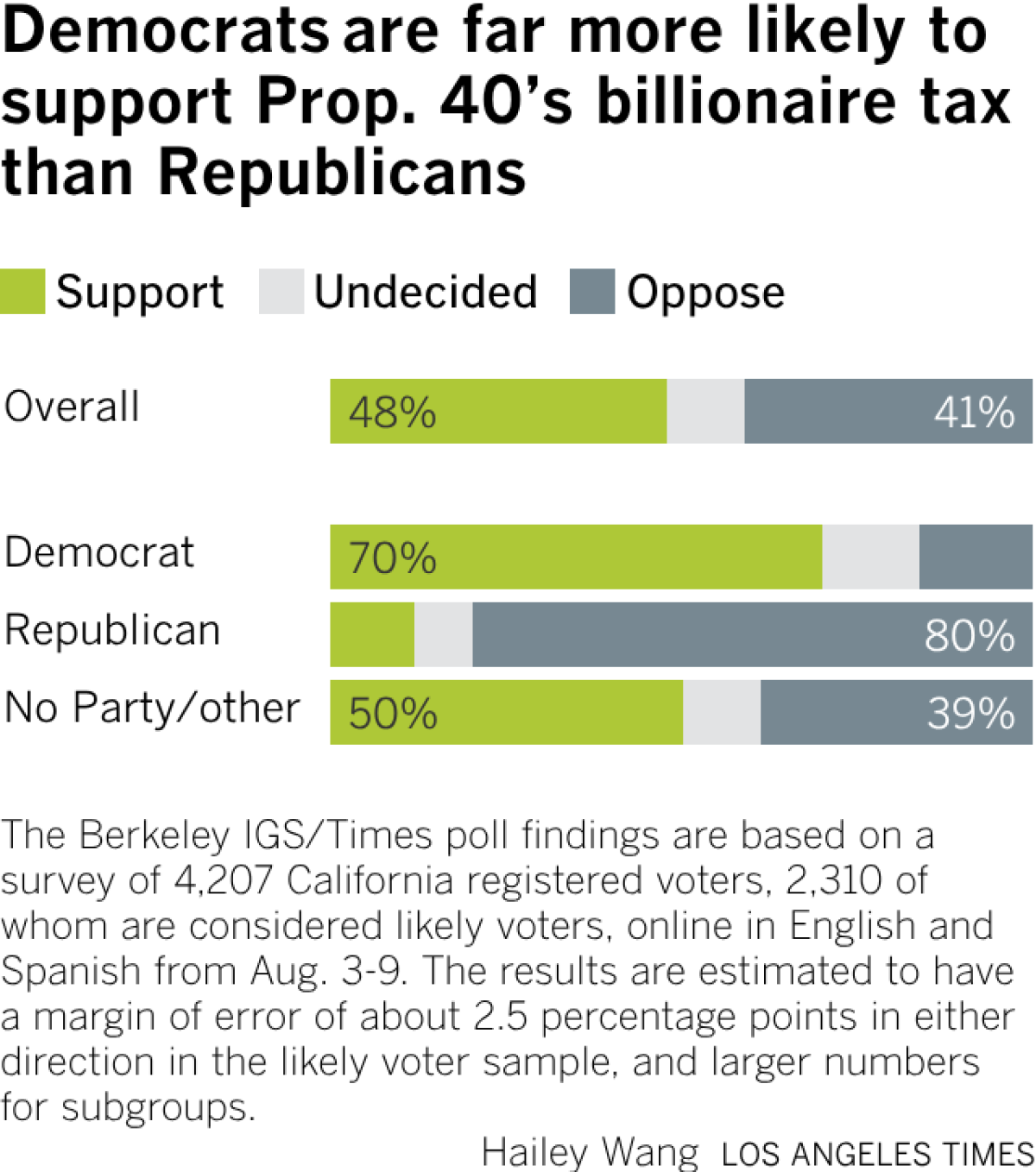
The proposal is aimed at countering a proposed one-time 5% tax on billionaires assets that would fund healthcare for the state’s neediest residents, but opponents say it would lead to lost tax revenues as California’s wealthiest flee the state.

Mailers and texts recently sent to voters describe the new proposal as an effort to create a more accountable, transparent and effective state government that would require auditing of new state taxes and ensuring they comply with existing law.

The small-font description of the proposed initiative included in the mailing specifies that any new tax enacted after Jan. 1 must be deposited into the state’s general fund and conform with current state tax policy, which is an oblique reference to a prior voter-approved ballot measure requiring that a significant portion of the state’s tax revenue be spent on education.

If competing proposals appear on a ballot and are successful, the one that receives the most votes nullifies the other. There are other ballot measure proposals aimed at thwarting the billionaires tax.

The mailers and texts were funded by a committee called Californians for a More Transparent and Effective Government, which was funded by another group, called Building a Better California, according to the California secretary of state’s office.

Earlier this year, the latter group received a $20-million donation from Google co-founder Sergey Brin, $2 million from former Google Chief Executive Eric Schmidt and $2 million from Stripe CEO Patrick Collison, among donations from other Silicon Valley leaders, according to fundraising disclosure reports.

Attempts to reach spokespeople connected with the effort were unsuccessful Monday night.

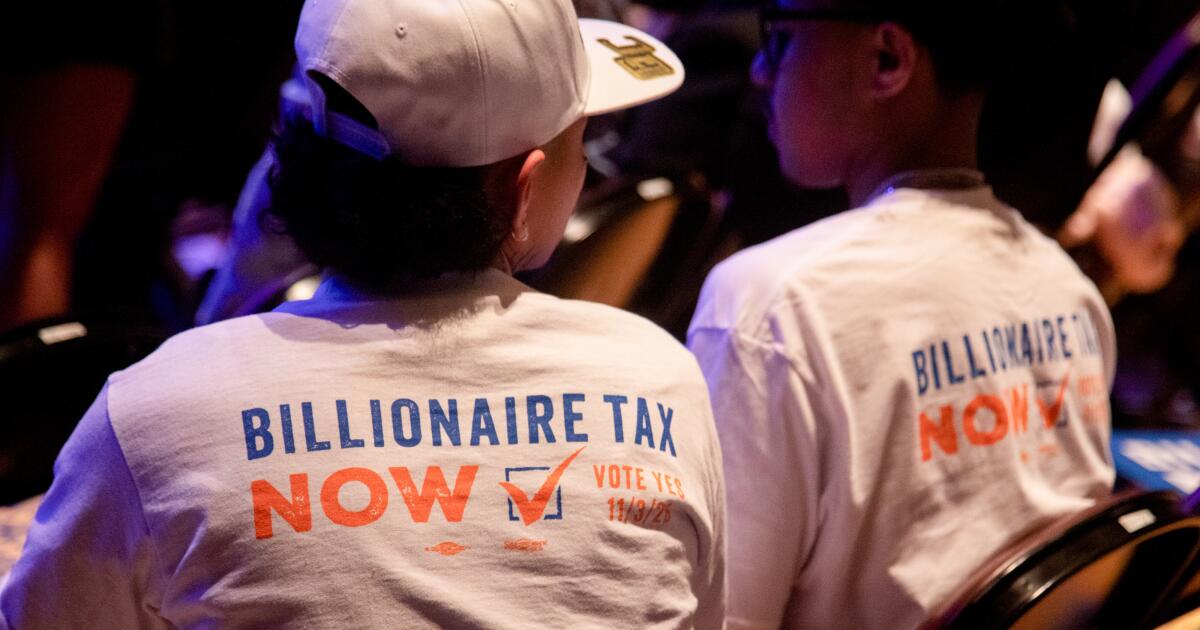
Suzanne Jimenez, chief of staff at SEIU-United Healthcare Workers West, the primary union backing the billionaire tax, decried what she described as an effort by a small number of the state’s wealthiest residents to avoid paying their fair share.

“So far, those few billionaires are failing,” she said in a statement. “Despite the expensive and wasteful tactics by a small group of billionaires that aim to deny voters a choice on the billionaire tax in November, our growing coalition and volunteer base is on track with signature collection and gaining momentum. The public is crystal clear on the fact that keeping ERs and clinics open is more important than billionaires getting more tax breaks.”

California’s budget is notoriously volatile because it is largely dependent on taxes paid by its wealthiest residents. Revenue hinges on capital gains from investments, bonuses to executives and windfalls from new stock offerings, all of which are grossly unpredictable.

The billionaire tax would cost more than 200 of the state’s richest residents about $100 billion if a majority of voters support it on the November ballot.

The proposed tax would retroactively apply to billionaires’ assets as of Jan. 1, and has already prompted some of California’s wealthiest residents to leave the state. It has also created a wedge among Democrats. Some argue that it is necessary to address tax inequities that benefit the rich and harm everyone else. Among the supporters is Sen. Bernie Sanders (I-Vt.), who kicked off the billionaire tax proposal drive in February.

But others, notably Gov. Gavin Newsom, oppose the effort, saying policies that vary by state would drive innovators and businesses outside of California.

Source link