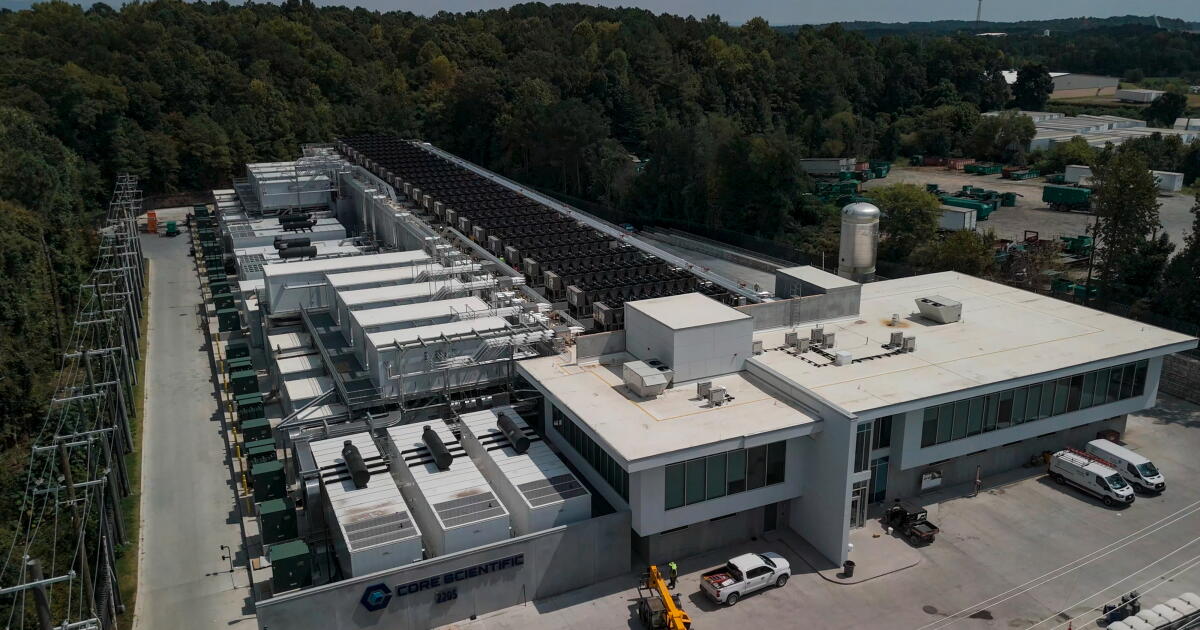
California’s Prop 45 aims to speed construction projects. Opponents say data centers will benefit
When a county judge put the brakes on what would be the largest data center in California, ruling the whole project needed extensive environmental review, Kristian Salgado was relieved.
The community organizer lives in Imperial County, where the nearly one-million-square-foot facility was proposed. The rural county near the Mexico border struggles with bad air pollution and has one the state’s highest rates of asthma hospitalization for kids, according to the National Institute of Environmental Health Sciences. One of Salgado’s nephews lives right next to the site and struggles with the respiratory disease.
“It just seemed very unusual that a project of this scale, with that many backup generators could be permitted without requiring any further [analysis] of what that would mean for residents,” she said.
Now, Salgado and others who share her concern believe Proposition 45 on the November ballot could roll back their wins. The initiative changes the California Environmental Quality Act, or CEQA, a law intended to inform decision makers and the public about a project’s possible environmental impacts — and mitigate them to the extent possible.
Supporters say Prop 45 will speed up environmental review for essential housing, transportation, water, health, education and other projects, cutting costly delays and passing the savings on to consumers. Opponents say it not only weakens environmental protections for many developments, but will cover potentially polluting ones — including data centers. The Yes on 45 campaign forcefully rejects the data center claim, but independent legal experts are divided.
At the heart of the debate is the definition of one of the categories covered by Prop 45: “broadband internet access projects” or “mass-market retail service … that provides the capability to transmit data to, and receive data from, all or substantially all internet endpoints.”
Dan Dunmoyer, president and chief executive of the California Building Industry Assn., which supports the proposition, was adamant: “We specifically excluded data centers” when crafting the measure.
Yet the proposition expressly names certain excluded projects: nuclear energy, high-speed rail, jails and Delta conveyance facilities. Data centers aren’t among them.
Dunmoyer maintains that even if they’re not explicitly listed, data centers just don’t fit the measure’s definition.
In a Daily Journal op-ed, Rachelle Chong, a former Federal Communications Commission member, similarly argues that the definition refers to internet access bought from a provider like AT&T or Comcast. “A conventional data center ordinarily performs an entirely different function,” she wrote, arguing data centers aren’t in play.
But land use attorneys Matthew McKerley and Richard Frank, in another op-ed, say many modern data centers fit the bill because they house equipment used to transmit consumer data to and from the internet.
They also highlight conspicuous campaign finance contributions, including $250,000 from Prologis, which developed two data centers in San Jose.
Ethan Elkind, director of the climate program at UC Berkeley Law, said data centers will argue they fit the definition — and then it will be up to the courts to decide.
“Anyone telling you that it’s definitely not going to be data centers, they cannot read the future,” he said. “The way they’ve written the language, they can’t provide 100% assurance.”
Eric Biber, a UC Berkeley law school professor with expertise in environmental law, pointed to language in the measure requiring it to be interpreted broadly “to afford the fullest possible weight to the interest of, and the approval and realization of, essential projects.” In a blog post, he called it “a thumb on the scale” that could lead courts to conclude that projects should be covered when their eligibility is in doubt.
But Ryan Thomason and J. Scott Miller, partners at the law firm Mitchell Chadwick with CEQA expertise, think it’s likely courts would rule otherwise. In an article, they note that the definition used in the measure hews closely to another section of California law, which distinguishes providing internet services from offering content, services and applications online. “Courts generally interpret identical language in related statutes to have the same meaning,” they write.
Dunmoyer, of the California Building Industry Ass., stressed that the measure doesn’t overthrow local zoning rules.
Opponents are “making it sound like in your backyard will be a data center,” he said. “Well, that doesn’t happen at all by this initiative. That has to happen by a county board of supervisors voting to put a data center in your backyard. And if they decide to do that, this initiative does nothing to expedite that CEQA review.”
But what if local officials run afoul of their constituents? In the case of the Imperial Valley Data Center Campus, the roughly 75 acres of unincorporated land where it would go had already been zoned for data centers. As a result, county officials said they had the power to move forward with the facility for artificial intelligence computing infrastructure without city approval.
They granted the project an exemption from the state environmental review.
Then came the backlash. Residents spoke out at public meetings, rallied on the streets, circulated a petition and formed a community organization. The city of Imperial and the Sierra Club sued. In the wake of the outrage, the county walked back its decision, declaring a moratorium on data centers. (The developer sued the county over the ban, and the county recently rescinded it following a court order.)
If Prop 45 passes — and data centers are covered by it — Eric Biber, of UC Berkeley Law, told The Times that such a moratorium wouldn’t be possible. That’s because the measure prevents state and local officials from changing the rules for a project once its application is submitted, he said. So if a community didn’t have a moratorium in place and its zoning laws allow a data center, “They’re done,” said. Existing bans aren’t expected to be affected.
Attorneys for the No on Prop 45 campaign argue that it could have real-world impacts for the Imperial Valley facility, saying the developer could claim the new rules apply. For instance, the measure would prevent courts from overturning approvals of qualifying projects because of CEQA violations. Courts would only be able to halt the affected portion of the project while the issue is fixed.
Sebastian Rucci, principal developer of the Imperial Valley data center, said he will fight for his project to move forward and that there’s an environmentally sound way to do it. He said he’s willing to negotiate and mitigate where necessary — but will not go through the CEQA process. If push comes to shove, he said he’ll move the project elsewhere. California could “get in the game” or be left in the dust, he said.
Imperial Valley Computer Manufacturing, the company behind the project, says it will create at least 100 permanent jobs and generate $28.7 million in annual property tax revenue.
CEQA requirements “are not about the environment,” Rucci said. “They may be for some, but they’re not for many. For many, they are about killing things.”