progressives

Cautious on police reform, Becerra risks losing progressives — and his political future

Few California Democrats have garnered more praise from the party’s various constituencies than Atty. Gen. Xavier Becerra, who has led the state’s charge against the administration of President Trump with 47 lawsuits on issues including immigration and healthcare.

But in recent months, Becerra has come under criticism from progressives and civil rights leaders for his reticence to support legislative checks on police use of force. That blowback could have ramifications for an ambitious politician who seems primed for ever-higher offices.

On Tuesday, Becerra announced that his office would not seek criminal charges against two Sacramento police officers involved in the fatal shooting of Stephon Clark, an unarmed African American man.

While that decision was not unexpected, it built on another recent controversy in which Becerra was sued by civil rights groups for not releasing use-of-force records. He later outraged many progressive allies by threatening legal action over police misconduct records he said were improperly released to the media.

Becerra has long walked a line of presenting himself as both a civil rights defender and a friend of law enforcement. But has also disappointed some supporters for not taking a stand in support of legislation that would toughen use-of-force rules as well as a proposal that the state Department of Justice routinely provide independent investigation of police shootings.

“A Democratic attorney general, in particular, is kind of torn between two worlds — the law enforcement entities and officials with which he or she must work and build credibility with, and Democratic constituencies that are highly suspicious of, if not downright hostile to, law enforcement,” said Garry South, a Democratic political consultant.

“Becerra is now caught between these two constituencies in a pretty public way,” said South, who managed Gov. Gray Davis’ 1998 and 2002 campaigns that portrayed Davis as a law-and-order Democrat. Sen. Kamala Harris faced the same pressures when she was attorney general, South said.

Capitol watchers see Becerra as a possible contender some day for higher office, including governor or U.S. senator if one of those jobs opens up.

But Becerra risks alienating key voters by his handling of the Clark case and his refusal to take a position on legislation making it easier to prosecute police officers, said the Rev. Shane Harris, a civil rights activist who has long served as a delegate for the California Democratic Party.

“He needs to realize that if he wants to be governor someday, he is going to need black votes and brown votes,” said Harris, president of the People’s Alliance for Justice. “If he has any aspirations, they just went out the window for now. This right here really took him backwards when it comes to the black vote in the state of California.”

Harris said Becerra could regain ground with minority voters by supporting tough reform legislation and embracing calls for the attorney general’s office to independently investigate all fatal police shootings.

Then-Gov. Jerry Brown appointed Becerra as attorney general in 2017 after he served 12 terms in Congress — a perch that provided little opportunity to be involved in state discussions of law enforcement oversight. Many activists did not know where he would stand on policing matters.

He won election last year with strong support from police groups, including big campaign checks from the California Statewide Law Enforcement Assn. political action committee, the California Correctional Peace Officers Assn., the Los Angeles Police Protective League, the Assn. of Orange County Deputy Sheriffs PAC, the Long Beach Police Officers Assn. and the Oakland Police Officers Assn. PAC.

Becerra is too close to the law enforcement community, said Melina Abdullah, a professor of Pan-African Studies at Cal State L.A. and a member of the Black Lives Matter movement.

“I think the complete unwillingness of the attorney general to intervene in the murders of black people by law enforcement — even under the most extreme circumstances, like Stephon Clark — demonstrates either a completely failed moral compass or a shameful submission to political cowardice,” Abdullah said.

On Tuesday, Becerra defended his actions in police use-of-force cases as “by the book” and based on the evidence.

He resisted the idea that his office should routinely “parachute in,” as he calls it, and investigate officer-involved shootings that are now reviewed by prosecutors in each of the state’s 58 counties.

“I don’t have the capacity and the resources to try to take over the work of 58 different D.A.s in this one shop,” Becerra said.

He said local prosecutors are “far closer” to what is going on in their communities.

He said he knows the African American community feels hurt by the shooting of Clark, but added “I think there is a lot of hurt in the Police Department too, because they are under a microscope and two of their fellow officers are now under a microscope.”

The attorney general’s actions on law enforcement issues have frustrated some people who supported his election last year, including civil rights attorney John Burris, who represented Rodney King in his civil rights lawsuit against the Los Angeles Police Department.

“I’m disappointed,” Burris said after Becerra’s announcement in the Stephon Clark case. “I supported him wholeheartedly [during the election]. I think I had higher hopes for him in the beginning.”

Burris said he has asked Becerra in the last few years to look at other police shootings and the attorney general has always sided with the local district attorneys in not pursuing action against officers.

“At the end of the day, the attorney general is law enforcement, and they have to work with law enforcement throughout the state,” Burris said. “That’s what makes it very difficult for him and others to be very critical of the local police unless the evidence is overwhelming.”

The Clark decision was not the only action that concerned some Becerra allies.

Becerra is under criticism from groups including the First Amendment Coalition, which sued him last month after he refused to release records related to investigations of shootings or confirmed cases of sexual assault by officers.

The lawsuit alleges that Becerra is required to turn over the documents by a law — SB 1421 — that was approved last year. Police unions have sued to keep records from being released.

The ACLU of Southern California is “very disappointed” that Becerra is refusing to make public records ordered released by the state Legislature, said Melanie Ochoa, a staff attorney for the group.

“It is unfortunate that the state’s top cop is sending a message that it is OK for agencies to deny the public access to information about serious police misconduct and uses of deadly force — particularly when we already have numerous courts that have decided that agencies must release this information,” Ochoa said.

Becerra’s actions on the release of records are defended by Robert Harris, a director with the Los Angeles Police Protective League.

Harris praised Becerra for withholding such records in the Justice Department’s possession while court cases deciding whether the law applied to investigations of incidents that occurred before this year were pending.

“I think that’s an appropriate decision until we have a definitive answer,” Harris said.

Becerra defended his actions on the release of police misconduct records, citing privacy laws.

“My progressive values are still there,” Becerra told The Times.

“If I have your Social Security numbers, and there’s a good chance I do in one of my databases … you would not want me to disclose it lightly,” Becerra added. “My job is to protect that privacy.”

In January, in response to a group of journalists in Berkeley, the state’s Commission on Peace Officer Standards and Training released a list of 12,000 names of police officers and job applicants who had been convicted of crimes.

Becerra later said the state office made a mistake in releasing the names to reporters for the Investigative Reporting Program at the UC Berkeley Graduate School of Journalism.

In a letter, he told the reporters to destroy the records, arguing that possession of the data was a criminal offense.

Becerra said this week that his letter to Berkeley was part of due diligence to enforce the law.

“Someone needs to ask the folks that are in possession of information that they are unauthorized to possess or use, what don’t they understand about the law that says, ‘You are in possession of information that you shouldn’t have.’ It’s like stolen property,” he said.

The attorney general also finds himself in the center of a storm of controversy over possible legislative measures to reduce excessive force.

Becerra refused Tuesday to take a position on pending legislation by Assemblywoman Shirley Weber (D-San Diego) that would make it easier to criminally prosecute law enforcement officers who kill civilians.

Police unions and chiefs are supporting a separate measure that would instead focus on internal department policies and training.

Becerra said he has withheld taking a position on the two use-of-force bills because he has not read them yet and he wanted to first complete the investigation into the Clark shooting, which he wanted to be seen as independent and fair.

“I have not gone through the bills to the point of making decisions,” Becerra told reporters at a news conference on the Clark shooting.

“I will get involved because it’s important,” he said. “I don’t intend to be AWOL when it comes to the discussion of how we write this new chapter.”

Coverage of California politics »

patrick.mcgreevy@latimes.com

Twitter: @mcgreevy99


Source link

Democrats try a new tactic to win a House seat in Utah — running as progressives in a red state

For decades, Democrats’ only chance of getting elected to Congress from the conservative state of Utah was by convincing voters that they were sensible moderates, not like the zealous progressives from California or Colorado.

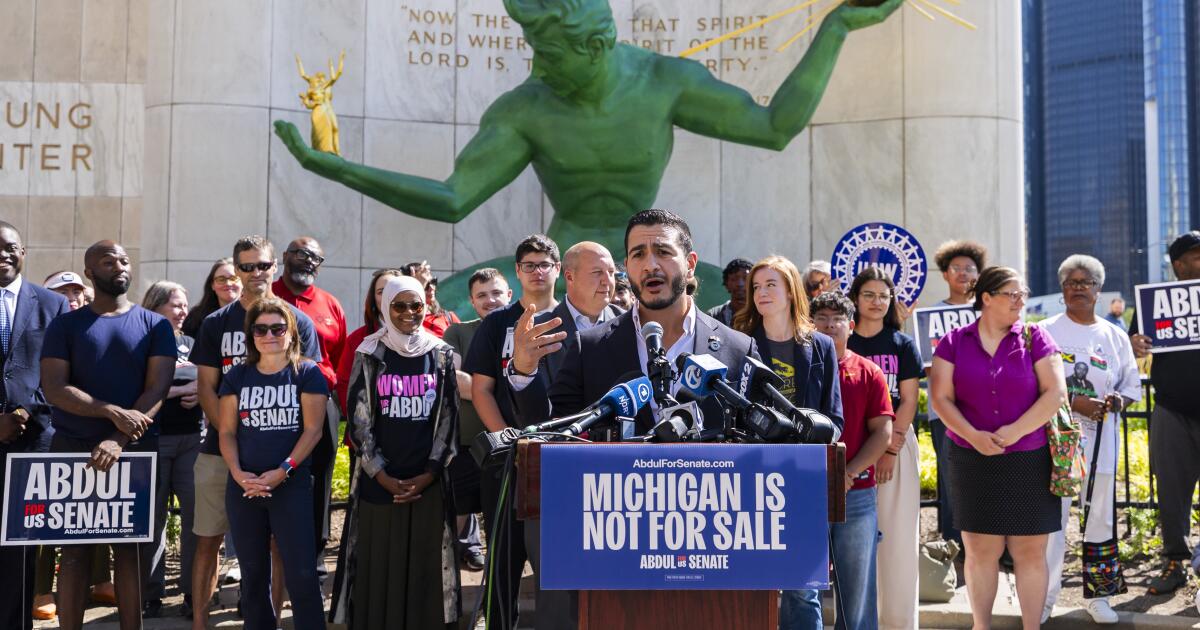
But the political landscape has changed, thanks to a redistricting shakeup that created a deep blue district anchored by Salt Lake City. Suddenly, congressional candidates are trying to outflank each other on the left in an unusual race that could help determine whether Democrats take back control of the U.S. House in the midterms.

Exhibit A is Ben McAdams, a former congressman who once described himself as pro-life and voted against a federal minimum wage increase. As he mounts a comeback campaign in a much more Democratic district, he pledged his support for abortion rights and raising the minimum wage during a recent forum for young voters.

As primary opponents criticized McAdams as the most conservative among them, he insisted that he’s only “moderate in tone.”

It’s a far different approach than McAdams used in 2018, when he ousted a Republican incumbent in the midterms of President Donald Trump’s first term. While representing the southwest Salt Lake Valley and parts of deep-red Utah County in the former 4th district, he was considered the most conservative House Democrat during his single term by one analysis, before losing reelection to a Republican.

McAdams is now running in the new 1st district, including all of Salt Lake City and much of its suburbs, which emerged from a years-long legal battle over Utah’s congressional map.

Whoever wins the primary will likely win the November general election, and McAdams faces a half-dozen Democratic opponents.

“What makes me a strong candidate is the fact that I’ve actually delivered on a lot of things people are talking about,” McAdams told The Associated Press. “It’s easy to have a strongly worded tweet or talking points, but I can actually follow that up with accomplishments that are making life better.”

Democratic National Committee Chairman Ken Martin views Utah’s 1st district as a foothold in a red state that could not only help the party win the House this year but set it up for long-term success. He said the party is pouring more money into Utah than ever before — at least $22,500 a month — to build infrastructure ahead of the 2030 census, when the fast-growing state could gain House seats.

The recipe for success, Martin said, is a willingness to meet voters where they’re at and a platform that reflects “not just the majority of Democrats, but the majority of the people in the district.”

Unlike state Republicans, the Democrats are holding an open primary on June 23, meaning anyone in the district can vote, regardless of party affiliation. That could benefit a candidate like McAdams, who built a broad base during his previous campaign. But state party leaders have said they’re confident that registered Democrats have a strong enough majority to decide the primary.

Democrats have historically struggled to gain solid footing in Utah, where about half the population belongs to The Church of Jesus Christ of Latter-day Saints. Members of the faith known widely as the Mormon church have always leaned Republican.

Even though the church is headquartered in Salt Lake City, the capital is one of the only places where Democrats hold local control and religion takes a back seat in politics.

Martin expects the youth vote will be key to winning in Utah and building longevity there. Utah is the youngest state, with a median age of about 32.

“This is a group that’s up for grabs,” he told the AP, noting that Democrats too often assume young voters are with them. He said that could mean Utah “is one of the biggest potential swing states in the country.”

Robert Axson, chairman of the Utah Republican Party, rejected that notion.

“Everything I am seeing shows the younger generation continuing to lead in the promotion of our conservative principles,” he said. “While we see the generational passing of the torch, there is not a political swing away from the values that make Utah a wonderful place to call home.”

Jockeying for the Gen Z vote

Several young voters who came to meet candidates on a Saturday morning in Taylorsville said they hoped to capitalize on the opportunity to elect a progressive.

Milo Hohmann, 22, of Holladay, said state Sen. Nate Blouin is the “firebrand” that Utah needs in Congress.

Perhaps the most vocal Democrat in the Republican-led state legislature, Blouin has racked up endorsements from some of the country’s most prominent progressives, including Sen. Bernie Sanders and Reps. Pramila Jayapal, Greg Casar and Maxwell Frost.

Blouin said he aims to energize an electorate that has grown accustomed to settling for someone who will “play nice” with Republicans.

He jabbed at McAdams’ voting record while defending himself against criticisms that he has never passed legislation. Blouin said he’s been effectively blacklisted by Republican legislative leaders, and at least two bills that he originally sponsored passed after they advanced under other lawmakers’ names.

“I don’t measure progress by how many times you can get pats on the back from Republicans,” he told the AP.

His stance resonated with Hohmann, a transportation engineer, who said Utah has “an electric moment” to elect a Democrat who won’t compromise their values.

Hannah Paisley Zoulek, 19, of Millcreek, said she’s leaning toward Blouin or his colleague in the state Senate, former teacher Kathleen Riebe. But she had a concern about Blouin.

“I struggle a bit with Senator Blouin’s emphasis on how hard he holds his own positions,” Zoulek said. “It’s great if you want to make a statement, but not necessarily if you want to do the work.”

Neither Hohmann nor Zoulek thought McAdams was the right fit for the new district given his more moderate past.

Ben Iverson, who will be voting for the first time this year, disagrees.

The 17-year-old from Cottonwood Heights considers himself very progressive and said he thinks McAdams is “a great option.” He noted that McAdams voted to impeach Trump in 2019, despite knowing it could cost him reelection.

“I don’t think left-wing voters want a moderate Democrat who will capitulate to the right,” Iverson said, adding that he thinks McAdams has successfully shed the moderate label.

Throughout his life, Iverson said McAdams has been a mainstay of local politics. He was Salt Lake County’s state senator, then its mayor, and represented much of the area in his previous congressional district.

“I’ve been in the trenches, rolling up my sleeves, saying not ‘How do we pass a bill that will never become law?’ but ‘How do we actually enact legislation that will make people’s lives better?’” McAdams said.

Schoenbaum writes for the Associated Press.

Source link