Progressive

California voters favor progressive candidates, split over democratic socialism, poll finds

California voters are more inclined to back progressives running for office than mainstream Democrats, a new poll found, though a marked generational divide separates those who favor each camp.

Registered Democratic voters over 65 were overwhelmingly more inclined to support a candidate identified as a mainstream Democrat, whereas more voters under 40 favored those more aligned with the party’s left wing, including democratic socialists.

The results, from a new poll conducted by UC Berkeley’s Institute of Governmental Studies and co-sponsored by The Times, illustrate the highly visible midterm-season debates unfolding within the Democratic Party over age, ideology and the party’s future.

“There’s particular frustration among the younger voting population,” said IGS poll director Mark DiCamillo. “Their views of mainstream Democrats are not that positive, and that’s a long-term problem, I think, for the Democratic Party.”

The poll asked voters about how they perceived candidates described as a progressive, democratic socialist, mainstream Democrat, Republican and MAGA supporter. Voters were asked whether each label made them more inclined or less inclined to back a given candidate, or if they believed there was not much difference or had no opinion.

Among all California voters, a candidate described as “progressive” drew the broadest support — besting both mainstream Democrats and Republicans, as well as democratic socialists and members of President Trump’s MAGA movement. At 40%, support for progressive candidates registered just two percentage points above support for democratic socialists and within the poll’s margin of error, though fewer people felt negatively toward progressives than democratic socialists.

Among registered Democrats, the survey found 60% said they would be inclined to support a candidate identified as progressive; 58% felt the same when asked about a democratic socialist and 48% about a mainstream party member.

The polling offers a glimpse into how California voters feel about democratic socialism, the brand of liberal politics popularized by Sen. Bernie Sanders (I-Vt.) and New York Mayor Zohran Mamdani (D).

The views among all California voters were split, with 38% saying they would be more inclined to support a candidate labeled as a democratic socialist and 38% saying they would be less inclined. That makes the concept both more polarizing and more popular than the idea of a mainstream Democrat.

“To us, it’s honestly an incredibly good thing to hear that by and large, California voters see democratic socialism as a preferable option,” said Misha Kesselman, who leads membership coordination at the California Democratic Socialists of America.

“Being only two percent behind a progressive Democrat is the perfect place for us to be and for our organization to organize from,” Kesselman added. “I don’t see this as our ceiling; this is a great floor for us to start running from.”

Notably, more voters, 36%, said they were less inclined to support a mainstream Democrat than those who said they’d be more inclined, 29%. Twenty-seven percent showed indifference, however, possibly demonstrating that most voters would be fine supporting them in a general election, said Christian Grose, a political science professor at the University of Southern California.

The results could reflect a shift in labeling as much as in politics, Grose said, noting that most California Democrats now refer to themselves as progressive, a term that was not as popular 20 years ago, regardless of policy differences.

“Progressive Democrat in California has really in some ways become a mainstream Democrat, and then ‘mainstream’ is often associated with Washington,” Grose said, referring to the more moderate party establishment.

As the two parties compete for control of Congress in November’s midterm elections, the rise of democratic socialist ideas within the Democratic party has set off a debate among left-leaning leaders and voters about how best to counter Trump’s cultural dominance, appeal to disillusioned voters and create a winning presidential strategy for 2028.

The split does not fully fall along generational lines, but it often overlaps with the growing push by some younger candidates to oust veteran lawmakers, a debate over experience and seniority versus fresh blood.

Republicans have used the phenomenon as a key line of attack, as Trump and others have labeled Democrats as communists and extremists. In recent weeks, Trump argued that Democrats want to “destroy the traditional American way of life.”

“Sadly, young people have not been taught the truth about socialism and communism. It’s a dangerous road, and this is one of our efforts to make sure people know that,” House Speaker Mike Johnson (R-La.) said Saturday on Fox News, after launching a website last week dedicated to the idea that socialism and communism have failed.

Meanwhile, many establishment Democrats fear that a far-left candidate would be unable to win a general presidential election and worry a swing in that direction could jeopardize the party’s chances in 2028. House Minority Leader Hakeem Jeffries (D-N.Y.) said Sunday on NBC News’ “Meet the Press” that he does not support the Democratic Socialists of America agenda, further underscoring internal divisions.

Democratic socialism generally centers on an anti-capitalist agenda, including higher taxes for the wealthy and universal healthcare. Many progressive candidates support policy ideas backed by socialists but do not identify themselves as such.

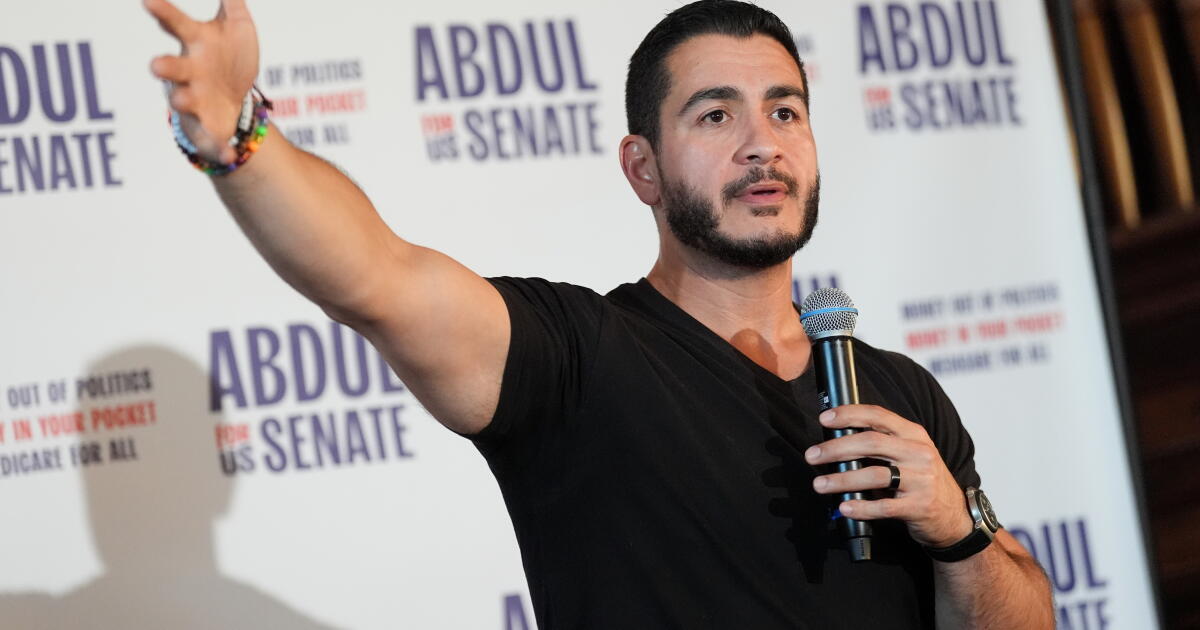
A handful of high-profile progressive primary wins against Democrats backed by the establishment has supercharged the conversation in recent weeks, including this month in Michigan’s Democratic Senate primary, where progressive Abdul El-Sayed narrowly defeated a moderate opponent.

But progressives have lost elsewhere, including in Wisconsin, where democratic socialist Francesca Hong last week was defeated in the gubernatorial primary by David Crowley, the more moderate Milwaukee County executive.

California was not host to that type of showdown this year, and Democratic gubernatorial candidate Xavier Becerra, though progressive by national standards, was viewed by many left-leaning voters as a safer or more moderate primary choice. He faces Republican Steve Hilton in November.

In Los Angeles, however, the mayor’s race between incumbent Democrat Karen Bass and democratic socialist Nithya Raman is set to draw national attention. A handful of progressive candidates also advanced in House races, including Randy Villegas, who is challenging Rep. David Valadao (R-Hanford); Mai Vang, challenging Rep. Doris Matsui (D-Sacramento); and Angela Gonzales-Torres, challenging Rep. Jimmy Gomez (D-Los Angeles). Vang identifies as a democratic socialist.

The new polling also showed a generational divide among Republican voters: A higher share of older voters than younger said they would be more inclined to back a MAGA supporter, though all ages favored the Republican category over MAGA.

Seventy percent of GOP voters said a Republican label would make them more inclined to support a candidate, and 46% said the same of a MAGA label. Sixteen percent said they would be less inclined to vote for a candidate with a MAGA label and 29% said it didn’t make much difference.

Among California voters who eschew both the Democratic and Republican parties, either registered as no party preference or with other parties, a progressive candidate drew the most favorable reaction, but they also showed more support for a democratic socialist than a mainstream Democrat.

Those voters were not positively inclined toward right-leaning candidates, with 15% responding favorably to Republicans and 7% to MAGA.

In California, Democrats account for nearly 45% of all registered voters, compared to 25% who are Republican and almost 23% who don’t belong to either party, according the California Secretary of State’s office.

Whether voters’ shifting preferences for the progressive or democratic socialist labels translate into any different policy action from those who are elected is an open question, Grose said.

“The labels are changing things… but it’s not clear yet if it’s changing the actual ideology of voters and elected officials,” Grose said. “What the elected officials do in office who are Democrats, that remains to be seen.”

The Berkeley IGS/Times poll findings are based on an online survey in English and Spanish of 4,207 California registered voters from Aug. 3-9. The results are estimated to have a margin of error of about 2.5 percentage points in either direction in the likely voter sample, and larger numbers for subgroups.

Source link

Hiltzik: The Democrats’ age revolt took down a progressive leader

The youth movement among our political leaders, especially among Democrats, is in full cry. On the whole, this looks to be a positive inflection point in our political leadership, empowering a new generation of leaders advocating needed changes in the government’s relationship with its constituents.

But in some particulars it’s misplaced. As the smoke from the recent party primaries clears, it’s proper to take stock in what we’ve lost, alongside what we may gain from a changing of the guard.

For example, take Rep. John B. Larson (D-Conn.), 78, who was turfed out of his seat in his state’s Aug. 11 primary by his Democratic challenger, former Hartford Mayor Luke Bronin, 47.

When it comes to fighting for Social Security, no one has worked harder than Rep. Larson.

— Social Security advocates Nancy Altman, Max Richtman and Rich Fiesta, the day before Larson’s defeat in a Democratic primary

Given that Larson is in his 28th year as a member of congress, it sounds reasonable to suggest that it’s his time to go. But that means overlooking Larson’s most important role in the House, as a member of both the majority and (currently) the minority. And that’s his persistent campaign to preserve Social Security — indeed, to enhance it so it serves today’s workers as well or better than it has served Americans since its enactment in 1935.

There doesn’t seem to be much risk that Bronin’s election, which looks likely, will undermine the progressive faction in the House.

Get the latest from Michael Hiltzik

Commentary on economics and more from a Pulitzer Prize winner.

Connecticut’s 1st Congressional District, which Larson represents, is perhaps the bluest district in a blue state, and Bronin’s policy positions tick all the appropriate progressive boxes. But it will probably take years for Bronin to acquire the credibility on Social Security that Larson possessed, even assuming that he wishes to do so.

Larson’s instrument has been the Social Security 2100 Act, which he first introduced in 2017. The act has never passed, but in its draft versions it has embodied several principles that remain fundamental to the Democratic approach to Social Security.

Among them: augmenting benefits to the lowest-wage workers; providing coverage to those whose work has been outside the system, such as family caregivers; and raising Social Security taxes on the rich, who have increasingly avoided paying their fair share of the costs of this all-important antipoverty program. More on that in a moment.

Larson’s loss didn’t result from his championing Social Security. The thrust of Bronin’s campaign was almost entirely that Larson had grown too old in the job, and the path should be cleared for new blood (i.e., himself).

Nothing is new about the drive to bring fresh faces and fresh ideas into the political mainstream. Youth movements arise regularly in politics, especially in times of partisan discontent.

George Orwell, whose observations about the politics and mores of his time remain relevant to the present, wrote (in 1932) of the youth movement that erupted in Britain in 1918.

“At that time,” he wrote in “The Road to Wigan Pier,” his classic about class and economics, “there was, among the young, a curious cult of hatred of ‘old men.’ The dominance of ‘old men’ was held to be responsible for every evil known to humanity, and every accepted institution from [Sir Walter] Scott’s novels to the House of Lords was derided merely because ‘old men’ were in favor of it.”

Orwell traced the phenomenon to Britain’s experience in World War I, which he wrote “had been conducted mainly by old men and had been conducted with supreme incompetence. By 1918 everyone under forty was in a bad temper with his elders, and the mood of anti-militarism which followed naturally upon the fighting was extended into a general revolt against orthodoxy and authority.”

Today’s youth movement, which is concentrated among Democrats, has an analogous origin. It’s rooted in distaste for a politics that has impoverished a generation while filling the pockets of the wealthy.

In some cases, the need to usher superannuated politicians out the door is indisputable. A prime specimen was Sen. Dianne Feinstein (D-Cal.), whose mental and physical incapacities became manifest as she neared the end of her life; in 2023 she died in office at 90.

On the other hand, Rep. Nancy Pelosi (D-San Francisco), led her Democratic caucus with a firm hand as Speaker until she yielded the gavel in 2023 at age 82, having notched one of the most successful speakerships in history. (She’s not running for reelection this year.)

Joe Biden, whose apparently faltering faculties became a political talking point during his 2024 presidential reelection campaign, when he was 82 and was in the process of returning the U.S. economy to its pre-pandemic strength when he lost to Donald Trump — who at the age of 80 has been systematically dismantling Biden’s economic policies to the disadvantage of middle-class and working Americans.

Meanwhile, has anybody heard recently from Sen. Mitch McConnell (R-Ky.), age 84? He hasn’t been seen in public since mid-June. At the moment, he’s regarded as one of those politicians determined to hold on to their seats with what Orwell (him again) described as their “prehensile bottoms.”

As I wrote in 2023, when the age issue was all the rage, “concern-trolling about the advanced age of government leaders hasn’t always been a path to political success.”

Franklin D. Roosevelt cited a “hardening of the judicial arteries” in announcing his 1937 scheme to pack the Supreme Court, which involved shifting the politics of the court to the left by trying to force justices to retire when they reached the age of 70, or adding a justice to the court for every sitting justice who refused. FDR’s plan collapsed after it provoked widespread opposition, the most significant political failure of the New Deal.

That brings us back to the Social Security 2100 Act. The measure, which was introduced in the Senate by Sen. Richard Blumenthal (D-Conn.), isn’t perfect. In fact it has been revised at least three times, typically to address political wavelets that come and go.

In all versions, over time it would eliminate the cap on payroll taxes, which are currently limited to 12.4% on wage income up to a maximum of $184,500. That’s a maximum tax of $22,878, divided 50/50 between workers and their employers.

Because of the cap, the effective payroll tax rate on someone with income of $1 million falls to about 2.3%; in reality it’s even lower, because unearned income such as capital gains, interest and dividends, which constitute half or more of the income of wealthy households, isn’t taxed at all.

Originally, the bill called for raising the payroll tax rate by one-tenth of a percentage point a year, to an employer/employee combined 14.8% by the 2040. On the other hand, Larson would reduce the income tax on Social Security earnings, returning a bit to middle- and lower-income workers. Social Security’s actuaries calculated that Larson’s bill would ensure the program’s solvency for at least 75 years, but in practical terms into the almost limitless future.

The rate increase was dropped in subsequent versions, but it was supplanted by a 12.4% tax on net investment income for taxpayers with income over $400,000. That would guarantee the system’s solvency into the 2060s, the actuaries calculated.

Social Security’s advocates plainly could see Larson’s defeat coming. The day before the Connecticut primary, three of them published an op-ed calling Larson an “irreplaceable” asset to their cause. “When it comes to fighting for Social Security,” they wrote, “no one has worked harder than Rep. Larson.” They pointed out that the “Social Security 2100 Act earned in the last Congress support from over 90% of House Democrats, representing all corners of the Democratic coalition.”

Bronin hasn’t said anything specific about Social Security, beyond a campaign pledge that he’ll work for “strengthening” the program. I asked his campaign whether he had any details to offer, but didn’t get a reply. Larson, for his part, has reacted to his defeat with a gentlemanly call for all Democrats to come together to defeat Trump.

Unlike Republicans, who have spent decades slandering Social Security as an undeserved “entitlement” and suggesting that it’s responsible for federal budget deficits (impossible, as a matter of law) and sluggish economic growth (untrue, as a matter of fact), Democrats have worked to preserve it, if not always effectively.

In coming Congresses, Republicans will be offering all sorts of nostrums to “save” Social Security. History says that these will aim to impose benefit cuts on workers to protect the rich from higher taxes.

Will the Democrats stand fast against this long GOP campaign? With Larson’s defeat, they’ll be short one leader. Let’s hope the rest of the party keeps the faith.

Source link

Democrats’ 2028 presidential calendar set

Democrats seeking the party’s presidential nomination in 2028 will need to prove themselves early on in states where Black and Latino voters and union members are key supporters, under an election year calendar approved Saturday.

The primary lineup pushes Iowa from the traditional top spot and makes South Carolina the leadoff state, voting on Jan. 22, 2028, followed by Nevada on Feb. 1. New Hampshire, New Mexico, Michigan and Virginia round out the early states, throughout February, according to the plan endorsed by the Democratic National Committee at its meeting in Texas.

DNC Chairman Ken Martin said that to win the general election, “you have to be battle-tested in a way that you already have campaigned in front of and for the support of various communities throughout the country.” That is why the calendar designed by the party matters, he said in an interview.

Some potential candidates in what is expected to be a large field have visited early-voting states such as South Carolina. Party leaders have said the order gives candidates the best shot at winning back the White House after President Trump’s final term.

“They have to show that they can go to the South and talk to Black voters and rural voters, as well as out west, talking ranching and mining issues, to a border state, to union members,” said party strategist Karen Finney, who has worked on multiple presidential campaigns. “Whoever survives will be battle-tested.”

Former presidential candidate Howard Dean, a onetime Vermont governor, recalled his tenure as national party chairman, when Democrats solidified Nevada and South Carolina as early states behind Iowa and New Hampshire. The latest change is even better, he said.

“These states look more like the country” as a whole, he said, “whereas Iowa and New Hampshire don’t.”

Rita Hart, chair of the Iowa Democratic Party, said bypassing her state in the early going would sideline important voter voices and give a political edge to Republicans, who are expected to keep Iowa atop their calendar.

Nonwhite voters claim top billing

As the first-in-the-South primary, South Carolina was more decisive than Iowa and New Hampshire for nominees Barack Obama in 2008, Hillary Clinton in 2016 and Joe Biden in 2020. All three dominated among South Carolina’s large Black population, which can yield more than half the state’s Democratic primary electorate.

With Nevada and New Mexico following, that will require candidates to court more Latino voters early in the process.

Shifting from Iowa and New Hampshire does not mean little-known candidates cannot catch fire, as Pete Buttigieg did in Iowa and New Hampshire in 2020, when he was a 37-year-old former mayor. They just will not be able to do it with an almost entirely white audience.

“If you can’t go to every part of this country and make your case, you should not be running for president,” Finney said.

Progressive vs. establishment dynamics

There is disagreement over how Democrats’ split between progressives and mainstream liberals may or may not surface in the nominating calendar.

“I think our primary voters up north are probably a little different than primary voters in South Carolina,” said Boyd Brown, a former DNC member from South Carolina. “It’s not the woke ideologies that we just can’t get away from” in other places, Brown said.

Nina Smith, a former Buttigieg advisor who works closely with progressive causes, disagreed. Smith said Black South Carolinians, especially, have gravitated to more moderate candidates — twice rejecting Vermont Sen. Bernie Sanders in favor of Clinton and Biden.

But, she said, “Southern Black voters are more progressive than they’re given credit for” on policy but also “realists” about what is possible.

“Living through Jim Crow and other oppressive structures will force you to take that approach,” she said.

Smith said that with South Carolina leading off and many Southern states following on Super Tuesday soon after the early lineup concludes, progressives will have to take the time to listen and then tailor their messages.

“A lot of Black voters don’t necessarily see themselves in the ideas and arguments that progressives put forward,” she said.

Unions in the spotlight

Nevada has the service industry unions because of Las Vegas; Michigan has the auto industry and associated manufacturing support industries; Virginia is home to more federal workers than any other state.

“Labor is still so important,” Dean said.

Beyond seeking the backing of organized labor, the campaigns and the party will look to unions for help in spreading Democrats’ message to voters and getting people to the polls.

Scheduling efficiency

Campaigns struggle to balance many demands such as meeting voters in person, raising money and the logistics of travel. As a result, places such as Nevada have gotten short shrift in the past because candidates, most from the eastern part of the country, have concluded the investment of time is not worth it.

An expanded calendar offers more clustering opportunities.

A swing to the West could hit two early states — Nevada and New Mexico — and include a fundraising stop in California, full of Democratic donors. A South Carolina trip could mean fundraisers and public appearances in Atlanta along with Charlotte and Raleigh, both in North Carolina. Virginia offers proximity to donors and national TV studios in Washington; the same options are available by adding a New York City stop on the way to New Hampshire.

Bre Maxwell is a DNC member from South Carolina who said the state’s smaller size and lower media costs are a financial equalizer, allowing not only the best-funded candidates to have an impact.

“They can campaign from the top to the bottom in a day,” Maxwell said.

Keeping a focus on November

Of the six early states, all but South Carolina have been competitive in general elections.

That means that even before Super Tuesday, the Democratic candidates will have spent significant time and resources in states worth a combined 43 electoral college votes. That is not insignificant on the way to the 270 needed to win.

Television ads and news coverage can spill over, as well. Markets targeting parts of South Carolina also reach portions of North Carolina and Georgia.

After all, Brown said, the point is to put a Democrat in the White House.

“This is not a social or a debate club. It is a political party,” he said.

Catalini and Barrow write for the Associated Press. Barrow reported from Atlanta. AP writer Meg Kinnard in Columbia, S.C., contributed to this report.

Source link

Wisconsin governor’s race deals upset to favored progressive in another key primary

In another major test of how far left Democratic voters in swing states are willing to go, moderate David Crowley narrowly defeated democratic socialist Francesca Hong to become the Democratic nominee for governor of Wisconsin.

The surprise result in Tuesday’s primary — in a closely watched swing state seen as a possible bellwether of Democratic sentiment — came after polls had shown Hong leading the field by double digits. With 95% of the vote counted, Crowley clinched the nomination early Wednesday by just 3,000 votes.

It was the second purple-state race between Democrats in two weeks to have an extremely narrow result, following the slim win by progressive Abdul El-Sayed in the Michigan Senate primary last week. Polling also overestimated progressive performance in that race.

In the November general election, Crowley, the Milwaukee County executive, will face Republican Rep. Tom Tiffany, who was endorsed by President Trump. If Crowley were to defeat Tiffany, he would become the first Black governor in the state’s history.

The race had been closely watched as an example of the national fissure between progressive and establishment Democrats.

“Hong’s candidacy is a sign of the broader trends in the party, with outspoken progressives and socialists emerging in some primaries and having real sway in the party,” said University of Wisconsin-Madison professor Barry Burden. “With Crowley, he has a more conciliatory approach … that probably sits better with the average independent voter or moderate in the state who’s just looking to get some problems addressed.”

Crowley and his backers had undertaken an intense late-July sprint to persuade Democrats to coalesce around him. He suspended his campaign amid low poll numbers, then rejoined the race with less than a month before election day after establishment frontrunner Lt. Gov. Sara Rodriguez dropped out.

“It was fast and furious very late in the campaign to try to build a movement in the party behind Crowley as the establishment candidate who is presumably more likely to win in a general election,” Burden said.

In another upper Midwest contest highlighting the choices confronting Democratic voters, progressive Lt. Gov. Penny Flanagan defeated center-left Rep. Angie Craig. Flanagan will face former television sports reporter Michele Tofoya, a Republican, in November for the seat held by Democratic Sen. Tina Smith, who is retiring.

As Democrats grapple with creating a party identity that will draw swing voters away from President Trump’s Republican Party in November and in 2028, a fierce debate has taken hold between the party’s factions — progressives who argue their approach is the key to the party’s fresh path forward, and moderates who fear that a far-left presidential candidate could cost Democrats the presidency in 2028.

Wisconsin Democratic gubernatorial candidate Francesca Hong waves to supporters on Tuesday night.

Wisconsin Democratic gubernatorial candidate Francesca Hong waves to supporters on Tuesday night.

(Nam Y. Huh / Associated Press)

Progressive candidates so far have fared well in blue strongholds such as Denver, New York and Minnesota this cycle, but they have struggled in Missouri and Wisconsin.

“Democrats of all ilk are winning elections all across the country,” said strategist Hyma Moore on Wednesday on CBS News, “and it’s very specific to what that state or that district needs.”

Moore said Hong’s loss was not “a setback for progressives,” arguing that she was a weaker political candidate than Crowley regardless of her ideology.

In his victory remarks Wednesday morning, Crowley rejected the framing of an intra-party conflict.

“We may not agree on every policy, we may not use the same labels, but we all want safe communities, strong schools, affordable healthcare, good-paying jobs and a brighter future for all of our children,” Crowley said.

Hong, a member of the state Assembly, ran into controversy late in the campaign with resurfaced social media posts in which she called for defunding the police and shared her negative opinions on Thanksgiving. Although she sought to retract or revise many of those comments in televised interviews, moderates and centrists seized on these points to argue against her electability.

“She had a whole smorgasbord of positions that were perfectly designed to repel voters in the middle that Democrats have to win,” said Kate deGruyter of the centrist Democratic group Third Way, which is funneling money into an effort to discredit democratic socialism ahead of the 2028 presidential election.

The race remained exceedingly tight until early Wednesday, when the Associated Press projected Crowley as the winner. In counties where Crowley was expected to dominate, such as Milwaukee, Hong performed better than expected. While Hong won the city of Madison and areas with University of Wisconsin satellite campuses. the margin was too small to push her past Crowley, according to AP election data.

Rep. Ilhan Omar (D-Minn.) and Rep. Ro Khanna (D-Fremont) chose to publicly back Hong, but she was unable to secure key national endorsements from the two most prominent progressives in Congress, Rep. Alexandria Ocasio-Cortez (D-N.Y.) and Sen. Bernie Sanders (I-Vt.).

Hong told her supporters Tuesday night, hours before she conceded, that regardless of the result, progressive politics would have to be reckoned with in Wisconsin’s electoral future.

“We have built something that will change politics forever,” she said. “I am so deeply grateful, to my core, for how hard you have all fought, and for what this fight, our movement, means for all of Wisconsin.”

Times staff writer Justine McDaniel in Washington contributed to this report.

Source link

Wisconsin and Minnesota primaries next to feature progressive clash with Democratic establishment

Progressive candidates for governor in Wisconsin and U.S. Senate in Minnesota are making their final pushes ahead of Tuesday’s election, increasing the pressure on a Democratic establishment that has spent the year on its heels.

The primaries come a week after Abdul El-Sayed narrowly defeated Rep. Haley Stevens in Michigan’s divisive and costly U.S. Senate primary. El-Sayed’s victory has energized the left while stoking fears among Democratic Party leaders that the shift to the left, particularly in battleground states like Michigan and Wisconsin, will make it more difficult to win in November.

Wisconsin’s chaotic primary pits progressive against governor’s pick

In Wisconsin, democratic socialist Francesca Hong is trying to win a four-way Democratic primary for governor where her top opponent has been endorsed by popular Gov. Tony Evers, who isn’t seeking a third term.

Evers got behind Milwaukee County Executive David Crowley on July 18, the same day Crowley reentered the race after dropping out 10 days earlier. Crowley rejoined after the candidate he backed, Lt. Gov. Sara Rodriguez, ended her candidacy amid a campaign finance scandal.

Evers and Crowley were crisscrossing the state together in the last days before final ballots are cast Tuesday.

Evers and more establishment Democrats were hoping to finally coalesce around Crowley in the final days of the chaotic primary that saw two other candidates drop out, most notably former Lt. Gov. Mandela Barnes on July 29.

Barnes and Rodriguez, who were both seen as potential front-runners, remain on the ballot and absentee votes already cast for them can’t be undone.

Republicans are spending to influence the Democratic primary

Republicans are putting money behind Hong, thinking she will be the better matchup for Republican U.S. Rep. Tom Tiffany in November. The Republican Governors Association has spent nearly $3.6 million through its Right Direction Wisconsin PAC on ads contrasting Hong with President Donald Trump and playing up her liberal policies.

Crowley and other Democrats argue the ads are meant to bolster Hong’s standing in the primary because Republicans see her as the easier opponent.

Evers projected confidence at a rally that attracted hundreds of people in Hong’s hometown of Madison on Sunday night, saying Crowley was the best chance Democrats had to defeat Tiffany.

“We’re going to win this thing,” Evers said, telling the Crowley supporters that Tiffany would be “the worst governor in the history of Wisconsin.”

“If Tom Tiffany wins in November that will be like electing Donald Trump as governor of the state of Wisconsin,” he said.

Crowley urged Democrats to come together after the primary to beat Tiffany.

“Our ultimate goal is to make sure we don’t have a MAGA extremist occupying the governor’s office,” Crowley said.

Tiffany, one of the most conservative members of Congress, is endorsed by Trump.

The president called Hong a communist in remarks on Wednesday, where he mentioned a 2020 social media post by Hong calling for Thanksgiving to be canceled. Asked about the post this week, Hong reversed herself and said that Thanksgiving was her favorite holiday.

Trump won Wisconsin in 2016 and 2024, and Republicans have held majorities in both chambers of the Legislature since 2011. Holding onto the governor’s office is key to Wisconsin Democrats’ effort to gain full control of state government for the first time in 16 years.

In the race to replace Tiffany, U.S. Transportation Secretary Sean Duffy’s son-in-law Michael Alfonso is in a five-person Republican primary. Alfonso, who is trying to represent Duffy’s old congressional district, has Trump’s endorsement.

Minnesota primary comes in wake of immigration enforcement surge

In neighboring Minnesota, voters are choosing between moderate U.S. Rep. Angie Craig and progressive Lt. Gov. Peggy Flanagan in a Democratic U.S. Senate primary that’s playing out in the aftermath of Trump’s aggressive immigration enforcement surge in the state.

The race has been shaped by the killing of Renee Good and Alex Pretti by federal immigration officers in Minneapolis, confrontations that were caught on camera and fueled a backlash to Trump’s immigration policies.

Both Craig and Flanagan spent the weekend traversing the Twin Cities metro area.

In a driveway in suburban Eagan on Sunday, Craig spoke to the angst among Democratic primary voters who feel that Washington isn’t working for them. Members of Congress need to stop trading stocks and becoming lobbyists when they leave office, she said, and the U.S. needs to restrict the flood of corporate campaign spending.

“But the only way we pass any of the progressive policies that all of us here support is by winning elections and taking damn majorities,” she said.

Unlike in Wisconsin, where the incumbent governor has endorsed a candidate in the race to succeed him, Minnesota Gov. Tim Walz has not gotten involved in the Senate primary. But his wife, Gwen Walz, has endorsed Craig and campaigned with her on Sunday.

Flanagan campaigned Saturday with U.S. Sen. Chris Van Hollen, a Maryland Democrat, who helped her make the case that Washington needs a shake-up to root out the deep-pocketed forces propping up a broken status quo.

“It is big corporations, it’s special interests who are putting their thumb on the scale in our elections across the country,” Flanagan said. “And it’s not just Republicans. It’s Democrats, too.”

The race has been one of the most expensive Minnesota has seen, with millions of dollars backing both candidates, but disproportionately falling in Craig’s favor.

Whoever wins the primary will be the front-runner to replace retiring Democratic Sen. Tina Smith in November. Minnesota voters haven’t elected a Republican to a statewide office since 2006.

Mike Lindell, the founder of MyPillow, is a top Republican candidate in the governor’s race. He’s endorsed by Trump, and he was a prominent promoter of falsehoods about election fraud. U.S. Sen. Amy Klobuchar is in a six-person primary on the Democratic side.

Democratic struggles also on display in other states’ primaries Tuesday

Two veteran Democratic incumbents in Connecticut face challenges from the left.

Moderate Democratic Gov. Ned Lamont is running for a third term but faces progressive state Rep. Josh Elliott. The Democratic nominee will face Republican state Sen. Ryan Fazio in November.

Longtime Democratic U.S. Rep. John Larson, 78, is running for a 15th term and his age and health have been major issues in the four-person race.

Former Hartford Mayor Luke Bronin narrowly won the party’s endorsement at its state convention in May. Other candidates are Hartford Board of Education member Ruth Fortune and state Rep. Jillian Gilchrest.

In Vermont, two Democrats are running in for a chance to take on Republican Gov. Phil Scott.

Former child advocacy organization CEO Aly Richards boasts endorsements from former Democratic Govs. Howard Dean and Madeleine Kunin. She faces economist Amanda Janoo.

Bauer and Cooper write for the Associated Press.

Source link

Michigan Senate victory boosts progressives as Democrats wrestle with party’s direction

The narrow victory of progressive doctor Abdul El-Sayed in Michigan’s bitterly fought Democratic Senate primary sets up a defining test of the party’s progressive wing in one of the highest-stakes U.S. Senate contests of the midterms.

Whether El-Sayed, a former public health official, can carry swing voters in a battleground state could both determine the outcome of a Senate seat viewed as crucial to determining control of Congress and have broader ramifications on the Democratic Party’s struggle for its identity.

El-Sayed, a 41-year-old epidemiologist, defeated U.S. Rep. Haley Stevens, a moderate Democrat, by a narrow margin Wednesday after a long and intense campaign that was seen as a proxy for the party’s fissures.

The race was far closer than some polls had indicated. El-Sayed was leading Stevens by 15,000 votes, about 1 percentage point, with 99% of votes counted Wednesday, according to the Associated Press.

El-Sayed will face former Rep. Mike Rogers, a Republican, in the general election. The winner will succeed retiring Democratic Sen. Gary Peters, whose seat Democrats see as critical to retain for the party to have a chance at flipping the Senate.

“We’ve got an opportunity to bring ourselves back together, to come together around a movement, to take our democracy back,” El-Sayed said Wednesday on MS NOW’s “Morning Joe.”

El-Sayed’s victory will put to the test in a swing state the broader strength of the progressive movement, which has found success in deep-blue places like New York City, where Zohran Mamdani was elected mayor last year, and Los Angeles, where City Councilmember Nithya Raman is locked in a tight race mayoral contest with incumbent Karen Bass. Both Mamdani and Raman are democratic socialists.

As Democrats struggle over the party’s post-2024 identity and grapple with how to win back voters, the divide between the party’s progressive and centrist wings has been on display in primary fights. Both camps have notched victories: Many of the leftist wins have come in intensely blue districts, such as in New York, while more moderate districts have chosen centrists, as in Iowa.

On Tuesday, two progressive congressional candidates in Michigan beat out establishment Democrats in House races — in one case, ousting an incumbent. But in Missouri, democratic socialist and former Rep. Cori Bush lost to incumbent Rep. Wesley Bell, a moderate, for a key House seat.

In California, a handful of progressive candidates are on the November ballot, including the challengers to Rep. Doris Matsui (D-Sacramento) and Rep. David Valadao (R-Hanford). In the Aug. 18 runoff to fill the vacant seat of former Democratic Rep. Eric Swalwell, progressive state Sen. Aisha Wahab is battling it out with fellow Democrat and BART board president Melissa Hernandez.

Progressive leaders celebrated El-Sayed’s win on Wednesday. Sen. Bernie Sanders (I-Vt.), who backed El-Sayed, argue that his working-class-centered politics are more likely to have mass appeal.

“If you’re a working-class Republican in Michigan, I think you’re going to listen to what El-Sayed says,” Sanders told NBC’s “Meet the Press” on Sunday. “I think many of them will end up voting for him, independents as well, of course.”

Throughout the campaign, Stevens argued that El-Sayed would not be able to defeat Rogers, a refrain some moderates repeated Wednesday. El-Sayed vowed to unite Democrats around defeating Rogers, who previously served seven terms in Congress, saying that he and Stevens would be focused on “bringing the party back together.”

Rogers on Wednesday portrayed El-Sayed as an “extremist,” saying in a statement that the election is “about deciding whether Michigan has a future built on common sense — or whether we hand the keys to the most fringe extremists in the nation.”

El-Sayed, a former city and county health official, focused on opposing money in politics and pushing for Medicare for All, among other issues. His opposition to Israel’s war in Gaza and Stevens’ support for Israel became a major issue in the campaign. AIPAC, the pro-Israel lobbying group, spent millions in support of Stevens.

Early in the primary race, El-Sayed sought to temper some of the concerns around his progressive agenda by presenting himself as a Michigan-first, working-class-focused candidate, said John Barry Ryan, a University of Michigan professor of political science.

But as excitement over his campaign began to mount among progressives on a national level, Ryan said, El-Sayed’s public posture swung to a middle ground.

“The signal he’s trying to send is, I’m not a moderate, but I’m also not an extremist,” Ryan said.

Whether El-Sayed can effectively sell his message to undecided voters against Rogers now becomes a key question of the general election, said Corwin Smidt, a politics professor at Michigan State University.

“[Rogers] has experience. He has credentials,” Smidt said. “El-Sayed doesn’t have that. But I do think he’s got the skill and the right language to get him over.”

At least two key Michigan Democrats signaled a desire to move past the primary’s fights. Late Tuesday, Mallory McMorrow, a Michigan state senator who launched her own bid for the seat but suspended her campaign in early July, released an endorsement of El-Sayed.

“Whatever differences there were between the candidates in this race, those differences are nothing compared to the contrast in November,” McMorrow wrote on X. “The only way we get there is together.”

After conceding, Stevens sent a similar signal in a statement:

“We need to win this Senate race,” she said.

Source link

Maine Democrats choose Troy Jackson as new Senate nominee

Former state lawmaker and logger Troy Jackson secured the Democratic nomination for U.S. Senate in Maine on Saturday and will face longtime GOP Sen. Susan Collins in November in a race that could decide which party controls the Senate.

Jackson replaces Graham Platner, who won the Democratic primary in June but withdrew from the race this month following an allegation of sexual assault that Platner has denied. Maine Democrats met Saturday to choose a new nominee to face Collins.

Support coalesced around Jackson, a former Maine Senate president and fifth-generation logger from rural northern Maine who campaigned alongside Platner during a failed bid for governor and was a favorite among progressives to replace him.

“When the people in power refuse to listen, you have to organize, you have to stand in solidarity, together. And you have to make them listen,” Jackson said during a speech at a last-minute nominating convention held Saturday.

The Maine Democratic Party has been scrambling to choose a new nominee after Platner, who sailed to victory in the Democratic primary in June, was accused by a former girlfriend of sexually assaulting her in 2021. Platner denies the allegation, but quit the race after key supporters called on him to withdraw.

Democrats have seen Maine as the party’s best opportunity to flip a Senate seat this year because it is a competitive Senate race in a state that Donald Trump lost in 2024. But defeating Collins won’t be easy. The five-term incumbent holds a fundraising advantage, while the new Democratic nominee will have less than four months to sell himself to voters.

Maine law gave the state party authority to choose a replacement and required a new nominee to be named by Monday — 99 days before the Nov. 3 election.

Maine Democrats’ never-before-used process of voting on a new nominee involved hundreds of Democratic delegates gathering in Bangor, about 130 miles north of Portland. The delegates were elected at county party meetings last weekend. The nominating convention began Saturday morning and wrapped by noon.

Jackson’s victory was largely expected after his campaign touted that more than 480 delegates selected to go to the convention had promised to vote for him, a progressive who supports Medicare for all and dismantling Immigration and Customs Enforcement. He ended up winning 566 of 571 delegates who cast votes.

Jackson first ran for office as a Republican in 2000 when he sought a seat in Maine’s House of Representatives. He lost, but won two years later when he ran as an independent. He switched to the Democratic Party in 2004 and eventually became the Maine Senate president before leaving the statehouse in 2024.

He came in third while running for governor in this year’s Democratic primary election, but had the backing of Platner, U.S. Sen. Bernie Sanders and Our Revolution, the political organization founded by the Vermont independent.

Other top candidates dropped out

Once Platner dropped out July 10, Jackson and a flood of other former gubernatorial candidates and others jumped in to try to take Platner’s place. But by July 19, most had abandoned their bids, with Jackson emerging as the clear favorite.

Jackson received early support from progressives who had backed Platner before he dropped out. Our Revolution initially backed Jackson for governor and Platner for Senate. When Platner left the race, the group rallied behind Jackson.

Jackson previously ran Maine operations for Sanders’ 2016 presidential bid. This election cycle, Sanders endorsed Jackson for governor and Platner for Senate, though he withdrew his support for Platner after the sexual assault allegation. He said he didn’t plan to weigh in on which Democrat should replace Platner.

Just one other candidate remained in the race for the Senate nomination — women’s health company Chief Executive Saundra Pelletier. She faced long odds against Jackson, who has been a fixture in Maine politics for more than a decade.

Jackson has supported progressive positions such as Medicare for all. He also has called for the abolition of ICE, whose presence in Maine has been hotly debated since an agent fatally shot Johan Sebastián Durán Guerrero, a 25-year-old Colombian national, near his home in Biddeford, Maine.

Maine key to Democrats’ Senate path

Democrats have a narrow path to take back the Senate in November, and it’s unlikely they can do it without a win in Maine. In addition, they need victories in most other competitive races — including in North Carolina, Alaska, Ohio and Texas — and they need to hang on to the seats they already have. That includes open Senate seats in Michigan and Minnesota, where Democratic incumbents are retiring.

Maine’s Democratic primary was one of the early contests where progressives took on establishment-backed Democrats. While Platner faced several controversies during his campaign, he easily outlasted Gov. Janet Mills, who was backed by Democratic Senate leader Chuck Schumer of New York but dropped out before the June 9 primary.

Platner had backing from Sanders as well as Arizona Sen. Ruben Gallego and Massachusetts Sen. Elizabeth Warren. That support disintegrated after the sexual assault allegation surfaced this month.

Midterm messages

Jackson will need to convince the state’s large independent voting bloc that it’s time to replace Collins. Republicans have called Jackson too extreme for Maine voters, and Collins said this week that she knows Jackson well and that his positions are “clearly” in line with socialism.

She noted that Jackson ran democratic socialist Sanders’ first presidential campaign in Maine, adding, “He’s a Bernie Bro.”

Jackson also needs to scramble to make up a fundraising gulf against Collins, who has been raising money for months.

Federal filings show she has raised more than $16 million so far. Jackson’s campaign this week said he raised more than $1 million since jumping into the Senate race.

Jackson said Saturday he believed his team is up to the task.

“We’re not from the left, we’re not from the right. We’re from the bottom, and we are rising,” he said during a speech.

Whittle and Kruesi write for the Associated Press. AP journalist Nathan Ellgren in Washington contributed to this report.

Source link

Graham Platner’s ruined campaign in Maine adds pressures for Democrats

The campaign of U.S. Senate nominee Graham Platner was buckling in Maine on Tuesday after he was accused of rape, injecting uncertainty into a contest that is central to determining which party wins Senate control in November’s midterms.

The situation set off swift debate about how state Democrats would choose Platner’s replacement if he were to withdraw, and which Maine figures might be best positioned to play off the progressive messaging he used to win over voters.

With Maine viewed by Democrats as a key seat to win in their long-shot bid for a Senate majority, the decision would be high stakes, analysts said. In the meantime, with uncertainty clouding the race, the shake-up could put additional pressure on the party to win Senate races in states seen as more difficult to flip.

Platner has denied the rape allegation, which came in a Politico report Monday from a woman who said Platner forced her to have sex with him when he was intoxicated. Platner said Monday that he would “reflect” on his candidacy but has not withdrawn.

“The calculation that almost everyone on the Democratic side is making is that with Platner in it, it is an unwinnable race,” said John Cluverius, director of survey research for the Center for Public Opinion at UMass Lowell, “and without Platner in it, they have a much better chance.”

An oyster farmer and Marine veteran, Platner had entered the race to challenge Republican Sen. Susan Collins as an outsider and was seen as riding an anti-establishment wave of support.

His candidacy highlighted the split within his party between progressives and establishment Democrats and represented a matchup between an older incumbent and a younger outsider candidate.

By Tuesday afternoon, Platner’s financial backing was disintegrating and prominent Democrats had withdrawn their support — including Sen. Bernie Sanders (I-Vt.), a key endorser of Platner’s, who said Tuesday afternoon that he had told Platner to withdraw.

A spokesperson for Platner’s campaign did not immediately respond to a request for comment Tuesday.

Rep. Ro Khanna (D-Fremont), who had been one of Platner’s most visible backers, quickly withdrew his endorsement Monday.

“I’ve been very clear that sexual assault or violence against women is a red line. These allegations are very serious and credible,” Khanna, who has been a prominent supporter of victims of the late sex offender Jeffrey Epstein, wrote on X.

The California congressman had been among progressives, including Sanders and Sen. Elizabeth Warren (D-Mass.), who previously stood by Platner. Khanna had rallied for Platner at a pre-primary event in June after a set of allegations about the candidate’s “unsettling” conduct from his exes reported by the New York Times and the revelation that he had sent sexually explicit messages to women outside his marriage.

Platner’s collapse comes after the fall of former California Rep. Eric Swalwell, whose ascendant campaign for governor was ended in April after he was accused of sexual assault.

As in Swalwell’s case, Platner’s support has unraveled quickly, leaving him with little path forward.

The Democrats’ formal Senate campaign arm and the Senate Majority PAC, which is aligned with Senate Minority Leader Chuck Schumer, both pulled investment from the race, their leaders said in statements. Swing Left, an organization working to flip seats for Democrats, removed Maine from its target Senate races for now.

“We continue to believe this seat is winnable if Platner is not on the ballot,” said Senate Majority PAC spokesperson Lauren French.

Under state law, Platner has until Monday to withdraw in order for the Maine Democratic Party to be able to nominate a replacement. The committee would have until July 27 to do so.

For Collins, facing a new candidate could make for a harder race than going up against Platner, analysts said.

The fifth-term senator has survived reelection repeatedly, including in 2020, when the state went blue in the presidential election, but drawn ire from some moderate and left-leaning voters who want her to push back more forcefully against President Trump.

Without Maine, Democrats would have to pick up an additional race in a state that went for Trump in 2024 in order to flip the four seats required to win a majority.

To get to four, the party needs to win some mix of Maine, North Carolina, Ohio, Texas and Iowa and must also retain its seats in Michigan, Georgia and New Hampshire.

That scenario could be within reach for Democrats but they face a steep climb, a New York Times/Siena poll released last week found.

“This does put enormous pressure on Democrats across the country with every viable race,” said David Niven, who teaches American politics at the University of Cincinnati. “The margin of error was already slim, and it’s approaching none.”

In Texas, a heated and expensive race has shaped up between Democrat James Talarico, a state representative who is facing Republican Ken Paxton, the state attorney general.

“I would suspect that Democrats are going to be relatively all-in on Texas simply because they can no longer rely on Maine in the way they thought they were going to be able to,” said Mark Jones, a political science professor at Rice University.

The Politico report came after a string of other controversies for Platner, who had successfully batted them away ahead of the state’s June primary.

His quick rise in the campaign excited Democrats looking for younger, non-establishment leaders. His primary opponent, Maine Gov. Janet Mills, suspended her campaign in late April, clearing his path.

But questions about the rushed vetting of Platner soon arose.

He faced scrutiny over a tattoo on his chest that was widely recognized as a Nazi symbol, which he then said he had covered up, and a tranche of deleted Reddit posts that he said were “stupid” comments from a time when he had post-traumatic stress disorder.

Ahead of the primary, the report of his extramarital texts and the allegations by exes about volatile behavior revived questions about his candidacy; Platner described them as politically motivated and privately assured Democratic leaders that nothing else was coming.

The situation “reinforce[s] the need for more careful vetting [of] first-time outsider candidates,” said Dan Schnur, who teaches political communications at USC, UC Berkeley and Pepperdine.

“Every political professional knows that the most important type of candidate research is not opposition research — it’s research on your own candidate,” Schnur said.

Progressive leaders on Monday sought to validate the success of Platner’s campaign in energizing Maine voters while disavowing Platner. They urged Democratic leaders to stick with a candidate who shares Platner’s working-class image if he withdraws — something Platner may hope to influence, the New York Times reported.

“To the Democratic establishment: this is not your opening,” Joseph Geevarghese, executive director of the progressive organization Our Revolution, said in a statement. “Whoever leads this movement forward must be someone who has actually lived the fight Graham Platner ran on.”

Some Democrats were already looking to the party’s gubernatorial primary candidates as possible replacements, including Maine Secretary of State Shenna Bellows, former state Sen. Troy Jackson and former state health official Nirav D. Shah.

The July deadlines would leave enough time before November for Democrats to persuade voters of a new candidate, said Mark Brewer, a political science professor at the University of Maine, but how the party chose to select a replacement would probably be as important as whom it chose.

“Having a 100-person executive committee select it on their own would probably not sit well with Platner’s supporters,” Brewer said. “A caucus they could pull off; if they want to be as open and inclusive as possible, that’s probably their best option.”

McDaniel reported from Washington and Kwok from Los Angeles.

Source link

New York sweep by Israel critics shines light on a fraught issue for Democrats

When Varun Venkatesh cast his ballot in New York’s primary this week, he thought about “a good litmus test for me as a voter.” He wanted to know what the candidates are doing for the Palestinian cause.

The 27-year-old Brooklyn resident decided to support Claire Valdez, who was backed by Mayor Zohran Mamdani, over Antonio Reynoso, another progressive who was the choice of the Democratic establishment, because she had “a clear and more consistent stance.”

Valdez triumphed in her congressional primary, as did two other insurgent candidates endorsed by Mamdani, and Israel was a key issue in each of the races. Now the question for Democrats is how many more voters like Venkatesh are out there as the party charts its path toward the November midterms and the next presidential election.

The war in Gaza, which began during Joe Biden’s presidency and undermined Kamala Harris’ bid to replace him, remains an open wound, and how Democrats attempt to stitch it closed will help define their future. A step in any direction risks alienating pieces of the party’s unwieldy coalition at a time when it’s trying to unify around the mission of retaking control of Congress.

“The Israel question has become defining,” said Matt Bennett, who leads the centrist Democratic group Third Way and frequently criticizes progressives as jeopardizing outreach to independent voters. He said some in Mamdani’s camp have embraced “a new level of extremism,” warning that “Republicans are very good at weaponizing crazy ideas on the fringe against mainstream candidates.”

Mamdani has no such concerns as he tries to reshape the Democratic Party from the mayor’s office of the country’s largest city. He sharply criticized the American Israel Public Affairs Committee for defending what he calls “a status quo of immorality” in Gaza, and voters who celebrated his slate’s victories on Tuesday night chanted “Free Palestine.”

The mayor, meanwhile, argues that New York should shape Democrats’ search for their national identity in the coming years.

“When does the race for 2028 begin?” Mamdani asked last week on a stage with his slate of candidates. “It starts now.”

Israel-Palestine conflict animates Democrats’ left flank

Even for a party accustomed to searing debates between progressives and moderates, the schism over Israel has been blistering. Although the U.S. alliance with Israel once had bipartisan support, the ascendancy of Israel’s right wing led by Prime Minister Benjamin Netanyahu strained those ties over the years. Then the war in Gaza shredded them.

Biden was denounced as “Genocide Joe” by pro-Palestinian supporters, who shifted their attention to Harris once she replaced him as the Democratic nominee for president two years ago.

“She was trying to the right thing,” said Jamie Harrison, who led the Democratic National Committee at the time. “It was a hard and awkward place to be in.”

Harrison said the war in Gaza helped cost Harris the state of Michigan, which has a sizable Arab American population. However, he doubts that it was a defining national issue then or now.

“It’s one thing to be in New York. But I can tell you that most places, including where I am in South Carolina, it’s not what people are talking about,” he said. “They are concerned about affording gas and groceries and housing.”

Harrison expects Democrats to look for middle ground in the future, which includes “still supporting Israel’s sovereignty” while calling for “reducing U.S. aid to Israel and changing the nature of the relationship.”

One primary victor blasted the ‘hug Bibi’ strategy

Finding middle ground has been difficult so far, as demonstrated by the primary in New York’s 10th congressional district.

Brad Lander, the former city comptroller backed by Mamdani, successfully challenged U.S. Rep. Dan Goldman in the race.

Both candidates are Jewish, and both have criticized the Israeli government. But Lander says the war in Gaza is a genocide, and Goldman does not.

“Our party needs to admit that Joe Biden’s ‘hug Bibi’ strategy was a catastrophic mistake,” Lander said in his primary victory speech. He added, “We cannot keep paying for Netanyahu’s wars with our tax dollars. Democratic voters are saying this, loud and clear.”

Ari Rassouli, a voter in the district, said the incumbent’s views on Israel were “one of the many reasons that I didn’t like Dan Goldman.”

Describing the war as a genocide, she said “a candidate that is in support of that has no place in our democracy at all.”

While talking to reporters on Tuesday, Lander acknowledged that Israel was among the top issues along with affordability and immigration.

“I like talking to Jewish voters who feel anxiety about the times we live in and say, ‘I have these values, I want to treat everyone like they’re equal and with dignity and created in God’s image. How do we navigate the times we’re in?’” he said.

He added with a smile, “Those are probably the longest conversations at the polls.” ___

Barrow, Peoples and Offenhartz write for the Associated Press. AP writers Anthony Izaguirre and Larry Neumeister contributed to this report.

Source link

US progressive Lewis George on track to become DC mayor after Trump threats | Politics News

The Democratic Socialist has vowed aggressive response to Trump, who has said he could ‘take back’ DC if she wins.

Washington, DC – Janeese Lewis George, a Democratic Socialist who has promised an aggressive approach to United States President Donald Trump, is on track to become the next mayor of Washington, DC.

Lewis George already had a commanding lead after Tuesday’s Democratic primary. Her top competitor, Kenyan McDuffie, conceded on Thursday, all but assuring her victory.

Recommended Stories

list of 3 itemsend of list

Washington, DC, trends heavily Democratic, with the primary winner likely to win the general election in November. There is no Republican challenger for the post, although independent and third-party candidates can mount challenges.

Lewis George, a council member and former prosecutor, had garnered labour groups’ support as she vowed to set clear boundaries with the Trump administration, including ending cooperation between local police and Immigration and Customs Enforcement agents. Her victory would make her the first member of the Democratic Socialists of America, to which NYC Mayor Zohran Mamdani and Congressmember Alexandria Ocasio-Cortez also belong, to lead Washington, DC.

Her competitor, McDuffie, a former councilmember, had gained support among DC’s business community and pitched himself as a moderate. His style hewed close to that of current Mayor Muriel Bowser, who has walked a careful line between criticism and cooperation with Trump.

For his part, the US president has made his preference clear, floating that he might “take back Washington and run it on the federal basis” if Lewis George became mayor.

Washington, DC, is a federal district, giving the White House and Congress outsized influence. However, under a 1973 law, the district has so-called “home-rule”, allowing residents to elect the mayor, council members and neighbourhood commissioners to run daily affairs.

Advocates have long called for the district, with a population of more than 700,000, to become a state. Both Lewis George and McDuffie support DC statehood.

Since taking office in January of last year, Trump has repeatedly threatened to assert more control over the district.

He briefly federalised the city’s police department in August of last year, claiming a crime emergency, surged federal immigration enforcement in the district, and deployed the National Guard as part of a “beautification” project.

Responding to Trump’s threats ahead of Tuesday’s vote, Lewis George said a strong response was needed.

“We are not going to get ICE off our streets or protect Home Rule by fearing this President,” she said.

“Threatening DC because you do not like how our residents vote is an attack on democracy itself. The people of DC elect the Mayor of DC. And they want someone who will stand up to Trump,” she said.

Source link

In Orange County, progressive Latina pol beats back haters — again

On election night, Santa Ana City Council member Jessie Lopez found herself in third place, far behind fellow Democratic council colleague David Penaloza and Republican business owner Mayra Ruiz in the race to represent Orange County’s 68th Assembly District.

Tearful supporters at a California Working Families Party shindig at the Mission Control bar and arcade in downtown Santa Ana hugged Lopez, gifted her flowers and wished her well.

If the 37-year-old was sad, she didn’t show it. Lopez had seen this game play out before.

In 2023, the councilmember decisively beat back a recall attempt funded by Santa Ana’s police union and apartment owners who didn’t like her unabashedly progressive views in a city where centrist Democrats have dominated politics for decades and lefty ones were long ostracized.

I wrote a column shortly after, heralding Lopez’s overwhelming victory as a new era for Latino politics in Orange County, where Latinos make up a third of the population but still wield little power.

Lopez spent the next three years along with her fellow progressive Santa Ana council members shoring up the city’s rent control policies and its immigrant defense fund. Nevertheless, few gave Lopez a chance in her assembly race.

Penaloza — who declined to vote when the council deadlocked on whether to cancel Lopez’s recall election — had the backing of the Orange County and California Democratic Party establishment, from current 68th District Assemblymember Avelino Valencia (who’s running to represent the 34th Senate District) to Assembly Speaker Robert Rivas to Katie Porter, a former Orange County congresswoman who ran unsuccessfully for governor this year.

Penaloza’s campaign mailers and video ads were so ubiquitous these past few weeks that they filled up my mailbox and interrupted my binging of Hulu’s “Vanderpump Villa.”

So did anti-Lopez mailers and commercials, funded by nearly $2.7 million in independent expenditures. Yet Lopez once again beat back her well-funded opposition.

As of Wednesday evening, the latest Orange County Registrar of Voters election results had her in second place — less than 1,000 votes away from Penaloza.

“Voters proved that while money can influence politics, it can’t buy community support,” Lopez said this week as she unsuccessfully tried to enjoy tacos and guacamole at Lola Gaspar in downtown Santa Ana, where well-wishers kept calling her or congratulating the candidate in person. “This race is about the future of California — whether we answer to corporations and insiders or to the hard-working people we’re elected to serve.”

With Orange County Supervisor Vicente Sarmiento easily winning reelection and Unite Here Local 11 co-president Ada Briceño currently coming up short in her bid to represent the 67th Assembly District, which includes parts of Los Angeles County, Lopez may be the sole O.C. Latino progressive running in November for a seat beyond the local level.

Expect Lopez versus Penaloza to become a referendum on whether the leftward trend of Latino voters in Orange County continues — or whether its center holds.

“I’ve chosen my side,” Lopez told me. “I’m proud to stand with working people.”

Then she excused herself — someone else wanted to say what’s up.

Insights

L.A. Times Insights delivers AI-generated analysis on Voices content to offer all points of view. Insights does not appear on any news articles.

Viewpoint
This article generally aligns with a Center Left point of view. Learn more about this AI-generated analysis
Perspectives

The following AI-generated content is powered by Perplexity. The Los Angeles Times editorial staff does not create or edit the content.

Ideas expressed in the piece

  • The column portrays Jessie Lopez as a symbol of an emergent, unapologetically progressive Latino politics in Orange County, arguing that this movement is challenging decades of centrist Democratic dominance and Latino underrepresentation in positions of real power.

  • It emphasizes that Lopez’s political credibility comes from having already survived a 2023 recall effort backed by Santa Ana’s police union and apartment owners, which the piece describes as a decisive victory that marked a turning point for left-leaning Latinos in the region.[1]

  • The article frames Lopez’s record on the Santa Ana City Council—particularly work to strengthen rent control and expand an immigrant defense fund—as proof that progressive Latinos are now governing, not just organizing, and that these policies are resonating with working-class residents.[1]

  • It stresses the scale of opposition Lopez faces, noting that powerful interests and nearly $2.7 million in independent expenditures were deployed against her, and yet she still advanced to November, which the article casts as evidence that grassroots support can overcome big money in politics.

  • The column contrasts Lopez’s underdog status with the institutional backing behind rival Democrat David Penaloza, who is aligned with the county and state Democratic establishment, and interprets Lopez’s surge into second place as a rebuke to party insiders who had largely written off her chances.

  • It presents Lopez’s own framing of the race as a choice between “corporations and insiders” and “hard-working people,” highlighting endorsements from labor and progressive leaders as reinforcing her identity as a champion for working families rather than entrenched interests.[2]

  • The piece suggests that the Lopez–Penaloza matchup will function as a broader referendum on whether Latino voters in Orange County will continue a leftward drift or whether a more centrist orientation will reassert itself, positioning Lopez as the standard-bearer for the progressive side of that divide.

  • It further underscores Lopez’s uniqueness by noting that, with some other Latino progressives either safely re-elected at the local level or trailing in their own legislative bids, Lopez may be the only Orange County Latino progressive on the November ballot for higher office, heightening the stakes of her campaign.

Different views on the topic

  • Critics of Lopez in Santa Ana have argued that the councilmember’s agenda is too ideologically driven and insufficiently attentive to public safety and fiscal stability, a view that surfaced prominently during the 2023 recall, when backers contended that her policy positions undermined effective governance and community security.[1]

  • Recall supporters, including police union and property-owner interests, have maintained that Lopez’s role in strengthening rent control and supporting tenant protections represents an overreach that they believe discourages investment, burdens small landlords, and could ultimately reduce the supply and quality of housing in the city.[1]

  • Opponents have further asserted that her stances on issues such as policing and criminal justice skew too far left for parts of the electorate, arguing that more moderate Democrats or centrist candidates are better positioned to balance reform with public safety and to appeal to a broader cross-section of Orange County voters.[1]

  • From the perspective of some business-oriented and landlord groups, Lopez’s alignment with organized labor and progressive advocacy organizations, along with endorsements from high-profile national progressives, signals a policy direction they associate with higher regulatory costs, stricter labor standards, and a political climate they view as hostile to business growth.[2]

  • Within Democratic circles, the strong institutional support for David Penaloza and other establishment-aligned candidates reflects a competing view that stability, incremental change, and coalition-building with moderates are more effective strategies in competitive areas like Orange County than the confrontational style and ambitious reforms favored by progressive challengers.

  • Additionally, some analysts and political operatives point to mixed results for progressive Latino candidates elsewhere in the region as evidence that Lopez’s success is not guaranteed to translate into a broader realignment, and argue that many Latino voters in Orange County remain pragmatic swing voters rather than committed partisans of the left.

  • Skeptics of Lopez’s framing of “insiders versus working people” contend that such rhetoric oversimplifies complex policy debates, noting that unions, nonprofits, and progressive political organizations backing her are themselves powerful actors that shape legislation and budgets, and that community interests cannot be neatly divided into grassroots versus establishment.[2]

  • Finally, opponents warn that if Lopez’s approach becomes the dominant model for Latino politics in Orange County, it could sharpen ideological polarization inside local Democratic politics, potentially weakening the party’s ability to compete against Republicans in closely contested districts and to assemble broad coalitions needed to pass durable reforms.

Source link