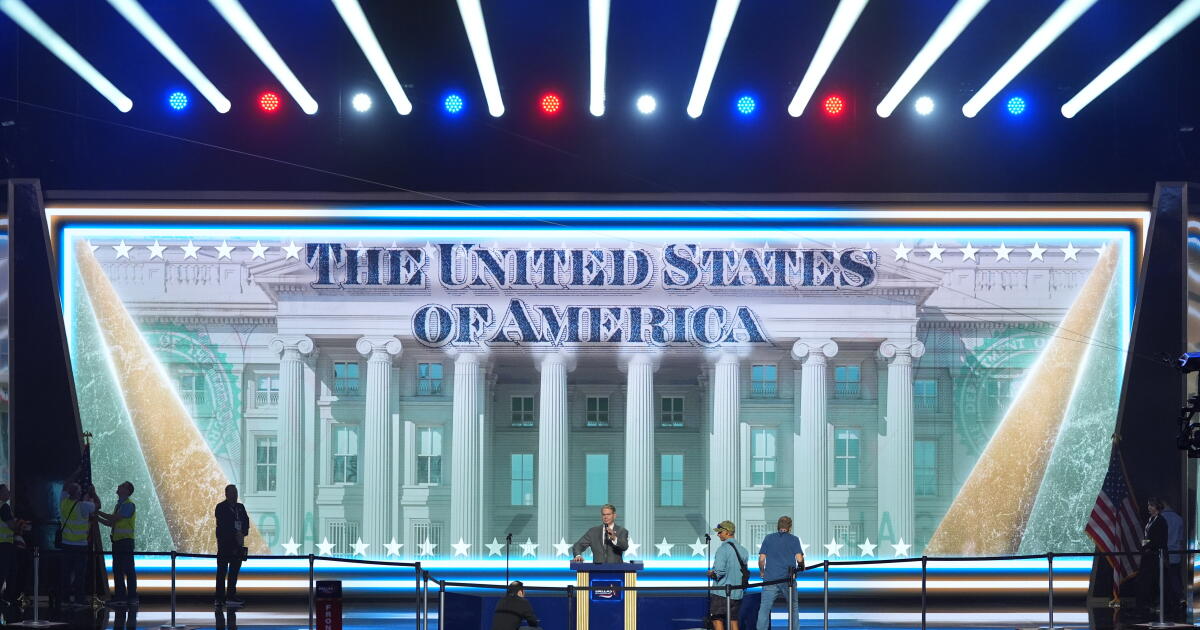
Republicans gather in Dallas for two-day midterm convention billed as a ‘Trump-a-Palooza’
NEW YORK — Republicans are gathering in Dallas on Wednesday for a highly unusual midterm convention, a “Trump-a-Palooza” that will put President Trump at the center of this fall’s midterm elections — whether the candidates running like it or not.
Many party members, including those facing tight races, are skipping the two-day affair, citing conflicting obligations or balking at demands that they pony up for access. Others are hoping an appearance alongside Trump will put them in the national spotlight as they work to turn out his voters without him on the ballot.
The convention, which is part rally and part fundraiser, comes as Republicans try to boost enthusiasm heading into the midterms’ final stretch despite Trump’s low approval ratings. Organizers have cast it as “a primetime showcase for President Trump’s success, candidates, and causes that have propelled the 2026 midterms to unprecedented focus.” Much of the programming will focus on Democrats, trying to cast them as extremists by highlighting the party’s insurgent left wing.
The lineup features Trump and more Trump
Normal political conventions are held every four years and serve a purpose beyond pomp and circumstance, with parties formally nominating their presidential picks. In 2024, Trump used the opportunity to announce JD Vance as his running mate.
The schedule this week released by organizers makes clear that the convention will be the Trump Show, through and through.
“It’s gonna be a Trump-a-Palooza,” RNC Chairman Joe Gruters told Spectrum News.
The president will be speaking both nights, delivering a keynote address on Wednesday night and speaking again Thursday after Vance to close out the event. He had originally been scheduled for only one speaking slot.
Also addressing the convention will be members of the Republican congressional leadership and Cabinet members including Atty. Gen. Todd Blanche and Health Secretary Robert F. Kennedy Jr. The president’s oldest son, Donald Trump Jr., is on the roster, too.
Candidates who will speak include Michigan Senate nominee Mike Rogers, who is running a high-profile race against Abdul El-Sayed, and North Carolina Senate nominee Michael Whatley, who is up against former Gov. Roy Cooper.
Organizers have outlined 12 hours of programming over the two nights that will include more than 100 speakers and segments focused on subjects like tax cuts, fraud allegations, border security and a proposed ban on members of Congress trading stocks.
Missing from the public lineup: any mention of the unpopular war with Iran.
Republican House Speaker Mike Johnson said some members of his caucus plan to skip Dallas, preferring to stay home and campaign for reelection, but many of them will make an appearance.
“We’ll parade our stars across the stage,” he said.
Many will be skipping the event
An Associated Press survey of more than four dozen Republican candidates found a majority either planned not to attend, said their plans were to be determined, or ignored requests for comment.
“I had stuff already planned in my congressional district or I would be there,” Kentucky Rep. James Comer told NewsNation. “Got a lot going on back in Kentucky, so my time is needed there.”
“Well, unfortunately, I have a family obligation, so I won’t be able to be there,” Georgia Rep. Buddy Carter said on Fox Business.
Some members balked at high attendance fees. Republican House members were being asked to pay $25,000 for convention tickets and lodging, according to people familiar with the situation and granted anonymity to speak frankly about the private arrangement.
An additional 2,000 tickets were distributed by the House GOP’s campaign arm, largely to donors and others to attend the convention. Other tickets were allocated to state parties to distribute as they saw fit.
“Per the RNC, this is a ticketed fundraiser and rally, not a traditional national convention,” the Denton County Republican Party in Texas wrote in a Facebook post, which advertised packages from $5,000 to $20,000.
The Republican Party of Virginia was offering a relative discount of $1,000 to $1,500, not including accommodations, according to an email obtained by the AP.
Despite the many no-shows, more than 100 Republican House members and candidates are expected to be in Dallas, including almost all of the MAGA Majority class of candidates in the most targeted congressional districts, according to a person familiar with the event who requested anonymity before it begins.
“It’s like any political convention, it’s no different than the traditional RNC,” said Matt Beynon, a spokesperson for Pennsylvania Rep. Scott Perry, who won his district by barely 1 percentage point in 2024 with Trump on the ballot. “Obviously, you’re out of the district, but it’s a really good opportunity to get in front of people” and “talk to the press.”
It remains unclear what kind of air time the convention will receive. The two nights of programming will coincide with the launch of football season. The NFL season is set to kick off Wednesday with a game between the Seattle Seahawks and the New England Patriots. And on Thursday, the San Francisco 49ers and Los Angeles Rams will be playing an international game in Australia.
In a sign of the growing focus on the midterms, Trump’s political organization, which is sitting on a big war chest, is spending heavily to back a new group, the No Going Back PAC Inc., The New York Times reported Wednesday. The new group started reserving $47 million for six competitive Senate races and one competitive House race. That’s in addition to the $10 million the Trump-affiliated MAGA, Inc. political group is spending in the Texas Senate race.
Democrats say Republicans are out of touch
Democrats, meanwhile, are planning their own counterprogramming.
“The fact that these Republicans are planning a celebration in the middle of an economic crisis — where everyday Americans are drowning because of this high cost of living — is extraordinary,” Rep. Hakeem Jeffries, the House Democratic leader, said at the U.S. Capitol.
Democrats have held such midterm conventions in the past but are not doing so this year. Rep. Suzan DelBene of Washington, chair of the Democratic Congressional Campaign Committee, said she wasn’t worried that her party was missing an opportunity to make its case on a national stage like Republicans.
“They are not focused on the issues that people are struggling with right now, that they’ve created,” DelBene said. “Cost, housing, food, healthcare, childcare, energy costs, gas prices all going up. That’s what we’re talking about on the ground all across the country.”
Americans “are going to continue to see how much they don’t care,” she added. “And we’re gonna be on the ground all across the country with great candidates talking directly to the American people.”
Colvin writes for the Associated Press. AP writers Steven Sloan and Lisa Mascaro in Washington, Marc Levy in Harrisburg, Pennsylvania, Hannah Fingerhut in Des Moines, Iowa and Sarah Rankin in Richmond, Va., contributed to this report.