Feb. 27 (UPI) — President Donald Trump announced he was directing all federal agencies to stop using Anthropic’s artificial intelligence solutions even as it’s the only one being used in the military’s classified systems.
Trump lashed out on his social media network Truth Social Friday.
“THE UNITED STATES OF AMERICA WILL NEVER ALLOW A RADICAL LEFT, WOKE COMPANY TO DICTATE HOW OUR GREAT MILITARY FIGHTS AND WINS WARS! That decision belongs to YOUR COMMANDER-IN-CHIEF, and the tremendous leaders I appoint to run our Military,” he posted.
“The Leftwing nut jobs at Anthropic have made a DISASTROUS MISTAKE trying to STRONG-ARM the Department of War, and force them to obey their Terms of Service instead of our Constitution. Their selfishness is putting AMERICAN LIVES at risk, our Troops in danger, and our National Security in JEOPARDY,” he wrote.
But an unnamed source told Axios that despite the president’s post, Anthropic and the Pentagon were still negotiating ahead of the 5:01 p.m. deadline that Defense Secretary Pete Hegseth set.
Undersecretary of Defense for Research and Engineering Emil Michael called Anthropic CEO Dario Amodei a liar on X. “It’s a shame that @DarioAmodei is a liar and has a God-complex. He wants nothing more than to try to personally control the U.S. Military and is OK putting our nation’s safety at risk,” he posted on X. “The @DeptofWar will ALWAYS adhere to the law but not bend to whims of any one for-profit tech company.”
Trump’s post continued: “Therefore, I am directing EVERY Federal Agency in the United States Government to IMMEDIATELY CEASE all use of Anthropic’s technology. We don’t need it, we don’t want it, and will not do business with them again! There will be a Six Month phase out period for Agencies like the Department of War who are using Anthropic’s products, at various levels. Anthropic better get their act together, and be helpful during this phase out period, or I will use the Full Power of the Presidency to make them comply, with major civil and criminal consequences to follow,” the president said.
“WE will decide the fate of our Country – NOT some out-of-control, Radical Left AI company run by people who have no idea what the real World is all about.”
Anthropic’s AI model Claude was used to capture Venezuelan president Nicolas Maduro and could be used in Iran, if needed. Axios reported that defense officials praised Claude’s abilities and one admitted that it would be a “huge pain in the ass” to stop using it.
Anthropic faced a 5 p.m. EST deadline to comply with the Pentagon and allow it to use the company’s artificial intelligence system without restraint.
If Anthropic declines, Hegseth has said he will have the company labeled a “supply chain risk” or invoke the Defense Production Act to force it to agree.
In July, Anthropic signed a $200 million contract with the Pentagon, but Amodei insists that its AI model Claude not be used for mass surveillance in the United States or for autonomous weapons without human approval.
The Defense Department has said it doesn’t plan to use the tools in that manner, but that Anthropic doesn’t get to make those decisions. It says the U.S. government can use tools “for all lawful purposes.”
“Legality is the Pentagon’s responsibility as the end user,” a senior Pentagon official told NPR.
On Thursday, Amodei said the company wouldn’t agree to the Pentagon’s terms.
“I believe deeply in the existential importance of using AI to defend the United States and other democracies and to defeat our autocratic adversaries,” he wrote in a statement. “Anthropic understands that the Department of War, not private companies, makes military decisions. We have never raised objections to particular military operations nor attempted to limit use of our technology in an ad hoc manner.
“However, in a narrow set of cases, we believe AI can undermine, rather than defend, democratic values. Some uses are also simply outside the bounds of what today’s technology can safely and reliably do. Two such use cases [domestic surveillance and autonomous weapons] have never been included in our contracts with the Department of War, and we believe they should not be included now.”
Amodei acknowledged Hegseth’s threats to blacklist the company or force it to comply.
“These threats do not change our position: we cannot in good conscience accede to their request,” Amodei wrote. “But given the substantial value that Anthropic’s technology provides to our armed forces, we hope they reconsider.”
Pentagon spokesperson Sean Parnell said on X Thursday: “Here’s what we’re asking: Allow the Pentagon to use Anthropic’s model for all lawful purposes. This is a simple, common-sense request that will prevent Anthropic from jeopardizing critical military operations and potentially putting our warfighters at risk. We will not let ANY company dictate the terms regarding how we make operational decisions. They have until 5:01 p.m. ET on Friday to decide. Otherwise, we will terminate our partnership with Anthropic and deem them a supply chain risk for DOW [Department of Defense].”
Geoffrey Gertz, a senior fellow at the Center for a New American Security, told NPR that both measures the Pentagon threatened are unusual and contradictory.
“It’s this funny mix where they both are such a risk that they need to be kicked out of all systems, and so essential that they need to be compelled to be part of the system no matter what,” he said.
Lauren Kahn, a senior research analyst at Georgetown’s Center for Security and Emerging Technology, told CNBC: “There are no winners in this. It leaves a sour taste in everyone’s mouth.”
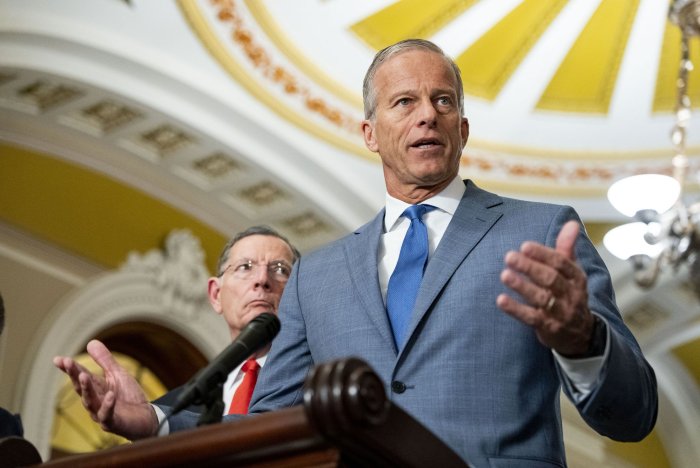
Senate Majority Leader John Thune, R-S.D., speaks during a press conference after the weekly Republican Senate caucus luncheon at the U.S. Capitol on Wednesday. Photo by Bonnie Cash/UPI |
License Photo