procurement

European Commission proposes EU preference in public procurement, excluding Chinese firms

Published on Updated

The European Commission unveiled on Wednesday a legislative proposal allowing EU public authorities to favour European companies in public procurement for key public services such as energy, water, railways, ports, airports and postal services.


ADVERTISEMENT


ADVERTISEMENT

The move comes as European policymakers seek to shield the bloc’s market from China amid heated trade negotiations, as the EU grapples with a trade deficit with Beijing of roughly €1 billion a day.

Public procurement markets in Europe represent €2 trillion every year — 15% of Europe’s GDP.

“Public money must serve our collective interests,” Commission Vice-President Stéphane Séjourné said on Wednesday. “A public buyer will be able to organise his European preference and to exclude operators coming from countries with which we do not agree on public markets, both on the basis of the nationality of the company or on the base of the origin of the products.”

Under the Commission’s proposal, EU public authorities will be able to exclude non-European companies from public contracts when they come from countries that do not allow Europeans access to their own public procurement markets.

“A municipality will be very clearly able to exclude a Chinese company or a European company that offers Chinese products,” Séjourné added. “It will also be able to give more points and more visibility in his offer to European offers compared to competition offers.”

Swift reaction from China

The Commission proposes that at least 30% of the evaluation of supplies for public procurement rely on quality criteria and not only on price, which will also hit low-cost Chinese products.

“The new standard is the best quality-price ratio, and not just the price,” Séjourné said. “Our choices must also be able to meet social and environmental demands, but also sovereignty.”

The legislation, which still has to be adopted by the EU co-legislators — the European Parliament and the EU Council — prompted a swift reaction from China. In a statement released after the commission’s announcement, China’s Chamber of Commerce to the EU said that such a European preference could “distort a level playing field” for Chinese companies participating in the European public procurement market.

“Public procurement should not discriminate against suppliers or goods on the basis of the supplier’s nationality or the country of origin of the goods.”

In March, another proposal creating a European preference in EU strategic sectors such as green tech, cars and energy-intensive industries also prompted Chinese ire, with Beijing threatening to retaliate.

EU Trade Commissioner Maroš Šefčovič will travel to China in early October, hoping to reach a political deal with Beijing to rebalance the trade relationship with the EU.
Source link

Poland’s Name Appears in U.S. F-15EX Deal, Warsaw Denies Procurement Plans

In an intriguing development, Poland has been named among the Foreign Military Sales (FMS) customers covered by a massive new U.S. contract with Boeing for the F-15 program. This has prompted renewed speculation that Warsaw could eventually acquire the F-15EX Eagle II. Poland’s Ministry of National Defense, however, says there is currently no such plan, but there is a precedent here, with the Polish order for AH-64E Apache Guardian attack helicopters following a very similar path.

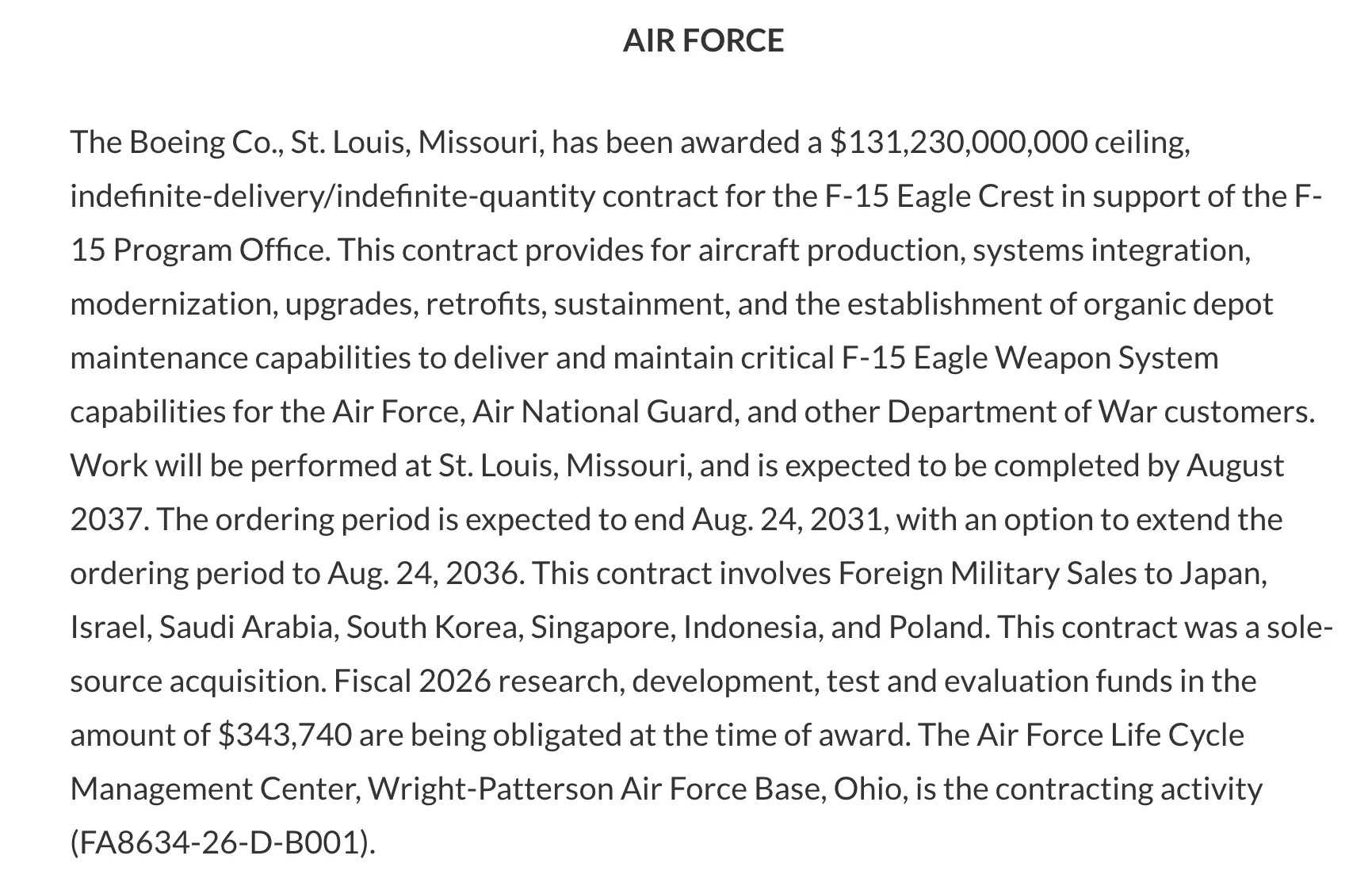
The U.S. Department of War announced Monday that Boeing had received an indefinite-delivery/indefinite-quantity contract with a ceiling value of $131.23 billion for the “F-15 Eagle Crest” program. The agreement covers production, systems integration, modernization, upgrades, retrofits, sustainment and the establishment of depot-level maintenance capabilities for F-15 aircraft. Work is expected to continue through August 2037, with orders initially permitted through August 2031 and an option to extend that period to 2036.

The distinction is significant. An IDIQ contract establishes a mechanism through which orders can subsequently be placed; it does not itself constitute an aircraft purchase by every country named within it. The $131.23 billion figure is therefore a maximum contractual ceiling for the wider F-15 program, rather than the value of aircraft already ordered by the United States and its foreign customers.

Importantly, the contract also covers Foreign Military Sales customers. The Pentagon specifically lists Japan, Israel, Saudi Arabia, South Korea, Singapore, Indonesia, and Poland.

Of these, it should be noted that Indonesia was once in line to be the first export operator of the F-15EX, but, earlier this year, Boeing confirmed the country had abandoned its plans to buy the jets. The deal had been in stasis for the previous two years.

An Indonesian delegation, led by Indonesian Minister of Defense Prabowo Subianto (center), during a visit to Boeing’s St. Louis facility. Boeing

Poland, however, had never formally announced plans to order the F-15EX, although Boeing eyes the country as a potential customer for the aircraft.

Boeing has actively promoted the F-15EX to Warsaw, while Polish military officials have previously visited the company’s facilities in the United States. In 2025, then-Inspector of the Polish Air Force Gen. Ireneusz Nowak flew an F-15EX at Boeing’s facilities.

The aircraft has frequently appeared in discussions about Poland’s requirement for additional fourth-generation fighters. Warsaw has already committed to a large expansion of its fifth-generation F-35 fleet, with Polish officials confirming plans for another 32 F-35As in addition to the 32 aircraft already ordered.

One of the first three Polish Air Force F-35 fighter jet, known in Poland as Husarz, during a ceremony marking the aircraft's official entry into service at the 32nd Tactical Air Base in Lask, Poland, on June 12, 2026. NO SALES POLAND (Photo by Andrzej Iwanczuk/NurPhoto via Getty Images)
One of the first three Polish Air Force F-35 fighter jet, known in Poland as Husarz, during a ceremony marking the aircraft’s official entry into service at the 32nd Tactical Air Base in Lask, Poland, on June 12, 2026. Photo by Andrzej Iwanczuk/NurPhoto via Getty Images Andrzej Iwanczuk
F35 - HUSARZ thumbnail

F35 – HUSARZ


As we have discussed in the past, the F-15EX could provide a compelling complement to the F-35, providing a large weapons payload, long range, and a substantial air-to-air weapons capacity. But there is currently no indication from Poland that such a procurement has entered a formal acquisition phase.

Poland’s Ministry of National Defence told Defence24 that the Polish Armed Forces “do not plan to acquire F-15EX aircraft” and that the country’s inclusion in the U.S. framework contract does not mean a decision has been made or that a procurement process has begun.

As it is, the wording of the U.S. announcement is best understood as identifying countries that can potentially participate in F-15 Foreign Military Sales under the new contractual framework.

For Poland, Washington has established a long-term contractual vehicle that could facilitate a future F-15EX purchase, even though Warsaw says it has no current plan to acquire the aircraft.

Whether that changes in the future remains a separate question. However, as Gareth Jennings, aviation desk editor at Janes, has pointed out, in 2017 the U.S. Department of Defense denied that Poland had selected the AH-64 after it was named in a similar contract, for sensors. Not long after, Warsaw became the largest international customer for the Apache, buying 96 examples of the attack helicopter.

A Polish Army Boeing AH-64 Apache attack helicopter flies over the city during the Polish Armed Forces Day military parade in Warsaw, Poland on 15 August 2026. (Photo by Marek Antoni Iwanczuk/NurPhoto via Getty Images)
A Polish Army Boeing AH-64 Apache attack helicopter flies over the city during the Polish Armed Forces Day military parade in Warsaw, Poland on August 15, 2026. Photo by Marek Antoni Iwanczuk/NurPhoto Marek Antoni Iwańczuk

Boeing today told Jennings that Poland has not yet made a decision about the F-15EX.

As for the Apache buy, this is just one part of an extraordinary military expansion underway since Russia’s full-scale invasion of Ukraine. Warsaw has pursued major acquisitions across nearly every part of its armed forces, including 48 FA-50 light combat aircraft, 180 K2 tanks and 250 M1A2 SEPv3 Abrams tanks, alongside its 32-aircraft F-35 order. Its existing fleet of F-16 fighters is also set for a major upgrade.

With the FMS case for Indonesia having expired earlier this year, an F-15EX sale to Indonesia now looks far less likely.

For now, there is no Polish F-15EX deal, and Warsaw is clear that no procurement process has begun. But the country’s inclusion in the U.S. framework, combined with Boeing’s continued interest and the Apache precedent, means the possibility is worth watching.

Contact the author: thomas@thewarzone.com

Thomas Newdick is a staff writer at TWZ, where he covers military aviation, defense technology, weapons systems, and international security. Based in Berlin, Germany, he reports on conflicts, military modernization efforts, and emerging aerospace technologies around the world, with a particular interest in airpower and its role in contemporary warfare. His reporting is informed by deep expertise in modern and historical airpower, particularly in Europe, with a focus on military aviation, air campaigns, and aerospace developments across the continent and beyond.


Source link