problems

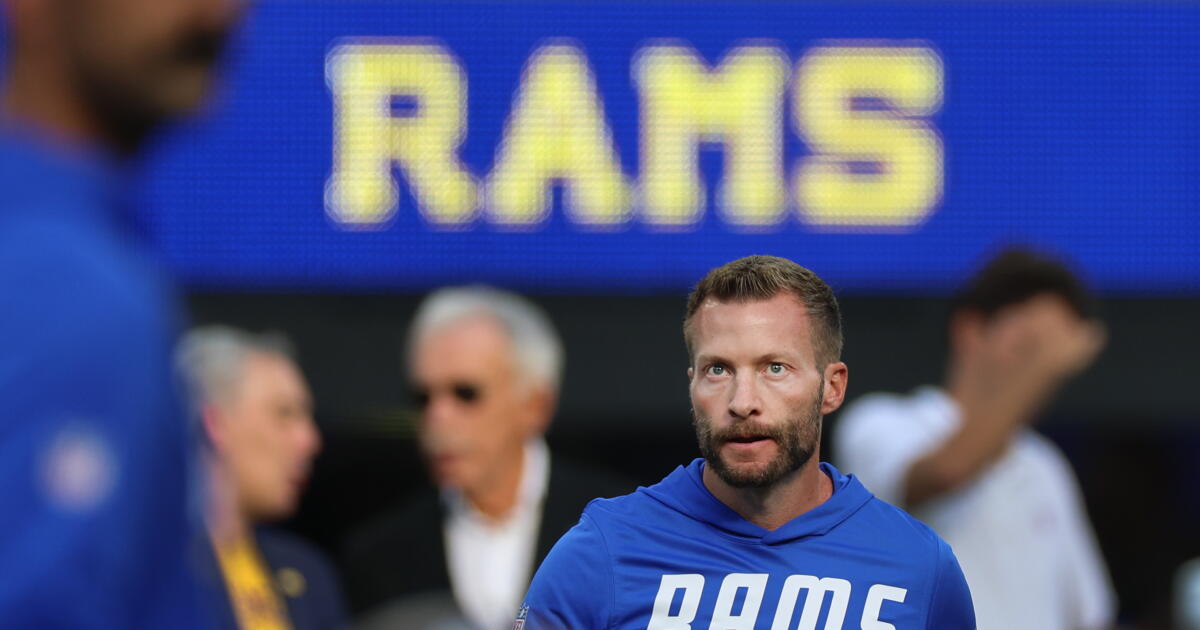
Sean McVay knows Rams must fix special teams problems vs. Cardinals

Though not part of an NFL punter’s official job description, Ethan Evans was on the phone seeking information again this week.

Evans called players who were holders for new Rams kicker Blake Grupe in New Orleans and Indianapolis.

“I was like, ‘Hey, what do I need to know about him?’” Evans said. “‘Is there anything special he wants with holds?’”

Evans is accustomed to the research.

In 2023, the Rams replaced Brett Maher during the season with Lucas Havrisik, and then eventually re-signed Maher. Last season, Harrison Mevis replaced Joshua Karty at midseason, and now Grupe replaces Mevis.

Special teams miscues — including surrendering a 70-yard kickoff return, a missed field-goal attempt and a blocked field-goal attempt — helped doom the Rams again Monday in a 37-34 overtime defeat by the Buffalo Bills at SoFi Stadium.

On Sunday, the struggling 2-3 Rams will attempt to bounce back against the struggling Arizona Cardinals (1-4).

“I want to see this get fixed,” coach Sean McVay said of special teams breakdowns, adding, “Let’s have solves, let’s have solutions and let’s give our players a chance to be able to have 11-as-one executed in each phase as consistently as possible.

“That’s what we’re going to keep striving for,” he said before quipping, “and I’m hopeful that it does happen so I don’t have to keep talking about it.”

Said special teams coordinator Bubba Ventrone: “It ultimately comes down to reverting back to your fundamentals and your techniques that enable you to be able to protect, block, tackle, all of those things.”

After playing four of their first five games against teams that made the playoffs last season, the Rams will face a Cardinals team coached by former Rams offensive coordinator Mike LaFleur.

LaFleur is the latest former Rams offensive assistant to be hired as a head coach. His older brother Matt LaFleur coaches the Green Bay Packers, Zac Taylor the Cincinnati Bengals, Kevin O’Connell the Minnesota Vikings and Liam Coen the Jacksonville Jaguars.

Former Rams defensive coordinators Brandon Staley and Raheem Morris also parlayed their time under McVay into head coach roles.

“As much as I love Sean, haven’t really thought of him too much,” Mike LaFleur told Arizona reporters this week, “and I’m sure he’s kind of feeling the same way about me right now.”

McVay said he talks with LaFleur “a lot.” But had not this week, “just because it’s been busier than normal, but I will talk to him at some point.”

McVay was busy releasing Mevis and signing Grupe, and dealing with the NFL’s suspension of left tackle Alaric Jackson.

The league initially suspended Jackson for two games for striking Bills linebacker Bradley Chubb in the face on the field after the Rams’ defeat. The suspension was reduced to one game on appeal.

Veteran David Quessenberry, a ninth-year pro who last started a game in 2023, will start in place of Jackson as quarterback Matthew Stafford’s blindside protector.

“This is kind of why I’m here — when things like this happen,” Quessenberry said. “So I’m ready to go. This is what I’ve worked for … I’m fired up.”

Source link

Column: Becerra on cruise control, Hilton offers contrived fixes for California’s problems

Look, Xavier Becerra could cruise to a South Pacific island and bask on the beach until election day and Californians would still choose him as their next governor.

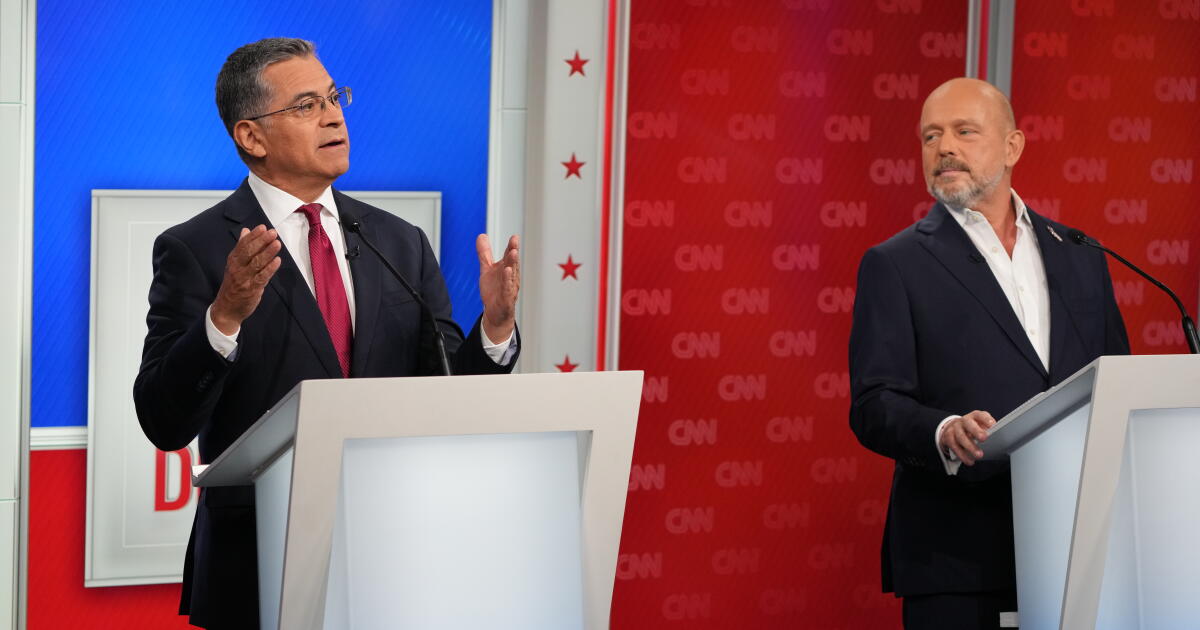
So, last week’s televised CNN debate between Becerra and Republican Steve Hilton really had no election significance, although it was important for the Democratic frontrunner in other ways.

Who won the debate? Becerra, because he came across as calm, collected and capable of governing this troubled state — certainly very few voters’ ideal candidate, but the only real choice for most Californians.

There’s simply no way Becerra can lose on Nov. 3 because his only opponent is a Republican. Californians will not elect a Republican governor in this polarized era, particularly one endorsed by the reviled President Trump.

Moreover, Hilton’s only previous political experience was as an advisor to a British prime minister and his sole claim to U.S. notoriety was as a Fox News TV host–not exactly resume boosters in California.

Becerra — with public office experience spanning more than three decades — held a growing 25-point lead in a recent poll by the UC Berkeley Institute of Governmental Studies.

He’s a shoo-in simply because he has a “D” beside his name in this state where Democrats outnumber Republicans nearly 2-to-1 and despise the GOP president.

Californians haven’t elected a Republican to statewide office in 20 years — and that’s Hilton’s main pitch to voters.

You’re reading the L.A. Times Politics newsletter

Expert columnists cover the insights, legislation, players and politics you need to know.

“The definition of insanity is doing the same thing and expecting a different result,” the GOP candidate asserted during the debate, as he does several times a day.

Turning to Becerra, Hilton said:

“You’re the candidate who is supported by the machine in Sacramento — the unions, big business, all these people that for 16 years have given us the highest cost of living in the country, made it impossible to build anything, given us the highest unemployment rate, the highest poverty rate….

“And that’s why we’ve got to try something different this time instead of voting for more of the same.”

OK, fair point. But try what exactly? That’s where Hilton stalls or veers erratically.

He’d build “10 new cities.” Build them where exactly? He doesn’t say.

He definitely doesn’t want to construct new apartment buildings in the suburbs “when we have got so much space that we could be building on in California.”

Like out in Southern California deserts or Central Valley farm fields — requiring two-hour commutes to urban jobs?

And where does the water come from for these 10 new cities as the West scrambles for what’s left of diminishing supplies? But unfortunately there was no discussion of that during the debate.

One debate exchange that caught my attention was about vaccines. Hilton seemed to be carrying the torch for whacko anti-vaxxer Robert F. Kennedy Jr., Becerra’s successor as U.S. health secretary in the Trump administration.

Debate co-moderator Dana Bash recalled what Hilton said previously about children’s vaccinations: “The government should have nothing to do with these fundamental and vital decisions.” And she asked whether he’d push to eliminate California’s vaccine requirements.

“No,” Hilton replied. “I’m pro vaccine.” But then he seemed to wander all over the stage looking to have it both ways.

It’s a “very, very emotional issue for a lot of parents,” he said, adding there’s “data around the world” showing that where vaccine “mandates are lower… you actually have higher [vaccination] compliance, where parents don’t feel that they’re being bullied into doing something that they don’t want to do. And that’s what I want to see here.”

But he ultimately said,“I’d follow the law.”

In California, the law requires all children without medical exemptions to be vaccinated for several diseases — including polio, measles, mumps, chickenpox, hepatitis B and whooping cough — before they’re admitted to school.

That’s a blessing. When I grew up, practically every kid at some point was bedridden with one or more of those dangerous ailments. Then some saviors invented vaccines.

“We had nearly eradicated measles,” Becerra said, responding to Hilton. “When I left HHS, you rarely heard of a case of measles…. Today, children are dying of measles. Today, the spread of measles has reached a proportion we haven’t seen since the 1960s.

“That’s what happens when vaccine deniers take over.”

Becerra achieved all he needed to in the debate. He didn’t screw up. He kept cool and actually was fairly quick on his feet in replying to Hilton’s attacks, while planting a MAGA hat firmly on the Republican’s head.

He missed an opportunity to accomplish more, however — like making Californians feel really good about voting for him, rather than merely because he’s the only Democrat left standing in the contest to replace the termed out Gov. Gavin Newsom.

Voters might like to hear what Becerra’s vision is — if he has one — for the California he wants to build.

What does he have in mind besides just defending California against Trump? That’s a given. How’s he going to lower our living costs? Upgrade public education? Prevent wildfires? Details, not platitudes.

Rather than relaxing on his lead, Becerra should be constantly moving around the state, introducing himself to Californians and — more importantly — listening to their problems and ideas. To his credit, he’s doing that this week.

“The debate was boring and uneventful, but Becerra won it,” says Republican consultant Rob Stutzman. “He is perfectly vanilla and that makes it really hard to pin him down in an attack.”

“We got the genuine Xavier Becerra. That’s exactly who he is,” says veteran Democratic strategist Garry Sragow, a longtime political ally. “Thoughtful, committed and very decent, but does not go very high on the charisma meter.”

In California right now, a candidate’s charisma rates much lower than a simple “D.”

What else you should be reading

The must-read: Voter ID proponents accuse California Democrats of lying about Trump’s support for Prop. 39
Eyes of the World: Will or won’t they? Newsom and Harris weigh 2028 contest — and possible collision
The L.A. Times Special: Voter guide to the 2026 California general election

Until next week,
George Skelton

—
Was this newsletter forwarded to you? Sign up here to get it in your inbox.
Source link

‘Digger’ could add to Warner Bros.’ box office problems

Tom Cruise is one of the bankable stars in Hollywood. But his pull may not be enough to lift his upcoming film “Digger” from a likely hard fall at the box office this weekend.

That would be unwelcome news for Warner Bros., whose movies have largely struggled to connect with audiences this year, in contrast to 2025, when the studio ran up a string of hits such as “Sinners” and “Weapons.”

All of this comes as the studio braces for an uncertain future with Paramount Skydance’s $111-billion acquisition of Warner Bros. Discovery set to close on Tuesday.

“No single film is going to capsize the boat,” said Stephen Galloway, dean of the Dodge College of Film and Media Arts at Chapman University. “However, it’s coming at a precarious time because it follows a series of less-than-successful releases at the very moment when the Warner Bros.- Paramount deal has been greenlit, and everybody — no matter how high up — is terrified for his or her job.”

Matching the success of the 2025 film slate was always going to be a tall order, particularly when so many of Warner Bros.’ movies that year overperformed.

So far this year, the studio’s domestic box office haul is $437.7 million, representing about 5.6% of the total theatrical revenue in the U.S. and Canada, according to Rentrak data.

Last year, Warner Bros.’ total at this time was $1.8 billion, aided by back-to-back successes starting with “A Minecraft Movie,” which went on to become the highest-grossing movie at the domestic box office during that calendar year.

The studio currently does not have any film in the top 20 of domestic box office earners this year, which includes some holdovers from 2025, with Emerald Fennell’s adaptation of “Wuthering Heights” ranking at 21 with $84 million. Bets on films like Maggie Gyllenhaal’s “The Bride!” cratered, while DC Studios’ “Supergirl” misfired.

“Digger” is unlikely to turn things around.

The satire from director Alejandro González Iñárritu about an impending climate change apocalypse has divided critics, yielding very mixed reviews. Tracking predictions for the film’s debut have steadily trended downward and settled between $15 million and $19 million.

That would be a major miss, given the film’s production budget was about $125 million (not counting marketing costs).

“Digger” faces several hurdles. For one, the film has a major twist, which complicates its marketing and makes it difficult to tell audiences what it’s about.

Then there’s Cruise’s nearly unrecognizable performance as Digger Rockwell, an eccentric oil tycoon whose drilling operations have led to the unfolding climate disaster. Clad in prosthetics with a head full of graying hair, Cruise is far from his usual stunts-heavy, bravado-filled roles, which could make his typical audience less likely to come out to theaters, analysts said.

“It has a lot of question marks,” said David A. Gross, who writes the movie industry newsletter FranchiseRe. “It doesn’t look like it’s heading for financial success.”

The film will have value to Warner Bros. beyond its theatrical reception. “Digger” probably will also make money through ancillary revenue streams such as premium video on demand and streaming, industry experts said. And if Cruise wins his much-coveted Oscar for his role as Digger, that is also a plus, Galloway said.

Beyond the fate of “Digger,” Warner Bros.’ theatrical business will be of prime importance to the combined Paramount-Warner company.

Last year, Warner’s studio business, which includes both film and television production, brought in $12.6 billion in revenue. This year, it’s projected to generate $11.1 billion, according to market expectations. On a positive note, Warner Bros. still has its animated “The Cat in the Hat” film releasing in November and the popular “Dune: Part Three” at the end of the year.

The prospects for Warner Bros. should improve next year, when the film and TV studios are expected to amass $11.7 billion in revenue, driven by strong titles including the sequel to “Minecraft” and a new “Lord of the Rings” movie, according to Bernstein research.

Aside from theatrical revenue, Warner Bros.’ film and TV properties have been key drivers of business to HBO Max and will also provide valuable content to Paramount+, particularly as the linear cable networks continue to decline.

“I would argue the studios are the very reason Paramount Skydance is buying Warner Bros.,” said Laurent Yoon, senior analyst at Bernstein. “Everything starts with the studios.”

The combined company is also legally required to release at least 30 films a year as part of a settlement agreement over antitrust claims with 12 state attorneys general, including California’s Rob Bonta. Paramount Chief Executive David Ellison has previously said the two studios would each release 15 films a year.

But the type of content the studios release could change after the merger is completed. Under film chiefs Pam Abdy and Mike De Luca, Warner Bros. developed a reputation for auteur-driven, original stories, particularly after the success of the 2025 slate. Ellison’s slate has trended toward blockbuster fare.

The combined company will also face a massive debt load of more than $80 billion after the merger closes, meaning there may be greater pressure for future films to be hits.

“Ellison is primarily in the business of delivering blockbusters,” Galloway said. “That’s going to be even more important as he tries to right the ship of his debt.”

Source link