probes

Jeffries backs Hegseth impeachment as Democrats vow probes of Trump allies | Donald Trump News

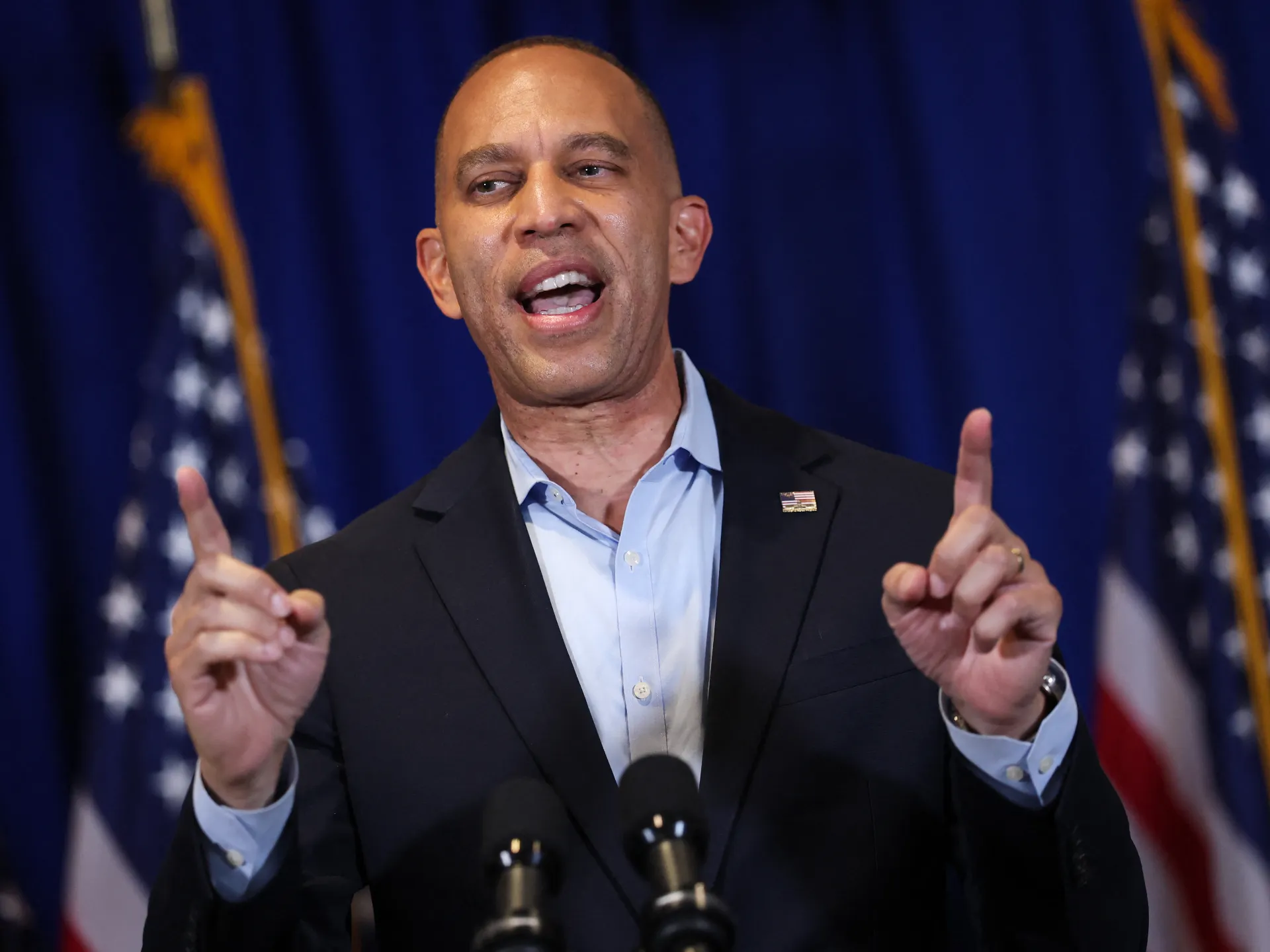
United States House Minority Leader Hakeem Jeffries has thrown his support behind impeaching Defense Secretary Pete Hegseth, as the Democratic Party prepares to use its incoming congressional majorities to probe President Donald Trump’s administration.

In a Sunday appearance on the Television show This Week with George Stephanopoulos, Jeffries weighed in on the upcoming impeachment resolution, anticipated for the coming days.

Recommended Stories

list of 3 itemsend of list

“I’m a hard yes on the Hegseth resolution,” Jeffries said. “The so-called secretary of defence has abused his power, undermined our national security, and engineered this reckless and costly war of choice in Iran.”

The impeachment resolution has been spearheaded by outgoing Republican Representative Thomas Massie of Kentucky, a vocal critic of the US-Israel war on Iran.

“Pete Hegseth has got to go,” Jeffries added. “I believe there will be incredibly strong support for that resolution.”

Investigating ‘unprecedented corruption’

Jeffries is poised to become the next speaker in the House of Representatives after Democrats notched a historic victory in the November 3 midterm elections.

Both the House and the Senate flipped into Democratic control, with the left-wing party making some of its biggest gains in the lower chamber in more than half a century.

Democrats are expected to use their new congressional majorities to launch investigations into the Trump administration.

There have also been concerns, voiced by Trump himself, that he and other top officials could face impeachment.

In Sunday’s interview, Jeffries said the Democratic majority would move “aggressively” in its first 100 days in office, both to address affordability and “unprecedented corruption” under Trump.

“We are committed to cleaning up the mess wherever it’s found,” Jeffries said. “That’s in Congress, in the Supreme Court, and with respect to this administration.”

Currently, Republicans hold a government “trifecta”, with control of both chambers of Congress and the presidency. The Supreme Court also boasts a conservative supermajority, shaped by three Trump appointees.

But a new Congress will be sworn in on January 3. In the coming weeks, Democrats will choose their party leaders for both chambers.

Representative Robert Garcia formally announced his bid to lead the House Oversight Committee in a letter to colleagues on Thursday.

The committee is the chamber’s principal investigative panel, with the power to subpoena witnesses and documents.

‘Very serious’ allegations

On Sunday, Garcia told CNN that Stephen Miller‘s influential role in the Trump administration warranted investigation.

Miller, who was named last week as White House chief of staff, has been closely associated with Trump’s hardline immigration policies since his first term as president.

“What we think is that Stephen Miller is the architect of this horrific, unjust policy happening across the country,” Garcia said, pointing to policies of separating immigrant families and accusations of due process abuses.

“Stephen Miller is at the centre of major policy decisions that are happening in the administration, and it does deserve oversight and investigation.”

Garcia also signalled interest in questioning businessman Elon Musk over his leadership in the Department of Government Efficiency (DOGE), a federal initiative that led to widespread federal workforce cuts at the start of Trump’s second term.

DOGE also sought access to sensitive government data, including Americans’ personal information.

“What happened with DOGE, in particular, and the federal employees losing jobs the way they did and people’s data likely being compromised, I think, is very serious,” Garcia said.

Congressional committees have the power to hold hearings, subpoena witnesses, and demand documents, giving lawmakers a constitutional check on the executive branch.

The House can also impeach administration officials if a simple majority votes in favour.

Conviction and removal, however, require a two-thirds vote in the Senate, a high bar even with Democrats controlling the chamber.

Trump’s camp bites back

The White House was quick to draw its own battle lines.

Speaking on CNN’s State of the Union on Sunday, Attorney General Todd Blanche said there could be investigations into Democratic lawmakers over their “threatening” rhetoric.

He added he was ready to counter Democratic efforts to probe and impeach Trump officials.

“If that’s what this new incoming leadership wants to do, we are ready,” said Blanche, a former personal lawyer for Trump. “If you work in this administration, you have a lawyer. It’s me.”

Trump, meanwhile, made similar remarks in a Truth Social post on Saturday.

He called on the Justice Department to investigate Democrats over their plans to haul his allies before congressional committees, branding them as “SLEAZEBAGS” who “should go to jail”.

“The threats being made by the Democrat Party against innocent Republican Donors and Party Members are absolutely unprecedented, and totally illegal,” the president wrote.
Source link

After taking control of Congress, Democrats vow major probes into Trump’s ‘tentacles of corruption’

Corruption topped the list of concerns for voters who ousted Republicans and handed Democrats control of Congress in the midterm elections. Now, the newly empowered Democratic Party is putting the issue front and center as its leaders chart their course for investigations and policymaking.

Senior Democrats in both chambers of Congress have vowed to marshal the subpoena powers and larger investigative staffs that come with their soon-to-be majorities to probe what they say is the self-enrichment that President Donald Trump and people in his orbit have done at the public’s expense. The Republican president and his White House have long denied any wrongdoing.

House Democrats are preparing a vast oversight agenda to look at how Trump and his family have become wealthier since he returned to office — and Democratic leader Hakeem Jeffries of New York, who’s in line to become House speaker, has not ruled out trying to impeach Trump for a third time.

Months ago, Jeffries tasked the ranking Democrats on the Oversight and Judiciary committees, Rep. Robert Garcia of California and Rep. Jamie Raskin of Maryland, with leading the effort, as Democrats work to link the costs of public corruption to the affordability concerns hitting Americans’ pocketbooks.

“Lawyer up,” Garcia posted on X as election results favoring Democrats began coming in on Tuesday night.

The Senate is expected to conduct similar investigations.

“Americans want us to clean up corruption in government,” said Sen. Chuck Schumer, D-N.Y., who is poised to return as Senate majority leader next year. “No American should have to make tradeoffs at the supermarket while Trump is making inside trades on the stock market.”

Investigation targets could include ICE raids, Epstein and DOGE

Garcia, the top Democrat on the Oversight and Government Reform Committee, has outlined five priorities, including Trump family business dealings, the administration’s handling of the Jeffrey Epstein investigation and Immigration and Customs Enforcement operations. Rep. Jared Huffman of California, the ranking Democrat on the Natural Resources Committee, said he wants to dig into Trump’s White House ballroom and other construction projects, as well as the Trump family’s role in mineral deals.

With the House majority comes an infusion of congressional committee staff and resources, and the effort is expected to be sprawling, involving House committees with authority to conduct oversight on Cabinet officials and the agencies they lead.

In the Senate, Sen. Richard Blumenthal, D-Conn., who is expected to become the chairman of the Homeland Security Committee’s Permanent Subcommittee on Investigations, said his panel will want to look into Trump’s real estate projects around the nation’s capital and his crypto dealings with special envoy Steve Witkoff. Witkoff is a longtime ally who partnered with Trump on the president’s family cryptocurrency venture, World Liberty Financial.

“The tentacles of corruption reach deep in this administration, and they have added costs to everyday Americans,” Blumenthal said in an interview with The Associated Press on Wednesday. The senator added that he also wants hearings on ICE raids, the actions of the Department of Government Efficiency and Medicare plans he says are too restrictive and have cost some patients care.

Meanwhile, Democratic Sen. Ron Wyden of Oregon, who is in line to become Senate Finance Committee chairman, ticked off several investigative targets that he describes as part of an “accountability” agenda, including banks that he contends ignored red flags about the financial dealings of Epstein and pharmaceutical companies that have profited from their ties to the Trump administration.

“When I am chair, they will be forced to answer to the Senate Finance Committee for their role in hurting the American people and enabling Trump’s corruption,” Wyden said in a statement Wednesday.

The issue of corruption resonated for voters, The AP Voter Poll shows

Many U.S. voters in Tuesday’s elections expressed deep concerns about government corruption and the state of democracy, according to The AP Voter Poll, which surveyed more than 100,000 voters nationwide.

While roughly 4 in 10 voters said the economy was the top issue facing the country, about 3 in 10 said that “the state of democracy” was the top issue. About half of U.S. voters said government corruption was “crucial” to their vote for Congress, and most of those voters supported the Democratic candidate in their local U.S. House race, while about one-third said they voted for the Republican.

About 8 in 10 voters who said “the state of democracy” was the top issue facing the country supported the Democrat, while about 2 in 10 supported the Republican.

Older voters, those age 65 or older, were more likely than voters under 65 to say “the state of democracy” was the most important issue facing the country. About 4 in 10 older voters pointed to this as the nation’s top problem, compared with about 3 in 10 who said the economy. That view was reversed with younger voters, who were more likely to call the economy the top issue.

That explains why anti-corruption played such a central role in Democratic campaigns this cycle, with candidates accusing their Republican opponents of looking out for themselves or their donors rather than a broader constituency. They embraced stock trading bans and bans on former members of Congress becoming lobbyists and promised to be part of an effort to root out corruption.

Democrats’ challenge: Focusing on corruption without ignoring cost-of-living issues

In his public comments since his party lost the elections, Trump has taken a conciliatory tone toward Democrats, conceding that they “did a good job” in their campaigns as he’s tried to skirt personal blame for the GOP’s midterm thrashing. That could change as investigations ramp up.

“As the president has said, he’s willing to work with anyone to continue delivering victories for hardworking Americans,” White House spokeswoman Lauren Bis said Wednesday. “If Democrats choose to pursue sham investigations and radical left policies, they are choosing to work against the American people.”

Schumer insisted that congressional Democrats will be able to balance legislating on key issues, such as affordability, while launching investigations to target “rampant corruption.”

In a letter to Democratic lawmakers announcing his candidacy for House speaker, Jeffries said the “days of the House functioning like a wholly owned subsidiary of the Trump administration are over.”

“The massive corruption the country has experienced from the Trump Cartel explains why very little is getting done to help everyday Americans,” Jeffries wrote as he promised to target price gouging and push for a stock trading ban for lawmakers. “That changes immediately.”

The challenge for Democrats will be to continue to tie corruption to the affordability issues that topped the list of concerns for voters.

The Congressional Integrity Project, an advocacy group initially created to combat Republican investigations into President Joe Biden’s Democratic administration, is now shifting its focus to help Democratic lawmakers make that connection. In a memo, the group urged congressional Democrats to trace the Trump administration’s actions to people in and outside government, as well as corporations, who may be profiting from those moves.

“Corruption is not just corruption,” said the group’s senior adviser, Jack Miller. “It is costing taxpayers and costing Americans in their everyday lives.”

Some Democratic lawmakers are already stressing that congressional investigations have to be directly tied to affordability issues, while urging restraint.

Sen. Peter Welch, D-Vt., said that Democrats need to earn voters’ trust, and while investigations are an important part of the Democratic agenda, “we can’t turn this into just a vengeance tour.”

“We have to be careful, cautious and judicious about that,” Welch said.

Kim and Jalonick write for the Associated Press. Associated Press writer Lisa Mascaro and polling writer Linley Sanders contributed to this report.

Source link

Top Democrats join California immigrant, Nevada group to sue over federal election probes

Top Democrats in Congress have joined a California immigrant and the Nevada State Democratic Party in suing the Trump administration over its unprecedented voter fraud probes in both states and broader efforts to meddle in state-run elections nationwide — alleging they are a “pretext to seize control over elections.”

The lawsuit, filed in federal court in Washington, D.C., late Tuesday, accuses President Trump, Homeland Security Secretary Markwayne Mullin, Atty. Gen. Todd Blanche and the agencies they lead of using “shoddily compiled lists of supposed noncitizens” and “coercive threats of legal retaliation against state officials” to assert federal control over the Nov. 3 midterms.

In addition to Senate Minority Leader Chuck Schumer, House Minority Leader Hakeem Jeffries and several national Democratic groups, the plaintiffs include Erick Jose Jimenez, an “active California voter” and naturalized U.S. citizen since 2006 who now “fears that he will be unlawfully targeted for voting and disenfranchised (or worse)” given the Trump administration’s track record of misidentifying naturalized citizens as noncitizens.

Lauren Bis, a White House spokesperson, said in a statement that while “Democrats and the media continue to dismiss concerns about voter fraud, the Trump Administration is taking decisive lawful action to protect our elections,” including by “prosecuting election crimes, strengthening election infrastructure security, and protecting vulnerable voters from fraud and coercion.”

“Anyone who illegally votes in our elections will be held accountable,” Bis said.

A Justice Department spokesperson said “election integrity is a top priority” and that the department’s actions are “grounded in the law and being litigated in open court.” A Homeland Security spokesperson said it is “laser focused on prosecuting and removing aliens who vote and preventing the dilution of the votes of U.S. citizens.”

Officials from both agencies have asserted that California and other states have ineffective policies for ensuring noncitizens do not vote — relying in part on voters attesting to being citizens — and staunchly defended their own processes for identifying noncitizens on state rolls.

Democrats and leading elections experts say isolated voter fraud does occur and should be taken seriously, but that there is no evidence of widespread fraud.

Tuesday’s lawsuit cites Trump administration claims of thousands of potential noncitizens on Nevada voter rolls crumbling amid state scrutiny. It also cites an administration list of 20,000 “likely noncitizens” allegedly on California rolls being “proven remarkably slapdash” and inaccurate in recent litigation between the administration and California.

The lawsuit alleges a coordinated effort between Trump and other administration officials — in violation of the 10th Amendment and other federal law — to intimidate state and local elections officials nationwide into removing voters from rolls, denying ballots to legally registered voters and segregating the ballots of others “based on spurious and unreliable claims that they are not citizens.”

It says the president is pushing the above efforts not “in a vacuum,” but in the face of repeated steps by Congress and the courts to block his election agenda.

The lawsuit, backed by prominent Democratic elections attorney Marc Elias, follows another filed in the same court last month by attorneys with the UCLA Voting Rights Project, on behalf of the Coalition for Humane Immigrant Rights, or CHIRLA, and a California voter named Pedro Trujillo.

That ongoing lawsuit challenges the Trump administration’s use of unproven federal databases to allege registered California voters are not citizens, which it says risks misidentifying eligible voters and has left naturalized citizens frightened — the same argument made by Jimenez.

Jimenez, who could not be reached for comment, has “eagerly and consistently exercised his right to vote” since becoming a citizen two decades ago, and plans to vote in the Nov. 3 election but fears being misidentified as a noncitizen and targeted, Tuesday’s lawsuit says.

Administration officials have defended the accuracy of their lists, including in the lawsuit the Justice Department filed against California last week. In that case, the Trump administration has asked the court to force California to set aside the ballots of the 20,000 “likely noncitizens” it flagged until their citizenship is confirmed.

First Assistant U.S. Atty. Bill Essayli, the lead federal prosecutor in L.A., has said that list was compiled using public California voter registration records and third-party and law enforcement data, and that federal authorities have “overwhelming evidence” that those voters are ineligible.

On Monday, federal authorities filed fraudulent registration and other election-related charges against 28 lawful permanent residents in California, which Essayli said “prove our list is accurate and that noncitizens are actually voting.”

However, other administration officials have acknowledged the lists may not be entirely accurate. Acting Deputy Atty. Gen. Trent McCotter said Monday that “there may be some names on there who, it turns out, ultimately are citizens.” A Homeland Security official said in a court filing Monday that “discrepancies” have been found in about 189 of the records.

California Secretary of State Shirley Weber and Dean Logan, head of the Los Angeles County Registrar-Recorder/County Clerk’s office — both named defendants in the California case — have accused the Trump administration of illegally interfering in state elections and trying to purge voters in the immediate lead up to an election in violation of federal law using inaccurate data.

Logan’s office said Tuesday that a preliminary analysis of a subset of the administration’s list found many were born in the U.S., weren’t registered or had never voted.

Source link