Billionaire candidate for California governor catching heat for past business interests, wealth
Billionaire hedge fund founder turned environmental warrior Tom Steyer, a leading Democratic candidate for California governor, is facing mounting questions about how he earned his wealth — notably investments in private prisons that are now being used to house undocumented immigrants facing deportation.
Some of the most vicious political attacks come from his Democratic rivals and Sacramento special interest groups as the June 2 primary election fast approaches, but Steyer has been dogged for years about his past, controversial business ventures and how they help fund his unbridled campaign spending.
Steyer, 68, faced that ire during a town hall event in San Diego last week.
“Tom, you’re not going to come to San Diego and ignore this detention center,” Holly Taylor, a 37-year-old Democrat screamed at Steyer, holding signs with QR codes to help detainees at an Otay Mesa private prison that Steyer’s hedge fund backed. “It’s a concentration camp. They’re drinking water out of a toilet.”
Taylor, a crime scene cleaner from Pacific Beach, is among scores of people who gather weekly at the facility to raise money for detained immigrants to provide them some comfort amid the Trump administration’s Immigration and Customs Enforcement raids.
In 1986, Steyer, co-founded Farallon Capital, which had shares valued at $89.1 million in the Corrections Corp. of America in 2005, according to the Securities and Exchange Commission. That company, now known as CoreCivic, operates private prisons around the nation that are housing people picked up by federal immigration agents, including the one in Otay Mesa.
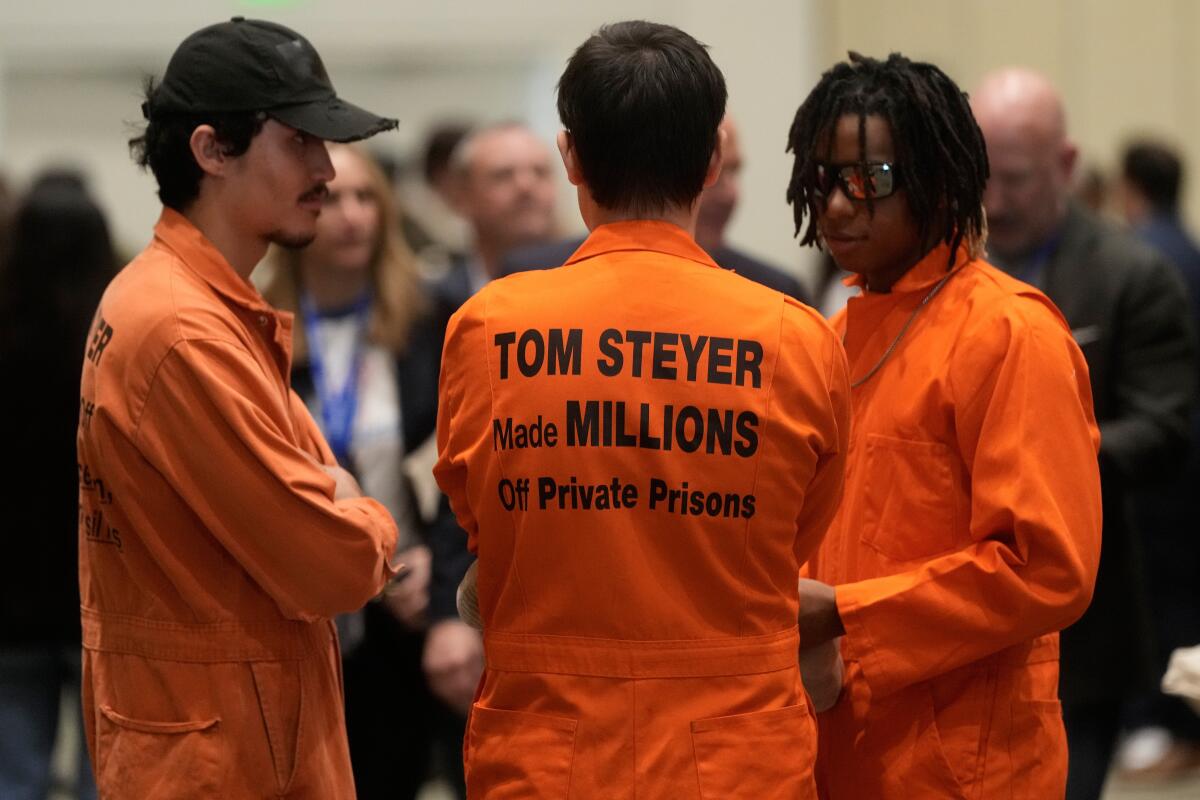
It is not the first time Steyer has faced criticism about the connection with private detention facilities. At the California Democratic Party convention in February, protesters dressed in orange prison jumpsuits sought to draw attention to the controversy.
His Democratic rivals have also seized upon the issue to question the billionaire’s progressive credentials.
“Before he was a progressive, he made millions off of companies that operate ICE detention centers, that operate private prisons that incarcerated young children,” state Supt. of Public Instruction Tony Thurmond said during a recent interview with a political influencer known as Mrs. Frazzled.
“His entire campaign is built on the backs of kids in cages,” Rep. Eric Swalwell, (D-Dublin) wrote Tuesday in a post on X.

People protest outside of a lunch held by California gubernatorial candidate Tom Steyer at the 2026 California Democratic Party State Convention in San Francisco on Feb. 21.
(Jeff Chiu / Associated Press)
Several years earlier, Yale University’s graduate teachers union called upon the school — Steyer’s alma mater — to divest from Farallon because of concerns about how the private prison company treated detainees, notably minorities.
Steyer has repeatedly expressed remorse about his former firm’s ties with the detention company. In 2012, he sold his stake in Farallon, which was named in reference to islands off the coast of San Francisco and was once one of the largest hedge funds in the world.
“I deeply regret that Farallon made that investment, and I personally ordered the investment in CCA to be sold because it did not accord with my values then or now,” Steyer told The Times in 2019 after he launched a short-lived presidential campaign.
Asked to comment about the latest iteration of the controversy, Steyer’s campaign pointed to comments he made in March at a town hall in San Francisco about how among the hundreds of thousands of companies his hedge fund invested in, the private prison company changed the course of his life.
“It was a mistake, and I sold it over 20 years ago, thinking, not that it won’t be profitable, it’s just a mistake. I don’t want to be in that business. But let me say this, it wasn’t just a mistake,” Steyer said. “It was also a big wake-up call that I was in the wrong place, that I was in a business that was taking me to places I absolutely didn’t want to go. And there’s a reason I walked away from that business and walked away from a ton of money, because I felt like that is not the life I want.”
He added that he and his wife, Kat Taylor, have spent the past two decades pushing for rehabilitative justice — treatment instead of mass incarceration except for violent felons.
“Am I a perfect person? No, have I made mistakes? Yes,” Steyer said. “But for those of you who like to read the Bible, there is a moment on the road to Damascus when someone makes a change, and I have made a big change, and I did it a long time ago, and I’ve been pushing very, very hard the other way.”
Farallon also invested in fossil fuel projects, including an Australian coal mine that denuded thousands of acres of koala habitat and generated an enormous amount of carbon emissions.
Steyer, who has a net worth of $2.4 billion according to Forbes, has painted himself as a reformed billionaire who walked away from Farallon because of angst about how he earned his fortune. He has spent hundreds of millions of dollars supporting Democratic causes, notably efforts to fight climate change.
“The truth is that is not where I think there is value, and that is not what I’m seeking in my life,” he said at a Sacramento town hall in March when retired state employee Gina Coates asked how, as a woman of color, she could believe his promises given his privilege as a wealthy white man.
“In terms of trusting me, let me say this, I left my business 14 years ago, and anybody who cared about money would not have done it,” Steyer said.
Steyer later said at the town hall that he left Farallon because he realized that he didn’t want to remain on that path.
“I want to have a meaningful life,” he said. “I want to stand with the people of this state and have actual prosperity. Twelve trillionaires and 40 million people who can’t make rent is not success.”
But Steyer and his wife continue to receive significant income from the hedge fund, including millions of dollars in investments, holdings and various complicated transactions in 2024, according to a statement of economic interest and tax returns he was required to file with the California Secretary of State’s office because of his gubernatorial run.
A Steyer campaign spokesman said Steyer created guardrails to ensure that he does not profit off companies he morally disagrees with.
“Tom has put in place an investment policy to ensure that he does not directly invest in fossil fuels, payday lending, or private prisons,” spokesman Anthony York said. “To the extent he inadvertently incurs exposure to those industries through third-party managers or liquid legacy investments, Tom will donate all profits to charity.”
After leaving Farallon, Steyer became one of the nation’s top Democratic donors. And he has used his wealth to fund his political ambitions. Steyer contributed nearly $342 million of his own money to his short-lived 2020 presidential campaign, according to the Federal Election Commission.
In the 2026 governor’s race, Steyer has donated nearly $112 million to his campaign as of Thursday, according to the California secretary of state’s office. He has been an ubiquitous presence on the airwaves, including local news programs and campaign ads that aired during the “Puppy Bowl” on the Animal Planet channel on Super Bowl Sunday. In the past month, Steyer has aired more than 5,000 ads, according to iSpot, which tracks television commercials.
California, home to 23.1 million registered voters, is home to some of the nation’s most expensive media markets. And candidates, particularly those who are not well known, need to spend heavily on television advertising if they hope to have a successful campaign.
But money is no guarantee of success. Billionaire Meg Whitman, the former eBay chief and formerly a longtime Republican donor, spent $144 million of her money on her 2010 gubernatorial bid. That set a record for a candidate’s contribution in a state race at the time, but Whitman lost to Jerry Brown by nearly 13 percentage points.
In 1998, Democratic multimillionaire Al Checchi who had been the co-chair of Northwest Airlines spent $40 million of his wealth on an unsuccessful run for governor, also a record at the time.
Steyer is one of the top three Democrats in the sprawling field to replace termed-out Gov. Gavin Newsom. And his liberal positions are drawing the ire of powerful forces in Sacramento. On Tuesday , the state’s Realtors donated $5 million to an independent expenditure committee opposing Steyer’s bid.
Taylor, who confronted Steyer at the San Diego town hall, said she had not planned to be so vocal. But as the event unfolded, she decided she had to speak, not only to Steyer but to the attendees. She and her compatriots gather every Sunday outside the Otay Mesa facility to raise money to help detainees buy food in the prison commissary and call their families.
“My main issue is that he has gotten financial gain off of these people suffering,” she said.