‘Bait’ star Riz Ahmed on Prime Video series, representation in Hollywood
In this week’s episode of The Envelope podcast, Riz Ahmed talks about drawing on his own experience for “Bait,” his Prime Video series about a British Muslim actor whose life is upended when he’s rumored to be the next James Bond.
Kelvin Washington: Hello, everyone, and welcome to the next episode of The Envelope. Kelvin Washington, Yvonne Villarreal, we have Mark Olsen. And Mark, I’ll stay with you for a second. You had a chance to speak with Riz Ahmed, who is the creator and the star of “Bait,” which centers around the idea of who could be the next James Bond. So then, dang it, I’m asking you two the same question: Who could be, should be the next James Bond? Is there somebody or somebodies that you’ve thought about for a while and said, “Well, that would fit, that could work”?
Mark Olsen: It was recently announced that they have begun the casting process to replace Daniel Craig in the beloved and long-running James Bond franchise. And there have already been at least one sort of confirmed person, the actor Tom Francis, auditioned. But then there’s a lot of other names being thrown around, like Callum Turner, Jacob Elordi, Aaron Taylor-Johnson. Kind of everybody about that age bracket you could think of. You know, it’s funny, in the last movie, “No Time to Die,” Lashana Lynch was given the number 007, so she was not James Bond, but she was 007. And I always thought, actually, in the last couple of movies, that Léa Seydoux would make a perfect [00 agent] — she’s cool, she feels kind of dangerous. She would have seemed to me like a great person for that kind of role. But then also, that’s obviously not James Bond. So who knows who it could be. Yvonne, what do you think? Do you have anybody in mind?
Yvonne Villarreal: Can it be a toss-up between you two? How would you fare?
Olsen: I don’t know if I’d pass basic training.
Washington: They have doubles, OK? They got stunt doubles and CGI and AI for all of that and for you, OK.
Villarreal: It’d be like the Leslie Nielsen version.
Washington So it’d be like 007 with a question mark: 007?
Villarreal: More seriously — not that I don’t take you two seriously as candidates — I would throw my enthusiasm around Jonathan Bailey or Damson Idris.
Washington: I’m gonna one-up your Idris and just go [with] the obvious, Idris Elba. It’s been sitting there for the last 15 years or so.
Villarreal: That’s why I didn’t [say that], because I’m like, “It’s been sitting there and they still haven’t.”
Washington: But sometimes it just makes sense. Sometimes it’s just sitting smacking you in the face, or shooting you with a silent 9mm — whatever he uses, James Bond. It just makes sense, and to be honest, it’s one of those, he’s probably passing [on the role] because you wanna have a franchise you can hold on to for 20 years with a particular actor, give or take, and he seems like he’d be probably too senior for that at a certain point. The podcast, the conversation behind what really happened there is going to be fascinating because, to your point, it just seems like the momentum was building for it and it didn’t happen. So it would be interesting to hear what actually comes out of that. But those are my are my guesses right there.
All right, Mark, you had a chance to speak with Riz Ahmed, obviously the creator and the star of “Bait.” Fascinating to me, just the concept of the show as a whole.
Olsen: Riz Ahmed is someone who, he’s so thoughtful about his own career, but also his place in the world. And so he does such a great job with this show and taking this idea of like, “Could an actor like Riz Ahmed, could he be James Bond? Should he be James Bond? Why not?” And so the show is just so thoughtful and finds all these really inventive ways of exploring that idea. He’s playing a little-known actor who it becomes public that he’s auditioned for the role and that throws his whole life into tumult both within the industry, with sort of like online hate towards him, but then also with his own family. And the show is also meant to be kind of a real love letter to the South Asian communities of London. Riz in the conversation talks about how they went out of their way to shoot in parts of London that you don’t normally see. So the show, it’s just so inventive and fun in a lot of really terrific ways.
Washington: Well, let’s hear more of your conversation with Riz now.

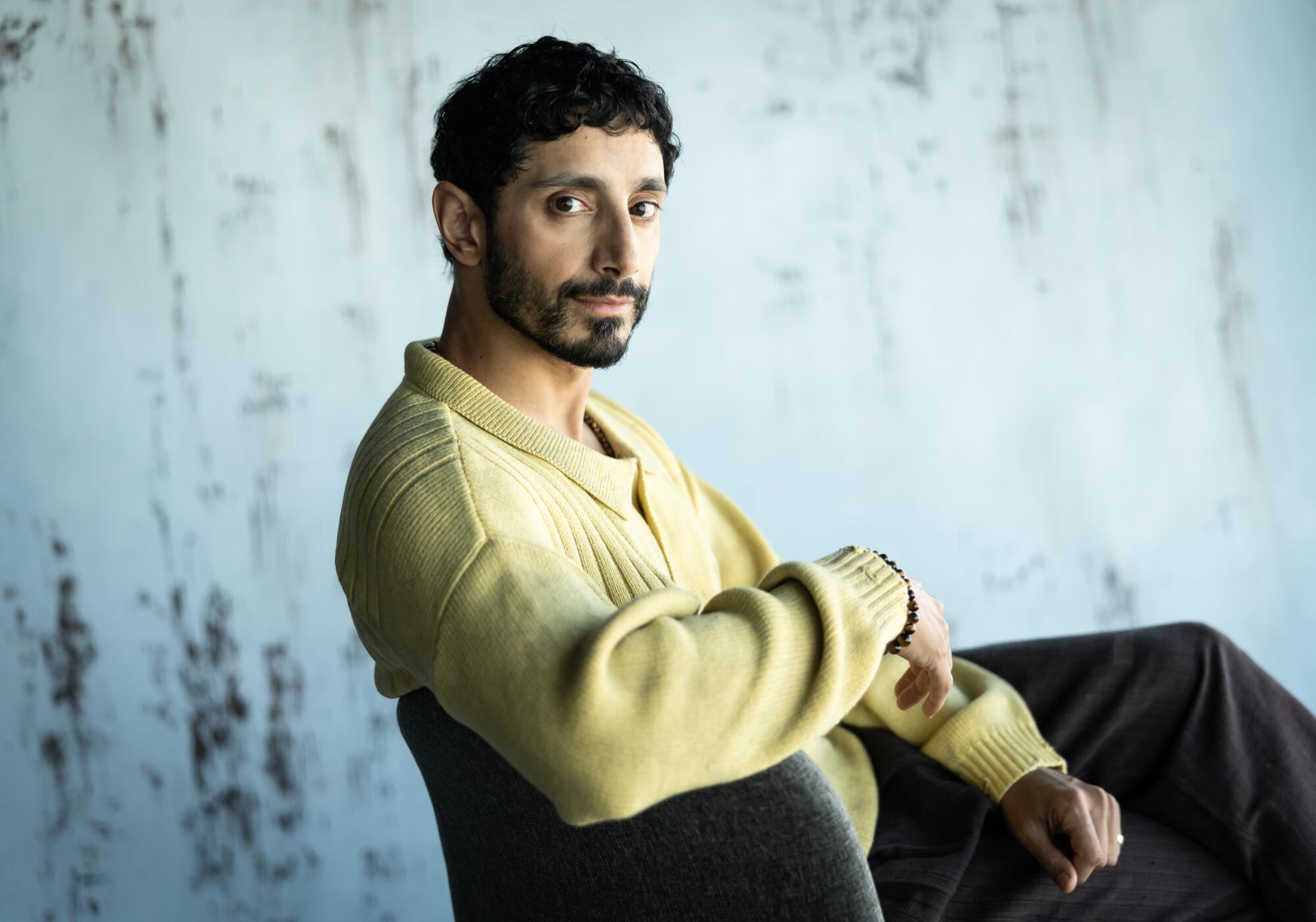
Riz Ahmed.
(Christina House / Los Angeles Times)
Mark Olsen: On the show, you play an actor who auditions for the part of James Bond. It leaks to the press, and then his whole world turns upside down. For you, is the premise of the show predicated on the idea that someone like you would never get that part, or is it that, of course you should get that? Which end of the telescope are you looking at it from?
Riz Ahmed: Kind of neither, really. The premise of the show was something a bit more emotional than that. The James Bond thing came right at the end, to be honest, of the creative process. Really, the heart of the show is the idea of auditioning. James Bond really serves as a symbol in the show, a symbol of aspiration, pinnacle of achievement in this industry and also of alpha masculinity and all this kind of stuff. And so it’s really the idea of trying to be that guy, which on some level, we’re all trying to be this kind of preferred version of ourselves, right? We’re all performing. We’re actually all always auditioning. So it’s about that feeling, [which] I think extends outside this industry. We’re doing that on LinkedIn or social media, on this podcast right now. We’re performing a version of ourselves. When actually the true version of ourselves is kind of messy, chaotic and vulnerable. So it’s that distance between the public and private self that I was really interested in, and James Bond just served as an aspirational symbol of that public way that you would love to be seen.
Olsen: But Bond, because of the specific cultural baggage that comes with that franchise, did you feel like it fit thematically with what you were trying to do?
Ahmed: Oh, perfectly. It was a godsend. It was like one of those moments where it’s like, “OK, so we want to do something about, like, aspiring to be anything but yourself. We want to do something about feeling like life is one big audition, but we need something that encapsulates success and cultural acceptance.” And it was like … Of course: Bond. And because the process of making this show was one of pulling so much from my own personal life, there was a moment or two when my name was mentioned in that conversation. I mean, along with, you know, everyone and their dog. But it was an interesting kind of thought experiment, it was an interesting, as I said, kind of vessel to place all of the themes into. And so when that idea came about, it was like, “This is perfect. We can talk about everything we want to talk about using this symbol.” We’re like, “OK, now how are we gonna get it?” And everyone told us Barbara Broccoli would never let us use it. Rightly so, she was very protective of this IP. But I wrote her a letter, sat down with her, showed her the scripts and she understood. She understood that it’s not really about Bond. It’s a show about self-love, and she really kind of vibed with that. Shout out Barbara Broccoli, thank you for letting us use Bond exactly how we wanted to.
Olsen: You recently hosted the new “SNL UK” and in your monologue, you made this joke that you don’t just play intense roles, that there’s this image of you that it’s all that you do. Did you purposely want to make “Bait” as a way to break you out of that perception?
Ahmed: It wasn’t that careerist and calculating, to be honest. I was just trying to make something that was authentically me. And I think the people who know me know that I’m a lover of comedy. My first rap song was a comedy rap song. I got banned on British radio back in the day because it was a quite an acerbic kind of satire. And actually it’s funny because I think that’s an American perception of me. In the UK, nine times out of 10, when I get stopped is for a British comedy I did called “Four Lions.” Which is like a kind of cult classic British movie. It’s a very British comedy. That’s like me, that’s like how I am in real life. And so when I wanted to make my own show, it just stands to reason it would be a reflection of my taste. So the overall frame was comedy, but I kind of have quite a maximalist sensibility. I want to have my cake and eat it. So I also wanted it to be a spy thriller and a family drama and quite surreal and psychological thriller and all of these elements kind of put together, but the frame of it all, I would say, is comedy. And yet it was really actually important to us that we tried to defy genre and defy categorization in that way.
Olsen: Did you feel like this was a role that, like, nobody was going to give you, like you had to write this for yourself?
Ahmed: It wasn’t so much out of a kind of frustration or a desire to create work for myself or break out of a pigeonhole or anything like that. Honestly, I just tried to make something as honest and authentic and vulnerable as possible, if that doesn’t sound too eye-rolly. I guess I reached a point in my life as a creative where I realized, actually, performance isn’t about putting on the mask, it’s about taking it off. It’s about sharing with the world who you are, sharing your privacy and your insanity. And if you do that, people will connect with it because it’s honest. And if you name your pain and your craziness, there’s something healing in that for yourself and others. I had kind of gotten to that place in my life. And so I wanted to kind of follow that through to a place that felt quite scary and pull on the most personal aspects of my own neuroses and my life and my neighborhood that I grew up in — so many locations are literally where I’ve grown up. So many moments in the show I pulled very directly from my life experience. My character has a panic attack at the end of Episode 1 at this particular music venue in North London. I had a panic attack in that venue in North London when I was supporting Wu-Tang Clan. My character is approached by MI5 and MI6. They say, “Hey, you’re a rising actor, do you wanna work with us, help with messaging?” That happened to me specifically once I started to become a bit more well known. There’s just so many things that kind of came from that place, and it was all based on this idea of like, “If I wanna make a show about a character who needs to learn how to take off the mask, then I need to do that as well.” And we kind of had a mantra in the room, which was like, “If it feels scary and it’s true, do it.” And there were times when I didn’t want to do it, definitely times when I wanted to kind of hide, but I just increasingly have this feeling that if you can offer up a part of yourself, then that’s one of the most liberating things you can do as an artist. And also for an audience, it just feels honest. That’s where you can connect most with people, if you’re willing to share that vulnerability.
Olsen: What was the writing process of the show like for you? Was there a moment where you had like a whiteboard with a list of awkward things that had happened to you?
Ahmed: That whiteboard would be very, very big, very, very large. Let’s say we’ve got a lot left in the tank if we ever do another season. The writing process was a learning curve for me, never having been in an American writers’ room system before. Hugely grateful to my co-showrunner, Ben Karlin, who’s got himself a really eclectic background. He’s one of the founding writers of the Onion, the satirical website. He has this track record, “The Daily Show With Jon Stewart” and “The Colbert Report,” but also “Modern Family.” And so I wanted someone who had that eclectic background, and we had a writers’ room that was similarly very eclectic. We had stand-up comedians. We had novelists. We had playwrights. We had experienced TV writers. We had U.S. [people], we had UK people. I just knew that I wanted this to feel quite eclectic, and as I say, kind of genre-bending. And so I wanted that breadth. So actually the writing process for this was like, “How do we make this feel as chaotic and messy and unpredictable as possible?” That requires a crazy amount of craft. And there were a lot of late nights, there was a lot of hair being pulled out. And it was, I think, one of the most intense periods, more so than the shoot, even. It was just trying to figure out what this show was. And I came to this realization, which is, Shah Latif, my character, is having an identity crisis. He’s trying to work out who he is. So it stands to reason the show should also be trying to work out what it is. The show needs to be having an identity crisis. So then we gave up on this mission of trying to make it feel coherent and consistent. And we said, “Of course, he’s an actor trying to work out who he is. Every episode should be a different genre. We should have our James Bond-goes-to-the-gala-in-a-tux episode. We should to have our Bollywood-proper episode. We should have our Linklater walk and talk. We should have our Greengrass does a spy thriller.” So we really deliberately and really defiantly tried to embrace the identity crisis of the character in how we told the story. And when we did that, everything fell into place. We would stop trying to straitjacket this into something more predictable.
Olsen: And what was it like for you to be filling this role of not just actor but also writer, producer, showrunner? How did you feel about taking on all those roles?
Ahmed: I felt scared. I felt out of my depth. I felt like I needed the help of people much smarter than me. Luckily, I had that help. And more than that help, their patience. I continually said, “No, we’ve got to go back and do it again. We’ve got to rewrite that episode. We’ve gotta redo this whole section,” as it felt so personal to me. Not just because it’s my personal experiences, but because there’s a world that hasn’t quite been put on screen before in this show, and I felt a tremendous sense of responsibility and emotional connection to that world and these characters. So at times it felt overwhelming. ButI’m of this philosophy that usually when you’re making something, you kind of end up feeling how the character is feeling. The character feels out of his depth, feels overwhelmed, feels like he does not quite know what he’s doing, it stands to reason I should feel like that. If I really feel like I’ve got it all worked out and I’m in control, we’re doing something wrong. So as far as possible, I tried to remind myself that that was a sign of almost being in touch with the material. At least that’s how I tried to talk myself off the ledge, man.
Olsen: Can you just talk to me a little bit about the title? As I understand it, “Bait” is UK slang?
Ahmed: The title actually has many different layers to it. I always say this is a show that’s hard to sum up in a sentence, but it’s really easy to sum up in one word, and that word is bait, because it has like five or six different meanings. So one key meaning is British slang. It means really blatant and in your face. So if you’re blowing up someone’s spot, you’re baiting them up. You’re being really kind of, “Look at me, look at me,” you’re being bait. So that speaks to Shah Latif, the character, and his attention seeking. But bait also means, online, trolling. It also means, in Urdu, your loyalty or your allegiance. It also mean in Arabic, in Hebrew, home. And it also, in literal meaning, it’s something used as part of a trap, which speaks to the spy thriller element to the show. So all these different layers to the word bait correspond to a different layer of show, correspond to each different episode. That’s exploring that meaning. And I wish I could tell you we had this all worked out upfront, but we struggled with the title for so long and it kind of like hiccuped itself up into the ether in a late-night kind of hair-pulling session. We realized, “Oh, my God, that’s it. That’s exactly what it should be.” So yeah, the title I think encapsulates how we’re trying to explore these different genres and all the different narrative threads in the show.
Olsen: All the things that your character of Shah Latif is going through trying to move forward in his career as an actor, remaining true to his community and his sense of self, how much of those are your own issues? Are there things that you feel like you’re on the other side of now? Are those things that you’re sort of constantly trying to figure out for yourself?
Ahmed: Of course, like this idea of searching for your identity in a world that either commodifies it or punishes it, that’s something I relate to. But I also kind of feel like that’s something we all relate to. There’s a lot of me in Shah Latif, but I actually think there’s a lot of Shah Latif in all of us. This idea of feeling as though you’re not enough. This idea of trying to cultivate a public version of yourself because you’re ashamed of the private version of your self. I think that’s such a universal feeling right now in this performative culture that we live in. We all wanna be looked at, but we don’t wanna be seen. And somebody once told me that the distance between your public and private self is the amount of shame that you carry. I think it’s true, more or less. I’m not saying you shouldn’t have a private life and some things shouldn’t be kept private. It probably should. But in a kind of deeper sense, I think there’s a truth in that. So I wanted to make a comedy in this playground of shame because it’s something that I can relate to, but I just had a sense that this is a very universal feeling.
Olsen: How much of these are issues or things you were going through in your career maybe five years ago, 10 years ago? What are the the sort of top-line things that you feel like you’re struggling with now?
Ahmed: This is where it becomes a full-blown therapy session. I would say that there was a period of time when I was just really desperate to be in the room. And now I’m in a place where I’m really excited to try and build my own room. And that, in a way, is a journey that the character goes on. I think it’s a journey that I’ve gone on, and the show, in a way, is a culmination of that journey. You know, it was just such a privilege to be able to create a playground and bring together this kind of ensemble. I don’t think there’s ever quite been a brown ensemble like this on screen before and [to] showcase all that talent and create that sense of family and specificity. And yeah, as I said, kind of build my own room rather than asking for a seat at someone else’s table. So I think that journey is one that I’ve been on and one that, I think, the show is exploring.
Olsen: There are these title cards throughout the series that give you these neighborhoods and locations, and I don’t know London super well, but like, it feels like it’s a very specific version of London. What was the importance of those locations for you?
Ahmed: The shows that I really adore and the ones that really inspired me on this journey are ones that are unapologetically specific. The Holy Trinity in my mind was “Atlanta,” “I May Destroy You” and “Fleabag.” These half-hour shows that are super personal, but also super specific in the world they’re exploring, whether they’re a city like Atlanta or a certain kind of Black London, or a very particular kind of white, middle-class British family in “Fleabag.” And so I wanted that unapologetic specificity. I wanted it to be a love letter to my London. And so I wanted to shout out these neighborhoods that really mean something to me. But more than that, I wanted to give a nod to the spy genre with those title cards. You know, in a Bond movie it says like, “Somewhere in the Caribbean,” you know, “Mexico City.” I wanted do that with Kentish Town, with Brick Lane, with Wembley. I wanted to elevate our daily experience and those neighborhoods to that kind of grand stage and those epic stakes and say, “Actually, this is as magical, as important, as exotic, as thrilling as any of those locations within that kind of genre.” Jordan Peele, when he made “Get Out,” said, “Being Black in America is like living in a horror movie. That’s why I made ‘Get Out.’” I can add this thesis that being brown in the West is like being in a spy thriller. And that’s why we made this. So I wanted those neighborhoods to feel like those chyrons you have in a spy thriller.
Olsen: You’ve often mentioned in the past, it’s a phrase I’m very taken with, “stretching culture,” expanding the idea of what’s possible. And I’m just curious, like, how is that going for you?
Ahmed: There’s the idea that the universe is expanding in all directions at the same time. I feel like that with culture. I feel like things are getting crazier and better at the same time simultaneously at an accelerating pace. You know, that’s kind of how I feel about it. And it’s like our consciousness, right? You get a little bit crazier, even as you get smarter. It’s that kind of feeling. For whatever it’s worth, it may sound pretentious, but I kind of feel it’s important to try and anchor myself in some sense of purpose. And I think that’s the purpose of storytelling, is to kind of constantly expand horizons of who is considered human and what is considered human. And I think for me, at least in this moment in my journey, I want that to be about telling stories that haven’t been told before, portraying worlds and communities and characters that maybe we haven’t been that familiar with.
Olsen: You’ve expressed some frustration recently with the phrase “representation” — that it’s become kind of a hollow gesture. What would you like to see happen moving forward?
Ahmed: Well, I was really proud to be part of the conversation, when we were kind of collectively coining that term, right, going from diversity to representation. But I do think it’s not an end in itself. Like I said, being in the room doesn’t necessarily change anything. It’s what are you allowed to do in that room? Does the room change you, or do you change it? It’s what the show’s exploring. And so at least for me right now, the kind of representation I’m interested in is how authentically we can represent ourselves. Do you know what I mean? Like, do I have to code switch? Do I have put on a mask or do I get to take it off? That to me is, I think, the most exciting kind of knot to unpick right now. And as I said, that’s kind of at the heart of the show.
Olsen: I want to be sure to ask you about some of the other cast on the show, specifically Guz Khan. I feel like I could watch the two of you just driving around in a car together for hours.
Ahmed: I’ll send you the rushes.
Olsen: Did you two have an immediate chemistry?
Ahmed: Can I tell you, the story of me and Guz is its own bizarre bromance. Here’s how I thought I knew Guz. Guz went viral in the UK because he did a joke, kind of like [a] shout-out against Steven Spielberg, right? Because there’s a kind of dinosaur in his “Jurassic Park” reboot that sounds like a racial slur in the UK. I’m just gonna let people check it out for themselves. I’m not gonna say more than that. This is like 10 years ago, something like that. He goes viral, he starts blowing up, people start offering him his own TV show. He DMs me on Twitter and he’s like, “Bro, like, what’s the industry like? Is it like crazy Illuminati vibes?” I was like, “Yes, but the Illuminatis are actually very fun, come and join us.” And just started this banter with him, and he goes on his journey, becomes one of the most beloved comedians. I’m on set with him, shooting “Bait.” And he goes, “You don’t remember the first time we met and we spoke, do you?” I said, “I remember, you DM’d me like a crazy guy.” And he was like, “No, no. We met 20 years ago.” I was like, “What are you talking about?” I was doing a spoken-word performance in the Midlands in the UK. No one was coming to see it. It was a completely empty club. So I take it upon myself to go outside and start flyering passers-by. Down a dark alley, I see guys with some of his friends engaged in a business of some sort. His legal team have asked me to refer to it as “selling tulips.” They were selling tulips, OK? I go down to this alleyway, I hand him flyers, him and his friends. I’m like, “How are you doing there, gentlemen? Would you like to come and see me do some spoken word?” They’re like, “What the hell? We’re in their mid-tulip transaction.” He decides out of the kindness of his heart with his boys to come and watch me do spoken word at Coventry Student Union. And he said it was the first time he saw someone that looked like him doing something like that in a space like that. … Twenty years later, we’re on set together. We met when we were like 20 years old and I’d completely forgotten him, but he remembered. We have like a brotherhood and a friendship in real life. I wrote that role for him. He is someone who constantly reminds me that as an artist, your art can only be as expansive as your heart is. He’s just that guy on set you want to be around. He brings the positive energy, he reminds you this is meant to be fun. And actually, when you’re having fun, you’re feeling relaxed and loose, you do great work. He’s evidence of that. And so I just have so much love for him, but I would only say that because he’s not here. If he was here, I would be making fun of him aggressively.
Olsen: Now that to me seems like this notion of stretching culture, where you’ve had this influence on him that you kind of didn’t even know.
Ahmed: I would love it if he would say that publicly, rather than me having to tell the world that I’m responsible for his career. Thank you for saying it. If we can clip that bit, that would be great. Send it to Guz, yeah? Email that to him. I don’t know, man. I kind of feel like we’re all in this relay race, right, and we’re just fumbling the ball to one another and trying to move forward. And one of the great things about this show was being in community in that way. I think for some people, particularly in the UK, they’re familiar with the world that’s portrayed here. I think, for a lot of Americans, they’re really not. Interestingly, I’ve had a lot of Latin viewers and Latina viewers approach me saying, “That’s my family, I get that, I know what that is.” And so I don’t know, I just think it’s kind of exciting. One of the things I love most about storytelling on screen is we can bring people into worlds they haven’t been to before. That’s what I remember falling in love with when I watched “Goodfellas” and “Mean Streets” in that world that Scorsese creates. So yeah, I think as long as we’re all leaning into this specificity, doing so in community, maybe that’s how we get to stretch culture.
Olsen: In a recent profile on you, the actor Sandra Hüller, who you work with on the upcoming movie “Digger,” she said that one of the things she most admires about you is that you take yourself and your work seriously. And I think I feel the same way, like there’s an intentionality to what you do, there’s a sense of purpose to what do.
Ahmed: It sounds so boring, though, when you put it like that. Doesn’t it? I hope I don’t take myself too seriously. I guess I take it seriously that I’ve got this opportunity to try and tell stories, and I believe that they matter. But I actually hope I don’t take myself seriously, very seriously. I hope this show in a way is evidence of that. That’s Exhibit A. Yeah, you got Hüller’s testimony here and then you got “Bait” over here. Who do you believe?
Olsen: Is there anything you can tell me about “Digger”? It’s a new film from Alejandro González Iñárritu, it stars Tom Cruise, and it has quickly become, I think, one of the most anticipated movies of the year. People are very excited about it. And there’s very little known about it, is there anything you can say about it?
Ahmed: It’s funny you should say that because I spoke to Alejandro today and he gave me permission to reveal something exclusively to you on this podcast. No, not really. There’s nothing. Absolutely nothing. I actually might get assassinated for just saying that even.
Olsen: And have you seen it?
Ahmed: I feel like anything I say, there’s like a bomb on my leg that might go off. I’ll say this, it was a really unique and incredible experience. Alejandro is this crazy genius and being around that level of — Tom Cruise as well — they’re all obsessive perfectionists that have just like endless rocket fuel in them. It’s just inspiring to be around, honestly. Really, really unique. I don’t know if I’ll ever have an experience like that again.
Olsen: And then you were nominated for an Academy Award for acting for “Sound of Metal,” but you won an Academy Award for the short film “The Long Goodbye” that was based on an album that you put out. As you’ve become busier in your acting career, has it become difficult for you to still make time for your music?
Ahmed: The projects that I have out right now with “Hamlet” and “Bait” are things that I’ve built. I’m not saying this is the way, necessarily, it’ll always be, but at least over the last several years, acting is like this cherry on the cake. I’m spending all this time building these other things and writing these things and producing these things. And in a way making music is part of that. It’s like being in a writers’ room, with musicians in a studio. And one of the things that I’ve enjoyed most is bringing the development of stories together with the development of albums. “The Long Goodbye” short film is an example of that. But I mean, I joke about this to my friends, one of the main reasons I made “Bait” as a TV show is so that I could make a soundtrack. You know, I grew up on Bollywood where, in a way, the movie was just an excuse for the music. I partly almost feel the same way here. We’ve got a soundtrack for “Bait,” which I’m very, very proud of. And it’s a reflection, I think again, of that eclectic, multicultural London that I know and love. It pulls together artists from across the diaspora, from the Bay Area and the U.S. through to India and Pakistan, from Trinidad and Bangladesh and Karachi and London. And it’s something that I think kind of speaks to the genre-bendiness of the show as well. So in a weird way, as I’m developing more of my own stories, I’m able to incorporate music into that process more.
Olsen: But are you making music of your own?
Ahmed: Yeah, I’ve got two tracks on that soundtrack, for example. Yeah, one of them with a rapper who I’ve been a huge fan of for many, many years. So that was a lovely moment. His name is Casisdead, makes very kind of cinematic UK hip-hop. So I’ve got two tracks on that and yeah, I mean, watch this space. Hopefully I’ll have some more time.
Olsen: And then, this is a moment in the show, and I know it’s something that’s happened in the past, but are you still ever mistaken for Dev Patel?
Ahmed: Honestly, every time I’m mistaken for Dev Patel, I’ll take the flowers. I’m such a fan of his, personally, and he’s actually also from that very particular pocket of Northwest London where I’m from, that this show is almost a love letter to. That pocket of London has produced, if I may humbly put myself in that bracket, myself, but also Dev Patel, Jay Paul, Jay Sean and Jay Shetty. All the Jays. All of them. So I’m very proud of Dev and everything he’s doing, and he’s telling his own stories as well in a way that I find really inspiring.