president trump

Trump says Iran wants to ‘make a deal’ as it continues to strike Israel and gulf nations

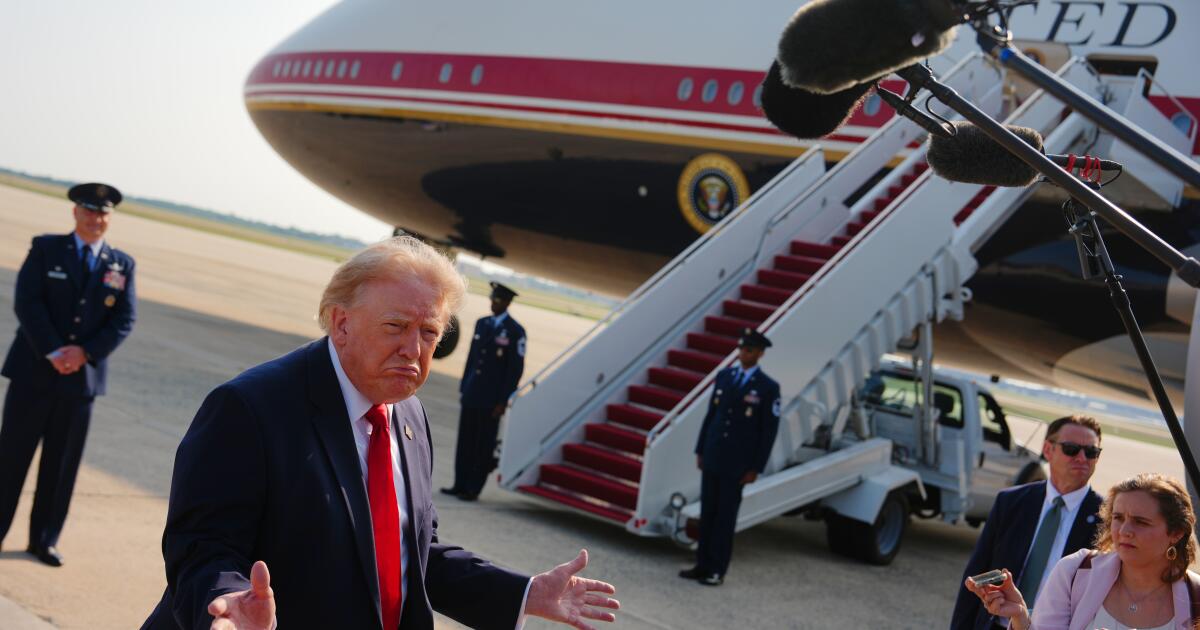
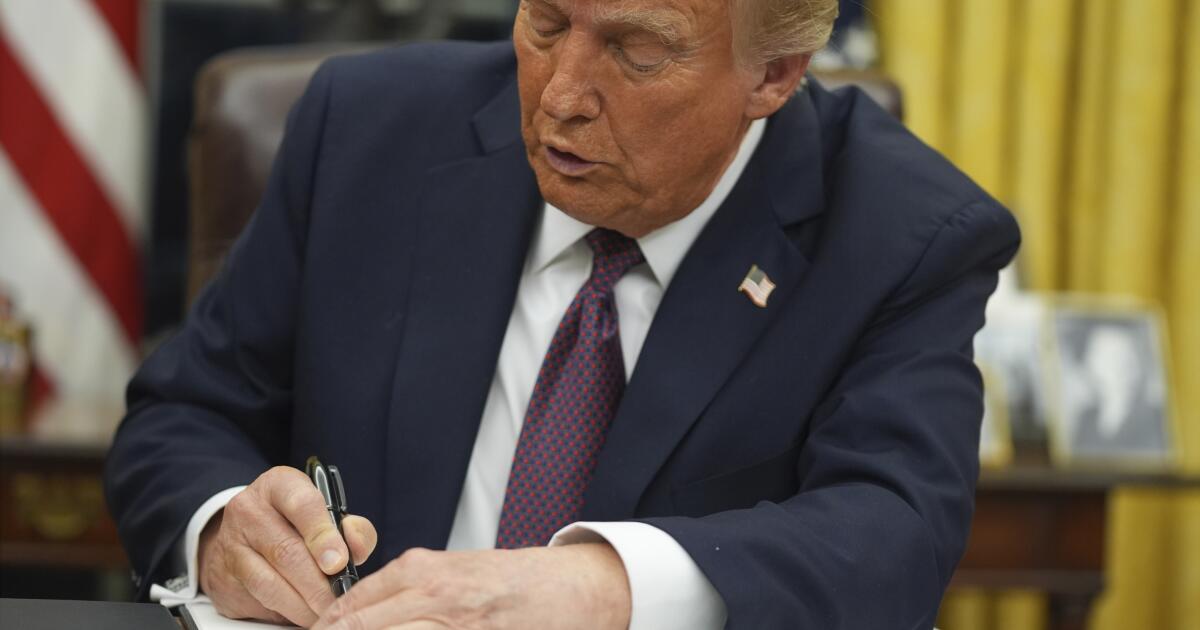
President Trump said Tuesday that Iran wants to “make a deal” with the United States to end the war in the Middle East, saying that negotiations are ongoing with the conflict in its fourth week.

Iran has publicly denied that talks are happening. But Trump told reporters during an Oval Office event that negotiations are underway and being led by Vice President JD Vance and Secretary of State Marco Rubio.

“I’d like to think we are in a good bargaining position,” Trump said.

Trump said he remains skeptical of Tehran’s intentions, saying he doesn’t necessarily “trust them,” but indicated that he is encouraged to continue talks after receiving what he described as a “very big present worth a tremendous amount of money” from Iran.

“I am not going to tell you what the present is,” Trump told reporters. But he said it was a “significant prize” related to “oil and gas” that signaled to him that he was “dealing with the right people.”

Conflicting messages over the diplomatic efforts between Washington and Tehran come as Pakistan has offered to host peace talks in Islamabad aimed at ending the hostilities, which have killed more than 2,400 people, further destabilized the Middle East and disrupted global oil markets.

“Pakistan welcomes and fully supports ongoing efforts to pursue dialogue to end the WAR in Middle East, in the interest of peace and stability in region and beyond,” Prime Minister Shehbaz Sharif wrote on X.

Any potential talks between the United States and Iran would face significant challenges. Key U.S. demands — particularly related to Iran’s ballistic missile and nuclear programs — remain difficult to resolve, even though Trump claims Iran has already agreed to concessions related to its ability to have nuclear weapons.

It is also unclear who within Iran’s leadership would be willing to negotiate, especially as Israel has vowed to keep targeting Iranian leaders after killing several already.

Trump has not publicly responded to Pakistan’s offer to act as an in-between for the United States and Iran. He also sidestepped a question about a New York Times report that said the Saudi crown prince, Mohammed bin Salman, has been pushing him to continue the war against Iran.

The president instead expressed confidence in his senior advisors handling the negotiations with Iran. He did not specify who U.S. officials are engaging with, but insisted they are “talking to the right people.”

When asked by a reporter why he had agreed to a cease-fire with the Iranians, Trump said: “They are talking to us, and they’re making sense.”

As the talks continue, Trump said that the United States is “way ahead of schedule” in its war with Iran, a nation that he said was so battered that it had no choice but to come to the negotiating table. Iran, however, showed on Tuesday that it still has firepower as it fired a new wave of missiles at Israel, Iraq and other gulf nations.

Iran fired at least 10 waves of missiles at Israel. In Tel Aviv, a missile with a 220-pound warhead slammed into a street in the city center, blowing out windows of an apartment building and sending smoke billowing. Four people suffered minor wounds, rescue worker Yoel Moshe said.

In Kuwait, power lines were hit by air defense shrapnel, causing partial electricity outages for several hours. Bahrain said it was attacked with missiles and drones, and that an Emirati soldier serving with its forces had been killed. The United Arab Emirates said air defense systems responded to similar attacks, and Saudi Arabia said it destroyed Iranian drones targeting its oil-rich Eastern Province.

Israel pounded Beirut’s southern suburbs, saying that it was targeting infrastructure used by the Iran-linked Hezbollah militant group, and carried out an extensive series of strikes on Iranian “production sites,” without providing more information.

On Tuesday, Defense Minister Israel Katz said Israel intended to seize Lebanon’s south Lebanon to a create a “security zone.”

Speaking at an assessment meeting with the Israeli military’s chief of staff, Katz said the military would control up to the Litani River, a waterway that runs through south Lebanon, meeting the Mediterranean some 20 miles north of the border with Israel.

“Hundreds of thousands of residents of southern Lebanon who evacuated northward will not return south of the Litani River until security for the residents of the north [of Israel] is ensured,” he said.

His words were the clearest articulation yet of Israel’s plans in Lebanon, going far beyond the “limited and targeted ground operations” announced by the Israeli military earlier this month.

Lebanon, meanwhile, took steps to undercut Tehran’s influence in the country and its support for Hezbollah. In a statement released on X on Tuesday, Lebanese Foreign Minister Youssef Raggi said the government was expelling Iranian Ambassador Mohammad Reza Shibani and declared him persona non grata. He gave Shibani until Sunday to leave the country.

Hezbollah condemned the move and called it a “grave national and strategic mistake.” Political figures aligned with the group also issued public statements urging the Iranian ambassador to ignore the decision.

In Washington, Trump said he would like to find a resolution that would avoid further casualties and damage to critical infrastructure in the region.

“If we can end this without more lives being down, without knocking out $10-billion electric plants that are brand new and the apple of their eye, I’d like to be able to do that,” he said. “But they can’t have certain things.”

Defense Secretary Pete Hegseth, meanwhile, told reporters that he would rather “negotiate with bombs.”

“The president has made it clear that you will not have a nuclear weapon. The War Department agrees,” Hegseth said. “Our job is to ensure that, and so we’re keeping our hand on that throttle, as long and as hard as is necessary to ensure the interests of the United States of America are achieved on that battlefield.”

His comments came as thousands of U.S. Marines were on their way to the region, raising speculation that the U.S. may try to seize Kharg Island, which is vital to Iran’s oil network. The U.S. bombed the Persian Gulf island more than a week ago, hitting its defenses but saying it had left oil infrastructure intact.

The Pentagon declined to comment on the deployment.

Ceballos and Quinton reported from Washington. Times staff writer Nabih Bulos in Beirut contributed to this report.

Source link

Minnesota sues Trump administration over shootings, including deaths of Alex Pretti and Renee Good

Minnesota officials sued the Trump administration on Tuesday for access to evidence they say they need to independently investigate three shootings by federal officers, including the killings of Renee Good and Alex Pretti.

The lawsuit claims that the federal government reneged on its promise to cooperate with state investigations after the surge of federal law enforcement in Minneapolis, and are seeking a court order demanding that the Trump administration comply.

“We are prepared to fight for transparency and accountability that the federal government is desperate to avoid,” Hennepin County Atty. Mary Moriarty told reporters.

The lawsuit marks an escalation in the clash between Minnesota leaders and the Trump administration over the investigations into the high-profile shootings by federal officers that sparked public outcry and protests. The Trump administration has suggested that Minnesota officials don’t have jurisdiction to investigate, but state officials insist they need to conduct their own probes because they don’t trust the federal government to investigate itself.

“There has to be an investigation any time a federal agent or a state agent takes the life of a person in our community,” Moriarty said.

The administration sent thousands of officers to the Minneapolis and St. Paul area for the immigration crackdown as part of President Trump’s national deportation campaign. The Department of Homeland Security considered its largest immigration enforcement operation ever a success but was staunchly criticized by Minnesota’s leaders who raised questions over officers’ conduct.

There continues to be fallout from Operation Metro Surge in the form of a Homeland Security shutdown, as Democrats in Congress hold up funding in an effort to secure restraints on Trump’s immigration agenda.

Minnesota’s lawsuit said the federal government is not permitted to “withhold investigative evidence for the purpose of shielding law enforcement officers from scrutiny where a State is investigating serious potential violations of its criminal laws, targeting its citizens, within its borders.”

Moriarty said Tuesday that the federal government “has adopted a policy of categorically withholding evidence,” calling the practice unprecedented and alarming. She said the lawsuit followed formal demands for evidence after the federal government blocked Minnesota investigators from accessing evidence related to the shootings.

In addition to the Pretti and Good cases, the lawsuit demands access to evidence in the case of Julio Cesar Sosa-Celis, who was shot and wounded in his right thigh by a federal agent in January.

Federal officials initially accused Sosa-Celis and another man of beating an Immigration and Customs Enforcement officer with a broom handle and a snow shovel. But federal prosecutors later dropped all charges against the men and authorities opened a criminal investigation into whether two immigration officers lied under oath about the shooting.

Emails seeking comment were sent to DHS and the Justice Department.

The Justice Department in January said it was opening a federal civil rights investigation into Pretti’s killing but has said a similar federal probe was not warranted in the killing of Good. The decision in Good’s case marked a sharp departure from past administrations, which moved quickly to investigate shootings of civilians by law enforcement officials for potential civil rights offenses.

Deputy Atty. Gen. Todd Blanche has said that the department’s Civil Rights Division does not investigate every law enforcement shooting and that there have to be circumstances and facts that “warrant an investigation.”

Moriarty has said a lack of confidence in the federal government’s review of these incidents makes the state’s independent investigations into the shootings, as well as officers’ actions during the immigration enforcement operation altogether, especially important. The county office received over 1,000 tips from the public on the shootings of Good and Pretti via an online portal they opened to collect evidence. Earlier this month, Moriarty initiated a second portal and said her office was investigating a number of incidents of potentially unlawful action by officers over the course of the immigration enforcement operation.

Fingerhut and Richer write for the Associated Press. Fingerhut reported from Des Moines, Iowa.

Source link

Senators consider deal to fund Homeland Security but not ICE enforcement

Senators raced Tuesday to clinch an emerging proposal to end the Homeland Security shutdown by funding much of the department, including the Transportation Security Administration airport workers going without pay, but excluding ICE enforcement operations that have been core to the dispute.

The sudden sense of urgency comes as U.S. airports are snarled by long security lines, with travelers being told to arrive hours before their flights in Houston, Atlanta and Baltimore Washington International. Routine Homeland Security funding was halted in mid-February ahead of the busy spring travel season. Nearly 11% of TSA workers — more than 3,200 — missed work Monday, and at least 458 have have quit altogether since the shutdown began, according to Homeland Security.

Democrats are refusing to fund the department without restraints on Trump’s immigration and deportation agenda after agents killed two citizens in Minneapolis.

A potential breakthrough came late Monday, after a group of Republican senators met at the White House with President Trump after his decision to deploy federal immigration officers at some airport security checkpoints — a move some lawmakers warned could lead to heightened tensions.

“All I can say is that the discussions have been very positive and productive, and hopefully headed in the right direction,” said Senate Majority Leader John Thune (R-S.D.) late Monday evening.

Senate Democratic Leader Chuck Schumer sounded a similarly hopeful tone: “Both sides are working in a serious way.”

Hopes high for a quick deal

Next steps in Congress could move quickly, if lawmakers can reach a deal, or sputter out just as fast.

The contours of the deal under consideration would fund most of Homeland Security, but not one main part of ICE — the enforcement and removal operations that are core to Trump’s deportation agenda.

Under the proposal being floated, ICE’s Homeland Security Investigations would be funded as well as Customs and Border Protection. But that would come with guardrails — keeping officers from those divisions in their traditional roles, rather than deploying them in urban immigration roundups.

The plan would also include a number of changes in immigration operations that Democrats have demanded, including mandating that officers wear body cameras and identification. The ICE officers manning airports are already going without face-covering masks, another key demand Democrats want as part of any deal.

Since so much of ICE is already funded through Trump’s big tax breaks bill, and immigration officers are still receiving paychecks despite the shutdown, senators said the new restraints would also be imposed on operations that rely on that funding source, as well.

Republican Sen. Katie Britt of Alabama, a chief negotiator, returned from the White House meeting hopeful they had a solution to “land this plane.”

Both chambers of Congress are controlled by the Republican president’s party, and any deal reached in the Senate would also have to be approved by the House.

Political standoff, long airport lines

Key to the standoff appears to have been the senators’ ability to shift the president’s attention off his plan to link any department funding to his push to pass the so-called SAVE America Act, a strict proof-of-citizenship and voter ID bill that has stalled in the Senate ahead of the midterm elections.

Over the weekend Trump injected his demand for the voting bill as a condition for ending the funding standoff. Some GOP senators have pitched the idea of tackling it in the months ahead as part of a broader legislative package the party could pass on its own, similar to last year’s big tax cuts bill.

Sen. Chris Coons (D-Del.) who was not part of the group at the White House, said his understanding was that there was a “sense of urgency” coming from the talks as the airport disruptions worsen.

Senators are expected to discuss the proposals during their private caucus lunches Tuesday afternoon. “First step is to get the proposal in writing,” said Sen. Angus King, an Independent from Maine. “I want to see exactly what that means.”

Changes at Homeland Security

The deal could provide a political exit from the standoff over the embattled Homeland Security department, which was stood up in the aftermath of the Sept. 11, 2001, attacks but has come to symbolize Trump’s aggressive mass deportation agenda, with its goal of removing 1 million immigrants this year.

Under mounting political pressure, Trump ousted Homeland Security Secretary Kristi Noem amid the public outcry over the immigration operations, and senators late Monday confirmed one of their own, Markwayne Mullin, as the president’s handpicked replacement.

Mullin, an Oklahoma senator who aligns with Trump’s agenda, provides a potentially new face for the department. During his confirmation hearing, Mullin touched on another key demand of Democrats — ensuring a judge has signed off on warrants that immigration officers use to search people’s homes, rather than simply relying on administrative warrants issued by the department.

“This is significant,” Sen. Peter Welch (D-Vt.) said about the progress toward changes. “Noem is gone. That’s a big deal.”

ICE’s budget nearly tripled under last year’s bill, to $75 billion, which has been untouched by the shutdown. Rather its routine annual funding, some $10 billion, would be cut almost in half under the proposal.

After weeks of missed paychecks, many TSA agents have called in sick or even quit their jobs as financial strains pile up. Union leaders representing the workers have pushed Congress to reach a deal.

Mascaro and Cappelletti write for the Associated Press. AP writers Rio Yamat, Wyatte Grantham-Philips, Kevin Freking and Seung Min Kim contributed to this report.

Source link

Senate ready to confirm Mullin to Homeland Security as TSA standoff deepens

The Senate is on track to confirm Markwayne Mullin as Department of Homeland Security secretary, President Trump’s nominee to take over the embattled department after firing Kristi Noem amid a public backlash over the administration’s immigration enforcement and mass deportation operations.

Mullin, a Republican senator from Oklahoma known for his close friendship with Trump, has tried to present himself as a steady hand, saying that his goal as secretary would be to get the department off the front page of the news. But Mullin tangled with Republican Sen. Rand Paul of Kentucky, the chairman of the Homeland Security Committee, who questioned Mullin’s character and temperament during last week’s combative confirmation hearing.

Senators advanced Mullin’s nomination on Sunday during a rare weekend session on a largely party-line vote, and confirmation is expected late Monday.

He would take the helm of the department at a difficult time. The department’s routine funding has been shut down, leading to long waits at U.S. airports during the busy spring break travel season, as Democrats demand changes in immigration enforcement operations after the deaths of two U.S. citizens during protests this year in Minneapolis.

Trump announced over the weekend he’s ordering immigration officers to help Transportation Security Administration agents, which lawmakers and others warned could escalate tensions at crowded airports.
Although the senator comes to the position after more than a dozen years in Congress, and with the management experience of running an expanding family plumbing business in Oklahoma, he has not been seen as a key force in immigration issues.

A former mixed martial arts fighter and collegiate wrestler who has led early-morning workout sessions in the members-only House gym, he became close with members of both parties and is often seen as a negotiator in partisan Washington.

It is his loyalty to Trump that landed him the job, and he’s not expected to sway from the president’s approach. Mullin was a strong supporter of Trump’s immigration agenda and ICE officers before being tapped for the Homeland Security job.

“I can have different opinions with everybody in this room, but as secretary of homeland I’ll be protecting everybody,” Mullin said during his confirmation hearing.

Santana writes for the Associated Press.

Source link

Trump places statue of Christopher Columbus near the White House

A statue of Christopher Columbus has been placed on the grounds of the Eisenhower Executive Office Building adjacent to the White House, the latest effort by President Trump’s administration to recognize the controversial explorer.

The statue is a replica of one that was tossed into Baltimore’s harbor in 2020 during Trump’s first term at a time of nationwide protests against institutional racism.

Trump endorses a traditional view of Columbus as a leader of the 1492 mission seen as the unofficial beginning of European colonization in the Americas and the development of the modern economic and political order. In recent years, Columbus also has been recognized as a primary example of Western Europe’s conquest of the New World, its resources and its Native people.

“In this White House, Christopher Columbus is a hero, and President Trump will ensure he’s honored as such for generations to come,” the White House posted on X.

“We are delighted the statue has found a place where it can peacefully shine and be protected,” said John Pica, a Maryland lobbyist and president of the Italian American Organizations United, which owns the statue and agreed to lend it to the federal government for placement at or near the White House.

The statue, made mostly of marble, was created by Will Hemsley, a sculptor based in Centreville on Maryland’s Eastern Shore.

The original statue was toppled by protesters July 4, 2020, and thrown into Baltimore’s Inner Harbor during the national social justice reckoning in the months after the police murder of George Floyd in Minneapolis. It was one of many statues of Columbus that were vandalized around the same time, with protesters saying the Italian explorer was responsible for the genocide and exploitation of Native peoples in the Americas.

In recent years, some people, institutions and government entities have displaced Columbus Day with the recognition of Indigenous Peoples Day. President Biden in 2021 became the first U.S. president to mark Indigenous Peoples Day with a proclamation.

Trump dismisses the shifting views on Columbus as the work of “left-wing arsonists,” bending history and twisting Americans’ collective memory. “I’m bringing Columbus Day back from the ashes,” he declared last April. Echoing his 2024 campaign rhetoric, he complained that “Democrats did everything possible to destroy Christopher Columbus, his reputation, and all of the Italians that love him so much.”

Witte writes for the Associated Press.

Source link

‘It’s the Cuban people who are suffering.’ How Cuba is struggling under U.S. oil blockade

Reggaeton boomed in a neighborhood bar in Old Havana on a recent night, when, suddenly, the music stopped and everything went dark.

The customers groaned. Another blackout.

A U.S. blockade on oil shipments to Cuba has plunged the island into its worst energy crisis in modern history. The country’s already cratering economy now teeters on the verge of collapse, with vehicles idled by a lack of gas, hospitals forced to cancel surgeries and millions living without a steady supply of electricity and water.

It is the result of a calculated pressure campaign by President Trump, whose administration is negotiating with Cuba’s leaders over the future of the communist-ruled Caribbean island.

People fed up with rolling blackouts have staged sporadic protests in recent days, banging pots and shouting slogans against the government, rare demonstrations in a country known for repressing dissent.

Some power outages hit isolated areas, but in recent weeks Cuba has experienced three island-wide blackouts. The most recent one struck Saturday night and continued into Sunday.

A food cart on a street at night.

Two men sell food from a cart in front of the Kempinski hotel Friday night in Havana.

As Havana and Washington hash out a possible deal — which is likely to include some form of economic opening, and perhaps limited changes to Cuba’s leadership — many people here say they feel like pawns in a geopolitical game beyond their control.

Some, like those at the bar, who kept drinking in the dark after the power vanished, say they have little choice but to adjust to a life where flushing a toilet, cooking a pot of rice or riding a bus to work is now considered a luxury.

“The U.S. is trying to punish the Cuban government,” said one customer, named Rolando. “But it’s the people who are suffering.”

Cuba’s struggles long predate the oil embargo. For years, Cubans have complained of food shortages, crumbling public services and political repression. Demographers say Cuba is undergoing one of the world’s fastest population declines — a 25% drop in just four years — as birth rates fall and emigration soars.

Cuban President Miguel Díaz-Canel blames “genocidal” economic, financial and trade restrictions imposed by the United States in the decades since Fidel Castro’s army toppled the U.S.-backed dictator Fulgencio Batista in 1959.

1

Young people play dominoes in the streets of Old Havana

2

A woman reacts to her granddaughter at a bar

1. Young people play dominoes in the streets of Old Havana. 2. A woman reacts to her granddaughter at a bar in Old Havana. (Natalia Favre/For The Times)

But many Cubans blame their own leaders for mismanaging the economy — and straying from the ideals of Castro’s revolution. They were raised to believe in an implicit social contract, which maintained that while Cubans might not have luxuries or be allowed all civil liberties, they would always have free education and healthcare, a place to sleep and enough to eat.

“The pact has failed,” said Juan Carlos Albizu-Campos Espiñeira, an economist at the Christian Center for Reflection and Dialogue in Havana.

He faults the government for soaring inflation and a misguided investment strategy that pumped money into the tourism industry while neglecting fundamental sectors like industry and healthcare.

“This is the worst moment in Cuba’s history,” he said. “But things were really bad before this.”

An aerial view of the Vedado neighborhood in Havana.

The Vedado neighborhood in Havana.

Life has long been challenging for Pablo Barrueto, 63, who works mornings at a construction site and now spends afternoons filling plastic jugs from a tap on the street and hauling them up narrow stairwells to neighbors who have been without water for weeks.

His two jobs barely enough cover food for him and his partner, Maribel Estrada, 55, who earns $5 monthly as a security guard at a state-run museum.

The pair, who live in a cramped studio apartment in a crumbling colonial-era building, can’t afford butter or mayonnaise, so breakfast is a piece of plain bread. Barrueto said he often goes to bed hungry. It has been years since he has tasted pork or beef.

“I work so hard,” said Barrueto, who on a recent afternoon was cooking beans in a pair of tattered jeans. “But I don’t see the fruits of my labor.”

Men fill plastic containers with water on a sidewalk.

Pablo Barrueto, center, fills water containers from a public tap after more than 17 days without running water.

Estrada has developed ulcers on her legs, but the doctor who prescribed her antibiotics said she wouldn’t be able to find them on the empty shelves of state-run pharmacies. On the black market, the medication was being sold for more than what Estrada makes in a month.

“If I lived in another country, my legs wouldn’t look like this,” she said, rolling up her pants to show the chronic sores on her calves.

Estrada said she was reaching a point where she would accept anything that would improve her life, even U.S. intervention.

“If things don’t get better, they should just hand over the country to Trump,” she said.

The U.S. has long played a major role in Cuban history, from its involvement in the island’s war of independence from Spain to the heavy hand of American companies in Cuba’s sugar industry. Washington repeatedly backed unpopular leaders who protected U.S. interests, including Batista, whose corrupt and repressive regime sparked support for the Cuban Revolution.

For decades, the island was celebrated by U.S. critics worldwide as a scrappy symbol of anti-imperialism and a utopic experiment in socialism. But in recent years, amid a government crackdown on dissent, some of that support has faded.

A man holds a booklet and cash wrapped in a small plastic bag.

A man holds his ration book and cash while waiting to collect his daily bread in Havana.

The Trump administration’s bellicose new push to dominate Latin America with tariffs and military intervention has scared allies who in the past might have come to Cuba’s rescue.

Mexico, Brazil and Colombia, all led by leftists, have declined to provide emergency fuel shipments in recent months out of fear of angering Trump.

The current crisis was set in motion on Jan. 3, when the U.S. launched a surprise attack on Venezuela, killing 32 Cuban security guards stationed there — in addition to scores of Venezuelan troops and civilians — and capturing President Nicolás Maduro.

As the U.S. seized control of Venezuela’s oil industry, the impacts immediately rocked Cuba, which had long relied on subsidized oil shipments from Maduro’s regime.

Cuba’s leaders say the country has not received a single fuel shipment in three months, debilitating an economy that depends on oil to generate the electricity.

There is little relief in sight.

An employee of a grocery sells vegetables and other goods

An employee of a MIPYME sells vegetables and other goods to a customer Friday in Havana.

A state-owned Russian oil tanker loaded with 750,000 barrels of crude is currently crossing the Atlantic. It’s unclear whether the U.S. will try to stop the ship from reaching Cuba, where the oil, once refined, could provide Havana with energy for several weeks.

At the same time, the “Nuestra América” humanitarian convoy is in the process of delivering more than 20 tons of critical supplies to Cuba, some of which will arrive by boat in the coming days.

David Adler, a general coordinator of Progressive International, a global leftist group that helped organize the flotilla, said he hoped the delivery of medicine, food, baby formula and solar panels would highlight the severity of Trump’s restrictions on Cuba.

“We’re beginning to come to grips with the fact that there will be mothers and children and elderly and sick people who will die simply as a result of this senseless and cruel and criminal policy,” Adler said. “Why are we inflicting such cruel punishment on a country that does not represent any threat to the United States?”

In Cuba, where many fear the prospect of no electricity come summer, with its muggy heat and swarms of disease-carrying mosquitoes, people are getting creative. With virtually no public transport and few drivers able to find — or afford — gas that costs more than $5 a gallon, many people have resumed riding bicycles. Others have fashioned electric-powered scooters into slow-moving taxis.

Four young people stand and sit in a dark street.

Young people talk in the street in central Havana.

One man in the small town of Aguacate made headlines after he modified his 1980 Fiat Polski to run on charcoal, the same fuel many people here are now cooking with.

Camila Hernández, who works at Havana’s airport, had hoped to celebrate her 21st birthday at home with friends, eating and dancing. “It would have been wonderful,” she said.

But it had been weeks without regular electricity in the home she shares with her parents and boyfriend. His family’s home had power — but lacked water.

To avoid yet another night sitting in the darkness, she marked her birthday by strolling to the Paseo del Prado, an iconic boulevard not far from the waterfront cooled by a light sea breeze.

Her boyfriend’s mother, Yusmary Salas, 47, said poor living conditions were testing her patience. “I can’t even go to the bathroom without planning how I will flush the toilet,” she said. She said she is hungry for change, but has no idea what shape it will take.

Trump insists he “can do whatever I want” in Cuba, and recently said he expects to have the “honor” of “taking Cuba in some form.”

A man climbs a steep flight of stairs.

Pablo Barrueto carries a water container up to his home in Old Havana.

Such talk rattles many here who grew up in a country where government buildings still bear the revolutionary motto: “Homeland or death, we will prevail.”

Salas said she hopes that whatever comes next is peaceful, and that Cubans, long a proud people, have their dignity restored. And their power restored, too.

At the darkened bar in Old Havana, workers scrambled to light candles and serve beer that, without refrigeration, would soon go warm. Someone with a battery-powered speaker hit “play” on a song, the 2004 Daddy Yankee hit “Gasolina.”

Dáme más gasolina!” they sang together. “Give me more gasoline!”

Source link

For airline travelers, the shutdown answer is simple: Pay TSA officers

Regardless of politics or destination, American air travelers are unified by one desire: It’s time to pay Transportation Security Administration employees.

“Everybody got bills they have to pay, and it’s horrible,” said Patrice Clark, whose trip to Las Vegas began Saturday with a nearly four-hour wait in a security line at Dallas Fort Worth International Airport. “Times are hard for everybody at this point. Working and not getting paid and gas prices are extremely high — like everybody needs their money. They need to pay them.”

TSA officers haven’t gotten a paycheck since the Department of Homeland Security partly shut down on Feb. 14. Democrats balked at funding the agency, demanding changes to immigration enforcement by federal agents after the shooting deaths of Alex Pretti and Renee Good in Minneapolis.

Some travelers arrive 4 hours early

Christian Childress is a private flight attendant, so when he is working, he doesn’t wait in TSA lines. But he frequently goes through a checkpoint when flying commercial to get to his job.

Childress, who lives in Redwood City in Northern California, said shutdown effects have been “hit or miss” thus far. He came to the Atlanta airport nearly three hours before his 1:30 p.m. Saturday flight to Nashville for a leisure trip. Some passengers have been arriving even earlier in Atlanta — the world’s busiest airport — worried about missing flights.

“Issue No. 1 should be paying the people who need to get paid and keeping our air travel system secure,” Childress said. “Then they can debate whatever they want to debate about Homeland Security.”

Democrats have tried to advance legislation to fund TSA separately, but Republicans have refused, saying funding for the entire Department of Homeland Security must be approved. So the shutdown continues.

Some passengers said it is time for Democrats to relent.

“I don’t want to go between the Democrats and the Republicans, but I think the Democrats are holding everything up because they can’t get their way,” said Tyrone Williams, a retiree from the Atlanta suburb of Ellenwood. He was queued up for screening before his flight to Philadelphia on Saturday.

Atlanta’s checkpoint wait time was as high as 90 minutes Saturday morning before melting away to nothing in the afternoon on what is typically one of the slowest days of the week for air travel. Staffing shortages have forced some airports to close checkpoints at times, with wait times swinging dramatically.

ICE at airports

Concerns about long airport lines are increasingly capturing attention.

President Trump has announced plans to order Immigration and Customs Enforcement officers to take a role in airport security starting Monday, which he says will continue until Democrats agree to fund the Department of Homeland Security.

He said ICE agents would bring the administration’s immigration crackdown into the nation’s airports, arresting “all Illegal Immigrants” with a focus on those from Somalia.

“I look forward to moving ICE in on Monday, and have already told them to, “GET READY.” NO MORE WAITING, NO MORE GAMES!” Trump wrote.

Funding for the whole department failed to advance in the Senate on Friday after Democrats declined to support a bill. On Saturday, in a rare weekend session, the GOP-led Senate rejected the Democrats’ motion to take up legislation to fund TSA.

Travelers ‘grateful’ for unpaid TSA workers

The vast majority of employees at TSA are considered essential, and roughly 50,000 continue to work without pay during the funding lapse. Nationwide on Thursday, about 10% of TSA officers missed work, the department reported. Absentee rates were two or three times higher in places.

Merissa Thomas arrived in Las Vegas on Saturday after a quick trip through a checkpoint at Reagan National Airport near Washington, D.C.

“I’m so grateful for people who are willing to sacrifice a lot to make sure we’re safe,” Thomas said.

Union leaders and federal officials say TSA officers are under financial pressure. Airport screeners have spent nearly half of the last 172 days with paychecks delayed by politics — 43 days last fall during the longest government shutdown in history, four days earlier this year during a brief funding lapse, and now 37 days and counting during the current shutdown.

At least 376 officers have quit since this shutdown began, according to officials, exacerbating turnover at an agency that historically has had some of the U.S. government’s highest attrition and lowest employee morale.

“From now on I would drive wherever I have to go until they get this figured out,” said Clark, the delayed traveler. “It was horrible.”

Amy writes for the Associated Press. AP writers Collin Binkley in West Palm Beach, Fla., Ty O’Neil in Las Vegas and Mary Clare Jalonick in Washington contributed to this report.
Source link

Trump border advisor says ICE to deploy to U.S. airports Monday

What began as a social media post from President Trump on Saturday has grown quickly into a full-scale plan to deploy ICE agents to U.S. airports.

Amid a partial government shutdown, TSA lines have grown to be hours long at some U.S. airports, creating problems for travelers across the country. Call-out rates have started to increase at some airports, and the U.S. Department of Homeland Security said at least 376 TSA agents have quit since the partial shutdown began Feb. 14.

White House border advisor Tom Homan said that ICE plans to dispatch agents to airports as soon as Monday, and that he was working with other officials to determine where to send agents.

“It’s a work in progress,” Homan said during a Sunday appearance on CNN. “But we will be at the airports tomorrow helping TSA move those lines along.”

Homan stressed that ICE agents would provide support where possible, so that TSA staffers could better fulfill specialized positions.

“I don’t see an ICE agent looking at an X-ray machine, because they are not trained in that,” Homan said.

On Saturday, President Trump posted to social media, “If the Radical Left Democrats don’t immediately sign an agreement to let our Country, in particular, our Airports, be FREE and SAFE again, I will move our brilliant and patriotic ICE Agents to the Airports where they will do Security like no one has ever seen before.”

The pushback to the White House plans was immediate.

Rep. Bennie G. Thompson (D-Miss.), ranking member of the Committee on Homeland Security, released a statement that read, “Masked, armed police at travel checkpoints is a hallmark of dystopian movies. Now, Donald Trump is threatening to bring this tool of fascism to America. He is manufacturing chaos at airports for political leverage and trying to force Democrats to accept unaccountable secret police at security checkpoints around the country.”

Also speaking to CNN on Sunday, House Democratic Leader Hakeem Jeffries said, “The last thing that the American people need are for untrained ICE agents to be deployed at airports all across the country, potentially to brutalize or, in some instances, kill them. We’ve already seen how ICE conducts itself.”

Representatives from Los Angeles International Airport did not immediately respond to a request for comment. A spokeswoman for Orange County’s John Wayne Airport said she was not currently aware of any communication or Homeland Security guidance on the proposed plan.

A spokesperson for San Francisco International Airport said airport officials have not yet received anything specific from Homeland Security about a deployment of ICE agents. He said SFO security personnel are not part of TSA, and as a result, the airport has not had any checkpoint backups.

Source link

More than half a million ballots seized by top GOP candidate in California governor’s race

Riverside County Sheriff Chad Bianco, who is a leading Republican candidate for governor, has seized more than 650,000 ballots from last November’s election and is investigating whether they were fraudulently counted.

“This investigation is simple: Physically count the ballots and compare that result with the total votes recorded,” Bianco said at a news conference Friday.

The unusual probe drew a sharp rebuke from California Atty. Gen. Rob Bonta, who said in a statement Friday that it is “unprecedented in both scope and scale” and appears “not to be based on facts or evidence.”

“There is no indication, anywhere in the United States, of widespread voter fraud,” Bonta said. “Counts, recounts, hand counts, audits, and court cases all support this.”

According to Bonta’s office, Bianco’s department on Feb. 26 seized about 1,000 boxes of ballot materials in Riverside County related to the November election for Proposition 50, which temporarily redrew the state’s congressional districts to favor Democrats in response to partisan redistricting in Republican states, including Texas.

The sheriff said his investigators are looking into allegations by a local citizens group that “did their own audit” and found that the county’s tally was falsely inflated by more than 45,000 votes — a claim that local election officials have rejected.

President Trump, who remains fixated on his 2020 election loss, continues to amplify election conspiracy theories and has repeatedly called for the federal government to “nationalize” state-run elections to counter what he says is widespread fraud.

Bonta and California Secretary of State Shirley Weber, both Democrats, have vowed to fight federal interference that could affect voting in California, including efforts to seize election records, as the FBI recently did in Georgia.

Bianco is an outspoken Trump supporter who said in an endorsement video in 2024 that, after 30 years of putting criminals in jail, he figured it was “time to put a felon in the White House — Trump 2024, baby” — referencing Trump’s conviction by a New York jury for falsifying business records while paying hush money to a porn actor.

Bianco’s investigation, which includes all the ballots cast in Riverside County in November, raises questions about how he would handle the election denialism movement if elected governor.

A poll released last week by UC Berkeley’s Institute of Governmental Studies and co-sponsored by The Times showed Bianco and conservative commentator Steve Hilton leading the crowded field of gubernatorial candidates by slim margins, in a left-leaning state.

Last fall, Proposition 50 passed in Riverside County with 56% of the vote — a margin of more than 82,000 ballots.

A citizens group called the Riverside Election Integrity Team has said it performed an audit finding that 45,896 more ballots were counted than were cast.

In a lengthy February presentation to the Riverside County Board of Supervisors, Registrar of Voters Art Tinoco disputed that figure, saying it was based on a misunderstanding of raw data that had not been fully processed.

The actual discrepancy, Tinoco said, was 103 votes, a variance of 0.016% that was far below what he said was the state’s preferred 2% margin of error for certifying results.

Bianco on Friday said that there “is no acceptable error, small or large, in our elections.”

The sheriff did not name the Riverside Election Integrity Team, but his description of the allegations brought to him by “a group of citizen volunteers” matched theirs.

Bianco said the investigation was “not a recount” for the Proposition 50 contest and was “just as much to prove the election is accurate as it is to show otherwise — we will not know until the count is complete.”

Bonta said his office has “attempted to work cooperatively” with the Sheriff’s Department to understand the basis for the probe. The sheriff, Bonta said, “has delayed, stonewalled, and otherwise refused to work with us in good faith” and failed to provide most of the requested documents.

“We’re concerned that there is not sufficient justification for seizing every ballot that was cast in this very largely populated county,” an official in Bonta’s office said in an interview Friday night.

In a March 4 letter to Bianco, the attorney general cited Bianco’s plan to use Sheriff’s Department staffers, “who are not trained and have no experience,” to count the ballots.

“Let me be clear: this is unacceptable,” Bonta wrote. “Your decision to seize ballots and begin counting them based on vague, unsubstantiated allegations about irregularities in the November special election results sets a dangerous precedent and will only sow distrust in our elections. You are also flagrantly violating my directives.”

At his news conference Friday, Bianco fired back by calling Bonta “an embarrassment to law enforcement.”

A Riverside County Superior Court judge, Bianco said, has ordered the appointment of a special master to oversee the ballot count.

In a statement Friday, Secretary of State Weber said “the Sheriff’s assertion that his deputies know how to count is admirable. The fact remains that he and his deputies are not elections officials and they do not have expertise in election administration.”


Source link

Congress looks for Trump’s exit plan as the Iran war drags on

President Trump took the United States to war without a vote of support from Congress, but lawmakers are increasingly questioning when, how and at what cost the war with Iran will come to an end.

Three weeks into the conflict, the toll is becoming apparent. At least 13 U.S. military personnel have died and more than 230 have been wounded. A $200-billion request from the Pentagon for war funds is pending from the White House. Allies are under attack, oil prices are skyrocketing, and thousands more U.S. troops are deploying to the Middle East with no endgame in sight.

“The real question is: What ultimately are we trying to accomplish?” Sen. Thom Tillis (R-N.C.) told the Associated Press.

“I generally support anything that takes out the mullahs,” he said. “But at the end of the day, there has to be a kind of strategic articulation of the strategy, what our objectives are.”

Trump said late Friday that he was considering “winding down” the military operations even as he outlined new objectives and goals and despite the continued buildup of forces in the region.

Congress stands still

The president’s decision to launch the U.S.-Israeli war on Iran is testing the resolve of Congress, which is controlled by his party. Republicans have largely stood by the commander in chief, but will soon be faced with more consequential wartime choices.

Under the War Powers Act, the president can conduct military operations for 60 days without approval from Congress. So far, Republicans have easily voted down several resolutions from Democrats designed to halt the war.

But the administration will need to show a more comprehensive strategy ahead or risk blowback from Congress, lawmakers said, especially as they are being asked to approve billions in new spending.

Trump’s casual comment that the war will end “when I … feel it in my bones” has drawn alarm.

“When he feels it in his bones? That’s crazy,” said Virginia Sen. Mark R. Warner, the top Democrat on the Senate Intelligence Committee.

House speaker says mission is ‘all but done’

The president’s party appears unlikely to directly challenge him, even as the conflict drags on. House Speaker Mike Johnson (R-La.) has said the military operation will be over quickly.

“I do think the original mission is virtually accomplished now,” Johnson told the AP and others at the Capitol this week.

“We were trying to take out the ballistic missiles, and their means of production, and neuter the navy, and those objectives have been met,” he said.

Johnson acknowledged that Iran’s ability to threaten ships in the Strait of Hormuz is “dragging it out a little bit,” especially as U.S. allies have largely rebuffed the president’s request for help.

“As soon as we bring some calm to the situation, I think it’s all but done,” Johnson said.

But the administration’s stated goals — of ending Iran’s ability to obtain a nuclear weapon and degrading its ballistic missile supplies, among others — have perplexed lawmakers as shifting and elusive.

″Regime change? Not likely. Get rid of the enriched uranium? Not without boots on the ground,” Warner said.

“If I’m advising the president, I would have said: Before you take on a war of choice, make the case clear to the American people what our goals are,” he said.

The power of the purse

The Pentagon has told the White House that it is seeking an additional $200 billion for the war effort, an extraordinary amount that is unlikely to win support. Senate Democratic leader Chuck Schumer of New York called the amount “preposterous.”

The Defense Department’s approved appropriations from Congress this year are more than $800 billion, and Trump’s tax breaks bill gave the Pentagon an additional $150 billion over the next several years for various upgrades and projects.

Sen. Mazie Hirono (D-Hawaii) said the country has other priorities.

“How about not taking away funding for Medicaid, which will impact millions of people? How about making sure SNAP is funded?” she said, referring to the healthcare and food assistance programs that were cut as part of last year’s Republican tax reductions.

“These are things that we should be doing for the American people,” she said.

Many lawmakers have recalled the decision by President George W. Bush in the aftermath of the Sept. 11, 2001, attacks to come to Congress to seek an authorization for the use of military force — a vote to support his proposed military actions in Afghanistan and later Iraq.

Tillis said Trump has latitude under the War Powers Act to conduct the military campaign, but that will soon shift.

“When you get into the 45-day mark, you’ve got to start articulating one of two things — an authorization for the use of military force to sustain it beyond that or a very clear path on exit,” he said.

“Those are really the options the administration needs to be thinking about.”

Mascaro writes for the Associated Press.

Source link

ICE officers soon will help with airport security unless Democrats end shutdown, Trump says

President Trump said Saturday that he will order federal immigration officers to take a role in airport security starting Monday unless Democrats agree on a bill to fund the Department of Homeland Security.

In a pair of social media posts, Trump first threatened and then said he had made plans to put officers from U.S. Immigration and Customs Enforcement in airports if the congressional standoff continues. He made the announcement as a partial shutdown contributes to long lines to pass through screening at some of the nation’s largest airports.

The president suggested ICE agents would bring the administration’s immigration crackdown into the nation’s airports, promising to arrest “all Illegal Immigrants.”

“I look forward to moving ICE in on Monday, and have already told them to, ‘GET READY. NO MORE WAITING, NO MORE GAMES!’” Trump wrote while spending the weekend in Florida.

The move appears to be a pointed effort to expand the type of immigration enforcement that has become a sticking point in Congress. Democrats pledged to oppose funding for the Department of Homeland Security unless changes were made in the wake of a crackdown in Minnesota that led to the fatal shootings of two protesters. Democrats are asking for better identification for federal law enforcement officers, a new code of conduct for those agencies and more use of judicial warrants, among other measures.

The Minnesota operation was tied in part to allegations of fraud involving Somali residents. On Saturday, Trump said ICE officers sent to airports would focus on arresting immigrants from Somalia who are in the United States illegally. Repeating his criticism of Somalis, he said they “totally destroyed” Minnesota.

“If the Democrats do not allow for Just and Proper Security at our Airports, and elsewhere throughout our Country, ICE will do the job far better than ever done before,” Trump said.

Trump’s posts did not offer additional detail on how ICE would take a role in airport security and what it meant for the Transportation Security Administration, which screens passengers and luggage for hazardous items.

The vast majority of TSA employees are considered essential and continue to work during the funding lapse, but they are doing so without pay. Call-out rates have started to increase at some airports, and Homeland Security said at least 376 have quit since the partial shutdown began Feb. 14.

On Saturday, in a rare weekend session, the Senate rejected a motion by Democrats to take up legislation to reopen TSA and pay workers who are now going without paychecks. Republicans argue that they need to fund all parts of the Department of Homeland Security, not just certain ones. A bill to fund the agency failed to advance in the Senate on Friday.

There were signs of progress, though, with the restarting in recent days of stalled talks between Democrats and the White House. On Saturday, Republican and Democratic senators were set to meet for a third consecutive day with White House officials behind closed doors as Senate Democratic leader Chuck Schumer of New York spoke of “productive conversations.”

Senate Majority Leader John Thune (R-S.D.) urged the bipartisan group to act quickly. He has said that Democrats and the White House need to find compromise as lines at airports have grown.

“If that group that’s meeting can’t come up with a solution really quickly, things are going to get worse and worse,” Thune said Saturday.

Binkley writes for the Associated Press. AP writer Mary Clare Jalonick contributed to this report.

Source link

California attorney general asks judge to block Nexstar-Tegna merger

California Atty. Gen. Rob Bonta is asking a judge to unravel Nexstar Media Group’s $6.2-billion acquisition of rival TV station owner Tegna — the latest in a flurry of merger twists.

Nexstar announced late Thursday that it had consummated the Tegna takeover — despite a lawsuit that Bonta and seven other Democratic state attorneys general had filed in federal court the previous day.

The state officials sued to block the union of the station groups, alleging the new colossus would violate antitrust rules and a federal law limiting broadcast station ownership.

The lawsuit was filed in U.S. District Court in Sacramento.

Hours after that filing, the Federal Communications Commission’s Media Bureau in Washington approved Nexstar’s deal — clearing the way for the nation’s largest TV station group owner to swallow the third-largest station group.

The purchase gives Nexstar, which owns KTLA-TV Channel 5 in Los Angeles, 265 television stations.

On Friday, Bonta and the other attorneys general asked a judge for a temporary restraining order to freeze the takeover until a hearing on the matter.

“Nexstar/Tegna is not a done deal,” Bonta said Friday in a statement. “I will not let these corporate behemoths merge without a fight.”

It was not immediately clear when a judge might rule on the request for a restraining order.

Bonta appeared at a lawmakers’ hearing in Burbank on Friday to explore the impacts of another huge merger: Paramount Skydance’s proposed $111-billion takeover of Warner Bros. Discovery. Bonta’s office has opened an investigation into the Paramount-Warner merger, but Bonta said Friday that no decision has been made on whether he or other attorneys general will seek to block it.

For now, he is focused on derailing the Nexstar-Tegna deal.

“We filed a suit before that deal closed,” Bonta told The Times. “We think our case is extremely strong. There is no way this should be approved.”

At issue is whether the FCC had the power to grant a waiver that would allow Nexstar to control TV stations that reach nearly 80% of U.S. households. In 2003, Congress set the station ownership cap at 39% of the country.

The Department of Justice also gave its blessing to close the deal.

The three FCC commissioners did not vote on the matter — despite pleas from the lone Democrat on the panel who advocated for an open process.

Approval of the merger was rapid after President Trump endorsed the consolidation on Feb. 7.

“We need more competition against THE ENEMY, the Fake News National TV Networks,” Trump wrote in his social media post.

“Letting Good Deals get done like Nexstar – Tegna will help knock out the Fake News because there will be more competition, and at a higher and more sophisticated level,” Trump wrote. “GET THAT DEAL DONE!”

In a statement Thursday, Nexstar founder and chief executive Perry Sook thanked Trump and FCC Chairman Brendan Carr, saying Nexstar was “grateful” they recognized the “dynamic forces shaping the media landscape” and allowed the transaction to move forward.

Source link

Paramount deal for CNN and Warner Bros. draws concerns about news independence

Should Paramount Skydance prevail in its $111-billion takeover of Warner Bros. Discovery, the Larry Ellison family would control two historic Hollywood film studios, dozens of cable channels, HBO and two legendary newsrooms, CBS News and CNN.

Concerns about the potential loss of more Hollywood jobs, and questions about newsroom independence dominated a hearing Friday to address Los Angeles’ crisis of shrinking film and TV production jobs.

Paramount wants to wrap up its Warner merger by September — a rapid timetable. The takeover deal, which was struck last month after Netflix bowed out, would put HBO and CNN under the control of Larry Ellison and his son David, the chairman of Paramount, which includes CBS.

Both Ellisons maintain friendly relations with President Trump. Those bonds, along with challenges to legacy media and changes at CBS News in recent months, sparked handwringing during the hearing called by Sen. Adam Schiff (D-Burbank) and Rep. Laura Friedman (D-Glendale).

“The questions surrounding this merger go beyond jobs, contracts and consumers,” Schiff said. “They also go to editorial independence of two of America’s most significant news organizations, CNN and CBS News.”

Trump has long agitated for changes at CNN, and members of his cabinet, including War Secretary Pete Hegseth, have openly cheered for an Ellison takeover of CNN.

To pave the way for the Ellisons’ purchase of Paramount, the company paid $16 million to Trump last summer to settle his lawsuit over edits to a “60 Minutes” interview with Kamala Harris in October 2024. Most 1st Amendment experts had deemed Trump’s suit “frivolous.”

Since the Ellisons took the helm, there has been a change in direction at CBS News and a reduction in its size and scope. Staff members at CNN are bracing for similar changes, including to the tone of its newscasts.

In addition to the long-term health of Los Angeles’ film economy, the merger’s fate could determine “whether we have state sponsored media … or whether we have journalists who can truly follow the story,” Friedman said.

A Paramount spokesperson declined to comment.

The deal is currently before regulators in the U.S. and abroad.

Paramount Chairman David Ellison has vowed to “build a stronger Hollywood,” by increasing the creative output of the two legendary movie studios — Paramount and Warner Bros. — to 30 theatrical releases a year. Warner Bros., which owns such prominent franchises as “The Matrix,” Batman, Harry Potter, “The Big Bang Theory,” and “Friends,” has long been one of Hollywood’s most prolific studios.

But Paramount has suffered from years of under-investment and Ellison and his team have been working to boost the film pipeline.

Ellison has also pledged to keep both studio lots and preserve HBO.

“HBO will continue to operate independently under our ownership, enabling it to create more of the world-class content it is renowened for,” Ellison wrote in the Feb. 28 letter to Schiff and Friedman, responding to their concerns about consolidation.

During Friday’s hearing, the lawmakers turned to former CNN anchor Jim Acosta, who famously jousted with Trump during his first term, for his reflections. He was asked whether any “guardrails” could protect against potential merger harms.

“If this merger goes through, the guard-rails are gone,” Acosta said bluntly. “If we continue to go down this road it will be lights-out for the news industry… We need media options that are not controlled by the wealthiest and most powerful people in the country.”

The hearing occurred the same day that CBS News imposed another sweeping round of layoffs and disbanded its CBS News radio network. It also came the same week as Trump’s Federal Communications Commission approved a massive television station merger, which will allow Texas-based Nexstar Media Group to control more than 250 stations, despite a legal challenge from state attorneys general.

The proposed Paramount-Warner merger would prompt at least $6 billion in cost savings, according to Paramount. Industry veterans warn that billions more in cuts may be necessary to make the deal math work.

A combined Paramount-Warner would carry nearly $80 billion in debt, a legacy of the proposed leveraged buyout and the mergers that came before it.

The hearing at Burbank City Hall —“Lights, Camera, Competition”: Promoting American Film Production,” — was wide-ranging. Award-winning actor Noah Wyle, the star and a producer of Warner Bros.’ “The Pitt,” discussed the need to bring more productions back to Los Angeles where thousands of out-of-work film professionals have been suffering. “The Pitt” is filmed in Burbank.

“Over the last six years, the aggregate effect of projects leaving the state in search of tax credits, the pandemic and last year’s fires has been a near cratering of our once thriving industry,” Wyle said. “We lost 42,000 film and TV jobs between 2022 and 2024.”

The hearing unfolded down the road from the massive Warner Bros. studio complex, and was held to explore ways to boost the Hollywood economy, including the potential for a national tax credit under consideration in Congress. The campaign is intended to keep film jobs in the U.S. amid an increased migration to Britain, where Warner Bros. maintains an expansive studio complex in London, and other countries that offer generous subsidies.

“Work in the entertainment industry is precarious,” said Matthew D. Loeb, International President of the International Alliance of Theatrical Stage Employees (IATSE). “Past studio mergers have meant fewer jobs.”

Source link

Justice Department subpoenas Comey in Trump conspiracy probe

The Justice Department sent a subpoena to former FBI Director James Comey as part of an investigation into whether former law enforcement and intelligence officials waged a years-long conspiracy against President Trump, according to people familiar with the matter.

The grand jury subpoena was issued last week by the U.S. attorney’s office for the Southern District of Florida, according to the people, who asked not to be identified speaking about an ongoing investigation.

The subpoena seeks information about Comey’s role in putting together an intelligence assessment about Russia’s interference in the 2016 presidential election, according to the people.

The U.S. attorney’s office has previously sent subpoenas to other former U.S. officials. The office is conducting a sweeping investigation into whether former U.S. officials allegedly took actions to sabotage Trump starting in 2016 through his indictment over the handling of classified documents in 2023.

The new subpoena, reported earlier by Axios, marks an escalation of Justice Department efforts targeting Comey in particular, who Trump has repeatedly said should be investigated.

Comey was previously indicted by a grand jury at the request of the U.S. attorney for the Eastern District of Virginia for allegedly lying to senators during a congressional hearing — a claim that Comey has denied. The indictment was dismissed after a federal judge ruled that the U.S. attorney was unlawfully appointed. The Justice Department is appealing the ruling.

A lawyer for Comey declined to comment Thursday. The U.S. attorney’s office in Miami didn’t immediately respond to a request for comment.

Trump and Comey have had a contentious relationship. Trump fired Comey as FBI director in 2017 during his first term as president. Since then, Comey and Trump have publicly criticized each other.

Strohm writes for Bloomberg News.

Source link

Trump administration sues Harvard, saying it violated civil rights law and seeking to recover funds

The Justice Department filed a new lawsuit Friday against Harvard University, saying its leadership failed to address antisemitism on campus, creating grounds for the government to freeze existing grants and seek repayment for grants already paid.

The lawsuit, filed in federal court in Massachusetts, is another salvo in a protracted battle between the administration of President Trump and the elite university.

“The United States cannot and will not tolerate these failures,” the Justice Department wrote in the lawsuit. It asked the court to compel Harvard to comply with federal civil rights law and to help it “recover billions of dollars of taxpayer subsidies awarded to a discriminatory institution.”

The lawsuit also asks a judge to require that Harvard call police to arrest protesters blocking parts of campus and to appoint an “independent outside monitor,” approved by the government, to ensure it complies with court orders.

Harvard did not immediately respond to a request for comment.

The lawsuit comes after negotiations appear to have bogged down in the months-long battle with the Trump administration that has tested the boundaries of the government’s authority over America’s universities. What began as an investigation into campus antisemitism escalated into an all-out feud as the Trump administration slashed more than $2.6 billion in research funding, ended federal contracts and attempted to block Harvard from hosting international students.

In a pair of lawsuits filed by the university, Harvard has said it’s being unfairly penalized for refusing to adopt the administration’s views. A federal judge agreed in December, reversing the funding cuts and calling the antisemitism argument a “smokescreen.”

Ted Mitchell, president of the American Council on Education, a major association of colleges and universities, accused the administration of launching a “full scale, multi-pronged” attack on Harvard. Friday’s lawsuit, he said, is just the latest attempt to pressure Harvard to agree to changes favored by the administration.

“When bullies pound on the table and don’t get they want, they pound again,” Mitchell said.

The Trump administration began investigating allegations of discrimination against Harvard’s Jewish and Israeli students less than two weeks after the president took office. The allegations focus on Harvard’s actions during and after pro-Palestinian demonstrations during the Israel-Hamas war.

Officials concluded Harvard did not adequately address concerns raised about antisemitism that drove some students to conceal their religious skullcaps and avoid classes. During protests of the war, Trump officials said, Harvard permitted students to demonstrate against Israel’s actions in the school library and allowed a pro-Palestinian encampment to remain on campus for 20 days, “in violation of university policy.”

In its lawsuit Friday, the Justice Department also accused Harvard of failing to discipline staff or students who protested or tacitly endorsed the demonstrations, such as by canceling or dismissing classes that conflicted with protests.

“Harvard University has failed to protect its Jewish students from harassment and has allowed discrimination to wreak havoc on its campus,” White House press secretary Liz Huston said Friday on X. “President Trump is committed to ensuring every student can pursue their academic goals in a safe environment.”

Despite their bitter dispute, Harvard and the Trump administration have held some negotiations, and the two sides have reportedly been close to reaching an agreement on multiple occasions. Last year, the administration and the university were reportedly approaching a deal that would have required Harvard to pay $500 million to regain access to federal funding and to end the investigations. Almost a year later, Trump upped that figure to $1 billion, saying that Harvard has been “behaving very badly.”

At the same time, the administration was taking steps in a civil rights investigation that had the potential to jeopardize all of Harvard’s federal funding.

In June, the Trump administration made a formal finding that Harvard tolerated antisemitism.

In a letter sent to Harvard, a federal task force said its investigation had found the university was a “willful participant” in antisemitic harassment of Jewish students and faculty. The task force threatened to refer the case to the Justice Department to file a civil rights lawsuit “as soon as possible,” unless Harvard came into compliance.

When colleges are found in violation of federal civil rights law, they almost always reach compliance through voluntary agreements. When the government determines a resolution can’t be negotiated, it can try to sever federal funding through an administrative process or, as the Trump administration has done, by referring the case to the Justice Department through litigation.

Such an impasse has been extraordinarily rare in recent decades.

Last summer, Harvard responded that it strongly disagreed with the government’s investigative finding and was committed to fighting bias.

“Antisemitism is a serious problem and no matter the context, it is unacceptable,” the university said in a statement. “Harvard has taken substantive, proactive steps to address the root causes of antisemitism in its community.”

In a letter last spring, Harvard President Alan M. Garber told government officials that the school had formed a task force to combat antisemitism, which released a detailed report of what unfolded on campus after Hamas militants stormed Israel on Oct. 7, 2023, killing around 1,200 people and abducting 251 others. Israel retaliated with an offensive that killed tens of thousands of Palestinians and displaced around 90% of Gaza’s population — prompting pro-Palestinian demonstrations at colleges around the country.

After the demonstrations at Harvard, Garber said the university had hired a new provost and new deans and that it had reformed its discipline policies to make them “more consistent, fair and effective.”

Since he took office, Trump has targeted elite universities he believes are overrun by left-wing ideology and antisemitism. His administration has frozen billions of dollars in research grants, which colleges have come to rely on for scientific and medical research.

Several universities have reached agreements with the White House to restore funding. Some deals have included direct payments to the government, including $200 million from Columbia University. Brown University agreed to pay $50 million toward state workforce development groups.

Balingit and Casey write for the Associated Press.

Source link

California’s proposed billionaire tax gains majority support in new poll, with a partisan split on voter ID

A new poll shows California voters are sharply divided over two brewing statewide ballot measures stirring up the nation’s partisan and economic divides: a one-time tax on billionaires to pay for mostly healthcare and a voter ID mandate that includes citizenship verification.

The survey conducted by UC Berkeley’s Institute of Governmental Studies and co-sponsored by The Times showed 52% of registered voters supported the billionaire’s tax, while 33% said they opposed it. Fifteen percent were undecided.

Support for the voter ID measure was more evenly split, with 44% of voters in support, 45% opposed and the remainder undecided.

The pair of statewide proposals, which have yet to qualify for California’s November ballot, emanated from opposite sides of California’s political spectrum. Organized labor and progressives are pushing hard for a new wealth tax in response to Republican cuts to federal healthcare programs, and the GOP-led call for additional voter restrictions comes in the wake of President Trump’s baseless claims that the 2020 election was stolen from him.

Poll director Mark DiCamillo said he “was a little surprised” by the results given how much attention each measure has already received.

“Just from reading the press accounts of these initiatives, I thought they would both be well ahead. There’s been a lot of discussion about them and advocates seem to be very confident in their chances of passage, but the polls seem to indicate otherwise,” he said.

The divisions over each measure fell largely along partisan and ideological lines.

On the billionaire’s tax initiative, 72% of Democratic voters said they would support the measure if the election were held today — and the same percentage of Republicans oppose it. A slim majority — 51% — of voters who are unaffiliated or registered with another party support the wealth tax, while 30% said they oppose it, with the remainder undecided.

Republican voters overwhelmingly support the voter ID initiative, with 91% saying they would vote for it. More than two-thirds of Democratic voters, 68%, said they would oppose the measure. No party preference voters appeared evenly split.

Neither ballot measure has officially qualified for the November ballot thus far, though proponents of the voter ID measure said this month that they turned in 1.3 million voter signatures to elections officials, well above the 875,000 required to qualify. Proponents of the new tax on billionaires have until June 24 to submit signatures to elections officials.

The billionaire tax has generated national news coverage and widespread debate over whether it would benefit low-income Californians or end up hurting the state’s tax base as billionaires move out of the state to avoid paying it.

The proposal is backed by the Service Employees International Union-United Healthcare Workers West, which represents 120,000 workers in California. Union leaders say that the tax would raise $100 billion to backfill steep cuts to federal healthcare programs under a sweeping tax and spending bill approved by the Republican-controlled Congress and signed in the summer by Trump.

The measure would impose a one-time 5% tax on the assets of California residents who are worth $1 billion or more, with options to pay it over multiple years.

According to SEIU-UHW, the new tax would apply to around 200 people in the state, though several wealthy tech leaders have made moves to change their residences and avoid paying the tax should it pass. In recent months, Meta Chief Executive Mark Zuckerberg, Google co-founders Larry Page and Sergey Brin and others have bought up lavish beachfront estates and new commercial office spaces in South Florida.

Some of those billionaires are also ponying up to defeat the measure. Brin, who according to Forbes is the world’s third-richest person, has contributed $45 million to a new ballot measure committee called Building a Better California, which is pushing an alternative statewide ballot measure that could scrap the billionaire’s tax.

Brandon Castillo, a veteran ballot measure campaign strategist who is not working on either of the two measures, said even though it’s currently polling above 50%, the billionaire’s tax is starting out “in a really shaky position.”

“This is not a very strong place to start,” he said. “That’s not to say they can’t keep this thing over 50%, but when you’re starting just barely above 50% and you have a tsunami of money and a huge campaign against you, it’s really hard to keep yourself at that level.”

Though previous public opinion polls at the state and national levels have shown broad support for requiring proof of citizenship to vote in elections, even among Democrats, the new Berkeley poll showed liberal voters are skeptical of the measure.

Proponents of voter ID contend that such laws prevent election fraud and, along with proof of citizenship mandates, prevent noncitizens from voting. Opponents say ID requirements threaten the fundamental constitutional rights of Americans who do not have the documentation readily available, and that the restrictions are unnecessary given that voting by noncitizens is rare and already outlawed in the U.S.

Under current law, Californians are not required to show or provide identification when casting a ballot in person or by mail. They are required to provide identification when registering to vote, and must swear under penalty of perjury, a felony, that they are eligible to vote and a U.S. citizen.

The poll showed that slim majorities of predominantly Spanish-speaking voters, voters who were born in another country and first-generation immigrants support the voter ID measure. A plurality of Latino voters also favor it, with 44% in support and 41% opposed.

But DiCamillo cautioned against reading too much into those numbers, noting that awareness of the measure is still relatively low.

“I’ve always seen in my history of measuring Latino voters’ support that they are relatively late deciders on most ballot measures,” he said. “How they break will be critical. I would say we’ll have to look at how they feel when we do our final preelection poll.”

Voter ID laws are also a top priority of Trump, who has pressured the Senate into taking up the SAVE Act, which would impose nationwide requirements for proof of citizenship to vote and already has passed the House of Representatives.

Castillo said Trump’s support could sway Democratic and liberal-leaning independents to vote against the measure.

Both DiCamillo and Castillo noted that with the November election still seven months away, voters are not paying much attention and those on either side of each ballot measure have not launched major campaigns yet.

“I suspect by the time election day comes around, these awareness numbers on the billionaire’s tax certainly are going to be much higher,” Castillo said. “You’re going to see 80-90% of voters familiar with it, just because they’re going to be inundated with advertising and earned media between now and November.”

The Berkeley IGS/Times poll surveyed 5,019 registered California voters online in English and Spanish from March 9 to 14. The results are estimated to have a margin of error of 2.5 percentage points in either direction in the overall sample, and larger numbers for subgroups.

Source link

Israel kills Iran’s spy chief; government seen as ‘largely degraded’

The Iranian government remains “intact but largely degraded,” National Intelligence Director Tulsi Gabbard told Congress on Wednesday, as Israel continued to hunt down the Islamic Republic’s leadership with an overnight airstrike that killed the nation’s spy chief.

The death of Intelligence Minister Esmail Khatib, announced Wednesday by Israel, was the third high-level assassination in roughly 24 hours in a series of strikes that have hollowed out Tehran’s leadership ranks.

Israel ordered strikes Tuesday that killed Iranian security chief Ali Larijani and Basij paramilitary commander Gholamreza Soleimani.

Additional senior Iranian figures could be targeted, Israeli Defense Minister Israel Katz said Wednesday. “Israel’s policy is clear and unequivocal: No one in Iran has immunity — everyone is a target,” Katz said.

Ayatollah Mojtaba Khamenei, Iran’s new supreme leader, issued a rare statement Wednesday addressing Larijani’s assassination.

“Undoubtedly, the assassination of such a person shows the extent of his importance and the hatred of the enemies of Islam towards him,” he wrote, according to the Associated Press. “All blood has its price that the criminal murderers of the martyrs must pay soon.”

Tehran responded with renewed missile and drone attacks on Israel and U.S.-aligned countries across the Persian Gulf, further disrupting strained energy infrastructure and shipping lanes. Fighting has halted oil and gas production throughout the region, as shipping was stalled through the Strait of Hormuz, a key artery for global oil supplies.

The war has triggered a severe global oil shortage that has destabilized electronics, agriculture, pharmaceutical and energy supply chains.

Exacerbating those disruptions, the U.S. and Israel carried out a coordinated attack on the South Pars natural gas field on Wednesday. The strikes drew swift condemnation from Qatar, a U.S. ally that shares the reservoir with Iran. The Qatari Foreign Ministry called the attack “dangerous and irresponsible” and “a threat to global energy security.”

The attack is a major blow to Iran’s supply of electricity too, as most of the country’s energy grid relies on gas, analysts said. The field accounts for about 75% of Iran’s natural gas production.

Tehran promised to respond with more attacks on its Mideast neighbors, the Associated Press reported.

Meanwhile, near-constant Israeli strikes in Beirut and southern Lebanon have displaced over 1 million people, and killed 968 civilians, according to the Lebanese Health Ministry.

With the war in its third week, deaths now number in the thousands across Iran, Israel and neighboring countries.

International reaction has sharpened as the fighting showed no sign of relenting. Russia condemned the “murder and liquidation” of sovereign leadership and called for an immediate ceasefire, while European leaders voiced growing alarm about the war’s trajectory and the risks of broader destabilization.

Director of National Intelligence Tulsi Gabbard testifies Wednesday before the Senate Committee on Intelligence.

Director of National Intelligence Tulsi Gabbard testifies Wednesday before the Senate Committee on Intelligence.

(Jose Luis Magana / Associated Press)

All allies in the North Atlantic Treaty Organization have refused to heed President Trump’s call to send warships to the Strait of Hormuz, signaling a deepening rift in the world’s most powerful military alliance. Trump has sought to sever the U.S. from the alliance.

“We no longer ‘need,’ or desire, the NATO Countries’ assistance — WE NEVER DID! “ he wrote on social media Tuesday.

Trump on Wednesday signaled little appetite for de-escalation, floating the prospect of a decisive military endgame.

“I wonder what would happen if we ‘finished off’ what’s left of the Iranian Terror State,” he wrote on his social media website.

The president visited Dover Air Force Base in Delaware on Wednesday, where the remains of six U.S. service members killed in the crash of a refueling aircraft were returned to their families. The visit marks the second time since the Feb. 28 launch of the war with Iran that Trump has attended the solemn military ritual known as a dignified transfer, the Associated Press reported.

At a Senate Intelligence Committee hearing on “worldwide threats” Wednesday, Democrats grilled Gabbard and other intelligence leaders over their preparation for Iranian retaliation against Mideast energy infrastructure, civilian areas and American military sites and personnel.

Trump has maintained that the U.S. was caught off guard by Iran’s retaliatory strikes.

“Nobody expected that. We were shocked,” he said at a Kennedy Center board meeting Monday. Later in the day, when asked at an Oval Office news briefing whether he had been warned about the possibility of Iranian retaliation, Trump reiterated his surprise.

“Nobody, nobody, no, no, no. The greatest experts — nobody thought they were going to hit,” he said.

Last year, intelligence agencies testified to Congress that Iran was capable of inflicting substantial damage on an attacker, executing regional strikes and disrupting shipping, “particularly energy supplies, through the Strait of Hormuz,” Sen. Ron Wyden (D-Ore.) said at the hearing, reading from last year’s worldwide threats report.

“In other words, every problem we’re seeing now was not only foreseeable, but was actually predicted by the intelligence agencies,” Wyden told Gabbard. “It’s hard to see how you can sit here and say that the intelligence agencies couldn’t provide a clear warning that if attacked, the Iranians would respond by attacking our people.”

Gabbard refused to confirm whether intelligence agencies briefed the president on the subject, saying she “won’t divulge internal conversations.”

She also testified that U.S. strikes on Iran had “obliterated” the country’s nuclear enrichment program, including underground facilities, and said officials are now watching to see whether Tehran attempts to rebuild. So far, she said, Iran has not restarted the program.

But Sen. Jon Ossoff (D-Ga.) challenged that assessment, noting that Trump had used the same word — “obliterated” — to describe strikes just months before. He pressed Gabbard on how serious the nuclear threat was leading up to the February operation, given that timeline.

The intelligence community assessed that Iran “maintained the intention to rebuild and to continue to grow their nuclear enrichment,” Gabbard said adding that the “only person” who can determine what constitutes an imminent threat is the president.

“False,” Ossoff shot back. “It is precisely your responsibility to determine what constitutes a threat to the United States.”

Source link

Contributor: The U.S. desperately needs functional counterterrorism

On Monday came the latest evidence of dysfunction within the Trump administration’s counterterrorism apparatus, when Joe Kent, the director of the National Counterterrorism Center, resigned, citing his opposition to the war in Iran. But the disarray is not new.

In July 2025, Sebastian Gorka, the senior director for counterterrorism on President Trump’s National Security Council, announced that he was “on the cusp of releasing the unclassified new presidential U.S. counterterrorism policy.” Yet eight months later, while America wages war on a notorious state sponsor of terrorism, the strategy has yet to be released.

Meanwhile, the Department of Homeland Security has not published a National Terrorism Advisory since September and has failed to issue the annual Homeland Threat Assessment report since Trump returned to office. This remains the case, even as counterterrorism experts have warned about the possibility of Iranian-backed sleeper cells being activated because of the current conflict with Iran.

Without a strategy that clearly lays out American priorities and responses, America’s counterterrorism defenses are divided, disorganized and under-resourced. It is this malfunction that left Trump answering a question about whether Americans should expect more violence in the homeland with an effective shoulder shrug: “I guess.”

The homegrown backlash to the Iran conflict began on March 1, when a naturalized U.S. citizen opened fire at a bar in Austin, Texas. The gunman, who was wearing clothing pointing to his support of Iran, killed three before being killed by police gunfire. On March 7, two Islamic State-inspired teens hurled improvised explosive devices at a group of far-right protesters outside the New York City mayor’s mansion. March 12 then saw two attacks. First, a shooting erupted at Old Dominion University, as a former U.S. National Guardsman who had been prosecuted for Islamic State-related plotting killed an ROTC instructor. Then, a U.S. citizen with family ties to Lebanon drove his vehicle into Temple Israel in West Bloomfield, Mich., before dying in an exchange of gunfire with synagogue security officers.

In three of the four attacks, further violence was stopped by heroic takedowns on scene. Perhaps most notably, the Old Dominion attacker was neutralized by students, who stabbed the gunman to death. The heroic stories, while worth uplifting, underscore a bleaker truth: amid war abroad, Americans have been forced to take counterterrorism into their own hands in their own communities, left to fend for themselves against AR-15s, improvised explosive devices and weaponized vehicles.

The diversity of the attacks and the perpetrators makes matters worse. The attackers include a U.S. National Guard veteran who served several years in prison on terrorism charges, two teenagers who traveled to a different state with violent intentions, a man with an apparently long history of mental illness, and a U.S. citizen who lost family members in the latest Israeli-Hezbollah hostilities. Their targets also point to a complex and unpredictable terrorism environment.

Absent more predictable trends, law enforcement will be spread thin, asked to protect an impossible array of locations across the country against an impossible diversity of threats. In this environment, an effective national counterterrorism strategy would likely point to stopping terrorism further upstream, interrupting radicalization and violent mobilization at an earlier stage. Yet the Trump administration has effectively eviscerated its prevention infrastructure, largely dismantling the Department of Homeland Security’s Center for Prevention Programs and Partnerships.

Notably, too, none of the attacks to date seem to be coordinated or directed by the Iranian regime, with the war instead inspiring Western lone actors to attack their own communities. Yet Iran has long engaged in assassination plots in the United States, often by enlisting third-party criminal groups, and may yet seek to activate such a program. As journalists Peter Beck and Seamus Hughes warn: “Iran’s past calculus was low-grade operations in the United States, enough to keep the FBI busy but not large enough to trigger serious military consequences. With the latter now already a reality, the Islamic Republic has less to lose by orchestrating bolder attacks.”

The Trump administration has repeatedly invoked Iran’s history of support for terrorist proxies to justify the conflict: On March 2, for instance, Trump explained that one of the operation’s objectives was “ensuring that the Iranian regime cannot continue to arm, fund and direct terrorist armies outside of their borders.” Indeed, should it follow its historical model, Iran will likely continue to make external operations and inspired violence a significant part of its response, adding sleeper cell activation and sponsored individuals to the ranks of homegrown violent extremists who have so far plagued America’s homeland since hostilities broke out. But without a more defined strategy, America will likely struggle to mount an effective response.

If, as the old saying goes, “all politics is local,” then the modern-day corollary in an era of smartphones is, “all conflict is global.” Whenever there is a war in the Middle East, as kicked off in Gaza following the Hamas terror attacks in southern Israel on Oct. 7, 2023, it exacerbates the terrorism threat landscape around the world, including in the West. When images and videos of the errant U.S. missile attack on a girls’ school flood the internet, it raises the temperature, making attacks by lone actors and other violent extremists with only tangential connections to the conflict more likely.

The breadth of the violence, however, was not guaranteed or pre-ordained. As a Shiite-majority nation, Iran has long held fractious and even hostile relationships with Sunni jihadist actors. The extent of the violence indicates a broader anti-American sentiment prevailing across diaspora communities, likely precipitated by the decades-long war on terror, greatly aggravated by Israeli abuses in Gaza since Oct. 7, 2023, and punctuated by the killings of schoolchildren. The Iran war, in other words, seems to be superseding earlier grievances and instead uniting disparate extremist forces against the United States.

In this environment, the Trump administration needs to stop being so cavalier about counterterrorism. Devoid of an actual strategy and without a director of the National Counterterrorism Center, the United States is even more vulnerable to an attack on the homeland than it would be with those in place. Writing on X, Robert A. Pape, a longtime scholar of terrorism, posted: “After tracking terrorism for 25 years, this is a flashing red light — as bright as I’ve seen prior to a serious attack.”

Only a serious approach to countering terrorism will keep the United States safe, and this is the moment for the Trump administration to demonstrate that it recognizes the stakes. In counterterrorism, inattention can be deadly.

Jacob Ware is a terrorism researcher and the co-author of “God, Guns, and Sedition: Far-Right Terrorism in America.” Colin P. Clarke is the executive director of the Soufan Center. His research focuses on terrorism, counterterrorism and armed conflict.

Source link

Democrats face the possibility of a historic upset in California governor’s race, poll finds

Despite a long, entrenched Democratic reign over California politics, a new poll shows two Republicans leading by slim margins in the state’s 2026 race for governor as the June primary election fast approaches.

The confounding results appear to be mostly due to the state’s left-leaning electorate feeling uninspired by any single candidate in the crowded field of eight top Democrats. Because of California’s top-two primary rule, that lethargy could lead to Democrats being shut out of a November election that will determine the next leader of the largest state in the union, though that is still considered unlikely.

Conservative commentator Steve Hilton had the support of 17% of likely voters and Riverside County Sheriff Chad Bianco had the backing of 16%, according to a poll released Wednesday by UC Berkeley’s Institute of Governmental Studies and co-sponsored by The Times.

Following closely behind were Democrats Rep. Eric Swalwell of Northern California and former Orange County Rep. Katie Porter, both of whom had support from 13% of the likely voters surveyed. Aside from billionaire hedge fund founder and environmental activist Tom Steyer, who registered at 10% support after plowing tens of millions of dollars into his campaign, no other Democrat had won support from more than 5% of likely voters, the poll showed.

Mark DiCamillo, director of the poll, said he was stunned by how fractured voters are and how little knowledge they have about the candidates less than 60 days before ballots start arriving in Californians’ mailboxes.

“This is historic for me, and especially given that none of the candidates have really a positive image rating with voters, also startling. I mean, perhaps one of the reasons why voters are disengaged, they’re just not enthusiastic about any of the candidates,” he said. “They’re kind of sleepwalking to this election.”

Swalwell and Porter both hew toward the progressive wing of the party and rose to national prominence as frequent guests on cable news shows and as combative, at times theatrical, committee members during congressional oversight hearings. That notoriety prompted attacks from Republicans and the far right and increased their popularity among the Democratic base — both pivotal for voters seeking a strong candidate to challenge President Trump.

Porter slightly rebounded after a dip in polling in the fall after videos emerged of her berating an aide and a reporter. She also has the highest favorable rating of any candidate in the field at 34%.

According to the survey, Steyer’s support from likely voters increased to 10% from just 1% in Berkeley’s October poll. The momentum comes after Steyer spent about $50 million airing television ads since December, according to an analysis by data expert Paul Mitchell for Capitol Weekly.

Among the other top Democrats in the race: former U.S. Health and Human Services Secretary Xavier Becerra was backed by 5% of likely voters; former Los Angeles Mayor Antonio Villaraigosa and San José Mayor Matt Mahan by 4%, and former state Controller Betty Yee and state Supt. of Public Instruction Tony Thurmond by 1%.

The poll found that 16% of likely voters were either undecided or backed other, lesser-known candidates.

The splintered support for the Democrats hoping to become the state’s next governor has surfaced in other ways as well. On Monday, the powerful California Federation of Labor voted to endorse four gubernatorial candidates — half the Democratic field.

DiCamillo said he believes the poll’s inclusion of the candidates’ titles that voters will see on their ballots is crucial in a low-information contest.

“That really matters in a race where voters don’t have much information, or they say they don’t know much about the candidates,” he said, adding that it could particularly help Bianco, the Riverside County sheriff. “His job title is kind of impressive, and that voters think, well, that’s credible, so let me consider him.”

The fear of two Republicans winning the top two spots in the June 2 primary prompted California Democratic Party Chair Rusty Hicks to urge low-polling candidates to consider their viability and drop out if they didn’t see a path forward earlier this month.

Some candidates bristled, arguing that party leaders were in effect telling every candidate of color to leave the race. Aside from one candidate, all of the top Democrats in the race responded by quickly filing their campaign documents with the secretary of state’s office, meaning that their names will appear on the ballot.

The two candidates who receive the most votes in the primary are the only ones who advance to the November general election — regardless of their political party.

The odds that a Republican will become California’s next governor appear slim. No Republican has won a statewide election in California since 2006, the year Hollywood movie star Arnold Schwarzenegger was elected to a second term as governor. Democratic registered voters in the state outnumber Republicans by nearly 2 to 1.

Compared with prior gubernatorial races that had well-known Democratic front-runners, none of the candidates of either party are particularly well known by voters. Large numbers of voters have no opinion about any of the candidates — including roughly two-thirds of those asked about Mahan, Yee and Thurmond.

Voters were far more tuned in to the issues that they believe are most important for the state’s next governor to tackle.

Affordability was dominant among all voters, regardless of political ideology, the poll found. Four out of 10 voters said reducing the cost of living in California is among the top issues the next governor should prioritize, and smaller numbers also highlighted building affordable housing and lowering gas prices and utility rates.

Affordability “is the top issue for voters, both here in California and across the country. There’s no question,” DiCamillo said. “Perhaps it’s even of greater urgency here in California, just given our cost of living is higher than in most other places.”

Building new housing, paring back regulations to allow such construction quickly and to reduce the cost of buy a home, disincentivizing private firms from buying homes and reducing gas prices are among topics candidates frequently speak about on the campaign trail and in debates.

A notable split was evident among voters when asked about cutting waste, fraud and political corruption in state government, the poll found. Nearly 50% of Republicans said this was a top priority, compared with 10% of Democrats and a little over a quarter of voters who do not state a party preference.

DiCamillo said this sentiment aligns with President Trump’s messaging and what his administration has been pursuing in the federal government. Trump has repeatedly painted California as teeming with waste, fraud and abuse. On Monday, when he launched a task force to fight fraud that will be led by Vice President JD Vance, California was among the states he singled out as having insufficient oversight of federal funds.

GOP voters in California share similar sentiments, DiCamillo said.

In Washington, D.C., “they’re cutting back, trying to make government smaller, and … just cut the waste as well,” he said. California “Republicans, given the fact that Democrats have been controlling things for so long, they think … more of that is needed now here in California as well.”

The Berkeley IGS/Times poll surveyed 5,019 California registered voters online in English and Spanish from March 9 to 14. The results are estimated to have a margin of error of 2.5 percentage points in either direction in the overall sample, and larger numbers for subgroups.

Source link

A $50-million push hopes to make child care a top issue in the midterm elections

An advocacy group hoping to expand support for child and elder care is planning to spend $50 million to back Democrats in congressional races, tying the costs of caregiving to the nation’s affordability debate.

The Campaign for a Family Friendly Economy, created a decade ago, aims to make caregiver issues more salient in elections. The announcement comes as the cost of child care continues to rise and as waiting lists for federal child-care subsidies, which support working families in poverty, continue to grow.

Sondra Goldschein, executive director of the campaign and its political action committee, said child care and elder care are important to the affordability conversation, especially as child-care costs exceed what families pay for housing. Then there is the pressure on the “sandwich generation,” composed of middle-aged people who are caring simultaneously for their own children and parents.

“When child care can cost more than your rent or a mortgage, or you have to sacrifice a paycheck in order to be able to take care of a loved one,” that can motivate how people vote, said Goldschein. “Each election cycle, we see candidates recognizing that more and more.”

She hopes the message will resonate as families face a slew of rising costs, including climbing gas prices driven by a war in Iran that is unpopular with many voters.

The campaign plans to pour support for Democrats into Senate races in North Carolina, Georgia, Michigan, Maine and Ohio and into House races in Iowa and Pennsylvania. It is also slated to dispatch volunteers to talk with voters about caregiving.

The National Republican Congressional Committee did not immediately respond to a request for comment.

Republicans have begun to back child care as an issue crucial to growing the workforce, but their proposals tend to be less dramatic than those offered by Democrats. Last year, through President Trump’s One Big Beautiful Bill, Republicans made an estimated 4 million more families eligible for a child-care tax credit. The law also increased child-care aid for military families and tax credits for employers who provide child care to their workers.

Before 2020, many candidates rarely spoke about child care. But the COVID-19 pandemic laid bare the child-care industry’s precarity and necessity. Preschools and child-care centers were pressed to stay open so parents in front-line jobs — such as those in healthcare — could return to work.

Then-President Biden successfully persuaded Congress in 2021 to pass $39 billion in aid for child care, allowing states to offer support to more families and subsidizing wages for child-care workers. Later that year, Biden sought to create nationwide universal pre-kindergarten and to vastly expand child-care subsidies for families so that none would pay more than 7% of their household income for care. But the proposal narrowly failed in Congress. Since then, the pandemic aid has dried up and families are feeling the pinch of rising costs.

Now, several candidates have centered their campaigns around child-care affordability. New York Mayor Zohran Mamdani, a democratic socialist who won election after pledging to make the city more affordable for middle-class residents, ran on universal child care. Democratic Gov. Mikie Sherrill of New Jersey and Gov. Abigail Spanberger of Virginia won elections after pledging to expand child-care subsidies.

Candidates this election cycle are running on universal child-care pledges. They include Democrats Janeese Lewis George, who is running for mayor in Washington, D.C., and Francesca Hong, a gubernatorial candidate in Wisconsin. New York Gov. Kathy Hochul, who is up for reelection this year, has pledged to support Mamdani’s ambitions and eventually to expand universal child care statewide.

Neither the White House nor the Department of Health and Human Services, which oversees federal child-care programs, responded to requests for comment. In his 2024 campaign, during an address to the Economic Club of New York, Trump said increasing foreign tariffs would “take care” of the expense of child care. That plan, thus far, has not materialized.

In Trump’s current term, the administration has largely focused on cracking down on fraud, after a viral video alleged Somali-run child-care centers in Minneapolis were billing the government for children they weren’t caring for.

While there have been prosecutions stemming from child-care subsidy fraud, the Minneapolis video’s central claims were disproven by state inspectors. Nonetheless, the Trump administration attempted to freeze child-care funding for Minnesota and five other Democratic-led states until a court ordered the funding to be released.

Balingit writes for the Associated Press.

Source link

Trump’s mass deportation agenda is at a crossroads with the Homeland Security shake-up

The Department of Homeland Security will soon be under new management, an opportunity to reset President Trump’s immigration agenda or to double down on his signature campaign promise to conduct the largest deportation operation in American history.

The White House’s political director recently encouraged party lawmakers during a retreat at the Republican president’s golf club in Florida to focus on immigration enforcement against criminals, a pivot from the mass deportation agenda he ran on. House Speaker Mike Johnson said the aggressive operations have created a “hiccup” for the party, which is now embarking on a “course correction.”

Yet all indications are that Trump’s mass deportation operation is not stalling but intensifying, with billions of dollars being spent to hire Immigration and Customs Enforcement officers, build warehouse detention sites and meet the administration’s goal of rounding up and removing some 1 million immigrants from the U.S. this year.

“We are at an interesting moment where it has been an inflection point — the public has finally seen what mass detention and mass deportation mean,” said Sarah Mehta, who tracks the issue at the American Civil Liberties Union.

“This is not an agency that’s slowing down,” she said. “They’re really going forward with some of the cruelest policies.”

White House spokeswoman Abigail Jackson said the president’s policies have sent immigrants out of the U.S., either through forced deportations or on their own, and sealed up the U.S.-Mexico border.

“Nobody is changing the administration’s immigration enforcement agenda,” she said.

Senators ready to grill Trump’s DHS nominee over deportations

The questions put Homeland Security at a crossroads. Secretary Kristi Noem is on her way out, and Trump’s nominee to replace her, Sen. Markwayne Mullin of Oklahoma, appears this week for Senate confirmation hearings.

After the intense deportation sweeps in Minneapolis and other cities — and the deaths of at least three U.S. citizens at the hands of officers — Democratic lawmakers are refusing to provide routine funding unless the department changes its policies.

At the same time, those who believe Trump won the White House with his mass deportation agenda are disappointed the administration did not achieve its goals last year and insist he must do better.

“There has been a lot of talk in Congress and now in the White House about kind of backing away from President Trump’s, candidate Trump’s, mass deportation promise,” said Rosemary Jenks, co-founder of the Immigration Accountability Project, which argues for deportations.

“We believe that now is an opportunity,” she said. “We’ve got to get the deportation numbers up.”

A nation of immigrants no longer?

The debate is playing out as the United States, celebrating its 250th year, squares its founding as a nation of immigrants with images of masked federal agents breaking car windows and detaining people suspected of being in the U.S. without proper legal standing.

The Congress, controlled by Republicans, provided some $170 billion in last year’s tax cuts bill to fuel the effort, more than tripling the budget of ICE.

GOP Sen. Eric Schmitt of Missouri, in a fiery speech, fought back against the Democrats’ proposed restraints. “This question about deporting illegal immigrants was on the ballot. President Trump was not bashful,” he said. “And the American people supported the idea that we are going to deport people.”

Yet there are signs of cracks in the Trump coalition. Some Republicans prefer what one called a more humane approach and are sharing their views with Mullin.

Sen. Ron Johnson (R-Wis.), considered a stalwart against illegal immigration, said in his state it’s immigrants who milk most of the dairy cows, and he’s heard from restaurant groups that rely on immigrants to fill jobs.

“Can we just turn back the clock and have … all these people who came in here illegally, just be back home?” he asked.

“In terms of actually implementing that, it’s a lot tougher — particularly, in fact, when you realize a lot of these people, most of them, came here to seek opportunity, wanting freedom,” he said. “They’re working, supporting their family, contributing to organizations and community.”

Mass deportation group wants more

The Mass Deportation Coalition, a group of conservative organizations including the Heritage Foundation and Erik Prince, founder of the security firm Blackwater, was formed recently to keep the administration on track.

It calls last year’s focus on removing violent criminal immigrants “phase one” and says “phase two” should focus this year on deporting immigrants beyond those with violent criminal histories.

Mark Morgan, who served as acting head of ICE and Customs and Border Protection during Trump’s first term and is part of the coalition, said that doesn’t mean roving patrols through Home Depot parking lots. It’s about strategic enforcement focused on immigrants at worksites and those who have overstayed visas and whom a judge has already ordered removed, he said.

But they’re facing opposition from within the Republican Party, Morgan said, particularly from those who want to narrow deportation to mainly criminals and from business groups that want to ease up on worksite enforcement.

“The Republicans that are saying that their definition of targeted enforcement is only criminal, they’re wrong. They’re on the wrong side of this,” he said.

“That’s why you see some of the base that’s really becoming apoplectic because they’re like, ‘Wait a minute. You’re talking about only removing criminals now? That’s not what you promised,’” Morgan said.

What’s coming next

The deportation advocates as well as those working to protect the rights of immigrants see that the Trump administration’s best chance at reaching its goals is creating an environment so unwelcoming for immigrants that they just leave — what’s often called self-deportation.

Mehta, at the ACLU, expects the administration will step up efforts to end temporary permissions that allow immigrants to remain in the U.S. — particularly refugees and asylum seekers — while their cases are making their way through the system. She called it a “deliberate attempt to make people undocumented — to take away lawful status — and then to be able to enforce against them.”

Sen. Alex Padilla (D-Calif.) said he fears that more nonviolent immigrants will be rounded up to fill the new warehouses being equipped as the Trump administration tries to reach its deportation goals.

That’s unacceptable, he said, and among “the key questions that Senator Mullin will have to answer at his confirmation hearing.”

Mascaro, Santana and Cappelletti write for the Associated Press.

Source link

BBC asks U.S. court to dismiss Trump’s $10 billion defamation lawsuit

The BBC filed a motion Monday asking a U.S. court to dismiss President Trump’s $10 billion lawsuit against it.

The British national broadcaster said that the Florida court where the case is expected to be heard does not have jurisdiction over it. It also argued that Trump could not show that it intended to misrepresent him.

Trump filed a lawsuit in December over the way a BBC documentary edited a speech he gave on Jan. 6, 2021. The claim seeks $5 billion in damages for defamation and a further $5 billion for unfair trade practices.

Last month a judge at the federal court for the Southern District of Florida provisionally set a trial date for February 2027.

The BBC argued that the case should be thrown out because the documentary was never aired in Florida or the U.S.

“We have therefore challenged jurisdiction of the Florida court and filed a motion to dismiss the president’s claim,” the corporation said in a statement.

In a 34-page document, the BBC also argued that Trump failed to “plausibly allege facts showing that defendants knowingly intended to create a false impression.”

Trump’s case “falls well short of the high bar of actual malice,” it added.

The documentary — titled “Trump: A Second Chance?” — was aired days before the 2024 U.S. presidential election.

The program spliced together three quotes from two sections of a speech Trump made on Jan. 6, 2021, into what appeared to be one quote, in which Trump appeared to explicitly encourage his supporters to storm the Capitol building.

Among the parts cut out was a section where Trump said he wanted supporters to demonstrate peacefully.

The broadcaster’s chairman has apologized to Trump over the edit of the speech, admitting that it gave “the impression of a direct call for violent action.” But the BBC rejects claims it defamed him. The furor triggered the resignations of the BBC’s top executive and its head of news last year.

Source link