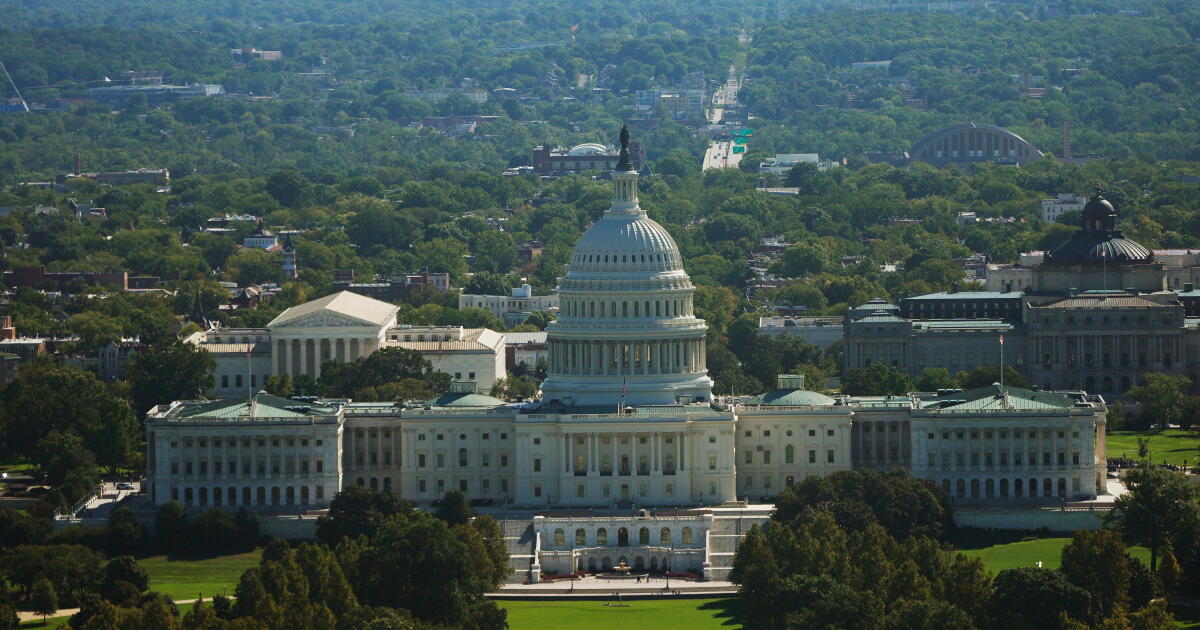
WASHINGTON — President Trump has notched a string of wins on the Supreme Court ’s emergency docket, in part because the conservative justices believe that blocking executive policies is a blow that can’t be easily fixed, Justice Sonia Sotomayor said Thursday.
The increase in emergency appeals by the Trump administration is “unprecedented in the court’s history,” she said in a speech at the University of Alabama School of Law.
The high court sided with the Trump administration in about two dozen decisions last year, often lifting the orders of lower court judges who found their policies were likely illegal on topics as diverse as immigration and steep federal funding cuts.
While designed to be short-term, those orders have largely allowed Trump to move ahead for now with key parts of his sweeping agenda.
The emergency docket, which is made up of appeals seeking quick intervention from the justices in cases that are still playing out in lower courts, is itself a source of disagreement among the justices. That spilled into public view when two other justices, liberal Ketanji Brown Jackson and conservative Brett M. Kavanaugh, publicly sparred over the emergency docket in an unusual exchange last month.
Sotomayor has disagreed with many of the decisions in Trump’s favor, but the conservatives who form the court’s majority often reason that blocking those policies — or laws passed by Congress — causes legal harm that can’t be easily fixed, she said. It’s a bar that’s tough for the other side to overcome, even for plaintiffs like immigrants who could be newly exposed to deportation or states where schools are losing teacher-training funding.
“If you start with the presumption that there is irreparable harm to one side, then you’re going to have more grants of emergency relief. Because the other side is going to have a much harder time,” she said. “It has changed the paradigm on the court.”
Her comments provided a window into the Supreme Court decisions that are often released with little explanation. While many emergency docket orders have gone Trump’s way, the court also struck down his sweeping tariffs, a central plank of his economic platform, after a longer process of full briefing and oral arguments.
A few years ago, some were predicting the demise of Spanish-language television.
Most of the Latino population growth over two decades has come from U.S. births, outpacing the arrival of immigrants. The thinking was that because most U.S.-born Latinos speak English and can consume a wide array of media, Spanish-language TV would recede in relevance.
But Telemundo has defied such forecasts to become one of the nation’s hottest news outlets.
Last year, Telemundo increased its audience for its evening news, anchored by Julio Vaqueiro, by 11% over the previous year, according to Nielsen data. Its Los Angeles station, KVEA Channel 52, has surpassed entrenched giants Walt Disney Co.’s KABC and Univision’s KMEX, attracting more viewers for its local evening and late-night newscasts.
The Miami-based division has a strong social media presence. Its Telemundo Noticias (News) account boasts 16 million followers on TikTok, topping ABC News, CNN and Fox News.
Cultural and demographic shifts have helped fuel Telemundo’s rise. After more than a decade of immigration declines, border crossings surged during President Biden’s tenure — a tide that turned with President Trump’s return to the White House. Instead, Trump brought a torrent of significant news events, including immigration raids that reverberated through Latino communities.
“We are growing because we are telling the stories that are important to our audience,” Gemma Garcia, Telemundo’s executive vice president for news, said. “We are very audience-driven.”
When U.S. military forces seized Venezuela’s then-president Nicolás Maduro in January, Telemundo quickly flew its main news anchor, Vaqueiro, to report from Colombia, which borders Venezuela. The network interrupted its usual Sunday night fare for a news special that scored solid ratings.
The younger journalist brings a softer tone to his reports. He was promoted to Telemundo’s main news anchor in 2021 after several assignments, including working at KVEA in L.A. He loves stepping out from behind the anchor desk in Miami to cover big stories.
“We’re very focused on being out there and reporting on the ground,” Vaqueiro said in an interview. “Being close to our audience, that’s a big part of what we are doing at Noticias Telemundo.”
Another key to Telemundo’s momentum has been its commitment to the Spanish language.
Media companies a decade ago raced to engage young, bilingual Latinos by launching start-ups, including a joint venture between ABC News and Univision called Fusion that flopped.
“With Bad Bunny’s rise and the Super Bowl, it felt like a shift in values towards the Spanish language,” said Mark Hugo Lopez, Pew Research Center’s director of race and ethnicity research. “It has become a source of cultural pride … and it seems to be impacting the ways in which English-speaking Latinos also think about their identity.”
Bad Bunny performed the Super Bowl halftime show in Spanish in February.
(Eric Thayer / Los Angeles Times)
That increased affinity suggests that Spanish isn’t going away anytime soon.
“Our data has shown that Latinos say it’s important that Latinos in the future speak Spanish here in the United States,” Lopez said.
A slow build to a news leader
Telemundo’s rise was a slow build, coming nearly a quarter-century after NBC bought the network for nearly $2 billion.
Years of effort took root after NBCUniversal agreed in 2011 to spend big for the U.S. Spanish-language media rights to the FIFA World Cup, dethroning Univision, which had long televised the prestigious soccer event. This year, Telemundo is poised “to deliver the largest coverage in Spanish-language media history,” the network said in a statement.
It will provide live coverage for all 104 matches, including on the Telemundo and Peacock streaming apps.
NBCUniversal integrated its English and Spanish-language news units at its television stations. In Los Angeles, KVEA’s newsroom is in the same building on the Universal lot as KNBC-TV Channel 4. The same managers run both divisions.
“All of these things have evolved,” said Millie Carrasquillo, a Hispanic media consultant and former Telemundo research senior vice president. “It’s an alignment of the audiences, an alignment of how technology is evolving — and also the way that news is being delivered.”
Telemundo’s national newscast, anchored by Vaqueiro, averages 1.2 million viewers, its largest audience in years.
But audiences, particularly younger ones, are less likely to watch TV news, so network executives have tapped the potential of TikTok, Instagram and YouTube to boost their reach.
On TikTok, Telemundo reporters broadcast live from outside the U.S. Supreme Court last week as justices heard oral arguments on Trump’s push to end birthright citizenship for babies born to parents who are in the country unlawfully. Telemundo featured live coverage of the traditional Easter egg roll at “La Casa Blanca” (the White House) and frequent reports about NASA’s Artemis II mission, which scored millions of views.
“Radio and television hasn’t gone away,” said Mari Castañeda, University of Massachusetts Amherst’s Commonwealth Honors College dean. “But Telemundo has recognized that [cellphones] are where most of their audience is located and they leaned into that.”
Social media posts are easy to share, serving as a viral expansion of the network’s audience.
“Telemundo has emerged as a leader because it has modernized,” added Castañeda, a native of La Puente in Los Angeles County.
The U.S. Latino population nearly doubled between 2000 and 2024, rising from 35 million to 68 million, according to the Pew Research Center. Since the Great Recession, the growth has largely come from U.S. births, and the median age of U.S.-born Latinos is about 21.
The trend line bent during the Biden years as U.S. births roughly equaled the arrival of immigrants, Lopez said.
“Immigrants are still a very large part of the Latino story,” he said.
Noticias Telemundo anchor Julio Vaqueiro talks to a child living in a makeshift migrant camp along the Rio Grande near the Ciudad Juarez-El Paso border on Feb. 28, 2024.
(Telemundo)
‘This is a country we really love’
Telemundo’s brightest star — Vaqueiro — was born in San Juan del Río, north of Mexico City and came to the U.S. when he was 26 with his wife, who was also born in Mexico.
“We have three American kids,” Vaqueiro said. “All we know as a family is the U.S. This is a country that we really love and we’re grateful to it.”
In many ways, Vaqueiro’s journey is the story of U.S. Latinos.
“He’s Mexican but he’s also a U.S. Latino and he understands the context and issues that communities are feeling,” said Castañeda. “There’s a sense of authenticity and care that comes through.”
Vaqueiro wrote a book, “Río Bravo. México, Estados Unidos y el regreso de Trump, (Rio Grande: Mexico, the United States, and the Return of Trump),” to explore the political mood during a period of tumult and often tense relations between the countries.
Telemundo strives to stay out of the political fray, Garcia said.
“We don’t think about politics,” Garcia said. “We cover what is happening within our community, and now more than ever, we are on top of our community’s stories.”
Vaqueiro added: “We have to be very careful reporting the facts and verifying every information that comes to us.”
Political divisions course through Latino communities, including in South Florida where Telemundo is headquartered.
“We’ve always known that Latinos are not a monolith,” Vaqueiro said. “This is a complex community that is constantly growing. It’s diverse: geographically, culturally and generationally.”
Interest in news has swelled since Trump began his second term. Ratings are also up for ABC’s “World News Tonight with David Muir,” which is drawing 8.4 million viewers per telecast this season, outpacing NBC, Fox News and CBS.
In national news, Univision still tops Telemundo. In local news, Telemundo’s KVEA has continued to build on its lead this year, although KMEX remains competitive and Disney’s KABC remains dominant among English-language stations.
“I just hope that we meet the moment,” Vaquerio said. “This is a critical moment for Latinos who are navigating very difficult times under a lot of pressure.”
He has another goal, too.
“I want to lift Latino voices who are moving forward — opening new businesses and graduating from college,” Vaqueiro said. “I want to talk about the positive side of this community that brings huge contributions to the United States.”
MIAMI — President Trump shared video of a deadly attack allegedly by a Haitian immigrant accused of bludgeoning a woman with a hammer at a Florida gas station, portraying the killing as justification for his administration’s mass deportation agenda.
Rolbert Joachin, 40, was arrested and charged with killing a woman on April 2 in Fort Myers, about 160 miles northwest of Miami. Authorities said the man was from Haiti and arrived in the U.S. in 2022. The woman who was killed was identified as a 51-year-old immigrant from Bangladesh and a mother of two adult daughters.
Trump, who posted the video late Thursday to his Truth Social account, has often sought to portray immigrants as bringing crime to the U.S., and the video emerging from the Florida attack presented him with a new, particularly graphic opportunity to do so. Trump also often paints Democrats and his predecessor, former President Joe Biden, as allowing in immigrants who posed a criminal or national security threat to the U.S.
Critics say the president unjustly paints all immigrants as criminals in an effort to bolster his immigration agenda, when studies have found that people living in the U.S. illegally are less likely than native-born Americans to have been arrested for violent, drug and property crimes.
“The video of her brutal slaying is one of the most vicious things you will ever see,” Trump said in his post, describing the man as an “animal.”
Graphic video captured woman’s killing
The woman who was killed was working as a clerk at the convenience store of the gas station, according to court documents. The killing happened outside the store and the man was arrested the same day.
In security camera footage of her killing posted on the Department of Homeland Security’s X feed, the man can be seen repeatedly slamming the hammer into a black vehicle parked in front of the gas station. Eventually a woman in black pants and a pink shirt comes out and appears to question him.
The man, wearing a yellow shirt and black shorts, walks up to the woman and immediately swings the hammer at her head. The woman falls down on the sidewalk in front of the gas station’s front doors. The man attacks the woman with the hammer multiple times before stepping over her unmoving body and walking away, out of the frame of the camera.
The victim was later identified in a police report as Nilufa Easmin, 51. A GoFundMe started by Samir Bahadur Syed, the President of the Bangladesh Association of Southwest Florida, described her as a “devoted mother who worked tirelessly to provide for her two young daughters.”
Syed said that Easmin arrived in the United States about three decades ago and resided in Miami and Palm Beach before moving to Florida’s west coast. She was a single mother, and her two daughters — one 23 years old and the other about 26 — were born in the U.S., Syed told the Associated Press.
He added that Easmin had been working at the convenience store for nearly five months and that she also held another job.
Fort Myers police said they responded to a report of a woman being hit with a hammer at a Chevron gas station. When officers arrived they found a woman on the ground with blood around her head and multiple cuts.
Officers later located Joachin walking on the street and took him into custody. The police said he has confessed. He was charged with murder and property damage and appeared in court on Wednesday. His arraignment is set for May 4.
An email message sent to the public defender listed in court records as Joachin’s lawyer seeking comment was not immediately returned.
Trump blamed Biden for granting the man temporary protection to stay in the U.S.
Kelly Walker, acting field office director for ICE enforcement and removal operations for the Miami field office, said during a news conference Friday that Joachin arrived in a “water vessel” near Key West, Fla., in August 2022. He was arrested and given Temporary Protected Status in 2023. That status was revoked this week, Walker said.
The Trump administration has harshly criticized the use of Temporary Protected Status, or TPS, which can be granted by an administration to citizens of a country going through turmoil or strife. Immigrants who qualify are allowed to stay in the U.S. and work for a temporary period, although Republican critics contend that the Biden administration misused its TPS authorities to broadly allow hundreds of thousands of people to stay in the country.
There are several lawsuits at the federal courts challenging Trump’s efforts to terminate TPS for more than one million people, including 350,000 Haitians. In March, a federal appeals court sided with a lower judge’s ruling against the end of temporary status for Haiti and the U.S. Supreme Court will hear arguments on April 29.
The Department of Homeland Security and the Trump administration have often highlighted crimes committed by immigrants and created a website where one can look up people arrested by Immigration and Customs Enforcement and the crimes they’ve committed in the U.S.
The administration often highlights “Angel Families” who have lost family members to crimes committed by immigrants.
On Thursday, ICE held an event marking the one-year anniversary of the reopening of an office dedicated to assisting those families, including emotional testimony from some of the surviving family members.
Salomon, Bellisle and Santana write for the Associated Press. Bellisle reported from Seattle and Santana from Washington.
Rep. Eric Swalwell, a Democratic front-runner in the hotly contested California governor’s race, was accused of sexual assault and misconduct by a former staff member and other women, according to reports published on Friday.
The woman who worked for the Northern California congressman said she had a consensual relationship at times, but that he sexually assaulted her twice when she was too inebriated to consent, according to a report by the San Francisco Chronicle. Three other woman also have accused Swalwell of sexual misconduct, including receiving unsolicited nude photos from the Democrat, according to CNN.
The allegations against Swalwell has his campaign teetering on collapse, with powerful labor organizations and other major supporters pulling their endorsements and dropping political ads promoting the once-promising candidate. U.S. Sen. Adam Schiff, one of many prominent Democrats who supported Swalwell, and others have called on him to drop out of the race.
Swalwell had been gaining traction in the crowded field, and the controversy completely upends the race just as voters are starting to pay attention.
“It’s like a bomb went off,” said Mike Madrid, a Republican strategist who runs the research nonprofit Latino Working Class Project.
Swalwell’s staff member was 21 years old when she started working for the congressman, who is nearly two decades her senior, and said she did not report the incidents to police because of fears she would not be believed.
“I have no skin in the game of who becomes governor of California, but I feel people have a right to know whether the person who leads a state that is a safe haven for so many women actually treats women with dignity and will protect their rights,” the woman, who was not identified because she is the alleged victim of sexual assault, told the Chronicle. “No one protected me from him, and so I have to protect the other young women like me who aspire to work in this field and he could prey upon.”
Swalwell on Friday denied the accusations.
“These allegations are false and come on the eve of an election against the front-runner for governor,” he said in a statement. “For nearly 20 years, I have served the public — as a prosecutor and a congressman and have always protected women. I will defend myself with the facts and where necessary bring legal action. My focus in the coming days is to be with my wife and children and defend our decades of service against these lies.”
State Supt. Tony Thurmond and San José Mayor Matt Mahan, other Democrats running for governor, immediately called on Swalwell to drop out of the race. Multiple staff members working for Swalwell’s campaign have resigned, according to a source close to the candidate who was not authorized to speak about the matter. .
Allegations of inappropriate behavior by the congressman have been circulating on social media and in political circles for weeks. On Thursday, an attorney representing Swalwell sent a cease-and-desist letter to at least one person demanding that they stop accusing the congressman of sexual assault.
Two days earlier, the congressman denounced online claims that he had inappropriate relationships with young congressional staff members.
“It’s false,” he told reporters after a town hall in Sacramento, saying he had never behaved inappropriately with female staff members or had a sexual relationship with a staff member or an intern, and denied allegations that his staff members were asked to sign nondisclosure agreements or entered into legal settlements.
In 2025, another woman said after drinking with Swalwell, she ended up in his hotel room without recollection of how she got there and that her memory of what happened is “a blur,” according to CNN. Two other women told the cable network’s reporters that the congressman sent them unsolicited photos of his penis and other sexual messages on Snapchat.
The allegations come at a pivotal time in the race to replace termed-out Gov. Gavin Newsom. The primary is June 2, but ballots start landing in voters’ mailboxes in less than a month.
The race to lead the nation’s largest state remains up for grabs, with eight prominent Democrats and two top Republicans jockeying to finish in first or second place in the primary and advance to the November election.
Swalwell, 45, is among the leading Democrats with the support of 13% of likely voters in a recent UC Berkeley poll co-sponsored by the Los Angeles Times. That places him tied for first place among Democrats with former Orange County Rep. Katie Porter, with billionaire Tom Steyer not far behind.
Swalwell has won the support of powerful unions, including the California Teachers Assn., along with Schiff (D-Calif.) and many of his Democratic colleagues in Congress.
CTA President David Goldberg called the allegations “incredibly disturbing and unacceptable.”
“We are immediately suspending our support,” he said. “Our elected board will be meeting as soon as possible to follow our union’s democratic process to determine next steps.”
Rusty Hicks, the chairman of the California Democratic Party, said victims must be believed and also reiterated his call for Democratic candidates to gauge their viability.
“The allegations against Congressmember Swalwell are deeply disturbing,” he said in a statement. “Any person engaged in misconduct must take responsibility and be held accountable for their actions — including a Member of Congress and candidate for Governor. Finally, my call for all — repeat, all — candidates for Governor to ‘honestly assess the viability of their candidacy and campaign’ still stands. In fact, that call is more important now than ever before.”
The woman told the Chronicle that she was hired in 2019 to work in Swalwell’s Castro Valley district office when she was 21. He quickly began sending her messages and then nude pictures on Snapchat.
In September of that year, she said she had drinks with the congressman, blacked out and could feel the effects of intercourse when she woke up naked in Swalwell’s hotel bed, according to the report. In 2024, when she no longer worked for Swalwell, she said she attended a charity event honoring the congressman and met him for drinks afterward. She was intoxicated, but recalled Swalwell forcing himself upon her, and pushing him away and saying, “No,” according to the Chronicle.
The Chronicle corroborated her report with texts she sent a friend at the time and interviews with the friend and the woman’s then-boyfriend. The Chronicle’s reporters also reviewed medical records about a pregnancy and tests for sexually transmitted diseases a week after the alleged assault. She told them she had kept quiet about the alleged assaults because of fears about professional and personal repercussions.
Concern began brewing among Democrats before the allegations were published.
Cheyenne Hunt, a Laguna Hills attorney and executive director of a progressive advocacy group, and social media influencer Arielle Fodor, known online as Mrs. Frazzled, are among those publicizing the allegations online. Republican Rep. Anna Paulina Luna of Florida, who has sparred with Swalwell in the past, has amplified the allegations on social media as well.
The Times has not independently corroborated reports of sexual misconduct.
Many politicians have survived serious allegations of sexual misconduct, including President Trump, who was accused of rape before winning the White House in 2016.
Others have seen a swift reckoning. In the hours and days after the late farmworkers rights leader César Chávez was accused of sexual abuse, his name and image were stripped from schools, streets and murals.
Two recent California governors have been accused of sexual impropriety; former Gov. Arnold Schwarzenegger admitted to behaving improperly during his movie career and Gov. Gavin Newsom acknowledged an affair with a married staffer while mayor of San Francisco.
Swalwell, a former prosecutor, is married and has three children. The Iowa native briefly ran for president in 2020. On Thursday, he canceled a town hall in Palm Desert, reportedly because he was sick.
He has previously spoken out against sexual misconduct, most recently in support of women who told the New York Times that they were assaulted by Chávez.
“The women who have come forward are carrying years of pain. Speaking about that takes real courage,” Swalwell wrote in a tweet last month. “Ana Murguia, Debra Rojas and Dolores Huerta are speaking with clarity and strength. I stand with them and condemn all instances of sexual assault.”
The congressman also defended women who accused Brett Kavanaugh, then a nominee to serve on the U.S. Supreme Court, of sexual misconduct in 2018.
“The more and more cases that are separate and independent that look the same, pretty soon a prosecutor starts to say to a jury … that the arrows are pointing in the same directions and what are the chances that three or four women independently, who never met each other, would have similar experiences with one person,” he said on MSNOW’s Ari Melber in September 2018 amid Kavanaugh’s confirmation hearings.
In Congress, Swalwell has been a prominent critic of President Trump, serving as a manager of the second impeachment of the president and frequently blistering Trump on cable news shows.
In late March, the Washington Post reported that FBI Director Kash Patel may release documents about a decade-old investigation about Swalwell’s connections with a suspected Chinese spy. Swalwell cut off ties with Christine Fang, or Fang Fang, in 2015 after intelligence officials warned him and other members of Congress about Chinese efforts to infiltrate legislators’ offices. Swalwell was not accused of impropriety.
After news of the potential release of the files broke, Swalwell accused Trump of trying to sway the gubernatorial election and weaponizing the federal government against his political enemies.
Swalwell’s attorneys filed a cease-and-desist letter with Patel and the FBI. No documents have been released as of Friday.
He was previously accused of mortgage fraud by Federal Housing Finance Agency Director Bill Pulte. Swalwell sued Pulte last year but dropped the suit this month.
In the gubernatorial race, Swalwell has faced criticism from fellow Democrat Tom Steyer that he was ineligible to run for governor because he did not truly live in California. Earlier this year, a Sacramento County judge ruled against a similar claim made by a conservative filmmaker.
Times staff writer Melody Gutierrez in Sacramento contributed to this report.
WASHINGTON — Vice President JD Vance departed Friday for Islamabad, Pakistan, to open the first direct negotiations aimed at ending the war between the United States and Iran.
Together with a delegation of deeply mistrusting negotiators from Tehran, Vance is tasked with striking a lasting peace between rival nations which have failed to keep promises made days ago in a delicate last-minute ceasefire. Ongoing military activity in the Middle East and disagreements over Iran’s control of key shipping routes have left the diplomatic effort vulnerable to collapse before the talks even begin.
“If the Iranians are willing to negotiate in good faith, we’re certainly willing to extend the open hand,” Vance told reporters before boarding Air Force Two. “If they’re gonna try and play us, then they’re gonna find that the negotiating team is not that receptive.”
On Tuesday, President Trump called off his plans to unleash “hell” on Iran based on assurances that it lift its blockade of the Strait of Hormuz, but traffic through the vital waterway was still at a trickle Friday, as more than 600 ships remained stranded in the Persian Gulf, according to marine tracking data. Trump accused Iran on Thursday of doing a “very poor job, dishonorable some would say,” of allowing oil through the strait.
“The Iranians don’t seem to realize they have no cards, other than a short term extortion of the World by using International Waterways. The only reason they are alive today is to negotiate!” he wrote on Truth Social Friday.
Meanwhile, Lebanon has emerged as the central dispute threatening to derail the talks before they begin.
Hours after the ceasefire took effect, Israel launched what Lebanese officials described as its heaviest wave of strikes since the war began, killing at least 303 people, according to local health officials.
Jerusalem argues the Lebanese front is still on the table, but Iran and Pakistan disagree.
“The Iran–U.S. Ceasefire terms are clear and explicit: the U.S. must choose — ceasefire or continued war via Israel. It cannot have both,” Iranian Foreign Minister Abbas Araghchi said earlier this week. “The world sees the massacres in Lebanon. The ball is in the U.S. court, and the world is watching whether it will act on its commitments.”
Vance has acknowledged a “legitimate misunderstanding” over whether Lebanon was included in the ceasefire terms, telling reporters Washington never made that promise.
Separate negotiations regarding Lebanon are expected next week in Washington, Lebanese President Joseph Aoun confirmed Friday. Israeli Prime Minister Benjamin Netanyahu has also OK’d the talks, but said a ceasefire is not possible.
Parliament Speaker Mohammad Bagher Qalibaf and the Iranian delegation arrived early Saturday in Islamabad, Iranian state media reported. Hours earlier he said a ceasefire in Lebanon “must be fulfilled before negotiations begin.”
Bagher Qalibaf added a second condition — the release of frozen Iranian assets — which he suggested must be returned before Tehran takes its seat at the bargaining table. Little is known about the halted Iranian funds overseas, but such assets are typically held back as a result of U.S.-imposed sanctions.
The vice president’s role in peace talks has grown in recent weeks. Administration officials have cast Vance as one of the few leaders Tehran would be willing to engage with directly. With a global economy upended by Trump’s far-reaching military ambitions, a victory in Islamabad could spike Vance’s standing as a prospect to lead the GOP post-Trump.
That’s if he’s able to take pressure off American wallets with an agreement that liberates Iran’s grip over the strait, which has choked much of the world’s oil supply,
Americans have continued to feel the fallout at the gas pump and grocery stores, as U.S. inflation climbed to 3.3% in March, the highest annual rate in nearly two years, according to the data released Friday by the Bureau of Labor Statistics.
Monthly prices rose 0.9%, a sharp increase from February’s 0.3% monthly rise, when annual inflation sat at 2.4%, the new data showed.
The White House characterized the rising inflation as a short-term disruption caused by the Iran war, while noting that the administration is “diligently working to mitigate” rising costs.
“As the Administration ensures the free flow of energy through the Strait of Hormuz, the American economy remains on a solid trajectory thanks to the Administration’s robust supply-side agenda of tax cuts, deregulation, and energy abundance,” White House spokesperson Kush Desai wrote on X.
Britain announced a meeting next week with dozens of countries to coordinate efforts to reopen the Strait of Hormuz. The summit will focus countering Iran’s proposal to charge transit tolls to allow ships through the waterway.
In a televised address to the nation, Pakistan’s Prime Minister Shehbaz Sharif spoke of a “devastating storm of inflation,” if peace talks don’t succeed in liberating the Middle East’s oil supply. He characterized the current stage as a “make-or-break moment.”
“We will make every possible effort to ensure the success of the peace process,” he said.
SACRAMENTO — Gov. Gavin Newsom has dismissed questions about the race to succeed him in California for much of the last year.
“You know my position,” he said to reporters last month. “I don’t talk about this governor’s race.”
But as his party runs the risk of losing the most powerful office in the state, Newsom recognizes that he may need to step in and endorse one of the Democratic candidates whether he wants to or not.
California Democrats have put themselves in an unnecessary pickle in the 2026 gubernatorial election: Too many candidates, with few policy distinctions between them, are running to replace Newsom. Opinion polls show no clear favorite and Democrats largely splitting votes.
The tepid support raises the possibility that two Republicans in the race could place first and second in the June primary and advance to the general election. By their own strategic blunder, Democrats could be knocked out of the contest in a state where they outnumber Republicans nearly 2 to 1.
It’s a disaster everyone saw coming and no Democrat, except perhaps Newsom, has the power to stop, said Thad Kousser, a professor of political science at UC San Diego.
“Gavin Newsom’s megaphone is loud enough to echo across this race, leading other prominent members of the party to endorse whomever he chooses and vaulting someone, finally, out of the crowded pack,” Kousser said. “This could be the last remaining chance for the party to avoid splitting its vote in June and being locked out of November.”
Endorsing a successor before the primary carries inherent risk and perhaps more so for Newsom, who is positioning himself as a potential leading candidate in the 2028 presidential contest. Publicly backing a candidate for governor ties Newsom to the outcome of the race and the candidate.
“If it doesn’t work, his endorsement would broadcast his political vulnerabilities and attach him to his party’s weakness just at the time when he needs to project his personal strength,” Kousser said. “But if his intervention rescues the party and elevates his chosen successor into being an overwhelming favorite in the general, it would further elevate his national profile while winning him a close friend in Sacramento.”
Newsom is taking a wait-and-see approach for now, tracking polls to determine whether his intervention is necessary.
President Trump’s decision to endorse conservative commentator Steve Hilton over the weekend could relieve some pressure on Newsom to weigh in.
If Trump’s support causes support for Hilton to rise and Bianco to drop, it’s more likely that one Democrat and one Republican will place in the top two in the primary.
Trump’s endorsement left Kousser and other California political observers scratching their heads. If a candidate from each party advances to November, the Democrat is expected to easily win the race because of the voter registration advantage.
But the governor publicly celebrated a California Supreme Court ruling this week that Bianco halt the investigation.
“This rogue sheriff chased conspiracy theories, tried to undermine our elections, and got the ruling he deserved,” Newsom posted on X, the social media platform owned by Elon Musk. “Trump and MAGA’s election denialism is a cancer, a danger to our democracy, and it must be stopped.”
Rob Stutzman, a Republican political consultant in California, compared Newsom’s posts about Bianco to “trying to return a gift.” The Democratic governor’s attack could boost Bianco’s profile and support among Newsom-hating voters.
“Trump has probably bailed the Democrats out of their dilemma by elevating Hilton and for Newsom’s response to be to elevate and draw attention to Bianco, just doesn’t make any sense, and it’s everything Bianco wanted out of this whole ballot seizure gambit to start with,” Stutzman said.
Newsom’s reluctance to endorse a Democrat in the race is, in part, a reflection of his feelings about leaving a position he’s held for eight years and a recognition of his own “sell-by date” in the post. His answers to questions about the contest vary from declining to comment to pointing out that voters don’t appear interested in the race, either.
The focus on national politics, attention Trump draws “24 hours a day” and earlier speculation over whether former Vice President Kamala Harris or U.S. Sen. Alex Padilla would run for governor distracted from the candidates in the field, he said.
“But when I’m out in the community, people aren’t talking to me about it, which is interesting this late, just weeks and weeks before early voting,” Newsom said in March. “And so, as a consequence, I’m not directly as engaged as perhaps I might need to be.”
His comments suggesting that he isn’t paying attention to the race haven’t sat well with some of the candidates. Some Democrats, including San Jose Mayor Matt Mahan, were already running against Newsom’s record.
For Newsom, inaction is more risky than picking a losing candidate, Kousser said. Though California’s top-two system and poor leadership from the state party would mostly be to blame if Democrats lose, giving control of California to the GOP would bolster criticism of Newsom’s leadership.
“A Republican victory in the state Newsom leads would be read, on the national stage, as a rejection of his legacy,” Kousser said.
RANCHO MIRAGE, Calif. — As Republicans vie for their best shot to win the California governor’s office in two decades, the fight between the most prominent candidates to win over the party of President Trump has switched from subdued to vicious.
Conservative commentator Steve Hilton, at their first one-on-one debate in Rancho Mirage earlier this month, accused rival Riverside County Sheriff Chad Bianco of coddling illegal immigrants and called him “wishy-washy.” The law enforcement chief called Hilton, a British immigrant, a “fraud” and heartless for denying others the same pathway to U.S. citizenship he received.
“What an outrageous and offensive insult that Chad just made to every legal immigrant in this state and in this country,” Hilton fumed.
The heated exchange took place days before the California Republican Party weighs making an endorsement in the 2026 race for California governor. Hundreds of party delegates will gather in San Diego this weekend to decide, though it’s unclear if either candidate will be able to win the 60% vote threshold to receive the official party nod.
Most polls have shown the two Republicans as the top candidates in the race, despite registered Democratic voters outnumbering Republicans nearly 2-to-1 in California.
Bianco and Hilton are competing against eight heavyweight Democrats who are splintering their party’s votes in the election to replace termed-out Gov. Gavin Newsom. Under California’s unique primary system, the two candidates who receive the most votes in the primary will move on to the November general election, regardless of party affiliation.
The prospect has alarmed state Democratic leaders, who unsuccessfully urged struggling candidates todrop out to avoid their party being shut out of the November election.
Still, a lot can happen before the June 2 primary to stir up the race. President Trump endorsed Hilton late Sunday, which could significantly influence the state’s GOP voters. More than 6 million Californians voted for Trump in the 2024 presidential election, though he was trounced by Vice President Kamala Harris, one of the state’s top Democrats.
Riverside County Sheriff Chad Bianco, a Republican candidate for governor, and Kate Monroe, chief executive of VETCOMM, talk with a woman lying on the sidewalk on Skid Row in Los Angeles in January.
(Jason Armond / Los Angeles Times)
On the campaign trail, Bianco and Hilton have frequently raised the prospect of a Republican being elected governor as the result of failed Democratic rule of the nation’s most populous state and the world’s fourth-largest economy.
“For the first time in probably our lifetimes, really since Ronald Reagan … every legitimate poll has either shown me or Steve Hilton at the top two Republicans at the top of [every] statewide poll,” for the last six months, Bianco recently told about 100 attendees at a Valley Unity Republican Women luncheon at the Woodland Hills County Club overlooking verdant fairways.
Hilton, who has participated in more gubernatorial forums and debates than Bianco, said polling that shows him besting Democratic rivals proves that Californians are fed up with 15 years of one-party rule.
“I tell you right now, there is not a single one of them who represents to the slightest degree the change we need in California,” he told a few hundred people at Big Bear’s Calvary Chapel. “We are going to do it this year.”
From afar, Bianco appears to be out of central casting for a GOP candidate for governor: an armed lawman, with a salt-and-pepper mustache and close-cropped hair who has dedicated his life to protecting the vulnerable and locking up criminals.
Bianco, echoing independent pollsters as well as political strategists in both parties, said having “Riverside County Sheriff” next to his name on the official state ballot will be a major boon to his campaign.
“I will tell you this, if we took the names and the party off of the ballot and simply went up with resume — we made you all read a resume of who you’re going to put as your next governor — I would win this election 100% to nothing,” Bianco told the GOP women’s group.
Republican gubernatorial candidate Steve Hilton greets a member of the Big Bear Valley Republican Assembly before speaking at a town hall at Calvary Chapel in Big Bear in March.
(Gina Ferazzi / Los Angeles Times)
But Bianco’s badge hasn’t shielded him from Hilton’s blistering attacks about the sheriff’s past statements about immigration, pandemic mask mandates and Black Lives Matter protests — which is disqualifying for some GOP voters.
Bianco opposes “sanctuary city” laws, calls for the deportation of criminal illegal immigrants and says the border must be secured. But he has also supported a pathway to citizenship for lawful, working undocumented people and told his constituents that his deputies were not taking part in ICE raids.
In the early days of the COVID-19 pandemic, Bianco ordered county residents to wear masks or face punishment, though he later pushed back at Newsom’s stay-at-home orders.
That same year, he and his deputies were photographed kneeling and speaking with protesters in the aftermath of the killing of George Floyd, an action he has since recast as praying.
Bianco’s wife, Denise, on Thursday accused Hilton of endangering her husband by sending mailers to voters that featured Bianco’s face surrounded by circles that she described as a “bullseye target.”
“We have all watched way too much political violence directed at law enforcement officers in recent years. I never imagined it would come from a political candidate directed at my husband,” she said in an Instagram post. “Steve, why on God’s earth would you think it’s acceptable to put my husband’s face, a dedicated sheriff, on a shooting target?”
Election security has also highlighted differences in the candidates’ views.
Hilton and Bianco echoed Trump’s call to make GOP voter turnout “too big to rig.” But their statements about alleged malfeasance differed.
Hilton decried “total corruption in the voting system in California.”
“I’ve said for the longest possible time that I don’t understand why we can’t do things the way that most places do it, which is vote on one day, count on one day, get the results on one day,” he said.
Asked by a voter about electoral fraud in California in March, Bianco replied that he was confident that law enforcement in California ensures that such fraud is “not happening here,” while agreeing that such “cheating” occurred in states such as Ohio and Pennsylvania in the 2020 election.
But the same month, he seized more than 650,000 ballots from the November election as part of an investigation to determine if they were fraudulently counted.
California voters have not elected a Republican as governor since Arnold Schwarzenegger won reelection in 2006. Two Republicans on the ballot in the June 2 primary election hope to change that.
(Justin Sullivan / Getty Images)
Hilton has sought to capitalize on these positions, labeling Bianco the “shifty sheriff,” an attack that resonates with some voters.
“The man lies. The man is not honest about taking a knee to BLM, which is unacceptable,” said Agnes Gibboney, 71, of Rancho Cucamonga. “And coming up with three, four different excuses is unacceptable. And then to get mad at the voters for asking the question.”
Bianco has labeled Hilton as a shape-shifting opportunist, pointing to him championing a climate change agenda while advising British Prime Minister David Cameron and expressing support for views expressed by Sen. Bernie Sanders (I-Vt.) in the 2016 presidential election, and posting a picture of Hilton hugging Newsom on social media.
“Steve is a fraud. He’s a liar, and I’m not going to sit by and just let him do it anymore,” Bianco said after the Rancho Mirage debate. “When he starts attacking me, he starts attacking my deputies, my profession, I’m not gonna let it happen anymore.”
“He remade himself just for this governor election, and everyone is starting to see through it,” Bianco said.
The son of Hungarians who emigrated to Britain, Hilton served as an advisor to Cameron before becoming an American citizen. At campaign events, supporters have gifted Hilton with a Kézimunka, a traditional Hungarian embroidered cloth, which was stitched with a heart, as well as stars-and-stripes bathing trunks.
“My parents are Hungarian refugees from communism,” Hilton said. “I am fighting to make sure that this state that I love does not turn into the country that I left …. I have renounced my U.K. citizenship. I’m all in for California and America.”
Of the two candidates, Hilton has been more publicly visible, and benefits from GOP voters seeing him speak on Fox News for several years.
Both men argue one-party Democratic rule of California has destroyed a state once viewed as the epitome of the American dream.
Hilton describes state leaders as “far-left lunatics.” They’ve ruined the most amazing, the most beautiful place on earth,” and tweaked a popular Texas slight about someone being all hat and no cattle to describe Newsom.
“He’s all hair, nothing there. Don’t you think it’s time in California we have a governor with less hair?” said Hilton, who sports a smooth crown.
Bianco calls the state’s Democratic leaders “far-left psychopaths” who have enacted policies, taxes and fees that are forcing Californians to flee the state.
“We all know government has completely failed and we’re ready to take our state back,” he said, later adding, “They don’t want our lives better. I do …. No one leaves California because they want to. It’s government agenda and policy that is harming California and making it bad.”
Most of the candidates’ pledges, such as tackling unaffordability, reducing gas prices, increasing capacity in state prisons, protecting gun owners’ rights and keeping trans athletes out of girls’ locker rooms, are nearly identical.
They both promise to slash California’s vehicle registration fees, a proposal that echoes former Republican Gov. Arnold Schwarzenegger’s pledge to repeal the car tax during the 2003 recall election that was immortalized by his campaign dropping a wrecking ball on an Oldsmobile in Costa Mesa.
Schwarzenegger was elected governor soon after.
No candidate in either party can match Schwarzenegger’s global appeal, or voters’ familiarity with the state’s most recent Democratic governors — including Jerry Brown, the scion of a storied political family — or Newsom’s charisma, added GOP strategist Rob Stutzman, a former Schwarzenegger advisor who is not aligned with any candidate in the 2026 race.
“Voters are finding this to be an uninspiring list of candidates. And in fact, the impressive list would be those that chose not to run, right?” he said, referring to Harris, Sen. Alex Padilla and Atty. Gen. Rob Bonta. “So it’s not a surprise that there isn’t much interest.”
Though Hilton and Bianco were previously cordial in person, such as when they crossed paths at September’s state GOP convention, their public criticism of each other has ratcheted up in recent weeks, which could sway the many undecided GOP voters in the race.
“My main contention is looking to see whether or not they’re gonna follow the will of the Lord. So I’m paying attention to what they say and what they do,” said retired Air Force IT specialist David Solomon, 42, after seeing Hilton speak in Big Bear. “It really just comes down to who’s gonna be able to enact their plan.”
Jane Price, a 77-year-old Sherman Oaks resident, said she worried that Republicans failing to unite behind a candidate would give Democrats an edge in the governor’s race.
“We don’t want to split, right? That’s a problem,” the charter member of the woman’s GOP group said after seeing Bianco speak. “The state of California is at stake. We were thriving here in California. But now, it has been nothing but a downhill slide. We need people who appreciate what California is all about.”
They’re the ones who lecture religious leaders on what Jesus stood for, demanding blessings for Trump’s actions — or else.
Just check out the recent allegations in The Free Press that senior defense officials dressed down the Vatican’s ambassador to the U.S. in January over Pope Leo XIV’s lack of enthusiasm for Trump’s imperialist ambitions. Or Secretary of Defense Pete Hegseth, he of the tattoos hailing the blood thirst of the Crusades (another Middle Eastern forever war that the “civilized” side lost), who compared the rescue of a downed American aviator in Iran over Easter weekend to the resurrection of Jesus.
It’s a playbook straight out of the Book of Revelations, which describes a Beast in the End Times with “a mouth speaking great things and blasphemies” in its quest to hold dominion over the earth.
In the other corner of this existential fight is an actual man of God: Pope Leo XIV.
Rather than cower before a despot who makes the Pharaoh in the Old Testament seem as stable and kind as St. Francis, the first American pope has resisted Trump like a protester at a “No Kings” rally. He has yet to denounce by name anyone in the president’s sordid orbit — but Pope Leo has returned to their actions again and again in his first year as head of the world’s 1.4 billion Catholics.
He began his papacy by greeting a cheering crowd with “Peace be with you all” — what Jesus told his disciples after his Resurrection and a brilliant, biblical way to telegraph where he stands in our bellicose times.
On Palm Sunday a few weeks ago, the pontiff proclaimed during Mass in St. Peter’s Square that God “does not listen to the prayers of those who wage war” — a not-so-subtle rebuke to Hegseth, who prayed shortly after the U.S. launched the Iran war for “every round [to] find its mark” and for “overwhelming violence of action against those who deserve no mercy.”
For his first Easter message, Pope Leo wrote, “Let those who have the power to unleash wars choose peace! Not a peace imposed by force, but through dialogue!”
Meanwhile, President Trump told a reporter that God supports the destruction he’s inflicting on Iran because “God is good. God wants to see people taken care of.”
Secretary of Defense Pete Hegseth speaks to reporters at the Pentagon, July 16, 2025, in Washington.
(Julia Demaree Nikhinson / Associated Press)
According to the Free Press article, the Vatican declined an invitation from Vice President JD Vance for Pope Leo to visit the U.S., for fear that Trump would use him as a political pawn. Instead, the man born in Chicago as Robert Prevost plans to spend July 4 — America’s 250th birthday — on a Mediterranean island that has long served as a gateway for migrants trying to make it to Europe.
Critics will accuse Pope Leo of Trump Derangement Syndrome and call him particularly short-sighted, since he stands athwart the desires of many American Catholics.
Though he isn’t Catholic, Trump has favored Catholicism far above any other mainline Christian denomination, from acknowledging feast days to packing his administration and the Supreme Court with adherents in a way that even Joe Biden — a lifelong Catholic — never did.
About 55% of Catholics voted for Trump in 2024, per the Pew Research Center. A survey last year by The Catholic Project at The Catholic University of America found “a clear generational shift away from liberal self-identification” among younger priests. Dioceses across the country are reporting the highest amount of converts in decades, many of them drawn in by orthodox Catholic influencers.
But Trump’s embrace of Catholicism, like everything else in his life, has been conditional on fealty to him. His administration pulled tens of millions of federal funds from Catholic charities because they assisted migrants regardless of legal status — something the American Catholic church has done for over a century. Vance, himself a Catholic convert, accused bishops of being “worried about their bottom line” for daring to criticize the move and his boss’ deportation Leviathan.
The Free Press also reported that Trump’s lackeys invoked the Avignon Papacy — when 14th century French kings exiled a succession of popes from the Vatican and made them their puppets — during their browbeating of the Vatican ambassador.
Re-litigating history is an obsession of the Trump regime, so bringing up a medieval episode amounted to a threat to Leo to shape up — or else.
That’s what makes Pope Leo’s stance against a modern-day Babylon even braver. A pope’s main role is to bear witness to the words of Christ, who said far more about taking care of the meek and turning the other cheek than he did about waging war.
The best popes, from John XXIII to John Paul II, know that their words stand as a challenge for all people, believers and not, to create a better world that paves the way for the world to come. Trump wages war for himself; Pope Leo urges us to stand for something other than ourselves.
At this point in his reign, Trump is a dead ringer for the Antichrist, described in the Second Book of Thessalonians as a “man of sin … the son of perdition who opposeth and exalteth himself above all.”
Pope Leo would never characterize his opposition to Trump in such apocalyptic terms, of course. But his stance against the president’s tyranny is a call to action in the same vein as John Paul II’s exhortation to the free world to oppose the Soviet empire.
“Let us abandon every desire for conflict, domination, and power,” Pope Leo stated on Easter, “and implore the Lord to grant his peace to a world ravaged by wars and marked by a hatred and indifference that make us feel powerless in the face of evil.”
Los Angeles officials are expressing growing fears that taxpayers and the city treasury could be hit with a round of crippling costs to support the 2028 Olympic Games if the city doesn’t ink a rigorous deal to assure a “zero–cost” Games.
Some city officials have long been concerned that taxpayers could be left with massive bills if the Olympics don’t generate the income organizers have promised. Delays in finalizing a deal between City Hall and the Olympics committee have heightened those tensions.
The exact costs to L.A. and other local governments remain unknown, as officials wait to hear from LA28 and federal security agencies about exactly what services they will need. Recent controversy over the ties between Casey Wasserman, the head of the L.A. Olympics, and Jeffrey Epstein have added to the uncertainty over the finances in the minds of some city leaders.
City Atty. Hydee Feldstein Soto and Councilmember Monica Rodriguez both issued letters demanding a contract pledging that LA28 cover any of the city’s future costs that arise as the city plays host to hundreds of thousands of athletes and fans.
The contract, more than six months overdue, is needed “to foreclose any scenario in which funds might go back to the wealthy backers and investors of the LA 28 organization without reimbursing taxpayer funded extraordinary costs,” the city attorney wrote to council members.
Rodriguez agreed in a separate letter this week that the city needs a contract that assures that the Olympics organization will pay any excess costs for policing, transportation, trash pickup and more, so that taxpayers are not burdened or “core city services” slashed.
That should take priority over the private nonprofit LA28 building a “Legacy Fund” to bankroll future youth sports programs, public sports facilities and the like, argued the city officials, who are both up for reelection this year.
“Bankruptcy cannot be the legacy of these Games,” Rodriguez wrote, without elaborating on what she meant, though L.A.’s top budget official recently projected a deficit, unconnected to the Olympics, of “several hundred million” dollars.
LA28 officials responded with a statement they issued previously, saying, in part, that “LA28 remains committed to delivering the safest, most secure, and fiscally responsible Games that will benefit Angelenos for decades to come,” adding, “We remain engaged in good faith negotiations and look forward to our continued partnership with the City of Los Angeles.”
LA28 Chief Executive Reynold Hoover said at a press event Wednesday that ticket sales were one vehicle for the host committee to assure that taxpayers didn’t get stuck with a big bill down the road.
The stakes remain high for both sides. The private LA28 group needs the city’s police, fire, sanitation, streets and transportation services to deliver a successful event. The city wants the sports extravaganza to succeed, not only to burnish its image on an international stage, but also to assure there is enough money to pay for all the extra tasks city workers will perform.
The LA28 leaders project the Games will cost more than $7.1 billion. They say that money will come from a variety of sources: nearly $1 billion from the International Olympic Committee, $437 million from international marketing rights, $2.5 billion from corporate sponsors in the U.S., $2.5 billion from ticket sales and hospitality packages, $344 million from licensing and merchandise and $405 million in other revenue.
LA28 reports being ahead of schedule on the revenue front. But city officials worry that unforeseen events — including an economic downturn or natural disaster — could blow up the income model, with one of many wild cards being the willingness of President Trump and the Republican-controlled Congress to follow through with a funding pledge to the Democratic-controlled city.
L.A. officials have long expressed concern that Trump and Congress might belatedly yank away $1 billion already set aside to reimburse state and local governments for security, planning and other Olympics-related costs.
While the two elected officials and some others, including an attorney representing city employees, raised alarms, an individual with knowledge of the talks between the city and LA28 said that a tentative agreement would likely be before the City Council “within two or three weeks.”
The knowledgeable individual, who asked not to be named because of the sensitive nature of the discussion, said negotiators on both sides must bear in mind how a third party, the federal government under Trump, is integral to the financing model.
The source tracking the negotiations said that both sides needed to make sure the pact creates a path to “maximize federal resources, which were dedicated by Congress for the Games,” adding: “The contract needs to avoid saying that LA28 is going to pay, for example, for all of the LAPD’s extra costs in such a way that the federal government says, ‘Fine, then you don’t get any of the federal money.’ We can’t afford to leave a billion dollars on the table.“
City Administrative Officer Matt Szabo, one of those bargaining for the city, struck a positive note.
“We are invested in a successful Olympics. The organizing committee knows that it needs the city and city services to have a successful Games,” said Szabo. “It’s in both the city’s and the organizing committee’s best interest to have a successful Games. We’re joined at the hip and we’ll succeed together, or not.”
The 2028 Games have been designated a National Special Security Event, placing it in the same category as major party political conventions and Super Bowls. The U.S. Secret Service sets the security plan for those events.
Officials in L.A. have said they are still waiting to learn from the Secret Service how broad the security “blast area” should be around each athletic venue. The federal agency will then dictate how many police and federal agents will flood those zones, which include the Los Angeles Memorial Coliseum, Exposition Park and Crypto.com Arena.
Attorney Connie Rice, who represents L.A. city employees concerned about how the city will pay for the Games, said that her clients still had questions. Rice, whose past litigation helped force LAPD reforms, said that employees helping to plan for security said they had estimated that the Los Angeles Police Department and the Los Angeles County Sheriff’s Department, alone, would need at least $1 billion to pay for extra security during the Games.
The current federal allocation would not get the city and county of Los Angeles $1 billion since many other jurisdictions, including Long Beach, Oklahoma City and the state of California also will be competing for U.S. funding. And the federal government has not yet released its “notice of funding opportunity” — laying out the parameters for claiming a part of the $1 billion.
Rice argued that the city gave up its best leverage when it signed an earlier agreement to host the Games. “Who is going to pay the bill, or who are they even going to send the invoices to, when the Games are over and LA28 is dissolved?” Rice asked. “LA28 has no obligation to raise money once the event is over.”
Los Angeles city officials expect to have requests by October from LA28 for the services the Games organization needs at each venue. The Games organizing group has agreed to pay any costs that exceed the city’s typical expenditures. But there is not a clear understanding of what constitutes a customary level of service. The massive event is expected to require an array of services, including trash pickup, bus service, street closures, park maintenance, drinking water stations and building inspections of temporary Olympic structures.
In her letter late last month to City Council members, the city attorney raised a slew of questions about the fiscal contract with LA28. Feldstein Soto contended the Games had a “heightened risk exposure … given the recent claims against LA 28 Chairman Casey Wasserman.”
Wasserman’s name appeared in the files about convicted sexual predator Epstein, with records showing the then-28-year-old sports marketer had gone on a two-week tour of Africa sponsored by Epstein and later exchanged risque emails with Epstein accomplice Ghislaine Maxwell. Though some activists demanded Wasserman leave his post as LA28 chair and called for a Games boycott, there has been no apparent reduction in sponsorships or ticket sales because of the furor.
As city attorney, Feldstein Soto is advising the city officials negotiating the Olympic contract. Her letter says she will insist that “transparent audit rights and procedures” be put into place to assure the city treasury does not take a hit in supporting the Games.
The letter raises the possibility that natural disasters or other emergencies could cut into LA28’s bottom line. It also asks: “What happens if the federal government does not pay the assume $1 billion [or] … [w]hat happens if the city’s actual expenses exceed $1 billion?” Feldstein Soto’s answer: “In either situation, this office believes that all surplus funds must reimburse the city and its taxpayers first, as promised, before any surplus funds are available for a [LA28] legacy or tribute fund.”
WASHINGTON — President Trump’s threats to wipe out Iran, “a whole civilization,” ended the restraint that Democrats have mostly practiced when it comes to questions of removing him from office in his second term.
By the dozens, Democrats came out to say that Trump should no longer serve in the White House, either through the impeachment process or the 25th Amendment, which allows the vice president and the Cabinet to declare that a president is no longer able to perform the job.
While Trump eventually pulled back on his threat and agreed to a two-week ceasefire with Iran, the episode highlighted the growing demands for Democrats to oppose the Republican president in the strongest possible terms. Calls about Iran flooded into congressional offices, lawmakers said.
The breadth of the Democratic pushback underscored the gravity of Trump’s apocalyptic threat to a country of more than 91 million people. It also served to raise the domestic political stakes for a conflict that is far from over. The Trump administration faces mounting calls to testify about the war and justify its demands for hundreds of billions of dollars in new military spending.
“We cannot excuse what the president said as a negotiating tactic,” Rep. Sara Jacobs, a California Democrat, told reporters at the Capitol Thursday.
“It is important that even though we were able to get this ceasefire, which I pray holds, that we hold this president accountable for what he threatened because threatening genocide is not just against international law, it’s against our federal law, too,” she added.
Still, Democratic leaders and many moderates in the party have steered clear of endorsing impeachment, and any attempt to remove Trump from office is seemingly doomed to fail so long as Republicans control Congress.
In the near term, Democratic leaders in the House and Senate are instead pushing Republicans to join them and pass legislation that would force Trump to get congressional approval before carrying out any more attacks on Iran.
A few Democrats attempted during a brief session of the House on Thursday to pass what’s known as a war powers resolution on Iran, but Republicans, who control the chamber, did not acknowledge their request.
“We need Speaker Johnson to call us into session,” said Democratic Rep. Emily Randall of Washington. “The American people deserve that.”
At the White House, Press Secretary Karoline Leavitt has defended Trump’s rhetoric as effective.
“I think it was a very, very strong threat from the president of the United States that led the Iranian regime to cave to their knees and ask for a ceasefire and agree to reopening the Strait of Hormuz,” she said at a Wednesday White House press briefing.
Callers jam congressional phone lines
As they press their case against Trump, Democrats are responding to the worries of their own base and constituents. Congressional offices were bombarded with phone calls and emails this week, largely from people alarmed by the president’s rhetoric.
In the House, the office of Rep. Suzan DelBene (D-Wash.) received a “ton” of calls and emails Monday and Tuesday, mostly about Iran but also about impeaching Trump or removing him by deploying the 25th Amendment, said one aide who was not authorized to discuss the internal office situation and requested anonymity.
When her district staffers in the state office took a break Tuesday, they returned to 75 voicemails on Iran an hour later, the aide said.
“My office phones have not stopped ringing,” said Rep. Maxine Dexter (D-Ore.) at a press conference in Portland, urging House colleagues to immediately return to Washington.
Dexter’s office received more calls on Tuesday, 257, more than it has ever received in a 24-hour period since the first-term lawmaker’s team began keeping track.
The groundswell appeared to be organic, rather than an orchestrated campaign to pressure lawmakers to act.
While outside groups have been circulating some discussion points, including the legal details around invoking the 25th Amendment, there has not been an organized effort to flood the congressional offices with a strategic message, said one Democratic strategist familiar with the situation who requested anonymity to discuss the private conversations.
It was simply the “horror” of what Trump was saying, the strategist said, and the scale of the president’s threats, that appeared to have sparked the mobilization.
On the political right, several prominent figures including former Rep. Marjorie Taylor Greene of Georgia, also suggested Trump should be removed from office through the 25th Amendment.
Will Democrats make an impeachment push?
Democrats twice impeached Trump for actions taken during his first term, but he was acquitted each time. They have tried to avoid such debates for the last 16 months as they tried to center their midterm message on kitchen table issues rather than opposing a president who narrowly won the popular vote.
Republicans also have the majority in the House and have easily fended off two previous efforts to impeach Trump in his second term. A significant number of Democrats have either joined with Republicans or voted “present” as the House blocked impeachment resolutions sponsored by Rep. Al Green (D-Texas).
Then came Trump’s threat on Tuesday morning to wipe out “an entire civilization.”
“Temporary ceasefire or not, Trump already committed an impeachable offense. Congress needs to get back to work and remove him from office before he does more damage to our country and the world,” said Massachusetts Rep. Seth Moulton, a veteran of the war in Iraq.
It’s unclear how House Democratic leader Hakeem Jeffries will handle the demands for another impeachment push. But Democratic leaders are holding a call on Friday with members of the House Judiciary Committee that is focused on “Trump administration accountability and the 25th Amendment.”
Standing on the Capitol steps Thursday, Rep. Madeleine Dean (D-Pa.) said she supports impeachment, but nevertheless hit the brakes on it for now, as the Democrats are in the minority. Instead, she called on Republicans to stand up to Trump’s threats, including by invoking the 25th Amendment.
She predicted the imperative to remove Trump from office could only grow as negotiators navigate a fragile framework for a peace deal. Dean and other Democrats criticized the plan as “chaotic” and unworkable.
Yet Dean said Trump’s threat to destroy Iranian civilization should have already been enough. “The president brought the entire globe to watch his madness,” she said.
Groves, Mascaro and Freking write for the Associated Press.
WASHINGTON — Pivotal negotiations in Pakistan this weekend between the United States and Iran could hinge on developments in Lebanon, where ongoing Israeli strikes Thursday risked derailing a wider regional ceasefire.
Tensions only deepened amid reports of limited Iranian drone attacks across the region, and as Arab states warned that the Strait of Hormuz — a vital global shipping route — had only partially reopened despite President Trump’s assurances that Tehran had guaranteed full access.
Yet tests of the ceasefire have not deterred Iranian and American officials from their plans to travel to Pakistan on Saturday for the highest-level talks between the two nations, aimed at a final agreement to end the war, now in its sixth week.
The stakes are high for Iran, which has been pummeled by U.S. attacks, and for Trump, whose pursuit of the war has been domestically unpopular. The plan appeared precarious early Thursday, amid ongoing disagreement over whether the ceasefire included Lebanon.
Iran warned that continued Israeli attacks targeting the militant group Hezbollah in Lebanon could jeopardize the two-day-old truce. Hours later, Israel Prime Minister Benjamin Netanyahu said his government would open direct negotiations with Lebanon — but subsequently declared he would not cease strikes there.
His move to negotiate with the Lebanese came the day after President Trump asked Netanyahu to slow operations in Lebanon ahead of the Pakistan talks, a source familiar with the matter told The Times. Iran’s Foreign Ministry spokesman, Esmail Baghaei, told reporters Thursday that the talks starting would be “contingent” upon hostilities ceasing in Lebanon.
As Israel’s posture on Lebanon injected uncertainty into the situation Thursday, the Strait of Hormuz — which Iran agreed to reopen in the ceasefire deal — remained closed, according to Sultan Al Jaber, a government minister in the United Arab Emirates. Traffic through the strait was below 10% of its usual volume Thursday, with only seven ships passing through in a 24-hour period, Reuters reported.
Trump, however, projected optimism Thursday about the weekend negotiations in Islamabad — even as the U.S. position appeared to weaken.
“I spoke with Bibi and he’s going to low-key it. I just think we have to be sort of a little more low-key,” Trump saidin an interview with NBC News. He said he was “very optimistic” that a deal with Iran was in reach.
A White House official said Vice President JD Vance will lead the U.S. delegation, which will also include special envoy Steve Witkoff and Jared Kushner, the president’s son-in-law. They would be the highest-level talks between the United States and Iran since the 1979 Islamic Revolution.
An Israeli official said the separate talks with Lebanon, to be conducted by the Israeli and Lebanese ambassadors to Washington, would start next week at the State Department. A State Department official confirmed the agency would host the talks.
Israel is not a direct party to the weekend negotiations in Pakistan between the U.S. and Iran. But “the United States knows our red lines in terms of nuclear disarmament, proxies, ballistic missile production,” the Israeli official said. “We believe we’re on the same page here.”
The Tuesday night ceasefire deal between the United States and Iran came after 39 days of conflict in the region, set off by Trump’s Feb. 28 attack on Iran. The full terms have not been publicly disclosed, and much remains uncertain about the agreement.
The agreement got off toa shaky start Wednesday: The strait remained restricted as the Iranians accused Americans of violating the agreement and it emerged that the U.S. and Israel were at odds with Iran over whether Lebanon was part of the ceasefire.
Trump threatened late Wednesday on his social media website that if Iran did not comply with the ceasefire, “then the ‘Shootin’ Starts,’ bigger, and better, and stronger than anyone has ever seen before.”
The deal’s status became even more fragile as Thursday dawned and Iran said Israeli strikes in Lebanon overnight violated the agreement. European leaders and the prime minister of Pakistan, which is brokering U.S.-Iran talks, warned that the operations could be putting the truce at risk.
“This is a dangerous sign of deception and lack of commitment to potential agreements,” Iranian President Masoud Pezeshkian said Thursday. “The continuation of these actions will render negotiations meaningless.”
The speaker of Iran’s parliament, Mohammad Bagher Ghalibaf,warned of “explicit costs” for any moves Iran views as violations of the ceasefire, saying Lebanon was an “inseparable part” of the deal.
Israel and the U.S. have said that Lebanon, where Israel says it is targeting Iran-backed Hezbollah militants, was not part of the ceasefire agreement. Netanyahu said in a Thursday evening statement that he was pursuing negotiations at the request of the Lebanese government.
“There is no ceasefire in Lebanon. We are continuing to strike Hezbollah with full force, and we will not stop until we restore your security,” he said.
Also Thursday, House Republicans rebuffed an attempt by Democrats to vote on restricting Trump’s war powers. Democratic leaders — who have raised concerns about Trump’s Easter Sunday threat to wipe out Iranian civilization and said his statement amounted to threatening war crimes — afterward called on Speaker Mike Johnson (R-La.) to bring Congress back to session.
Meanwhile, Trump railed on his social media website against conservative figures who have criticized his approach to the war, including former Fox News hosts Tucker Carlson and Megyn Kelly, calling them “stupid people” and proclaiming that the United States “IS NOW THE ‘HOTTEST’ COUNTRY ANYWHERE IN THE WORLD!”
He also continued to attack NATO members for not living up to his expectations in helping him with the war in Iran. In a post earlier Thursday, the president said the North Atlantic Treaty Organization has been “very disappointing” and suggested the United States needs to pressure allies in order for them to respond to its needs.
That followed a meeting Wednesday afternoon with NATO Secretary Mark Rutte at the White House, after which Trump asserted online that “NATO WASN’T THERE WHEN WE NEEDED THEM, AND THEY WON’T BE THERE IF WE NEED THEM AGAIN.”
In an interview with CNN, Rutte said Trump had made his disappointment with NATO allies clear. Rutte said he had emphasized to Trump that a large majority of European nations have given the U.S. some logistical military help, such as allowing American warplanes to land at their bases and fly over their territories.
Lebanon’s Health Ministry said Israel’s surprise barrage of airstrikes on Wednesday killed 303 people and wounded about 1,150 others, in a preliminary toll. It added that the numbers were likely to rise while search efforts for bodies and DNA testing continue.
If direct negotiations with Israel do take place, they would break a long-standing political taboo for Lebanon. Successive governments have dealt with Israeli diplomats only as far as allowing technical discussions with Lebanese military officials via the United Nations.
The prospect of direct negotiations is likely to kick up fierce opposition from Hezbollah and its political ally, the Lebanese Shiite party Amal.
Both parties — which together form the so-called Shiite Duo, are part of a voting bloc in parliament and hold important portfolios in Lebanon’s Cabinet — are already in a war of wills with the Lebanese government, which recently declared the Iranian ambassador-designate persona non grata and ordered his departure.
Amal and Hezbollah officials told the ambassador-designate to remain in Lebanon and exhorted the government to reverse its decision. He remains at the embassy in Beirut.
McDaniel and Wilner reported from Washington and Bulos from Amman, Jordan. Times staff writer Ana Ceballos in Washington contributed to this report.
U.S. abortion opponents are increasingly frustrated with the lack of action by President Trump’s administration to stem the flow of abortion pills prescribed online that they view as undermining state abortion bans.
A court ruling this week in a lawsuit the Louisiana attorney general brought against Trump’s Food and Drug Administration cast a spotlight on the simmering tension. The judge said the state has a strong case while declining to block telehealth prescriptions to the pill mifepristone for now.
Anti-abortion groups are pushing the FDA to move faster with a review that they hope will result in restrictions on the abortion pill, including blocking its prescribing via telehealth platforms. The administration says the work takes time.
The groups have focused mostly on the health agency and not the Republican president whose three U.S. Supreme Court appointees were instrumental in the 2022 ruling that overturned Roe v. Wade and allowed the state bans in the first place. But the administration’s requests in the Louisiana lawsuit and similar ones elsewhere to delay rulings until it finishes a review have sparked anger for some activists.
“The stall tactics are beyond frustrating,” Kristi Hamrick, a spokesperson for Students for Life of America, said in an interview. Hamrick said the administration could also block the pills from being mailed by changing its interpretation of a 19th century law and enforcing it.
A judge opened the door to pushing the administration
U.S. District Judge David Joseph, who was nominated to the bench by Trump, gave a mixed ruling Tuesday in a case brought by Louisiana Atty. Gen. Liz Murrill and a woman who says her boyfriend coerced her into taking mifepristone to end a pregnancy.
Their overall aim is to roll back FDA rules that have made the pills more accessible. Murrill, like officials in other states that have filed similar lawsuits, contends that the availability of the pills via online providers takes the teeth out of the bans in the 13 states that bar abortion at all stages of pregnancy, with limited exceptions.
Surveys of abortion providers have suggested that its availability through telehealth is a reason the number of abortions in the U.S. has not dropped since the overturn of Roe. While state abortion bans include prohibitions on abortion using the pills, some Democratic-controlled states have adopted laws that seek to protect medical providers who prescribe them over telehealth and mail the pills to states with bans. Those so-called shield laws are being tested through civil and criminal cases.
In the Louisiana case, Joseph declined to grant Murrill’s request to block telehealth prescriptions to the pills while the case moves through the courts. But he said he could do that eventually and the plaintiffs in the case are likely to succeed on the merits of their arguments because the state has demonstrated it’s suffered “irreparable harm.”
He also ordered the FDA to report to him within six months on the status of its review of the drug.
On Wednesday, Murrill filed a notice that she’s taking the case to the U.S. 5th Circuit Court of Appeals in hopes of forcing faster action.
The politics aren’t simple
Family Research Council President Tony Perkins, an influential conservative voice who is also a former Louisiana lawmaker, applauded Murrill’s step.
He said people he meets are often shocked to learn that the number of abortions has not dropped since the 2022 Supreme Court ruling.
“Bewilderment sets in,” he said. “We’re already seeing an enthusiasm gap between the parties. What the Republicans do not need is a dampening of enthusiasm in their base.”
He’s hoping the administration will restrict abortion pills rather than risk losing support from conservative, anti-abortion voters in November’s midterm elections.
Other groups are being more cautions.
Madison LaClare, director of federal government affairs at National Right to Life, said her group trusts the administration to review mifepristone. Marjorie Dannenfelser, president of Susan B. Anthony Pro-Life America, avoided harsh words for the president: “The Trump-Vance administration has an important opportunity right now to prioritize women’s safety,” she said in a statement.
Still, recent electoral results suggest that voters seeking to keep abortion available have the political momentum. Since Roe was overturned, abortion has been on the ballot directly in 17 states. Voters have sided with the abortion-rights side in 14 of those questions.
“There seems to be an emerging consensus in the country that people don’t want to ban abortion,” said Rachel Rebouche, a professor at the University of Texas School of Law who studies abortion.
The FDA says it’s working on it
In a statement Wednesday in response to questions from the Associated Press, the FDA said it’s reviewing the safety of mifepristone, “including the collection of robust and timely data, evaluation of data integrity, and implementation of the analyses, validation, and peer-review.”
After that, the agency said, it will decide whether to make changes to the rules about how the drug can be prescribed.
It said this kind of study can take a year or more to complete by academics but the agency is trying to move faster than that. A spokesperson did not answer questions about when the work began.
Mifepristone has been a political priority for anti-abortion activists and their allies in Congress since Trump returned to office last year. In his January 2025 confirmation hearing, Health and Human Services Secretary Robert F. Kennedy Jr. was repeatedly asked about the drug by Republican lawmakers and said the president had requested a safety review.
Frustration over signs that the FDA isn’t prioritizing curbing abortions flared last fall when the FDA approved an additional generic version of mifepristone.
The drug is most often used for abortion in combination with another drug, misoprostol.
Mifepristone was approved in 2000 as a safe and effective way to end early pregnancies.
Because of rare cases of excessive bleeding, the FDA initially imposed strict limits on who could prescribe and distribute the pill — only specially certified physicians and only after an in-person appointment where the person would receive the pill.
Both those requirements were dropped during the COVID years. At the time, FDA officials said that after more than 20 years of monitoring mifepristone use, and reviewing dozens of studies involving thousands of women, it was clear that women could safely use the pill without direct supervision.
Mulvihill and Perrone write for the Associated Press.
WASHINGTON — A day after the United States and Iran agreed to a two-week ceasefire, the truce showed signs of strain Wednesday as Iranian leaders accused Americans of violating the agreement and reports emerged that Tehran had moved to restrict traffic through the Strait of Hormuz.
The developments tested President Trump’s ability to parlay a fragile pause in fighting into a lasting peace deal with a country he has spent weeks threatening to destroy, and raised questions about whether the Trump administration had the diplomatic leverage to hold the deal together.
The White House sought to project confidence about the ceasefire, but the fragile deal grew shakier after Israel carried out its largest attack against Hezbollah in Lebanon since the conflict began. Iran said the strikes by the U.S. ally amounted to a breach of the ceasefire terms, even as Trump and Israeli Prime Minister Benajmin Netanyahu maintained that Lebanon was not subject to the agreement.
“The big issue seems to be that the two sides can’t agree on what the agreement is,” said Michael Rubin, an expert on Iran at the American Enterprise Institute. At best, he said, the two sides had secured a “tactical pause.”
Iranian Foreign Minister Abbas Araghchi said the United States must choose between a ceasefire or “continued war via Israel.
“It cannot have both,” Araghchi wrote on X. “The world sees the massacres in Lebanon. The ball is in the U.S. court, and the world is watching whether it will act on its commitments.”
Whether Iran will draw a red line over Lebanon could become a key question. The Wednesday back-and-forth represented “threshold-testing” of Iran and whether it will be willing to reengage the United States in conflict over the issue, said Ross Harrison, senior fellow at the Middle East Institute.
The parties’ prospects for reaching an agreement — and what Trump’s options become for declaring success — will depend on how the ceasefire goes in the coming days, Harrison said.
“There’s some room here … if [the Iranians] see that negotiations are real and not a pretext for further attacks,” he said. “A lot of what the United States can get depends on what the United States is willing to give — not just in terms of the points of their plan, but also in terms of the signaling that they too have an interest in de-escalating.”
Reports that Iran had moved to restrict traffic through the Strait of Hormuz, a crucial waterway whose opening was central to the truce negotiations, further complicated the ceasefire.
“Any vessel trying to travel into the sea … will be targeted and destroyed,” the Iranian navy told shipping vessels, Fars News reported. The news agency is aligned with the Islamic Revolutionary Guard Corps.
At a news briefing Wednesday, White House Press Secretary Karoline Leavitt said Trump was aware of reports that the Strait of Hormuz had been closed, a move she called both “completely unacceptable” and “false.” She added that the president expects the waterway will be “reopened immediately, quickly and safely” during the ceasefire.
Leavitt sidestepped questions about who currently controls the oil route.
Earlier in the day, at a Pentagon briefing, Defense Secretary Pete Hegseth told reporters that “commerce will flow” through the strait, but did not say whether U.S. warships would be escorting vessels through the waterway. Joint Chiefs of Staff Chairman Gen. Dan Caine, who stood next to Hegseth, was asked whether the strait was open. He said: “I believe so.”
Hegseth emphasized that Iran should keep its end of the bargain or face the consequences.
He said the U.S. military plans to maintain a presence in the region to ensure Iranian compliance, saying American troops are ready to “go on offense and restart operations at a moment’s notice” if the truce broke down.
“We’ll be hanging around,” Hegseth said. “We are going to make sure Iran complies with this ceasefire and then ultimately comes to the table and makes a deal.”
The warning came as several Persian Gulf nations reported Iranian missile and drone attacks on their territories despite the ceasefire. Kuwait said its air defenses intercepted drones, while Bahrain reported that an Iranian attack has sparked a fire at one of its facilities.
Hegseth downplayed the continued Iranian attacks in the region, saying that “it takes time sometimes” for ceasefires to take hold, but advised Iran to “find a way to get a carrier pigeon to their troops in remote locations” and ensure compliance moving forward.
Israel, meanwhile, carried out its largest strike against Hezbollah since the militant group began launching rockets in solidarity with Iran last month. Lebanese health authorities said hundreds were killed and wounded in the Israeli strikes.
Trump and Israeli Prime Minister Benjamin Netanyahu have maintained that Lebanon is not subject to the ceasefire agreement. Leavitt reiterated that stance, telling reporters that “Lebanon was not part of the ceasefire” and that it had been relayed to all parties.
Asked whether Trump would want to add Lebanon to the agreement in the future, Leavitt said that the matter “will continue to be discussed but that “at this point in time they are not included.”
More than a dozen European heads of state called on “all sides” to cease fire, including in Lebanon. In a Wednesday statement, they urged the parties to move quickly in diplomatic talks.
“The goal must now be to negotiate a swift and lasting end to the war within the coming days,” they said in the statement, which was signed by French President Emmanuel Macron, Italian Prime Minister Giorgia Meloni and German Chancellor Friedrich Merz, along with Japanese Prime Minister Sanae Takaichi as well as other European leaders.
Pakistani Prime Minister Shehbaz Sharif, who helped broker the ceasefire, wrote on X that ceasefire violations had been reported at “a few places across the conflict zone” and urged all parties to exercise restraint. He did not detail the violations but said the attacks “undermine the spirit of the peace process.”
The situation in the Strait of Hormuz underscores how much remains uncertain about the agreement between the United States and Iran. The full terms of the ceasefire have not been publicly disclosed, and Trump wrote on his social media website that the “only group of meaningful ‘POINTS’ that are acceptable to the United States” will be discussed behind closed doors.
Trump also seemed to take issue with the 10-point peace plan that Iran publicly released Wednesday. He said that there are terms being floated by people who have “absolutely nothing to do” with the negotiations between the United States and Iran. He said that “in many cases, they are total Fraudsters, Charlatans, and WORSE.”
Leavitt declined to offer details about the working proposal being negotiated, saying the talks will take place privately. Both Leavitt and Hegseth, however, mentioned that the U.S. wants to ensure Iran does not have stockpiles of enriched uranium, the fissile material that is key in developing nuclear weapons.
“This is on the top of the priority list for the president and his negotiating team as they head into the next round of discussions,” Leavitt said.
Hegseth told reporters earlier in the day that Iran may “hand it over.” If they don’t, he said, “we will take it out, or if we have to do something else ourselves like we did [with] Midnight Hammer or something like that, we reserve that opportunity.” He was referring to the 12-day war against Iran in June.
Leavitt reiterated that administration officials “hope it will be through diplomacy,” but left open the possibility that the uranium could be retrieved through ground operations.
There is probably negotiating room over enrichment, said Harrison of the Middle East Institue, while Iran may be less flexible on the Strait of Hormuz. The United States needs a resolution more quickly than Iran, he added.
“Time is their friend, not a friend of Donald Trump’s,” Harrison said.
TORONTO — Canadian Prime Minister Mark Carney has attracted another opposition Conservative lawmaker to the Liberal party, further assuring that he will soon have a majority government.
Ontario Member of Parliament Marilyn Gladu alluded to President Trump’s threats to Canada’s sovereignty and economy for her decision to defect to Carney’s governing Liberals. Trump has talked about making Canada the 51st state and has applied punishing tariffs on certain key sectors.
“The past year has been like no other Canada has ever faced,” Gladu said in a statement Wednesday. “I’ve heard from constituents that you want serious leadership and a real plan to build a stronger and more independent Canadian economy.”
Gladu is the fifth Member of Parliament to defect to Carney and the fourth Conservative.
“She is going to be a great member of our team,” Carney said outside his office. “This all comes at a time when the country as a whole is uniting.”
The floor crossing puts the Liberals closer to having a majority government and being able to pass any bill without opposition party support.
With another lawmaker decamping from the Conservatives, the Liberals would have 171 Members of Parliament in the House of Commons. They need 172 to secure a majority government, which would allow them to unilaterally pass any bill.
Carney has called special elections for three districts for Monday that would give the Liberals a majority government if his party wins one of them.
The prime minister announced March 8 that votes will be cast April 13 in the Toronto-area districts of Scarborough Southwest and University-Rosedale, which are considered safe seats for the Liberals, and in the Montreal-area riding of Terrebonne, which is considered a toss-up.
The three other Conservative Members of Parliament who defected from their party to join the Liberals in recent months were Chris d’Entremont, Michael Ma and Matt Jeneroux.
Jeneroux referenced Carney’s speech at the World Economic Forum in Davos as helping his decision. In the speech, Carney condemned economic coercion by great powers against smaller countries and received widespread praise and attention for his remarks, upstaging Trump at the gathering.
Carney has moved the Liberals to the center since replacing Justin Trudeau as prime minister in 2025 and winning national elections
The defection is another blow to Conservative leader Pierre Poilievre, who lost the last national election last year and even his own seat in Parliament. He has since rejoined the House of Commons.
Poilievre won a party leadership review earlier this year but continues to have problems controlling his lawmakers.
RINGGOLD, Ga. — Republican Clay Fuller on Tuesday won Marjorie Taylor Greene’s former U.S. House seat in Georgia, turning back a Democratic challenge with the help of President Trump’s endorsement despite uneasiness over the war in Iran.
In a deep red district that Greene won by 29 points and Trump carried by almost 37 points two years ago, Fuller was on track to prevail by about 12 points with almost all votes counted. The result added to a string of special elections where Democrats performed better than expected, a track record that the party hopes will create momentum toward November’s midterm elections when control of Congress hangs in the balance.
In another election held Tuesday, a Democratic-backed candidate for the Wisconsin Supreme Court won by double-digit margins, growing the liberal majority there.
Fuller insisted that his victory over Democratic candidate Shawn Harris in Georgia was a testimony to Trump’s staying power.
“They couldn’t beat Donald Trump and they never will,” he told supporters in Ringgold, near the border with Tennessee. “And I will be on Capitol Hill as a warrior to have his back each and every day.”
However, Trump’s escalating rhetoric had some Republicans concerned, even in this deep red district. The president had set a deadline for Tuesday at 8 p.m. — one hour after polls closed in Georgia — for Iran to reach a deal with the United States, saying that “a whole civilization will die tonight, never to be brought back again.” However, he later announced a two-week ceasefire to allow negotiations to continue.
Acworth resident Jason McGinty said he was worried Trump was “about to go too far” and “may be committing a war crime” if he followed through on threats to bomb power plants and other infrastructure in Iran. He voted for Fuller to “make sure the America First party is still in place.”
Retiree Judy McDonald agreed with the president’s decision to go to war but was “very anxiety-ridden” over the conflict.
“Eventually we will have peace and the Iranians will kind of come to a conclusion that they won’t have a country if they don’t stop the terrorism,” she said.
Some Democrats hoped the election would send a message to Trump
Fuller will serve out the remaining months of Greene’s term, bolstering the party’s slim majority in the House, where Republicans control 217 seats to Democrats’ 214, with one independent.
He’ll have to face another Republican primary on May 19 to win a full two-year term, and could face a June 16 party runoff. Harris is already the Democratic nominee for November.
Retiree Melinda Dorl supported Harris “so it sends a message to Trump and his cronies that people aren’t happy,” she said.
“This war was totally uncalled for. Trump is a liar. Everything he says is a lie,” Dorl said, adding that Trump was wrecking relationships with countries that have traditionally been American allies.
Harris, a cattle farmer and retired general who describes himself as a “dirt-road Democrat,” stirred enthusiasm even among supporters who expected him to lose.
“I voted for the Democrat even though this is a very red district and the Democrat has almost no chance of winning,” said Michael Robards, a software engineer from Kennesaw who calls himself a center-right independent. He said he wants to see Trump’s policies rolled back and the president again impeached.
Georgia’s 14th District stretches across 10 counties from suburban Atlanta to Tennessee. After losing to Greene two years ago, Harris said his strong showing this time would be a stepping stone to November.
“We’re going to beat him next time,” Harris said on Tuesday in Rome, Georgia.
Fuller said he had withstood Democrats’ best punch.
“The left did their best. They poured in millions upon millions of dollars,” Fuller told reporters. “And what you’re seeing is the best that they can accomplish.”
Fuller had presidential support
Trump endorsed Fuller, a district attorney who prosecuted crimes in four counties, to succeed Greene in February, boosting him over other Republican candidates in a crowded field.
Greene, once among Trump’s most ardent supporters, had split with the president by criticizing his foreign policy and his reluctance to release documents involving the Jeffrey Epstein case. The president eventually had enough, saying he would support a primary challenge against her. Greene announced a week later that she would resign.
Outside of Congress, Greene has continued to assail Trump.
“Trump was elected to go to war against America’s deep state and to end America’s involvement in foreign wars,” she wrote on social media on Tuesday. “Not to kill an entire civilization while waging a foreign war on behalf of Israel, another foreign country.”
However, Fuller has backed Trump to the hilt — including the war — and has identified no issue on which he disagreed with the president.
Trump reiterated his support for Fuller on Monday night and then again on Tuesday.
“To the Great Patriots in Georgia’s 14th Congressional District: GET OUT AND VOTE TODAY for a fantastic Candidate, Clay Fuller, who has my Complete and Total Endorsement!” the president wrote on social media.
When the speaker of the Texas House recently outlined his priorities for the next legislative session, he mentioned tax relief, the development of data centers and a notion that sent many eyebrows skyward.
Dustin Burrows, a Republican from Lubbock, directed the chamber’s governmental oversight committee to study the legal and economic implications of Texas absorbing one or more counties in eastern New Mexico.
The “conversation,” Burrows told the Dallas Morning News, “is ultimately about culture, opportunity and the right to choose a path that reflects the shared values of the Permian and Delaware basins,” a vast desert expanse awash in oil and natural gas.
Apparently, Texas lawmakers have time and money to burn.
The notion of the swaggering state swallowing a chunk of its resistant neighbor is completely far-fetched. Just four states have been carved from the territory of others: Kentucky, Maine, Vermont and West Virginia. And it’s been quite a spell since the last time that happened. West Virginia split off from Confederate Virginia in 1863.
Realistically, there is no end of hurdles — legal, political, practical — that would have to be surmounted for a partial Texas-New Mexico merger to occur. Both states would need to agree — New Mexico is a hard no — and Congress would also have to approve.
But the impulse to bust up, break away and move on is as old as America itself and, at the same time, as fresh as the latest provocation to pass the lips of the nation’s frothing commander-in-chief.
The notion being if you don’t like it, then leave.
Or, at least, make noise about doing so.
Eastern New Mexico — dry, desolate — looks and feels very much like an appendage of West Texas. Its residents have long been estranged from the rest of their state and, especially, the Democratic leadership in Santa Fe, the state capital. That is not to say, however, the slightest inch of New Mexico territory will be going anywhere anytime soon.
Earlier this year, two Republican state lawmakers introduced a measure to give voters a say on whether they wanted their counties to break away — or, as one of the legislators put it, “Get the hell out of New Mexico.” The constitutional amendment died without a hearing.
When Burrows renewed talk of a takeover, Javier Martinez, speaker of the New Mexico House, responded without equivocation. “Over my dead body,” he said.
But the notion has garnered Burrows plenty of attention in the Lone Star State, a place with no lack of self-regard. And it certainly hasn’t hurt his standing with Texas’ arch-conservative Republican base, which has sometimes viewed Burrows with suspicion.
“People in Texas have a lot of fun with the idea that Texas … is entitled to secede and that maybe it can restore lost lands in New Mexico, Kansas, Colorado and beyond,” said Cal Jillson, a longtime student of Texas politics at Southern Methodist University. “It [appeals to] the conservative base, but also to everyone who loves to chuckle.”
Serious or not, secession — or independence, as some prefer to call it — has long been the dream of dissenters, of the discontented and those who feel put upon or politically unrepresented. America, after all, was birthed by divorcing itself from Britain and King George III.
For the longest time, residents in the ruddy north of blue California have agitated for a breakaway state called Jefferson. In recent years unhappy conservatives in eastern Oregon have spoken of splitting from their Democratic state and becoming a part of Republican Idaho. (Lawmakers in Boise passed a measure in 2023 inviting Oregon to the negotiating table; Oregon has so far declined to show.)
Since 2020, voters in 33 rural Illinois counties have voted to separate from their state and its Democratic leadership, a move welcomed in a measure passed by the Republican-run Indiana Legislature and signed by the state’s GOP governor, Mike Braun. (Illinois Gov. JB Pritzker dismissed the 2025 legislation as “a stunt.”)
Which, indeed, it appeared to be.
But Richard Kreitner said there is a certain logic behind secession movements, as governments from Washington to the statehouse are seen as increasingly unresponsive and dysfunctional.
“As people become more disenfranchised … more disillusioned from the political process, you’re going to start looking outside of the political process, the political structure, the constitutional structure, for a possible solution,” said Kreitner, who hosts a history podcast, “Think Back,” and has also written a book on secession. “If you’re going to do that in a country founded with a secessionist manifesto, the Declaration of Independence, at some point people are going to start thinking about that.”
Legitimate grievance grounded in serious concern is certainly worthy of attention. But exploiting that discontent to draw notice or score cheap political points — as Burrows seems to be doing in Texas — is something altogether different.
The chance of New Mexico ceding a part of itself to Texas is precisely zero, meaning the legislative study is less about “culture” and “opportunity” than the speaker and fellow Republicans evidently looking to troll their blue-state neighbor.
There are better, more productive ways for lawmakers to spend their time.
SACRAMENTO — A federal judge appears willing to block a $6.2-billion merger of two large TV station groups as he evaluates whether Nexstar Media Group’s takeover of a rival violates U.S. antitrust laws.
At the conclusion of a two-hour hearing in Sacramento on Tuesday, U.S. District Court Chief Judge Troy L. Nunley signaled he was preparing to issue a preliminary injunction that would prevent Nexstar and Tegna from combining operations amid an ongoing legal challenge.
Nunley said he would draft a written order, which is expected by Friday.
Previously, Nunley had issued a temporary restraining order to pause the merger.
Last month, Nexstar raced to finalize its blockbuster purchase of Tegna — despite a lawsuit filed by California Atty. Gen. Rob Bonta and seven other state attorneys general. The state officials, all Democrats, claimed the massive merger would give Nexstar too much control over local TV stations, ultimately hurting consumers by diminishing the diversity and quality of their newscasts.
California Deputy Attorney General Laura Antonini argued that when news consolidates, it results in a loss of diverse viewpoints.
“That’s extremely harmful to democracy and to the citizens of this state,” she said at the hearing.
President Trump has championed the Nexstar-Tegna merger, suggesting it would diminish the clout of the major TV networks, including those he often gripes about: ABC and NBC. Nexstar, based in Irving, Texas, owns dozens of network affiliate stations.
Nexstar, which also owns KTLA-TV Channel 5 in Los Angeles, already is the nation’s largest station group. The deal was expected to reshape the local television industry by extending Nexstar’s reach to 265 television stations, up from 164.
If the acquisition is finalized , Nexstar stations would cover 80% of the U.S. population, exceeding a 39% ownership cap set by Congress.
El Segundo-based DirecTV separately sued, alleging the combination of the nation’s two largest television station groups would do irreparable harm to its pay-TV business by raising prices and potentially increasing programming blackouts.
Representatives of Nexstar, DirecTV and Bonta’s office declined to comment after Tuesday’s hearing.
During the hearing, Nexstar attorney Alexander Okuliar, argued against an injunction, saying the plaintiffs had failed to demonstrate that the merger posed an immediate threat to the public. He said DirecTV and the attorneys general had only offered proposed financial harms.
In court documents, the state attorneys general and DirecTV alleged the deal would give Nexstar multiple TV stations in dozens of markets. That raised concerns about layoffs in an industry that has sustained significant downsizing in recent years as viewers and advertisers migrate to streaming options and social media platforms like TikTok.
Nexstar could “shut down local newsrooms in dozens of markets, reducing the amount, variety, and quality of local broadcast news that Americans rely on for trusted information about their communities,” DirecTV alleged.
For example, Nexstar owns the Fox station in Sacramento, while McLean, Virginia-based Tegna owns the ABC affiliate.
Okuliar pushed back, saying there was no evidence that local newsrooms would be shuttered.
“One of the reasons for this deal is to protect local broadcasters, to protect local journalism,” he told the judge.
Nexstar contends the deal would strengthen TV station economics, allowing stations to bolster their news gathering and expand the number of newscasts. The company cited dozens of awards won by Nexstar journalists, including in Oklahoma City.
In addition to Bonta, the plaintiffs include state attorneys general in Colorado, Connecticut, Illinois, New York, North Carolina, Oregon and Virginia.
Nearly two dozen lawyers attended the hearing on behalf of the other plaintiffs. Eight lawyers represented Nexstar and Tegna.
Nexstar Chief Executive Perry Sook and Chief Operating officer Michael Biard also attended.
In its complaint, DirecTV argued that it would suffer financial harm because Nexstar would use its increased heft to demand significantly higher fees for the rights to carry its network-affiliate stations, which carry local news, primetime shows and professional sports, including NFL football. Such programming disputes can lead to blackouts which infuriate customers.
Nexstar’s lawyers disputed such allegations, telling the judge the merger would ultimately increase the value of content. The company suggested the deal could lower prices for distributors like DirecTV, which has about 10 million customers nationwide.
Nunley recently combined the DirecTV and state attorneys general lawsuits into one.
The judge, who was elevated to the federal bench by President Obama, had already expressed concerns about the merger.
In his March 27 order granting the temporary restraining order, Nunley said DirecTV had demonstrated that it could prevail at a trial due to the merits of its arguments.
He then instructed Nexstar to “immediately cease all ongoing actions relating to integration and consolidation of Nexstar and Tegna.”
Instead, the Tegna unit must continue to operate independently as “an ongoing, economically viable, and active competitor,” the judge wrote.
The Nexstar-Tegna merger took on political overtones in early February after Trump threw his weight behind it, writing in a post on Truth Social that the proposed union was among the “good deals,” because it would provide competition against “THE ENEMY, the Fake News National TV Networks.”
“GET THAT DEAL DONE!” Trump wrote.
The state attorneys general sued to block the merger on March 18, when the transaction was still pending at the U.S. Justice Department, which is tasked with conducting anti-trust reviews, and the Federal Communications Commission, which oversees TV station licenses.
The DOJ and FCC blessed the deal the following day.
Within an hour, Nexstar announced that it finalized the transaction and that Tegna had been disbanded.
“It’s very rare to do what Nexstar did here,” DirecTV’s attorney Glenn Pomerantz said.
Nexstar had asked the judge to require the plaintiffs to post a $150 million bond to compensate it for damages it would suffer from any delays in closing the deal.
ATLANTA — Republican Clay Fuller will try to close the deal with Georgia voters on Tuesday to succeed Marjorie Taylor Greene in Congress, while Democrat Shawn Harris seeks an upset.
Harris led a first round of voting on March 10 with 37% in the district that stretches across 10 counties from suburban Atlanta to Tennessee. While Fuller came in second in the 17-candidate all-party special election with 35%, the Republican candidates combined won nearly 60% of the vote. The 14th District is rated as the most Republican-leaning district in Georgia by the Cook Political Report.
President Trump in February endorsed Fuller, a district attorney who prosecuted crimes in four counties, to succeed Greene in Georgia’s 14th Congressional District. Greene, once among Trump’s most ardent supporters, resigned in January after falling out with the president.
Fuller has backed Trump to the hilt, finding no issue on which he disagreed with the president when asked in a March 23 debate.
“We need an America First fighter to stand strong for northwest Georgia,” Fuller said March 23. He was a White House fellow in the first Trump administration and is a lieutenant colonel in the Georgia Air National Guard.
Trump reiterated his support for Fuller on Monday night.
“I am asking all Republicans, America First Patriots, and MAGA Warriors, to please GET OUT AND VOTE for a fantastic Candidate, Clay Fuller, who has my Complete and Total Endorsement!” the president wrote on social media.
Harris, a cattle farmer and retired general who lost to Greene in 2024, has contrasted himself with Greene’s bomb-throwing style. He said he’s a “dirt-road Democrat” with common sense, and practical-minded Republicans should vote for him because he will focus on the district’s interest.
“He has sold his soul to Donald Trump,” Harris said of Fuller on March 23. “The reality of it is he cannot fight for you because he cannot go against the president.”
The winner will serve out the remaining months of Greene’s term. A Republican win would bolster the party’s slim majority in the House, where Republicans control 217 seats to Democrats’ 214, with one independent.
But if the winner wants to remain in Congress beyond January, he will have to run again. Republicans seeking a full two-year term are set for a May 19 party primary, and possibly a June 16 party runoff, before advancing to the general election in November. Harris is the only Democrat running, meaning he faces no primary election.
Greene was one of the most well-known members of Congress until she left in January. She remained loyal to Trump after he lost to Democrat Joe Biden in 2020, promoting Trump’s falsehoods about a stolen election. When Trump ran again in 2024, she toured the country with him and spoke at his rallies while wearing a red “Make America Great Again” hat.
But Greene began clashing with Trump last year after he and other Republicans pushed back against her running for U.S. Senate or governor. Greene criticized Trump’s foreign policy and his reluctance to release documents involving the Jeffrey Epstein case. The president eventually had enough, saying he would support a primary challenge against her. Greene announced a week later that she would resign.
MADISON, Wis. — Democrats hoped to increase liberal control of the state Supreme Court in Wisconsin on Tuesday in an election that has focused largely on abortion rights as cases affecting congressional redistricting, union rights and other hot button issues also await in the perennial battleground state.
This year’s Supreme Court election stands in stark contrast to the swing state’s previous two, where national spending records were set in battles over majority control. Spending and national attention is down dramatically this year without control of the court at stake.
Democrats are looking to tighten their control of the court just months before a November election in which they seek to keep the governor’s office and flip the state Legislature, where Republicans have held the majority since 2011. Democrats aspire to undo a host of Republican-enacted laws that made Wisconsin a focal point for the nation’s conservative movement in the 2010s.
In Tuesday’s Supreme Court race, Democratic-backed Chris Taylor, a former state lawmaker who also worked for Planned Parenthood, faces Republican-supported Maria Lazar. Both Taylor and Lazar are state Appeals Court judges.
Liberals would increase their majority on the court to 5-2 from 4-3 with a Taylor win. That would lock in the liberal majority until at least 2030.
Liberals took control of the state’s top court in 2023, ending 15 years under a conservative majority. They held onto their majority with last year’s victory in a race that drew involvement from President Trump and billionaires George Soros and Elon Musk, who personally handed out $1 million checks to voters in the state.
Liberals argued that democracy was at stake in the 2025 election, noting that when the court was controlled by conservative justices in 2020 it came just one vote shy of siding with Trump in his attempt to invalidate enough votes to overturn his loss in that year’s presidential election.
Since liberals took control, the court has reversed several election-related rulings, including one that overturned a ban on absentee ballot drop boxes, and it is poised to once again be in the spotlight around the 2028 presidential election.
Races for the court are officially nonpartisan, but support for candidates breaks down mostly along partisan lines.
Taylor has focused much of her campaign on abortion rights, with one TV ad saying that “abortion is on the ballot.” In another ad, she criticized Lazar for calling the U.S. Supreme Court’s overturning of Roe v. Wade in 2022 “very wise.”
Lazar, who was supported by anti-abortion groups in her run for the appeals court, tried to brand Taylor as nothing more than a politician who will push a partisan agenda on the court.
They sparred over each other’s partisanship during the campaign’s sole debate last week.
Lazar accused Taylor of being a “radical, extreme legislator” and a “judicial activist.” Taylor said that Lazar would bring “an extreme, right-wing political agenda to the bench.”
Lazar has had a much harder time getting her message out. Taylor had a large fundraising advantage and spent about nine times as much as Lazar on television ads, based on a tally by the Brennan Center for Justice.
The liberal-controlled court has already struck down a state law banning abortion and ordered new legislative maps, fueling Democrats’ hopes of capturing a majority this November.
Taylor has been a judge since 2020 and before that she spent 10 years as a Democrat representing the liberal capital city of Madison in the state Assembly.
Lazar, a judge since 2015, previously worked four years under a Republican attorney general in the state Department of Justice. In that role, she defended a law enacted under former Republican Gov. Scott Walker that effectively ended collective bargaining for most public workers.
A circuit court judge ruled in December that the law is unconstitutional, a decision expected to ultimately land before the state Supreme Court.
Lazar also defended laws passed by Republicans and signed by Walker implementing a voter ID requirement and restricting abortion access.
Democrats are optimistic given the past two Supreme Court elections, which saw candidates they backed winning by double digits.
The seat is open due to the retirement of a conservative justice. Another conservative justice is retiring next year, giving liberals a chance to take 6-1 control of the court if they win on Tuesday.
WASHINGTON — President Trump said Monday that the United States and Iran are at a “critical point” in negotiating a potential ceasefire agreement, but the chances of reaching a deal by a Trump-imposed deadline on Tuesday evening appeared uncertain.
In a lengthy news briefing at the White House, the president echoed an expletive-laden Easter Sunday warning to strike Iran’s vital infrastructure if Tehran does not agree to open the Strait of Hormuz by 5 p.m. PDT on Tuesday.
“The entire country can be taken out in one night and that night might be tomorrow night,” Trump told reporters.
Mediators from Egypt, Pakistan and Turkey sent the United States and Iran a draft proposal of the 45-day ceasefire on Friday, the Associated Press reported. Its prospects seemed dim amid the president’s threats and a lukewarm response from Iranian leaders, who dismissed the president’s diplomatic overtures as “unrealistic” and denying direct talks with the United States.
Iranian Foreign Ministry spokesman Esmail Baghaei rejected the latest ceasefire proposal, saying Monday that the American demands were “both highly excessive and unusual, as well as illogical.”
Still, Trump continued to assert that Iranian leadership has been negotiating in good faith. He characterized newly installed leaders as an improvement over their predecessors.
“The people that we are negotiating with now on behalf of Iran are much more reasonable,” he said Monday.
Trump declined to comment further on the ceasefire proposal at the news conference, but told reporters that Iran is negotiating ahead of his Tuesday deadline.
“I can tell you they’re negotiating, we think in good faith,” Trump said. “We are going to find out.”
The president did not say whom the United States is negotiating with, but said the most difficult challenge so far has been establishing a reliable channel of communicating with Iranian officials who he said have “no method of communicating.”
Trump also declined to say whether he was prepared to offer Iran assurances to wind down the conflict, or whether he would escalate by following through with his threats to bomb critical Iranian infrastructure, leaving the door open to both diplomacy and military action.
“I can’t tell you — it depends on what they do. This is a critical period,” he said,
Central to the negotiations is Iran’s control of the Strait of Hormuz, a choke point that, if left blockaded, could continue driving oil prices higher and further destabilizing global energy markets.
Trump, in characteristically unorthodox fashion, floated the possibility of the United States seizing operational control of the waterway and charging tolls for passage, a proposal that he provided without much detail.
“Why shouldn’t we?” Trump said. “We have a concept where we’ll charge tolls.”
He also mused openly about seizing Iranian oil, as he has in recent social media posts in which he floated the idea of using the war to claim Iranian energy resources. He acknowledged public pressure was holding him back from that course.
“Unfortunately the American people would like to see us come home,” he said. “If it were up to me, I’d take the oil, keep the oil and make plenty of money.”
In addition to reopening the Strait of Hormuz, Washington is also demanding the permanent decommissioning of Iranian nuclear sites and an end to its uranium enrichment programs. The proposal also requires Iran to halt support for regional proxies and accept strict ballistic missile limits.
In exchange, the United States says it will provide sanctions relief and assistance with civilian energy production, according to media reports.
Speaking at the White House Easter Egg Roll earlier Monday, Trump showed no signs of softening his posture to bring “hell” to Iran if a deal doesn’t materialize.
“We are obliterating their country. And I hate to do it, but we are obliterating. And they just don’t want to say uncle. … And if they don’t, then they’ll have no bridges, they’ll have no power plants, they’ll have nothing,” he said, adding ominously that “there are other things that are worse than those two.”
Iran has warned of “more severe and expansive” retaliations if Trump follows through on the threats.
Also at Monday’s briefing, Trump celebrated the dramatic rescue of the American officer whose fighter jet was downed by Iran last week. He told reporters the operation to retrieve the wounded officer from “one of the toughest areas in Iran” was possible with a mix of “talent” and “luck.”
The president, however, was angered that a news outlet, which he did not name, reported that the weapons system officer had gone missing and was stranded behind enemy lines. Trump vowed to root out the source of that information, including by threatening to jail the journalist who broke the story.
“We have to find that leaker because that is a sick person,” Trump said. “We are going to find out, it is national security. The person who did the story will go to jail if he doesn’t say.”
Also Monday, Israel struck Iran’s largest petrochemical facility in Asaluyeh and killed Gen. Majid Khademi, the head of the Islamic Revolutionary Guard Corps’ intelligence organization.
The Israeli military also hit three Iranian airports, purportedly targeting dozens of helicopters and aircraft it said belonged to the Iranian air force.
Iran responded with missile strikes targeting Haifa, Israel, and energy infrastructure in Kuwait and Bahrain.
President Trump endorsed conservative commentator Steve Hilton for California governor late Sunday night.
The endorsement could have a major impact on a race that remains up for grabs, with recent opinion polls showing Hilton and his top Republican rival, Riverside County Sheriff Chad Bianco, as top contenders in the 2026 contest.
“He is a truly fine man, one who has watched as this once great State has gone to Hell,” Trump posted on Truth Social, adding that he has known Hilton for many years.
Trump in his endorsement praised Hilton while attacking the record of California Gov. Gavin Newsom, using a derogatory name for the governor. Newsom is serving the last year of his final term as governor as he weighs running for president in 2028.
“Gavin Newscum and the Democrats have done an absolutely horrendous job. People are fleeing, crime is increasing, and Taxes are the highest of any State in the Country, maybe the World. Steve can turn it around, before it is too late, and, as President, I will help him to do so! With Federal help,” Trump said.
Despite California’s solidly Democratic electorate, a recent poll by UC Berkeley’s Institute of Governmental Studies found Hilton and Bianco leading the crowded field of candidates just months before the June 2 primary — leading to the possibility of Democrats being shut out of a November election that will determine California’s next governor. The crowded field of Democrats in the race has splintered their party’s voters, providing an opening for the Republicans, the poll showed.
Under the state’s top-two primary system, the top two candidates advance to the general election, regardless of their party affiliation.
If Trump’s endorsement leads to California Republican voters coalescing behind Hilton, severely damaging Bianco’s campaign, that likely would reduce the odds of two GOP candidates finishing in first and second place in the primary.
Trump’s endorsement came the day after Hilton and Bianco squared off in a testy debate in Rancho Mirage that was moderated by Richard Grenell, Trump’s former ambassador to Germany, and days before the state GOP meets in San Diego to consider an endorsement in the race.
On Saturday, Bianco said he suspected that Trump would weigh in on the race and that his team had been in talks with the president’s advisors.
“Of course, I would want him to support me. He’s the president of the United States,” Bianco said in an interview.
Hilton on Saturday questioned whether the president would weigh in on the race.
“I’ve said that I’d be honored to have the President’s endorsement. I think that the California Governor’s race is pretty low on his [agenda] right now,” he said in an interview. “I haven’t asked for that, and I’m not expecting him to weigh in.”
Jon Fleischman, the former executive director of the California Republican Party, wrote on Substack late Sunday that he believes that Trump’s endorsement will significantly boost Hilton’s support among GOP voters.
“This Timing Is Not Accidental,” he wrote, noting that while it was previously unclear whether either candidate could receive the 60% of delegate votes to secure the party nod at its upcoming convention. “Well, obviously this endorsement from the President for Hilton will supercharge his momentum going into the weekend convention”
WASHINGTON — The U.S. Secret Service said Sunday it was investigating reports of overnight gunfire near Lafayette Park, which is across the street from the White House.
No injuries were reported and no suspect was found after a search of the park and the surrounding area after midnight, the agency said in an online post.
President Trump was spending the weekend at the White House, which had no immediate comment on the incident. White House operations remained as normal but security in the area was increased, according to the Secret Service.
The park has been fenced off for weeks of renovations.
The Secret Service said it was working with the D.C. Metropolitan Police Department and U.S. Park Police.