president obama

Trump says we need a government shutdown. Here’s what’s happened in the past

It’s a political gambit that President Trump seems to think will pay off: Let the federal government grind to a halt.

“Our country needs a good ‘shutdown’ in September to fix mess,” he tweeted last week.

The unconventional proclamation from the unconventional president raised concern from both sides of the aisle.

His comments came as lawmakers agreed to a $1-trillion bipartisan budget bill that funds the federal government through September, which means another battle and potential government shutdown looms this fall.

Under a shutdown, thousands of federal employees would go without pay and national parks would close, among other things. In short: It will upset a lot of people.

Here’s a look at the key players and fallout from recent government shutdowns.


October 2013

How it happened

It’s simple — the battle over healthcare closed the government.

That year, House Republicans, angered by President Obama’s Affordable Care Act, repeatedly offered resolutions during budget negotiations that would have defunded the healthcare law. These resolutions were rejected by the Democratic-controlled Senate, which led to a budget impasse.

The government shut down for more than two weeks after Congress was unable to agree on a budget for the new fiscal year, leaving nearly 800,000 federal employees out of work without pay.

On the political front, the ramifications went both ways.

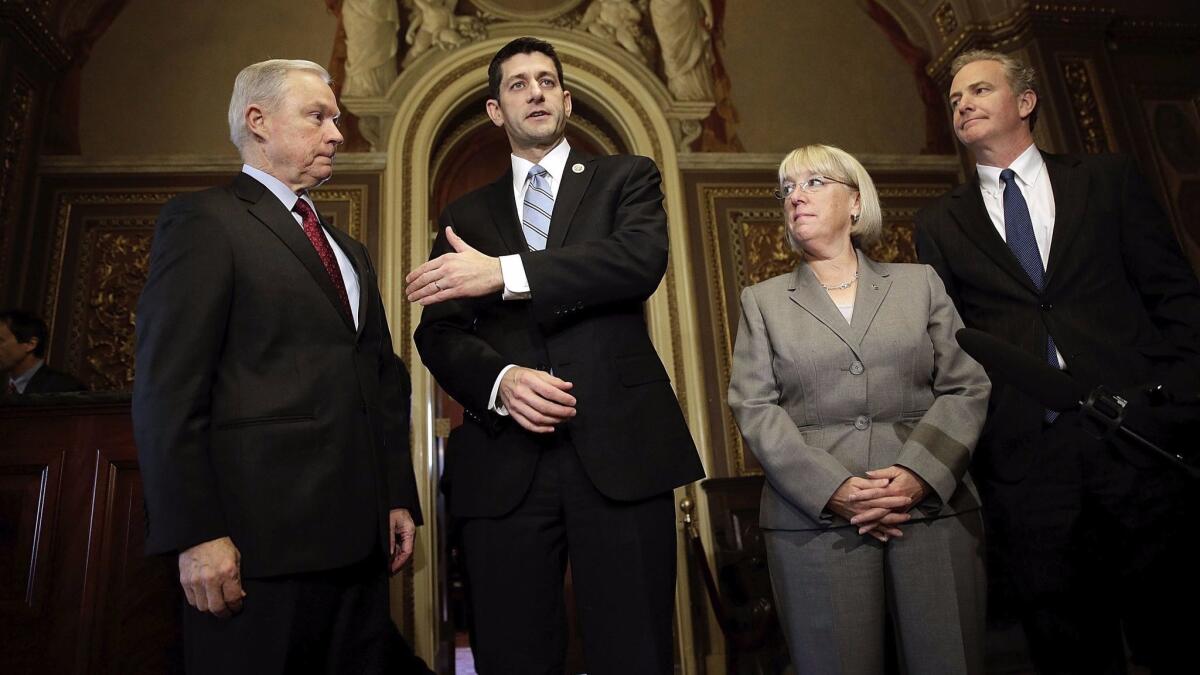
Members of the bipartisan budget conference Sen. Jeff Sessions (R-Ala.), Rep. Paul D. Ryan (R-Wis.), Sen. Patty Murray (D-Wash.) and Rep. Chris Van Hollen (D-Md.) speak to the media the day after Congress voted to ending a 16-day government shutdown. (Win McNamee / Getty Images)

Members of the bipartisan budget conference Sen. Jeff Sessions (R-Ala.), Rep. Paul D. Ryan (R-Wis.), Sen. Patty Murray (D-Wash.) and Rep. Chris Van Hollen (D-Md.) speak to the media the day after Congress voted to ending a 16-day government shutdown. (Win McNamee / Getty Images)

(Win McNamee / Getty Images)

Winners

Sen. Harry Reid (D-Nev.)

WASHINGTON, DC - OCTOBER 16: U.S. Senate Majority Leader Sen. Harry Reid (D-NV) (2nd L) speaks as Majority Whip Sen. Richard Durbin (D-IL) (R), Sen. Charles Schumer (D-NY) (L), and Sen. Patty Murray (D-WA) (3rd L) listen during a news conference after a vote October 16, 2013 on Capitol Hill in Washington, DC. On the 16th day of a government shutdown, the Senate has approved a bill to reopen the government until January 15 and raise the nation's debt ceiling until February 7, 2014. (Photo by Alex Wong/Getty Images) ORG XMIT: 185146633 ** OUTS - ELSENT, FPG, TCN - OUTS * NM, PH, VA if sourced by CT, LA or MoD **

(Alex Wong / Getty Images)

The then-Senate majority leader was a vocal Democratic critic of Republican-led efforts to defund President Obama’s healthcare bill. He relentlessly castigated Republicans for their tactics to defund Obamacare, which ultimately led to the shutdown.

“You know with a bully you cannot let them slap you around, because they slap you around today, they slap you five or six times tomorrow. We are not going to be bullied,” Reid told reporters.

In the end, Reid came out of the shutdown with a bolstered reputation as a fighter of Democratic causes and earned plaudits from Obama.

Obamacare

(Gary Friedman/Los Angeles Times)

At the time, the botched rollout of the healthcare law drew daily headlines. Web sites for healthcare exchanges didn’t work and the administration had few answers. Still, the healthcare law was able to remain intact and public scorn focused on Republicans as the government remained shuttered for 16 days and federal employees nationwide stayed home. Republicans thought their efforts would prove fruitful.

Sen. John McCain (R-Ariz.)

WASHINGTON, DC - MARCH 19: U.S. Sen. John McCain (R-AZ), talks with reporters on his way to the weekly Senate Republicans policy luncheon on March 19, 2013 in Washington, DC. The Senate is expected to pass a revised continuing resolution and send their edits back to the House in order to prevent a government shutdown next week, but any action in the Senate may be delayed until later in the week. (Photo by T.J. Kirkpatrick/Getty Images) ORG XMIT: 164200606

(T.J. Kirkpatrick / Getty Images)

In the months and weeks leading to the shutdown, McCain served as a voice of reason for the Republicans. He insisted that it would be unwise for the party to allow a shutdown over Obamacare.

“I campaigned in 2012 all over this country for months: ‘Repeal and replace Obamacare.’ That was not the mandate of the voters. If they wanted to repeal Obamacare, the 2012 election would have been probably significantly different,” he said at the time.

Ultimately, his efforts faltered as Republicans charged ahead with efforts to defund Obamacare and the government shutdown.

Losers

House Speaker John A. Boehner (R-Ohio)

WASHINGTON, DC - OCTOBER 16: U.S. Speaker of the House Rep. John Boehner (R-OH) walks to the House Chamber for a vote October 16, 2013 on Capitol Hill in Washington, DC. On the 16th day of a government shutdown, the House has passed a bill to reopen the government until January 15 and raise the nation's debt ceiling until February 7, 2014. (Photo by Alex Wong/Getty Images) ORG XMIT: 185146633

(Alex Wong / Getty Images)

He failed to rein in the most conservative grassroots wing of his party. Boehner was the middle man of sorts in negotiations between Democrats, moderate Republicans and conservative activists. Two years later, he resigned because of the strong opposition he faced from the Republican caucus.

Sen. Ted Cruz (R-Texas)

WASHINGTON, DC - OCTOBER 16: Sen. Ted Cruz (R-TX) answers questions from the media after meeting with Republican senators regarding a bipartisan solution for the pending budget and debt limit impasse at the U.S. Capitol October 16, 2013 in Washington, DC. The Senate announced that it had reached a bipartisan deal on funding the federal government and the extending the nation's debt limit after 16 days of a government shutdown. (Photo by Andrew Burton/Getty Images) ORG XMIT: 185146633 ** OUTS - ELSENT, FPG, TCN - OUTS * NM, PH, VA if sourced by CT, LA or MoD **

(Andrew Burton / Getty Images)

While Cruz raised his national profile as a staunch critic of Obamacare, he also made a lot of enemies. Weeks before the shutdown he delivered a 21-hour talkathon on the Senate floor, assailing the health care law — a move that drew scorn from Democrats and Republicans alike. Cruz’s vocal opposition to the law helped establish him as a force within the GOP grassroots and set him up for a presidential run in 2016.

Debbie Wasserman Schultz (D-Fla.)

(Carolyn Kaster / Associated Press)

(Carolyn Kaster / Associated Press)

(Carolyn Kaster / AP)

Public opinion polls consistently showed that Republicans were blamed for the government shutdown. Even so, the former Democratic National Committee chairwoman was unable to turn that into victory in the 2014 midterm. Many Democrats fault her leadership as a factor in the party’s sweeping losses in the midterm election.


November/ December 1995 and January 1996

How it happened

This battle over funding Medicare, public education and environmental initiatives pitted President Clinton against Republican House Speaker Newt Gingrich. It turned into the longest government shutdown in the country’s history. The shutdown came in two phases, with government services being shuttered from Nov. 14-19, 1995; then from Dec. 16 until Jan. 6, 1996. In total, the government closed for 27 days.

President Clinton and bipartisan leaders meet at the White House on Dec. 30, 1995, for talks on the federal budget. (Greg Gibson / Associated Press)

President Clinton and bipartisan leaders meet at the White House on Dec. 30, 1995, for talks on the federal budget. (Greg Gibson / Associated Press)

(GREG GIBSON / AP)

Winner

President Clinton

(Marcy Nighswander / Associated Press)

(Marcy Nighswander / Associated Press)

(Marcy Nighswander / AP)

He stood firm in his battle with the Republican-controlled Congress. Clinton wanted a budget that increased expenditures on, among other things, Medicare and public education, but Republicans wanted to slow government spending. This led to months of negotiations — the government closing, opening, then closing again — and through it all, Clinton’s public approval ratings dipped only slightly. He easily won reelection in November 1996.

Loser

House Speaker Newt Gingrich (R-Ga.)

(J. Scott Applewhite / Associated Press)

(J. Scott Applewhite / Associated Press)

(J.SCOTT APPLEWHITE / AP)

After sweeping gains in the 1994 midterm election, Republicans were emboldened and ready for a showdown.

“He can run the parts of the government that are left, or he can run no government,” Gingrich told reporters weeks before the first shutdown. “Which of the two of us do you think worries more about the government not showing up?”

News reports at the time also noted that Gingrich was open to a shutdown after Clinton made him exit the rear of Air Force One after the two attended the funeral of slain Israeli leader Yitzhak Rabin. The comments made the Republican leader appear petty. In the end, after weeks of a shutdown, Republicans ultimately conceded to Clinton and Democrats.


May 2017

What’s happening now

Last week Congress passed a $1-trillion budget that funds the federal government through September. However, the budget bill does not allocate funds for Trump’s much-promised border wall. It’s the first bipartisan piece of legislation of the Trump presidency and funding for his signature proposal is nowhere to be found. The bill, however, does have funding for border security and increases to defense spending — both of which were touted as wins by the Trump administration.

Senate Majority Leader Mitch McConnell (R-Ky.), flanked by Sen. Cory Gardner (R-Colo.), Sen. John Barrasso (R-Wyo.) and Sen. John Thune (R-S.D.), speaks to the media about the recent spending bill that averted a government shutdown. (Aaron P. Bernstein / Getty Images)

Senate Majority Leader Mitch McConnell (R-Ky.), flanked by Sen. Cory Gardner (R-Colo.), Sen. John Barrasso (R-Wyo.) and Sen. John Thune (R-S.D.), speaks to the media about the recent spending bill that averted a government shutdown. (Aaron P. Bernstein / Getty Images)

(Aaron P. Bernstein / Getty Images)

Key players

President Trump

It’s clear Trump does not like to lose and does not like bad headlines. By all accounts, Trump and his policies did not come out on top in the budget deal.

Trump blamed the Senate rules, which require 60 votes to pass most legislation, for the exclusion of key priorities from the spending bill.

This has in turn led some conservatives to push for Trump to support a government shutdown if Congress does not heed his policies this fall. Trump has always trusted his gut instinct in politics — so far it’s seemed to benefit him — and his comments will be closely watched this fall.

House Speaker Paul D. Ryan (R-Wis.)

FILE - In this April 4, 2017 file photo, House Speaker Paul Ryan of Wis. pauses during a news conference on Capitol Hill in Washington to talk about the failed health care bill. From cancer to addiction, doctors and patient groups are warning that the latest Republican health care bill would gut hard-won protections for people with pre-existing medical conditions. Some GOP moderates who may seal the legislation’s fate are echoing those concerns. (AP Photo/J. Scott Applewhite, File)

(J. Scott Applewhite / Associated Press)

He’s often had to stake out a position when Trump tweets. Indeed, this time was no different. Ryan alluded to Trump’s qualms with Senate rules.

“Look, we’ve got a long ways to go between now and September, but I share the president’s frustration,” Ryan told reporters. “What a lot of people in America don’t realize is appropriations bills, they take 60 votes to pass. They can be filibustered. So, all appropriations bills therefore have to be bipartisan because Democrats can always filibuster an appropriations bill. Having said all that, I feel very good about the wins that we got with the administration in this bill.”

Senate Minority Leader Charles E. Schumer (D-N.Y.)

Senate Minority Leader Chuck Schumer of N.Y. speaks with reporters about his opposition to Supreme Court nominee Neil Gorsuch on March 21, 2107, on Capitol Hill.

(J. Scott Applewhite / Associated Press)

He’s Trump’s chief critic in Congress and warned the president that a government shutdown is not wise.

“The president’s threat to shut down the government in September is just a very, very bad idea because it would hurt so many average folks,” Schumer said recently. “I strongly urge my colleagues, and they have already … said they have no desire to shut down the government. That is not the way to govern. That is not the way to come up with bipartisan compromise.”

Voters

Public opinion is not on Trump’s side when it comes to talk about a government shutdown.

In a Politico/Morning Consult poll released in April, 65% of voters said that Congress should “take all necessary steps to avoid a government shutdown.”

Other polls show similar disapproval among voters toward a government shutdown.

kurtis.lee@latimes.com

Twitter: @kurtisalee


Source link

SXSW 2026: On aliens and UFOs, Spielberg says, ‘We are not alone’

One of the most anticipated events at this year’s SXSW Film & TV Festival wasn’t a movie at all, but a speaking appearance by director Steven Spielberg. The talk, a live taping of the podcast “The Big Picture” lead by co-host Sean Fennessey, covered many aspects of the Hollywood legend’s career, with a through line of sci-fi and space aliens in conjunction with Spielberg’s upcoming alien invasion thriller “Disclosure Day,” due June 12.

Though no real details about the new film were revealed, references to it peppered the conversation as if it were very much on Spielberg’s mind — the film he was ostensibly there to promote.

To an audience that included filmmakers Robert Rodriguez and Daniel Kwan, the event began with a clip reel that served as a reminder (as if anyone in the packed hotel ballroom needed one) of just how influential the 79-year-old filmmaker is. A selection of Spielberg’s work plays like a trailer for the idea of movies themselves; this one included “Jaws,” “Raiders of the Lost Ark,” “E.T.” “Schindler’s List,” “Jurassic Park,” “The Sugarland Express,” “Catch Me If You Can,” “Munich” and many more.

Fennessey noted that Spielberg wanted to make 1977’s “Close Encounters of the Third Kind,” his first sci-fi movie about the existence of aliens from other worlds, even before making 1975’s “Jaws.” Spielberg went further, saying he had actually wanted to make “Close Encounters” — then just referred to as “The UFO Movie” — even before 1974’s “Sugarland Express.”

Asked about President Obama’s recent comments about the possible existence of intelligent life elsewhere in the universe and how his own feelings may have evolved over the years, Spielberg said, “I think that for one thing, when President Obama made that comment, I thought, ‘Oh my God, this is so great for “Disclosure Day,”’ and then, two days later, he stepped back the comment and said what he believed in was life in the cosmos, which of course everybody should believe that because no one should ever think that we are the only intelligent civilization in the entire universe. So I’ve always believed, even as a kid, that we were not alone. So that just goes without saying. The big question is: Are we alone now?”

He added this interest was “reinvigorated” by a 2017 New York Times article about U.S. Navy pilots seeing unexplained aerial phenomenon, then by a 2023 Congressional subcommittee hearing on the topic.

“I don’t know any more than any of you do,” Spielberg said, “but I have a very strong, sticky suspicion that we are not alone here on Earth right now. And I made a movie about that.”

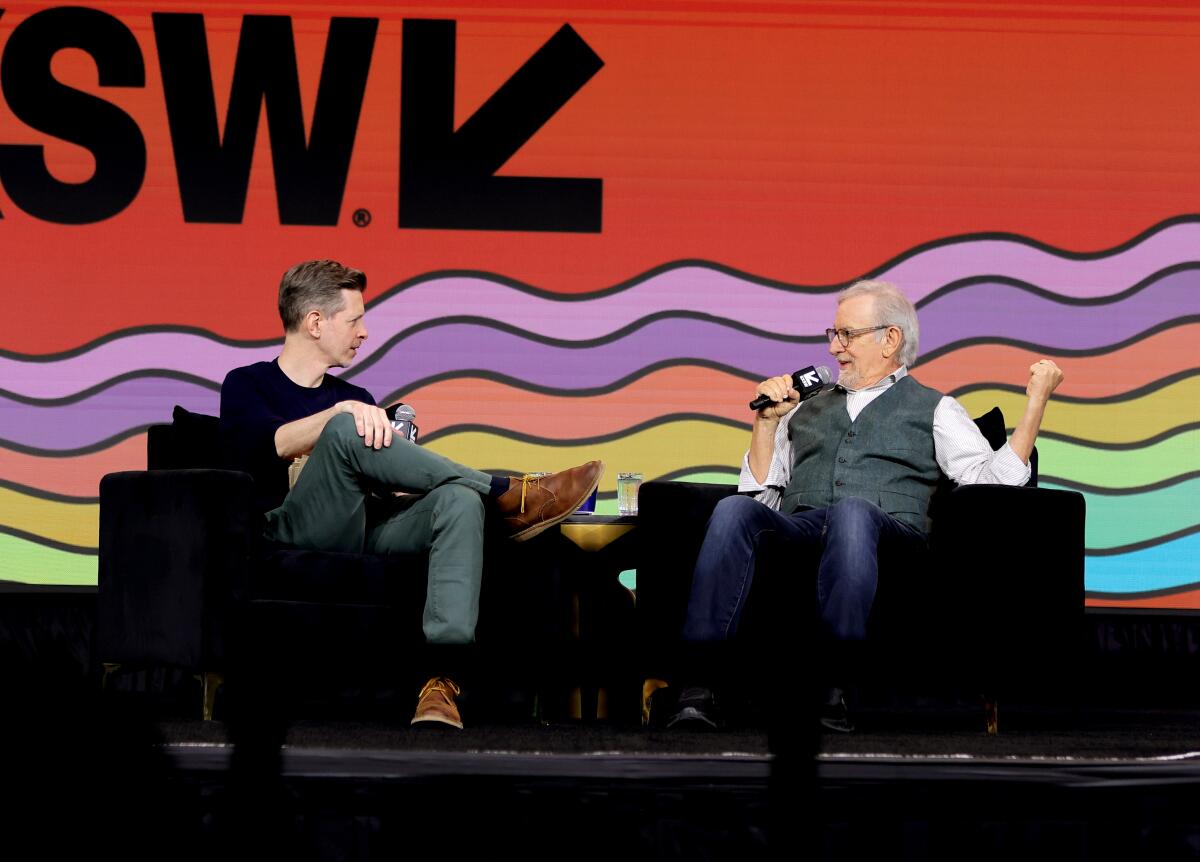
Two men have a conversation on stage at a film festival.

Spielberg and “The Big Picture” co-host Sean Fennessey taping a live podcast at SXSW on Friday.

(Tibrina Hobson / Getty Images)

As to how he feels about that possibility, Spielberg added, “I’m not afraid of any aliens, there or here. I have no fears about that, whatsoever. I think our movie does take into consideration, without giving too much away, the social dislocation that could occur, theologically, if it would be announced that there’s evidence — not only evidence, where it’s interaction that’s has been going on for decades, that we are not just now finding out about. It is going to cause a disruption in a lot of belief systems, but I don’t think it’s a lethal disruption at all.”

Among other topics that were discussed, Spielberg revealed he is developing a western that would shoot in Texas, though he was reluctant to discuss it in any further detail except to say it would contain “no tropes.”

He also said he is not on any social media, but did install Instagram on his phone once for two weeks and felt as if he had been abducted by aliens for the amount of time he lost.

To that end, he also noted, with comic frustration, how he himself has never had any sort of alien encounter.

”I made a movie called ‘Close Encounters of the Third Kind.’ I haven’t even had a close encounter of the first or second kind,” Spielberg said. “Where’s the justice in that? If you’re listening out there, I’m talking to you.”

There was a brief moment of confusion when Fennessey asked Spielberg for his thoughts on AI and Spielberg wasn’t clear if he was asking about his own 2001 movie or the broader topic of artificial intelligence.

Once that was cleared up (Fennessey meant the latter, a serious labor issue in Hollywood), Spielberg noted he has not used AI on any of his own films. “I don’t want to go into a whole rant about AI because I am for AI in many different disciplines. I am not for AI if it replaces a creative individual.”

Speaking to the theatrical experience, Spielberg made a brief allusion to the flare-up around comments by Timothée Chalamet regarding the popularity of opera and ballet in relation to the movies.

He noted that he does not decry the at-home streaming experience and that he works with Netflix, but that “for me, the real experience comes when we can influence a community to congregate in a strange dark space. All us are strangers and, at the end of a really good movie experience, we are all united with a whole bunch of feelings that we walk into the daylight with or into the nighttime with. And there’s nothing like that. I mean, it happens in movies, it happens at concerts and it happens in ballet and opera.”

Here there was a round of applause from the audience. “And we want that sustained and we want that to go forever.”

Spielberg noted how many of his favorite filmmakers, including David Lean and Billy Wilder and more recent examples such as Paul Thomas Anderson and Christopher Nolan, are always making films that feel different from what they have done before. He sees himself as part of that same school.

“If we’re just not making the same sequel over and over and over again and they’re not the same Marvel title over and over and over again, we all get a real chance to experience something, which is freshness,” Spielberg said. “And that is why I don’t judge my accomplishments based on a single film.”

Source link