Accelerating yield hikes fuel capital repatriation, threatening to drive up USD debt issuance costs.
Japan’s rapidly rising interest rates are providing another significant variable for corporate treasurers with upcoming bond offerings or refinancings to monitor.
While the deluge of debt issued by so-called hyperscalers has yet to increase other companies’ borrowing costs, it’s critical for treasurers to track it alongside another recent development: rapidly rising Japanese interest rates.
The Japanese government and private investors hold $1.2 trillion of U.S. federal debt, more than any other country, according to the Congressional Research Service, and they are major investors in U.S. corporate bonds. Three years ago, the 10-year Japanese government bond rate was close to zero, as it had been for decades, prompting Japanese investors to seek yield abroad. The rate began increasing in 2022 and has nearly doubled over the past year, approaching 2.9% by mid-August.
Lotfi Karoui, a multi-asset credit strategist at PIMCO, noted in an Aug. 3 report the accelerating reduction in U.S. Treasury purchases by non-U.S. public and private sector entities. The best evidence of that trend is Japan, he wrote, where Bank of Japan (BoJ) data show government and private Japanese investors becoming net sellers of long-term U.S. debt securities in the 12 months leading up to May 31, following three years as net buyers.
There is little evidence so far of a “sell America trade,” Karoui said, and demand for U.S. corporate credit remains strong. But issuers may have to pay more for it.
The U.S. federal government must fund a record deficit, and investment-grade corporate issuance in August, typically a slow month, is setting records.
“If Japanese investors are also selling U.S. securities into the market, that’s a lot of selling pressure that could push up U.S. rates,” said Amol Dhargalkar, senior managing director at Chatham Financial, which advises corporates on debt and hedging strategies. U.S. issuers, he added, could see wider spreads on top of a higher benchmark rate.
One indication of further retrenchment by Japanese investors, Dhargalkar said, would be more non-Japanese issuers pursuing yen offerings to take advantage of growing demand for yen-denominated securities. Alphabet and Berkshire Hathaway recently completed large yen offerings, and he anticipates more, especially from companies with Japanese operations that can avoid costly currency hedges.
Another wrinkle is the intervention starting in late July by the Japanese and U.S. governments to counter the yen’s dramatic weakening against the U.S. dollar by selling dollars and buying yen. Further yen appreciation will likely require more rate hikes by the BoJ, according to Aug. 5 commentary by Fitch Ratings, prompting even more yen repatriation.
“This is one of many new avenues that CFOs and their finance teams have to make sure they’re looking at as they consider capital markets transactions,” Dhargalkar said.
John Hintze is a contributing writer based in the U.S.
Dorsey High’s 1982 City Section football championship team walked onto the stage with a youthful swagger. Though it has been decades since they celebrated within the halls of the school, it was like they had never left that courtyard.
Alumni and family cheered and danced alongside them at Dorsey’s first full athletics reunion. Soon after, the cheerleaders for the 1976 championship basketball team came out to perform. The up and coming sports teams for the 2026-27 school year came out with their families, as hundreds of people celebrated the legacy and the future of the school.
But Dorsey has undergone a lot of changes since the turn of the century.
In 25 years, it has gone from a well-attended school with a successful athletics program to one that has faded into the background of Los Angeles.
The last football championship came in 2001. The next year, Dorsey enrolled 2,211 students, the most in school history, according to Public School Review. Now, enrollment is hitting a low with 792 students, according to US News, and the athletic teams are trying to find that powerhouse status again.
Enter former football head coach Paul Knox. He had a solution — or at least an idea. Bring together the athletics alumni of Dorsey for a day of celebration, with a look ahead to the future.
On Saturday, hundreds of current and former Dorsey Dons came to the school for the reunion. There were a lot of stories, old photos, laughter and love being passed around from people who haven’t touched the campus in four decades. Alumni from all the way back in the 1950s came. Knox gave tours of the renovations the school has undertaken, and the event also highlighted the soon-to-be football stadium and new basketball gym.
Later in the day, the current teams were introduced to everybody in attendance as was the 1976 City championship basketball team. The chance to showcase both the past and present is what inspired Knox, who hasn’t coached at Dorsey since 2014, to put on this event.
“The atmosphere that is here, the pride that everybody has in the school in general … it’s one of the most passionate alumni that you are going to have,” Knox said.
Dorsey’s enrollment struggles are not unique. Across California, public school enrollment is down. In the Los Angeles Unified School District, enrollment dropped over 16,000 in the past year. Private and charter schools are on the up in both academics and athletics, leaving places such as Dorsey — that dominated for so long — behind.
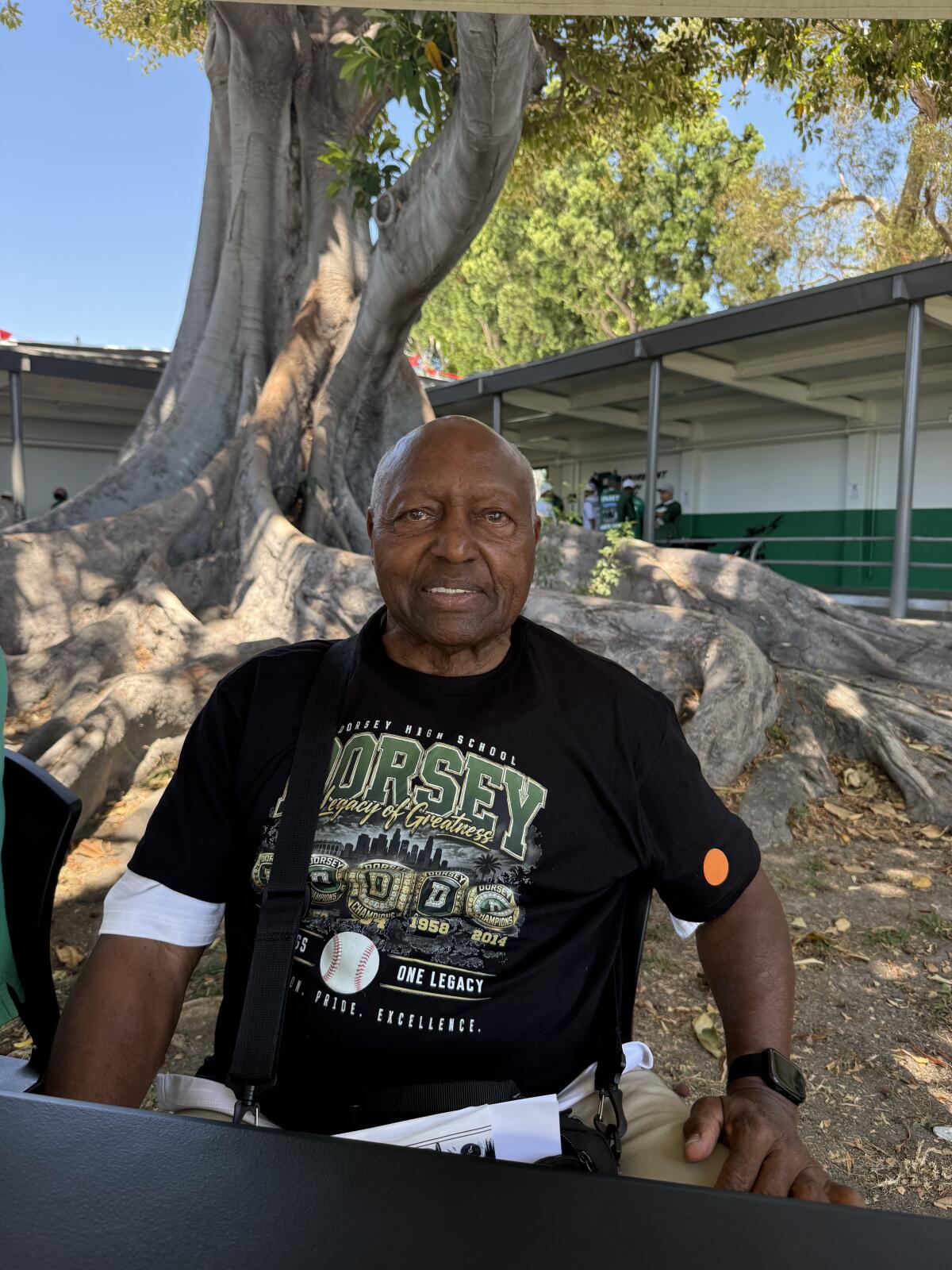
Dorsey High alum and former major leaguer Don Buford sits under a towering ficus tree on campus Saturday during the school’s all-sports reunion.
(Caleb Otte / For The Times)
Dorsey has a long history of sending athletes to the professional leagues. Former major leaguer Don Buford, who graduated in 1955, was present at the event. He barely had a moment to himself as multiple other alumni wanted to chat and grab photos with him, and Buford was happy to exchange excited, reminiscent anecdotes.
Buford was sitting in front of a massive ficus tree, with roots the size of a 5-year-old child coming up out of the ground. He took a moment to look back when talking to a class of 1958 alumni, noticing the size of the plant.
“When I went here, this was just a little tree,” he said.
Eighty years of students coming through the halls of Dorsey watched the small seedling sprout into a towering, beautiful beast.
Knox, and the administration of the school, are treating this reunion as the initial seed for the rehabilitation of the athletics program and hopefully the entire school.
“The passion is there,” Knox said. “We’re really hoping to inspire the teams now, to show them that there’s depth behind the things they do.”
Beyond the prime directive of the event, it simply served as a way for the Dorsey community to experience joy. So many former players caught up with their coaches. People were introducing themselves to legendary alumni that they hoped to meet. Finding a face without a smile would’ve been a Herculean task.
The day also served as a chance to show the current students at Dorsey what opportunities are out there for them, whether that be from sports or otherwise. Former champions were highlighted alongside what Dorsey hopes are their future champions.
Baseball alumni all wore shirts that said “Legacy of Greatness … Five Rings, One Legacy.” Their most recent championship was in 2014. Little signs like that permeated the day, as did a big one displaying every Dorsey championship.
The idea that the school has a history of success, and they want to get back there, was the cornerstone of the event — without it being explicitly stated.
“Once you go here, you get that feeling,” Knox said.
Even with all the fanfare, the man giving out raffle tickets at the front entrance encapsulated it perfectly.
In a darkened room in Maldon, Essex, a ship’s lantern illuminates the laundry drying on a web of ropes suspended from the ceiling. Between piles of sailing memorabilia, 86-year-old Barry Pearce is flipping through a yellowing logbook, watched by his mongrel, Winkle. It feels more like a ship’s cabin than a terrace house. Pearce is one of a handful of surviving skippers who delivered freight on the Thames by sailing barge, the flat-bottomed trading boats famous for their striking red sails that were endemic to the river’s estuary until the 1960s. He remembers the names of every vessel he worked on – Remercie, Edith May, Colonia.
In the 19th century, the ochre sails of thousands of Thames sailing barges pierced the skyline as the craft carried cargo from the Thames estuary and beyond in and out of London. Their shallow draft allowed them to snake far upriver in as little as a metre of water (bargemen would boast that they could sail anywhere there had been a heavy dew). Their ingenious rig, with sails that could be set and stowed with the help of winches, meant around 150tonnes of cargo could be shifted by just a skipper and mate – often accompanied by a guard dog. This efficiency allowed them to outlive all other commercial sailing vessels, surviving until the 1960s, when Pearce himself took the helm.
Illustration: Guardian Graphics
Today, only about 30 Thames barges are still sailing, either as private homes or leisure cruisers. Two of them – Pudge and Centaur – lie like beached krakens on the oozing mud of Maldon’s Blackwater estuary. Both are owned by the Thames Sailing Barge Trust, a charity run entirely by volunteers, including Pearce. Every summer, both vessels can be hired as private charters for groups of up to 12, or you can book a berth on one of their one- to three-day public sailing cruises. They also offer events such as children’s art days throughout the year.
I’m here on a scorching evening at Hythe quay to spend the weekend exploring the River Blackwater and Essex coast aboard Centaur, a barge built in 1895. Itineraries are flexible and based on passengers’ interests. For us it involves sailing up the Blackwater, a Pimm’s at Tollesbury Marina, and a swim off Shingle Point and wander around West Mersea on Mersea Island. Our motley crew consists of three trainees overseen by skipper Chris Martin, who teaches boatbuilding at vocational training organisation Circles Alternative Education.
Centaur in the Blackwater estuary. Photograph: Chris Bourne
There are also six passengers, ranging in age from 18 to 76, in five cabins, which are basic but comfortable (each has a wash basin). Although I am the only one who is not a competent sailor, Martin makes it clear that helping to handle the barge is optional.
Unwisely, given our 3am departure to catch high tide, I sink several pints with the two youngest members of Pudge’s crew in the Little Ship Club on the quay. A behemothic man wielding a squeezebox sings sea shanties as salty couples slow dance nearby. “I only know of one or two people my age who are into barging, and I find that disturbing,” yells 25-year-old Charlie Francis over strains of Bound for South Australia. “Barging was the lifeblood of the east coast. We should be proud of our heritage and celebrate the communities working to preserve it.”
After a few hours in my bunk, I make it on to deck at 4.15am. The moon is a slice of radish in a lilac sky. We’re bearing away from the wind and, having set the sails, the crew is already on their second round of tea and custard creams.
As dawn paints its peachy palette, Martin turns the great wheel. He points out Blackwater landmarks that only a local would know: the green buoy known as the Doctor, where early 20th-century fishers left spirits for the alcoholics supposedly drying out at Osea Island’s temperance resort; the pub where, as recently as 20 years ago, Martin witnessed a smuggler wordlessly deliver two dripping bags while regulars stared determinedly into their pints; the hulking trawler, Ross Revenge, which is still home to Radio Caroline, the former pirate station – another relic kept alive by volunteers of the Blackwater.
The writer on the deck of the Centaur. Photograph: Laura Lewis/The Guardian
Where the river opens into the silvery sea, the wind picks up and the barge rocks gently against the tide. My eyelids are heavy and the slowness of the whole experience is working its magic on my screen-frazzled brain. Martin calls for the staysail to be unfurled, a 20-minute task that rewards the barge with another knot and a half of speed. “This life is the antithesis of the digital age’s obsession with instant gratification,” he says. “Sailing barges may not be able to teach us much about cargo any more, but they can teach us the value of slowing down, doing things with our hands and spending time in nature.”
As we make our stately, seven-knot progress, 370 sq metres of rust-red canvas billows above and fingers of salt marsh slide by. With so little distraction, the coffee tastes lip-curlingly bitter, the bacon sandwiches as saline as the deep. I settle on a coil of rope to scan the horizon for porpoises, but soon drift into sleep.
A swim from a sandbank near Tollesbury is followed by a meander through West Mersea at golden hour. Clapboard cottages framed by hollyhocks sit beside sailmakers and chandleries converted into trendy cafes. We drop anchor in the Blackwater estuary and beneath a blazing sunset tuck into lasagne on deck. I haven’t felt this present for months. It’s all such a delight I begin to feel concerned about the trust’s future. Sailing barges cost between £30,000 and £100,000 a year to keep afloat. The trip I’m on costs just £220 including meals, while the Trust’s annual membership is only £37.50.
Although the trust offers training in many of the skills needed to maintain the barges, sourcing the timber is becoming increasingly difficult – and expensive. “Centaur’s exterior planking is pitch pine from the Mississippi basin, which is incredibly durable, but has been virtually exhausted,” says Martin. “And so much of the timber trade has been replaced by plastic.”
The trust also offers free training for future skippers, including the mate on our trip, 18-year-old Ben Weldon, the son of a local shipwright. However, it typically takes 2,000 hours – or 10 years – and the dropout rate is high.
While the trust has recently been awarded £28,090 from the National Lottery Heritage Fund to develop a bid for the £4m needed to restore Centaur, it seems wrong that responsibility for keeping this thread of Britain’s maritime story from unravelling rests on so few shoulders. Sailing may be associated with privilege, but we are a seafaring nation and this inheritance belongs to all of us.
Skipper Chris Martin, on the left, on board Centaur. Photograph: Imogen Lepere
On Sunday morning, our last on board, a westerly fills the sails, and the tea-coloured Blackwater wrinkles beneath the bow as we beat our way back towards Maldon. “Lee ho,” Martin calls, showing me how to spin the wheel to help the crew tack. “So far we’ve used less than a gallon of fuel to do 50 miles. Pretty extraordinary, given that a family car does about 30 miles to the gallon.”
When I asked Pearce at the start of the trip why keeping Thames sailing barges afloat is worth the fight, he looked blank, as if such a question had never occurred to him. He showed me a pencil sketch of a barge he had drawn at the age of 15 in Greenwich, left half-finished when his skipper had poked his head through the hatch and invited him below for dinner. Now, more than 70 years later, he bends once more over that drawing as though no time has passed.
Eventually, he half-whispers: “Well, they’re just lovely, ain’t they?” He glances toward the window. Nearby, Centaur waits on the mud for the returning tide.
Lamine Yamal insists he would take no fear into Spain’s World Cup semifinal against France when both sides meet after he celebrated his 19th birthday.
The Barcelona prodigy raised eyebrows following Spain’s 2-1 quarterfinal defeat of Belgium last week after being quoted as saying that France rather than Spain ought to be “afraid” given recent defeats against La Roja.
A relaxed-looking Yamal addressed those comments as he spoke to reporters on Monday at a press conference.
“I was asked if I was afraid of France, and I said no,” Yamal explained. “We are European champions. It’s simply football,” the teenager explained.
Yamal said he had marked his 19th birthday by buying a chunky jewel-encrusted necklace he wore to his press conference. The real birthday present, though, would be a place in Sunday’s World Cup final.
“I haven’t received many gifts yet. The best gift would be a win on Tuesday and a trip to New York,” he said.
While other stars at this World Cup have been in blistering goal-scoring form, Yamal so far has only found the net once during the tournament – but is ready to add to his tally against France.
“I don’t focus on goals, but it’s always special to score in a match like this. I accept the challenge. That’s why I came here,” Yamal said, promising a “beautiful match for the spectators”.
“It’s the game everyone was waiting for,” he added.
While acknowledging the momentous nature of Tuesday’s game, Yamal remained laid-back in his approach.
“There are far more difficult situations in life than a football match, so I’m calm,” he said. “I don’t feel any extra pressure; I’ll go out and play like always and give my all for the team.”
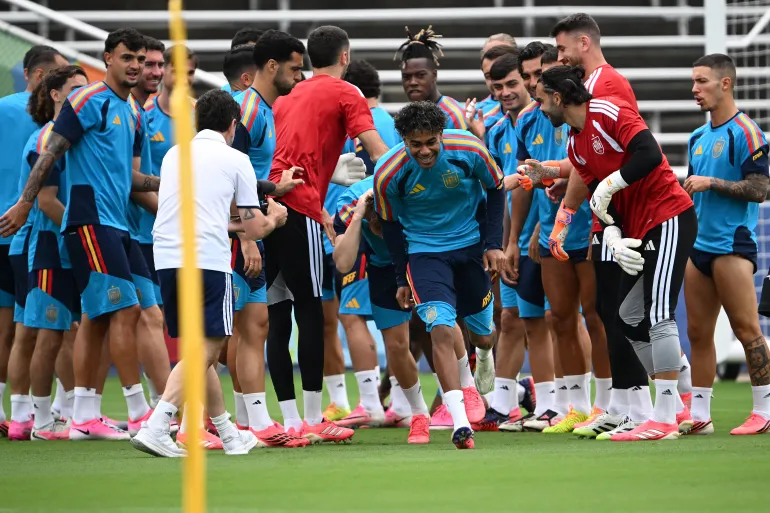
Spain’s players formed a guard of honour for Yamal to celebrate his birthday [Maurio Pimentel/AFP]
‘We’ve known each other for a while’
Spain coach Luis de la Fuente says his team plan to go on the “front foot” against tournament favourites France when they face off in a heavyweight semifinal showdown.
De la Fuente’s Spain will attempt to impose their possession-based game on France in what is shaping up as a gripping clash of styles.
While France coach Didier Deschamps insists Spain remain favourites for the World Cup, betting markets overwhelmingly back France to clinch a second title in three attempts.
Les Bleus have powered into the last four with a scintillating brand of attacking football based around such talents as Kylian Mbappe, Michael Olise and Ousmane Dembele.
But De la Fuente, whose team have beaten France in their last two meetings, is quietly plotting another ambush at the AT&T Stadium in Arlington, Texas on Tuesday.
“We’ve already analysed France in great detail; we’ve known each other for a while now,” De la Fuente said.
“We faced each other for a few years now, and they have great players, but so do we. We have to put all of our virtues on the table and try to counteract the strengths of the opponent.
“And that’s what football is about – the team that strikes a better balance is usually closer to getting the victory.
“We’ll have to think about their players. We’ll try to win those duels and will try to be on the front foot during the game, imposing our style.”
Spain’s players train at Cotton Bowl Stadium, in Dallas, Texas, US on July 13, 2026 [Albert Gea/Reuters]
France ‘far better’
De la Fuente, though, is under no illusions about the difficulty of the task facing his side.
France, he said, have improved significantly since Spain defeated them 5-4 in a hectic UEFA Nations League semifinal in Stuttgart last year, when the Spaniards led 5-1 before a late French rally. That encounter would bear no resemblance to Tuesday’s game, De la Fuente said.
“We’re talking about two very different matches,” he admitted.
“Tomorrow is another semifinal. I will just try to repeat the positive scenarios, but there were other details where things weren’t that positive.
“We were winning 5-1, and in a few minutes they managed to make it 5-4. So we’re trying to repeat what we did well and the opposite of what we didn’t do well.
“We need to try and impose our game. We have completely antagonistic playing styles, so we’ll try to be on the front foot and take the initiative.”
De la Fuente also believes a maturing France squad will be a tougher proposition.
“I think they are a better team, far better, because those players have grown, and what they are doing now is better than what they were doing then,” he said.
“So they’ve improved their skills in the past two years, and that’s the reality.”
While controlling possession and tempo will be key, De la Fuente will also tell his players to savour the challenge. Asked what his final message to his team would be, he replied: “Let’s get out there and enjoy it.
“We are in a unique setting. Who knows whether we will come back? We must be the team that we know that we can be. We must be strong and try to counter the strength of the opponent.”
1 of 3 | Philippine Congresswoman Gerville Luistro (L), a member of the prosecution panel, delivers an opening statement during proceedings for the impeachment trial of Philippine Vice President Sara Duterte at the Philippine Senate in Pasay City, Metro Manila on Monday. Photo by Rolex Dela Pena/EPA
July 6 (UPI) — Prosecutors in the Philippines called for accountability Monday on the first day of an impeachment trial for Vice President Sara Duterte, whose lawyers said the case was politically motivated.
Sara Duterte, who is the daughter of former President Rodrigo Duterte, faces allegations of misusing public funds. The House of Representatives voted overwhelmingly to impeach her in May, with 257 of 290 lawmakers voting in favor.
The allegations center on the wealth she gained after becoming mayor of Davao in 2019 along with her use of funds as vice president.
In opening arguments, Gerville Luistro, a House representative from Batangas, questioned, “does accountability still matter in our country?”
“If a small village treasurer can’t explain missing funds, he is investigated. If a school principal squanders public funds, even just 5,000 pesos, she is punished. If ordinary people are held to account, why not the most powerful government official,” Luistro questioned, as reported by the BBC.
Sara Duterte’s lawyer, meanwhile, said lawmakers are targeting her politically because she received more votes in the 2022 presidential election — 32.2 million — than President Bongbong Marcos did in his race — 31.6 million.
“It is clear that the objective is to oust her,” lawyer Sheila Sison said.
“Whatever one’s political persuasion is, the reality is that the prosecution now comes for this court to remove a vice president chosen by an overwhelming number of the electorate,” she added, as reported by the Philippine Star reported.
After opening statements, Sen. Chiz Escudero, the presiding officer in the trial, ordered the return of Sara Duterte’s tax records to the Bureau of Internal Revenue.
Sara Duterte was not present in the courtroom as the trial got underway.
She issued a statement saying her decision not to attend the proceedings and not to testify are a “legal strategy.” She also criticized Marcos for speaking against that decision.
“The burden remains on the prosecution to prove its case,” Sara Duterte wrote in her statement on Facebook. “Choosing to appear through counsel rather than testify personally does not diminish accountability or imply a lack of transparency. The integrity of an impeachment trial depends on adherence to the rule of law — not on whether the respondent personally takes the stand.”
Marcos, who was on a trip to Canada, told reporters in Vancouver that he would appear in person in court if he were facing an impeachment trial.
While this is Sara Duterte’s first impeachment trial, it’s her second impeachment as vice president. In 2024, she claimed to have arranged for Marcus to be killed if she were killed. The House of Representatives voted to impeach her for the comments, but the country’s Supreme Courtblocked the effort.
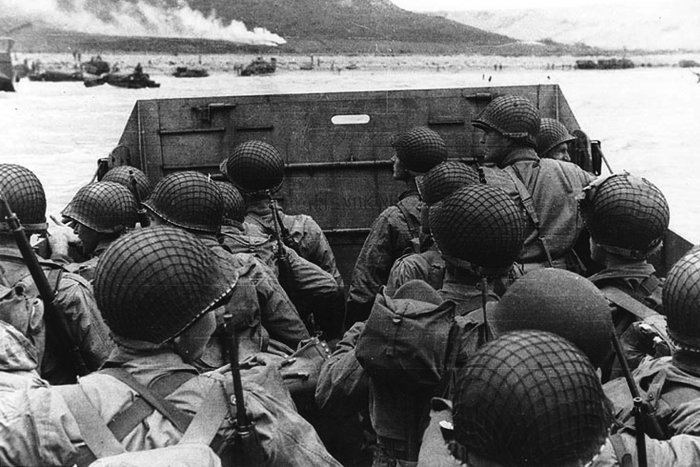
Troops in landing craft approach Omaha Beach on D-Day in Normandy, France, on June 6, 1944. D-Day was the largest seaborne invasion in history and turned the tide of World War II. Photo by UPI | License Photo
FIFA president Gianni Infantino will be ‘enjoying the final’ with Trump and present the trophy together on July 19.
Published On 23 Jun 202623 Jun 2026
FIFA president Gianni Infantino has confirmed plans to include United States President Donald Trump in the trophy presentation ceremony at the World Cup final.
“We will be together with the president, enjoying the final, and handing the trophy to the winner – of course, together,” Infantino said during an interview with Fox News on Tuesday morning.
Recommended Stories
list of 4 itemsend of list
Asked to clarify that he and Trump would present the trophy together at the match on July 19 in East Rutherford, New Jersey, Infantino added: “Of course. We are together all the time.”
Trump notably participated in the ceremony at last year’s Club World Cup final, when Chelsea defeated Paris Saint-Germain 3-0 at the same venue.
Chelsea’s Reece James lifts the trophy as he celebrates with teammates after winning the FIFA Club World Cup, with US President Donald Trump and FIFA president Gianni Infantino also on stage [Jeenah Moon/Reuters]
He remained on stage as Chelsea lifted the trophy. Later, the trophy was spotted in the Oval Office, with Chelsea reportedly having received a replica version.
According to The Athletic, citing FIFA sources, Infantino has been aiming to attend as many matches as possible at the tournament.
So far, that has been up to two a day. Trump has yet to attend any matches in this year’s World Cup.