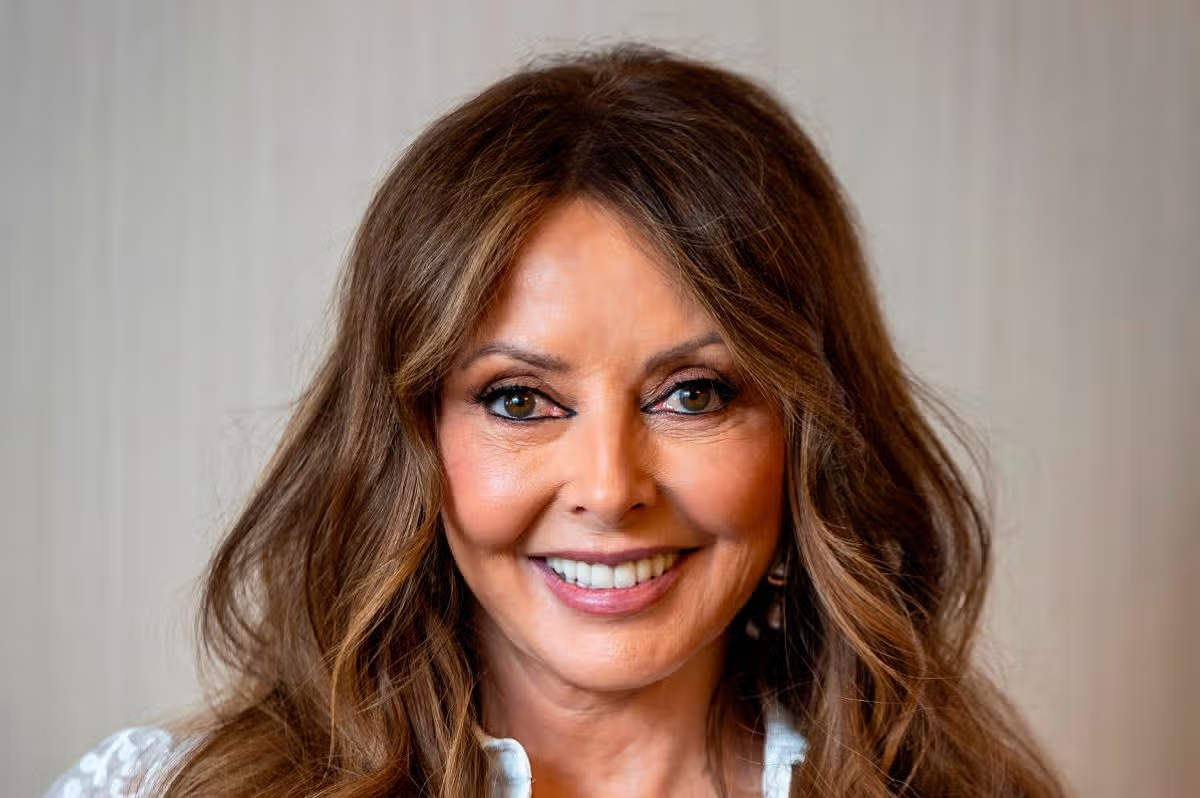
Pride of Britain host Carol Vorderman says her recent health crisis has given her a new perspective, forcing her to focus on what truly matters.

Carol says: “As you get older, health becomes one of your top priorities.”(Image: Adam Gerrard / Daily Mirror)
After a year-long health crisis, and as she marks 44 years on television, Carol Vorderman wants to “deep cleanse” her life and focus on what matters. The 65-year-old Pride of Britain presenter and former Countdown star was completely floored for most of last year, with a sudden debilitating case of rheumatoid arthritis.
She couldn’t walk without crying in pain and found the experience depressing and a shock to the system. Carol says: “As you get older, health becomes one of your top priorities. And time – who you spend that time with, and what you spend that time on. Time becomes your currency, so you don’t want to waste it.
“Every single person I know of my age group, we’re all trying to get rid of stuff. You spend all your life accumulating, but you don’t want to waste time curating things you’ve accumulated. It’s a deep cleanse for old age. Being really poorly and on a lot of medication for so much time really has given me a new perspective.
“You become much more conscious of your overall health. Your priority list changes. It was a big shock to the system, and that’s why I have every sympathy for people with chronic pain. I just don’t know how they live with it. It’s just depressing.”
Carol is due to present The Daily Mirror Pride of Britain Awards, in partnership with P&O Cruises, for the 27th year – a show she has recently co-hosted with Diversity star Ashley Banjo.
The event, shown on ITV and ITVX, celebrates the nation’s unsung heroes and includes awards for Child of Courage, Outstanding Bravery, Lifetime and Young Fundraiser.
Carol says: “The first Pride of Britain was 1999, so it only occurred to me this week that I was on Countdown for 26 years, but now Pride of Britain is my long runner. On November 2, I celebrate 44 years on TV. I’m not having a party, but I am getting a BAFTA Cymru for Outstanding Achievement. In other words, still being alive!
“The reason I keep doing Pride of Britain is because it’s the best job. It’s very glam. There are lots of very glam shows, but it’s very real. I do get emotional about the show about a week before. I remember the people who have won awards and have either passed away through old age or particularly the youngsters who died. They came on because they had cancer and raised money, or whatever their story might have been, and they’re no longer with us.
“Then you also remember the people who were doing these great things 15 years ago are still doing them. I always come back to how many great people there are. The show makes you want to be better and it’s made me more of a fighter.”
Carol recalls how she had to fight when her health nosedived. She says: “I had travel vaccines for a trip to Thailand and within three days I had chronic rheumatoid arthritis. I can’t prove that they caused it. My hands doubled in size. I couldn’t walk. I literally couldn’t move anything without crying in pain.
“I was on steroids probably for about eight months, and now I’m on other medication for the rest of my life. That’s hard because I’ve always prided myself on being healthy. It was as much as I could do to look out of the window and think, ‘I hope one day I’ll be able to walk without pain again.’
“The big thing for a lot of older people is community. You’ve got to feel a part of something. I know that my mum living with us and being around the kids, living in a busy house, gave her a purpose.
“If she’d just been living by herself somewhere, she wouldn’t have lasted. And smartphones don’t help. I love keeping up to date with what people are doing on Instagram, but it’s not the same as getting people together.”
Carol also reveals that laughter is extremely important to her wellbeing. “People who laugh are very special,” she says. “I love laughing. I love laughing at myself. Most of my friends just completely take the p*** out of me all the time.
“As you get older, you realise that even people who make you laugh and want to share, there’s a kindness in it. So for me, there are people who are heroes, because they make you feel better, they make you laugh, rather than taking offence, and I think there’s something quite heroic in that. There’s something about laughter that just breaks down the barriers.”
Carol has also long been a passionate, unfiltered voice of public frustration, turning to political advocacy to expose what she calls “political corruption”. She says: “Good people also need support so that they can do even more good things. Some people have been through so much pain and grief, some of it caused by certain politicians.
“Those things make me very angry, and I suppose now I’m at an age where I no longer need to build a career. A lot of girls say to me, ‘I believe in everything that you do, Carol, but I wish I could say the things you do. I just don’t feel strong enough.’ I say, ‘Yeah, but you’re not in a position to. I am in a position to say it, so I feel that responsibility.’”
Despite the emotional weight of Pride of Britain, Carol says there is always lightness on the show. She recalls: “The one that I always remember was in 2012 when we had lots of people on the stage, because we were celebrating the London Olympics. To present the award was Prince Charles and Camilla, Duchess of Cornwall, as they were then.
“Then in my ear, the show’s boss said, ‘You’ve got to make Charles do the Mobot. Do it.’ So I talked about the wonderful Mo Farah and said, ‘Obviously sir, you will have seen this, shall we all do the Mobot?’ I collared him into it, he couldn’t stand there and say no. So he did it, what a good sport. The next day officials at Clarence House brought up that they hadn’t approved the Mobot ‘incident’ and asked who was responsible.”
For Carol, Pride of Britain is a chance to take a moment and appreciate good people. She says: “Pride of Britain gives us all an opportunity to take a breath for a couple of hours and witness these very real people who are doing very real things because they are brave, they’re determined. It’s a whole balance of life.”
*The Pride of Britain Awards will take place on 19th October, before airing on ITV and ITVX from 22nd October. Find out more about the Pride of Britain Awards 2026 HERE