pratt

L.A. could get democratic socialists in mayor, city attorney spots

Democratic socialists are looking to extend their power in Los Angeles City Hall this fall with their biggest prizes yet: mayor and city attorney.

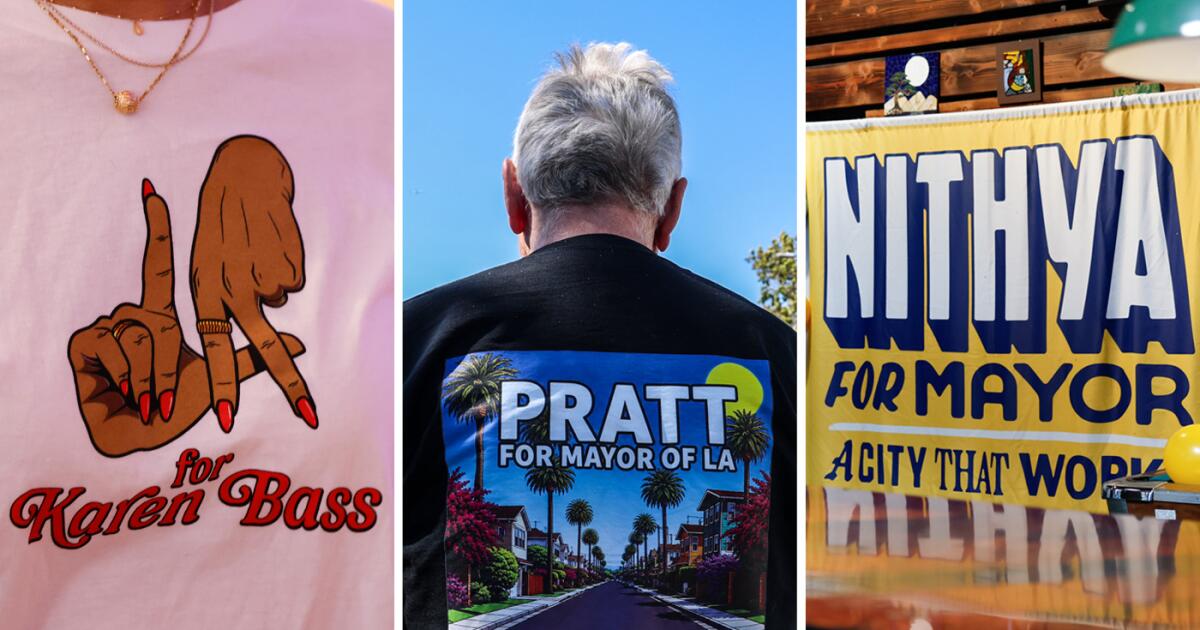
Mayoral candidate Nithya Raman and city attorney hopeful Marissa Roy, both members of the Los Angeles chapter of the Democratic Socialists of America, are heading into the Nov. 3 general election with strong showings in the June 2 primary as tailwinds.

If she prevails in November, Raman would join the ranks of democratic socialists leading big U.S. cities, including New York’s Zohran Mamdani and Seattle’s Katie Wilson. Washington, D.C., looks to be next: Janeese Lewis George won the Democratic primary for mayor there this month, all but ensuring her a general election win in that deep-blue city.

In Los Angeles, a democratic socialist mayor and city attorney could mean added clout because of an ideological lockstep between the two offices, said Fernando Guerra, a political science professor at Loyola Marymount University. In such a scenario, he said, the city attorney’s office is less likely to be a check against the mayor’s authority to set policy on issues such as land use and public safety.

“It’s incredibly substantive that the city attorney will interpret much of the policy that the mayor may push to be the right policy, and not challenge it,” Guerra said.

The election of Raman and Roy would also underscore the leftward tilt of Los Angeles, which has four City Council members, including Raman, who are DSA members — two of whom were reelected in the primary. City Controller Kenneth Mejia, who was recommended (although not formally endorsed) by DSA, was also reelected.

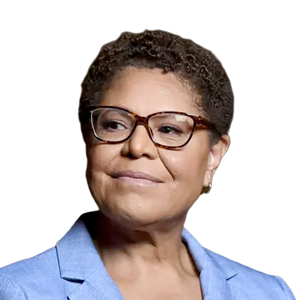
The DSA champions ideas sharply to the left of more establishment Democrats, such as incumbent L.A. Mayor Karen Bass. The L.A. DSA chapter, for example, says its objectives include abolishing prisons and defunding the police.

DSA-L.A. co-chair Sean Wakasa said his organization is thriving in L.A. and across the country because it has destigmatized the concept of socialism.

“Democratic socialism ultimately, at the end of the day, is about making the politics that working-class Americans can see themselves in,” Wakasa said.

In Los Angeles, Wakasa said, a DSA mayor would be expected to build more public transit, strengthen protections for renters, fight for workers’ rights, raise the minimum wage and defend local immigrants from the federal government.

The city attorney, he said, would be expected to defend working-class Angelenos by enforcing renter protections, resolving wage-theft issues and enforcing sanctuary city policies.

Business groups and public safety advocates have voiced concerns over the prospects of DSA members calling the shots at City Hall.

“They would run roughshod over the city,” said Stuart Waldman, president of the Valley Industry and Commerce Assn. He said Raman and Roy “don’t just drink the DSA Kool-Aid, they live it.”

Waldman said he would expect Los Angeles under democratic socialist leadership to adopt overzealous tenant protection policies that would discourage new rental development. He said they would also seek to weaken the police, leading to a “free-for-all for crime.”

“They would run business out,” Waldman said.

Roy, who has promised to turn the city attorney’s office into “the largest public interest law firm in the city,” targeting wage theft, tenant harassment and other issues, disputed Waldman’s assertion.

“Allowing corporate bad actors to violate our laws doesn’t make L.A. safer or more affordable — enforcing protections for renters, workers, and consumers does,” Roy said in a statement.

Raman said in a statement that she shares “DSA’s commitment to fighting for working people and those who have been left behind by a political system that too often serves powerful interests instead of everyday Angelenos.”

But she also said “there is no liberal or conservative way to fill a pothole.”

“I’ve always believed the most progressive thing you can do is actually make government deliver,” Raman said. “Every time City Hall fails to do that— potholes that don’t get fixed, streetlights that stay dark, 911 calls that go unanswered — it erodes people’s faith that government can solve problems at all.”

Rick Cole, a former deputy mayor of L.A., said the DSA label for both candidates doesn’t mean they’ll adhere to the most dramatized versions of what DSA stands for. Neither candidate is an ideologue, he said.

Raman’s membership in DSA “is a signifier she’s going to be more skeptical of current policing,” said Cole, a Pasadena City Council member. “She’s going to be more focused on affordable housing. She’s going to be more focused on a humane approach to getting people off the streets.”

A poll by the UC Berkeley Institute of Governmental Studies that was co-sponsored by The Times showed that in a head-to-head runoff, Raman was supported by 32% of the registered voters polled, compared with 28% for Bass.

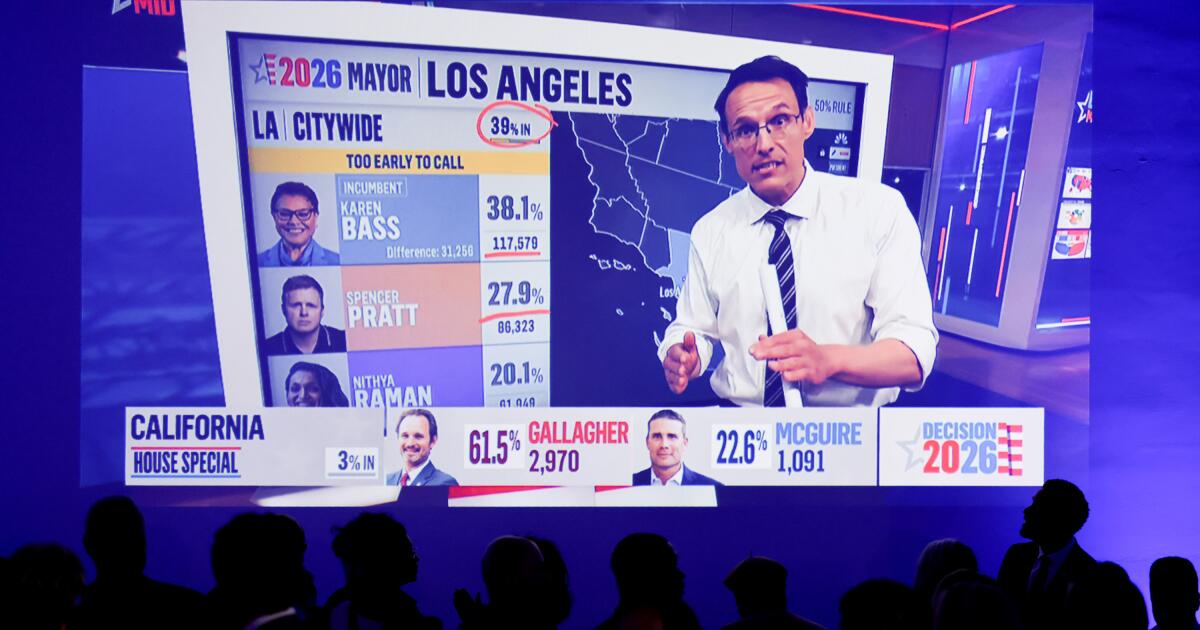
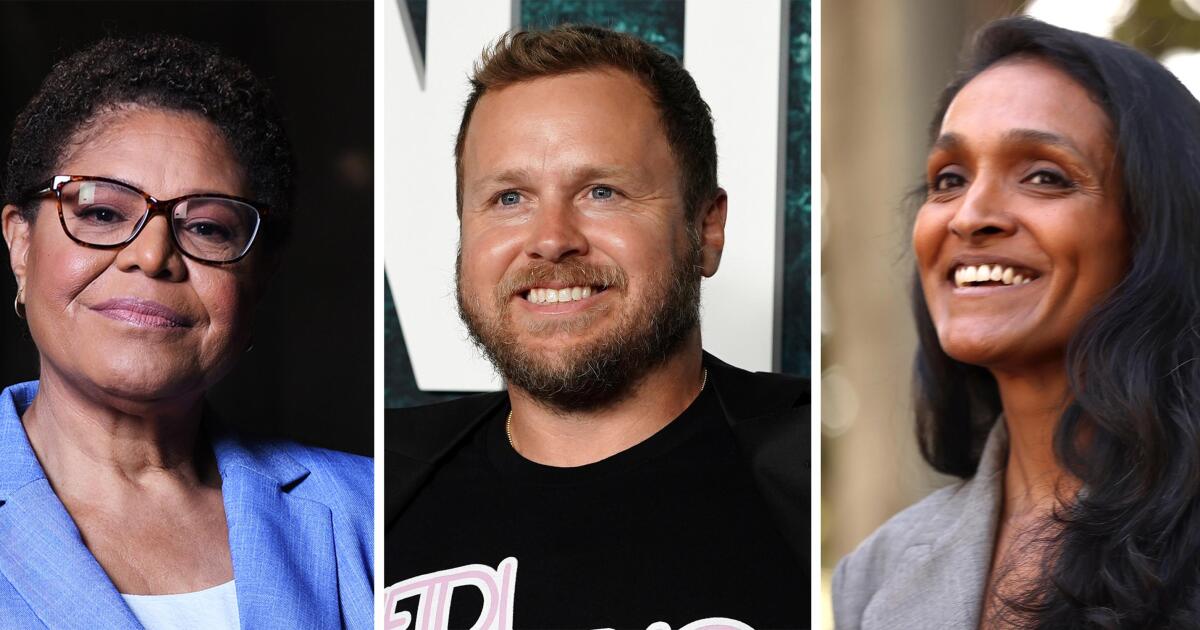
Bass finished first in the primary, ahead of Raman, with former reality TV personality Spencer Pratt finishing in third place.

With Pratt now out, the race is on for both campaigns to appeal to his voters, who are generally considered more conservative. Even so, the Bass campaign said it doesn’t plan to focus on Raman’s DSA affiliation.

“What’s important isn’t labels — it’s what her [Raman’s] record shows, and that’s voting over and over and over to allow encampments near schools and to shrink our police force. It goes against what L.A. needs and what most of L.A. believes,” Bass campaign spokesperson Alex Stack said in a statement.

Raman, who was twice elected to the City Council with DSA support, has voted against additional police hiring and spending and creating new anti-encampment zones around the city.

One irony is that the three other members of the DSA on the City Council — Eunisses Hernandez, Ysabel Jurado and Hugo Soto-Martínez — have all endorsed Bass, citing the mayor’s fierce resistance to the Trump administration’s immigration raids last year, among other factors.

In the primary, DSA’s L.A. chapter recommended Raman but didn’t endorse her, with the distinction being that an endorsement comes with active canvassing and support from DSA members. DSA-LA co-chair Leslie Chang said it wasn’t yet clear whether her group would endorse Raman in the runoff.

A DSA endorsement for Raman now might be a mixed blessing, given that Pratt’s support came from more conservative parts of the city, said Christian Grose, a political science professor at USC.

“Karen Bass is not popular with Pratt voters, and the DSA is not popular with Pratt voters, but that’s who will decide the mayor’s election,” he said.

Roy, a deputy state attorney general, finished first in the city attorney primary by a wide margin and will compete against John McKinney, a deputy district attorney, in the runoff.

McKinney said electing Roy to the city attorney’s office would be like “going back in time” to when George Gascón was the top prosecutor in Los Angeles County, which police and prosecutors said was a disaster for public safety.

In the recent City Council primaries, DSA-endorsed incumbents Hernandez and Soto-Martinez both won reelection easily, while DSA-endorsed Faizah Malik failed to push incumbent Traci Park into a runoff in her Westside district.

In the Council District 9 race, DSA-endorsed community organizer Estuardo Mazariegos will be in a runoff with Jose Ugarte, a former aide to termed-out incumbent Curren Price.

DSA leaders are pleased overall with how their candidates have performed.

“DSA has really claimed a foothold for ourselves in L.A. County politics,” Chang said.

Source link

Spencer Pratt concedes mayoral primary, vows to keep fighting for L.A.

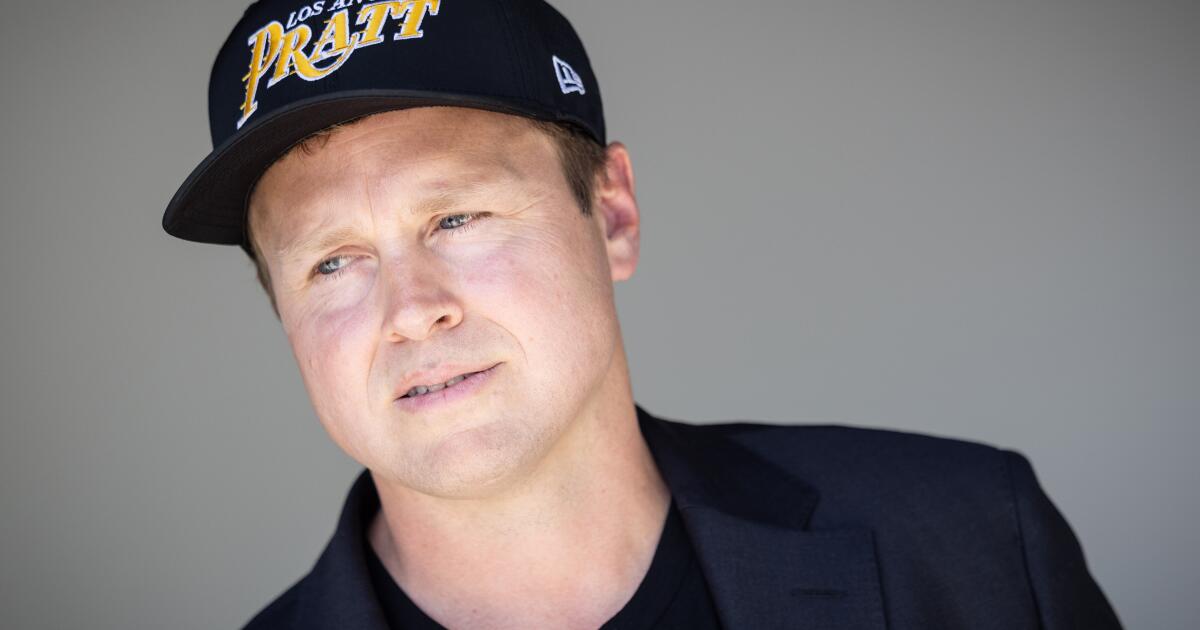
June 13 (UPI) — Reality TV star-turned-Los Angeles mayoral candidate Spencer Pratt says he does not expect to advance to the general election after projections from primary voting suggest he will rank third behind incumbent Karen Bass and challenger Nithya Raman.

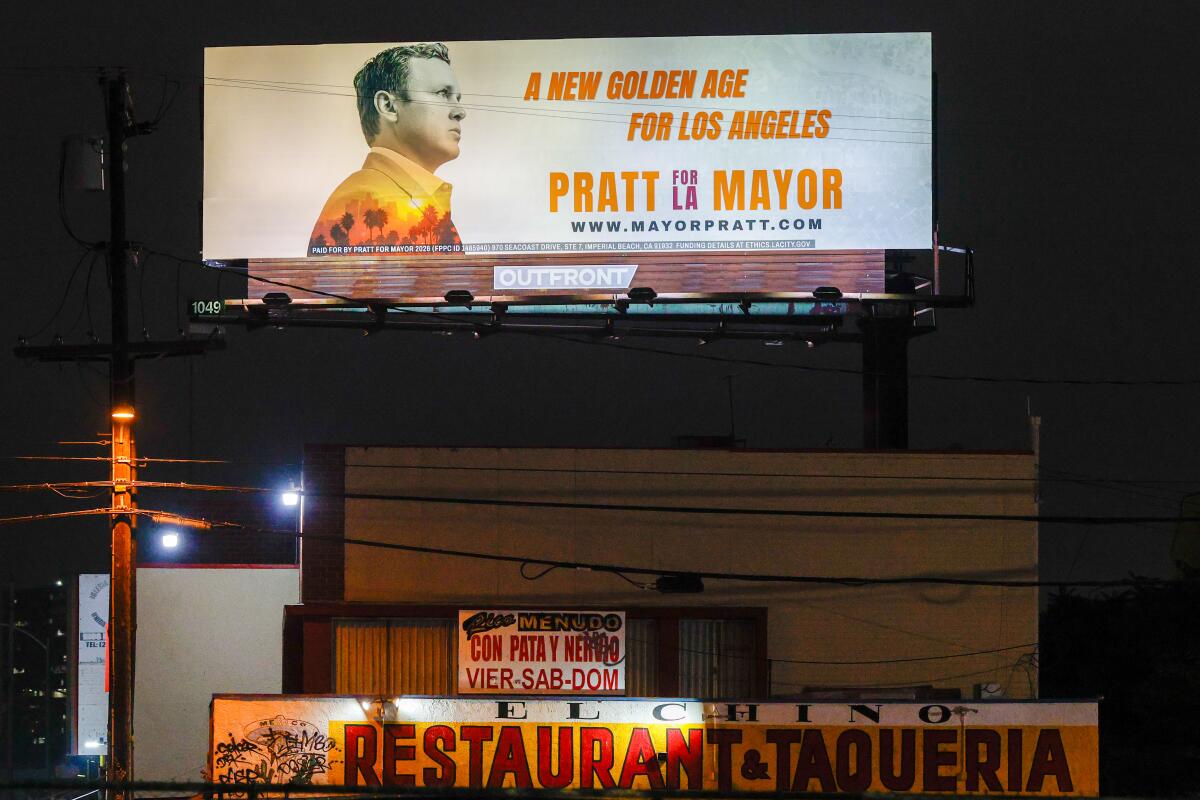
The Hills alum ran on a platform of making the city’s streets cleaner and safer, and speeding up the rebuilding of homes and businesses destroyed by wildfires in the Pacific Palisades more than a year ago.

Pratt, who lost his home in the blaze, released a 3-minute video Friday, stating the “campaign portion of my mission to save Los Angeles is coming to a close and I’m moving on to the next, more interesting phase.”

The spot already has gotten more than 8.6 million views on X.

It appears to be a mix of real and AI-generated footage, as well as movie clips.

In the video, Pratt said he plans to keep fighting to improve the lives of Los Angeles residents using the national social media following he has amassed in recent months.

He added that he has evidence that could damage one of the candidates as they head to the general election in November.

“We have some recordings of one of your exalted candidates doing and saying something that would make her resign in shame. I was saving it for the general election,” Pratt said.

“So, Karen, Nithya, ask yourself, ‘Is it possible that one of your employees may have a recording of you doing or saying something that would force you to resign in disgrace?’ Hope you sleep well at night over the next five months.”

The Los Angeles Times said the Bass and Raman campaigns have declined to comment on Pratt’s remarks.

According to the votes tallied Bass is in first place with 34 percent of the vote, Raman earned 29 percent and Pratt scored 26 percent.

If Pratt had won, he would have been the first Republican mayor of Los Angeles since Richard Riordan served two terms, ending in 2001.

Evacuated residents and those who lost their homes in the Eaton wildfire find supplies, resources and aid at the Clay House of Pasadena, which was turned into a donation center in Altadena, Calif., on January 12, 2025. Photo by Jim Ruymen/UPI | License Photo

Source link

Spencer Pratt decries ‘suspicious’ fire at his Pacific Palisades office

Last January, Spencer Pratt’s house in Pacific Palisades was razed by the raging flames of the Palisades Fire. Now, there has been what he called a “very suspicious fire” in a building in the neighborhood’s tony Highlands where he maintained an office for his crystals company.

Pratt, a former reality TV star who ran a high-profile campaign for Los Angeles mayor that he appeared to concede on Friday, talked to the California Post about the incident, which was first reported by the Palisadian-Post. According to the company’s website, the business sells precious and semi-precious crystal pendants, carvings and chains.

“I want to be careful to not compromise an arson investigation, but this incident is very suspicious,” Pratt told the California Post.

“I will wait for the investigators to make public the details, but this was no accident, and the timing of this … on the heels of all of the contentious election tomfoolery of the last two weeks, it is very suspect, indeed.”

Fire officials have not determined what sparked the blaze, and, in an interview with the Palisadian-Post, the building superintendent said he doesn’t believe the fire is related to Pratt’s campaign for mayor.

A spokesperson for Pratt did not immediately respond to phone calls and a text message seeking comment Saturday afternoon. Pratt suggested in his remarks to the California Post that he believes the fire may have been a politically motivated arson.

“This fire was not an accident, and it would not surprise me in the least if this were a reprisal for my work in opposing Karen Bass and Nithya Raman,” he said.

LAFD Public Service Officer Jamie Stewart told The Times in a phone interview Saturday afternoon that the department received a call at 6:09 p.m. Thursday reporting “a two-story commercial building with light smoke showing.” Stewart added that “arson was notified” and that LAFD arson personnel “did respond and they were on scene” of what he said was a one-alarm fire.

According to the Palisadian-Post, on Thursday, “Multiple firefighting units, including two ladder trucks, were dispatched by LAFD from Fire Stations 23 and 69 in the Palisades and Station 92 in Cheviot Hills to respond to the fire.”

The complex’s superintendent, Oscar Chang, told the local publication that the building was being remediated while waiting for a permit for work on its roof. Eyewitnesses, he told the Palisadian-Post, “saw two guys exiting the building shortly before the fire was reported.”

Chang added that he did not believe the fire was related to Pratt’s political campaign.

“One of the tenants shared a video with me of a homeless person right around the corner,” Chang told the publication, but “no one was living in the building.”

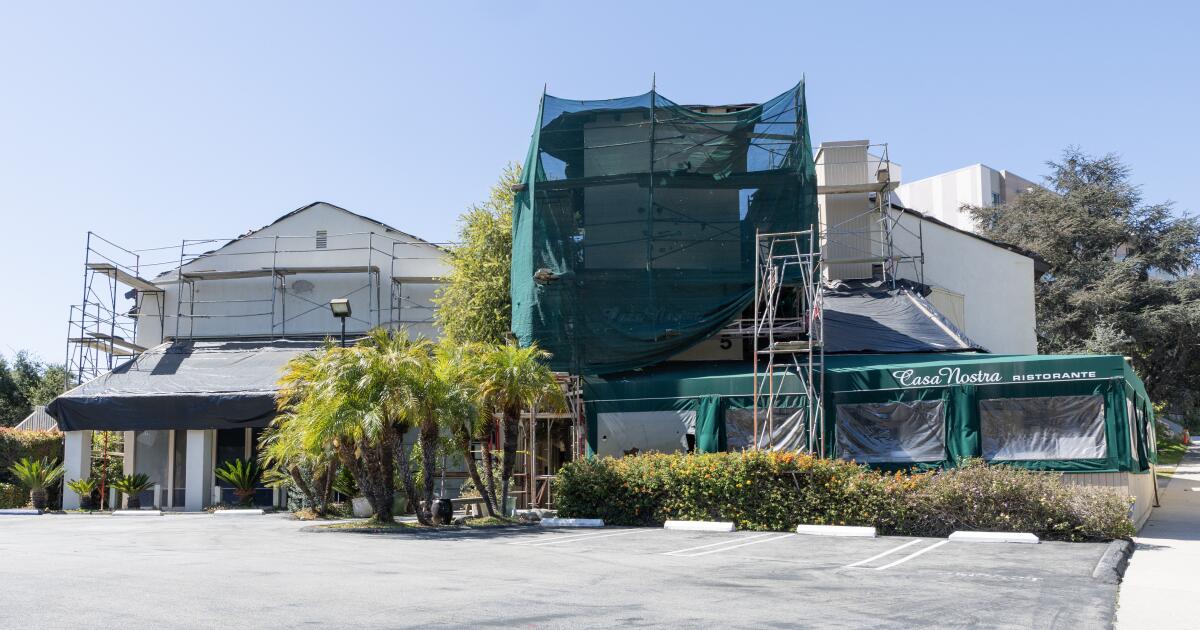
On Saturday morning, Pratt posted on social media about the Thursday fire, which tore through the Highlands Circle commercial complex at 1515 Palisades Drive. The complex was best known as the longtime home of the beloved Italian eatery Casa Nostra Ristorante, which closed a week before the Jan. 7, 2025, Palisades Fire and never reopened.

In the social media posting, he referred to the Los Angeles Times as the El Segundo Times — a derisive moniker referring to the location of its building in the coastal city near LAX Airport — and his repeated allegation that the newspaper “doxxed” him by reporting in April that he was staying in Santa Barbara County, not L.A.

“The El Segundo Times were very eager to dox where my children sleep; they thought that was newsworthy,” he wrote on X, formerly known as Twitter. “Have they reported on the arsonists who set fire to my office in the middle of my election?”

Overhead video footage of the fire posted on the Palisadian-Post’s YouTube channel showed smoke rising from the building as firefighters stood on the roof.

A filing in February with the L.A. City Department of Buildings and Safety proposed work for “change of use from commercial to retail, 2-story” at the property. In September, the department issued a code enforcement violation for “ABANDONED OR VACANT BUILDING LEFT OPEN TO THE PUBLIC.”

Source link

Who loved Bass, Raman and Pratt the most? A district-by-district breakdown

Good morning, and welcome to L.A. on the Record — our City Hall newsletter. It’s David Zahniser and Noah Goldberg, giving you the latest on city and county government.

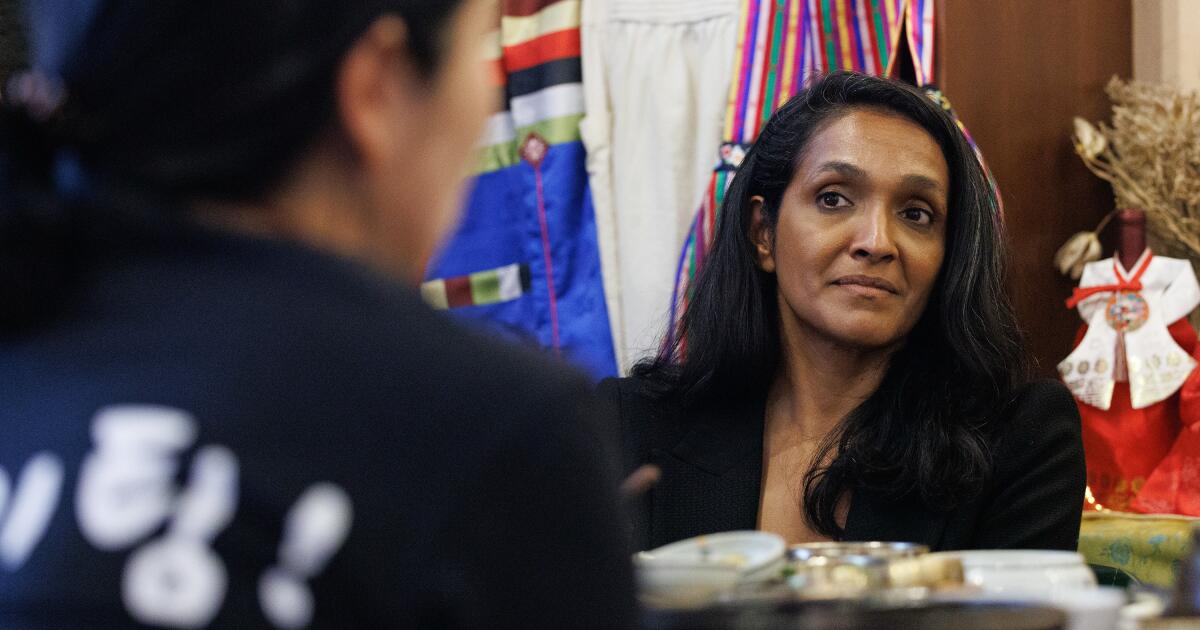
Los Angeles voters have finally gotten some closure on the outstanding contests in the June 2 primary election, with City Councilmember Nithya Raman qualifying for the runoff against Mayor Karen Bass, and Measure ER, the countywide sales tax hike, prevailing after a week of ballot counting.

With nearly all the votes counted, Angelenos are now getting a more granular understanding of the strongholds built up by each of the top three mayoral candidates.

Districts that went big for Bass, Raman and Pratt

Early on in the vote-counting process, it looked like Raman might not win her Hollywood Hills-based district, which stretches from Silver Lake to Reseda. In the end, she pulled out a first-place finish, securing nearly 34% of the vote compared to Bass’ 31%, according to Paul Mitchell, vice president of the voter data firm Political Data Inc, who aggregated county precinct data into council districts. Spencer Pratt, the former reality TV personality, trailed at 27%.

Still, Raman’s strongest support came from three districts on the eastern end of the city.

Mitchell’s analysis showed Raman with 45% of the vote in Council District 13, which includes all or parts of Echo Park, Hollywood and Atwater Village. She got nearly 40% in Council District 1, which takes in parts of Highland Park, Mt. Washington and Angeleno Heights. And she scored nearly 38% of the vote in Council District 14, which includes downtown, Boyle Heights and El Sereno.

Those districts are represented by Hugo SotoMartínez, Eunisses Hernandez and Ysabel Jurado, respectively — all members of Democratic Socialists of America, who all endorsed Bass instead of Raman, a DSA member herself. Raman placed first in all three.

Bass found her greatest strength in the three districts that cover South L.A., coming in first in all three. Her best performance was in District 8, represented by Council President Marqueece Harris-Dawson, where she led with nearly 62% of the vote.

You’re reading the L.A. on the Record newsletter

Sign up to make sense of the often unexplained world of L.A. politics.

The mayor received 45% of the vote in Council District 10, which stretches from Koreatown to the Crenshaw Corridor, and 42% in Council District 9, which stretches from the southern edge of downtown south to 95th Street.

Pratt performed the strongest in the west San Fernando Valley. He was the top vote-getter in District 12, which is represented by Councilmember John Lee and includes Chatsworth, Granada Hills and Porter Ranch. In that district, he received 39% of the vote, Mitchell’s assessment showed.

Pratt got nearly 37% of the vote in District 3, which is represented by Councilmember Bob Blumenfield and includes Woodland Hills, Warner Center and Canoga Park.

Pratt also led the pack in the 5th District, which takes up much of the Westside and is represented by Councilmember Katy Yaroslavsky. He had 30.7% of the vote, compared to Raman’s 30.6%, according to Mitchell’s analysis.

Nithya Raman attacks the L.A. ‘political machine’

It was one of tougher attacks of the mayoral primary: Raman accused Bass of engaging in “pay to play” — making decisions that benefited certain interest groups, who then spent big on her reeelection.

At her first post-election press conference Wednesday, Raman revisited that line of attack, criticizing Bass over her push to upgrade the city’s Convention Center. That $2.6 billion project was approved in the middle of the city’s financial crisis, when the council was contemplating major job cuts, Raman said.

“Downtown business groups then spent over a million dollars supporting her in her reelection. Meanwhile, the city went back to voters asking them to pay more to fix their streetlights. That is the political machine at work,” she said.

Pay to play was a potent issue in the 2005 election, when Mayor James Hahn was defeated by Councilmember Antonio Villaraigosa. At the time, federal agencies had opened corruption investigations into decisions at the city’s harbor and airports, as well as the Department of Water and Power. That year, the phrase “pay to play” was synonymous with criminal wrongdoing.

In a video acknowledging his primary defeat, Pratt said he got into the mayor’s race to “expose this corrupt machine.”

Raman stopped short of such a framing.

“It’s not corruption,” Raman told reporters at Vista Hermosa Park. “But it is evidence that the system, and how it works, particularly the influence of money in politics, has led to some very broken priorities here in the city.”

Last year, policy analysts warned the Convention Center project would be a financial drag from the moment it opens, consuming more than $100 million per year throughout the 2030s. Business groups and labor organizations pushed back, saying the project would help revitalize downtown while creating much needed construction jobs.

The Central City Assn., a downtown-based business group that supported the Convention Center upgrade, spent about $1.6 million on efforts to reelect Bass.

“Nithya Raman doesn’t think we need more jobs or visitors to our hotels and restaurants that produce the tax revenues downtown generates for the entire city, so it’s hard to support her,” said Central City Assn. President and Chief Executive Officer Nella McOsker in a statement.

Bass spokesperson Alex Stack also pushed back on Raman’s criticism, saying the mayor has been with “every group and industry to deliver results for Angelenos.”

“Nithya Raman can’t get anything done and then attacks the same groups she sought to endorse her campaign,” he said.

Pratt trailed Trump among L.A. voters

As a mayoral candidate, Pratt was dogged by questions about whether he was MAGA — shorthand for the movement that first powered President Trump into office in 2016. The Republican had received fulsome praise from Trump-aligned figures, including podcast host Joe Rogan and Greg Gutfield of Fox News.

Pratt downplayed his GOP ties. Still, there’s one area where he definitely had some similarity with Trump: His performance with L.A. voters.

Trump and Pratt both picked up roughly one out of every four votes in L.A. during their respective campaigns.

Pratt, former star of MTV’s “The Hills,” had 25.5% of the vote in L.A., according to results posted Friday. In November 2024, Trump did a little better, receiving 26.5%, county election results show.

Trump had 369,319 votes in L.A. two years ago, compared to 976,781 for then-Vice President Kamala Harris. By Friday, Pratt had 217,638 votes, compared to 247,242 for Raman and 292,115 for Bass.

It might not be fair to compare Pratt and Trump, given that there were key differences between the elections. Pratt was competing in a primary campaign, while Trump was in a general election. The candidate pool was different as well.

Trump was running in a six-way contest where Harris was his main rival. Pratt, on the other hand, was in a race featuring 13 other candidates.

Although two-thirds of those candidates were complete unknowns, four of Pratt’s rivals ran serious campaigns, amassing endorsements and spending significant amounts of money.

State of play

— TRUMP VS. LAHSA: The Trump Administration moved Thursday to block the embattled Los Angeles Homeless Services Authority from receiving federal funds, saying the agency was badly managed and engaged in fraud. Elected officials across the city denounced the move, while nonprofit groups also voiced alarm. “This is intended to create chaos,” said Jerry Jones, the head of the Greater LA Coalition on Homelessness, which represents groups that serve the region’s unhoused.

— PAYOUT PROBE: Dist. Atty. Nathan Hochman said Wednesday that he believes four out of every five claims in the largest sex abuse settlement in U.S. history — one that resulted in a $4 billion payout by Los Angeles County— may be fake. Hochman has asked a judge to pause the sex abuse payments while he continues his criminal investigation into the plaintiffs, lawyers and therapists involved in filing the claims.

— GET READY TO RUMBLE: The showdown between Bass and Raman is going to get ugly, political experts said this week, in part because they agree on a number of big-picture political issues. Both will need to court at least some of the disaffected voters who picked Pratt in the primary.

— A SCATHING SENDOFF: As we mentioned higher up, Pratt released a video Friday that was both an acknowledgment of his primary election defeat and a vitriolic screed against Bass and Raman, his former rivals. Pratt called them “morons,” “commie animals” and “corrupt communists,” and made clear he intends to ramp up his attacks in the coming months. “I don’t have campaign laws hamstringing me now. It’s war,” he said.

— WOOING LATINOS: Bass carried far more Latino-majority neighborhoods than her rivals in last week’s primary, a Times analysis found. She carried 35 Latino-majority neighborhoods, including Boyle Heights, Pacoima and Historic South-Central. That was a 46% increase from 2022, when she won 24 Latino-majority neighborhoods in her primary against Rick Caruso and Kevin de León, the analysis found.

— EKING OUT A WIN: The countywide sales tax hike known as Measure ER prevailed this week, with late-arriving ballots pushing the number of ‘yes’ votes just above 50%. “It’s a lifesaver to carry us through the storm we’re all in,” said County Supervisor Holly Mitchell, who led the push among her colleagues to get the measure on the ballot.

— AN EXPENSIVE FEE-FA: Bass was set to attend the U.S. opening game of the World Cup Friday at SoFi Stadium in Inglewood after being invited by FIFA, her office said. Still, Bass wasn’t exempt from the high ticket prices she criticized earlier this year. She paid $2,735 out of pocket for her ticket, a spokesperson said. On a related note, the mayor announced more than 100 “Kick it in the Park” events where Angelenos can watch World Cup games for free.

— MORE OF THE SAME: In a break with recent history, every council member who ran for reelection this year won their race. “People see what we’re doing, and they want us to keep fighting for them,” said Councilmember Tim McOsker, who won nearly three out of every four votes in his San Pedro-to-Watts district.

QUICK HITS

  • Where is Inside Safe? The mayor’s signature program to address homelessness went to the area around 54th Street and Western Avenue, in the South L.A. district represented by Harris-Dawson.
  • On the docket next week: The City Council meets Wednesday to take up a sprawling package of charter reform proposals, including a move to ranked-choice voting and a larger number of council members. Will the council send those ideas to voters or punt them for another two years? Stay tuned!

Stay in touch

That’s it for this week! Send your questions, comments and gossip to LAontheRecord@latimes.com. Did a friend forward you this email? Sign up here to get it in your inbox every Saturday morning.

Source link

Spencer Pratt became a voice for L.A.’s disaffected. Where do his supporters go now?

When Republican Spencer Pratt burst into Los Angeles politics, venting a torrent of online fury against Mayor Karen Bass’ handling of the Palisades fire, he pitched his mayoral campaign as a full-bore challenge to L.A.’s political status quo.

The former reality TV star, who lost his home in the blaze, started as a long shot but emerged as a national story, with the ability to harvest social media attention, rally a base and dominate the news cycle.

But in a city overwhelmingly Democratic, where Republicans make up just 15% of registered voters, even some of his supporters wondered how far he could rise. In the end, voters selected Bass, a Democratic centrist, and democratic socialist City Councilmember Nithya Raman, who ran to Bass’ left, to face off in the runoff.

Still, for many of the 200,000 Angelenos who voted for Pratt, his brash, social media-fueled campaign was not just a long exercise in trolling. Pratt gave voice to their discontent with the system of one-party rule and said things they too often felt uncomfortable saying.

And now, they face a difficult choice of who to support in November.

“I know a lot of people who are disappointed,” said Meghan Daum, an L.A. writer and podcaster and former Los Angeles Times columnist who endorsed Pratt. “They are saying, ‘OK, now what? What can we do?”’

While Pratt did not make the runoff, political experts said his candidacy tapped into Angelenos’ dissatisfaction with the Democratic establishment and resonated with a sizable number of Angelenos who are rarely represented in L.A. politics.

“He identified a previously invisible level of anger and frustration,” said Dan Schnur, a longtime politics professor at USC, UC Berkeley and Pepperdine University, of Pratt. “The question going forward is whether he, or someone else, can shape that raw emotion into a movement.”

Pratt has yet to put out a statement conceding the race or contesting the results. As a stream of Republicans, including President Trump, made unfounded allegations of election fraud in California, the campaign’s most online candidate was conspicuously absent on X and Instagram.

Some Democrats in L.A. urged Pratt to make good on his promise to leave the city if Bass or Raman were elected. Late night TV host Jimmy Kimmel, a prominent Democrat, told Pratt he had rented him a U-Haul.

Despite the snark from Democrats, political observers say Pratt changed the terms of L.A.’s mayoral debate.

“He forced the more conventional candidates to talk about the issues in a way that would not have been the case if he weren’t in the race,” Schnur said.

“For the first time in years, there is a critical mass of citizens who are done pretending that what they see before their eyes isn’t really there,” Daum wrote on her Substack. “The people in charge will have to answer to those citizens.”

In the final weeks of the campaign, Pratt became ubiquitous in the national media. There were profiles in high-end publications, podcast interviews and regular reports from Fox News. But the results show he fell short of persuading enough Angelenos to make the runoff.

“It doesn’t appear that he’s impacted the political underpinnings of a deep blue city like Los Angeles,” Schnur said. “His impact was less ideological than attitudinal. He wasn’t convincing the voters to become more conservative, he was convincing them that it was OK for them to vent their anger in an unconventional way.”

Dissatisfaction is building in L.A. as the city’s cost of living mounts and a new generation of young Angelenos are unable to buy homes. Many are concerned about the lack of visible progress on street homelessness. Some are angry at what they see as city leaders’ poor preparation and response to the Palisades fire.

Ultimately, the momentum for change in Los Angeles was divided. As Pratt challenged Bass from the right, Raman tacked to the left of Bass on homelessness and policing and made affordability a key plank of her campaign.

Whatever their concerns about the status quo in L.A., many Angelenos were unwilling to vote for a Republican.

During the course of the campaign, Daum said she had numerous conversations with Angelenos who said: “I can’t associate with anybody who voted for Trump. I can’t have them in my house. I can’t have a conversation with them. I want nothing to do with them.”

A 42-year-old millennial who became famous on “The Hills” and owns a business selling “healing” crystals, Pratt had no political experience when he entered the mayoral race. He didn’t even appear to have a campaign manager.

“The system in Los Angeles isn’t struggling, it’s fundamentally broken,” Pratt said as he launched his campaign on Jan. 7, the anniversary of the fire. “It is a machine designed to protect the people at the top and the friends they exchange favors with while the rest of us drown in toxic smoke and ash.”

Bombastic and full of braggadocio, Pratt critiqued what he saw as Bass’ failure to prepare for and respond to the wildfires. He berated city leaders for not doing enough to get unhoused people off the streets. He railed against the city’s challenges with public safety, potholes, and the abuse of dogs on Skid Row. He even seized on a comment Bass made on the campaign trail about using taxpayer money to fund dental care for meth users.

As Pratt talked about homelessness, his message resonated with Marissa Comstock, 36, a stay-at-home mom and former software engineer in Eagle Rock.

“It’s totally obvious to me,” she said. “We need to get these people off the street.”

Last year, Comstock said she and her husband had a negative encounter at Griffith Park as they pushed their daughters around in strollers. Just a few minutes into their hike, she said, they were accosted by an unhoused person who screamed at them and threatened to cut off their daughters’ legs.

Since that incident, Comstock said, she takes her daughters only to places like the Huntington or Descanso Gardens that require membership to be admitted.

“I don’t feel comfortable even being on regular streets,” she said. “If there’s some crazy homeless person, what am I supposed to do?”

Pratt did extraordinarily well in capturing attention and developing a message, said Paul Mitchell, vice president of the Sacramento-based bipartisan firm Political Data Inc. Many Angelenos, he noted, had a better sense of Pratt’s viewpoint than they did of much more deeply funded California gubernatorial candidates, like Matt Mahan or Xavier Becerra.

During his campaign, Pratt did not express support for Trump or the Make America Great Again movement. He insisted he was a nonpartisan candidate running on local issues.

“I’m going to show everybody that I’m their mayor,” Pratt said on election night.

But even if Pratt was not explicitly MAGA, his reality TV theatrics mixed with antiestablishment populism were so MAGA-coded that he struggled to persuade disaffected liberal Angelenos. He referred to the homeless as “fentanyl zombies.” He railed against California’s “socialism.” He called Bass “Basura,” Spanish for trash.

When Trump spoke of Pratt, telling reporters “I heard he’s a big MAGA person,” Raman was quick to share Trump’s remarks on social media, warning Angelenos that Pratt was wildly out of step with their views.

While Pratt impressed some political observers with his performance in a May 6 televised debate with Bass and Raman, others said he alienated a significant portion of Angelenos with some of his social media antics.

“He could have talked about the drug use and the risks and the filth and the fire risks and all that,” said Rob Stutzman, a GOP political strategist, of Pratt’s zombie rhetoric, “but then paired that with, ‘My God, these liberals are leaving these people out here to die,’ and expressed some humanity towards the population that’s on the streets.”

Ultimately, Daum said Pratt was a “terrible candidate.”

“He did a million things wrong,” she said. “The whole time, I was yelling on Twitter about how he’s got to stop it: the AI videos are gonna hurt him, the Basura stuff, the zombie stuff. Like, stop it! Stop it!”

As Pratt’s campaign came to an end, Stutzman said, it is not clear that he represents any kind of lasting political movement.

“The question remains: Did he create a political movement or did he exploit the opportunity to run for mayor to restoke his diminishing fame?” Stutzman said. “He’s in the mold of a Kardashian: He’s just found ways to be famous without ever really doing anything important. I suspect that this was more about him acting out as to what he is as a reality celebrity versus becoming a leader of a political movement in L.A. We’ll see.”

When Angelenos go to the polls in November, there are several paths for Pratt voters.

Some, Mitchell said, will probably sit the election out entirely.

“You’ll get some Republicans who vote for Raman because they’re like, ‘Well, she’s a socialist and I can’t stand her, but I’m just voting no on Bass.’ And then you’ll have a lot of Republicans who are like, ‘OK, Raman’s a socialist.’”

After Raman made it to the runoff, Bass’ campaign slammed the city council member for voting against hiring more police and blocking efforts to keep homeless encampments away from schools. Meanwhile, Raman positioned herself as the anti-status quo candidate.

In a statement celebrating her advance to the general election, Raman did not mention Pratt or his supporters, but railed against “powerful interests” in City Hall.

“Working people pay the price in higher rents, depleted services, and a city that has stopped working for them,” she said. “If you’re as frustrated by the broken status quo as I am, I hope you’ll join our movement to build a city that works for everyone.”

Even as Daum felt depressed that Pratt’s campaign was not continuing, she said she felt more engaged in L.A. politics than she had ever been. She planned to vote in November and would be watching both Bass and Raman to see how they responded to Angelenos’ concerns about street homelessness.

“If Karen Bass said, ‘OK, I get it, “housing first” is not the panacea that I’ve been thinking it is. Seriously, I’m gonna put together a task force of people who are going to actually think this through.’ … I would be following that. I would be very curious,” Daum said. “Same if Nithya said that, too. I’m open to either of them, I guess.”

Comstock said she would probably vote for Bass in the runoff.

“Nithya Raman is just way too far on the socialist scale for me and will likely do more damage, rather than Karen Bass’ ineffectualness,” she said. “I don’t want to go any farther left.”

Source link

Commentary: Spencer Pratt could have been a real contender. His greatest enemy was himself

Spencer Pratt had a few things going for him when he launched an insurgent campaign to become Los Angeles’ next mayor.

He had a heart-tugging origin story that saw him transform from a has-been television star into one of the thousands of residents who lost their home in last year’s Palisades fire. He faced an unpopular incumbent in Mayor Karen Bass. He was powered by a vigorous social media presence and an angry electorate thirsty for change.

He was able to capitalize on those conditions to outraise his main rivals, Bass and city council member Nithya Raman, and transform his candidacy from an afterthought into a national story. Running as a Republican in a super-blue city like L.A. put him at an automatic disadvantage — one that might have been extremely difficult to overcome in the end. But the Pratt posse started to feel like a bona fide movement the more it thundered on, the type of revolt against the old guard that in previous eras led to the passage of Proposition 13 and the recall of Gov. Gray Davis — the type of movements that forever alter California politics.

Pratt, however, faced an apparently insurmountable obstacle.

Pratt.

With almost all votes counted, he’s going to finish in third place with about 26% of the electorate — the same slice Donald Trump received in 2024 — while Bass and Raman proceed to face each other in November. Political strategists will teach his failed attempt to their clients as a cautionary tale of how a candidate blew every advantage they had when they couldn’t afford to lose one.

Pratt’s first mistake was thinking that Angelenos wanted a campaign of wanton rage. Yes, many residents are furious at the state of the city. Yes, they want change. Yes, the angry Angeleno archetype is a real phenomenon that flares up in local elections to smack back at the powers that be.

But L.A. is not MAGAlandia — running from the right on apocalyptic, whiny messaging will only get you the few Republicans that remain in the city and some disaffected liberals. Pratt didn’t run as a MAGA candidate, but it’s hard to say he didn’t run like one — even as he swore he was running for everyone.

He took every opportunity to ridicule progressives in a city where four democratic socialists sit on the city council, one of them — Raman — has a good chance of becoming the next mayor, and five of the six candidates endorsed by the local chapter of the Democratic Socialists of America either won outright or are moving on to the general election.

Instead of making overtures to that side of the populist coin, Pratt recorded videos obsessing over Bass’ trip to communist Cuba in the 1970s, a well-known fact he treated as revelatory and which made Pratt sound like he was stuck in a John Birch Society meeting circa 1965. His dismissal of Raman as “stupid” and the mayor as “Basura” — trash — came off as facile juvenilia at a time when we already have the Big Juvenile Delinquent running things in the White House. Ridiculing homeless people as “zombies,” “vagrants” and “bums” only riled up the worst elements of the city and turned off anyone with a heart.

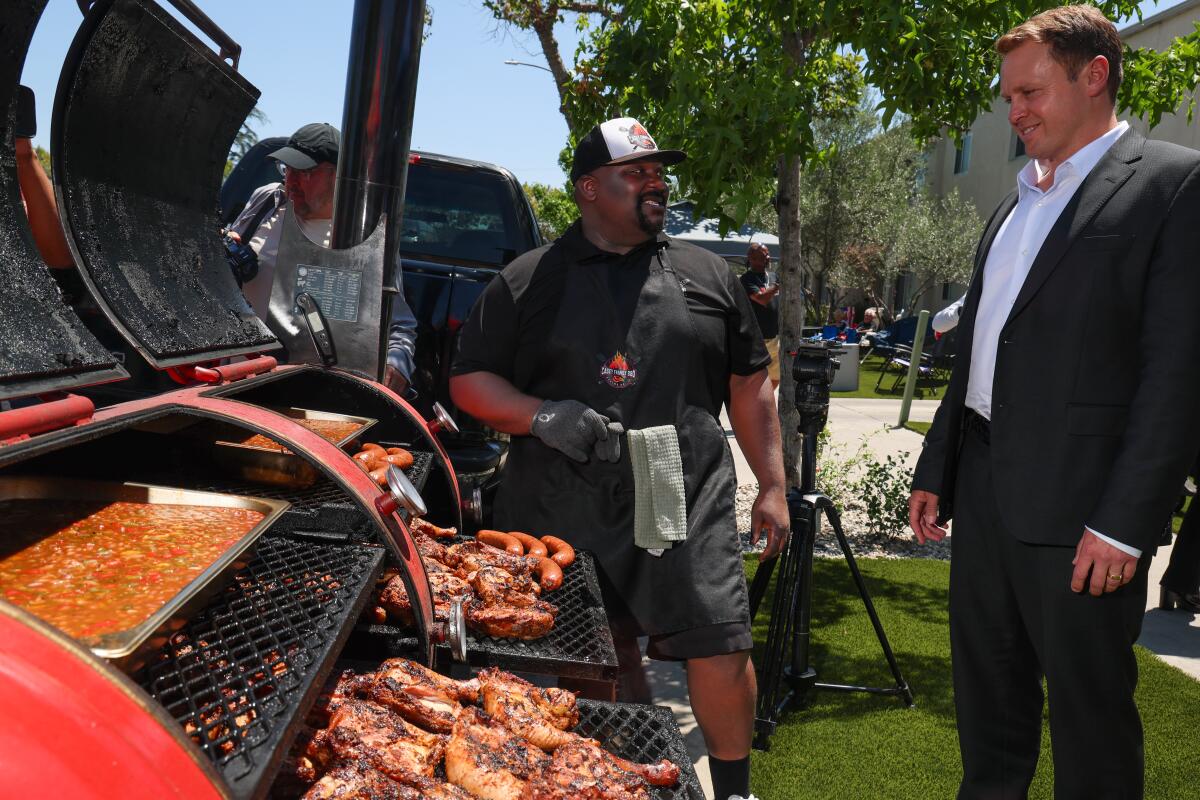
Keith Casey of Casey's Family BBQ serves up food as LA Mayoral candidate Spencer Pratt hosts a campaign "block party" event

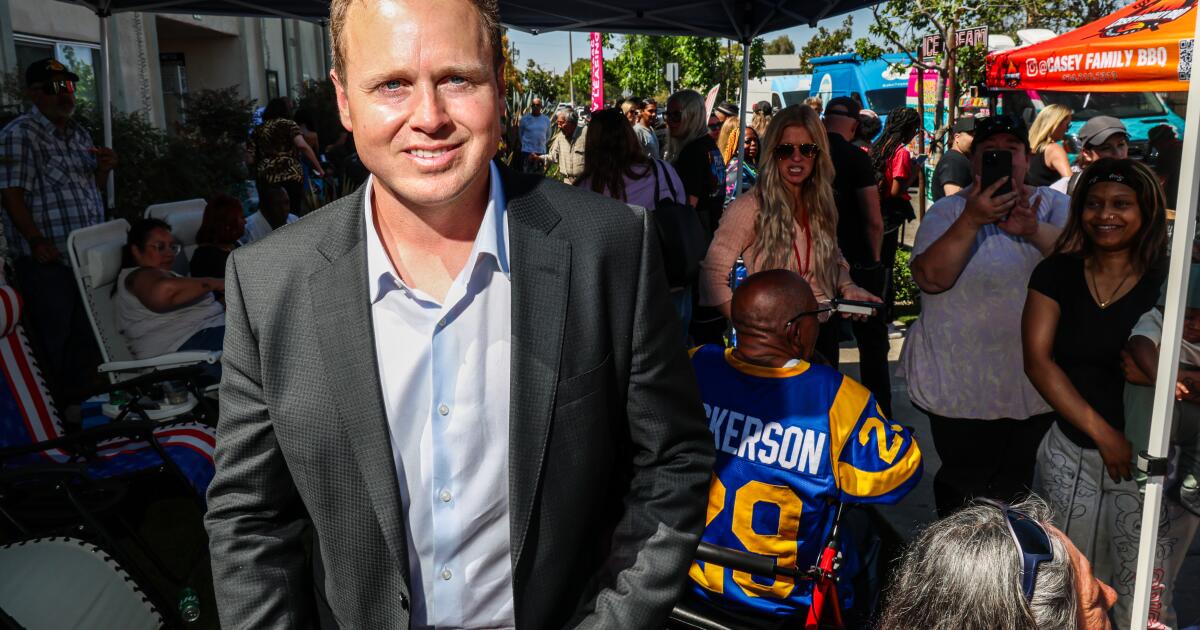
Keith Casey of Casey’s Family BBQ serves up food as L.A. mayoral candidate Spencer Pratt hosts a campaign “block party” event on 10th Avenue in Los Angeles on May 20.

(Robert Gauthier / Los Angeles Times)

Pratt undoubtedly attracted votes from a good amount of non-MAGA people fed up with various problems afflicting L.A. But many of the supporters who brayed the loudest on his behalf were the same people already doing daily propaganda on social media for a failed, hate-filled president and his baleful cronies.

Pratt acted like he believed the AI-generated videos created by fans that cast him as a comic-book hero was real life instead of forgetting that he was a novice trying to take on two experienced politicians. While Bass and Raman trekked across the city during the primary, Pratt limited his public appearances mostly to the Westside and random encounters with supporters he posted on social media. The few times he appeared outside those safe spaces came off as safari expeditions in a mysterious city the 42-year-old lifelong Angeleno obviously didn’t know.

Take the South L.A. block party he hosted last month. Instead of having something thoughtful to say about the state of Black L.A. or how its political leaders continue to neglect the region, all Pratt seemed to take away from that afternoon was that it was in the territory of the Rollin’ 60s Neighborhood Crips, a detail he shared ad nauseum on social media and to the press — as if kicking it with gang members would fix L.A. or gain him any votes or grant some kind of street cred.

That self-centered cluelessness ended up torpedoing Pratt’s best campaign moment. In the one debate he participated in, Pratt put Bass on the defensive, turned Raman into a tongue-tied mess, kept his answers sharp and relatable, and even earned the praise of the moderators. He should’ve demanded more gatherings like that to flex his mastery of television cameras, make his case to as many Angelenos as possible and showcase the self-proclaimed Pratt Daddy as someone willing to take on hard questions anytime, anyplace, from anyone.

Instead, Pratt declined an invite to their only other scheduled debate and never bothered with the forums civic groups across the city held in order for their members to hear from candidates. Instead, Pratt flew out to New York the week before election day to appear on Fox News.

Sticking to largely sycophantic media who lobbed softball questions hardened his ceiling. Pratt needed to proselytize — not preach to the choir.

The thing is, Pratt made some strong points about the inefficiencies of L.A.’s political status quo and the outrage that is having tens of thousands of people live on our streets. And there’s something appealing about an outsider crashing City Hall, which is way too beholden to sclerotic lifers who can be as clueless about what the city needs as Pratt turned out to be.

Instead, he platformed people who saw L.A. as a hellhole — or “shithole,” as Trump likes to call certain places. It was hard to see what some of Pratt’s loudest and most strident supporters actually thought was worth preserving in the city — but not why they felt he was their man.

In the wake of his loss, Pratt sure hasn’t push back against unfounded claims by too many of his followers and Trump, Vice President JD Vance and House Speaker Mike Johnson that Democrats somehow rigged the election against him. Quite the contrary, Pratt has insinuated on social media that they’re onto something.

That last point reinforces the ultimate reason Pratt could never become L.A.’s next mayor: He really doesn’t believe in L.A.

Angelenos don’t mind haters — it’s the type of city that frustrates residents even on its best days. But one insult residents won’t brook is someone who doesn’t have confidence in better days ahead for the city no matter how dire things may be.

Angelenos can spot a phony from far away — and Spencer, you’re turning out to be phonier than the fake drama on any of the television shows you ever appeared in.

You vowed to leave L.A. if you didn’t win the race for mayor. Maybe you should stay and try to righteously pressure Bass and Raman to make much needed changes. If you do, urge your followers to do the same instead of them pouting and sitting out the mayor’s race.

But if you don’t, well, maybe you never really loved L.A. as much as the City of Angels, warts and all, deserves. And you kind of need to really love L.A. to really fix what ails it.

Step up, or step outta town.

Source link

Raman closes in on Pratt as more votes in L.A. mayor’s race are tallied

Los Angeles City Councilmember Nithya Raman cut deeper into the lead of reality television personality Spencer Pratt on Saturday, as his lead slimmed to just a single percentage point.

Pratt fell to just over 27% of the vote while Raman jumped up to slightly over 26%, according to the results from the Los Angeles County Registrar-Recorder. Pratt now leads Raman by just 7,494 votes.

“We’ve seen Nithya Raman catching up on every update and the last two in particular she’s accelerated,” said Paul Mitchell, vice president of the bipartisan voter data firm Political Data Inc. “She’s continued to gain at a rate that means she will eventually catch up unless Pratt starts getting some ballots coming in that are either geographically or demographically better for him.”

Democratic consultant Michael Trujillo, who doesn’t represent anyone in the mayoral race, said the results suggest Raman will surpass Pratt as more votes are counted.

“I think it’s over,” Trujillo said. “It appears Nithya will be in the runoff. Pratt doesn’t appear to be growing much more.”

The second-place finisher in the mayoral primary will face Mayor Karen Bass in a Nov. 3 runoff. On election night Tuesday, the Associated Press determined that Bass had secured enough votes to qualify for the runoff.

Pratt has been in second place since then, but Raman has gradually eroded his lead as mail-in ballots have been counted. The updated vote tally released Thursday showed Pratt with 29% of the vote and Raman with 23%.

With Friday’s update, Raman’s share had risen to 25% and Pratt’s shrank to 28%, for a 3 percentage point gap.

In the most recent batch of mail-in ballots counted, Raman received 23,514 votes, while Pratt gained 10,336.

Election analysts expected Raman to gain ground as the mail-in ballots were tallied, reasoning that many left-of-center voters — Raman’s base — held onto their mail-in ballots until the last minute as they waited to choose between Democratic gubernatorial candidates. They also say younger, more progressive voters tend to hold onto their ballots longer generally.

Although the mayor’s race is nonpartisan, Pratt is a Republican in a city that is overwhelmingly dominated by Democratic voters and elected officials.

A poll by the UC Berkeley Institute of Governmental Studies, which was co-sponsored by The Times, had Pratt running in third place behind Bass and Raman.

The poll of 1,351 likely voters conducted May 19-24 had Bass with 26% support, Raman with 25% support and Pratt with 22% support, with a 3% margin of error.

Los Angeles voters have become accustomed to seeing election results change as late-arriving ballots are tabulated. In the 2022 mayoral primary, real estate developer Rick Caruso led the pack for about a week before Bass pulled ahead.

Pratt was favored in many of the same neighborhoods that voted for Caruso, according to a Times analysis of precinct-level returns provided by the Los Angeles County Registrar-Recorder on Wednesday, when an estimated 62% of the projected vote had been counted. Raman, by comparison, made inroads in progressive areas dominated by Bass four years ago.

Pratt, whose Pacific Palisades fire home burned in the January 2025 fire, was strong there and on the Westside, as well as in the San Fernando Valley communities of Encino, Woodland Hills, Chatsworth and Sunland-Tujunga.

Raman dominated precincts known for their progressive politics, particularly those with younger people in renter-heavy neighborhoods stretching from Hollywood to Highland Park, including her home base of Silver Lake.

Mail-in ballots with an election day postmark will continue to be accepted by county election officials through Tuesday.

Source link

Proud Boy booted from Spencer Pratt election night party

Proud boy expelled from Pratt’s party

Spencer Pratt’s election night party at Don Antonio’s Mexican restaurant in West Los Angeles included a few uninvited guests, and it wasn’t just members of the news media.

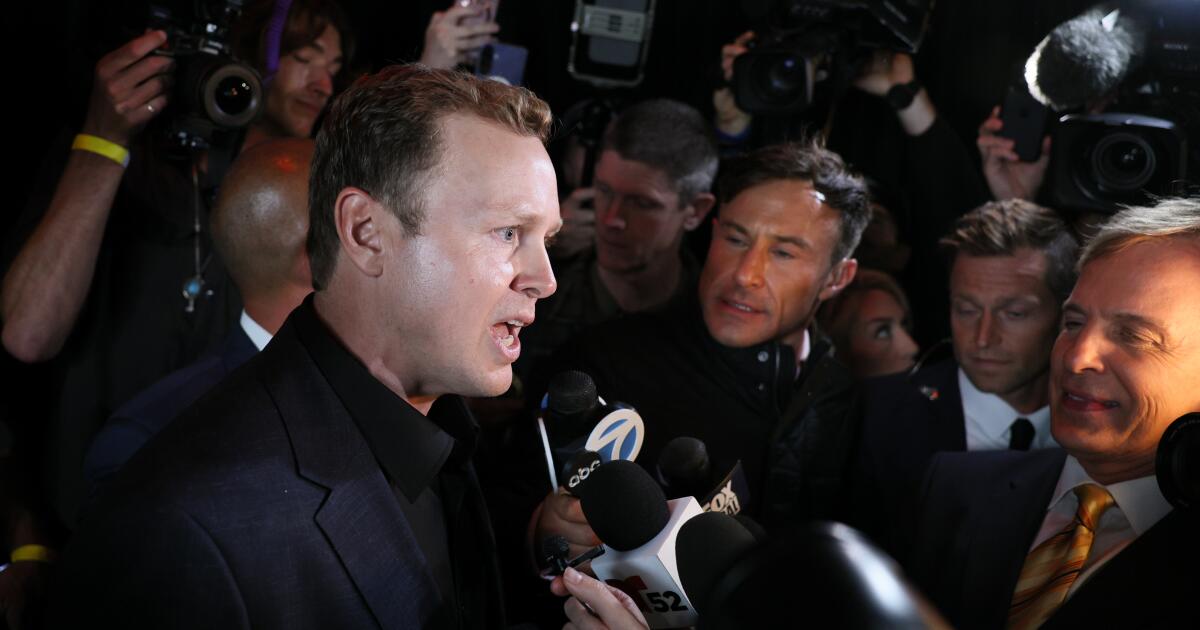
As Pratt spoke to reporters relegated to the sidewalk, a Virginia man convicted of joining in the Jan. 6, 2021 assault on the U.S. Capitol hovered behind him, trying to horn his way into the candidate’s frame as Pratt spoke to the news cameras.

A member of Pratt’s security team grabbed the man, Jon Mellis, by the shoulders, dragged him past the TV cameras and pushed him down onto the pavement of Pico Boulevard as cars whizzed by.

Mellis — a member of the far-right Proud Boys who was pardoned by President Trump along with the other Jan. 6 rioters — wasn’t thrilled. He attempted to interrupt multiple news broadcasts to air his grievances.

“They can’t assault me like that,” Mellis said.

“They hate MAGA,” someone else in his group chimed in.

Earlier Tuesday evening, Mellis had happily mugged for one news camera after another, expressing his fealty for Pratt.

Mellis described himself as “ultra-MAGA” to The Times and, pre-shove, said he didn’t mind that Pratt was distancing himself from the MAGA movement as he campaigns for votes in the Democratic stronghold of Los Angeles.

Recent polling showed most Democrats were less likely to vote for Pratt when perceiving the candidate as tied to MAGA and Trump. Given that, it’s hardly surprising that Pratt’s security team gave Mellis and his friends the bum’s rush.

“Those guys are paid ops,” a member of Pratt’s campaign wrote on X. “They crash every single event.”

Airbnb’s election night sweep

It was a good election night for short-term rental giant Airbnb, which infused numerous city races with cash and didn’t take a single loss.

The company teamed up with the Central City Assn., a group representing downtown Los Angeles businesses, to fund ads in support of Karen Bass, city attorney candidate John McKinney and five City Council candidates.

The business group said its PAC, which received funding from Airbnb and the Los Angeles Police Protective League, spent nearly $5 million during the primary election cycle, up from $1 million during the 2024 primary and general elections.

“We have been intentional about supporting candidates and causes focused on building more housing; investing in public safety, transportation, and infrastructure; and supporting the diverse businesses that provide jobs and put paychecks in Angelenos’ pockets,” said Nella McOsker, president of the Central City Assn.

“The results speak for themselves,” said Justin Wesson, Airbnb senior manager of public policy in California. “Airbnb has arrived in L.A. politics — not as a guest, but as a permanent resident.”

In council, CCA and Airbnb supported Traci Park, who declared victory and had a big lead over her opponent; Jose Ugarte, who will probably advance to a November runoff; and Timothy Gaspar, who was leading in his primary as well, though votes are still being tallied and it wasn’t clear if he would make the majority threshold needed for an outright victory. CCA also supported Monica Rodriguez, who ran unopposed and Tim McOsker (Nella McOsker’s father), who coasted to a big lead in the primary.

Betting on whims and vibes

This is Los Angeles’ first mayoral election in the age of prediction markets, and two giants of the field, Kalshi and Polymarket, have been actively promoting betting on who will be the next mayor — and even sub-bets within the election, such as which candidate will come in second place in the primary or which two candidates will advance to the runoff.

On election night, as Spencer Pratt led Nithya Raman for second place by about 9 percentage points, both Kalshi and Polymarket had Pratt favored to move on to the runoff.

But overnight, the market shifted, with a Bass versus Raman runoff now considered more likely by bettors, probably due to a widely held belief that the remaining votes to be counted will lean more Democratic as the county tallies late-arriving vote-by-mail ballots.

Although Kalshi promotes its markets as the “odds” that a certain candidate will win, experts warn it merely represents the beliefs of bettors, who are not always the best-informed.

“This is people’s whims and vibes. You might have better luck in Vegas; at least when you bet in Vegas there’s math involved,” said Democratic consultant Mike Trujillo.

A spokesperson for Kalshi said “sharp traders on Kalshi are experts at pricing likelihoods in real time.”

Eric Zitzewitz, a professor of economics and expert on prediction markets at Dartmouth College, said that sites such as Kalshi and Polymarket are pretty accurate, and that smart money usually corrects the market.

“Historically that movement in Pratt’s price would reflect a movement in his odds,” Zitzewitz said.

As of Friday, Polymarket had a Bass-Raman runoff at 80%, and a Bass-Pratt runoff around 22%. Kalshi gave Bass and Raman a 78% chance of advancing and Bass and Pratt 22%.

Pratt currently leads Raman, but Los Angeles County is still tallying ballots and Raman has gained some ground following initial results Tuesday.

You’re reading the L.A. on the Record newsletter

Sign up to make sense of the often unexplained world of L.A. politics.

State of play

— BASS VERSUS?: Mayor Bass will advance to a runoff against either Pratt or Raman after a bruising primary campaign during which the incumbent was attacked from the left and the right.

— COALITION KAREN: A broad coalition of supporters assembled by the mayor helped her secure a spot in the Nov. 3 runoff. On her side was organized labor, including the powerful police officers’ union; business leaders, working closely with Airbnb; the Los Angeles County Democratic Party, including key elected officials; and immigrant rights groups that applauded Bass for her condemnation of federal ICE raids.

— COMEBACK COUNCILMEMBER?: Raman is still running behind Pratt, but experts say the remaining ballots to be counted should favor Democrats. “Don’t count [Councilmember] Nithya Raman out yet,” said Zev Yaroslavsky, director of the Los Angeles Initiative at UCLA Luskin.

— INCUMBENTS IN CONTROL: The mood was celebratory in Los Angeles City Council chambers Wednesday, as incumbents up for reelection held wide leads over their challengers as vote counting from Tuesday’s primary continued.

— FELDSTEIN SOTO OUT, MEJIA IN: Los Angeles City Atty. Hydee Feldstein Soto all but conceded that her reelection bid had failed Wednesday morning, as she lagged far behind her two well-funded challengers based on early returns. Her incumbent colleague, City Controller Kenneth Mejia, appeared to be faring better in his bid to stay in office, holding a double-digit lead over finance executive Zach Sokoloff.

QUICK HITS

  • Where is Inside Safe? The mayor’s signature program moved 20 people inside from Skid Row in Council District 14.
  • On the docket next week: Proposals from the Charter Reform Commission are still being reviewed by the Rules, Elections, and Intergovernmental Relations Committee, with the next meeting scheduled for June 12.

Stay in touch

That’s it for this week! Send your questions, comments and gossip to LAontheRecord@latimes.com. Did a friend forward you this email? Sign up here to get it in your inbox every Saturday morning.

Source link

Commentary: For mayoral candidates and all of L.A., here’s the homelessness conversation we must have

Ron, a West L.A. resident, thinks he knows why former reality TV star and political newcomer Spencer Pratt won so much support in his run for mayor.

People are frustrated, frightened and angry about homelessness “and the crime associated with it,” Ron said in an email. He added that he voted for Mayor Karen Bass, but “almost everything Pratt said about the homeless resonated with me. … The homeless run wild here, without consequence.”

“Many of us support him not because we think he’s perfect,” said Kathy, “but because we are deeply dissatisfied with the direction of Los Angeles and feel that traditional politicians have not delivered the results we were promised.”

Bob, “a left-leaning Palisades resident,” said the issue is not Pratt’s lack of credentials, but the failures of incumbents. “There was a columnist … who documented in depth the situation at MacArthur Park,” Bob wrote in reference to me. “What was his name and what happened to him? Did he change his tune?”

These are all fair points, and if Pratt holds onto one of the top two spots and makes it to the Nov. 3 general election, or he’s overtaken by late-charging Councilmember Nithya Raman, we’re going to hear a lot more about homelessness in coming months.

So whether we’re looking at a Bass-Raman contest or a Bass-Pratt showdown, here are some random musings, and I’ll begin by responding to Bob’s question about whether I have changed my tune.

Not in the least.

The situation in MacArthur Park — targeted Thursday in a crackdown that involved multiple arrests — has long been a disgrace, and the same is true of many other places I’ve written about for the past quarter of a century. Last month, I visited a Hollywood neighborhood where one frustrated resident hired her housekeeper to document chronic problems related to homelessness, illegal dumping and criminal activity.

Residents have good reason to ask why they haven’t gotten better results after responding to politicians’ pleas for more money over the years.

It’s no surprise that Bass had high unfavorability ratings and why, despite leading in the primary vote count, she’ll fall far short of the 50% needed to avoid a second election phase. I still can’t believe that when I first asked her about the sad state of MacArthur Park, she told me she was fully aware, because she often drove through the area on her way to work.

Then why hadn’t she led the charge to address the problems and return the park to the community?

It shouldn’t take months, let alone years, to take back control of public spaces, and Pratt’s criticism is warranted, no doubt. And my main issue is not the hypocrisy of him saying God wants him to be mayor while calling his opponents demonic entities and villainizing homeless people he intends to shoo away to Seattle. It’s that his “fixes” demonstrate a lack of understanding.

Let me make a confession. From one angle or another, I’ve been writing about the intersection of homelessness, mental illness and addiction for a couple of decades, and I still have a lot to learn.

And on a personal note, I lost my son to a drug overdose. He had a job and wasn’t homeless, but like a lot of people who struggle with depression and other demons, he was resistant to help, and even to the idea that he needed help.

There are a lot more substance users like him, living out of public view, than there are on the street. We notice only those who don’t have the means to pay the rent or the mortgage as housing prices rise. So when Pratt says we don’t have a homelessness problem, but a drug problem, he’s missing a critical component in understanding why L.A. has tens of thousands of unsheltered people.

Pratt said on his website that his “treatment first” approach would direct resources into mental health and drug treatment care, which sounds good except that those responsibilities are primarily under county jurisdiction, not city control.

He and others have attacked harm reduction practices, such as distribution of needles and other paraphernalia. And I have to admit that it seems counterintuitive to enable further drug use. But the idea is to prevent death, engage clients and start a relationship that might lead to transformative care.

The county reports that in 2024, fentanyl-related deaths decreased by 37% and meth-related deaths by 20%. Harm reduction can be “absolutely invaluable,” addiction specialist Rick Rawson told me when I was working in MacArthur Park, but we need much more than that.

“When you have someone who becomes so incapacitated that they can’t stand up,” Rawson said, “to say that you’re just going to provide them with harm reduction and hope they don’t die, I think that falls short of the responsibility we have to each other and to the sickest people.”

I’ll add here that I firmly believe we should intervene more aggressively with people who are gravely ill, or are a threat to themselves or others. I recently profiled two San Diegans who are advocating for use of an existing law to allow for deeper evaluations and longer-term treatment plans for people with chronic drug and mental health issues.

It’s worth noting that drug and alcohol rehab is seldom a quick or surefire remedy. As for mental illness, it took me one year, along with the help of trained professionals, to convince my friend Nathaniel to seek help after he’d spent decades on the street following a diagnosis of schizophrenia.

What I’ve found over the years is that many of those living in tents and cars and alleys and parks are damaged in numerous ways.

I’m less inclined to judge people from a distance after having met a man on Skid Row who said he fell apart after his young daughter drowned. I’ve met women who are victims of domestic abuse or sexual assault. People in the grip of killer drugs like meth or fentanyl don’t think as clearly as we’d like them to, and they repeatedly sabotage their own self-interest.

To see people take over public spaces, openly sell or use drugs, lash out and scare those around them is disturbing and sometimes scary. But to say they choose to live on the street, as Pratt has, is to miss the point, to excuse our own complicity, to overlook historic policy failures, and to choose contempt over compassion.

Homelessness can cause mental illness, and mental illness can cause addiction, and vice versa. One condition alone can be difficult to address, but intertwined maladies further complicate matters.

I recently checked in with a guy I wrote about who had been addicted and homeless in Koreatown, and he said his recovery took more than half a year. He was in residential treatment for a few months, then in intensive outpatient treatment. There are no shortcuts, he said.

I’m not here to defend Bass, or Raman and the rest of the City Council, which shares responsibility for the current state of the city. Limited progress has been made in the last 3½ years, with a marginally lower number of homeless people.

But there’s a long way to go in moving people indoors and restoring a sense of order and public safety. The many needs include smarter enforcement of existing laws, faster development of low-cost interim and permanent housing, better coordination of outreach and follow-up services and more people willing to do all of this work.

Let’s hope that in the coming months we’ll get an honest conversation about what’s working, what isn’t, and how to do better.

steve.lopez@latimes.com

Source link

L.A. divided: Bass, Pratt and Raman dominated in different parts of the city

Mayor Karen Bass ran the table in South Los Angeles, Spencer Pratt found strong support from his Westside base, and Nithya Raman racked up votes in Echo Park and other neighborhoods with a concentration of renters, according to a Times analysis of partial precinct-level results from this week’s primary election.

The Times analysis, based on an estimated 62% of the ballots counted so far, found that Pratt was favored in many of the same neighborhoods that voted for mayoral candidate Rick Caruso in 2022, while Raman made inroads in progressive areas dominated by Bass four years ago.

Bass found support in neighborhoods along much of the Harbor and Santa Monica freeway corridors, along with central San Fernando Valley communities from Van Nuys to Arleta.

With much of the vote left to be counted, a map prepared by The Times showing how neighborhoods voted represents a snapshot of an election still very much underway. Bass garnered enough votes on election night to qualify for a Nov. 3 runoff, the Associated Press determined, but votes are still being tallied and it’s not yet clear if she will face Pratt or Raman.

Early returns show Pratt with a significant lead over Raman, but some analysts expect the remaining ballots to lean Democratic, as many left-of-center voters held onto their mail-in ballots until the last minute as they waited to choose between Democratic gubernatorial candidates.

Not surprisingly, Pratt did well in the Pacific Palisades, where his home burned down in the 2025 fire, garnering 60% in one precinct. The next closest candidate there was Adam Miller at 14%.

A registered Republican, Pratt also led in many of the more conservative neighborhoods that were dominated in the 2022 mayoral primary by Caruso, a former Republican who switched to being a Democrat before running for mayor. Pratt was ahead in much of the Westside and the West Valley, the analysis found, including much of Woodland Hills, Encino, West Hills and Chatsworth — just like Caruso four years ago.

“The Pratt vote mirrors a tremendous amount of the Rick Caruso vote: geographically, demographically and ideologically,” said Dave Jacobson, a Democratic consultant and co-founder of J&Z Strategies.

Certain Valley neighborhoods that supported Caruso didn’t go to Pratt, though, as Bass made inroads in areas including Northridge and North Hills, extending her support farther west into the Valley than she did in her last primary.

At the same time, Pratt appeared poised to win some neighborhoods that Bass carried in 2022. He was leading in Studio City and Hancock Park, according to the preliminary returns in areas where Bass led Caruso after the primary.

Bass’ stronghold in South L.A.

Bass’ support eroded to some extent since 2022, when she secured 43% of the vote in the primary against Caruso, then-Councilmember Kevin de Leon and leftist Gina Viola, the analysis based on partial returns shows. Even so, Bass outperformed her 2022 primary results in many areas south of the Santa Monica Freeway, though the precincts are slightly different than they were four years ago, making direct comparisons difficult.

In one precinct in Gramercy Park, Bass picked up 82% of the vote so far — up from a similar precinct where she won about 75% of the vote in 2022. Part of Bass’ dominance in the area could have to do with the fact that Pratt and Raman didn’t perform as well as Caruso did in many of these South L.A. neighborhoods.

Still, in some parts of the neighborhood, Bass underperformed 2022, though she still won more than half the vote.

In a Baldwin Hills neighborhood precinct where she won 77% of the vote last time, Bass was down to about 64% this year so far, as Raman took 20% of the precinct and Pratt had 9%. In 2022, Caruso won less than 13% of the area.

Bill Carrick, a longtime Democratic consultant, said it was unsurprising to see Bass’ support continue to be strong in South L.A.

“She’s been in the community there, lived there a long time and represented them in various capacities,” he said. “She’s a pretty well-known figure. She’s tied into all the networks.”

The Raman factor

The partial election returns show Raman leading the pack in precincts known for their progressive politics, particularly those with younger people in renter-heavy neighborhoods stretching from Hollywood to Highland Park.

Every neighborhood that Raman won was taken by Bass during the primary in 2022, though Viola, a leftist candidate that year, also did well in these precincts compared with other parts of the city.

On the Westside, Raman found few spots to lead, taking Sawtelle and Palms by fairly narrow margins, although those margins could possibly increase as more votes are counted.

She also dominated the Westwood precinct that includes UCLA, winning 56% of the vote in one precinct, compared with Bass’ 19% and Pratt’s 10%. And in a Los Feliz precinct in her council district, Raman so far has 58% of the vote, far ahead of Bass and Pratt.

Still, as of Wednesday, Raman was trailing in 54 of the 66 precincts in her own council district.

Zachary Donnini, a data expert with the nonpartisan group VoteHub, said he expects to see Raman’s numbers rise as the county continues to count late-arriving mail-in ballots, which he says tend to skew younger and more Democratic — which is Raman’s base.

“All the areas that are good for Pratt are going to become less good for him, and all areas that look less good for Raman are going to look better for her,” Donnini said.

Too close to call

Across the city, certain battleground precincts were so tight that no single candidate had a lead as of Wednesday’s count, on which The Times’ analysis was based.

In two adjacent Koreatown precincts, Bass and Raman were tied, with 117 votes in one and 187 votes in another, with Pratt trailing not far behind in both.

Bass and Raman also split a downtown Los Angeles precinct with 199 votes each, though Raman carried much of the rest of downtown, which Bass won in 2022.

In the Valley, it was Bass and Pratt who split precincts. In one Sun Valley precinct, the two each took 151 votes compared with Raman’s 80. They also tied in an Encino precinct.

Source link

How a simple mix-up fueled false conspiracies about L.A. vote count

Since election night in California, a single theory of election fraud has taken root like no other — not just among online conspiracy theorists or bot accounts, but among major conservative influencers and people close to President Trump.

Late on election night, an update of vote counts in the Los Angeles mayor’s race appeared on election results pages of various media outlets including the Los Angeles Times.

It showed leading Democrats Mayor Karen Bass and Councilmember Nithya Raman receiving tens of thousands of new votes, and leading Republican former reality TV star Spencer Pratt receiving no new votes.

Close observers of the vote tally immediately took screenshots, with some shouting fraud. Others ran statistical analyses that showed it would be impossible for a candidate such as Pratt — running second in the race — to receive zero votes in such a large batch of ballots.

  • Share via

“They’re not even trying to hide the fraud anymore,” wrote Elon Musk, the world’s richest man and one-time member of Trump’s inner circle.

The claim fit into the broader narrative being pushed relentlessly by Trump and other Republicans in recent days, that California Democrats were cheating.

But the discrepancy in the Tuesday vote count in the mayor’s race was not fraud.

What attracted far less attention than the update with zero Pratt votes was another update one minute later that showed tens of thousands of votes for Pratt, and none for Bass or Raman.

There was no batch of votes that included zero votes for any candidate, as Los Angeles County’s own data show plainly.

But voting data pushed out by the Associated Press came as two separate updates one minute apart, with Bass’ and Raman’s votes in the first and Pratt’s in the second.

“The AP vote count receives updates as provided by election officials and adds them to our vote count. What happened in this case is that there was a lag in an automated update such that some candidates’ votes were added in one update and the other candidates followed about a minute later,” the Associated Press said in a statement to The Times.

“Specifically, an electronic update from the Los Angeles County website pulled in votes for only one group of candidates, including Karen Bass and Nithya Raman. Exactly one minute later, the electronic update picked up the votes for another group of candidates including Spencer Pratt. Taken together, the updates included 21,870 votes for Pratt, 12,850 votes for Bass and 9,521 votes for Raman, along with votes for other candidates.”

The Times’ election results page relies on the AP’s data feed, and checks for updates once a minute.

According to a Times review of election night results data, The Times pulled data from the AP’s feed at approximately 8:35 p.m. that included 0 new votes for Pratt and eight other candidates. When The Times’ system next checked for new numbers a minute later, there was an update with votes for Pratt but no new votes for Raman, Bass and others.

Michael Sanchez, a spokesperson for Dean Logan, head of the L.A. County registrar-recorder/county clerk’s office, said he could not speak for how news outlets report county data, but that he could confirm there were no batches of votes that included zero votes for Pratt.

“It is false,” he said of that narrative. “In every single result update that we released on election night and since election night, he has received votes,” Sanchez said.

Justin Grimmer, a political science professor at Stanford University and senior fellow at the Hoover Institution who researches and evaluates claims of election fraud, conducted his own data analysis of the vote updates, and came to the same conclusion.

He said there was an initial update with no Pratt votes, but a second one 41 seconds later with no votes for Bass or Raman — leading him to believe the single batch of ballots was just reported in two back-to-back updates rather than one.

“Because they came so close together, it looks like it was just a sequence of updates,” he said.

Grimmer said news outlets are “thinking about speed” and the best way to get people the most accurate information as quickly as possible, but “haven’t quite adjusted to being in this world where there’s this group of people who monitor these data feeds as if they are official government reports.”

“It leads to these horrible tweets about there being evidence of fraud,” he said.

Grimmer said he operates under the “mantra” that such fraud claims can’t be dismissed “by mere assertion” that the fraud didn’t happen, but must be looked into — which is why he dived into the data in the first place. This claim, he said, was similar to claims about odd-seeming vote tallies that were made during and after the 2020 election of Joe Biden over Trump, so he was familiar with how to look into the data.

“You can just go to the source code for the page, and then you can find where the sort of feed is, and that’s all I did — just found the feed, downloaded it, and then just saw what the updates were,” he said.

Grimmer said it was not surprising to him that people were watching the data feeds come in closely enough to notice an apparent discrepancy in the data that lasted less than a minute.

“There is a group of individuals who are convinced that there’s lots of fraud going on in U.S. elections, and for whatever reason, this group is convinced that they’re gonna uncover this by careful monitoring of these data feeds and the data that is being reported,” he said.

Grimmer said he would not presume to tell news outlets how to do their job of delivering election results quickly in the future, but does hope they balance the need to move quickly with “this reality that their feeds are now being monitored by individuals who think that they’re able to discover instances of fraud from what’s happening in the feeds.”

Sanchez reiterated that the county’s own official results of votes have been accurate — saying that “at no point” did the county office “report an official results update in which Pratt received zero votes.”

Source link

California voters are eager to know who won. Here’s the holdup

After the 2022 Los Angeles mayoral primary, developer Rick Caruso looked to have a surprising, and sizable, lead over then-U.S. Rep. Karen Bass.

The morning after the polls closed, Caruso was ahead by 5 percentage points — 42% to Bass’ 37% — and the former Republican called the early results “a victory story.”

But that lead did not last as the vote count continued. By the time all votes were tabulated two weeks after election day, Bass had come out on top, with 43% of the vote compared with Caruso’s 36%.

Welcome to the postelection vote-count slog in California, where tight races are often impossible to call even when the initial results seem clear-cut.

The California governor’s race still has not been called even though Republican Steve Hilton has been the top voter-getter and Democrat Xavier Becerra has been in second place since election night. The same is true in the battle over who will face Bass in the mayoral election: reality TV personality Spencer Pratt, who is now in second place, or L.A. City Councilmember Nithya Raman, who is in third place.

At this point in the vote tally, “everybody has an opinion and very few facts” about what the results will be, said Mike Murphy, a Republican strategist.

“Nobody in politics wants to be patient,” Murphy said, adding that California has “adopted a system that’s slow and deliberate.”

It’s not just the L.A. mayor’s race where mail-in ballots have swung election outcomes. Other contests, including those for highly competitive Orange County congressional districts and L.A. City Council seats, have come down to extremely narrow margins that have shifted long after election day.

On election night in November 2024, just over 1,000 votes separated Democrat Dave Min and Republican Scott Baugh in their bid for the 47th Congressional District, with Baugh enjoying a slight lead.

But, ultimately, as more ballots were counted, Min pulled ahead. He ended up winning by about 10,000 votes.

Similarly, in the race between Democrat Derek Tran and then-incumbent Michelle Steel to represent Congressional District 45, it took until Nov. 27 to determine that Tran had won the contest by just over 650 votes.

In 2022, the race between then-incumbent Gil Cedillo and community activist Eunisses Hernandez for L.A. City Council was similarly unsettled. On election day, Cedillo had a comfortable lead with 56% of the vote. But two weeks later, Hernandez ended up in the lead with 54% of the vote to Cedillo’s 46%.

Experts say confirming the final spot in the mayor’s race could still take several more days, depending on how close the contest becomes and how many ballots still need to be counted. Only an estimated 62% of ballots from the city of Los Angeles had been counted as of Thursday morning.

“Of the 40% remaining, or outstanding, there could still be a chance that there would be a significant return of more left-leaning votes, which would certainly benefit Raman,” said Pete Peterson, dean of the School of Public Policy at Pepperdine University.

Late results tend to favor Democrats — as seen in the 2022 Bass-Caruso contest — as Democrats tend to be more likely to vote by mail, a system that accepts ballots up to seven days after election day as long as they are postmarked by that Tuesday. And this year, Democratic voters held on to their ballots longer amid an unsettled governor’s race, which could further boost that phenomenon.

“The major difference between ’26 and ‘22, you had two candidates versus three,” Peterson said. “Mathematically, it’s a different situation.”

Three experts The Times interviewed said Raman still had a chance to pass Pratt, but it seemed more likely at this point that Pratt would survive and challenge Bass in November.

The remaining ballots to count, even if they are overwhelmingly left-leaning, will probably be split between Raman and Bass, which means Raman needs to outperform not just Pratt but Bass to make such a comeback possible, Peterson said.

He called her chances of ousting Pratt “dastardly remote … but it’s not impossible.”

In L.A. County, the registrar of voters reported late Wednesday that officials estimate they still have about 713,000 ballots to process and count, which primarily includes vote-by-mail ballots postmarked by election day but not yet received, as well as ballots returned to drop boxes and vote centers on election day. The registrar only made countywide estimations, which includes a much larger pool than L.A. city voters who will decide the mayor’s race.

Kamy Akhavan, the managing director at the USC Dornsife Center for the Political Future, said there’s a theory circulating among pundits that ballots submitted later are going to break more progressive, meaning they’ll be more friendly to Raman.

“Whether there is enough of them to tilt the outcome in favor of Raman taking a second place position, right now, it seems unlikely,” he said.

Pratt is pulling from the same electorate in Los Angeles that voted for President Trump and could snag a few more voters who are angry about the state of the city. But his lead very well could shrink a bit as more Democrats’ ballots are counted, Murphy said.

“Nithya, she’ll probably go up because there’s going to be a fair amount of Democratic votes and she’ll get her chunk, but will she catch Pratt? You can extrapolate it either way,” Murphy said.

A similar left-leaning shift also occurred as more ballots were counted in November 2022 when Bass and Caruso faced off in the general election. Results on election night wavered between the two candidates, but by the following morning Caruso had a thin lead with 51.25% of the counted votes. Bass sat at 48.75%.

Caruso remained in the lead — though it continued to shrink — as the week dragged on, but by Saturday, Bass had pulled ahead with 50.78% of the counted vote. Caruso had fallen to 49.22%.

Her momentum continued to grow as more ballots were processed. Eight days after polls closed the following week, the Associated Press called the race for Bass. At that point, she led Caruso by six points with 53% of the vote.

The final tally would have her winning almost 55% of the vote.

California officials have worked to dispel rumors and falsehoods about slow election results — explaining that it’s part of the process to accurately count and confirm ballots, especially those mailed in — though there has been a growing push to expedite results to build voter trust.

The process has been particularly slow in L.A. County, though experts say that is mostly a result of the county’s massive voter base. Mail-in ballots are also heavily scrutinized with workers verifying signatures and giving voters a chance to remedy the situation if their signature doesn’t match, a process that takes time.

“They’re using that level of care because they’re supposed to — that’s their protocol — and also because it could make a big difference,” Akhavan said. “We’ve seen some elections in Southern California decided by single digits. And that just means this is going to take time. That can be very frustrating, even annoying, to Angelenos.”

Source link

2026 primary election results: Here’s how your neighborhood voted for Los Angeles mayor

In the race for Los Angeles mayor, incumbent Karen Bass secured a place on the November ballot. But who will challenge her is yet to be determined, as votes are still being tallied.

With 62% of the expected vote counted, reality television personality Spencer Pratt sits in second place and City Councilmember Nithya Raman trails in third. Although Pratt has declared victory, the Associated Press, which estimates the expected votes in, has not called the race.

This story is based on a snapshot of precinct-level results provided by the L.A. County registrar on Wednesday. The Times analyzed the 525,326 votes processed so far. This story will be updated when winners are finalized in early July by the secretary of state.

This map shows the margin and density of votes by precinct. Areas where a candidate leads by a wide margin, such as Brentwood for Pratt, appear darker on the map. More densely populated neighborhoods — such as Bass strongholds in Baldwin Hills and Hyde Park — appear in brighter colors. As of Wednesday, an estimated 710,000 ballots were yet to be counted, according to L.A. County officials.

The preliminary results show narrow margins among precincts on the Eastside, with some precincts showing an almost 30% split across the top 3 candidates.

Bass retained a strong lead in precincts across South L.A. compared with her 2022 race against Rick Caruso. Pratt has garnered heavy support from his neighbors in Pacific Palisades, as well as precincts in Bel-Air and Shadow Hills.

Raman, who represents Los Feliz, Hollywood Hills, Sherman Oaks and Encino on the city council, has so far underperformed in her home 4th District. She led in 12 of the 66 precincts, particularly in parts of Los Feliz. A few precincts in East Hollywood swung heavily for Pratt; but Bass led much of CD-4.

To win the race outright, Bass needs to secure at least 50% of the vote. She currently holds 35% of the vote and a five-point lead over Pratt. A Berkeley IGS poll released last week found that Bass and Raman would likely defeat Pratt by double digits in the event of a runoff.

Mail-in ballots with a June 2 postmark will be accepted by county election officials through Tuesday.

Source link

One thing was clear on election night: Angelenos want change

A huge, waning moon glimmered over Los Angeles on election night, a metaphor for a trend that emerged in early returns.

The city’s political establishment seemed to be on the retreat in favor of populist insurgents from both the left and the right.

Mayor Karen Bass held a cushy lead in her bid for a second term, and the Associated Press declared that she had made it into the November runoff election. But the underwhelming amount of support she got thus far showed that many voters in a super-blue city didn’t have enough confidence in a Democratic stalwart to return her to office. Instead, many chose self-proclaimed upstarts from opposite ends of the political spectrum: Republican reality TV star Spencer Pratt and democratic socialist City Councilmember Nithya Raman.

Raman launched her campaign at the last moment, just weeks after endorsing her longtime ally Bass, figuring that enough Angelenos were tired of the incumbent and would join her message of change from inside City Hall.

Raman’s instincts were half right. Voters did want change. But they didn’t view her as a challenge to the status quo — to many, she is the status quo.

The mayoral hopeful didn’t articulate a platform that radically departed from Bass’, and voter antipathy to her muddled messaging showed: she ended the night in third place. If the current results hold, Bass would face Pratt in the runoff.

At Raman’s election-night party at Boomtown Brewery on the outskirts of Little Tokyo, I saw why her chances of becoming L.A.’s next mayor were slim from the start. The gathering felt like happy hour at a Silver Lake bar: far whiter than the city overall, with few Latinos. Her address to a packed house was a grab bag of platitudes mixed with a broadside against MAGA, which is a political nothing in L.A. politics. It was an uninspiring cri de coeur and reflective of a campaign that wasn’t apocalyptic enough for those, such as Pratt’s people, who want radical change, while offering nothing new for Bass supporters.

Yet Raman still insisted she had unlocked something transformative.

“Together, we built something extraordinary,” she said to cheers. “And it gives me so much inspiration to be a part of it, a movement powered not by cynicism or political insiders, but by ordinary people who still believe Los Angeles is worth fighting for.”

Raman then went on the dance floor to greet well-wishers, pumping her fist while a DJ blasted Daft Punk’s “Lose Yourself to Dance.”

A political billboard for City of Los Angeles mayoral candidate Spencer Pratt.

A billboard for L.A. mayoral candidate Spencer Pratt near MacArthur Park on June 2, 2026.

(Ronaldo Bolanos / Los Angeles Times)

Across town in West Los Angeles, Pratt reveled in his second-place position, enjoying a Mexican dinner with friends and family. It was a peaceful conclusion to a spring of fulminations against Bass (“Karen Basura”), nonprofits, homeless people (“zombies”) and anything that reeked of Democratic pieties, even as the Republican swore he was campaigning for all ideologies in a nonpartisan race.

Long dismissed as a has-been joke, Pratt correctly judged that Angelenos are angry and don’t want to be polite about it anymore. He and his supporters will take his unlikely rise as a mandate to double down against liberal L.A.

But if Pratt, who lost his house in the Palisades fire, does move on to the general election and is serious about winning, he needs to learn from the political revolution successfully pursued by his polar opposites, the local chapter of the Democratic Socialists of America.

Six years ago this spring, L.A.’s political establishment wrote off DSA-LA as wokoso upstarts in their long-shot quest to get a political novice named Nithya Raman elected to the city council. Even as Raman and three other DSA members joined the council, skeptics dismissed them and their progressive policies as anomalies that didn’t reflect how Angelenos actually wanted the city to work.

Tuesday night, four of the six DSA-endorsed candidates in L.A. city elections were in first place by large margins and another was comfortably in second, reflecting DSA’s multicultural, citywide reach. In a telling sign of its newfound king-making status, the local chapter declined to endorse Raman or any other mayoral candidate. Without that powerful backing, their trailblazer, along with DSA member Rae Huang, withered on their L.A. revolutionary vine.

Councilmember Hugo Soto-Martínez and L.A. Unified school board member Rocío Rivas looked to be coasting to outright victories. Marissa Roy was on her way to a runoff that would exclude the incumbent city attorney, Hydee Feldstein Soto, who was a distant third in the early returns. In District 9, where Curren Price is terming out, Estuardo Mazariegos stood comfortably in second place and looked to headed to a runoff against a fellow Latino candidate in a race that will see South Los Angeles elect its first non-Black council member in 63 years.

The most surprising outcome involved Councilmember Eunisses Hernandez, who became a punching bag, along with Bass, for people who thought L.A. had transformed into a hellhole. So-called dark money groups, which don’t have to reveal where their funding comes from, poured hundreds of thousands of dollars into negative mailers. Opponents vying for her seat cast federal raids against drug dealers and gangs in the MacArthur Park area as an indictment of her leadership, berating her during debates and on social media.

Even Hernandez’s supporters were fretting about what might happen on election night. But by the time I arrived at her raucous soirée in Highland Park, early returns showed her way ahead of the field and perhaps avoiding a runoff.

“It’s reassuring to see [DSA’s success],” she said as jubilant supporters lined up beside her to get tattoos — real ink, not temporary — of hummingbirds, her campaign’s logo. “That means people see us. That means people want more.”

Hernandez pointed to her fellow DSA member, New York City Mayor Zohran Mamdani.

“What happened with DSA over there didn’t happen overnight,” she said. “In L.A., we’re getting there.”

A table filled with campaign buttons for Hugo Soto-Martinez.

A table filled with campaign buttons for Council Memer Hugo Soto-Martinez, who ran for reelection this year and is expected to win outright.

(Jason Armond/Los Angeles Times)

L.A. hasn’t suddenly become a land of Trumpers and closet commies, of course. Two incumbent council members who are centrist Democrats are also on their way to easy victories, while Councilmember Monica Rodriguez walked into a third term because no one ran against her. Centrists Timothy Gaspar and Barri Worth Girvan have a huge lead over their rivals for the San Fernando Valley council seat that Bob Blumenfield is leaving due to term limits.

But anyone who wants to win in Los Angeles needs to realize that antiestablishment sentiment is in the air.

At the same time, I would remind the victorious populists to look up in the sky and remember their Shakespeare.

“O, swear not by the moon, th’ inconstant moon / That monthly changes in her circle orb / Lest that thy love prove likewise variable,” Juliet warned Romeo.

Politics, like la luna, waxes and wanes whether we like it or not, and anyone who bets on a permanent transformation at City Hall will probably lose.

Angelenos have declared that they want dramatic change. But how will they feel in November?

Source link

If Pratt holds off Raman, the L.A. mayor’s race could be a holy war

L.A. Mayor Karen Bass made what sounded like a victory speech Tuesday night.

Councilmember Nithya Raman made what sounded almost like a concession speech.

And former reality TV star Spencer Pratt relayed a message from the heavens.

“Well, obviously God wanted five more months of me exposing all the failures of our mayor, so it’s gonna be a fun ride,” Pratt said. “I hope she’s ready.”

Assuming Pratt holds on to one of the two spots in the Nov. 3 general election as the final votes are tallied in the next few days, the smart money will be on Bass, for reasons I’ll get into in a moment.

But the supreme being and patron of all pontiffs has to be considered a wild card. This is the first time, to my knowledge, that an incumbent mayor in the City of Angels would be running against a challenger whose campaign manager is God Almighty.

So here we go. We could be in for one of the more remarkable electoral adventures in city history, with a complete novice and MAGA conservative going up against a liberal career politician in a deep-blue city and state full of people who are tired of hearing excuses from Democrats. (If Raman ends up ousting Pratt, my apologies for jumping to conclusions. But it’s not my fault. The devil made me do it.)

If you intend to follow closely, as of course you should, maybe you can help me count the number of times Pratt plays the faith card. I went to St. Peter Martyr School and attended the church by the same name, and I don’t recall ever hearing a nun or a priest drop God’s name as often as Pratt does.

In fact, I just watched a clip of Pratt talking to Fox News TV host and Donald Trump disciple Kayleigh McEnany, and over the course of 1 minute and 52 seconds, he mentioned God or Jesus 10 times.

“Thankfully, I married an angel who was very connected with Jesus and has brought me to the light,” Pratt said of his wife and former reality TV co-star Heidi Montag. “It’s been very empowering to just pray and just be on his path and just say, ‘God, if you want me to save these animals, save these humans and protect my city, just keep putting me in the place where I can do that.’”

Is he running for mayor or cardinal?

Look, I totally respect your average true believer. But I’m not entirely comfortable with a mayor who might be sitting around City Hall waiting for signs and smoke signals rather than knowing what to do on his own.

God has a lot on his plate. He might be busy multiplying fishes and loaves so people don’t go hungry thanks to the president’s tariffs and warmongering. Is he going to rush to answer a prayer for guidance about underfunded parks or broken sidewalks in Los Angeles?

How did we get here, you ask?

Well, Pratt is an AI creation, in a way. A composite of sorts. You combine the forces of social media, political rebellion, second-rate celebrity obsession and the Peter Principle, and here’s a little Trump puppet walking around L.A. like he’s the chosen one.

Add to that the very real essence of his appeal to some voters:

Los Angeles has problems. Big problems that don’t get fixed quickly enough or at all, and Pratt represents the angry voter who wants to know why City Hall can’t do better and where all the money went. He’s absolutely right when he says we shouldn’t have people living on the streets, using drugs on the streets and dying on the streets.

But if Pratt is in the general election rather than Raman, we’re in for a national media circus rather than a summit on solutions. Raman is well-versed on matters of relevance and could have pushed back against Bass in substantive, detailed ways. On the other hand, as Pratt has fairly argued, Raman headed City Council’s homelessness committee, so isn’t she partly to blame for the failures she tried to pin on Bass?

As for Pratt’s policy chops, he has not responded to my offers of a get-together. Absent that, and given his careful avoidance of local reporters who know their stuff, I read his platform on his campaign website and I can tell you that while he touches on many of the right issues — public safety, fiscal integrity, homelessness — attention to detail and depth of knowledge are not God-given strengths.

Maybe Pratt can actually deliver on his promise of a “treatment-led recovery model that addresses mental illness and addiction as the primary drivers of chronic homelessness.” But that would require an act of God (which I suppose is possible given their relationship), because those matters are primarily under the direction of the county, not the city.

This is the main problem here. Bass was beatable, and could have been pushed by a serious challenger to do better.

In the last election, Rick Caruso gave her a scare. That was partly because he had some depth on the issues, he was a successful businessman and philanthropist, he had served on the police commission and the water and power board, he had built relationships across the city and, along with his family, he had poured time and millions of dollars into underserved communities.

In this election, it looks as though Bass could get lucky and face off against a guy who lost his house in the Palisades fire, saw a few homeless encampments through his car window, and decided he wanted to be mayor. Some might have questioned his hubris, but only before learning that he was on a mission from God.

If you’re keeping count, that’s nine mentions of God so far in this column.

One more for the tie, with an eye toward five more months of campaign fodder.

Thank you, God.

steve.lopez@latimes.com

Source link

Two of music’s most powerful executives maxed out donations to Spencer Pratt

Los Angeles’ music industry, in recent years, has generally supported progressive causes. But as the primaries for the city’s mayoral race and California‘s governorship wrapped up Tuesday, some music executives and performers have supported and donated large amounts to Spencer Pratt, the right-leaning activist and reality TV star running for mayor.

According to data from the Los Angeles City Ethics Commission, Pratt’s supporters include two members of the record industry’s most powerful family who donated the maximum amount allowed by law.

Pratt is a registered Republican whose heated rhetoric about homeless “zombies” and AI-created advertisements have rankled progressives and delighted conservatives. He has received support from President Trump, who told reporters that “I’d like to see him do well. He’s a character. I don’t know him, I assume he probably supports me… I heard he’s a big MAGA person.”

In response, Pratt told TMZ that “Everybody wants me to succeed because L.A. is the most important city in the country. The only support I need is from moms that wanna feel safe in Los Angeles. I’m laser-focused on that.”

Universal Music Group is home to some of music’s most outspoken progressives, including Olivia Rodrigo and Billie Eilish, whose brother and collaborator Finneas O’Connell donated $250 to the progressive mayoral candidate Nithya Raman on May 6.

Earlier this year, UMG’s chairman and chief executive Lucian Grainge presented Rodrigo with the company’s Universal Music Group x REVERB Amplifier Award, which advocates for “social and environmental nonprofit campaigns through the cultural power of music,” according to a release.

On May 9, Grainge (listed as a resident of Pacific Palisades, where Pratt lost his home in the 2025 fires) maxed out with an $1,800 donation to Pratt’s campaign, as previously reported in The Times. A representative for UMG did not immediately return a request for comment on Grainge’s donation.

He’s not the only Pratt donor in the family.

Grainge’s son Elliot ascended through the record industry with his 10k Projects label, and now heads UMG’s competitor Atlantic Records. Vocal progressives like Cardi B, the Marías and Charli XCX are some of the label’s most high-profile acts.

On May 8, Elliot Grainge also gave $1,800 to Pratt‘s campaign. A representative for Atlantic did not immediately return a request for comment.

Last month, the record producer and composing titan David Foster and his wife, singer Katharine McPhee, performed at a fundraiser for Pratt where they crooned a version of Tina Turner’s hit “The Best” to the mayoral hopeful. “Spencer, you’re simply the best. Better than all the rest. Better than Karen Bass and Nithya Raman,” McPhee sang.

At Warner Music, Gabz Landman, the senior vice president for A&R at Warner Chappell, its powerful music publishing wing, who has worked with Dua Lipa, Laufey and Amy Allen, gave $105.24 to Pratt on Feb. 4. Through a Warner Music representative, Landman said the donation was for merchandise given to a friend, and was not intended as support for Pratt’s campaign.

The superstar EDM producer and DJ Kaskade has left supportive messages on Pratt’s social media, commenting on one of the candidate’s posts that “At this point, who is buying in to Bass’s fairytale narrative?! I am still shocked she hasn’t resigned!” The DJ and producer Diplo also left a supportive comment — a prayer-hands emoji and “please” — on one of Pratt’s social media posts. Records do not show any personal donations to Pratt’s campaign from either artist.

Public records do not show any donations to Pratt’s campaign from live-industry executives atop firms like Live Nation, AEG or Goldenvoice.

Source link

3 things to watch on California election night as ballots are counted

The most important thing political junkies might need this week is patience.

With so many key races expected to be tight, officials are warning it could takes days — perhaps even more than a week — to know the outcome of Tuesday’s primary election.

Here are some important things to watch as the results roll in:

From left; Steve Hilton; Tom Steyer; and Xavier Becerra.

From left; Steve Hilton at the California Republican Convention in San Diego; Tom Steyer campaigning in downtown Santa Ana; and Xavier Becerra in San Diego.

(Los Angeles Times)

1. The fight for the second top spot

Most polls and pundits say Democrat Xavier Becerra is likely to be the top voter-getter in the primary to replace Gavin Newsom as California governor.

Until recently, it was assumed that Republican Fox News host Steve Hilton would also advance, especially after he was endorsed by President Trump.

But a new poll suggested Hilton was in a tight race for second place with Democratic billionaire Tom Steyer, who is spending heavily from his own fortune. If he is successful, California could see a competitive Democrat-versus-Democrat general election come November.

Under California’s election rules, the top two vote-getters move on to the general election regardless of party preference.

Hilton is urging Republicans to unite around him to avoid being shut out. His main GOP opponent is Riverside County Sheriff Chad Bianco.

A few months ago, Hilton and Bianco led some polls amid a crowded Democratic field, prompting fears that Democrats might be locked out of November’s general election. But those concerns have subsided somewhat with Becerra’s rise in the polls.

More to read:

Karen Bass on Friday, April 8, 2022; Spencer Pratt on April 16, 2025; Nithya Raman on March 3, 2026.

Left to right: Karen Bass on Friday, April 8, 2022; Spencer Pratt on April 16, 2025; Nithya Raman on March 3, 2026.

(Christina House / Los Angeles Times; Jordan Strauss / Invision/AP; Genaro Molina / Los Angeles Times)

2. Is the mayor’s race really a tossup?

It’s rare for the Los Angeles mayor’s race to become a national story. But that has happened this year thanks to a showdown few would have predicted.

Former reality TV star Spencer Pratt is a big reason for all the attention, running from the right in a very liberal city. Embattled Mayor Karen Bass is the incumbent, with City Councilwoman Nithya Raman running from the left.

A UC Berkeley-L.A. Times poll released last week found a close race with Bass at 26%, Raman at 25% and Pratt at 22% among likely voters. Other polls have shown Pratt doing better.

Pratt had overshadowed his opponents when it came to social media (and old media) attention. But is that enough to get him into the runoff? Bass has big labor on her side, and we’ll see whether that helps her get out the vote. But Bass is also unpopular, according to polls. Does that give Raman an opening among Democrats who are looking for an alternative?

More to read:

Dan Egelhoff plays with his dog in a room with patriotic decorations

Dan Egelhoff plays with his dog at a “Barbecue, Beer and Ballots” event at Rep. Ken Calvert’s office.

(Christina House / Los Angeles Times)

3. The fallout from California redistricting

When it comes to congressional elections, this should be a good night for Democrats, by design. That’s because California voters last year approved Proposition 50, which redrew congressional districts to favor Democrats.

It was part of a national battle by both red and blue states designed to help their respective parties secure control of Congress. The new California maps give Democrats an advantage in some areas, but it’s still unclear how sweeping the victories will be. There are some notable intra-party battles in “safe” districts as well.

The Times’ data and graphics team has identified a few races to watch:

  • Rep. Ken Calvert (R-Corona) lost his seat in redistricting and is now challenging incumbent Young Kim (R-Anaheim Hills) in the 40th District.
  • In San Francisco, several factions of the Democratic Party are vying to replace former House Speaker Nancy Pelosi in the 11th District.
  • California’s 48th Congressional District in San Diego and Riverside counties has traditionally been red. But the sudden retirement of longtime Republican incumbent Darrell Issa and redistricting puts it in play.
  • Veteran Rep. Brad Sherman is facing a strong challenge from fellow Democrat Jake Levine in the 32nd District.

More reading:

Want more information about the ballot-counting process? Times reporter Grace Toohey breaks it down, including how to track your mail-in ballot, how races get called and why it takes so long.

Source link

Bass, Raman or Pratt? Three L.A. residents explain who got their vote for mayor

As the voters deliver their ballots to neighborhood drop-off sites and others wait to vote in person Tuesday, Times reporters fanned out across the city to ask residents whom they planned to support for mayor.

Here is a sample of what voters said about their preferred candidate.

‘The other choices were not worth my vote’

Steven Travers
57
Glassell Park
Self-employed

Voter Steven Travers told The Times that he didn’t feel like there were many options for him in the mayoral election this year, except for the incumbent Karen Bass.

Shopping at Vons in Echo Park, Travers said, “Just what I’ve seen of her, and you know, the way she speaks, she seems to be OK.”

“I guess she’s done an OK job since she’s been the mayor,” Travers said. “The people she’s running against, I mean, there’s really nobody else that I think I would want to be in that position.”

This decision to vote for Bass, despite the wide field of options, came down to how she had handled homelessness in the city and Travers’ neighborhood of Glassell Park, where there had been homelessness issues “for a period of time.”

The issue, Travers said, has been lessened and “certain areas things are getting a little bit cleaned up. And I’m assuming that she’s, you know, part of that whole thing.”

Travers also said that “anybody involved in politics in Los Angeles” seems to always talk about homelessness “more than anything else” and that Bass “seems to be trying to maybe do something about it.”

Simply put, “The other choices were not worth my vote,” Travers said.

Looking for a more humane L.A.

Zorah Archie-Winston
22
View Park
Recent USC graduate

Zorah Archie-Winston said that she’s probably voting for Nithya Raman for mayor.

“If I had to choose, like, right now, I think I’m leaning more towards Raman,” Archie-Winston said.

One of the main reasons for that, she said, is Raman’s personality and the humanity she brings to the table.

The 22-year-old View Park resident said that the unhoused population is something she feels very passionately about, and she believes Raman shares that.

“We could have, like, a lot more of a compassionate view on the unhoused population and those adjacent,” Archie-Winston said.

She said she’s been following along with Raman’s journey on the L.A. City Council and looks forward to seeing what the candidate could do as mayor, especially for tenancy rights.

“I think there are a lot of resources and things that are really inaccessible to those who are struggling to live in L.A. for one reason or another, and I think that’s something Raman will be able to help with,” Archie-Winston said.

‘He might be our only saving grace’

Ann Raljevich
66
Westchester
Medical biller

Ann Raljevich, a 66-year-old medical biller, says Spencer Pratt could be the city’s hero in the mayoral race.

“I think he might be our only saving grace,” said Raljevich, of Westchester.

Under the city’s current leadership, Raljevich tells The Times, she said she hasn’t seen change in the city. She said she still sees the same unkempt streets, drug addicts around town and high sales taxes.

“Being in the medical field — the drugs bring on the schizophrenia and bring on all the other things, and I mean, I see it when I drive in and out of town,” Raljevich said. “I see it everywhere.”

Raljevich said she also admired that Pratt was from Southern California and graduated from USC.

She said the fact that he hasn’t directly declared a political party affiliation shows that he doesn’t care what people think and is just here to do the job.

“He never really came out to say whether he’s a Republican or a Democrat,” Raljevich said. “He’s just for the people.”

Source link

L.A. mayoral hopefuls Bass, Pratt and Raman make final primary push

The leading candidates for mayor fanned out across Los Angeles this weekend to make their final cases to voters ahead of Tuesday’s hotly contested primary election.

An energized Mayor Karen Bass galvanized crowds of labor union workers sporting union merch Saturday. “Four more years!” crowds chanted as a slew of local and state Democratic heavyweights joined the incumbent.

City Councilmember Nithya Raman spent the day dashing between local restaurants and bars in an old-school yellow Scout convertible to meet with business owners and her supporters.

Meanwhile, former reality TV personality Spencer Pratt hosted a block party in Baldwin Village with barbecue food, free merch and American-flag lawn chairs — although he spent much of the event off to the side, listening to the concerns of Black residents.

Recent polls have placed Pratt and Raman within striking distance of Bass, who had enjoyed a comfortable lead for much of the campaign. A recent survey, co-sponsored by The Times, had Bass at 26%, Raman at 25% and Pratt at 22% — with a roughly 3% margin of error in either direction and 10% of voters undecided.

The top two candidates in Tuesday’s jungle primary will advance to a November runoff, unless one candidate manages to garner over 50% of the vote.

Spencer Pratt, in a beige suit, speaks to a woman at an outdoor event.

Mayoral candidate Spencer Pratt speaks with Diane Waterhouse, a caregiver and Westchester native, about homelessness and drug addiction at a campaign event Saturday in Baldwin Village. “We just talk about it like, ‘oh it’s Skid Row, that’s just where the drug addicts are.’ No, there’s communities, there’s kids, there’s people that work there, businesses,” Pratt said.

(Noah Haggerty / Los Angeles Times)

“I believe God moves mountains; I believe that you can get that 51% on that Tuesday,” Diane Waterhouse, a 60-year-old caregiver, told Pratt at his Baldwin Village event.

On the lawn of Jim Gilliam Park on Saturday, supporters from across the city chanted Pratt’s name, took selfies in front of black campaign vans with his hummingbird logo and ate cookies decorated with his face as kids raced around on scooters and played with the handful of dogs attending.

But Pratt — who had spent the morning at the West Los Angeles Animal Shelter speaking with animal welfare advocates — headed toward the nearby recreation center to talk with residents away from the cameras.

“Most people that come here and want our vote — we give y’all our vote; we’re still living like this. Nothing changes,” Erica Helon, a 40-year-old bus driver, told Pratt in one of the most tense moments of the event.

Pratt, wearing a beige suit and a hat with his name stylized like the L.A. Lakers logo, emphasized he was in South Los Angeles to listen and wasn’t even asking residents for their votes. He pulled Helon aside and gave her his personal phone number so they could talk more.

“I’m here because I want to be a voice for the community,” he said at one point. “I’m here because I don’t know what I don’t know.”

Helon, who is still undecided, left the event open-minded on Pratt.

“I would love to see what he’s going to do for this city,” she said.

Nithya Raman stands in a group photograph with others

Los Angeles mayoral candidate Nithya Raman joins a group photograph during a campaign stop Sunday with SevaSphere volunteers after preparing meals for people experiencing homelessness at Oaks Kitchens.

(Kayla Bartkowski / Los Angeles Times)

Raman, who has made publishing detailed policy plans a staple of her campaign, spent Saturday meeting with local restaurant owners after recently dropping a policy plan for small businesses.

Around sunset, the yellow convertible pulled up to Lowboy Bar, an Echo Park staple. Raman, sporting a Japanese Dodgers hat and a rainbow City Council fanny pack, joined campaign staff for drinks at tables covered in “Nithya Raman for Mayor” pins.

A few young Angelenos, starting out their nights in trendy getups, recognized Raman and stopped by to chat and take pictures.

“I’ve lived in L.A. for 12 years. It’s a very, very important city to me,” said Ryan Bergeron, a 35-year-old who works in marketing and does art on the side.

Bergeron, who is on the Echo Park neighborhood council, hopes Los Angeles can serve as a “beacon in an otherwise scary time in the country” as it tackles affordability, the housing crisis and sustainability issues.

As for Raman, “I’ve seen her as a councilmember and been really proud of that,” Bergeron said. When she announced her candidacy for mayor, “It felt like everything really clicked.”

Mayor Karen Bass wears a red apron and stands next to Monica Rodriguez.

Mayor Karen Bass and Councilmember Monica Rodriguez attend the Los Angeles Democratic Party and Avance Democratic Club Carne Asada Tour, a community event held Saturday at the Yosemite Recreation Center. Avanceis one of the country’s largest Latino Democratic clubs.

(Karla Gachet / For The Times)

Bass, conversely, wound down after a day of union rallies by eating tacos at the Yosemite Recreation Center’s picnic tables in Eagle Rock with several local politicians, including Councilmember Monica Rodriguez and county Democratic Party Chair Mark Ramos.

California Atty. Gen. Rob Bonta and L.A. County Sheriff Robert Luna had joined Bass earlier in the day. Although Luna missed out on the picnic, he still enjoyed several tacos in his car.

Come Sunday, Raman, wearing jeans and a chartreuse cardigan, was greeting bike riders at a Sawtelle coffee shop and speaking to a phone bank group at UCLA.

“It is absolutely essential to making sure that our little campaign, without all the political machine behind us, without MAGA millions behind us, that our vision of Los Angeles still manages to get out to the people, and your work today is an essential part of that,” Raman told a group of United Auto Workers-represented graduate students from multiple nearby universities.

She had several other appearances scheduled for the rest of the day, including lunch with a group of Korean American Democrats in Koreatown, Encinofest, a block party in Silver Lake and a visit to Boyle Heights.

“There seems to be increasing awareness about the race and excitement about the issues,” Raman told The Times. “It’s been really exciting to see people engaging and feeling positive about the city’s future.”

About two dozen students spoke to potential voters associated with UAW and urged them to mark Raman’s name on their ballots by Tuesday.

Stephanie Wert, a 30-year-old psychology graduate student at UCLA and head steward for UAW, said the phone bank could determine whether Raman’s campaign would survive the week.

“This vote is going to be decided on the margins, and so I think we could really make the difference that pushes her to the runoff,” Wert said.

Bass peeked around the back doors of a supporter’s Venice home Sunday afternoon to cheers from several dozen supporters at an intimate event. Speaking over small snack plates and beverages, many said they saw real improvements in the homeless populations around their neighborhood during Bass’ tenure as mayor.

Tatiana Barhar, a Venice resident for over 30 years, said she saw in real-time an “extreme” homelessness problem get better during Bass’ term, thanks to her Inside Safe program. “I want to support her,” she said. “I think there’s a lot more she can do.”

Bass spoke of 1960s-level crime rates, thousands of unhoused people pulled off the street into housing and efforts to build up Hollywood during her time as mayor. “We got a lot to do,” Bass said. “We have such a bright future in the nation’s second-largest city, and I hope that you will continue to be there with me as we win.”

Pratt’s moves on Sunday remained more elusive. His campaign emphasized he was hoping to have intimate moments with L.A. communities, instead of a media and influencer frenzy like some of his previous, more widely publicized events.

One of those more intimate moments was a community event in a Latino neighborhood near downtown L.A. on Sunday morning. Pratt had spent Thursday in New York for some national media interviews to “get the message to as many people as possible.”
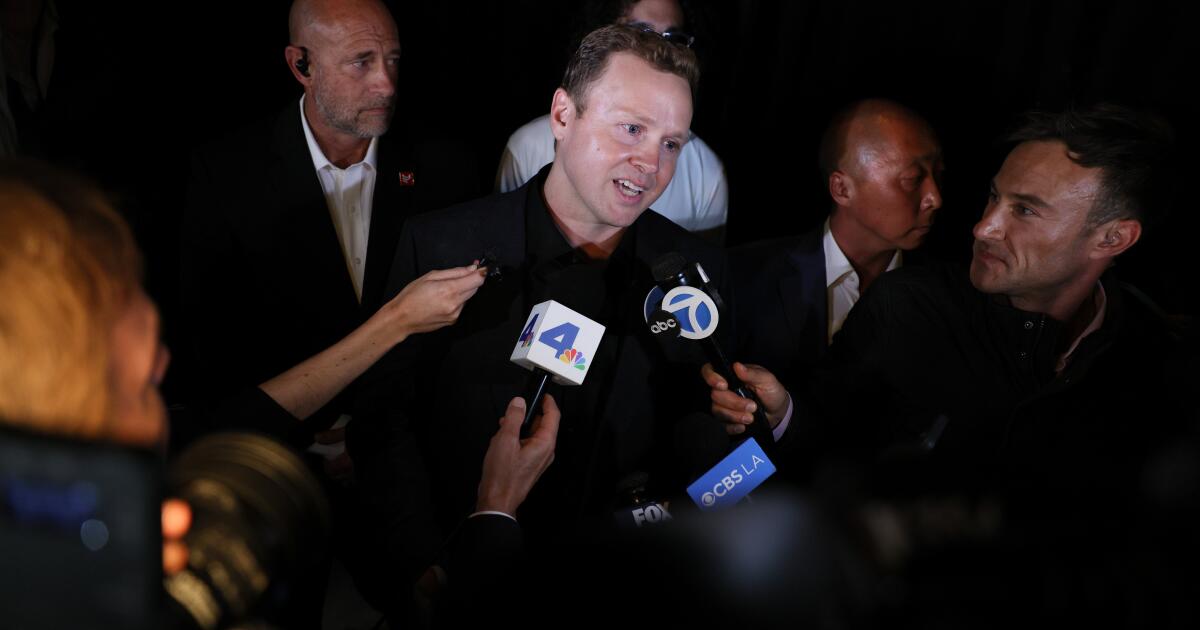
Source link

A second offering to Spencer Pratt, and 5 points about the L.A. mayor’s race

Well, I gave him a chance, offering my services.

I was willing to give the young novice a primer on what a mayor can and can’t do, and let him know City Hall is a reality show like no other he’s been on. But Spencer Pratt didn’t call me in response to my column last week.

I did, however, hear from a slew of his most ardent supporters.

Steven C. had this to say: “You’re a left-wing idiot, and … it’s time for you to retire. You’re a joke!!! You always have been!!! God bless Spencer Pratt and the 45th and 47th President of the United States Donald Trump!!!!!”

You may be onto something, Steven!!! I’ve been thinking about retiring!!!! But then a former reality TV star like Pratt comes along and tells Vanity Fair he had a chat with God, who told him He wants Pratt to be mayor of L.A!!!!! With people like this running for office, how can I retire?!!!!!

R.W. wrote to say: “You say Spencer has never done anything in his life…What credentials do you have? From what I’ve read about you, you are a lousy commie journalist who has never accomplished anything in your life!!”

Just recently, R.W., I replaced a broken toilet tank flush valve and I learned two Willie Nelson songs on the guitar. That’s not nothing.
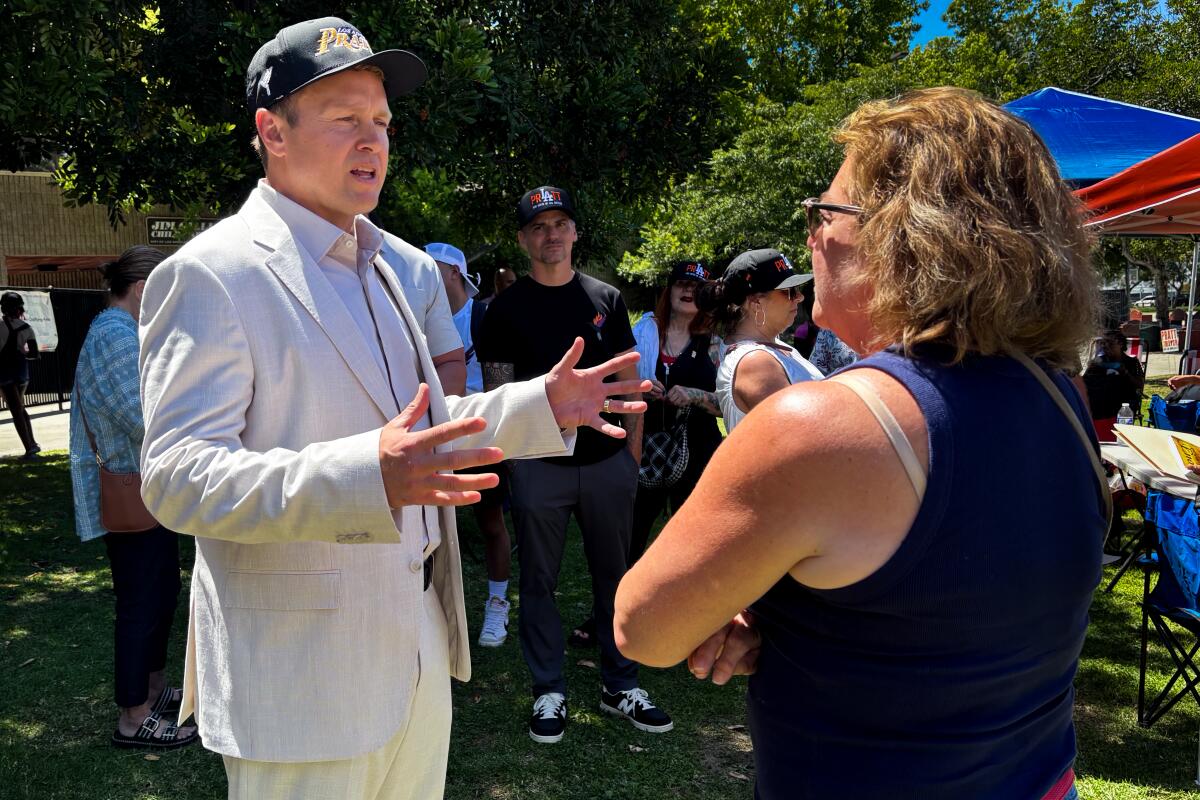
Peter did not mince words: “Your piece on Pratt is a hit piece filled with bull— . You should go f— yourself before someone takes you out, which is the appropriate response to a s—bag like yourself. So please f— off and drop dead, which is exactly what you deserve.”

Peter, I did drop dead once. Cardiac arrest. While on the other side, I saw God, who told me to snap out of it because He was going to tell Spencer Pratt to run for mayor. Who knew God had a defibrillator?

All of these, by the way, were actual emails, and there were many more just like them. But it’s only fair to note that despite the fulminating knucklehead wing of Pratt’s posse, he’s tapped into a justifiable sense of frustration with City Hall, given homelessness, the Palisades inferno and budget issues that squeeze all manner of basic city services.

That’s why Mayor Karen Bass is paddling furiously, trying to keep her political career afloat. In the latest UC Berkeley-L.A. Times poll, Bass is at 26%, Nithya Raman at 25% and Pratt at 22%. That’s so tight, it appears that no one will get the 50% needed to win outright, and if we get a top-two runoff, it’s not clear who will go to the dance.

So as we close out the primary, with the election on Tuesday, five talking points come to mind.

Which candidate knows the city best?

Los Angeles has 114 distinct neighborhoods spread across 470 square miles (that’s 10 times the size of San Francisco), with an estimated 220 languages spoken. Diversity is a defining characteristic, and roughly half the population is Latino, which makes it a shame there’s no Latino candidate for mayor, especially given the raids and roundups by President Trump.

A mayor doesn’t have to speak six languages and know every corner of the city, but residents want to be seen and heard, and feel like they’re understood and represented.

Raman is well-versed on homelessness policy, and she’s spot-on about the need for greater urgency in problem-solving, but as my colleague Noah Goldberg reported, constituents in her district complain that they haven’t seen enough of her.

As I said, Pratt has wisely targeted municipal failure. But in the realm of outsider candidates with Republican credentials, Rick Caruso, who ran against Bass last time, was comfortable whether he was in the Valley, South L.A. or anywhere in between. And he easily connected with people. Would Pratt be a tourist in his own city?

By virtue of her job the last four years, Bass — who raised a blended Black and Latino family — knows the city best, although her unfavorability rating is a big problem.

What about the other candidates?

In the aforementioned poll, minister and housing activist Rae Huang had 9% and former educational technology businessman Adam Miller had 5%. Virtual unknowns, neither had a legit chance of winning, but they could be spoilers for one of the top three candidates.

I spoke to both, and if you’re undecided, you should read up on them before voting. On Huang’s website, the first words are “Homes are for people, not profit.” Miller wants to bring his success in the business world to City Hall, and when you consider his policy agenda along with his nonprofit work with veterans and homelessness, he’s a better candidate than Pratt.

But he wasn’t on a reality TV show.

Democrats ruined L.A. and California, right?

If only I had a nickel for every time a reader suggested that.

By 101 measures, Los Angeles is one of the great cities of the world and California has built the world’s fourth-largest economy while leading on climate change, so apocalyptic diagnoses are a bit off the mark.

Also, local elections are nonpartisan. You don’t run for mayor as a D or an R.

And yet it’s true that Democrats and their policies and sensibilities rule the day, and they have a lot to answer for in Los Angeles and in California.

But would the same critics suggest that in conservative cities like Fresno and Bakersfield, which have their own homelessness and other problems, Republicans are to blame?

When it comes to housing, poverty, healthcare and streets occupied by people who are addicted or mentally ill, the failures go back decades, touch all levels of government, and cross party lines.

Have I given up on Los Angeles?

When I pointed out that Pratt seemed unaware of these complexities, and of the structural limits of mayoral power, readers suggested he was rising to the challenge while I was giving up on L.A.

Not at all. I care about L.A. enough to hold its leaders to a higher accountability, and to scrutinize posers and pretenders who think they can do a better job.

My advice for the next mayor.

Fix what’s broken, celebrate what works and take responsibility for what doesn’t.

Now let me try one more time:

Spencer, give me a call.

You can’t tell us you had a conversation with God about running for mayor and not share more details.

Did God scold you for referring to the mayor as Karen “Basura,” which means trash in Spanish?

Did He say we should pull out of the ‘28 Olympics, or have any advice on how to fill potholes and fix sidewalks?

If you’re having regular conversations about City Hall with the Father, the Son and the Holy Spirit, we’re dying to know:

On homelessness, what would Jesus do?

steve.lopez@latimes.com

Source link

Pratt says Jesus is his role model. His take on homeless people isn’t Christ-like

Spencer Pratt is a showboat, a loudmouth, a troll and a self-proclaimed villain who seems willing to say anything in his quest to be the next mayor of Los Angeles.

Little wonder that his critics rolled their eyes when the former reality television star told CNN host Elex Michaelson a few weeks ago that his campaign role model is Jesus Christ, because “he was a politician.” How on earth did Pratt — a man who tosses insults with the ease of someone spitting loogies — come off boasting that his political hero was the Prince of Peace?

But anyone who ridicules the exchange as a blasphemous moment by a deluded wannabe isn’t paying attention — which is exactly the error that has allowed Pratt to storm L.A. politics. He isn’t running on an explicitly Christian message — that would be risky in a city with large Jewish, Catholic and secular constituencies. But the proud born-again evangelical is channeling the zeal of an old-fashioned tent revival, even if some of his rhetoric falls far outside the bounds of the Good Book.

In his recent memoir, Pratt recounted his conversion — actor Stephen Baldwin baptized him in a river during the 2009 season of the reality show “I’m a Celebrity, Get Me Out of Here.” Before that, his Christianity had consisted of wearing a black diamond cross necklace he described as “thirty grand of Jesus bling” bought from a Beverly Hills boutique. Pratt credits his faith with providing direction at a low moment in his life, as he embraced Jesus with such fervor that a pastor told him to stop joining altar calls so much during church services — once was enough.

“I needed the receipt stamped weekly,” Pratt wrote, “like a parking validation, just to make sure it stuck.”

Seventeen years later, he’s still seeking that affirmation.

The memoir comes off as a millennial version of “The Confessions of St. Augustine” — perhaps the most famous literary example of someone who saw their wreck of a life not as a series of mistakes to apologize for but as necessary failures on the road to grace. That’s why Pratt and his followers don’t see his sketchy past as a disqualifier, but rather his biggest strength. Only someone who says he was reborn in the inferno of the Palisades fire could possess the clarity and willpower needed to bring salvation to an accursed land, they argue.

In another era, Pratt would have been a welcome edition to the roster of bombastic Southern California preachers a la Aimee Semple McPherson, Chuck Smith and Gene Scott, as well as radio titans such as George Putnam and John Kobylt. His claims that only he can deliver us from damnation and that we need to repent of City Hall’s status quo at the ballot box are nothing less than a modern-day gospel to his followers. Pratt feels the pulse of L.A.’s civic malaise far better than Mayor Karen Bass or another of his opponents, City Councilmember Nithya Raman. Like any good pastor, he knows how to distill that discontent into soundbites and stories.

That’s why the self-designated “Pratt Daddy” has cast this moment in L.A. history as a modern-day Armageddon, urging voters to wage war against apostates and usher in a Second Coming, lest the city continue its supposed descent into hell. He admits in his memoir to holding “epiphanies and apocalyptic visions” in equal measure — no wonder he told a Canadian podcaster in March that life for him is a “spiritual battlefield” where “however I can be to stop evil at this point feels like a purpose.”

Spencer Pratt is shown on a television

Spencer Pratt is shown on a television while journalists work during the 2026 Los Angeles mayoral debate at Skirball Cultural Center on May 6.

(Jason Armond / Los Angeles Times)

Far from me to criticize someone’s faith. But I urge Pratt to reacquaint himself with the words of the messiah in whose path he professes to follow. Humility, frugality, turning the other cheek — it’s what Jesus taught and what Pratt has long rejected.

Nowhere does Pratt need more of refresher on Jesus’ lessons than when it comes to homeless people.

Instead of offering compassion or viable initiatives, Pratt consistently calls the unhoused “zombies,” “vagrants,” “drug addicts” and “bums,” with a particular fixation on the naked ones. He vowed to ABC 7 recently that he would push people off L.A.’s streets and onto federal land — like herding stray wildlife. The mayoral hopeful added that “scam homeless nonprofits” exacerbate homelessness, which must have been news to Scripture-based organizations such as the Los Angeles Catholic Worker, Union Rescue Mission and the Salvation Army, which have been trying to help homeless people since before Pratt was born.

Pratt also told ABC 7 reporter Josh Haskell that most of L.A.’s homeless are not locals.

“These people, when I unplug them … they’re all going to Seattle, where the mayor will welcome them,” Pratt proclaimed.

Jesus would not only roll out the welcome mat for homeless people — he would embrace them.

Spencer, what New Testament book says that your crude campaign against the most destitute among us is holy?

Christ never looked down on itinerants, famously saying, “The Son of man hath not where to lay his head.” In the Book of Mark, when Jesus sent his disciples out into the world, he told them to bring no food or money, because good people would take care of them.

“And if any place will not welcome you or listen to you, leave that place and shake the dust off your feet as a testimony against them,” Jesus said.

Christ did do some name calling, but his ire was directed at the powerful, the braggarts, the hypocrites — the Pratts of his time. The Nazarene saved his kindest words for the meek, the poor, the peacemakers — who are sorely lacking in Pratt’s caravan of disaffected liberals, Trumpers and the wealthy. Christ didn’t offer counsel to the comfortable but to outcasts — lepers, prostitutes, people possessed by demons or afflicted with disease — whose modern-day contemporaries live on our streets and whom Pratt World blames for all of L.A.’s ills.

Jesus especially embraced outsiders — the Canaanite woman he initially compared to a dog because she sought help for her daughter, the Samaritan lady at the well, the Roman centurion in the Book of Matthew of whom Jesus proclaimed, “I have not found so great faith” anywhere in Israel. Pratt would have rounded up all of them in donkey carts and dumped them in Babylon, if he had been around back then.

I understand how frustrating it is to see homeless encampments in neighborhoods and to deal with unhoused people who disrupt one’s day, as my wife does at her restaurant in Santa Ana. But whenever annoyance gets the better of me, I remember what Jesus told his followers: “Inasmuch as ye have done it unto one of the least of these my brethren, ye have done it unto me,” warning that he would keep this in mind on Judgment Day.

Those who didn’t take his advice? “Depart from me, ye cursed,” Christ thundered, “into everlasting fire, prepared for the devil and his angels.”

Christianity — and good society — calls for us to look to our better angels, not to demonize others, as Pratt regularly does. He knows this too.

“When the whole world hates you,” Pratt wrote, “it’s comforting to think at least the big guy upstairs has your back, so long as you repent.”

But repentance means admitting you’ve done wrong. Instead, Pratt is doubling down on his anti-homelessness nastiness as more and more people join his crusade.

Let’s see how many Angelenos embrace this false prophet on election day.


Source link

Poll shows Bass, Raman and Pratt in tight race for mayor

Karen Bass, Nithya Raman and Spencer Pratt are locked in a tight battle for Los Angeles mayor, according to a poll released Thursday, with incumbent Bass holding what pollsters called a statistically insignificant lead ahead of Tuesday’s primary.

Bass had 26% support from likely voters, followed by City Councilmember Raman with 25% support, according to the poll by the UC Berkeley Institute of Governmental Studies, which was co-sponsored by The Times.

Pratt, the former reality TV personality making his first bid for elected office, had support from 22% of the likely voters surveyed.

Up until this latest poll, Bass had enjoyed a substantial lead over her challengers, with analysts predicting she would garner enough votes to make a Nov. 3 runoff with either Raman or Pratt. The latest survey suggests any of the three could advance.

“You’ve got three very different candidates, each with very different constituencies, all within the margin of error. It’s going to boil down to turnout,” said Mark DiCamillo, the director of Berkeley IGS polls.

The poll also showed that in a head-to-head runoff between Bass and Raman, the councilmember would lead, 32% to 28%, among the city’s registered voters, but in this scenario, a quarter of likely voters say they would choose neither or would not vote, and 15% were undecided.

The survey of 1,913 registered voters — 1,351 of whom are considered likely voters — is the largest sample of any public poll released in advance of the election. It was conducted between May 19 and 24. The poll has a margin of error of around 3% in either direction.

Just 10% of voters were still undecided, the poll found, down from 26% when the last survey by Berkeley IGS was conducted March 9-15.

Mayoral candidate Spencer Pratt at a campaign block party in South Los Angeles last week.

Mayoral candidate Spencer Pratt at a campaign block party in South Los Angeles last week.

(Robert Gauthier / Los Angeles Times)

Since then, Pratt and Raman have made steady gains while support for Bass has nearly flatlined.

The March poll had Bass with support from 25% of likely voters, followed by Raman with 17% and Pratt with 14%. Since then, Bass has gained just 1 percentage point, while support for Raman and Pratt jumped by 8 percentage points each.

There are 14 candidates running for mayor in Tuesday’s primary and all were listed in the Berkeley IGS poll, but Bass, Raman and Pratt have consistently led in polling. They’ve also raised the most money in campaign contributions. The latest campaign finance reports, filed last week, showed Pratt with $3.26 million in contributions through May 16, followed by Bass with $3.13 million.

Raman reported a total of more than $931,000 through the May 16 filing period, of which $60,000 came in the form of a loan from Raman to her own campaign. She also received the maximum amount of matching funds available in the race, $1.25 million.

Leftist candidate Rae Huang was favored by 9% of the likely voters surveyed, up 1 percentage point from March, while tech entrepreneur Adam Miller dropped from 6% to 5%, despite infusing his campaign with $4 million of his own money after the first poll.

The major issues in the race have included the city’s approach to homelessness, housing affordability and public safety.

Pratt, whose home burned in the Palisades fire, has blamed Bass for failing to prepare for the conflagration and for her postfire response. Raman has criticized Bass’ Inside Safe program for the unhoused, saying its high cost isn’t sustainable.

Bass has deemed Raman an ineffective City Council member who struggles to build alliances on the legislative body, and has said Pratt does not have a clue about how to run a city like Los Angeles.

Although Pratt now appears to have a chance at making the runoff, the poll showed he would face a steeper climb in potential November runoff scenarios with Bass or Raman. Pratt, a Republican who has been labeled “Trumpian” by Raman, is competing in a city where GOP registration is less than 15%.

“Pratt is an unusual candidate and is generating a lot of enthusiasm in the primary, but he trails by double digits to Raman and Bass in a runoff,” DiCamillo said.

In a showdown between Bass and Pratt, the incumbent mayor was ahead, 47% to 29%, among the city’s registered voters, with 12% undecided and 12% choosing neither or saying they would not vote.

Raman also led Pratt in a potential runoff, 45% to 28%, with 16% undecided and 11% choosing neither or saying they would not vote.

Pratt has repeatedly pointed out that the mayor’s race is nonpartisan. Even so, President Trump said last week that he hopes Pratt does well and that he heard Pratt was “a big MAGA person.”

Trump’s unpopularity in Los Angeles could lessen Pratt’s appeal to Democrats, according to a poll by Cygnal, a national polling group that has worked for Republican candidates.

Los Angeles mayoral candidate Nithya Raman walks down Olvera Street

Los Angeles mayoral candidate Nithya Raman walks down Olvera Street alongside Olvera Street business owners on May 19 in Los Angeles.

(Ronaldo Bolaños / Los Angeles Times)

There’s been just one debate featuring all three of the leading candidates, during which Raman asserted that Bass and Pratt were working to ensure that she would be knocked out in the primary, which Bass and Pratt disputed.

The debate was followed by a huge influx of campaign contributions to Pratt, who also was polling in second in an Emerson College poll earlier this month.

Raman’s strong showing in Thursday’s poll shows she is very much in the race despite assertions by Bass’ campaign and Pratt’s campaign that she is faltering after a lackluster debate performance.

The poll shows Bass and Pratt with high unfavorability ratings. Bass was considered unfavorably by 57% of likely voters, up 1 percentage point from the March survey. Pratt’s unfavorable rating in the current poll was also 57% — up dramatically from the 28% unfavorable rating in the previous poll, although in that poll, 55% of likely voters had no opinion of him.

In the May poll, Pratt was rated favorably by 25% of likely voters, and Bass by 35%.

The poll found that 40% of likely voters rated Raman favorably, with 35% viewing her unfavorably.

Source link