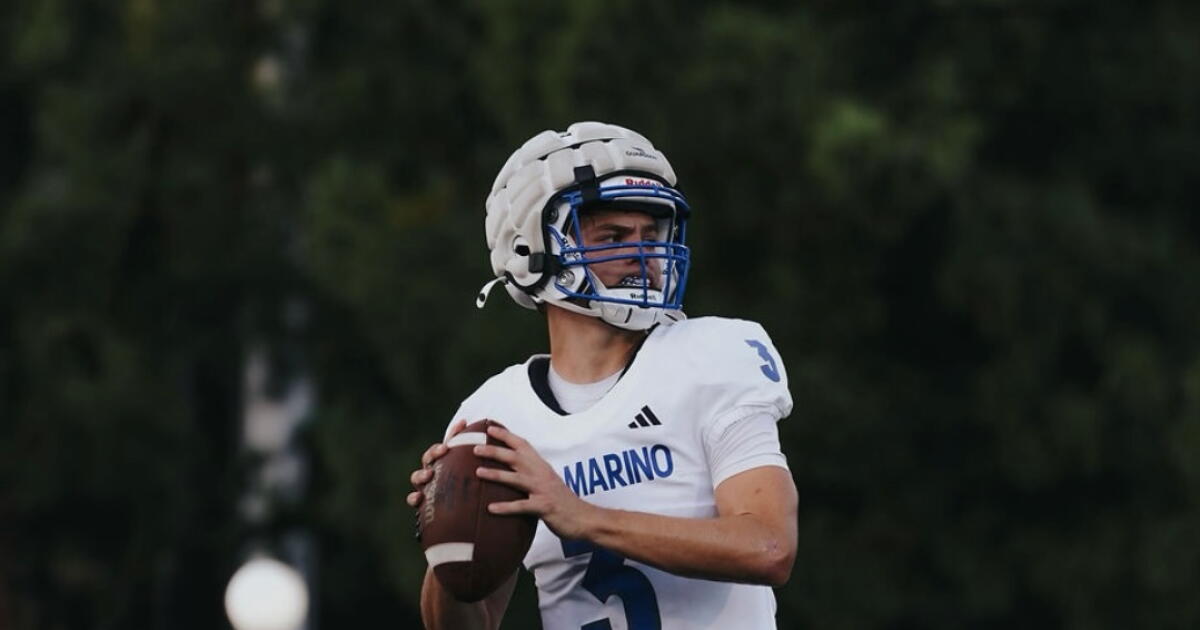
practice

Newsom signs bill banning tee-time brokers at public golf courses

Gov. Gavin Newsom has signed a bill that prohibits third-party brokers from advertising, selling or transferring tee-time reservations at publicly owned golf courses without the written consent of the course operator.

The state legislation is a response to a network of brokers that had sprouted up around Los Angeles municipal golf course tee times.

These brokers, many of whom were in the Korean community, would gobble up tee times, then advertise them on social media, particularly the Korean app KakaoTalk. They charged up to $40 as a booking fee.

Getting tee-time reservations at L.A. municipal golf courses had long been difficult. But after golf influencer Dave Fink revealed evidence of the broker network to his viewers, the problem became public.

“This is an issue that affects everybody who pays taxes in the city, and anybody who plays golf as well, so I just felt like it was my duty to say something,” Fink said in an interview with The Times in March 2024.

After Fink’s videos went viral, the L.A. Department of Recreation and Parks announced an investigation into the practice.

The state has more than 200 municipally owned golf courses, according to Assemblymember Christopher M. Ward (D-San Diego), who authored the bill.

“Public golf courses belong to the public, and residents shouldn’t have to compete with brokers buying up tee times just to turn around and sell them at inflated prices,” he said in a statement Sunday.

The legislation “puts an end,” he said, “to this unfair practice and helps ensure local residents, seniors, students and families can continue accessing the public courses their communities support.”

Source link

ICE hides locations of thousands of detainees with final removal orders

U.S. Immigration and Customs Enforcement has stopped publicly revealing where it is holding thousands of detainees who are subject to final deportation orders, an unannounced move that has made it far more difficult for lawyers and relatives to find them, according to current and former officials familiar with the practice.

ICE removed those detainees from its online detainee locator system on Sept. 15, according to three current and former ICE officials who spoke on condition of anonymity because they were not authorized to discuss the change. Several lawyers contacted by The Associated Press confirmed their clients vanished from the system this week, and the American Immigration Lawyers Association warned its members about the situation Friday.

The move represents a stark departure from previous practice and highlights the hardline nature of President Trump’s immigration crackdown, leaving thousands of detainees exceedingly hard to trace and potentially unable to exercise all of their legal options.

The practice, which applies to detainees who have received final orders of removal from an immigration court, could speed deportations by making last-minute legal challenges harder to pursue, immigration lawyers said. Nearly 16,000 people who were arrested and booked into ICE detention in July were subject to final removal orders, more than a third of the overall bookings, according to ICE data obtained by the Deportation Data Project based at U.C. Berkeley and UCLA.

The practice does not apply to detainees held at a detention facility in Adelanto, California or at temporary holding facilities in Minneapolis, New York City or suburban Chicago, the sources said. Judges have ordered ICE to list detainees in those facilities in the online locator promptly upon their arrival, as part of litigation over their detention practices.

Lawyers and relatives distressed by lack of information on detainees

The effort to hide their locations adds to the ways in which the Trump administration has made life harder for detainees and their families as it has increased pressure on them to waive appeals and agree to deportation.

ICE did not publicize the move and in a statement issued to the AP, the agency did not confirm or deny it. The statement said detainees with final removal orders were being prioritized for deportation, even as ICE faces a “historic number of injunctions” from courts stopping individual removals.

As a result of the change, lawyers and relatives lost track of their clients and loved ones without explanation, which is especially concerning because detainees are frequently moved to new facilities before deportation, said Greg Chen, senior director of government relations at the American Immigration Lawyers Association.

“Families are freaking out because they think the person has been deported and they don’t know where the person might be,” he said. “On the attorney side, this has serious implications for the ability to contact their client. It certainly has implications about how it will interfere with the attorney-client relationship.”

The Department of Homeland Security, ICE’s parent agency, has argued that people who are subject to final removal orders have received due process. That usually means an immigration judge has ordered their removal after a hearing, including cases when immigrants fail to show up, and the decision was affirmed on appeal or not appealed.

Detainees with final removal orders still have options to appeal

Still, those detainees have options to challenge their detention and removal, including seeking to reopen the case or by bringing what’s known as a habeas petition asking a judge to release them on constitutional grounds. Federal judges have granted thousands of rulings ordering that detainees be released or granted bond hearings.

ICE detention facilities held more than 65,000 people as of early July, the most recent available data. Around 30% of them likely have final removal orders, said Michelle Mendez, legal director at the National Immigration Project.

More people have been issued final removal orders after failing to show up for hearings in recent months because the administration’s immigration courts have taken steps to make it harder to participate and to reopen such cases, she said.

“To me, it’s just another iteration of disappearing people,” she said. “Why would we do that in the United States of America? It’s something we’d hear about in another country and be concerned about individual rights and due process.”

Some with final removal orders also have legal protections against deportation to their countries of origin based on the likelihood they would be tortured or persecuted. Many of them are facing removal to third-party countries where they have no ties and their disappearance in ICE’s system will make legal challenges harder, lawyers said.

Lawyers say clients have vanished from ICE locator system

ICE initiated the online detainee locator system in 2010 to allow relatives, lawyers and the public to search for people in custody. Previously they had to call ICE regional offices or individual facilities to try to track them down.

Many advocates and lawmakers have complained that the system updates too slowly and contains too much inaccurate or missing information, allowing ICE to shield the locations of detainees for days or weeks. Minors, people who have been held by U.S. Customs and Border Protection for less than 48 hours, and detainees who are being transported are not in the system, among others.

But the exclusion of detainees with final removal orders has no apparent parallel, several immigration lawyers said. Atenas Burrola Estrada, a deputy program director with the Amica Center for Immigrant Rights, said that “every single one of our clients who has a final order has disappeared from the locator,” including 17 in all as of Monday.

Among those disappeared from the locator system are eight Somali men being detained at the U.S. military base in Guantanamo Bay, Cuba, according to one of their attorneys, My Khanh Ngo, of the American Civil Liberties Union. She said the change could make it “nearly impossible” for people to challenge their removals in some cases.

“If you can’t find your client, don’t know what’s happening to your client, you can’t get that information to the court to stop their removal,” she said.

Foley writes for the Associated Press.

Source link

Sean McVay hopes Rams will never have to play in Australia again

The Rams will be without edge rusher Myles Garrett for at least the next four games.

Will they have Aaron Donald for Monday night’s game against the New York Giants?

“We’ll see how this week goes,” coach Sean McVay said Thursday before practice.

The Rams are coming off an embarrassing 27-7 defeat by the San Francisco 49ers in Melbourne, Australia.

Garrett, who failed to record a tackle or a quarterback hit in the defeat, had surgery on his left knee Monday. He will not play against the Giants, Denver Broncos, Philadelphia Eagles and Buffalo Bills.

McVay noted that Garrett was on crutches Wednesday but walking without them Thursday.

“He’s like Wolverine, healing fast,” McVay quipped, adding that Garrett would not be rushed back.

Donald, 35, ended a two-year retirement when he rejoined the Rams late last month. He did not travel to Australia.

Asked what benchmarks Donald would have to hit before returning, McVay said it was up to how Donald felt after getting more 11-on-11 reps during practice.

“There just hasn’t been a whole lot of opportunities for different reasons … based on the schedule that we’ve had,” McVay said. “But we are hopeful … that he’ll have some good work [Thursday], tomorrow and then hopefully he’s feeling good enough.

“And if he says he’s ready to go, then we’ll be excited to see him rock.”

McVay said the Rams have moved forward from the loss to the 49ers.

“It’s almost like you try and do the ‘Men in Black’ thing,” McVay said, referencing the movie franchise, “where you say all right, ‘hey I don’t remember what happened.’ That was so long ago. We’re not playing in Australia ever again, I hope. Not because it wasn’t a great atmosphere. That will get taken out of context.”


Source link

Family of ASU hockey player Matthew Mayich is ‘praying for a miracle’

Arizona State hockey player Matthew Mayich remains incapacitated more than two weeks after he collapsed during an outdoor team practice in Tempe.

“Matthew’s injuries [are] from exertional heat stroke that caused the lack of oxygen to his brain,” the family’s attorney, Robert Carey, told The Times on Thursday. “There were no other contributing conditions, only exertion-related heat. This is not a coma, and the family is at his bedside praying for a miracle.”

While the family has not given up on the 21-year-old former draft pick of the St. Louis Blues, Carey said the prognosis they have received is not good.

“He’s been incapacitated from the moment he left the field, and with no chance of recovering,” said Carey, who added that he is limited on what he has been authorized to discuss concerning Mayich’s condition.

He added that the family is “just giving him a chance to have a miracle. And when they decide that’s not coming — I don’t know. They’re in a position no parent should ever be in.”

Mayich was selected by the Blues in the sixth round of the 2023 draft but never signed with the team. He played four seasons in the Ontario Hockey League and one at Clarkson University last season before transferring to Arizona State.

Arizona State and its police department referred questions from The Times to a recent statement from the university. In its statement, the university did not mention Mayich by name because of “privacy interests” but talked about an ASU hockey player “who collapsed during an outdoor workout on Aug. 20” and “remains hospitalized.”

Arizona State said that the workout was a team event at which coaches and training staff were present, “along with a third party who had previously worked with the ASU Hockey team.”

The university stressed that it has policies regarding the engagement of “outside entities who interact with ASU student-athletes” and heat-illness guidelines for outdoor workouts. It added that James Rund, senior vice president for educational outreach and student services, would lead a review into the “circumstances surrounding the workout and related university policies, procedures and training protocols.”

“The review will take the time needed to collect and assess information in a manner that is thoughtful, respectful of the student-athlete, his family, his teammates and ASU’s privacy obligations,” the statement says.

The practice took place on a field outside the team’s on-campus arena. According to the university’s statement, the campus police department responded to a 911 call at approximately 8:30 a.m. “and began investigating as they would anytime they are called to a serious incident.”

The temperature at around that time in Tempe that morning was in the upper 80s.

Carey said that from talking to people who were present at the practice and relying on “other objective evidence,” he has determined that it was a military-style practice that ran “nonstop for well over an hour. And there was no rest, and there was almost no water.”

“Matthew was struggling,” Carey said, based on the information he has gathered. “He was disoriented, confused, dizzy, well before he collapsed. … Matthew was demonstrating signs of a problem well before he collapsed, and they did nothing.”

After Mayich’s collapse, Carey said, the staff was “completely and utterly unprepared” to treat him.

“So when he left the field that day, by the time he got to the hospital, there was almost zero chance of recovery,” Carey said.

Carey, who was chief deputy attorney general of Arizona during the 1990s, said he has been retained as the family’s counsel to help guide them through the situation, but no decision about any kind of legal action has been made at this point.

“They’re not going to make any decisions, and I’m not going to make any recommendations, until we get an investigation completed that’s transparent and robust and competent,” Carey said. “We need to know what happened before we can say you have rights or here’s a way to fix things for other kids down the road. …

“We just need to see what the evidence is. That’s our main goal right now, let’s go get the evidence and figure out what happened.”

He added that the family wanted him to express their gratitude for the outpouring of support they’ve gotten during this time.

“They’re from Canada and they’re in Arizona, where they had no connection really, and they’re sitting in a hospital every day,” Carey said, “and they’re just very appreciative of the support they’ve received across the country to help them.”

The Associated Press contributed to this article.

Source link

Italian Grand Prix: George Russell leads Charles Leclerc in Friday practice at Monza

Antonelli’s penalty is caused by using too many engine components this season after reliability problems earlier in the year. Russell will take one at a subsequent race, most likely the Azerbaijan Grand Prix later this month.

Mercedes have chosen this race because they hope the long straights will give him a decent chance of recovering a strong result.

And the Italian, who leads Hamilton and Russell in the championship by 59 points, was the quickest on the race-simulation runs towards the end of the session.

The race runs were inconclusive as Mercedes used the hard compound tyres, Ferrari the softs and Verstappen the mediums.

Antonelli was more than 0.2secs quicker than Russell on average. Norris, also on the hard tyre, was just under 0.2secs slower than Russell.

Meanwhile, F1 has announced that it will host a three-day event for fans before next season in Milan on 18-20 February.

A successor to the F1 Live event in London’s O2 Arena in 2025, it will feature all 11 teams and their drivers as well as music and entertainment.

Source link