Record-setting outside money pouring into California governor’s race
Corporations, labor unions, tech titans, Native American tribes and other special interests have donated a record-shattering $79.6 million to independent committees focused on swaying the volatile California governor’s race ahead of the June 2 primary.
Many of the largest backers to these committees will have significant business interests in front of the state’s next governor and state agencies, with hopes of either strengthening a candidate aligned with their political priorities or undercutting those who oppose them.
“This is the first time I’ve ever seen IEs [or independent expenditures] have this kind of an impact on a governor’s race,” said veteran GOP strategist Martin Wilson, who has worked on every California gubernatorial contest since 1978 and worked on an outside effort backing San José Mayor Matt Mahan’s 2026 bid for governor. “It’s totally unprecedented.”
Election laws bar independent expenditure committees from communicating or coordinating with campaigns, allowing candidates to emphasize that they have no control over the money that pours into these outside groups. The wall between the two has long been viewed as performative and penetrable.
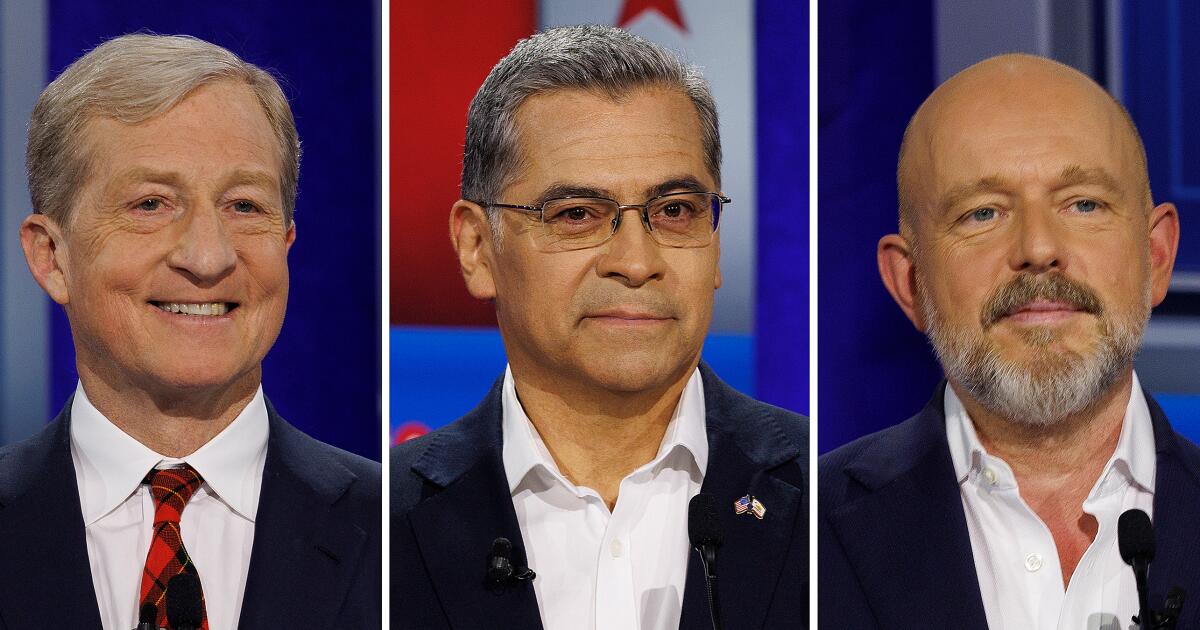
The greatest amount of outside spending has been directed at attacking billionaire hedge fund founder turned environmental warrior Tom Steyer, a leading Democrat in the race.
Nearly $32.3 million had been donated to opposing his candidacy as of Monday, according to the California Target Book, a nonpartisan political almanac, which tracks independent expenditure committees. Among the major donors are utility giant PG&E, a political action committee sponsored by the California Chamber of Commerce and the California Assn. of Realtors’ independent expenditure committee, which combined have utility, business, property tax and building issues affected by lawmakers and regulators in the state capital.
Independent expenditures supporting Steyer’s bid for governor have been minimal compared with the record-breaking $212 million Steyer has donated to his own campaign as of Monday, according to the California secretary of state’s office. Still, more than $1.4 million of outside money has been spent supporting his bid, largely by the California Nurses Assn., which shares his goal of creating single-payer healthcare.
Expenditure committees linked to Uber, the California Medical Assn., the kidney dialysis company DaVita and the California Dental Assn. contributed nearly $7.3 million to independent efforts backing former Rep. Eric Swalwell (D-Dublin) before he dropped out of the gubernatorial race in April because of sexual assault and misconduct allegations.
Several of those donors then coalesced behind former Biden Cabinet member Xavier Becerra, who was struggling to connect with California voters before he surged to become a front-runner, recent opininon polls show. More than $13 million has been contributed to outside groups backing the former U.S. Health and Human Services secretary.
The outside money has led to flashpoints in the race. Steyer points to corporations backing Becerra, such as a $500,000 Chevron donation to a group supporting him that was reported to state election officials on Thursday.
“The Becerra campaign was running out of gas until the latest half-million dollar influx from Chevron,” said Steyer spokesman Anthony York.
The message echoes a Steyer theme on the campaign trail — that candidates ought to be judged by who is supporting them and who is opposing them.
Becerra accused Steyer of misleading voters because the $500,000 from Chevron went to an independent expenditure committee supporting him that he has no control over. However, Becerra did receive a direct $39,200 contribution from the oil company to his campaign committee in June 2025.
“For him to say that I took the [$500,000] … that’s just an outright lie,” he said in a television interview this weekend. “It pains me to see that candidates for office believe that they have to descend to telling lies in order to gain favor with voters. If that’s what you do as a candidate, what will you do when you’re in the office?”
Steyer’s campaign, which used the Memorial Day weekend to attack Becerra with billboards highlighting high gas prices in Los Angeles and Fresno, said it was disingenuous for Becerra to feign ignorance of how the political system works.
“Chevron is charging Californians record gas prices on one hand and turning right around to spend $500,000 to elect Xavier Becerra with the other,” said Steyer spokesperson Danni Wang. “Now Becerra is playing semantic gymnastics trying to pretend voters are too stupid to understand how dark money in politics works. Californians aren’t buying it.”
Becerra’s campaign argued that such comments are the height of hypocrisy coming from a billionaire whose campaign is funded by his profits from a hedge fund that made investments that are opposed by many voters. Becerra said he continually took on oil companies when he served as California’s attorney general.
“Tom Steyer made his billions off fossil fuels and private prisons, then decided that qualified him to run California,” said Becerra spokesman Jonathan Underland. “He’s now attacking the only candidate in this race who actually held Big Oil’s feet to the fire and beat [President] Trump 100 times as [state attorney general]. The irony would be funny if Tom’s checkbook weren’t so thick.”
Mahan, a moderate Democrat, has benefited from $21.7 million in spending by outside groups backing him, while $570,000 has been spent by independent committees opposing him, according to the Target Book. The donors who supported his bid are a who’s who of Silicon Valley, including venture capitalists Michael Moritz and L. John Doerr, Stripe Chief Executive Patrick Collinson and Sun Microsystems co-founder Vinod Khosla. Other notable donors include billionaire real estate developer Rick Caruso, who unsuccessfully ran for Los Angeles mayor in 2022, as well as Griff Harsh V, the son of billionaire Meg Whitman, the unsuccessful 2010 GOP gubernatorial nominee turned Democrat who once led EBay.
Despite that generous support, Mahan remains mired in the single digits in the polls. On Wednesday, billionaire Netflix co-founder Reed Hastings received a refund of $1 million he had donated to one of the independent expenditure committees supporting Mahan’s bid.
Hastings said he had not requested the money to be returned to him.
“I’m voting for Matt Mahan. I didn’t ask for any refund and they shouldn’t have done it,” he posted on X on Saturday. “Go Matt.”
Matt Rodriguez, a spokesman for the Back to Basics committee backing Mahan, said that he believes Mahan’s standing in the race is a reflection of a number of factors — an underwhelming contest as well as Mahan’s January entry into it and the fact that he was not well known statewide.
“He got in a little bit late and it was a big climb … with an apathetic electorate,” Rodriguez said. “Politics is all about money and timing — both the amount of time and being there at the right time.”
Mahan’s priorities, such as housing and homelessness improvements he oversaw in San José, had an impact on the campaign, the Democratic strategist said.
“Democrats have to perform, and if we are going to perform, we have to have results,” he said.
The only other candidate who saw seven figures in independent expenditure spending was Republican Steve Hilton, a former Fox News commentator who has been endorsed by Trump and is the leading GOP candidate in the race. More than $1.8 million has been spent opposing Hilton and $13,750 was spent supporting him.
SEIU California donated $250,000 to opposing gubernatorial candidates. Oscar Lopez, the union’s political director, said it has opposed Hilton, Mahan and Republican Riverside County Sheriff Chad Bianco.
“Each of these candidates represents a serious threat to the wages, rights and dignity of California’s working people,” Lopez said.
Hilton said the spending against him represents Democratic recognition of him as a threat.
“They know that they’re vulnerable. The Democratic machine understands they’ve got weak candidates and a terrible record,” he said in an interview. “They see me as outsider and change agent. The only argument they have — if you can call it an argument — is to endlessly repeat the words Trump and MAGA.”
Outside spending has grown exponentially after a voter-approved 2000 California ballot measure limited how much donors can contribute directly to candidates. For the current election, it’s $78,400 for the primary and the general election in the governor’s race.
But donors can contribute unlimited amounts to outside groups, which are formally called independent expenditure committees. Though such donations were already legal in California, they greatly increased in the state and across the nation after the U.S. Supreme Court’s 2010 Citizens United decision that said limits on independent political spending by corporations, unions and other entities violated 1st Amendment free speech protections.
“It has been a steady increase in the amount of money going to outside groups,” said Rick Hasen, a professor of law and political science at UCLA.
In California, independent expenditure groups set a record in 2010 when they spent about $25 million supporting then-gubernatorial candidate Jerry Brown. Largely union money, it was spent in the summer after the primary and was viewed as critical to stalling self-funding Republican billionaire Meg Whitman’s campaign. Brown ultimately won the race by 13 percentage points.
In the 2018 gubernatorial primary, records were once again broken by more than $26 million of outside spending, with former Los Angeles Mayor Antonio Villaraigosa being the biggest beneficiary. Charter school backers spent nearly $16 million on unsuccessful efforts to boost his campaign.
In addition to an enormous financial advantage over campaign committees, outside groups have the ability to trumpet highly provocative adversarial attacks without the candidate they support being blamed for the often controversial messaging.
“IEs are as free to go as negative as they want without that negativity boomeranging back to hurt the candidate,” said Thad Kousser, a political science professor at UC San Diego.
While communication between candidate campaigns and independent committees is forbidden, these rules are commonly circumvented using legal but obvious methods. One called “red boxing,” which Becerra employed earlier this year, literally puts messages inside red-lined boxes on candidate websites that their campaign strategists would like to see outside groups highlight.
“There are technical rules that prevent certain types of communication, but it’s easy enough to communicate in public and be on the same page on messaging,” Hasen said.
Among the major donors in the 2026 campaign are the California Chamber of Commerce, PG&E, the California Assn. of Realtors, the Laborers Pacific Southwest Regional Organizing Coalition PAC, the Pechanga Band of Indians, the California Nurses Assn., and corporations and leaders or founders of companies such as Meta, Google and Uber.
Californians for the People, an outside committee that has spent nearly $32.3 million opposing Steyer, is the most well-funded independent expenditure committee this year. Among it’s largest donors is JOBSPAC, a group sponsored by the California Chamber of Commerce, that has donated nearly $11.8 million to the effort.
“CalChamber is participating in an independent expenditure campaign because voters deserve to know more about Mr. Steyer,” said John Myers, a spokesman for the chamber. “His policy promises will cost billions, driving investment out of California and worsening the state’s affordability crisis.”
The Pechanga Band of Indians has spent $1.5 million on pro-Becerra efforts.
“Secretary Becerra has stood with Indian Country for decades and understands Tribal sovereignty,” said Pechanga Chairman Mark Macarro. “When tribal healthcare was on the line, he was there. This experience comes from a lifetime of public service, not a checkbook.”