In the second week of the college football season, in a clash of titans, the University of Texas scored 21 unanswered points to surge past Ohio State in the fourth quarter and win, 24-23.
The comeback, Gov. Greg Abbott decreed, was the greatest home victory in more than 130 years of Longhorn football.
A screen grab of one celebratory moment showed a group of students ecstatic beyond belief. They were clad in the university’s signature burnt orange. Two wore cowboy hats. One flashed “Hook ‘em Horns,” the university’s proud hand signal.
To see the picture earlier this month was to witness pure, untempered joy.
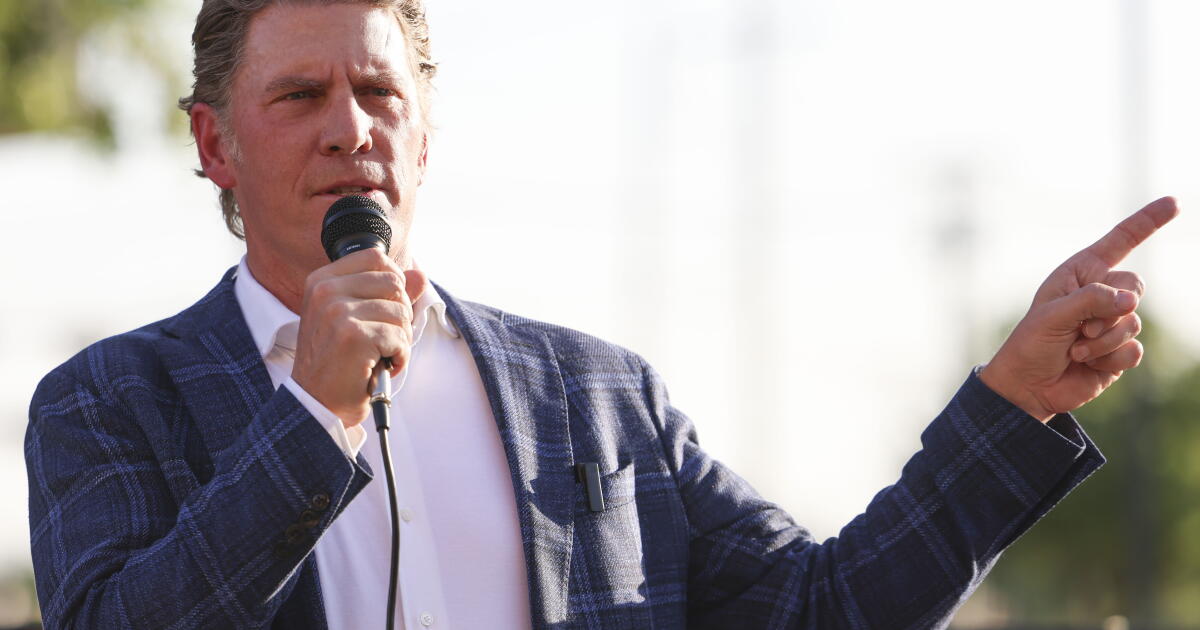
But Bo French, the Republican candidate for Texas Railroad Commission, saw something different.
Most of the students were darkly complected and apparently of South Asian heritage. French posted the photo and wrote on X, “I heard UT graduation this year looked like this. I didn’t believe it. The problem is now obviously far worse than anyone imagined.”
He followed with a second post, doubling down on the racist “Great Replacement” theory.
“Like body-cams exposed criminals, social media is exposing how many Americans have been displaced by foreigners,” French spewed. “It’s everywhere and far worse than any of us could imagine.”
In many places, French’s unapologetic, unvarnished bigotry would be disqualifying. But given Texas’ strong Republican leaning he stands a better-than-even chance of being elected in November to the state Railroad Commission, which, despite its name, oversees Texas’ vast oil and gas industry.
The hateful gibe was perfectly in character. “In some ways in Texas this is old news,” said Brandon Rottinghaus, who teaches political science at the University of Houston.
Last year, as chairman of the Tarrant County GOP, French posted an online poll asking, “Who is a bigger threat to America?” The choice on offer: Muslims or Jews.
Speaking in March at a political conference, he urged President Trump to round up and deport every Muslim in the country, calling the Islamic faith subversive and a clear and present danger to America.
“The Republican Party is used to Bo French making these kinds of outrageous statements,” Rottinghaus said.
Still, the response to French’s latest acrid emission was telling, not least for what it says about reflexive partisanship and today’s political reward structure.
As you’d expect, his Democratic opponent, state Rep. Jon Rosenthal, was scathing. “I spent 25 years as an oil and gas engineer,” he wrote on social media. “Bo French spent Sunday morning sorting our student section by skin color … A man who can’t tell a Longhorn from a foreigner has no business regulating anything in TX.”
The state’s outgoing U.S. senator, Republican John Cornyn, was also quick to denounce French. “This is the Republican nominee for statewide office,” Cornyn said in a post. “Are other Republican elected officials going to condemn the intolerance and racism, or look the other way while it becomes normalized.”
For Abbott and for Ken Paxton, who beat Cornyn in an eye-gouging, rabbit-punching Republican Senate primary, the answer was, for all intents, the latter.
“That is not my message,” Abbott said in a written statement, summoning the moral clarity and political courage of a puff pastry. “We all support our college football teams. The way we win the state is the same way we win football games. We unite under the brand of Texas.”
Then, just to have it both ways, Abbott suggested “that doesn’t mean that Texas cannot also lead in having the toughest immigration laws of any state in America and freezing H1B visas at our universities.” (The overwhelming majority of those holding H1B visas are Asian nationals from India and China.)
Paxton responded by attacking his Democratic opponent, state Rep. James Talarico, for saluting Cornyn for taking a stand against French’s prejudice. “I condemn racism in all its forms,” Paxton wrote on X, adding, “Only one person in this race has a history of dividing Texans by race, and it’s James Talarico.”
A simple, straightforward condemnation shouldn’t have been hard. Lacey Hull, a Republican state representative from Houston, was among those in the GOP who showed how.
“Please delete this,” she urged French on X. “This post breaks my heart. I see college kids cheering on their football team. I see Texans.”
But Abbott, bidding for an unprecedented fourth term, is facing a tougher than expected race against Democratic state Rep. Gina Hinojosa.
Paxton, whose unsavory resume includes impeachment, indictment, petty theft and charges of adultery, has managed the rare feat of turning his race against Talarico into a nail-biter. (It’s been more than three decades since a Democrat won statewide office in Texas.)
Both need a robust GOP turnout to win in November and neither wants to risk alienating too many within the party’s xenophobic, anti-immigrant wing.
“They’re concerned about turnout,” said Mark Jones, a political scientist at Rice University. “Texas is a red state, but one thing that Republicans are concerned about is that the base may not turn out in as large a number as they need.”
Given French’s loathsome history, Abbott and others in the party establishment worked hard to keep him from winning the Republican nomination, Rice noted. But not Paxton. He headlined the kickoff to French’s campaign and has good reason to be glad he won and is now part of the GOP ticket.
His presence means that Paxton is only the second most odious figure seeking statewide office in Texas in November.