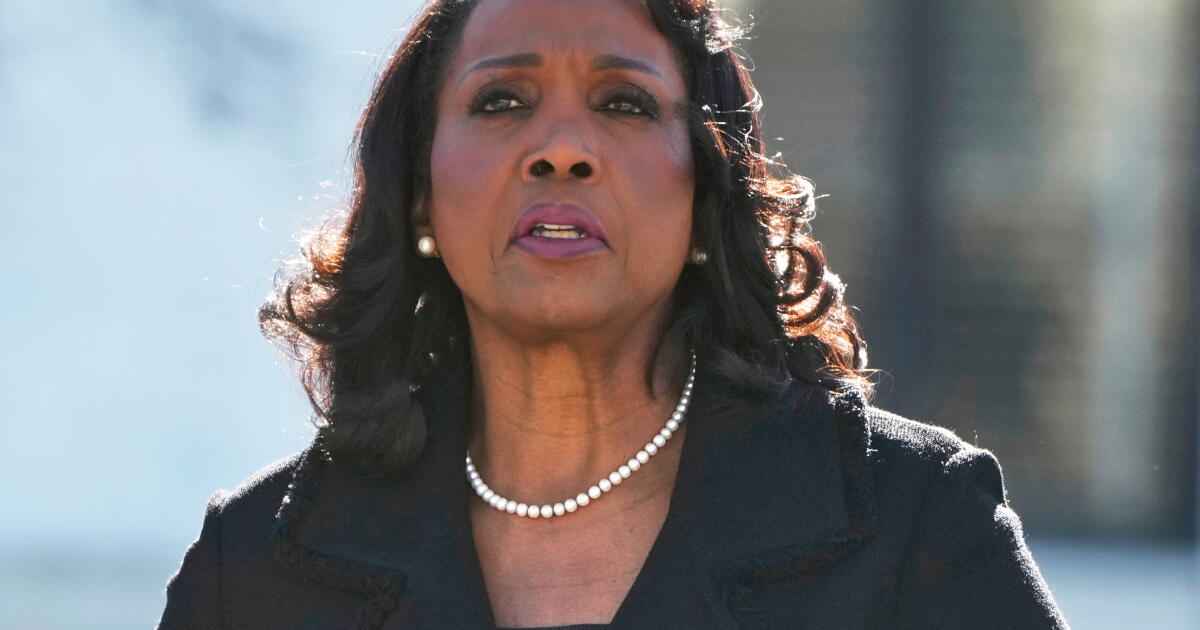
WASHINGTON — Cameron Hamilton, President Trump’s nominee to lead the Federal Emergency Management Agency, pledged to senators Wednesday to be “fair and reasonable” in assessing requests for disaster aid as he seeks to run an agency roiled by the administration’s threats to dismantle it.
Hamilton appeared before the Senate Committee on Homeland Security and Governmental Affairs at a hearing where lawmakers assessed a group of 10 nominees for administration posts.
“My focus will be to ensure that FEMA is objective, is fair and reasonable, follows the law, and is consistent” in how it reviews disaster declaration requests, Hamilton told Michigan Sen. Gary Peters, the top Democrat on the committee. Peters had asked about partisanship in granting major disaster declarations.
Hamilton had a brief tenure as FEMA’s temporary leader early last year but was ousted after defending the agency’s existence. At a House hearing in May 2025, he said he did not “believe it is in the best interest of the American people to eliminate” FEMA. He was fired the next day.
His nomination comes as the Republican administration has increasingly signaled it is backing away from promises to dismantle an agency that the president has heavily criticized.
If confirmed, he would be FEMA’s first permanent administrator in Trump’s second term. He will need to lead FEMA through what is expected to be a busy summer disaster season, while answering to Trump, who is likely to expect major changes after a council he appointed recommended sweeping moves at the agency that is part of the Department of Homeland Security.
Hamilton distanced himself from some FEMA controversies
Nominees did not give opening statements, but Hamilton received the bulk of lawmakers’ questions while appearing with four others in the first half of the hearing.
His answers suggested a departure from some of the more aggressive policies considered and enacted during Kristi Noem’s turbulent leadership at DHS. FEMA’s workforce has been worn down by mass staff departures, policies that hamstrung operations and a protracted DHS shutdown.
Hamilton expressed faith in the FEMA staff and praised the recent opening of 350 positions to counteract some of the cuts. He said that if confirmed by the Senate, he would do what he could to speed up disaster declaration decisions and reimbursements to states, tribes and territories.
“We owe you answers, I think, much faster,” he told Sen. Josh Hawley (R-Mo), adding that many FEMA processes needed to be simplified.
Hamilton disavowed a recommendation he included in an April 2025 memo to quadruple the threshold of financial damages a state needed to prove to receive FEMA public assistance. He also noted the importance of resilience funding, despite halting billions in resilience grants during his previous tenure.
Republican and Democratic senators at the hearing expressed support for FEMA’s mission, despite Trump’s early threats to eliminate it. “I think what your agency does is hugely important,” Hawley told Hamilton.
But multiple Democrats echoed Peters’ concern that Trump was approving far more disaster declaration requests from Republican states than Democratic ones.
Of the state disaster declaration requests Trump answered through the end of May, he approved about 82% from states that voted for him in the last election and 44% from states that voted for Democrat Kamala Harris, according to an analysis of public FEMA data by Andrew Rumbach, senior fellow at the nonpartisan think tank Urban Institute.
Hamilton, a former Navy SEAL, has never worked as a state or local emergency manager and has publicly criticized FEMA in the past. He has held positions at DHS and the State Department related to emergency response.
No senator questioned Hamilton’s suitability for the position.
Federal law requires the FEMA administrator to have “a demonstrated ability in and knowledge of emergency management and homeland security” and at least five years of “executive leadership and management experience.”
Criticism over hearing format
Peters criticized the committee chairman, Sen. Rand Paul (R-Ky.), for scheduling so many nominees at once, saying that made it more difficult for senators to properly screen them.
“The lineup today severely limits our ability to have transparency for the American public,” Peters said. He noted that Hamilton was among two nominees whose FBI background investigations were not yet complete, and that two others had not submitted their financial disclosure reports.
Others who appeared included Trump’s pick for deputy director of the Office of Management and Budget, Hal Duncan, and administrator of the Transportation Security Administration, David Cummins.
Paul said the committee would only vote on the nominees when their financial and background checks were complete.
A former top officer of the Los Angeles Fire Department’s labor union was arrested Wednesday and charged with grand theft and forgery for allegedly stealing more than $82,000 from a charity for injured firefighters.
Prosecutors from the state attorney general’s office announced the charges against Adam Walker, former secretary of the United Firefighters of Los Angeles City, at a news conference.
Walker “abused a position of trust for personal gain,” Atty. Gen. Rob Bonta said alongside Los Angeles County Dist. Atty. Nathan Hochman.
Walker opened a foundation bank account and transferred funds to his personal accounts, Bonta said, attempting to conceal those transfers with fake reimbursement records and forging receipts to mislead auditors. He used the funds for personal expenses, including online gambling, Bonta said.
Walker has been under scrutiny since 2024, when the local union’s parent organization, the International Assn. of Fire Fighters, suspended him from his union position and accused him of improperly depositing more than $75,000 of the charity’s funds into his personal accounts from December 2022 to January 2024. The IAFF accused him of using $5,000 for personal expenses.
Walker, who continued to work as a firefighter, told The Times last year that those allegations were false. He said the account he drew from was not for the charity, the UFLAC Fire Foundation, but was set up for two golf tournaments to raise money for a disabled former firefighter. He said all of the deposits were reimbursements for his legitimate out-of-pocket expenses for the tournaments.
“Not one penny of the money was foundation money,” he said. He said he understood that the deposits “look bad” but were a reflection of his “poor bookkeeping” and not any wrongdoing.
The Washington D.C.-based IAFF also suspended Walker from his positions as chairman and director of the foundation, which aids injured firefighters and their families, provides scholarships and is helping firefighters who lost their homes in the January fires.
WASHINGTON — Republicans are warning the White House that a critical surveillance authority is likely to lapse this week amid bipartisan backlash over President Trump’s pick to lead the nation’s intelligence community.
Sen. Tom Cotton, the chairman of the Senate Intelligence Committee, and Sen. Chuck Grassley, chairman of the Senate Judiciary Committee, sounded the alarm over the weekend after a failed procedural vote to extend the program.
The senators in a letter urged Secretary of State Marco Rubio to prepare “for a potential significant gap in foreign intelligence collection” if the authority expires. Section 702 of the Foreign Intelligence Surveillance Act, set to lapse June 12, allows agencies including the CIA, National Security Agency and FBI to collect communications from foreign targets overseas without a warrant.
Efforts to secure a long-term extension of the program already faced hurdles because of bipartisan concerns that the program can incidentally collect Americans’ communications. Privacy advocates and some lawmakers have been pushing to create a new warrant requirement before those communications can be searched.
Senate leaders from both parties appeared to be nearing agreement on a long-term extension. But the effort collapsed after Trump selected federal housing finance regulator Bill Pulte to serve as acting director of national intelligence.
“I know how important this tool is. Why the president would throw this live hand grenade of Bill Pulte in 10 days before this is due to expire, I’m not sure,” Sen. Mark Warner, the top Democrat on the Senate Intelligence Committee, said on ABC’s “This Week.”
Pulte pick upends bipartisan deal
Early Friday morning, after senators spent the night debating separate immigration legislation, seven Republicans joined nearly all Democrats in blocking a long-term extension of the surveillance authority.
Democrats and several Republicans registered their opposition to Trump’s selection of Pulte, arguing the federal housing finance regulator lacks the experience needed to oversee the nation’s 18 intelligence agencies.
“The naming of Pulte to that position, although the timing arguably wasn’t the best, I still don’t think it ought to derail something that’s this important,” Senate Majority Leader John Thune said.
Thune has expressed concern over Pulte’s pick, saying the nation’s top intelligence post should not be “weaponized” and that the job should be filled by “professionals.” Cotton, who rarely strays from supporting Trump and a leading advocate for the surveillance authority, declined to endorse Pulte, saying only that he had “no observations on the matter.”
“He’s not qualified for the long-term position,” Republican Sen. James Lankford, another member of the Intelligence Committee, told “Fox News Sunday.” “That’s been clear on this. He has no national security background.
Both Republican and Democratic senators skeptical of Pulte pointed to his record at the Federal Housing Finance Agency. In the role, he’s been linked with criminal referrals over allegations of mortgage fraud by public officials Trump sought to punish, including New York Attorney General Letitia James, a Democrat; Sen. Adam Schiff, D-Calif.; and Lisa Cook, a board member of the Federal Reserve.
Republicans will need to garner some Democratic support to pass any extension of the surveillance authority in the Senate. But a breakthrough appears difficult so long as Pulte remains in the position, which Trump said last week would only be temporary.
“I don’t see any path to convincing enough Democrats,” Warner said on CNN’s “State of the Union” when asked if renewal was possible with Pulte in the position.
The current reauthorization debate is hardly the first time that lawmakers have grappled with the fate of the surveillance program, particularly after a flurry of revelations about government misuse of the vast trove of intelligence it collects.
The topic in recent years has scrambled predictable partisan alliances, with Democratic critics of the Trump administration uniting with skeptics of government power on the right in voicing concerns about Section 702’s renewal.
In 2024, for instance, those divisions nearly caused the program to lapse. The Senate barely missed its midnight deadline that year before approving by a 60-34 margin legislation to reauthorize Section 702 that was subsequently signed by then-President Joe Biden.
A spokesperson at the Justice Department did not immediately return messages seeking comment Monday about the national security concerns that would be created if the program lapses. The Office of the Director of National Intelligence referred inquiries to the White House, which did not immediately respond to a request for comment.
“America faces real threats from foreign adversaries, terrorists, cyber actors, and hostile intelligence services,” Defense Secretary Pete Hegseth said on social media Sunday. “Section 702 remains one of our nation’s most effective tools for identifying and disrupting those threats before they reach our shores.”
Cotton and Grassley said they believed Democratic leaders would not support another short-term extension of the surveillance authority and urged Rubio to prepare contingency plans. They said Trump should consider an executive order to prevent a disruption in intelligence collection.
Cotton and Warner had said they were close on a bipartisan deal on a long-term extension and could still move quickly should a change occur before Friday. Still, the bill would likely need to go through the House — and the two chambers so far have disagreed on a separate issue regarding central banking digital currency.
“If we go dark next week, right before the World Cup FIFA games, and the 250th anniversary, that would be the most grossly irresponsible thing I’ve seen Congress do in my 22 years in office,” Texas Republican Rep. Michael McCaul said on ABC’s “This Week.”
Cappelletti, Jalonick and Tucker write for the Associated Press.
When Nithya Raman stepped up to a podium on the night of L.A.’s mayoral primary election, she thanked her supporters for standing up to the “powerful interests” who spent millions of dollars trying to “preserve this city’s broken and unjust status quo.”
“At a time when so many people have written Los Angeles off or have lost hope in the future of this incredible city,” the democratic socialist L.A. mayoral hopeful said, “you are proof that Angelenos are hungry for change.”
But as election results rolled in, the movement for change was underwhelming, or at least divided. Incumbent Mayor Karen Bass was in the lead, advancing to the November runoff. That left Raman locked in a battle for a second spot with Republican former reality TV star Spencer Pratt.
Bass is one of several high-profile establishment Democrats to emerge on top. In California’s gubernatorial race, centrist Xavier Becerra, a veteran of the Biden Cabinet, advanced to the runoff after being challenged from the left by billionaire green activist Tom Steyer and Democratic former U.S. Rep. Katie Porter. Steyer is now behind Steve Hilton, a Republican, and battling to make the runoff.
Still reeling from the rise of Donald Trump, Democrats in California and beyond are struggling to figure out the future direction of the party.
Some progressives, inspired by Zohran Mamdani’s New York mayoral victory, saw 2026 as an opportunity to move the city further left. But the results have been mixed in key races, with veteran Democrats like Bass and Becerra eking out leads even as polls show dissatisfaction with status quo politics in California.
“This was supposed to be a change revolution, but voters clearly said no to the revolution,” said Sara Sadhwani, a politics professor at Pomona College. “Voters want change,” she noted, “but it doesn’t appear right now that there has been an appetite for a major shift in the ideology of the city or the state.”
Xavier Becerra speaks during an election night event in downtown Los Angeles on Tuesday.
(Eric Thayer/Los Angeles Times)
Becerra emerged as the Democratic favorite late in the election and won support from many establishment party leaders. Pundits said after a wild primary that included the implosion of Democratic U.S. Rep. Eric Swalwell’s campaign amid sex assault allegations, Becerra emerged as a “safe” choice.
Some opponents attacked his moderate views and his willingness to accept campaign donations from big oil companies like Chevron. But that did not stop his rise.
Bass was also beset with challenges, being an incumbent in a city beset with problems.
For her, election night marked a “victory with an asterisk,” Sadhwani said, noting that Bass is first incumbent L.A. mayor in more than two decades to face a runoff. “It would be wrong for Karen Bass to think that this victory … is a ringing endorsement of the work she is currently doing.”
The results underscore Bass’ unpopularity as an incumbent, garnering just 35% of the vote so far. If Raman can catch up and eventually surpass Pratt in the vote count, she could pose a considerable challenge to Bass as more young voters come to the polls in November.
Mike Bonin, a former L.A. City Council member who leads the Pat Brown Institute for Public Affairs at Cal State L.A., said if Bass exceeded expectations it was because they were very low.
“Coming in first in a runoff isn’t a huge victory for an incumbent mayor,” he said. “Two-thirds of the city did not vote for her. That’s not a position of strength.”
James Adams, a political science professor at UC Davis, said that Becerra and Bass coming through indicates the centrist Democratic candidates were in a stronger short-term position than their rivals. But problems loom ahead, he said, as the longtime Democratic establishment that’s been governing California for the last 15 years failed to make notable progress in solving problems with affordable housing, homelessness, public transportation and education.
“I think the Democrats’ prospects are very bright in 2026 given the California Republicans’ dysfunctionality and a complete backlash against Donald Trump,” Adams said. “But I have much bigger concerns about the California Democrats long term, because it seems to me they’re setting a record for most consecutive years of failing to fix the state’s problems while getting reelected anyway.”
Democrats in California, he said, were suffering from being in power too long.
“Whenever one party gets into a long-term, dominant position, usually because the other party is just in the midst of self-destructing … the whole thing ends in tears, because the party that is in a dominant position, they don’t have to be that good.”
As the vote count continues in the mayor’s race, democratic socialists in Los Angeles already have some wins down-ballot.
“We are gaining momentum,” said Leslie Chang, a co-chair of the 5,000-member L.A. chapter of the Democratic Socialists of America, a decentralized anti-capitalist group that advocates for rental protections and defunding the police. Over the last six years, Angelenos have elected four DSA-backed City Council members and a DSA-recommended city controller.
The DSA did not officially endorse Raman, because she entered the race after the group had issued endorsements and another DSA candidate was also running for mayor. However, three of the six DSA-backed candidates for citywide office were projected to win outright.
DSA Councilmembers Hugo Soto-Martinez and Eunisses Hernandez were reelected by such large margins they avoided runoffs. In the city attorney’s race, DSA-endorsed Marissa Roy was in the lead and the mainstream Democratic incumbent became the first city attorney ousted in a primary in nearly a century. City Controller Kenneth Mejia, a progressive anti-establishment candidate who is not a DSA member but an ally of the group, led by nearly 20 percentage points.
When Chang knocked on doors, she said, some voters asked: “Well, what’s the difference between Nithya and Karen Bass?”
A few voters told her that after reviewing Bass’ and Raman’s websites, they found their platforms similar. Chang was surprised. She thought Raman articulated a clear and novel strategy for how to get L.A. out of the housing crisis, but she said some on the left took issue with her working with housing developers to reduce red tape.
Neel Sannappa, chair of the California Democratic Party’s progressive caucus, said Raman was stymied by getting into the race late and having only a few months to campaign. It also didn’t help that a more left-wing challenger, Rae Huang, already had some momentum — not enough to win, but enough to split the left.
“Nithya does represent something real and growing in Los Angeles,” Sannappa said. “There is a hunger for more progressive, left-leaning candidates that want to make sure that we’re investing in people and not so much investing in just police … and being able to build things that are new and innovative.”
Supporters watch election results come in on their phones during Nithya Raman’s election night party at Boomtown Brewery on Tuesday.
(Gina Ferazzi/Los Angeles Times)
Some have criticized Raman’s coalition-building, noting she was not endorsed by her fellow DSA-backed City Council members. Others said the MIT and Harvard graduate, who has been a councilmember for six years, performed tepidly in a May televised debate and suffered from Pratt’s attempts to tie her to the establishment.
“If you’re a part of the institution, which she is,” Sadhwani said, “then you can’t exactly claim that you’re going to bring massive change.”
Sadhwani said that California’s left, in contrast to New York’s, appears to have a charisma deficit. While Pratt and Hilton had an advantage with their television backgrounds, they also spoke “in plain terms about the real problems that the state faces.”
Part of Bass’ success can also be attributed to assembling a coalition that included the L.A. County Federation of Labor, the L.A. police officers union, the L.A. County Democratic Party and immigrant rights groups.
In the mayoral race, Sadhwani said, “the dominant political coalition still has power, money, the organization.”
“If you can garner the support of the unions, then having a broader message, maybe it’s less important,” she said. “You don’t have to work quite so hard, because the unions have the base machine.”
People attend Mayor Bass’ election party for the California 2026 primaries at the LINE Hotel on Tuesday.
(Carlin Stiehl/For The Times)
Yusef Robb, a longtime Democratic strategist who is an advisor to Bass, attributed the mayor’s lead to her campaign’s success in building a broad coalition and communicating across the political spectrum. Most voters, he said, tend to think less about ideology — and whether a Democrat was mainstream or DSA-supported — than candidates’ positions on bread and butter issues.
“Mayor’s races are first and foremost about what people see outside of their front doors, when they walk their kids to school, when they drive to work,” he said. “At the end of the day, the voters look at the field and say, ‘OK, who do I trust to keep my kids from having to skip around a tent on the way to school?’ ‘Who can I trust to hire more officers?’ … and ‘Who can I trust to fight back against ICE in court through executive action and even in the streets?’ And that’s Karen Bass.”
For Democrats in this robustly blue state, part of the challenge in figuring a path forward is that every candidate — even those already in power — pitches themselves as a bona fide progressive against the status quo.
“We have led a grassroots campaign because we want to bring change to our city,” Bass said on election night. “And that’s what we’ve been doing, and that’s what we’re going to continue to do.”
Raman also tried to tout herself as a change candidate. Articulating her platform in broad strokes rather than bread-and-butter detail, Raman said she wanted L.A. to be a place “where government actually functions and delivers every day on this city’s beautiful bighearted values, where we stand up against ICE, where we show up for our gay and trans siblings.”
But as she talked of neighborhoods “full of trees and shade … and people and good food,” she seemed low-key and equivocal. Her message was a far cry from the pressing one U.S. Sen. Bernie Sanders (I-Vt.) put forward in his presidential campaigns, highlighting the millions of Americans working for “starvation wages” and a young single mother in Nevada struggling on $10.45 an hour.
Ultimately, the fight between Bass and Raman, as a struggle between mainstream and progressive Democrats, is complicated by the fact that Bass came up through the progressive wing of the Democratic Party, founding the grassroots Community Coalition in South L.A. in the 1990s.
Campaign worker Khai Dombroe prepares balloons before Nithya Raman’s election night party.
(Gina Ferazzi/Los Angeles Times)
And even though Raman is a DSA member, she has tacked to the center during the campaign, distancing herself from past calls to defund the police by saying she did not want the LAPD to lose more officers.
While Raman and Bass have much in common, the most significant difference between them is on homelessness, Sannappa said. Even though Bass comes from a political tradition of not wanting to criminalize the unhoused, he said, she understood her voters include people wanting to move homeless people off the streets.
“Brass tacks is that we need people that are going to be willing to fight for mental health services,” Sannappa said.
“I think Nithya more so represents the direction where the Democratic Party is going to have to go.”
As L.A. becomes less affordable and homeownership becomes out of reach for many Angelenos, young renters have become a rising political constituency — a shift that many say will likely propel the city leftward.
Bonin said he expected the next new rising Democratic coalition in L.A. to be a labor-renter coalition. He cited Councilmember Soto-Martinez, a renter and union organizer, as probably the best avatar of that.
But as the middle-class splinters along generational lines, other political experts warn that many ordinary Angelenos feel increasingly shut out of L.A. politics.
“Once upon a time the Democratic Party was the party of the working class, and today it has become the party of the educated elites,” Sadhwani said. “Perhaps one of the gifts that Donald Trump has given to Democrats is to force them to contend with the everyday issues of voters, which they seem to have distanced themselves from.”
As many Angelenos feel worse off now than four years ago, Chang said Bass was not directly responsible for every problem. Still, she said, she could have done more to move the city in the right direction.
Delaying the wage boost tied to the 2028 Olympics, she said, was a move that failed working people at a time when many are struggling to make ends meet.
“My fear, of course, is people pivot away from corporate Democrats and they choose the MAGA Republican, because that is the most visible fight,” Chang said. “Or because they think, ‘Oh, well, a democratic socialist running on the Democratic Party line, this is just more of the same status quo.’ ”
WASHINGTON — President Trump said Thursday that federal housing finance regulator Bill Pulte, his pick for acting director of national intelligence, would not be his “permanent” choice for the critical security post.
The Republican president’s disclosure that he was ruling out installing Pulte in the position full time came after bipartisan pushback on Capitol Hill in recent days over Pulte’s lack of national security experience. The position requires Senate confirmation, something that lawmakers indicated was unlikely if Pulte were the nominee.
“He’s not going to be permanent because, you know, I don’t think he’d want to be permanent,” Trump said while taking questions in the Oval Office after an event on coal. He called Pulte a “very smart guy” and said he may look at past elections that Trump claims, without credible evidence, were “rigged” against him.
Trump said other candidates were under consideration for nomination to the post. “We’re interviewing people right now,” he said.
Pulte, a grandson of the founder of PulteGroup, has been a source of controversy within the administration for his work as director of the Federal Housing Finance Agency and his oversight of the mortgage companies Fannie Mae and Freddie Mac.
Pulte has used his position to pursue Trump’s perceived political rivals for alleged mortgage fraud and has verbally attacked Jerome H. Powell, whose term as the Federal Reserve chairman recently ended after months of Trump and Pulte attacking him for not slashing the central bank’s benchmark rates. The federal housing finance regulator has also pitched a 50-year mortgage, an idea that backfired as it meant that the process of building wealth through homeownership would be slowed.
Both Republican and Democratic senators expressed concerns about Pulte and his lack of national security credentials in occupying a role coordinating 18 federal agencies involved in domestic and foreign security issues. Trump’s initial director of national intelligence, Tulsi Gabbard, resigned last month, citing her husband’s recent cancer diagnosis.
Senate Majority Leader John Thune, a Republican from South Dakota, said the national intelligence director job shouldn’t be “weaponized” and should be led by “professionals.”
Republican Sens. Thom Tillis of North Carolina, Bill Cassidy of Louisiana and John Cornyn of Texas, who are each leaving the chamber after this year’s elections, also expressed concerns about Pulte.
Democratic senators view Pulte as a risk even if he is serving only temporarily as the director of national intelligence while keeping his position at the FHFA.
Sen. Elizabeth Warren (D-Mass.) sent Trump a letter on Thursday calling on him to rescind Pulte’s national security appointment.
“Americans cannot trust him to protect our nation and refrain from misusing the sensitive information he will have access to,” Warren wrote, saying that giving Pulte the job on an acting basis was a risk because Trump’s own words suggested the federal agency could be used “to promote election denial theories.”
At a hearing on Wednesday, Treasury Secretary Scott Bessent confirmed reports that he had threatened to fight Pulte in September, a sign of the friction that the federal housing finance director had generated inside the administration.
But as a frequent traveler on Air Force One, Pulte has a close relationship with Trump.
“He’s a person who’s got high integrity,” Trump said Thursday about Pulte.
In a few days, Los Angeles voters will be casting ballots for city attorney — and in a few months, they could be voting to sharply diminish the city attorney’s authority.
The city’s Charter Reform Commission has proposed splitting the city attorney’s office into two parts — an elected city prosecutor, charged with handling criminal misdemeanors, and a mayor-appointed and City Council-confirmed city attorney who would represent the city in civil cases and advise the mayor, city council and city departments.
The City Council is reviewing the recommendation as part of sweeping changes to city government, including expanding the council from 15 to 25 seats, which could go before voters in the Nov. 3 general election.
The proposed changes to the city attorney’ office, however, come in the midst of a heated primary campaign, where incumbent Hydee Feldstein Soto is up against three challengers, including a state deputy attorney general and a deputy district attorney.
Both of those challengers say plans to bifurcate the city attorney’s office are rooted in longstanding conflicts between Feldstein Soto and the City Council.
And last year, City Council took a 12-0 vote to direct Feldstein Soto to withdraw an effort to halt a federal judge’s order prohibiting LAPD officers from targeting journalists with crowd control weapons.
“When I first heard about this idea, I thought it was probably the greatest indictment of the current city attorney that I’ve heard yet,” said John McKinney, a Los Angeles County deputy district attorney who is running for city attorney in Tuesday’s primary.
McKinney opposes the bifurcation, saying it will cause overlap and confusion. “If she was doing a good job … we wouldn’t even be having this discussion,” he said.
Marissa Roy, another candidate in the race, hasn’t taken a position on bifurcation but said Feldstein Soto’s actions triggered the proposed change.
“The only reason that bifurcation, or splitting the city attorney’s office, is even going to be going before voters is because we’ve had an incumbent city attorney who has gone so rogue to politicize the role,” said Roy, a deputy state attorney general.
Roy said accused Feldstein Soto of inappropriately blocking an affordable housing project in Venice. And in her office’s role of drafting ordinance language, Roy said, Feldstein Soto has returned to city council ordinance language that isn’t “faithful to the intent of the drafter.”
Feldstein Soto said the proposal to bifurcate the office has nothing to do with her performance.
“This issue comes up every single time charter reform comes up,” Feldstein Soto said. “To me this is all political opportunism.”
Feldstein Soto has opposed the split, and former city attorneys have also come out against it, saying an appointed position threatens the independence of the city attorney’s office, takes away from voters the right to elect a city attorney and could cost taxpayers money in order to split the office.
In a March letter to the Charter Reform Commission, Feldstein Soto said an attorney “serving at the pleasure” of the mayor and city council would face an “innate, human pressure to harmonize legal advice with the political goals of the appointing officials.”
“I have been able to provide honest, accurate legal advice to the Mayor, City Council, Controller and departments — even when that advice is unwelcome — precisely because I am an independently elected officeholder with an ultimate duty to the public,” she wrote. “An appointed City Attorney, serving at the pleasure of the Mayor and City Council, faces enormous political pressure on all of these issues, behind closed doors, cloaked in privilege without an independent voice.”
Burt Pines, a former city attorney who served from 1973 to 1981, deeply opposes the bifurcation proposal, citing the threat to independence as the largest issue at stake. As city attorney, he said, he was empowered to tell city officials when a proposed action was unlawful and refuse to support it.
“You want to be able to call the shots as you see them, true to the law,” Pines said in an interview.
Advocates say other cities have bifurcated offices, and splitting it could reduce conflict and provide a clear delineation of roles.
After consulting with experts and good governance groups, the commission agreed the benefits of bifurcation outweighed the negatives, and it passed unanimously by the commission.
“It was easy to get consensus on this,” said Raymond Meza, chair of the commission. The commission’s proposal calls for the city attorney to be nominated by the mayor, and confirmed by the City Council.
In its report, the commission said that “the current structure creates conflicts when the same office advises the city and prosecutes cases. Separation provides clearer roles, reduces conflicts, and allows each function to be performed effectively.”
Other cities have different models for the city attorney’s office: Long Beach has a similar model with bifurcated duties, while New York City has legal representation split up several ways. The San Francisco City Attorney provides legal representation for the city and county of San Francisco, and the San Francisco District Attorney’s Office handles criminal cases in the city and county.
Mike Bonin, executive director of the Pat Brown Institute, said he has seen the question of splitting the office come up with at least three different city attorneys to varying degrees.
“Given that the city attorney is an elected position, there’s always going to be somebody who doesn’t like them,” Bonin, a former city council member, said. “You need to divorce the question from the occupant and focus on the role — the charter is not about a particular person, the charter is about the function of the office.”
JOHANNESBURG — The government in South Africa and Afrikaner advocacy groups on Wednesday rejected the position of the Trump administration that there’s a humanitarian emergency affecting white people in South Africa.
The argument served as the rationale for raising the U.S. refugee cap, but only for white Afrikaners. The Trump administration said Tuesday that it will admit an additional 10,000 white South Africans into the U.S. as refugees this year, increasing its annual cap, but blocking people from other countries from entering through the program.
President Trump’s announcement on the Federal Register that he was increasing the refugee cap because of “an unforeseen emergency refugee situation.” He blamed the South African government for “recent increases in the incitement of racially motivated violence,” but Trump gave no specific information.
The South African government’s international relations department said Wednesday that accusations of systemic persecution of white Afrikaners are unfounded, pointing out that some beneficiaries of an immigration program have chosen to return to South Africa.
“This reality is further corroborated by the actions of individuals who, despite having availed themselves of this preferential immigration program, have since resolved to return home,” spokesman Chrispin Phiri said.
Afrikaner trade union, Solidariteit, argued that refugee status isn’t a viable solution for Afrikaners, who should thrive in South Africa instead. Spokesman Jaco Kleynhans said that the organization hadn’t discussed any “unforeseen emergency refugee situation” with the Trump administration, but respects the autonomy of U.S. refugee policy toward Afrikaners.
The union “is in no way aware of anything that the Trump administration could be referring to,” Kleynhans said.
AfriForum, a lobbying organization for the country’s white Afrikaner minority with more than 300,000 members, said it “does not have information” regarding the specific assertion that there’s an emergency refugee situation.
The organization’s CEO, Kallie Kriel, said the group’s focus is “fighting to create the circumstances in South Africa where there is no need for Afrikaners to leave.”
Trump suspended the U.S. refugee program on his first day in office and, since then, has turned it into a vehicle to allow Afrikaners — a group of white South Africans descended mainly from Dutch settlers — into the United States. Advocates say the decision to focus a decades-old program on one group has left people around the world fleeing war and strife stranded and with few options.
Refugee groups have questioned why white South Africans are being prioritized ahead of people from countries facing war and natural disasters. Vetting for refugee status in the U.S. often takes years.
The Trump administration’s preference for white Afrikaner refugee admissions, according to Dr. Bryony Fox, a social justice researcher at Stellenbosch University, raises questions about selective humanitarianism, inconsistent refugee protection and favoring privileged groups, while ignoring other refugee populations experiencing severe hardships.
“This risks politicizing refugee protection in a way that may ultimately weaken the legitimacy and universality of the refugee regime itself,” she said.
THE UK suffered yet another crushing Eurovision Song Contest defeat in tonight’s grand final.
Look Mum No Computer’s Sam Battle took to the stage to perform his bonkers entry titled Eins, Zwei, Drei.
Sign up for the Showbiz newsletter
Thank you!
Look Mum No Computer’s Sam Battle finished at the bottom of the leaderboardCredit: AFPBulgaria secured the big win with pop singer’s Dara landing in top spotCredit: Getty
But it sadly wasn’t enough to win over the voters – landing just one point from the jury and zero points from the public, placing him in bottom spot.
The competition was won by Bulgaria after 25 acts battled it out on stage in Vienna, Austria at the Wiener Stadthalle.
Sam performed his upbeat hit, which was one of our most unconventional songs ever.
Last year’s UK entry – Remember Monday – finished in 19th place after performing What The Hell Just Happened? – landing zero points from the public.
Dara pipped Israel to take home the trophy for the 70th EurovisionCredit: ReutersSam divided fans with his performance tonightCredit: AFPDelta Goodrem blew fans away with her performance of EclipseCredit: ReutersIsrael’s Noam Bettan finished in second spotCredit: Getty
Pop star Dara’s high-energy song Bangaranga secured her the win.
Singer Dara came just ahead of Israel in the world’s biggest music competition, with an estimated audience of 160million.
Bulgaria’s best result is a second-place finish with Beautiful Mess performed by Kristian Kostov at the 2017 contest in Kyiv.
Dara performed a high pace dance routine while belting out her catchy tune in sync with her back-up dancers.
Strictly star La Voix was the United Kingdom’s very first Eurovision ‘spokesqueen’, and delivered the results of the UK’s National Jury live from Salford.
In an exclusive interview before tonight’s final, Sam said: “There are gonna be people that don’t like the UK for the sake of it being the UK, but that’s the way it is. We can’t change that.
“So we’ve just got to crack on. Keep calm and carry on.”
Due to its German title and lyrics about being “sick of munching roly-poly with custard” — and about how pounds “feel counterfeit” and needing “some euros to counter it” — some have interpreted it as an apology for Brexit.
He is also known for his madcap inventions — such as an organ made from Furbies and a synthesiser-equipped bike — which he shares with 721,000 YouTube subscribers.
Sam, 37, was picked for Eurovision by the BBC at the start of the year having made a name for himself by touring across Europe.
Sam recently admitted to The Sun that his song is like “marmite” and Eurovision fans couldn’t have agreed more.
One viewer wrote: “I can confidently say that the UK won’t be winning this year.”
A second posted: “What the hell was that UK Eurovision entry, looked like they picked the act out a pub raffle.”
A third echoed: “UK every year I think you can get any lower but this time I think you managed to do it.”
During tonight’s competition Israeli singer Noam Bettan performed their song Michelle.
At the start of tonight’s show, Graham Norton mentioned the five countries that had withdrawn from the competition.
He also noted that there was a “mixed response” in the hall, adding: “I’m not quite sure what we’re hearing”.
The crowd then booed when Israel’s entry was awarded a huge public vote – landing then in second spot.
Israel’s participation in the singing competition had sparked controversy.
The Eurovision walkouts followed the European Broadcasting Union’s (EBU) general assembly in Geneva on December 4, 2025.
EBU members voted on new rules to tighten voting and promotion guidelines, but did not put Israel’s participation itself to a separate vote – meaning Israeli broadcaster KAN was cleared to compete.
The boycotters have cited the war in Gaza and concerns over the integrity of recent contests.
Spain was the first of the contest’s Big Five broadcasters – the five biggest financial contributors – to officially confirm it was boycotting Eurovision.
BATON ROUGE, La. — Louisiana Republicans eliminated an elected position days before an exonerated man who overwhelmingly won the New Orleans-based clerk seat was set to take office.
Republican Gov. Jeff Landry on Thursday quietly signed into law legislation abolishing the long-standing Orleans Parish clerk of criminal court position, according to Louisiana Secretary of State spokesperson Trey Williams.
Republicans say wiping away the office is a consolidation effort meant to make the local judicial system more efficient and cut costs. But Democrats condemn the change as government overreach, arguing that it infringes on a predominantly Black parish’s decision at the polls.
Calvin Duncan, who spent nearly 30 years behind bars for a crime he did not commit, easily won election to the criminal court clerk position in November, beating the incumbent and earning more than two-thirds of the vote. He had been set to take office Monday and has asked a federal judge to allow him to take office as scheduled.
“It’s a sad thing to see the state government repeating what happened to Black public officials during Reconstruction,” Duncan said. “They will do what they do, and I will do whatever I have to do to vindicate the voters of New Orleans and make sure that what happened to me never happens to anybody else.”
Landry did not immediately respond to requests for comment.
Duncan, a Democrat whose murder conviction was vacated in 2021 after evidence emerged that police officers lied in court, has vowed to help fix the system that once failed him.
Duncan, 63, and his supporters say he is being targeted by the most powerful Republicans in the state, including those who have denied his innocence, even though Duncan’s name is listed on the National Registry of Exonerations.
“We’re doing something because powerful people don’t like him,” Rep. Mandie Landry, a New Orleans Democrat, told lawmakers during a legislative committee hearing in April. Landry, who is not related to the governor, described the Republican efforts as “atrocious” and worries what they could mean for other elected positions in the state.
Law consolidates two court clerk positions
Republicans say the legislation consolidates the civil and criminal court clerks’ offices in Orleans Parish, putting it in line with all other parishes in the state, which have a single clerk’s office. The civil clerk position would remain and absorb the criminal clerk’s role.
Eliminating the clerk position saves the state about $27,000 and the city $233,000, according to the office of the legislative auditor, which added that the long-term costs of consolidation are “unknown.” The legislation also shifts about $1.17 million in state expenditures to the parish. The civil and criminal court clerks have separate physical offices and different case management systems.
The governor told the Associated Press that eliminating Duncan’s elected office was about improving government efficiency and “cleaning up a system in Orleans Parish that has been plagued by dysfunction and corruption for years.”
The consolidation is part of a broader GOP effort during the ongoing legislative session to overhaul the judiciary in New Orleans — including bills that propose abolishing several other elected judicial positions in the parish. However, those jobs would be eliminated further down the line, allowing officials to serve out their terms.
The bill’s Republican author, Sen. Jay Morris, who represents a district several hours from New Orleans, said the goal was to implement the clerk consolidation before Duncan takes office, preventing him from starting a four-year term. Morris acknowledged that he expects lawsuits to be filed because of this law but believes the change to be constitutional.
“It’s unfortunate for Mr. Duncan, I concede that,” Morris told lawmakers in April. “He seems very nice, but we don’t make policy around here for just one person.”
Concerns of disenfranchisement
Although conversations have revolved around Duncan, many also raise concerns about how the change potentially could disenfranchise voters — a heightened worry in a deeply red state that has been central to efforts to weaken the Voting Rights Act, including the case at issue in a landmark Supreme Court ruling last week. Orleans Parish is a Democratic hub with a predominantly Black electorate.
“Mr. Duncan was elected by 68% of the vote in a city that’s majority African American. This is the will of the people, and what your bill attempts to do is usurp the will of the people,” Rep. Edmond Jordan, a Democrat, told Morris.
Well before the legislation reached the governor’s desk, Duncan said he could see the writing on the wall. Ahead of the outcome, Duncan’s advocates held a ceremonial swearing-in for him. Hundreds of people gathered on the steps of the Orleans Parish criminal courthouse to support him.
Duncan told lawmakers that along the campaign trail last year, he spoke with many people who told him they typically abstain from voting in elections. “Now, this bill tells people exactly what they had believed — that their vote doesn’t count,” he said.
Cline and Brook write for the Associated Press and reported from Baton Rouge, La., and New Orleans, respectively.
The Antrim senior hurling squad have requested a meeting with the county board at Tuesday evening’s training session to address “significant concern” after they claimed they received conflicting reports about manager Davy Fitzgerald’s future.
In a letter to the county board, which has been seen by BBC Sport NI, the players say they were under the impression that a decision was made to remove Fitzgerald from his role following last weekend’s Joe McDonagh Cup defeat by Laois, only for the decision to be reversed.
However, the squad said they were subsequently informed “that no such action had taken place” and when the matter was brought to Antrim GAA chairman Seamus McMullan, he “indicated that he had no knowledge of it”.
In the letter, the playing group say McMullan’s response is “particularly concerning” given that Fitzgerald confirmed that “the sequence of events did in fact occur”.
“The contradiction between what occurred and what has been communicated has created uncertainty and a lack of trust among players,” read the letter.
The players added that if the board do not attend the meeting and engage with the squad, they will “not proceed with the scheduled training session and further action could be taken”.
BBC Sport NI has contacted Antrim GAA for comment.
While the run of poor results has led to disquiet among the playing panel and some Antrim GAA administrators, it is understood Fitzgerald has indicated a desire to remain in charge.
Florida center Jake Slaughter gets set during a game against Kentucky in 2024.
(Gary McCullough / Associated Press)
6-4, 303 pounds | Florida | Round 2, Pick 63
Notable: Slaughter was a finalist for the 2025 Rimington Trophy, awarded to the top center in college football. He was a two-time All-American and three-year starter at Florida.
Last season: Slaughter, 23, ranked 18th among FBS centers in pass block grade (84.1) and third in run block grade (80.2) in 2025, per Pro Football Focus. Over 748 snaps last season, he allowed four total pressures, one sack and one hit on his way to earning All-Southeastern conference honors.
Why the Chargers drafted him: Despite Slaughter playing as a center in college, the Chargers are confident he can compete with Trevor Penning for a starting job at left guard. The Chargers like his versatility at both guard positions and center, offering them a potential starter at either position and much-needed depth. After last season’s struggles to protect quarterback Justin Herbert in the wake of injuries to Rashawn Slater and Joe Alt, it makes perfect sense Harbaugh and general manager Joe Hortiz would use a Day 2 pick to extend their flexibility on the offensive line.
The German airline is one of the biggest in Europe
Lufthansa has announced it is cutting 20,000 flights (Image: Getty )
Lufthansa has issued a statement after energy bosses claimed Europe has six weeks’ supply of jet fuel left. Fatih Birol, executive director of the International Energy Agency (IEA), warned there could be flight cancellations ”soon” if oil supplies remain restricted by the Iran war.
When approached for comment, Lufthansa told the Mirror that it claims to be in a better position than most competitors regarding its kerosene requirements. A spokesperson for the airline said: “The Lufthansa Group has secured (‘hedged’) approximately 80 per cent of its kerosene requirements for 2026.
“And approximately 40 per cent for 2027 based, among other things, on the price of crude oil – both at pre-crisis price levels. With this level of hedging, we are in a better position than most competitors.”
It comes as the airline announced it will cut 20,000 short-haul flights from its schedule this summer to save money amid rising jet fuel costs. Most of these cuts are due to the shutdown of its unprofitable CityLine fleet and the retirement of its 27 planes. The airline pointed out that jet fuel prices have more than doubled and noted labour disputes involving its employees.
A statement on the Lufthansa Group website reads: “In total, 20,000 short-haul flights will be removed from the schedule through October, equivalent to approximately 40,000 metric tons of jet fuel, the price of which has doubled since the outbreak of the Iran conflict. The schedule adjustments reduce the number of unprofitable short-haul flights across the Lufthansa Group network.
“The planned consolidation of the European network is being carried out across Lufthansa Group’s six hubs in Frankfurt, Munich, Zurich, Vienna, Brussels, and Rome. Passengers will therefore continue to have access to the global route network, particularly long-haul connections. However, due to the increase in jet fuel prices, this will be achieved significantly more efficiently than before.”
On Tuesday, April 21, the Prime Minister discussed the Government’s work to ease pressures caused by the Iran conflict with ministers and officials at a meeting of the Middle East Response Committee. A government spokesperson said: “The discussion focused on the Government’s ongoing work to ease pressures being felt here in the UK.
“This included the diplomatic activity to promote progress on negotiations, and bring back security and stability for the region, and the military planning to restore freedom of navigation in the Strait of Hormuz. The Prime Minister acknowledged that the impact of the war in the Middle East will be felt beyond the end of the conflict, and stressed the importance of protecting British families.
“They discussed a range of ongoing contingency planning, such as our work with fuel suppliers, airlines and international counterparts, to ensure people keep moving and businesses are supported. UK airlines are clear that they are currently not seeing a shortage of jet fuel, and it is right that the Government continues to work with industry to ensure we closely monitor the situation.
“They said it was right that this Government is introducing wider measures to strengthen long-term resilience, including measures announced today to accelerate breaking the link between gas and electricity prices to support families and businesses under pressure and exposed to volatile gas prices.”
For two thirds of Sunday’s Acura Long Beach Grand Prix, Alex Palou bided his time… waiting for the one break he needed.
It came in the form of a caution on the 58th lap, allowing him to overtake front-runner Felix Rosenqvist exiting pit lane and hold the lead the rest of the way, taking the checkered flag by 3.96 seconds for his third triumph in five IndyCar Series races this season and his first at Long Beach.
Right after being showered with applause and confetti at victory lane, the 29-year-old Spaniard thanked his crew, whose quick work on the last pit stop proved to be the difference.
“Everyone was coming in on that yellow and they did an incredible job,” he said. “We were either going to win it or not win right there.”
Rosenqvist settled for second and Scott Dixon, Palou’s Chip Ganassi Racing teammate, was third.
It was the 11th win over the last 22 races dating back to 2024 for the Barcelona native and the 22nd win of his career, tying him with Tony Bettenhausen and Emerson Fittipaldi. It also vaulted him to the top of the Series standings as he chases his fourth Series championship in a row and fifth overall. Palou won the opener March 1 in St. Petersburg (also a street course) and the fourth race March 29 in Alabama.
Palou led for only 32 of the 90 laps Sunday and acknowledged it would have been difficult to catch Enqvist if not for the stoppage.
“I wasn’t giving up but it would’ve been tough to get him today,” Palou admitted. “He was already three seconds ahead. I was happy with my car but I was struggling more on the soft tires than the hards so I’d say my chances were low. The feeling was great seeing all the open space coming out of pit lane because when you spend 60 laps behind a car it disturbs you. I tried to match him on soft tires but it wasn’t working.”
Alex Palou speeds through a curve of the track.
(Ronaldo Bolaños / Los Angeles Times)
In six starts at Long Beach, Palou has never finished lower than fifth.
There is little room to maneuver on the 1.968-mile course with 11 tight turns, but after starting in the third position next to defending champion Kyle Kirkwood, Palou managed to sneak past Pato O’Ward into second place heading into the first turn on Lap 2.
“Making that move on the straightaway was big because I knew it was one of our only chances to get a pass on Pato,” Palou said. “I got that good run on that last corner and he didn’t expect it.”
This year marked the 51st edition of the longest-running major street race in North America, which started in 1975 as part of the Formula 5000 Series, switched to the CART/Champ Car World Series in 1984 and joined the IndyCar Series in 2009.
The top four qualifiers started on softer, high-grip “alternate” tires to establish position while the rest of the grid started on harder, more durable “primaries” to manage degradation on the 110-degree track surface. Of the 25 starters, 24 completed the 177.12 miles.
“We were going to make the two-stop strategy work but didn’t know if it would be doable or not,” Palou added. “As soon as I saw I couldn’t get Felix it was all about patience, fuel and waiting for the right time. I owe this win to my team. Without that pit stop I probably wouldn’t be sitting here now. It only takes one mistake to go from second to seventh but they’re great under pressure.”
Cars make their way down a straightaway during Long Beach Grand Prix.
(Ronaldo Bolaños / Los Angeles Times)
Past winners Will Power and Josef Newgarden moved into the top two positions after Rosenqvist pitted but the Swede regained the lead when Newgarden pitted for the first time on Lap 37 and dropped back to 14th.
The first 45 laps were caution-free as Rosenqvist, Palou, Kirkwood, David Malukas and O’Ward held the top five spots. Newgarden fell out of contention when a flat spot on his left front tire dropped him back to 14th.
Rosenqvist’s three-second lead was erased when debris on the track exiting the Aquarium Fountain drew the only yellow flag all afternoon and narrowed the gap. Capitalizing on favorable pit position, Palou emerged from the lane just ahead of Rosenqvist.
After earning the pole position with a lap time of 1 minute, 7.4625 seconds in qualifying, the runner-up had mixed emotions after leading for 51 laps with no win to show for it.
“You want to win when you have an opportunity but I’m proud of today,” Rosenqvist said. “We weren’t as good as Alex on the blacks… the last pit cycle was the defining moment. We had to come around 14, he had more of an opening and his crew nailed it. That happens.”
Kirkwood, who was vying for his third win in four years, finished right where he started in fourth.
“I had a good cushion and figured even with a bad stop I’d probably stay ahead but I knew there’d probably be a yellow at some point and there it came,” Rosenqvist lamented. “Considering Alex had primary [tires] also I think we would’ve been able to hold him off. It’s definitely disappointing when you can’t wrap it up.”
Dixon, who started in the position, earned his first podium this season and the 136th of his career.
Fans watch with two laps left in the race.
(Ronaldo Bolaños / Los Angeles Times)
“The race itself was a bit blah — I sat in the same position for most of it,” Dixon said. “Luckily for us we had it easy out of that last stop.”
Al Unser Jr. holds the record for most wins at Long Beach, chalking up six in eight years, including an unmatched four in a row from 1988 to 1991.
Tom Sargent is becoming a fan of street circuits after two wins this weekend. Driving the Porsche 911 Cup for GMG Racing in the Mobil Pro Class, the 22-year-old Australian led from start to finish in Race 1 of the Carrera Cup North America on Saturday. In Race 2 on Sunday morning, he again started from the pole and claimed a 0.965-second victory over Aaron Jeansonne to complete the double.
In his last bid at Long Beach three years ago, he hit the wall on Lap 2 but still finished second.
“Momentum in sports is critical and the past few weeks have been really cool for me,” Sargent said. “I didn’t do any street circuit racing before I came to the States. Maybe it fits my driving style.”