PRINCE Harry and Meghan Markle are returning to the UK – but that’s not the only tie they have to Europe.
The couple are rumoured to have a luxurious bolthole in what is called the ‘European Hamptons‘.
Prince Harry and Meghan Markle have a coastal retreat in PortugalCredit: SplashThe quiet coastline near Comporta and Melides has some of the best beaches in PortugalCredit: Alamy Stock Photo
Found in Melides in Portugal, the luxurious CostaTerra is a 722-acre private community with high-profile and celebrity home-owners.
The royal couple reportedly paid £6.3million for a holiday home on the resort in 2023.
Sign up for the Travel newsletter
Thank you!
The golf and leisure complex is found between the coastal villages of Comporta and Melides which are 90 minutes south of Lisbon.
CostaTerra describes itself as ‘an ideal luxury getaway for families seeking an authentic lifestyle-focused coastal retreat.’
It has an 18-hole golf course and offers lots of activities for its homeowners like yoga, surfing, sailing, horse riding and bike riding.
One Sun Writer who visited described it as a “well-kept secret” – and it’s also home to one of the most beautiful beaches in Europe called Galé Fontainhas Beach.
The materials contain iron oxide, which gives them their distinctive reddish-orange colour.
The beach cliffs, reaching over 50 metres in height, and the waters are often clear.
One visitor wrote on a Tripadvisor review: “A real hidden gem. Beautiful clean beach, crystal clear water, just about right waves to have fun in the water, magnificent views from the top of the rocks.”
Another is Gale Beach which has carved sandstone cliffs that one visitor said “could have been cut straight out of the Grand Canyon.”
The region is considered the European HamptonsCredit: Alamy
Princess Eugenie and her husband Jack split their time between the UK and CostaTerra where they also own a house.
Jack actually works in marketing and sales at a private resort itself.
BothShakiraandMadonnahave reportedly both enjoyed stays at CostaTerra too.
The CostaTerra Club has is considered a coastal retreat in PortugalCredit: costaterraclub.comThe CostaTerra Club has activities like horse riding and yogaCredit: costaterraclub.com
Research highlights the vast difference between the same holiday items – from a cup of coffee to a meal out – between summer destinations popular with UK families
A typical family meal can cost almost double in different countries included in research by Post Office Holiday Money (Image: Getty Images/iStockphoto)
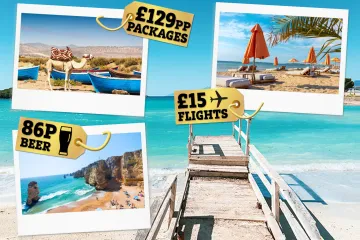
Families after a bargain break this summer should head to the Algarve, research found.
Portugal’s ever popular hotspot emerged as cheapest once holidaymakers get to their destination.
The research by Post Office Travel Money looked at 10 things tourist typically shell out on, including a three course family meal, lunch for two, through to suncream, a cup of coffee, and insect repellent. The results revealed a near £130 difference between the cheapest and the most expensive amount 22 destinations included, which could really stack up for a typical family over the course of a week or longer.
The Algarve came out top, with the 10 items costing £139.65, and 2.7% less than a year ago.
Next cheapest was Sunny Beach, Bulgaria, where the same came to £142.16, with the Canary Islands, Menorca and Spain’s Costa Brava making up the remainder of the top five where travellers’ money will go the furthest.
At the other of the scale, the most expensive among the 22 destinations included was Sorrento in Italy, with the 10 purchases costing £268. Families should expect to shell out a whopping £150 for a meal, compared with £88 on the Algarve.
The Post Office Travel Money Family Holiday Report was published in the week that many schools in England break up for the summer holiday
Echoing past years, prices varied by as much as 92% across the 22 destinations surveyed. There are also big differences between resorts in the same country.
In Greece, for example, the barometer totals ranged from £181 in Kos to £222 in Crete.
And while a cup of coffee in Sorrento can typically set tourists back £4.37, four hours across the country in Puglia it is £1.14, according to the report.
Laura Plunkett, head of Post Office Travel Money, which accounts for one-in-four UK currency
transactions, said: “We found big variations in costs between the European resorts surveyed, which means it is more important than ever to do some research before heading off on your holiday to inform how much holiday cash you’ll need for meals, drinks and other tourist staples. For those families who haven’t already booked and are looking for a late deal, the low resort prices in Portugal and Spain make these countries great value for money, while Bulgaria’s Black Sea resorts are strong contenders too.”
The fluorescent green gaiters seemed a ridiculous suggestion, but prove a godsend as we plod across the sand. “I bet you’re glad I told you to get a pair of these bad boys now, aren’t you?”my friend Luke jokes. We’re marching across a wide, crescent-shaped, honeyed beach. The sun is high in the sky and slivers of light flicker through a thick sea fog, as 6ft waves crash and fizz, their white foam licking the towering limestone cliffs.
I’m in Portugal, in the west Algarve, with two friends, hiking part of the Rota Vicentina, or Fishermen’s Trail, a 140-mile (226km) trek that runs from Lagos to São Torpes in Alentejo. Traversing cliffs that lead to wild, remote beaches like this one is part of the trail’s calling card. As the name suggests, it was originally carved out by fishers to reach otherwise inaccessible fishing spots along the Atlantic Ocean. Now it’s part of the Rota Vicentina, a hiking and cycling route spanning 466 miles across Portugal.
Already, this corner of the Algarve feels a far cry from downtown Lagos, where we’d been woken up the night before by noisy tourists after one too many Super Bocks. Our official starting point is 25 minutes away in Salema – a fishing village set within the Vicentine Coast natural park.
Barriga beach, on the Atlantic coast near Vila do Bispo. Photograph: Jose Luis Alvarez Esteban/Alamy
The sedate seaside haven is perhaps how the rest of the Algarve was before mass tourism arrived in this part of the Iberian peninsula following the opening of Faro airport in the 1960s. More than 20 million tourists visited the Algarve last year, 5.7 million of them from the UK.
Visitors to Salema drift in and out like the tide, pottering along cobbled streets, past traditional blue-and-white fishers’ cottages, stopping to indulge in fresh seafood on the terraces of family-run restaurants overlooking the long, empty beach flanked by chalky cliffs.
Tempted to postpone the first day of hiking to idle away the hours, we instead polish off a load of pastéis de nata and a bica or two down at Pastelaria Solmar, then set off. For the first few miles, we wend along a relatively flat, clay-coloured coastal path, following the blue-and-green striped Fishermen’s Trail logo that should lead us to Sagres.
A street in Salema. Photograph: CMS Pic/Getty Images
Keeping the sea to the left (we’re heading north), it’s easy to navigate. Magical, too, with views stretching as far as the eye can see, across an Atlantic Ocean glinting in the summer sun. Occasionally, we have to scramble up or down a steep, rocky embankment. But the rewards, a series of serene beaches that seem to get better with every mile, make it worthwhile. Given the remote location, these pretty coves attract only the hardiest beach-goers, and the odd naturist.
Over the day’s almost 12-mile hike, we hardly see another soul. So, when we arrive at Sagres, we’re ready for some human interaction. The seafaring town is where slave trader Henry the Navigator spent the final years of his life. Nowadays, Sagres is better known for its enviable surf breaks.
“I’m ready for a Sagres in Sagres,” Luke says, as we drop our bags and freshen up at Alojamento Mareta, a modest two-bed apartment that hovers on a cliffside with a blushing garden and sea views (about £78 per night). We mooch around looking for somewhere for dinner and a cold beer.
Sagres doesn’t have any sense of coherent organisation; its scattering of cafes, restaurants and bars appear to have been sketched out by bored teenagers when the city planners were on holiday. Instead of joining a growing gaggle of surfers waiting for live music to start at Three Little Birds, we order piri-piri chicken and a glug of local wine from the family-run Cafe Conchinha and retire to bed.
Waking early, we zip down to the empty Mareta beach for a meditation session led by another friend, James, before plunging into the icy sea. As if the morning isn’t already wholesome enough, we head to the Laundry Lounge – a boho, wooden-clad laundrette-cum-brunch spot – for a 90-minute yoga session and some breakfast before getting back on the road.
‘Craggy cliffs bathed in a golden light’ …. the lighthouse at Cabo de São Vicente. Photograph: Allard1/Alamy
We make our way to Cabo de São Vicente, where a 19th-century lighthouse sits perilously on an isolated rocky headland whipped by the elements. Mainland Europe’s most southwesterly point was known as the “end of the world”. It’s not hard to understand why. There’s nothing but an endless melange of blue water and craggy cliffs bathed in a golden light. It’s little wonder that the Greeks and Romans believed it to be a sacred promontory.
Later, we cut inland across a pancake flat expanse of arid shrubland with only the odd purple thistle for colour. Then, after 12 miles or so, we arrive in Vila do Bispo, a dusty, eerily quiet town, like something from a spaghetti western. Low-rise, pastel-coloured houses seem worn by time and old dusty cars sit beneath purple wisteria on cobbled street corners.
Fish, hung out to dry on washing lines, flap around in the wind as we wander the streets looking for somewhere to eat. We stumble across Pisco, an unassuming restaurant with a cosy atmosphere – whitewashed walls hung with art and crammed with wine bottles – where the vegetarian menu has excellent Mediterranean dishes, sourdough pizzas and organic wines.
Charging back towards the coast the following morning, we arrive at perhaps the most picturesque part of the hike. On the cliffs above Praia da Pena Furada, a vast, windswept beach, we perch on the cliffside for a moment to admire tall sea stacks battered by waves, the wind whistling through them as gulls swoop like kites overhead. It feels more like Steinbeck’s California than the Algarve. But for the hissing of the sea, everything is silent.
We barely say a word to one another until we land at the impossibly long sandy beach of Bordeira near Carrapateira a few hours later. The atmosphere here couldn’t be more different. The beach is busy with Portuguese holidaymakers and surfers. It’s the perfect antidote to hiking fatigue, so we settle in for a well-deserved burger at the hillside beach bar Amadobar as low-fi rock drifts from the speakers and surfers paddle out to distant breakers.
The hike ended at Praia da Arrifana in the Aljezur area of the west coast. Photograph: GM/Getty Images
Our digs for the night, which we make our way to after sunset, are about 20 minutes from the beach. Carrapateira Lodge (about £52 per night) sits in the centre of a small, charming whitewashed town with a scattering of restaurants, bars, cafes and surf shops. We dine alfresco on the cobbles just off the main plaza at O Pontal, getting to work on plates of tender octopus, roasted salt cod and beef entrecote to sustain ourselves for tomorrow’s final push.
When we arrive at Arrifana, our final destination the following afternoon, we’re beat. The parish town is settled on the hillside in the Aljezur municipality. Like Carrapateira, it’s popular with surfers. It feels closer to the Algarve most visitors know in some ways, but it’s still relatively low key. A single lane road helter-skelters down to another postcard-worthy beach, where there’s a sprinkling of bars and restaurants. Shattered, we round off the trip watching sunset at Café Restaurante Sol E Mar, a no-frills bar that spills out on to the headland overlooking the beach, which is busier than others we’ve passed but not as crowded as other Algarve hotspots I’ve visited. No rowdy Britons in sight – except us three.