Portugal holidays

Europe’s best beach for 2026 named – and it’s not Spain, Italy or Greece

This beach stuns visitors with its white sand, crystal-clear waters and dramatic cliffs.

The best bit of summer is unwinding on a spectacular beach with waves gently rolling onto the shore, seagulls crying above and sunshine beaming down. If this represents your ideal day, it’s essential that you discover the perfect beach to experience it on.

Fortunately, recent research has just ranked some of Europe’s finest beaches to identify the ultimate summer getaway destination. The study, carried out by airport transfer firm hoppa, has examined dozens of sought-after holiday destinations.

Each location was assessed based on its average three-star hotel price, journey time from airport to beach, and Google reviews to determine the very best options.

Taking the top spot as the finest beach for summer 2026 is Praia da Falésia in Portugal. Situated in the renowned Algarve area, this beach offers an utterly stunning day out, reports the Express.

The pale sand extends over 8km, protected by striking orange and white cliffs.

Those who visit the beach describe it as among the finest in the area, with one individual commenting on Tripadvisor: “The blend of the colours of the golden sand, the crystal blue sea and the imposing cliffs make it one of the most beautiful beaches in Portugal.”

Another said: “A wide expanse of golden and red sand, nice rock formations in the background and the waves here are gentle, perfect for swimming. It’s a popular beach, but due to its size, it’s a big, long beach; it never seems crowded even in high season.

“It’s a beach to most definitely check out if you’re planning a holiday to Albufeira.”

With lifeguards on duty and sunloungers available to hire, it caters to every need. Suitable for both families and couples, the beach’s generous size means it rarely feels overcrowded.

Europe’s best-rated beaches

  • Praia da Falésia — Algarve, Portugal
  • Platja de Muro — Majorca, Spain
  • Myrtos Beach — Kefalonia, Greece
  • Promenade des Anglais Beach — Nice, France
  • Playa de Poniente — Benidorm, Spain

Source link

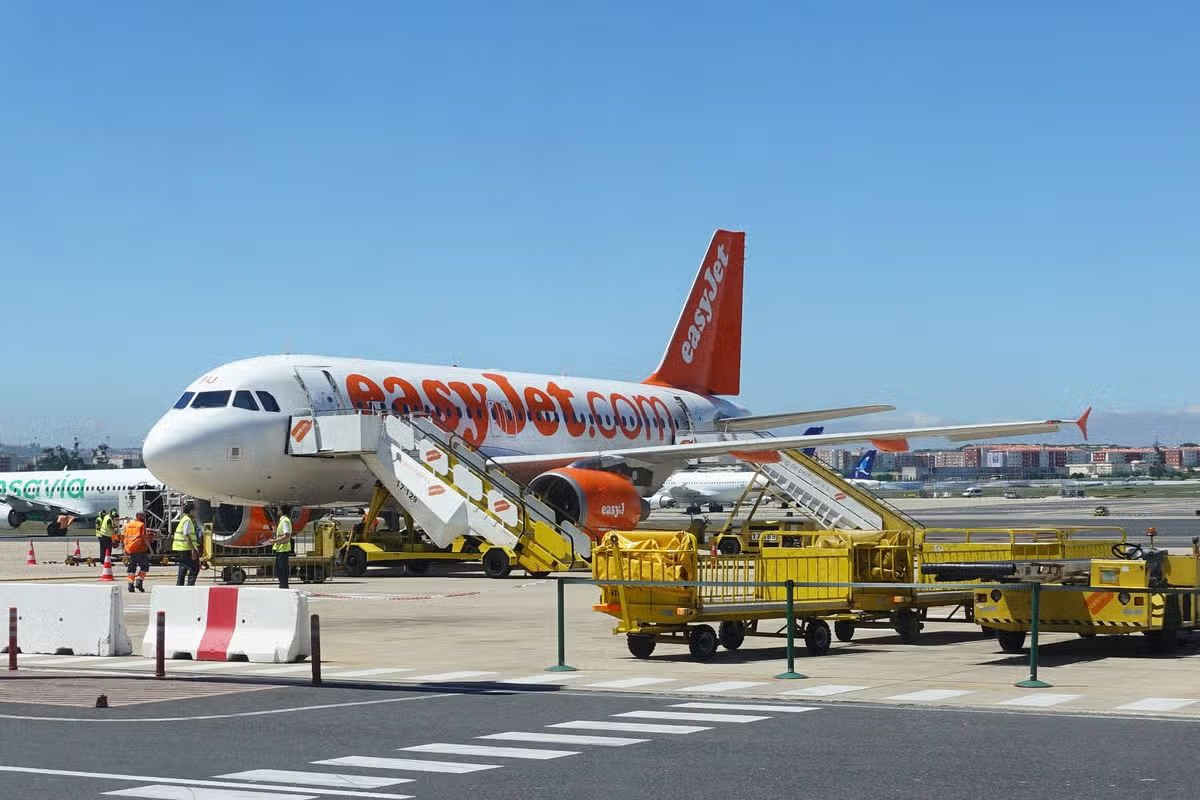
easyJet Portugal update as airline issues warning over new ‘allowance’ rule

EasyJet’s general manager in Portugal has issued a warning over new government proposals the carrier says will artificially inflate prices

easyJet is weighing up plans to cut back operations in Portugal, according to reports emerging from the country. The airline’s general manager there has issued the warning amid a dispute over government proposals which easyJet claims will drive up costs for passengers.

José Lopes, easyJet’s general manager in Portugal, announced on Monday that the carrier may cut back its domestic services following the scrapping of caps on something called the social mobility allowance for air travel. This caps maximum fares for some local passengers – but the changes are set to affect the airline more widely.

“Removing the upper limit will artificially inflate prices,” José Lopes said. He argued that the measure will deliver “zero benefits” for island residents while helping to deter tourists, who makeup the bulk of passengers on domestic routes.

The airline says it will not return to operate Azores routes due to the changes. It had already confirmed its departure from the region from March 29, 2026, blaming a 35 per cent increase in airport fees and what it describes as government inaction.

The easyJet representative was addressing journalists at a press conference in Funchal, held in partnership with the Regional Secretariat for Tourism, to outline the company’s operations and long-term pledges in the Madeira archipelago, SIC Noticias reports. Portuguese media outlets report that at Porto Santo airport, the two existing routes to Lisbon and Porto will be retained, albeit with a reduction to Lisbon owing to constraints at that airport, he indicated.

He warned that if the measure to alter the social mobility subsidy regime – which would remove the maximum limits for air travel for residents of Madeira and the Azores – is implemented, there will be implications for Easyjet’s operations. “I hope that an analysis will be carried out and a way will be found to be more rational and less emotional in dealing with the matter,” he said.

When asked about the possibility of abandoning the route to Madeira, the official ruled out this scenario. Yet reports say he highlighted the possibility of “a reduction in market capacity.”

The changes were given the green light on Friday in the Assembly of the Republic, but have yet to come into force. The amendments stem from two initiatives to revise the legislation put forward by the Socialist Party and Chega.

What is the social mobility subsidy?

The social mobility subsidy set a maximum fare of €79 for residents and €59 for students travelling between Madeira and the mainland (round trip), with an overall cap of €400. In the Azores, residents travelling to the mainland pay no more than €119, while students are capped at €89, with a recently introduced maximum ceiling of €600.

The Portugal Post reports that Portugal Parliament’s recent decision to abolish price caps has placed island connectivity under serious threat, with easyJet warning of capacity reductions to Madeira and confirming it will not operate Azores routes under the new framework.

Ryanair has also revealed plans to cease all operations in the Azores on March 29, 2026, citing cost pressures.

Source link

Jet2 ‘arrive early’ alert for anyone travelling to popular European destination

The budget airline has issued fresh guidance as passengers face “congestion everywhere”

Jet2 has issued a fresh alert to passengers travelling to a popular holiday destination as holiday-goers face long queues and waiting times. The budget airline is advising people to arrive ‘as early as possible‘ to avoid disruption to their travel plans.

It comes after a passenger claimed they were facing “congestion” at Faro Airport, located in southern Portugal, approximately 4km west of Faro city centre in the heart of the Algarve region. On X, the traveller with the username @MetalJim27 tagged Jet2 in a post, saying: “Congestion everywhere.”

Jet2 issued a new alert today (April 12), emphasising the importance of arriving at the airport early due to new systems being rolled out. A spokesperson said: “We’re sorry to hear this Jim. Unfortunately due to the new systems in place, the queues are completely out of our control.”

They added: “We kindly recommend customers arrive to the airport as early as possible, to allow plenty of time to make it through. Thanks, Lily.”

A statement on Faro Airport’s official website reads: “Due to possible constraints on departures border control, longer waiting times are to be expected. Passengers to international (Non Schengen) flights please arrive early at the Airport.”

Content cannot be displayed without consent

On the website’s ‘travelling to and from the UK’ page, another statement reads: “Passport controls on arrival at Portugal may take up more time, as the passport will have to be stamped and there are additional questions that may be asked by the border control officers.”

The new system being put in place is the European Union’s European Entry/Exit System (EES), which started on October 12, 2025. It is a new digital border system that has changed requirements for British citizens travelling to the Schengen area EES checks are being introduced in a phased way for non-EU and UK travellers, with full operation expected from April 2026.

If you are travelling to a Schengen country for a short stay using a UK passport, you will be required to register your biometric data, including fingerprints and a photo, upon arrival. You do not need to take any action before you arrive at the border, and there is no cost for EES registration.

The countries in the Schengen area include: Austria, Belgium, Bulgaria, Croatia, Czechia, Denmark, Estonia, Finland, France, Germany, Greece, Hungary, Iceland, Italy, Latvia, Liechtenstein, Lithuania, Luxembourg, Malta, Netherlands, Norway, Poland, Portugal, Romania, Slovakia, Slovenia, Spain, Sweden, and Switzerland. The Republic of Ireland and Cyprus are not part of the Schengen area, so EES is not required when travelling to either country.

As soon as passengers realise they’ll be late to their boarding gate, they should let their airline know via their app, email, or phone. Passengers can also ask airport staff for help, as some airports have electric cars or let passengers with short connections or flights departing soon go to the front of the line.

It is advised that passengers arrive at the airport early to handle any unexpected delays at security or passport control. A spokesperson for ABTA, the association of travel agents and tour operators, says: “We’re advising passengers to go straight to passport control as soon as you have gone through check-in and security; that way you get the EES checks out of the way as early as possible.

“We’re also advising passengers to follow their transport provider’s advice on when to arrive at airports/ports etc. If flying, the usual rule is to arrive at the airport for a flight from Europe at least two hours before, so we’d encourage people to apply that as a minimum, but to also check with their airline and airport.”

For passengers travelling with Jet2, the airline’s website offers airport information and an FAQ section for customers with booking queries. More information about the EU Entry/Exit System is available on GOV.UK.

Source link

Three hidden gem European destinations perfect for quiet summer holidays

Planning your summer holiday but want to avoid crowded tourist hotspots? These three stunning European destinations offer beautiful beaches and coastal charm without the crowds.

Spring has finally sprung, meaning summer is just round the corner. Britain is fortunate to have countless stunning countries within easy reach, and if you’re pondering where to head this year, you’re in for a treat.

One of the most frustrating aspects of arranging a holiday is deciding on a destination – and with hordes of tourists flocking to all the popular spots, finding somewhere peaceful and relaxing can prove even more challenging.

If you’re after coastal beauty without thousands of holidaymakers crowding the beaches with towels and parasols, these are the three European locations you need to consider, reports the Express.

La Gomera, Canary Islands

In contrast to Tenerife or Lanzarote, this stunning island remains relatively undiscovered and experiences fewer crowds during peak season than the British favourites.

Laura Evans-Fisk from eurochange commented: “It’s the perfect tranquil, peaceful alternative to the more popular islands. You could stay here for a restful few days or make a day trip from Tenerife by hopping on the ferry.

“La Gomera is also a great spot for hikers and nature lovers, home to the lush UNESCO-listed Garajonay National Park.

“Its beaches are much more secluded than the ones you’ll find on the other islands, and you’ll encounter no large-scale resorts or nightlife.”

“Like other islands in the region, La Gomera benefits from pleasant temperatures throughout the year too. And, its low light pollution means it’s an excellent spot for stargazing.”

Ksamil and Porto Palermo, Albania

Renowned for its breathtaking turquoise waters and pristine sand beaches, this stretch of Albania is known as the “Albanian Riviera”. It’s becoming increasingly popular with holidaymakers, yet sections of it remain largely undiscovered.

Laura explained: “Ksamil, an area often coined the ‘Maldives of Europe’, is one of the most beautiful and popular beaches, with white sands and strikingly clear waters.

“For a more relaxed vibe, visit Porto Palermo – this stunning bay has a small peninsula connecting it to the mainland, and an impressive 19th-century castle, Ali Pasha.”

Alentejo, Portugal

The Algarve is frequently packed with tourists, but further north in Alentejo there’s a far more laid-back atmosphere. With its picturesque coastal landscapes and gorgeous beaches it provides the ideal summer getaway.

Laura commented: “Further North than the Algarve, this coastline surrounds the city of Lisbon, making charming towns like Cascais, Estoril and Azenhas do Mar perfect day excursions from the capital.”

Source link