Pope

A president and a pope: The world’s most influential Americans are at odds over Iran

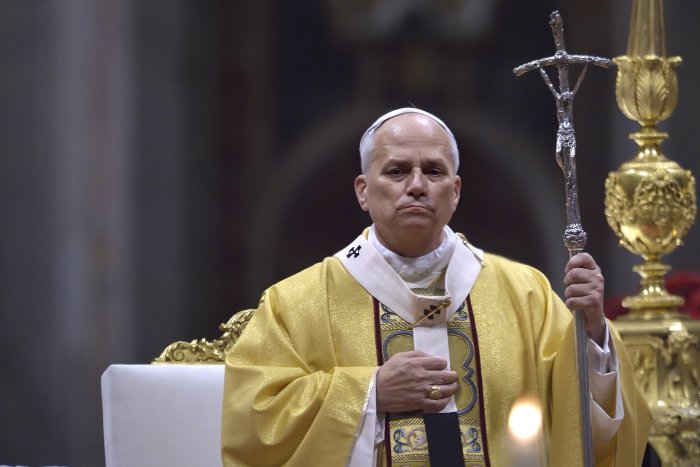
Donald Trump is accustomed to criticism from coast to coast — Democrats, disaffected Republicans, late-night comedians, massive protests. Yet in his second presidency, Trump’s most influential American critic doesn’t live in the country but at the Vatican.

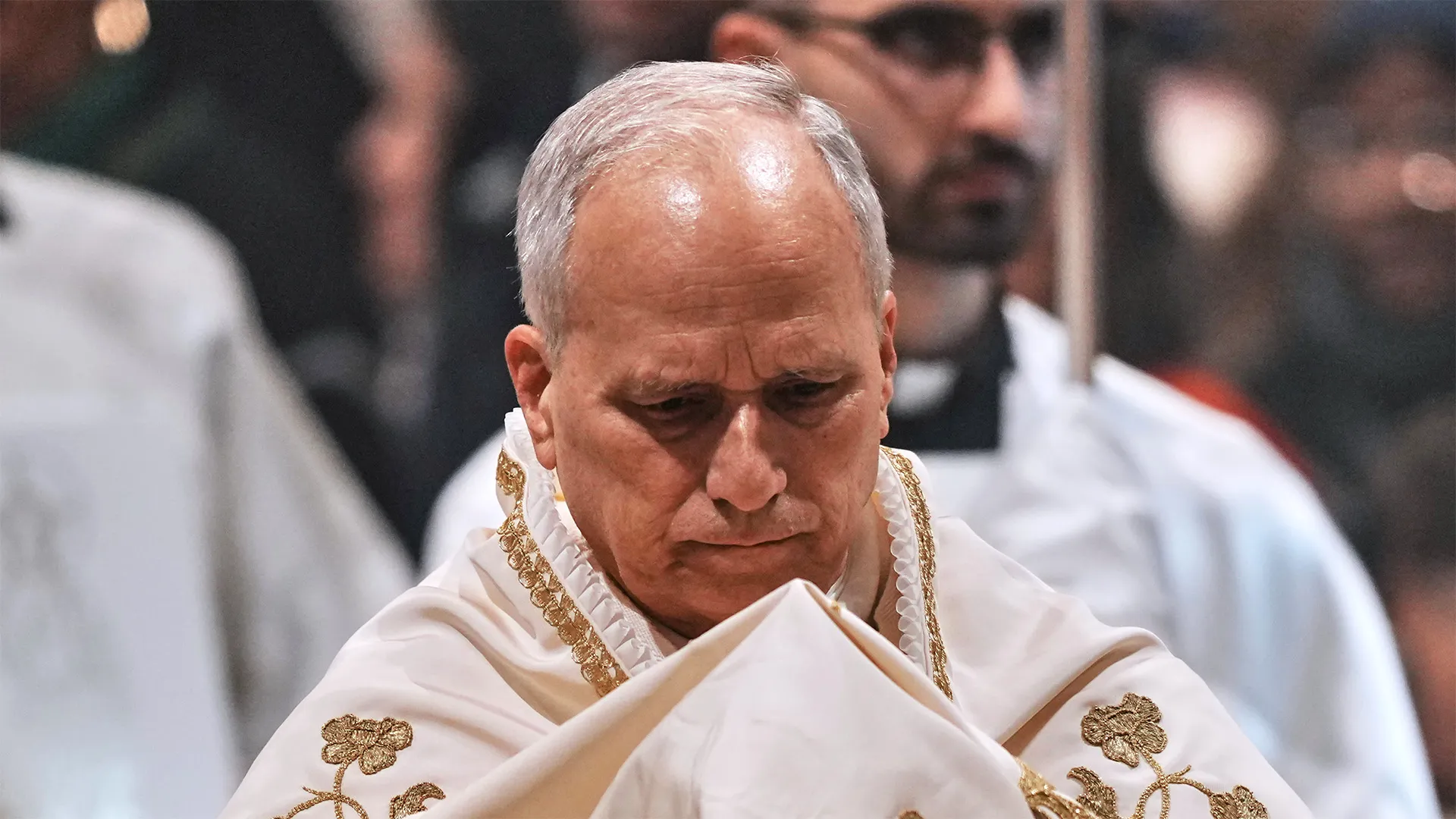
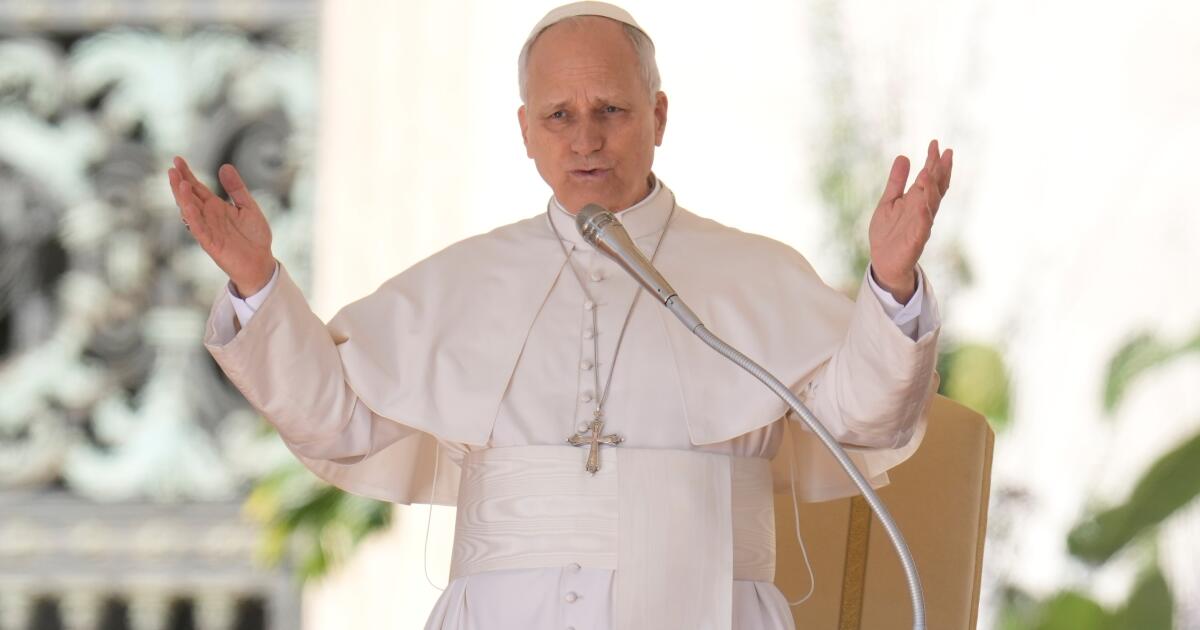
It’s an unprecedented situation, with the first American pope directly assailing the American president over the war in Iran, where a fragile ceasefire took hold this week. The announcement came after Pope Leo XIV declared that Trump’s belligerence was “truly unacceptable.”

Never before has the relationship between Washington and the Vatican revolved around two Americans — specifically, a 79-year-old politician from Queens and a 70-year-old pontiff from Chicago. They come from the same generation and share some common cultural roots yet bring jarringly distinct approaches to their positions of vast power. And the relationship comes with risks for both sides.

“They’re two white guy boomers but they could not be any more different in their life experiences, in their values, in the way they have chosen to live those values,” said theology professor Natalia Imperatori-Lee of Fordham University. “This is a very stark contrast, and I think an inflection point for American Christianity.”

Polar positions on Iran among U.S. Christians

Experts on the Catholic Church emphasized that Leo’s opposition to the war reflects established church teachings, not the reflexive politics of the moment.

“For the last five centuries, the church has been involved in a project of helping develop strong international norms,” including the Geneva Conventions in recent centuries, said Catholic University professor William Barbieri. “It is a very long-standing tradition rooted in Scripture and theology and philosophy.”

Yet the U.S. administration, which has close ties to conservative evangelical Protestant leaders, has claimed heavenly endorsement for Trump’s war on Iran.

Defense Secretary Pete Hegseth urged Americans to pray for victory “in the name of Jesus Christ.” When Trump was asked whether he thought God approved of the war, he said, “I do, because God is good — because God is good and God wants to see people taken care of.”

The Rev. Franklin Graham, son of iconic Baptist evangelist Billy Graham, said of Trump that God “raised him up for such a time as this.” And Graham prayed for victory so Iranians can “be set free from these Islamic lunatics.”

Leo countered in his Palm Sunday message that God “does not listen to the prayers of those who wage war, but rejects them.” He referenced an Old Testament passage from Isaiah, saying that “even though you make many prayers, I will not listen — your hands are full of blood.”

While it’s not unusual for popes and presidents to be at cross purposes, it’s exceedingly rare for the leader of the Catholic Church to directly criticize a U.S. leader, and Leo later named Trump directly and expressed optimism that the president would seek “an off-ramp” in Iran.

An even stronger condemnation came after Trump warned of mass strikes against Iranian power plants and infrastructure, writing on social media that “an entire civilization will die tonight.” Leo described that as a “threat against the entire people of Iran” and said it was “truly unacceptable.”

Experts: Leo doesn’t see himself as a Trump rival

Imperatori-Lee said Leo’s direct criticism stands out from the church’s more general critiques of political and social systems. For example, Pope Francis urged U.S. bishops to defend migrants without specifically mentioning Trump or his deportation agenda. Leo also previously called for humane treatment of migrants.

“Popes have critiqued unfettered capitalism before, very robustly. The popes have critiqued the Industrial Revolution, right? Things that the U.S. has been at the forefront of,” Imperatori-Lee said, “but it’s never been this specific and localized.”

She said Leo’s commentary resonates in the U.S. — with Catholics and non-Catholics — because he is a native English speaker.

“There’s no question about his inflection and meaning,” she said. “It removes any ambiguities.”

Trump welcomed Leo’s election last May as a “great honor” for the country, and he hasn’t responded to the latest criticisms. The White House did not respond to a request for comment.

“What Pope Leo and Donald Trump have in common is they both lived through the post-war polarization,” including the political upheaval of the Civil Rights Movement and Vietnam War, said Steven Millies, a professor at Chicago’s Catholic Theological Union, one of the pope’s alma maters.

He noted that Leo is a subscriber to The New York Times, plays the “Wordle” game, keeps up with U.S. sports and talks regularly with his brothers, including an avowed Trump supporter.

“In some ways he’s just like us,” Millies said, someone “who understands where our domestic political crisis came from,” unlike the Argentinian Francis, “who did not fully understand the peculiarities of the United States” even as he offered implicit criticism.

Barbieri said Leo’s American savvy still does not change an underappreciated reality of Catholicism and the papacy. “The Catholic Church doesn’t neatly fit into either right or left boxes as they’re understood in U.S. politics,” he said.

Leo’s global focus vs. Trump’s ‘transactional’ politics

Leo spent much of his pre-papal ministry, including all his time as a bishop and cardinal, outside the U.S.

He was educated in Rome as a canon lawyer within the church. He was a bishop in poor, rural swaths of Peru. He led the Augustinian order and served as Francis’ prefect for recommending bishop appointees around the world.

Imperatori-Lee said that global reach gave him a first-hand perspective on how Washington’s economic and military policies — including backing dictators in Latin America — have negatively affected less powerful nations and their citizens.

His varied experiences made then-Cardinal Robert Prevost uniquely suited to be elected pope despite the College of Cardinals’ traditional skepticism toward the U.S. and its superpower status. Millies argued that Trump and his advisers, even Vice President JD Vance, a Catholic convert, may not appreciate those distinctions.

“This is an administration that seems to think only in terms of transactional politics — who’s for us and who’s against us,” he said.

Polarization poses risks for Leo and Trump

Relations between Washington and the Vatican have become so strained that a report of an allegedly contentious meeting involving Pentagon and Catholic Church officials sent shockwaves through both cities.

According to the report in The Free Press, a member of Trump’s administration warned the church in January not to stand in the way of U.S. military might.

The Vatican on Friday issued a statement rejecting the report’s characterization of the meeting, saying it “does not correspond to the truth in any way.”

The U.S. Embassy to the Holy See also pushed back, writing on social media that “deliberate misrepresentation of these routine meetings sows unfounded division and misunderstanding.”

Millies, meanwhile, questioned whether anything the pope or U.S. bishops say can sway individual Catholics. Trump is likely to lose support among Catholics as he loses support across the broader electorate, Millies said, but that’s not necessarily because members of Leo’s flock are applying church doctrine.

“Partisan preferences always trump the religious commitments,” Millies said, describing a “disconnect” between church leaders and many parishioners who look to other sources, politicians included, when shaping their views of faith and politics.

“The icon of Catholicism in American politics now is JD Vance, and it’s more about winning an argument,” he said. “It’s a very different emphasis, but it’s one that may suit the Trump administration very well.”

Barrow writes for the Associated Press. AP reporters Nicole Winfield in Rome and Konstantin Toropin in Washington contributed to this report.
Source link

Pope Leo’s brave stance against Trump

A war for the soul of the world is happening right now that’s straight out of the Bible — and I’m not just talking about the Middle East.

In one corner are President Trump and his minions, who insist that everything they do is divinely mandated. They have consistently invoked a violent version of God as they deport undocumented immigrants, try to make the United States whiter, rip up long-standing treaties with allies, rain down bombs like a biblical plague on supposed narco boats and choke nations they deem a threat or whose resources they covet.

They’re the ones who lecture religious leaders on what Jesus stood for, demanding blessings for Trump’s actions — or else.

Just check out the recent allegations in The Free Press that senior defense officials dressed down the Vatican’s ambassador to the U.S. in January over Pope Leo XIV’s lack of enthusiasm for Trump’s imperialist ambitions. Or Secretary of Defense Pete Hegseth, he of the tattoos hailing the blood thirst of the Crusades (another Middle Eastern forever war that the “civilized” side lost), who compared the rescue of a downed American aviator in Iran over Easter weekend to the resurrection of Jesus.

It’s a playbook straight out of the Book of Revelations, which describes a Beast in the End Times with “a mouth speaking great things and blasphemies” in its quest to hold dominion over the earth.

In the other corner of this existential fight is an actual man of God: Pope Leo XIV.

Rather than cower before a despot who makes the Pharaoh in the Old Testament seem as stable and kind as St. Francis, the first American pope has resisted Trump like a protester at a “No Kings” rally. He has yet to denounce by name anyone in the president’s sordid orbit — but Pope Leo has returned to their actions again and again in his first year as head of the world’s 1.4 billion Catholics.

He began his papacy by greeting a cheering crowd with “Peace be with you all” — what Jesus told his disciples after his Resurrection and a brilliant, biblical way to telegraph where he stands in our bellicose times.

On Palm Sunday a few weeks ago, the pontiff proclaimed during Mass in St. Peter’s Square that God “does not listen to the prayers of those who wage war” — a not-so-subtle rebuke to Hegseth, who prayed shortly after the U.S. launched the Iran war for “every round [to] find its mark” and for “overwhelming violence of action against those who deserve no mercy.”

For his first Easter message, Pope Leo wrote, “Let those who have the power to unleash wars choose peace! Not a peace imposed by force, but through dialogue!”

Meanwhile, President Trump told a reporter that God supports the destruction he’s inflicting on Iran because “God is good. God wants to see people taken care of.”

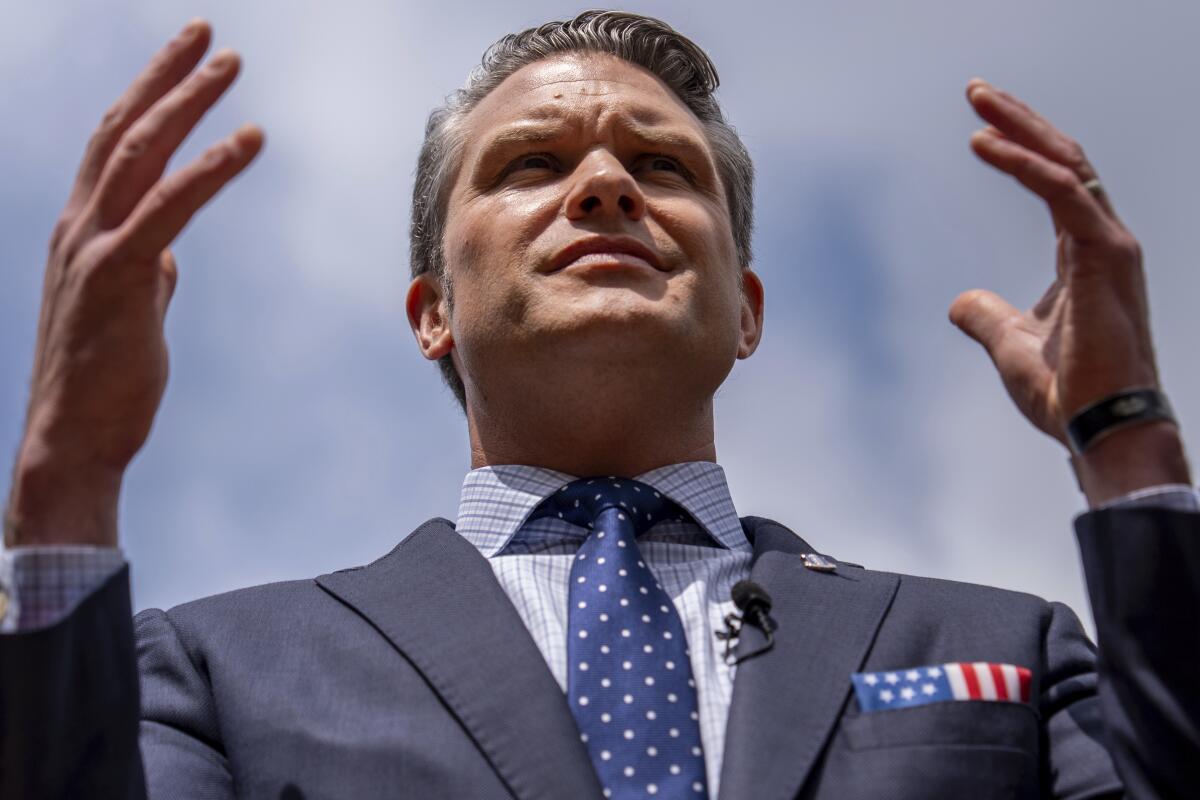
Secretary of Defense Pete Hegseth

Secretary of Defense Pete Hegseth speaks to reporters at the Pentagon, July 16, 2025, in Washington.

(Julia Demaree Nikhinson / Associated Press)

According to the Free Press article, the Vatican declined an invitation from Vice President JD Vance for Pope Leo to visit the U.S., for fear that Trump would use him as a political pawn. Instead, the man born in Chicago as Robert Prevost plans to spend July 4 — America’s 250th birthday — on a Mediterranean island that has long served as a gateway for migrants trying to make it to Europe.

Critics will accuse Pope Leo of Trump Derangement Syndrome and call him particularly short-sighted, since he stands athwart the desires of many American Catholics.

Though he isn’t Catholic, Trump has favored Catholicism far above any other mainline Christian denomination, from acknowledging feast days to packing his administration and the Supreme Court with adherents in a way that even Joe Biden — a lifelong Catholic — never did.

About 55% of Catholics voted for Trump in 2024, per the Pew Research Center. A survey last year by The Catholic Project at The Catholic University of America found “a clear generational shift away from liberal self-identification” among younger priests. Dioceses across the country are reporting the highest amount of converts in decades, many of them drawn in by orthodox Catholic influencers.

But Trump’s embrace of Catholicism, like everything else in his life, has been conditional on fealty to him. His administration pulled tens of millions of federal funds from Catholic charities because they assisted migrants regardless of legal status — something the American Catholic church has done for over a century. Vance, himself a Catholic convert, accused bishops of being “worried about their bottom line” for daring to criticize the move and his boss’ deportation Leviathan.

The Free Press also reported that Trump’s lackeys invoked the Avignon Papacy — when 14th century French kings exiled a succession of popes from the Vatican and made them their puppets — during their browbeating of the Vatican ambassador.

Re-litigating history is an obsession of the Trump regime, so bringing up a medieval episode amounted to a threat to Leo to shape up — or else.

That’s what makes Pope Leo’s stance against a modern-day Babylon even braver. A pope’s main role is to bear witness to the words of Christ, who said far more about taking care of the meek and turning the other cheek than he did about waging war.

The best popes, from John XXIII to John Paul II, know that their words stand as a challenge for all people, believers and not, to create a better world that paves the way for the world to come. Trump wages war for himself; Pope Leo urges us to stand for something other than ourselves.

At this point in his reign, Trump is a dead ringer for the Antichrist, described in the Second Book of Thessalonians as a “man of sin … the son of perdition who opposeth and exalteth himself above all.”

Pope Leo would never characterize his opposition to Trump in such apocalyptic terms, of course. But his stance against the president’s tyranny is a call to action in the same vein as John Paul II’s exhortation to the free world to oppose the Soviet empire.

“Let us abandon every desire for conflict, domination, and power,” Pope Leo stated on Easter, “and implore the Lord to grant his peace to a world ravaged by wars and marked by a hatred and indifference that make us feel powerless in the face of evil.”

Amen, amen, amen.

Source link

Pope Leo beseeches warring nations to lay down arms in Easter address

Pope Leo XIV waves to the crowd from the popemobile after he presided over the Holy Mass on Easter Sunday at Saint Peter’s Square in Vatican City on Sunday. It is Pope Leo’s first Holy Week as pontiff. Photo by Riccardo Antimiani/EPA

April 5 (UPI) — Pope Leo XIV on Sunday beseeched world leaders to “lay down” the weapons of war and use “dialogue” rather than force as the means to bring about peace.

In the annual Urbi et Orbi address delivered by the presiding Catholic pontiff each Easter Sunday in St. Peter’s Square at the Vatican, Leo said the holy day can provide a light from Christ allowing hearts “to be transformed by his immense love for us.

“Let those who have weapons lay them down. Let those who have the power to unleash wars choose peace. Not a peace imposed by force, but through dialogue. Not with the desire to dominate others, but to encounter them,” Leo said in his first Easter address as pontiff.

An estimated 50,000 people jammed the Roman square to hear Leo’s Urbi et Orbi Easter Mass homily, or “To the City and the World,” in which he warned against allowing “indifference” to blunt the impact of war’s devastation as conflicts raged in Iran, Lebanon, Gaza, Ukraine and elsewhere in the world.

“We are growing accustomed to violence, resigning ourselves to it, and becoming indifferent,” he said. “Indifferent to the deaths of thousands of people. Indifferent to the repercussions of hatred and division that conflicts sow. Indifferent to the economic and social consequences they produce, which we all feel.”

Instead, he declared, “We cannot continue to be indifferent! And we cannot resign ourselves to evil!”

Leo, the first American pope, has been a frequent critic of U.S. President Donald Trump, but did not specifically mention him or any other leader or country during the Easter homily. Rather, he anti-war remarks were universal.

“On this day of celebration, let us abandon every desire for conflict, domination, and power, and implore the Lord to grant his peace to a world ravaged by wars and marked by a hatred and indifference that make us feel powerless in the face of evil,” Leo urged.

In his time as pope, Leo has established a track record of issuing unambiguous calls for peace.

Last month, for instance, he voiced a direct demand for an end to the U.S.-Israeli war in Iran as the conflict entered its third week.

“On behalf of the Christians of the Middle East, and of all women and men of good will, I appeal to those responsible for this conflict: Cease fire!,” the pope said during the Angelus in St. Peter’s Square on March 15.

Pope Leo XIV celebrates the Christmas vigil Mass on Christmas eve on Wednesday in St. Peter’s Basilica in Vatican City, Vatican. Photo by Stefano Spaziani/UPI | License Photo

Source link