How Paris’ oldest bridge, Pont Neuf, was turned into a mountain cave
PARIS — There’s a present-day answer to the question that was posed in verse by the French medieval poet and street brawler François Villon: “Where are the snows of yesteryear?”
They’re right here, in high summer, on Paris’ oldest bridge, the Pont Neuf, where an enormous art installation, a trompe l’oeil inflatable snow-clad mountain range, has arisen over the river Seine.
Using about 200,000 square feet of printed fabric, Paris-born street artist JR has created “La Caverne du Pont Neuf.” It’s his version of and homage to the innovative work of groundbreaking environmental artists Christo and Jeanne-Claude.
They’re the fabled duo who first wrapped the arches of this same bridge in straw-colored fabric in 1985. Over the years, they also surrounded 11 islands in Florida’s Biscayne Bay with flamingo-pink cloth, hung saffron-colored fabric “gates” in New York’s Central Park, installed a “running fence” of billowing white material across nearly 25 miles of Sonoma and Marin counties and, in 1991, planted 3,100 yellow umbrellas, blooming like 20-foot-tall poppies, through the Tejon Pass north of L.A.
I interviewed Christo in 2011, and he was eloquent about how his and his wife’s work alters perceptions of nature, and about the deliberately transient character of the art itself. JR, an acolyte of their work, told me in an email that “an ephemeral artwork forces you to come now, and usually to come with other people. The visit becomes a shared moment … and this moment becomes a memory.”
In a city celebrated for artworks that have survived for centuries, this installation was very nearly too transient. A kooky hailstorm in late May, a heat wave in June, followed by ruthlessly ripping winds, delayed the opening by days. At last, beginning one midnight, the air pumps began and the work arose like a limestone-colored soufflé. It will be open around the clock until June 28.
Plus ça change, plus c’est la même chose. Back in 1985, Christo’s engineer on the Pont Neuf project, Ted Dougherty, pointed out that above 25 mph, “wind is not our friend.”
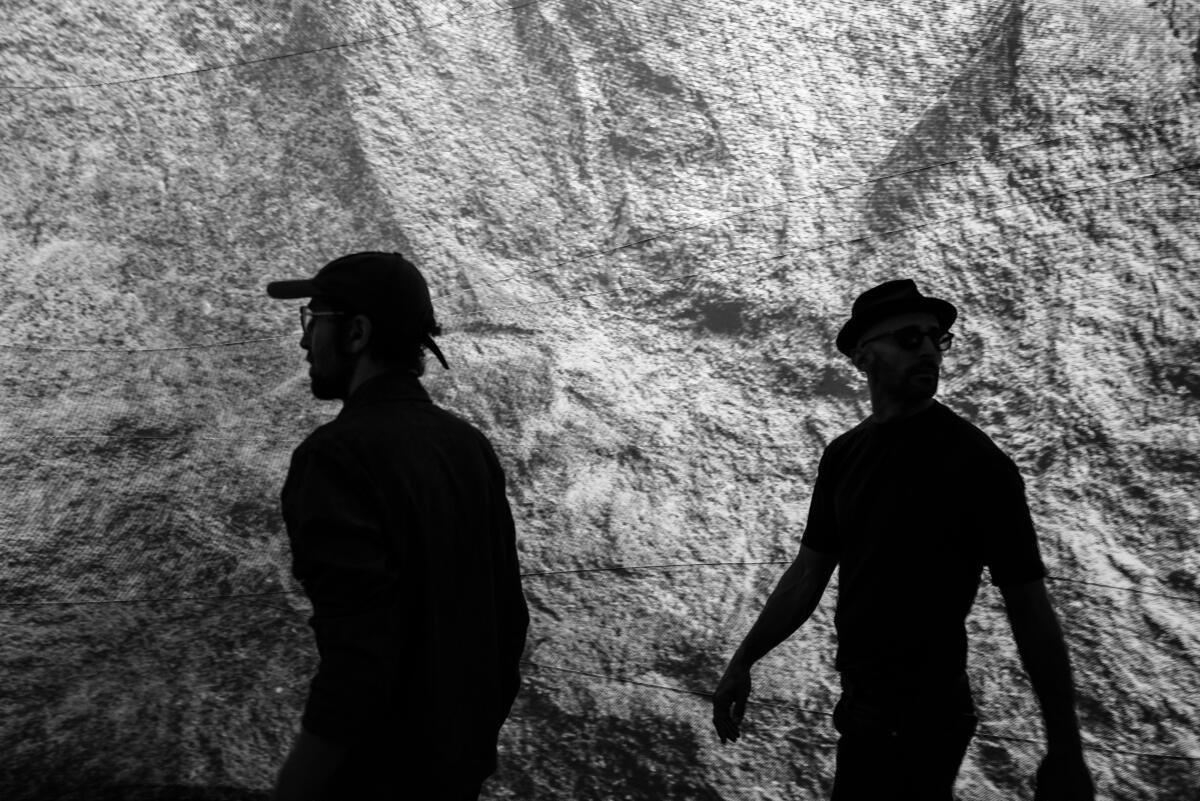
The piece works from two vantage points: from afar — visible from a lot of central Paris — and also from inside it, in the “cave” part. Pedestrians crossing the bridge pass through a fabricated interior, a cavern-like space printed in 3D realism and enhanced with a specially designed scent to evoke the dank, earthy aroma of humankind’s early habitations.

JR and Thomas Bangalter in “La Caverne du Pont Neuf” in Paris.
(Tara-Jay Bangalter)
JR intended it to be both. “From the start I designed two works in one. There is the silhouette — what you catch from the quais, from the bridges, from a boat on the Seine or simply walking past on your way somewhere else. That image belongs to everyone, including the people who never chose to look at art that day.”
And then, he said, “there is the inside, which is slower and more intimate, almost in the dark, hard to photograph.” That aspect is “a journey to cross the bridge, to go from darkness to light.”
When Christo and Jeanne-Claude wrapped the arches of the Pont Neuf more than 40 years ago, it took years of planning and permits to make it happen. “La Caverne du Pont Neuf” was a breeze by comparison.
JR, whose other vast outdoor works have delivered double-takes of humans’ scale and their architecture, told me that cities have come to understand “that public art brings people together and that the image travels around the world. Once Christo showed it could be done safely and beautifully, the conversation changed. It was much easier for me to have my project accepted, thanks to them. They also proved the economic positive impact to the cities they worked in. I believe there should be more large-scale, ambitious public art projects.”
It’s one thing to conceive of such a project and another altogether to make it happen — so much technology, compared to, say, mixing paints and choosing a paintbrush. But the science that “La Caverne” required “is the art, not an obstacle to it,” JR said.

“Trompe l’oeil turns adults back into children,” JR said.
(Elea Jeanne Schmitter)
All the canvas, the engineering, the meticulous assembly, the permits — “none of that is preparation for the work, it is the work. Christo taught me this. The process is visible, and even more after the storm we experienced a couple of days before opening to the public. Nature always reminds you who is in charge. When the wind tore the canvas before we opened, we took it down, re-sewed it, reinforced it,” all in full public view.
“Where I stay careful is in not letting the technology become the subject. The augmented reality by Snap’s AR Studio adds to the project, doesn’t take you away from it.”
That air should be JR’s vital collaborator — no complex and costly scaffolding for these magic mountains — is nothing new in Paris.
The first free flight of humans above the earth, on Nov. 21, 1783, sent aloft two men in a hot-air balloon crafted by the Montgolfier brothers from silk fancifully painted in blue and gold with figures of the zodiac. It wafted across Paris for about 25 minutes at about 3,000 feet. Ephemeral, yes — and unforgettable.
Artists and couturiers are fond of the whimsy of trompe l’oeil, the trick of the eye, the illusion of reality. I am a sucker for it, for fashion like that of clothing designer Elsa Schiaparelli. JR has used it often, as a massive-scale magical deception to make the Louvre Pyramid “disappear” into the old Louvre, and opening up an imaginary subterranean world below the Eiffel Tower.
“Trompe l’oeil turns adults back into children,” he told me. “You know it isn’t real, you know that ‘La Caverne du Pont-Neuf’ is not made of rock, that this is printed canvas. And yet your eye wants to believe it, and for a moment you let yourself. That gap between knowing and believing is where the play happens, and people love being inside that gap.”