COMSTOCK, Texas — The Trump administration has started building a border wall through a west Texas section of the Big Bend region, marking the first major construction in an area of the U.S.-Mexico border where the administration’s plans have met heavy, bipartisan opposition.
The start of construction marks a milestone in the administration’s $46-billion efforts to line the border with walls, barriers, roads and technology as it seeks to make good on a campaign promise by President Trump to finish the wall. And it comes as Customs and Border Protection says it has doubled the pace at which it is building the wall across the border.
Customs and Border Protection said in a statement to the Associated Press that “border wall panel installation is underway” in a 47-mile stretch of Hudspeth County in west Texas known as Big Bend 1. There are five project areas that make up the roughly 500-mile Big Bend region stretching from an area of Hudspeth County south of El Paso to Lake Amistad.
CBP said the first panels were erected Wednesday. On a map on the agency’s website where it posts updates of wall construction along the southern border, a photo showed a crane lifting one of the 30-foot-tall steel wall panels into place as construction workers looked on.
The new activity was separate from a border infrastructure project in the nearby Big Bend National Park, where the administration has suspended construction in an attempt to reach out to opponents.
In the broader Big Bend region of Texas, CBP has run up against concerted opposition from landowners, environmental groups, business owners and ranchers who say the remote region isn’t a high-traffic area for illegal immigration. Political leaders from both parties, including U.S. Sen. John Cornyn (R-Texas), have joined the opposition.
Activists said Friday they would continue opposing the border infrastructure projects in the rest of the Big Bend region, even as the panels were being installed.
Clara Benson, one of the founders of the No Big Bend Wall Coalition, which has been fighting against CBP’s plans, said in an interview Friday that the organization had been receiving reports of trucks moving supplies into the remote area along the Rio Grande and that contractors had been clearing yards to stage supplies.
Speaking from Washington, D.C., where she and others in the coalition were meeting with lawmakers, she said that the organization and others would continue to fight the wall-building plans across the region.
“We will continue to fight for this land no matter what the outcome is. We will continue fighting to the end,” said Benson. “You talk to people in west Texas and they say even if they put it up, we’ll fight for them to take it down. So this fight is not over.”
The news comes as the administration is speeding forward with a plan to line the entire border with a combination of 30-foot-tall steel bollard walls, barriers designed to stop vehicles from crossing the border, new patrol roads, and various technologies to deter and detect migrants or smugglers from crossing the border.
Customs and Border Protection said it is building an average of 12 miles of barriers per week along the 2,000-mile border with Mexico and recently reached a milestone of 200 miles of new barriers built since the second Trump administration took office. The 12-miles-a-week average is double the pace that the agency’s head, Rodney Scott, cited earlier this year.
The agency has faced opposition from environmental groups, a small town that worries the wall will cause flooding in its area, Native Americans who say the construction is disturbing sacred sites and landowners who say the construction will infringe on their land.
In Texas, much of the opposition has centered on the agency’s plans for Big Bend National Park, in the state’s southwest on the Rio Grande that is a draw for tourists from around the world. But up- and downriver outside the park, much of the land is owned by private landowners, many of whom have organized against the government’s efforts.
Earlier this week, landowners, ranchers and business owners in the Big Bend region along with a nonprofit organization dedicated to protecting the region’s landscape and heritage sued to stop the administration’s plans.
Activists and landowners have also shown up at county meetings to push their elected officials not to cooperate with contractors hired by CBP to build the wall, and many landowners have refused to allow government officials or contractors onto their land to survey it.
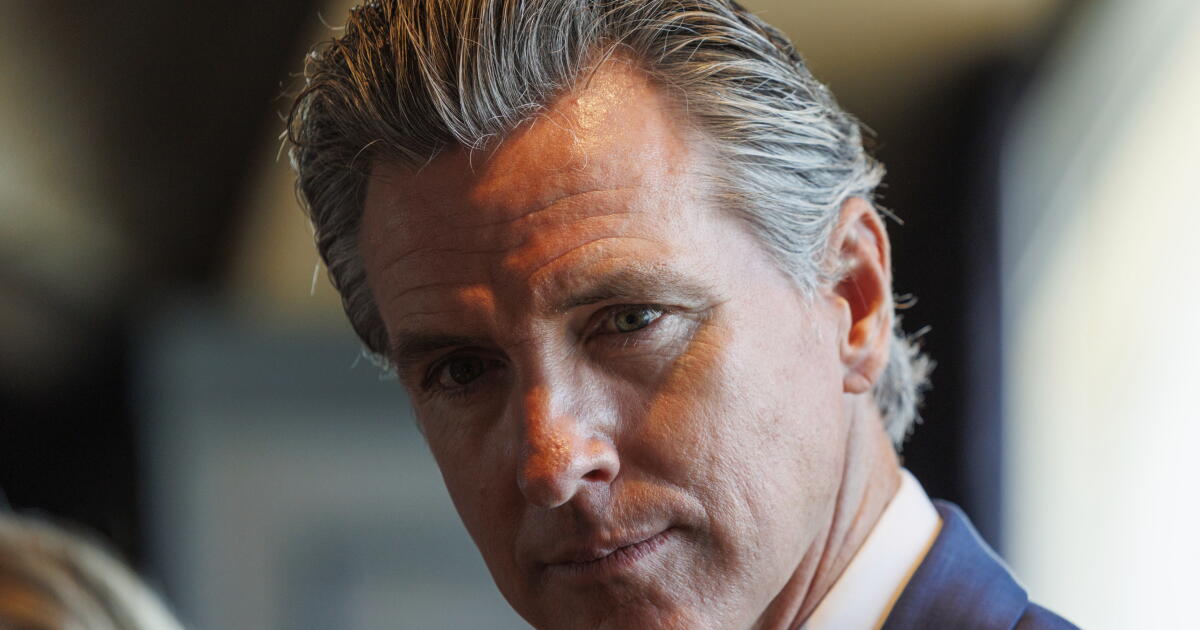
SACRAMENTO — Gov. Gavin Newsom on Saturday signed legislation to increase security for the state’s voting systems and protect Californians’ ability to cast ballots in an effort to guard against potential interference in the Nov. 3 election, including by the Trump administration.
Newsom pointed to the Trump administration’s recent effort to restrict mail-in voting through the U.S. Postal Service, which was struck down by the U.S. Supreme Court, and the presence of federal monitors at California polls last year as evidence that Trump “will continue his efforts to interfere with the November election.”
“Donald Trump won’t stop until he can exert dictatorial control over your free vote and disenfranchise millions of people this November. California will stop him at every opportunity,” Newsom said in a statement.”We have no bigger task than fighting to protect the right to vote from interference and meddling — the future of democracy is on the line. These bills today build upon the wall California has built to safeguard our electoral process.”
The governor signed the package of bills at the Japanese American National Museum in Little Tokyo, where a year earlier federal agents gathered outside a political rally he was hosting. Then Border Patrol Sector Chief Gregory Bovino, who had been leading the immigration operations in California, was among those outside the event, joined by agents in helmets, camouflage, masks and holding guns. Newsom described their presence as political intimidation.
One bill Newsom signed Saturday cites efforts to “weaponize law enforcement authority for political purposes,” including Republican “Sheriff Chad Bianco’s seizure of ballots in Riverside County,” and the election monitors sent by the U.S. Justice Department to polling sites in five counties during a 2025 special election on redistricting.
Such moves “have given rise to unprecedented concerns about law enforcement interference” in elections and “[demonstrate] that these threats are not merely hypothetical,” the bill by Sen. Tom Umberg (D-Santa Ana) reads.
The law, Senate Bill 884, which takes effect immediately, requires counties to open ballot drop-off locations 30 days before an election — two days earlier than usual — and allows counties to ban electioneering, or trying to influence voters’ decisions, within up to 200 feet of polling sites. It also bans police from making arrests near voting locations except for crimes against people, property, or disrupting the voting process.
Bianco, a GOP candidate for governor who placed fourth in the primary, drew swift condemnation and legal challenges this spring after he ordered deputies to seize more than 650,000 ballots from the Riverside County elections office. Voting rights groups and Atty. Gen. Rob Bonta challenged the move, which is being decided by the California Supreme Court.
Bianco carted off truckloads of ballots from the Riverside County Registrar of Voters in February after securing a warrant based on claims that the office allowed fraudulent votes in the special election to redraw California’s congressional districts under Proposition 50 in 2025.
Earlier this year, Newsom signed a bill preventing local and federal law enforcement agencies from taking ballots without a warrant.
On Saturday the Democratic governor signed a bill making it a felony to seize or order the seizure of ballots, election records or voting machines. Future seizures could be punishable by up to four years in prison.
“The federal administration and those seeking to spread lies about our democracy continue to call for interference in elections in ways we have never seen before in this country,” Assemblymember Gail Pellerin (D-Santa Cruz), the bill’s author and a former longtime county elections chief, said last month. “AB 282 helps ensure that every lawfully cast vote can be counted, and that the will of the voters of every political party will be respected.”
Republican lawmakers argued in previous hearings that the bill is unnecessary because it is already a crime to steal ballots.
Another bill, Senate Bill 259, makes it a crime to interfere with a mail ballot on the way to or from a voter or order the seizure of ballots that are in transit to a local elections office.
Newsom signed Assembly Bill 1664, which requires elections officials to immediately notify the attorney general and secretary of state immediately upon learning of any warrants, subpoenas or law enforcement investigations involving election records or voting equipment.
Newsom also signed bills to boost protections under the California Voting Rights Act, including an explicit ban on voter suppression and expanded access to election materials in languages other than English.
The governor also signed legislation to require more transparency from social media influencers who are paid by political campaigns. The measure, Assembly Bill 1130, came in the wake of a controversy in the June primary election when social media influencers took on a more visible role in the campaigns.
Candidates including Democratic billionaire Tom Steyer paid thousands of dollars to influencers who posted videos endorsing Steyer or talking about him in a positive light. These videos did not always disclose that influencers were paid by a candidate’s campaign.
NEW YORK — Journalists from three major news organizations — CNN, MS NOW and Politico — were denied access to the White House on Saturday morning, with reporters from the two cable networks both going live to report they’d been barred following a ban imposed by President Trump.
The actions escalated Trump’s long-running efforts to restrict news coverage by journalists he finds objectionable, and is the latest test of 1st Amendment protections in the United States. Trump said Friday he would ban all three organizations because of their coverage — which he called “fake news.”
Politico said its White House reporter Cheyenne Haslett was denied entry to the White House and had her badge confiscated Saturday. The announcement came shortly after the turning away of MS NOW and CNN journalists.
Editor in chief Jonathan Greenberger said in a statement to the Politico newsroom: “We stand by her and all reporters here covering the White House. … We will vigorously defend our First Amendment rights.”
CNN and MS NOW have issued similar statements.
“We will not be deflected from our duty to hold the government and other public bodies to account,” CNN said. The statement was shown on the air before senior White House reporter Betsy Klein began to report on her ban.
Journalists from three major news organizations — MS NOW, CNN and Politico — were denied access to the White House on Saturday morning.
(Graeme Sloan / Getty Images)
MS NOW said in a statement that it stands behind its journalists. “The White House belongs to the American people and the decisions made inside are funded by our tax dollars,” the network said in a statement Saturday. “MS NOW intends to take any and all steps necessary to defend our First Amendment rights and the essential role of independent journalism in our democracy.”
In his second term, Trump and his administration have upped the ante and punished certain media outlets, both in the courtroom and through regulatory action. Trump has also lashed out at individual reporters in person or over social media, sometimes in strikingly personal terms.
Turned away, badges confiscated
Both CNN White House reporter Betsy Klein and MS NOW reporter Akayla Gardner went on the air to report they’d been banned from entering the White House.
Network correspondents are usually present on the weekends when the president is in Washington or at nearby Camp David. Trump is at the presidential retreat in Maryland this weekend.
Gardner was turned away and her entry badge confiscated, she said. She noted she had walked through two gates successfully, but once she got to where her badge needed to be scanned, an officer told her it was disabled and asked her to hand it over. He said the decision “was above him,” she reported. An MS NOW producer was able to get in, but a photographer’s badge was also disabled, Gardner said.
CNN Senior White House Reporter Betsy Klein, left, walks to the White House, Saturday.
(Jose Luis Magana / Associated Press)
Klein, senior White House reporter at CNN, also said her badge had been deactivated.
CNN media analyst Brian Stelter called the move “a direct threat to press freedom in the United States.”
“It’s so much bigger than CNN,” Stelter said. “This is a free speech test in America.”
Continued attacks on press freedom
The president wrote on his social media site Friday that effective immediately, “I am banning” CNN, MS NOW and Politico “from the White House as a result of their constant ‘reporting’ FAKE NEWS!” Minutes later, speaking at an event in the Oval Office, Trump was asked to explain his statement.
“Because they’re fake news,” he said. “You get so tired of reading and seeing fake news. When you look at CNN, it’s just fake. That’s why their ratings are no good. When you look at MS NOW … , it’s fake news.”
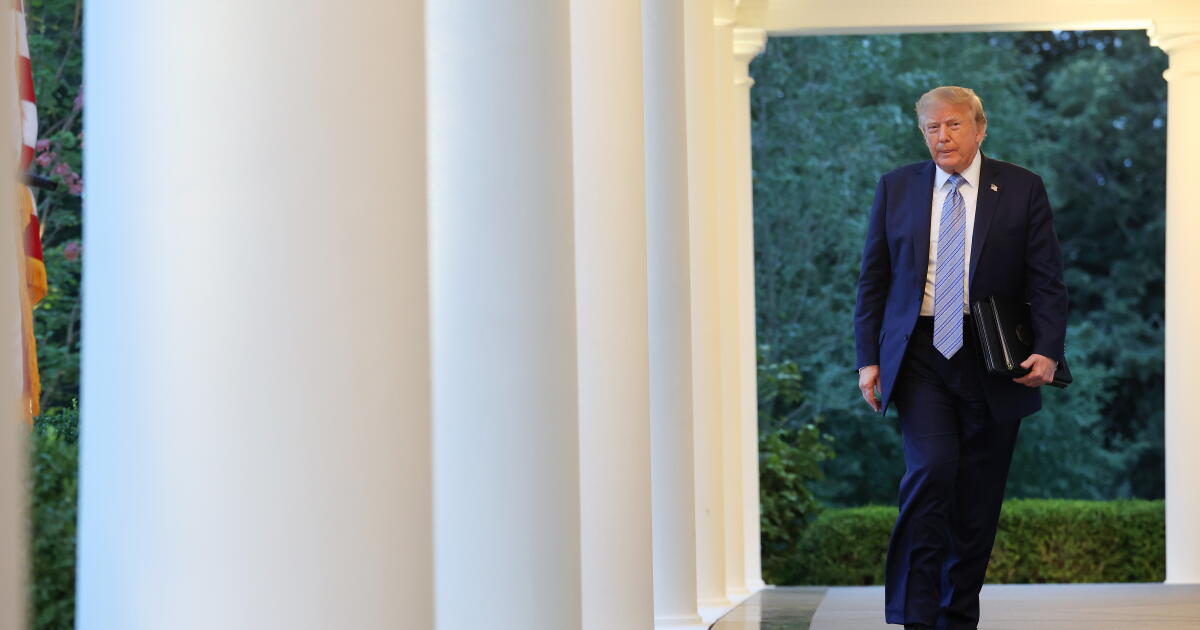
President Donald Trump arrives at the Ellipse before departing the White House on Friday. Trump hosting a MAGA fundraiser at his private club in Sterling, Virginia, before spending the weekend at Camp David.
(Chip Somodevilla / Getty Images)
“And when you look at Politico … the stories they wrote are fake. So there’s a lot of news and there may be others to join them, and maybe they can get better,” he said. “But our country has to have honest news.”
The move follows the president’s decision last year to bar Associated Press reporters from the Oval Office, Air Force One and other events in retaliation for the news outlet’s decision not to follow his lead in changing the name of the Gulf of Mexico, which lies partially in Mexican and other waters. The AP said that it would note when appropriate that Trump had ordered it renamed the “Gulf of America.”
The AP filed suit and the case is ongoing. Since returning to office, Trump has pursued other legal action against a variety of outlets, including the New York Times, the Wall Street Journal and the BBC. His administration is also involved in a long-simmering confrontation involving ABC over renewal of its broadcast licenses.
The advertising blitzkrieg of L.A.’s mayoral campaign is here.
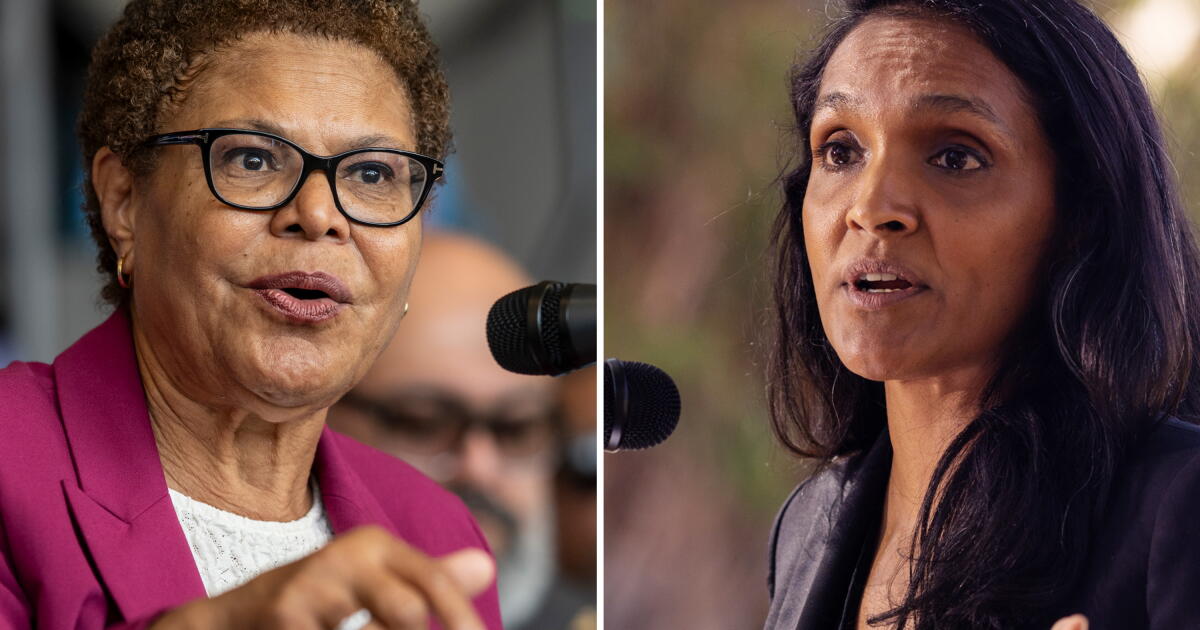
Mayor Karen Bass and her opponent, City Councilmember Nithya Raman, dropped new campaign commercials over the last week, buying time on television, streaming channels and other platforms. Supporters of both candidates released ads as well.
The two candidates relied heavily on free media for most of the summer, putting videos on Instagram and inviting the news media to cover their appearances.
The dam effectively burst on Monday, with Raman touting her new Hollywood-themed ad “For Your Consideration,” timed to coincide with the Emmy Awards.
You’re reading the L.A. on the Record newsletter
Sign up to make sense of the often unexplained world of L.A. politics.
By continuing, you agree to our Terms of Service, which include arbitration and a class action waiver. You agree that we and our third-party vendors may collect and use your information, including through cookies, pixels and similar technologies, for the purposes set forth in our Privacy Policy such as personalizing your experience and ads.
The 30-second spot starts with Raman stepping out on the town, then shifts to some standard L.A. imagery: freeways, palm trees, Echo Park Lake and, of course, the Hollywood sign.
“L.A. shows the world what it means to be a star,” declares the ad’s narrator, actor and screenwriter Bob Odenkirk. “And every Angeleno deserves the chance to reach for their own.”
After Raman has stopped off at a taco stand and hugged a dog, Odenkirk delivers the ad’s final message: “Change. Affordability. An L.A. that loves you back.”
That ad ran on television a few times before being cycled onto social media, per the Raman campaign.
Three days later, Bass went up with a 30-second spot — on digital platforms for now — centered on President Trump’s immigration raids.
The ad offers footage from the day in July 2025 when Bass confronted federal immigration agents in MacArthur Park. The video features images of gun-toting federal agents in military uniforms and Bass hopping out of a car in an aquamarine pant suit to face them.
“When someone comes after your family, you don’t hesitate,” Bass says. “You stand up. You fight.”
One of Bass’ most formidable allies — the Los Angeles Police Protective League — went hard negative with its first ad of the runoff campaign, offering the message that Raman “Doesn’t Get It.”
The commercial, released Friday, follows a young girl as she walks past a homeless encampment, juxtaposed against video of Raman talking about her opposition to a law that prohibits encampments near schools.
“I don’t think a kid’s gonna be safer because a tent is 500 feet away from a school,” Raman said in the clip, which was taken from a 2024 candidate forum in Sherman Oaks.
The backpack-wearing child speaks to the camera and says: “Walking to school shouldn’t be scary.”
“I’m just a kid,” she says. “But even I know I’d be safer if this was 500 feet away.”
The police union says the ad will start running on television this weekend and already is on social media platforms.
Meanwhile, Raman’s backers have an assortment of attack ads running on Facebook and Instagram.
Streets For All, a group that wants to expand the city’s bus and bike lane network, pulled video footage from a different Sherman Oaks candidate forum — this one featuring Bass and Raman last month.
At that event, Bass told the audience that Raman is unresponsive to her constituents, forcing many in Sherman Oaks to contact the mayor’s office directly.
“Many of you have my cellphone, you have called me,” Bass says in the ad. “You called on me specifically for help.”
Streets For All contends those remarks show that Bass gives wealthy homeowners her number while “regular Angelenos get ignored.”
“L.A. deserves a mayor who doesn’t just listen to the rich and powerful,” the ad says.
By Friday, Streets For All had nearly two dozen different video spots opposing Bass over such issues as homelessness, transparency and the Palisades fire, according to Ethics Commission filings.
The biggest backer of the group’s political action committee is hedge fund manager Aaron Sosnick. Of the $1.2 million that the group plans to spend in the mayor’s race, Sosnick has provided $1 million, said Michael Schneider, who heads the group.
Schneider said the committee also has financial support from retired real estate developer Yuval Bar-Zemer — known for his work in the Arts District — and Todd Wexman, chief principal of 4SITE Real Estate, a real estate development company.
Raman pollster says she’s in the lead
The Raman campaign shared the results of a new internal poll that showed their candidate with a five-point lead over Bass.
Of the 600 likely voters who were surveyed, 44% supported Raman and 39% backed Bass, with 17% undecided, according to a memo provided to the campaign and viewed by The Times. The survey, conducted by Hart Research Associates in early September, had a margin of error of 4 percentage points.
“In the initial trial heat for Los Angeles mayor, Councilmember Nithya Raman is in the rare position for a challenger of already LEADING the incumbent,” the polling firm wrote.
Another poll, commissioned by an independent expenditure group supporting Raman, portrayed the race as a statistical tie, at least initially. Estamos con Nithya for Mayor of LA 2026, sponsored by the Western States Regional Council of Carpenters, said its poll showed Bass with 38% and Raman at 37%.
However, when voters received more information on the candidates, Raman took a 7-percentage-point lead, with 41% supporting her and 34% supporting Bass, according to a memo prepared by the group’s pollster.
The margin of error was 3.7 percentage points.
The Bass campaign declined to share its internal polling when contacted by The Times.
However, Neighborhoods for a Better L.A., an independent expenditure group supporting the mayor, said a survey it commissioned in early August showed the mayor with an edge over Raman of 41% to 35%, with 24% of the electorate undecided.
That poll, conducted by Tulchin Research, surveyed 1,200 likely Los Angeles voters and has a 2.8-percentage-point margin of error, the group said.
The poll also found that when given “balanced biographies” about both candidates, Bass’ support grew to 45% while Raman went down to 33%.
“Communications focused on Raman’s record can both reduce her support and consolidate voters behind Bass,” the pollsters wrote.
Giving back El Grito cash
Los Angeles City Councilmember Imelda Padilla locked down sponsorships for the city’s celebration of El Grito, which marks Mexico’s independence.
Tuesday’s event, which featured an evening of musical performances, was sponsored by an assortment of city contractors and government agencies, including waste hauler Athens Services and the Department of Water and Power.
Still, Padilla decided she didn’t want to partner with one particular business, announcing at the last minute that organizers no longer would accept a $5,000 sponsorship from Home Depot.
On the day of the celebration, Padilla issued an apology on Instagram, saying she had heard from community members upset over the event’s affiliation with Home Depot, whose parking lots have been the site of many federal immigration raids.
“We have rescinded their partnership for this event,” Padilla said in her post. “The spirit of El Grito is rooted in celebrating our Latino heritage and creating a space where our families feel welcomed, safe, and celebrated.”
In an email, a Home Depot spokesperson said the company is not involved in immigration enforcement activities and doesn’t coordinate with Immigration and Customs Enforcement or U.S. Border Patrol. The company also doesn’t receive advance warning about enforcement actions, the representative said.
“We cannot legally interfere with federal enforcement agencies, including preventing them from coming into our stores and parking lots,” Home Depot spokesperson Evelyn Fornes said.
State of play
— COZY WITH CARUSO: Billionaire developer Rick Caruso, who was defeated by Bass in 2022, appeared alongside the mayor at a groundbreaking for the Palisades Recreation Center. Caruso praised her for her work on the project but stopped short of endorsing, saying he intends to meet with Raman in the coming weeks.
— LIFE AFTER PRATT: The voters who picked reality TV personality Spencer Pratt in the June 2 primary election are now up for grabs. But will they stay home instead of picking a mayoral candidate?
— BASS BAILS: The mayor skipped a congressional hearing on waste and fraud in homeless spending this week, calling the session politically motivated. Rep. Tim Burchett, the Republican who chaired the subcommittee meeting, accused her of dodging accountability.
— FINDING FRAUD: Federal authorities arrested three people who were working in Los Angeles-area homeless nonprofits this week, accusing one of them of misappropriating more than $7.5 million in taxpayer funds. Scott Turner, secretary of the Department of Housing and Urban Development, said the Los Angeles Homeless Services Authority, which provided the funding, had allowed fraud to “run rampant.”
— WE’RE IN THE MONEY: The 2028 Summer Olympic Games in Los Angeles will generate up to $40.6 billion in increased economic output and add as many as 224,000 jobs, according to an upbeat economic forecast released this week. Another, more tempered estimate put the increase at $20.5 billion to $25.4 billion.
— SEETHING OVER SKID ROW: Some activists want dogs taken away from homeless residents living in Skid Row, saying those animals are living in an unsafe environment. A Bass aide responded by cautioning that it is “neither humane nor legal to remove animals from their human companions without appropriate cause.”
QUICK HITS
Where is Inside Safe? The mayor’s signature program to combat homelessness went to Avalon Boulevard and 64th Street in South L.A., an area represented by Councilmember Curren Price.
On the docket next week: The council’s Public Works Committee meets Tuesday to discuss ways of cleaning, safeguarding or demolishing nuisance properties.
Stay in touch
That’s it for this week! Send your questions, comments and gossip to LAontheRecord@latimes.com. Did a friend forward you this email? Sign up here to get it in your inbox every Saturday morning.
In La Palma Park Stadium in Anaheim, a month before the Bay of Pigs invasion, 7,500 students and parents skipped school or work and gathered to learn about communist plans to take over the United States.
“Right now, we have a 50-50 chance of defeating the communist threat,” Herbert Philbrick, a former FBI agent, told the crowd on March 8, 1961. “Each day our chances grow less.”
Walter Knott, of berry-farm fame, sponsored the five-day “Christian Anti-Communist School” to help Orange County see the world that he saw, one where big government and liberalism led to Soviet domination.
The message stuck. Within the decade, Orange County would have 38 chapters of the conspiracy-minded, ultra-right-wing John Birch Society, which called Republican President Dwight D. Eisenhower a “communist tool.” Knott and actor John Wayne were members, as was the county’s congressman.
The rightward mobilization during the suburban explosion of the 1960s gave Orange County a national reputation for hard-line conservatism with a crackpot edge — “nut country,” in the words of Fortune magazine.
The county’s deep pockets funded right-wing candidates and movements throughout the nation. At home it spawned popular but ultimately doomed measures such as the Briggs Initiative in 1978 to ban gays and lesbians from working in public schools, and Proposition 187 in 1994, which would have denied public services to immigrants in the country illegally.
The Republican Party reached its peak in the Reagan era and has been slowly losing its membership edge since 1990, as the diversity of Los Angeles and the world at large started to bleed through the so-called Orange Curtain.
Source: California Secretary of State
(Priya Krishnakumar / Los Angeles Times)
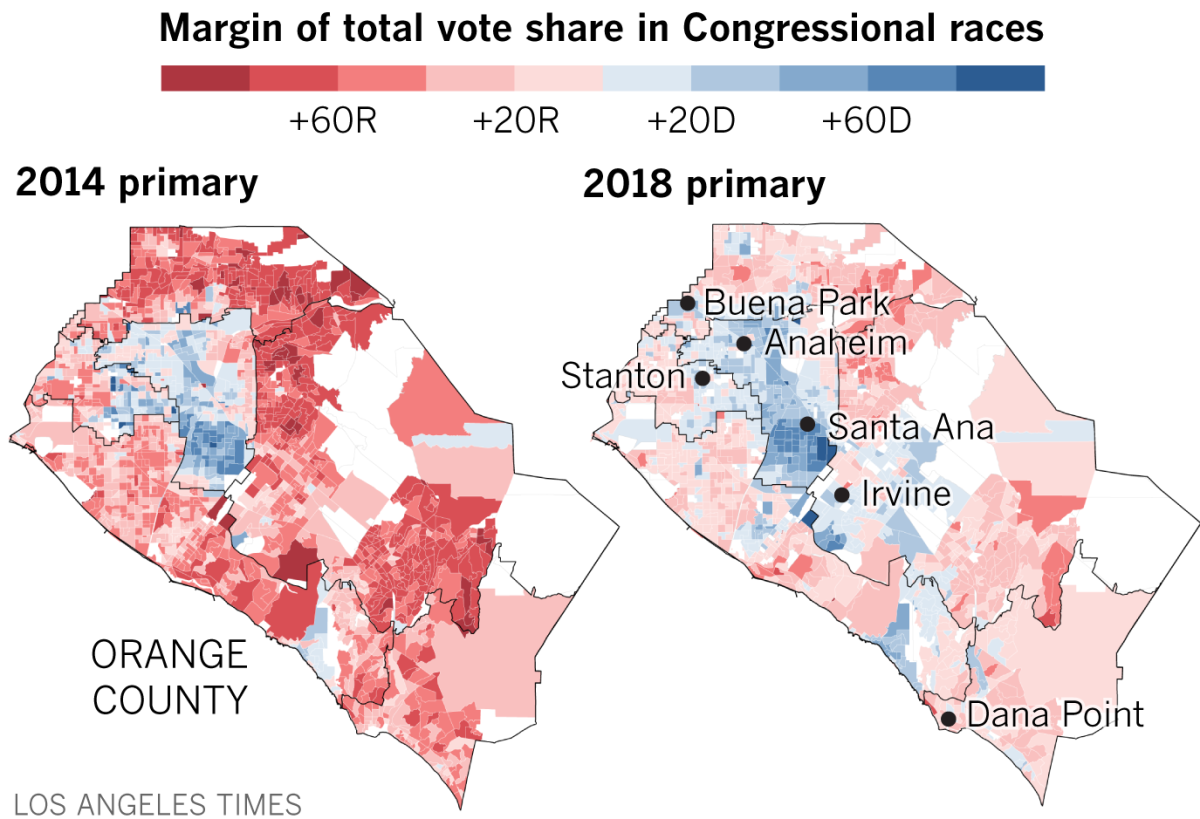
Registered Republicans today outnumber Democrats by only 2 percentage points, down from 22% at the peak, with a large contingent of self-declared independents positioned to swing elections either way. The GOP has a chance of losing four congressional seats in the county in Tuesday’s midterm election. If so, it would be the first time since the 1930s that Orange County would be without Republican representation in the House.
A GOP loss of even one or two seats would be significant, not as a turning point so much as a powerful sign of change — hastened by dislike for President Trump — in this one-time heart of American conservatism.
Source: Political Data, Inc.
(Priya Krishnakumar / Los Angeles Times)
::
Orange County seceded from its northwestern neighbor, Los Angeles, in 1889, led by fiercely independent ranchers, sheepherders, beekeepers, citrus growers and crop farmers who had bristled under the control of a rich city 30 miles up the rail line.
The county then was a constellation of small farm and dairy towns in the north and scattered resort towns along the coast. In the south, the basin tapered off into a narrowing valley between the Santa Ana Mountains and the coastal San Joaquin Hills, where sheep and cattle ranches had thrived since California was part of Spain and Mexico.
Americans had taken over the ranchos in the late 19th century after a devastating drought left many old landowners of Spanish ancestry, the Californios, broke.
Lewis Moulton was one of the Yankee migrants. He came from Boston in 1874 and grazed sheep on the open range from Oceanside to Long Beach. Family lore has it that natural gas seeps were so rich in some spots that, as he camped, he would light them to cook his breakfast.
After two decades of renting land, he and a Basque shepherd, John Pierre Daguerre, had enough money to buy Rancho Niguel, which they eventually expanded to 22,000 acres. It was rugged, isolated country, good mostly for grazing. The cheapest land was the steep part near the coast, between what would become Laguna Beach and Dana Point — about $15 an acre. Today, small fractions of an acre go for double-digit millions.
In the second half of the 20th century, these backwater ranchers and farmers, the Moulton family, the O’Neills, Floods, Irvines, Segerstroms, would physically and culturally shape Orange County into the suburban giant it is today.
But there was always an underclass that made their dreams work.
Tenant farmers — often with roots in Mexico, the Basque country or in California before the American conquest — rented spots on these ranches to graze and grow barley. Others toiled as hands for the landowners.
In the north, they lived in segregated barrios in Santa Ana, Westminster, Anaheim and Garden Grove — where their children attended separate “Mexican schools” until a federal appeals court ruled them unconstitutional in 1947. In the south, they made up smaller communities in El Toro and San Juan Capistrano.
Stephen Rios stands in the doorway of the adobe house in San Juan Capistrano built by his family in 1794.
(Mark Boster / For The Times)
“My tata got killed right there by the train when he was 93 years old,” Stephen Rios said of his grandfather, an American Indian named Mochanai, as he sat in his front garden across from the Mission San Juan Capistrano. “He was a vaquero, a well-known horse trainer.”
Rios’ family worked for the Moultons and O’Neills and lived in the adobe house built in 1794 for their ancestor Feliciano Rios, who came to California as a Spanish soldier and married an American Indian woman.
Rios, an attorney, inherited the home from his father and lives there today. His son’s bedroom has the ceiling boards that the famed bandito Joaquin Murrieta, a family friend known as the Robin Hood of El Dorado, would lift to hide in the attic in the 1850s. A flat-screen TV sits below them now.
The American Indian, Californio and Mexican residents of their dirt street — the oldest neighborhood in California — were conservative. “They loved their families, their church,” he said. “They loved their pieces of land. They were strong, religious independent people.”
Republicans reigned during the rural era. The land barons did not want labor organizers anywhere near their field hands.
When orange pickers walked out of the orchards in 1936, the strikers were arrested and beaten by police and mobs. The Times reported “old vigilante days were revived in the orchards of Orange County yesterday as one man lay near death and scores nursed injuries.”
Changes in Orange County’s 948 square miles — physical, demographic and political — have always rolled from north to south. While the Rios family was still living in the cowboy era, World War II brought rapid transformation to the northern part of the county.
The military needed more West Coast bases to fight the Japanese, and the open space between Long Beach and San Diego was perfect. The government built bases in Seal Beach, Los Alamitos, Santa Ana and El Toro.
Defense contractors and other big manufacturers followed: Hughes Aircraft, Rockwell, Ford Aeronutronic, Boeing, American Electronics, Beckman Instruments.
The farmers and ranchers became developers, or sold their land to other builders, creating vast tracts of homes across the northern end of the county from Huntington Beach to Fullerton. In this era of big cars and backyard barbecues, houses turned inward. Garages replaced porches and picture windows; neighborhoods were quiet.
The newcomers, many from the South and Midwest or white-flighters from Los Angeles, converged at church.
::
At its core, Orange County held a tension between Midwestern traditionalism and California’s drive for reinvention.
The midcentury suburbs in the north were libertarian-leaning enclaves, yet living on Washington defense spending, and listening to a sunny California-bred gospel of self-empowerment and prosperity.
An Iowan named Robert Schuller put out a newspaper ad in 1955, “Come as you are … In the family car!”
He preached from the roof of the snack bar at the Orange Drive-in theater, not about fire and brimstone, but about “possibility thinking” with catchphrases like “Turn your scars into stars.”
Robert Schuller, who delivered a new type of self-healing Gospel to the country, at the new Crystal Cathedral in 1980.
(Tony Barnard / Los Angeles Times)
Schuller’s congregation boomed, becoming one of the nation’s first megachurches. His “Hour of Power” television sermon beamed across the country. In 1980, he built a glass church longer than a football field, the Crystal Cathedral.
Orange County birthed hugely influential ministries that mixed God with conservative politics: Chuck Smith’s Calvary Chapel, Greg Laurie’s Harvest Crusade, Paul and Jan Crouch’s Trinity Broadcasting Network and Rick Warren’s Saddleback Church.
“The megachurches reinforced and marinated the conservatism coming out of the defense plants,” said Fred Smoller, associate professor of political science at Chapman University.
Orange County’s open space and space-age technology, coupled with fervent entrepreneurship and an-edge-of-the-continent mentality, let tinkerers and visionaries experiment with minimal regulation.
This was a suburban county that, like no other, reached deep into popular culture.
Knott’s Berry Farm was the nation’s first theme park. Disneyland became one of the world’s biggest destinations. The ministries reached millions. South Coast Plaza shopping mall would draw more people from around the world than Disneyland. The Irvine ranch grew into the largest planned city in America. Leisure World became the first retirement community.
Leisure World resident Jerry Wyss enjoys the pool in 1999.
(Mark Boster / Los Angeles Times)
In new coastal towns such as Dana Point and San Clemente, Hobie Alter, Gordon “Grubby” Clark and John Severson (living next door to Orange County native Richard Nixon in his “Western White House”) helped create a whole new culture around an ancient Polynesian sport that would become a multibillion-dollar surf industry.
In Laguna Beach, Tom Morey, a Douglas Aircraft composites engineer, invented the bodyboard. In Anaheim, the Van Doren brothers opened the first Vans store.
And the likes of Knott and Anaheim’s Carl Karcher, the founder of Carl’s Jr., would help give America a new brand of conservatism, with their friend John Wayne in Newport Beach to embody it.
With the Cold War at its peak in the 1960s, families in Orange County, so many of them in the military or defense industry, heeded their call.
“At living room bridge clubs, at backyard barbecues, and at kitchen coffee klatches, the middle-class men and women of Orange County ‘awakened’ to what they perceived as the threats of communism and liberalism,” wrote Lisa McGirr, a professor of history at Harvard, in “Suburban Warriors: The Origins of the New American Right.” “They became the cutting edge of the conservative movement in the 1960s.”
“The lack of a large organized working class and the near absence of racial minorities made it likely that Orange County’s political rainbow would consist of relatively few colors.”
The quiet homogeneity of the walled and gated communities allowed politicians to exploit fears of the outsider — whether they be African Americans from Los Angeles, immigrants from Mexico, or gays, Muslims and Koreans.
“The anti-minority stuff accelerated political careers here,” said Smoller, the political scientist. “We have a history of sending some real oddballs to Congress.”
An early one was Rep. James Utt, who in 1963 warned about the United Nations training “a large contingent of barefooted Africans” in Georgia to take over the country.
Cementing this conservatism: its daily newspaper, the Register, and its libertarian owner Raymond C. Hoiles. He had once waged war against a measure to improve mental health care in Alaska because he said it was a communist plot to brainwash Americans in concentration camps.
In 1964, Pat Donnelly, a young aerospace engineer working at McDonnell Douglas, bought a small home in Buena Park for $18,500. His neighbor’s first admonition to him: They must help ensure no blacks, Mexicans or Catholics moved in.
Donnelly was a Catholic, and even worse, a union-card-carrying Democrat who once played guitar and banjo in a touring folk band. He and his wife had two girls and joined the St. Pius V Church on Orangethorpe Avenue and started a choir. With his own slice of suburbia, he became more concerned about taxes and grew more conservative.
“I didn’t like some of the stuff I was seeing in the cities, the drugs and crime. It seemed like people were abusing welfare. I was paying for that.”
He switched parties and never looked back.
After Orange County’s favorite candidate Barry Goldwater lost to President Lyndon B. Johnson in 1964, Republican rainmakers turned their attention to Reagan’s run for governor. His first political fundraiser was at a home in Anaheim, and the county would nurture his ambitions the rest of his career.
By the 1970s, developers had reached deep into south Orange County. The Irvine Co. had wound down its cattle operations and was parceling out its 185 square miles of land. Some 1,500 acres near Newport Beach would become UC Irvine. The company developed a master plan for a city to grow around the university, which would incorporate in 1971.
The Moultons sold their land soon after to developers who would build Laguna Hills, Laguna Woods, Laguna Niguel and Aliso Viejo. In their yards, homeowners would find rattlesnakes that wandered out of the wild canyons and steep hillsides between subdivisions.
To the east and south, the O’Neills’ vast scrubby land would give way to even newer, posher cities such as Rancho Santa Margarita, Ladera Ranch and the community of Coto de Caza — the setting for the “Real Housewives of Orange County.”
With all this construction, Stephen Rios’ 225-year-old adobe home is hemmed in by suburbia.
The “Los Rios District” is now on the National Register of Historic Places and is highly sought-after real estate for its quaint atmosphere.
Most of the old Californio families sold and moved on.
“Everyone else wants to live here now,” Rios said.
Jared Mathis, left, and Scott T. Barnes stand off the trail in the Aliso and Wood Canyon Wilderness looking over the 22,000 acres that their great-grandparents bought in the 1890s.
(Mark Boster / For The Times)
Lewis Moulton’s great-grandson, Jared Mathis, came back from a job back east to Laguna Hills to manage the family’s remaining holdings. A few years ago, he took his dad — who moved away in the 1970s — for a drive to look at the old ranch where he grew up.
But his father couldn’t get his bearings. All the landmarks were gone, the hills terraced, new trees and houses blocked once wide views. “They say they moved more dirt building Aliso Viejo than they did digging the Panama Canal,” Mathis said.
Mathis drove his father to the ridgeline of Laguna Beach. From there, you could see the whole ranch area, smell the laurel sumac in Aliso Canyon, glimpse some old corrals in the distance, get a grip of the topography. The white striations of terraced neighborhoods faded in the haze. The twin peaks of Modjeska and Santiago, called Old Saddleback, framed the view, as they did in most of the county, one thing that never changed.
“He could see where they had the old roundups,” he said. “That was a powerful image for him.”
As development moved south, the older, northern parts of the county lost some of their luster. The affluent white Republicans drifted to the shinier places depicted in shows such as “The O.C.”
The explosion in South County home construction created thousands of jobs. “The people building all of those houses were Latino,” said Smoller, the political science professor. Like the old tenant farmers, they helped families such as the Irvines realize their dreams.
Thousands of other Latinos would follow to work in service jobs in these wealthy new areas.
The humming economy overall and good schools also lured professional and middle-class Latinos to the northern neighborhoods that Anglos were leaving in their migration south.
In Santa Ana in the 1970s, the population of Latinos went from 40,000 to 90,000. Today, Latinos account for 78% of Santa Ana’s population. Northwest Orange County looks a lot like Southeast L.A. County. La Habra is 57% Latino; Anaheim, 52%; Buena Park, 40%; Garden Grove, 37%.
The other big factor that brought demographic change was seeded 53 years ago, when the federal government removed racist quotas on immigrants from Asia, and Greater Los Angeles became a major destination for Koreans and Chinese.
In 1975, after Saigon fell, 50,000 South Vietnamese landed in nearby Camp Pendleton, and conservative Orange County stepped up to take the anti-communist refugees.
The Register called on churches and citizens to sponsor these newcomers. They were put up in apartments in neglected parts of Westminster and Garden Grove still surrounded by bean fields.
Soon the fields and dilapidated commercial strips gave way to bustling places such as Saigon Market and Hoa Binh Market, ushering in a wave of new Vietnamese businesses that would revitalize the area.
Frank Jao started off in America selling Kirby vacuum cleaners in Whittier. Within a year, he moved to Garden Grove, became a real estate agent, then developer, first building a shopping mall in Westminster with the help of Chinese investors.
So many Vietnamese storefronts were opening in Westminster, changing its look so rapidly, that more than 100 residents signed a petition calling for the city to stop issuing business licenses. It was an ugly time.
“Anyone driving on Bolsa would more than occasionally be confronted by drivers who rolled down their windows and asked us to roll down ours, and they’d give us the middle finger,” recalled Jao, now 70. “When we’d go to work in the morning, we’d find the windows shot out by BB guns.”
His buildings became the core of Little Saigon, notably its landmark Asian Garden Mall. His company built $400 million worth of shopping centers and apartment buildings throughout Orange County and beyond.
Upscale Chinese families took to Irvine. Many had left China because of the lack of opportunities for their children to attend college, and this master-planned community, built around UC Irvine, was a huge draw, as it was to moderately affluent Koreans, Iranians and Latinos. Irvine is nearly 40% Asian now.
Koreans had begun trickling in from Los Angeles during the 1980s, seeking better schools. The 1992 Los Angeles riots, in which many Korean store owners lost their businesses, sped up the flow. They often stuck close together, moving into specific neighborhoods in Garden Grove, Fullerton and Buena Park.
The Asian influx has also contributed to the reordering of politics in once reliably Republican Orange County.
As a whole, Asian Americans are more likely to register as “no party preference” and vote based on specific issues, not party, said Karthick Ramakrishnan, a professor of political science and public policy at UC Riverside. They leaned Republican during the Reagan era and well into the 1990s while subsequent generations moved to the left.
“About one-third of Asian Americans voted for Clinton in 1992,” Ramakrishnan said, “but two-thirds voted for Obama in 2008.”
He said in the last five years strong GOP outreach to the community in Orange County — and encouragement of Asian Americans to run for office — has brought many back to the party. But Ramakrishnan said too many factors are at play to say how they will vote on Tuesday. An example: They don’t like Trump’s anti-immigrant rhetoric, but Vietnamese, Taiwanese and Koreans like his confrontational stance toward China.
In Buena Park, Pat Donnelly, still a Republican, met a Korean American estate attorney named Sunny Park — a Democrat — at his Lion’s Club. He came to realize she had values he admired: honesty, a family focus, strong work ethic. Now he’s campaigning for her as she runs for City Council.
Park had followed her aging Korean clients from Los Angeles, moving into the affluent and increasingly Korean Bellehurst neighborhood. When she knocks on doors, many white people have offered support. But some have grumbled “No Koreans” and shut the door in her face.
A couple weeks ago, she started seeing campaign signs that said “No Sunny Park, Carpetbagger.”
She says the message that sends the Korean community is that she — and by extension they — are not from here and they shouldn’t try to take part in politics.
The political dynamic in Orange County is not so much a rising blue tide, but an ebbing red one. Since 1999, registered Democrats rose by less than 2 percentage points to 33.6%, while Republicans have fallen 14 points to 35.6% of voters. The wave is of independent voters who increased in numbers nearly as much as the Republicans fell.
A majority of Latinos vote Democrat, and growth in their community has buoyed the party. While they tend to be more socially conservative, they favor more lenient immigration policies, social programs that help the poor, strong unions and high minimum wages.
Historically, turnout has not matched their share of the population, but some Republican strategists fear Trump’s derogatory comments about Mexican and Central American immigrants might motivate them this year.
In 1996, the anti-immigrant rhetoric surrounding Proposition 187 helped end the ultra-right Orange County Republican Bob Dornan’s political career, and put Democrat Loretta Sanchez in Congress.
Just like the development, the diversity and Democratic edge are pushing south in this county of 3.2 million people.
In 2002, Democrats outnumbered Republicans only in Santa Ana, Buena Park and Stanton. Now they do in 11 cities reaching down to Irvine.
In Laguna Niguel, Candy Antone, 47, said Democrats such as her essentially lived in the closet until recently. She would go quiet when a Republican friend or neighbor would go on a political rant. “You just had to bite your lip,” she said.
But Trump is repelling even many Republicans here. “Democrats are coming out of the woodwork,” Antone said. “People we’ve known for years, we’re just finding out they’re Democrats.”
We’re living under a dark cloud, with a steady downpour of graft, thuggery and baloney.
There’s the raffling of presidential pardons and the attacks on reporters for doing their jobs, the clownish trade war with Canada, the bungled disaster in Iran, the petty obsessions with the ballroom and the Kennedy Center, the hogwash about a stolen election, the attacks on immigrants and the shameless presidential profiteering while working people suffer the cost of Trump’s countless broken promises.
I could go on, and I will. But rest assured, I have not forgotten about the boost I promised.
For all the affronts, nothing strikes me as more sinister than the Trump administration’s ambitious assault on the planet. Despite nearly daily headlines about the global calamity of overheated oceans, melting glaciers, stark weather transformations and species extinction, Trump keeps shoveling more coal onto a fire that will rage long after he’s dead and gone.
He’s gutted environmental protections and scientific research and dismantled clean energy initiatives. Now his administration is rolling back limits on power plant emissions, attempting to open the California coast to more oil drilling and sabotaging the state’s ambitious goals on emission controls and electric vehicle conversion.
We don’t need AI to threaten the future of humanity. We’ve got Trump.
It’s tempting to duck under the covers and wait for the nightmare to end, but the good news is that a lot of people are standing up rather than rolling over, rebelling against the ignorance and callous disregard that threatens our most precious and fragile shared inheritance.
In August, hundreds showed up to defend California’s authority to govern its own coast at a Santa Monica hearing of the National Oceanic and Atmospheric Agency, and 18,000 more people filed comments online.
The rollback of environmental safeguards is, for many, a call to arms.
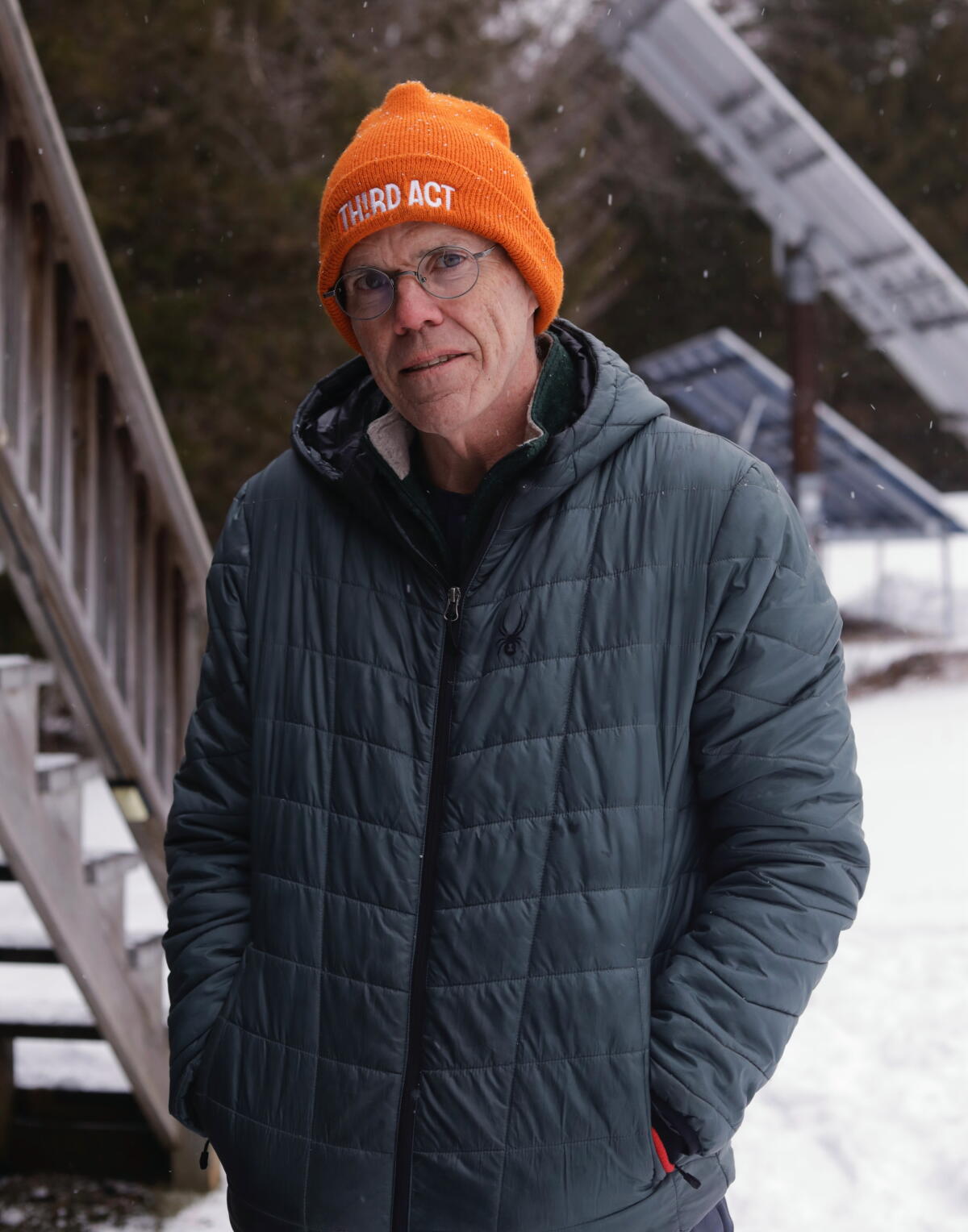
“Yes, I am discouraged. … But I am not despairing,” said Bill McKibben, an author and environmental activist who is organizing a worldwide event called Sun Day for next year to promote clean energy. “We’re reacting to multiple crises, and we’re led by a pack of fools, so why would anybody not stand up?”
McKibben launched a national movement five years ago called Third Act, and tens of thousands of people 60 and older have signed on to advocate for climate action, voting rights and civic participation. Third Act now operates in about 30 states, with a robust chapter in Southern California.
Former Times reporter Zan Dubin has worked as both a volunteer and a paid communications consultant for Third Act, and I asked her what someone could expect to do if they became a member of Third Act/SoCal.
Environmentalist and author Bill McKibben is organizing a worldwide event called Sun Day next year to promote clean energy.
(Amanda Swinhart / Associated Press)
“We do it all,” Dubin said, from promoting climate-friendly candidates to running phone banks and testifying at public meetings. She said Third Act co-sponsors protests at Dodger Stadium, and she and others planned to meet at Vin Scully Avenue and Stadium Way for Sunday’s game against the San Francisco Giants. They want the Dodgers to stop doing business with Big Oil and bench their sponsorship deal with Phillips 66.
She also called out Disneyland for its exhaust-spewing Autopia attraction, along with former Times climate columnist Sammy Roth, and Disneyland responded by announcing in 2024 that it was switching to electric cars beginning in 2027.
Dubin, co-founder of National Drive Electric Week, said 170 volunteer-led events were being held nationwide over the next month to promote EVs, and she was leading one Friday in Irvine.
“Action is absolutely the antidote to despair,” Dubin said. “I find that despite the onslaught of these horrifying headlines … taking action invigorates me.”
Claremont resident Margaret Davis knows that feeling. She emailed me in 2023, prior to participating in a Third Act event, and said many retirees have time on their hands, which puts them in a powerful position.
“The climate crisis is the greatest existential threat humans have ever faced, hence we live in a time when we can make the greatest change for the better,” Davis wrote at the time.
When I called her a few days ago, Davis told me she’s now a member of Senior Stewards Acting for the Environment. She lives at Pilgrim Place — a senior community with a focus on justice, peace and environment — where residents meet regularly to study, discuss and advocate for sustainability, biodiversity and environmental causes.
“When I was in college in 1970, we had the antiwar movement and that was the first year of Earth Day,” Davis said. “At the time, I thought Earth Day was just a distraction from what was going on in the world.”
Later, she said, “I came to realize it was the biggest issue of all time.”
Climate activist Sim Bilal stands next to pumps at an oil field in Los Angeles in 2024.
(Allen J. Schaben/Los Angeles Times)
Like Davis, I went to college in the ‘70s, and there’s no denying that our aggressively consumptive generation played a key role in manufacturing a crisis for our children and grandchildren. We’ve got matches in our hands and smoke on the horizon, and if we’re honest with ourselves, we’d see atonement not as a hobby, but as a duty.
As for the next generation, climate activist Sim Bilal, 24, said he too shares the sense that this is both a wickedly frightening time and a moment of opportunity.
“In the last month, we’ve gotten more young people involved,” said Bilal, executive director of Youth Climate Stewards 4 Local Action. “We usually have to reach out to them, but so many people have been wanting to get involved, and they’re so eager, and that’s been affirming for me. The policies are depressing, but the fact that people are reenergized and want to fight back is really exciting.”
Bilal said faith in politics, government and corporations is not high among his peers, but he’s trying to grow a network of young people to cultivate and support future leaders.
“A mentor told me there are two kinds of power — organized people, and organized money,” said Bilal, whose activism began when his grandmother died and he began wondering if her cancer, and global warming, were connected to the oil drilling in his South L.A. neighborhood. “We don’t have the money, but a lot of the work we do is political and civic education, demystifying power, and making people understand they have agency.”
Israel’s bitter political divisions are particularly sharp before the country’s October elections. But the furious response to a new documentary about the military’s actions in the genocidal war on Gaza has revealed an issue that much of Israel’s political and media establishment appears united on.
Few of the central allegations in NAZA, made by Israeli filmmakers Yuval Abraham and Rachel Szor, are new. Reports that the Israeli military was relying on artificial intelligence systems to generate targets in Gaza, often killing the inhabitants of entire buildings to kill just one individual identified by the system, were reported in April 2024.
Recommended Stories
list of 4 itemsend of list
Other accusations against Israel, such as committing genocide, deliberately causing a famine, and unlawfully killing children, have also not received much attention in Israel.
In contrast, NAZA has unleashed a litany of abuse from across Israel, and brought the allegations to the centre of Israel’s political debate.
Culture Minister Miki Zohar reacted to the film’s premiere at the Venice Film Festival – where it received a 25-minute standing ovation – by calling for the directors to be stripped of their citizenship and to be investigated by the internal intelligence service for treason.
Army chief Eyal Zamir has dismissed the film as being built on blood libel and ordered a legal probe to hunt down its military and intelligence sources.
Prime Minister Benjamin Netanyahu also cited the film when advancing legislation to revoke citizenship from anyone deemed to be smearing the country’s soldiers, while in the coastal city of Ashdod, graffiti branding the directors “traitors” has appeared on the walls.
“You can’t really understand the extent of the madness from outside of the country,” Orly Noy, an editor at Local Call, which first carried many of the accusations contained in the film, said. “They’re attacking the friends and families of [the filmmakers] Yuval Abraham and Rachel Szor. They’re talking about revoking their citizenship. They’re asking the Shin Bet to investigate them – for making a film, and it isn’t just the politicians. Journalists, who you might expect to show some kind of solidarity with them, are competing to attack them. It’s scary.”
Denial
In late 2025, the Committee to Protect Journalists reported escalating censorship and harassment in Israel, with Israeli journalists telling the organisation that the media’s approach had become “part of the war effort” and, by extension, significantly shaped Israeli view of their war on Gaza.
In October 2025, a study by the Israeli think tank Molad found that only 3 percent of Channel 12’s coverage of the first six months of the war mentioned Gaza’s humanitarian crisis. Of 206 war-related images and video clips broadcast by the network, Israel’s most-watched channel, only two showed Palestinian civilian casualties.
Nevertheless, before the film’s release, polls found that most Israelis believed the coverage they were receiving of the military’s conduct in Gaza was balanced.
Director Yuval Abraham and Director Rachel Szor winners of the Special Jury Prize for “Naza” attend a photocall on the red carpet following the closing ceremony of the 83rd Venice Film Festival at Venice Lido on September 12, 2026 [Tiziana Fabi/AFP]
“I guess it was because the mainstream media outlets in Israel did not investigate the conduct of the army during the war in Gaza, and hardly covered the war from the Palestinian point of view,” Anat Saragusti, the Israeli jurist and journalist responsible for press freedom at the Union of Journalists in Israel, said of the shock that had accompanied the release of the film. “[The Israeli media] hardly reported on the human toll and the scale of the humanitarian crisis in Gaza.”
Compounding the gap, Saragusti said, was a deep-seated national narrative: that the war had been imposed on Israel, that Hamas had carried out a massacre on October 7, 2023, and that Hamas’s use of civilians as human shields made mass casualties in Gaza all but unavoidable.
Palestinian deaths, in this telling, were framed less as the product of Israeli conduct than as collateral damage forced on Israel by its enemy’s tactics, she said.
Lynch mobs
“Even journalists that usually support the anti-Netanyahu bloc have criticised the filmmakers,” Israeli political sociologist Daniel Bar-Tal said.
“Israeli Jews deny the genocide,” he continued, “Even all the opposition parties joined the vicious criticism of the filmmakers.”
The language used against the filmmakers has been echoed by some of Netanyahu’s most prominent political rivals.
On Monday, former military chief and one of Netanyahu’s principal rivals Gadi Eisenkot denounced the film for “moral blindness, a detachment from reality, and harm to the State of Israel in a difficult hour”.
Former Prime Minister Naftali Bennett, who is also running in October’s election, called the film a “horrific blood libel against our sons and daughters”.
“Everything gets heightened the closer to the election we get,” Noy said. “But I think only now, for those of us who live here, is the extent of the fascism becoming clear. Journalists, politicians and the media are forming some kind of incitement machine.”
“I’ve had anxieties over where Israel had been going for a long time,” she said, “but right now I’m genuinely worried for my friends and colleagues.”
WASHINGTON — The governor of a Japanese territory where the Pentagon is thinking about basing missiles capable of threatening China has a message for the United States: Not on my island.
“I firmly oppose the idea,” said Gov. Denny Tamaki, the governor of Okinawa, in an email to The Times.
Officials in other Asian countries are also signaling they don’t want them.
But Pentagon planners aren’t backing down after the Trump administration withdrew last year from a 33-year-old arms control treaty that barred U.S. land-based intermediate-range missiles in Asia.
Senior officials now say that putting hundreds of American missiles with nonnuclear warheads in Asia would quickly and cheaply shift the balance of power in the western Pacific back in the United States’ favor amid growing Pentagon concern that China’s expanding arsenal of missiles and other military capabilities threaten U.S. bases in the region and have emboldened Beijing to menace U.S. allies in Asia.
The missile plan is the centerpiece of a planned buildup of U.S. military power in Asia projected to consume tens of billions of dollars in the defense budget over the next decade, a major shift in Pentagon spending priorities away from the Middle East.
But it also highlights the complex relationship between the U.S and its Asian allies, many of whom feel increasingly threatened by China but are reluctant to back new U.S. military measures that might provoke Beijing, which has built the biggest navy in the world in the last decade.
Australia and the Philippines publicly ruled out hosting American missiles when the Trump administration first floated the idea last year. South Korea is also considered an unlikely location, current and former officials say.
In Japan, the decision on whether to allow U.S. missiles on its territory will be made by the central government in Tokyo. Gov. Tamaki said officials at the Pentagon and in Tokyo have told him there are no definite plans to put missiles on Okinawa. But Tamaki isn’t reassured.
With a Japanese mother and an American father who served with the Marines on Okinawa before abandoning the family, Tamaki personifies the complex relationship between the U.S. and its allies in Asia. He was elected two years ago after pledging to oppose expansion of the already-substantial U.S. military presence on the island.
More than half of the 50,000 U.S. military personnel stationed in Japan are in Okinawa, most concentrated at a Marine base surrounded by residential areas in the largest city. Opposition to the 70-year-old U.S. military presence has sparked local protests for years, which would probably intensify if there were a move to base missiles there.
“If there is such a plan, I can easily imagine fierce opposition from Okinawa residents,” Tamaki said.
For the last year, the Pentagon has been testing several new types of short- and intermediate-range missiles — those with ranges up to 3,400 miles — including a ballistic missile that could be placed in Guam, a U.S. territory, and mobile missiles carried on trucks.
The first of the new weapons could be in operation within two years, though no decision has been announced about where they will be based. Similar missiles are now carried on U.S. warships and planes based in Asia, but there are no land-based systems.
U.S. officials say that many allies are privately supportive of the missile plan and may come around to permitting them on their territory but don’t want to provoke opposition from Beijing and their own public before decisions are on the table.
The U.S. has a defense treaty with Japan, as it does with South Korea, the Philippines and Australia. Taiwan is not a formal ally but has close, unofficial defense ties with Washington.
“We are very attentive to our allies’ concerns, and we recognized their political challenges,” said a senior defense official, who agreed to discuss Pentagon planning if he was not identified. “Everything that’s said in the media is not necessarily what’s said behind closed doors.”
To lessen the political opposition, the U.S. could rotate missile batteries in and out of locations around the region or place them in strategic locations without publicly disclosing it.
“It wouldn’t make much sense to announce plans now, which would stoke Chinese anger and possibly play into the domestic politics,” said Randy Schriver, who was a senior Pentagon official responsible for Asia until his resignation last year.
A decision to go ahead in Asia would intensify an arms race between the region’s two biggest powers whose relations — already tense over President Trump’s confrontational trade agenda and Chinese President Xi Jinping’s hawkish policies — have nosedived since the coronavirus outbreak.
“It’s naïve and dangerous,” said Alexandra Bell, a former Obama administration arms control official and a critic of deploying U.S. missiles. “Instead of looking at how we can prevent a full-out arms race, that’s our opening salvo?” added Bell, a senior policy director at the Center for Arms Control and Nonproliferation in Washington.
Putting land-based missiles in Asia capable of attacking China is not a new strategy.
In the 1950s and 1960s, the U.S. kept them at bases across the region, including in Okinawa, where hundreds of nuclear-armed warheads were stored secretly for decades even though Japan’s constitution prohibited the presence of nuclear weapons on its territory.
The missiles were gradually taken out of service in the 1960s and 1970s, because of budget cuts and a shift in U.S. strategy away from defense of the region focused on nuclear weapons. In 1987, the Reagan administration signed an arms control treaty that prohibited the U.S. and the Soviet Union (and later Russia) from deploying any land-based intermediate range missiles, including in Asia.
China was not a signatory, leaving it free to build up its missile arsenal.
The Trump administration withdrew from the treaty last year after accusing Russia of developing new land-based missiles that violated its terms. The exit opened the way for the Pentagon to consider reintroducing ground-launched missiles in Asia.
With mobile missiles around the region, the U.S. could pose an even bigger challenge for China, forcing it to hunt for hundreds of launchers capable of targeting its planes, ships and bases, strategists say.
“Ground-based missiles aren’t some kind silver bullet,” said Eric Sayers, a former consultant to U.S. commanders in the Pacific and a fellow at the Center for a New American Security, a Washington think tank. “But they are a way in the near term … to create dilemmas for the [People’s Liberation Army] planners.”
Although the risk of large-scale conflict with China seems low, tensions have continued to ratchet up over Beijing’s crackdown in Hong Kong, its military maneuvers near Taiwan, its border dispute with India and its offshore maritime claims in the East China Sea and South China Sea.
Nearly a quarter of world trade travels through the South China Sea, making the contest between Beijing and Washington over control of its maritime lanes and rich resources especially tense and certain to continue, no matter who wins the U.S. presidential election in November.
The U.S. Navy for decades dominated the “first island chain,” as strategists call the area of the western Pacific stretching from Japan to Taiwan to the Philippines that fell within America’s defense umbrella after World War II.
But American reliance on bases, warships and airfields in the region has become increasingly risky, officials and analysts say.
Sign up for alerts
Get breaking news, investigations, analysis and more signature journalism from the Los Angeles Times in your inbox.
By continuing, you agree to our Terms of Service, which include arbitration and a class action waiver. You agree that we and our third-party vendors may collect and use your information, including through cookies, pixels and similar technologies, for the purposes set forth in our Privacy Policy such as personalizing your experience and ads.
China has developed its own missiles, sophisticated radars and anti-satellite weapons as well as a growing fleet of warships and submarines in recent decades that could threaten American bases and other targets early in a conflict, said Collin Koh, a research fellow in Asian maritime security at the S. Rajatnam School of International Studies in Singapore.
China’s People’s Liberation Army can project significant firepower on U.S. and allied military installations in the western Pacific and “threaten to overwhelm” American forces “in times of armed conflict,” Koh said.
The Chinese weapons in many cases have ranges that exceed those on U.S. warships, though the U.S. retains a significant advantage in attack submarines and in advanced fighters and bombers armed with cruise missiles that can be fired from long distances.
“Their capability and their reach have created vulnerabilities for our legacy basing structure,” said the defense official, who agreed to discuss U.S. planning on condition that he not be identified.
Gov. Gavin Newsom on Friday vetoed legislation that would have narrowed exemptions to the California Environmental Quality Act for advanced manufacturing facilities amid pushback from business and industry groups.
Senate Bill 954 from state Sen. Catherine Blakespear (D-Encinitas) would have rolled back parts of last year’s controversial overhaul of CEQA, which fast-tracked approvals for a broad array of housing and infrastructure projects in an effort to ease new construction in the state.
Critics said the overhaul opened up a path for advanced manufacturing facilities such as strip miners, chemical producers, battery recyclers and semiconductor plants to open in communities without any environmental review. Dozens of environmental groups including the Sierra Club, the Natural Resources Defense Council and California Environmental Voters urged the governor to sign the legislation into law, arguing that it would have provided essential protections for communities that already experience the worst pollution from industrial facilities.
In his veto message, Newsom said last year’s CEQA reform was a “long overdue overhaul to get California building again.”
“While I appreciate the author’s stated intent to ensure these reforms do not result in unintended adverse impacts on the environment, this bill does not merely clarify or refine the existing exemption. It repeals the CEQA exemption for advanced manufacturing facilities,” the governor wrote. “Further, the bill’s numerous new siting, operational, and emissions requirements would make the narrower exemption impractical for many of the projects it was intended to support.”
In a statement, Blakespear said she was “disappointed” in the governor’s decision. While some of the new CEQA exemptions are important to stimulate construction, the recent near-miss chemical disaster in Garden Grove — which prompted thousands of evacuations in May —illustrates the danger that can come from siting advanced manufacturing facilities in communities, she said.
“We should not have to wait for another emergency before recognizing that sweeping — and rushed — exemptions from environmental review need reasonable guardrails,” Blakespear said. “Protecting communities and workers is not an impediment to economic growth; it is part of responsible growth. We need guardrails to these CEQA exemptions to safeguard Californians and ensure the environment isn’t damaged.”
Newsom’s veto came amid pushback from industry groups and prominent business organizations including the California Chamber of Commerce and the California Manufacturers & Technology Assn. The California Department of Finance also was opposed to the bill, which it described in an analysis as “inconsistent with Administration policy.”
Lance Hastings, chief executive of the California Manufacturers & Technology Assn., said in a statement Friday that the governor’s veto protects “the ability of manufacturers to innovate and create here in California.”
Manufacturing generates $382 billion a year for California and supports 1.24 million jobs, he said.
But opponents said Newsom’s decision will ultimately endanger communities and leave more people exposed to industrial hazards.
“Frontline communities across California continue to face consequences from polluting industries that have damaged our air, and water for the sake of corporate profit,” said Asha Sharma, deputy director at the nonprofit Sierra Club California. “SB 954 was developed to ensure those same mistakes do not continue.”
Blakespear said she will continue working on the issue next year.
US judges affirm migrants must have opportunities to voice safety concerns before deportation to unfamiliar nations.
Published On 19 Sep 202619 Sep 2026
A US federal appeals court has rejected the Trump administration’s policy of rapidly deporting migrants to countries other than their own – a ruling that could next go before the Supreme Court.
On Friday, a three-judge panel of the 1st US Circuit Court of Appeals in Boston largely upheld a February decision that found the Department of Homeland Security’s so-called third-country removal policy unlawful.
Recommended Stories
list of 3 itemsend of list
The case stems from a class-action lawsuit testing what due process migrants are owed before being sent to nations with which they have no ties.
Writing for the panel, US Circuit Judge Seth Aframe said migrants must be given a “meaningful” chance to raise safety concerns before removal, rejecting the Trump administration’s narrower reading of the law.
The court did overturn part of the ruling on procedural grounds, concerning whether officials must first try deporting migrants to countries they have ties to.
Trina Realmuto, a lawyer for the plaintiffs at the National Immigration Litigation Alliance, said the decision confirmed that “due process and the protections Congress enacted against persecution and torture cannot be circumvented by putting someone on a plane to a country that was never part of their removal proceedings”.
The DHS did not immediately comment. The Trump administration is expected to appeal the ruling.
Under Trump, the US has struck agreements allowing it to send more than 25,000 migrants to at least 29 third countries, most often Mexico, according to Third Country Deportation Watch, a tracker run by the rights groups Refugees International and Human Rights First.
The policy, adopted in March 2025, allowed removals with only minimal notice if officials had diplomatic assurances against persecution.
The controversial programme has reached the Supreme Court twice.
In 2025, the justices cleared the way for eight men, including nationals of Cuba, Myanmar and Vietnam, to be deported to South Sudan, a country the US State Department advises against visiting because of “crime, kidnapping, and armed conflict”.
The DHS called the removals “a win”, while rights groups said they flouted basic protections.
The Trump administration’s immigration agenda has faced a string of setbacks this month.
A federal judge blocked planned caps on student and journalist visas, calling the government’s justification “exceptionally weak”, while a coalition of 22 states and Washington, DC, sued to stop a separate rule that would let officials deny green cards to immigrants who lawfully use public benefits.
After a bitter standoff, Paramount Skydance and California Atty. Gen. Rob Bonta have made progress in settlement talks that could push Hollywood’s massive merger over the finish line, people familiar with the matter said Friday.
The two sides have quietly been negotiating a truce to end the antitrust lawsuit brought by Bonta and 11 other Democratic state attorneys general — a legal volley that has threatened to derail Paramount’s $111-billion takeover of Warner Bros. Discovery.
It’s not clear how close to a resolution the two sides are, but talks in recent days have been constructive, one of the knowledgeable sources said.
Paramount Chief Executive David Ellison is highly motivated to end the court battle with Bonta before Oct. 1, when his company will be obligated to make a higher payout — an extra $7 million a day — to Warner Bros. Discovery shareholders on top of the $81 billion the company has already agreed to pay.
For weeks, Ellison and his team have been ratcheting up political heat on Bonta to abandon his lawsuit, including threatening to pull Paramount out of Hollywood — a scenario that has rattled state and local lawmakers who desperately want to bring film jobs back to Los Angeles, not lose thousands more.
Paramount declined to comment.
A spokesperson for Bonta’s office said in a statement: “Potential settlement talks are confidential. We cannot confirm or deny whether settlement talks are occurring or their alleged substance.”
Both sides have incentives to settle. Ellison, who has leaned on his family’s connections to President Trump and Washington Republicans, would like to avoid taking on more debt for the already highly leveraged deal. And he is eager to close the transaction and take the reins at Warner Bros. before the midterm elections.
Bonta has been on a winning streak with favorable rulings against the Trump administration and social media giant Meta, and he doesn’t want to overplay his hand or risk having his coalition of state attorneys fall apart.
The war in Yemen intensifies with mounting clashes and reciprocal attacks between Saudi forces and the Houthis.
Published On 18 Sep 202618 Sep 2026
Yemen’s Houthi rebels have said Saudi Arabia carried out 26 strikes against areas under the group’s control in the past 24 hours, as the two sides continue trading attacks amid an escalating war in Yemen, according to the AFP news agency.
On Friday, the group claimed Saudi strikes on Houthi-held territory had reached 300 over the past week alone, hitting positions across the areas it controls, AFP reported.
Recommended Stories
list of 3 itemsend of list
Yemen’s government, backed by Saudi Arabia, said on Friday its forces had killed 30 Houthi rebels and wounded more than 60 in clashes in the al-Wazi’iyah district of Taiz province, one of several fronts where combat has picked up this week.
The exchange has come on the heels of a widening escalation of fighting in Yemen between the government’s military and the Houthi fighters.
Tens of thousands marched through Sanaa on Friday in a show of support for the Iran-backed Houthis and against Saudi Arabia, as the rebels press gains that have brought large stretches of Yemen’s Red Sea coast, including the strategic Bab al-Mandeb Strait, under their control.
Earlier this week, the intensifying attacks between the Yemeni government and the Houthi rebels killed at least five people, including three children, according to reports from both sides.
Saudi Arabia said one person was killed in the Taif governorate after a Houthi drone was intercepted, while Houthi-linked media reported deaths from Saudi strikes in Taiz and the town of Abs.
The escalation has drawn in Washington, though reluctantly.
US officials met Houthi representatives at the US embassy in the Omani capital, Muscat, over the weekend after the group’s rapid territorial gains raised concern over shipping through Bab al-Mandeb, a vital corridor for global trade.
The Houthis reportedly assured Washington that vessels not linked to Saudi Arabia would not be targeted.
Despite appeals from Riyadh for US President Donald Trump to strike the Houthis directly, Washington has so far held back, wary of opening a new front while still fighting a costly war with Iran.
Meanwhile, European Union foreign policy chief Kaja Kallas said on Friday the bloc’s Red Sea naval mission, Operation Aspides, had raised its alert level as the situation in the region worsened, the Reuters news agency reported.
“Houthi attacks on Saudi Arabia are unacceptable and sabotage the global economy,” Kallas said in a post on X.
She added that she had spoken with Saudi Foreign Minister Prince Faisal bin Farhan Al Saud about diplomatic efforts to end the fighting in Yemen and restore freedom of navigation in the Strait of Hormuz.
Denmark and Greenland plan to sign a US defence pact next week, pending approval from both parliaments.
Published On 18 Sep 202618 Sep 2026
United States President Donald Trump claimed on Friday that Washington has entered into an agreement with Denmark and Greenland that gives the United States “permanent control over security and all other needs”.
In a post on his Truth Social platform, Trump said, “At my direction, we worked with representatives of Denmark and Greenland to guarantee that the US will FOREVER have the complete ability to do what is necessary in Greenland”.
Recommended Stories
list of 3 itemsend of list
He added that US adversaries will be barred from establishing military bases or personnel in Greenland unless they receive written authorisation from the United States.
Trump alleged that plans will begin immediately to build a significant US military footprint in suitable areas across Greenland, noting there are numerous potential locations.
Denmark and Greenland released a joint statement on Friday indicating that a pact with the US is set to be signed during next week’s high-level United Nations General Assembly summit.
The statement added that the agreement remains subject to formal parliamentary approval in both Nuuk and Copenhagen.
Denmark’s Prime Minister Mette Frederiksen said the agreement “recognizes the sovereignty and territorial integrity of the Kingdom and the right of the Greenlandic people to self-determination.”
President Trump announced Friday he intends to ban CNN, MS NOW, Politico and other news outlets from covering the White House, his strongest threat yet against a free press.
In a statement on Truth Social, Trump attacked the the reporting of the three outlets which he described as “FAKE NEWS!”
“Media Outlets shouldn’t be able to constantly write or report FICTION and LIES when they’re covering the President of the United States of America,” Trump said.
How a ban would be enacted remains to be seen. In 2018, the White House tried to ban journalist Jim Acosta, then working for CNN, but a court ordered that his press credential be restored.
Trump has stepped up his attacks on the press during his second term. Federal Communications Commissioner Brendan Carr has threatened the broadcast licenses of outlets Trump dislikes. Carr has called for a review of ABC’s TV licenses, which the Walt Disney Co.-owned network is challenging in court.
After the post circulated, Trump held a press briefing from the Oval Office to discuss drug pricing. According to the pool reporter, no journalist was removed from the press room.
Trump was asked about the Truth Social post. He responded by further attacking the three outlets. He did not cite any specific report that led to his call for a ban.
“I dislike dishonest press,” he said.
Trump’s remarks generated an an immediate outcry from press freedom groups.
“It’s difficult to imagine a more blatant violation of the First Amendment than Trump banning news outlets from the People’s House for criticizing the government,” Seth Stern, chief of advocacy at Freedom of the Press Foundation, said in a statement.
“It’s also hard to imagine a dumber move. The historically unpopular president has been retaliating against the press for years, but it hasn’t helped him.”
As President Trump tries to convince voters that Democrats have let crime run amok, he’s digging into the country’s political past to cite one of the most controversial campaign advertisements that relied heavily on racist tropes.
During a campaign stop Wednesday in Gastonia, N.C., to stump for Republican U.S. Senate candidate Michael Whatley, Trump resurrected a 1988 George H.W. Bush presidential campaign ad featuring Willie Horton, a Black man convicted of rape and assault after his release through a Massachusetts prison furlough program.
A grainy black-and-white prison photo of Horton was used in the ad targeting then-Massachusetts Gov. Michael Dukakis, who was ahead of Bush in the polls. On Wednesday, Trump evoked the Horton ad in an effort to convince voters Democratic former Gov. Roy Cooper, Whatley’s opponent in the Senate race, is soft on crime.
“Willie Horton was a bad guy, really bad guy,” Trump said, before comparing Dukakis’s release of Horton to the pretrial release of a Black man who faces a murder charge for last year’s killing of a white Ukrainian refugee in Charlotte, N.C.
But Cooper was not the governor when the man was released or when he was later charged with killing the refugee.
“Same thing as this, same as, same exact thing,” the president told the crowd in Gastonia.
It’s the second time Trump has invoked Willie Horton while campaigning for his party. Last month during a speech in Las Vegas, Trump called the Charlotte killing a “Willie Horton — modern day” tragedy.
“After the Willie Horton ad dropped, Bush established a lead in the polls and never looked back,” said Andra Gillespie, a political scientist at Emory University outside Atlanta. “They showed the picture, and you ascribed race onto it. It wasn’t sufficiently condemned as racism.”
A spokeswoman for the Republican National Committee, which organized the Gastonia campaign rally, defended Trump’s reference to Horton.
“Roy Cooper emptied prisons and released thousands of violent monsters onto North Carolina streets,” RNC National Press Secretary Natalie Baldassarre said in a statement to the Associated Press. “The results had deadly consequences, and every Democrat who supports abolishing or defunding the police, paroling criminals, and implementing lax bail policies will have to answer for their dangerous records in November.”
Trump paints North Carolina as a ‘dangerous state’
Wednesday’s rally cited the Aug. 22, 2025, killing of white 23-year-old Iryna Zarutska on a commuter train in Charlotte.
Decarlos Brown Jr., who is Black, faces murder and other charges in Zarutska’s stabbing, which was captured on video. Court records showed that at the time of the attack, Brown had 14 prior cases in Mecklenburg County, including serving five years for robbery with a dangerous weapon. Doctors had diagnosed him with schizophrenia.
Republicans and other influential voices in Trump’s Make America Great Again movement claimed the attack showed how Democratic elected leaders in large cities across the U.S. failed to protect residents, while some conservative commentators suggested Democrats were ignoring an unfounded “black-on-white” crime problem.
“He should have been locked up for many, many years,” Trump said Wednesday of Brown.
“Nobody used to think of North Carolina as a dangerous state, criminally dangerous,” Trump added while blaming Cooper. “It was apple pie, right? Now, it’s one of the most violent, one of the worst in the whole nation.”
According to 2024 FBI crime data, North Carolina ranked 19th for statewide violent-crime rates in a 50-state comparison.
During the Gastonia rally, a mosaic of mug shots was displayed on a large screen for the crowd. Trump claimed Cooper had cut a deal with “radical activists” to release “some of the worst criminals in the nation into North Carolina.”
“He released these people. This is just a small group of them,” the president said, pointing to the mug shots that overwhelmingly featured Black people.
Although it is unclear under what circumstances the people in the mug shots were released, state corrections officials have said Brown was not released early from prison or under Cooper’s COVID-era prisoner-release settlement that Trump referenced.
Before fatally stabbing Zarutska, according to court records, Brown had been on a pretrial release over a misdemeanor offense that was ordered by a magistrate after Cooper left office.
‘Tapping into anger’
Republicans are under pressure to win over swayable voters as the November midterms approach with Democrats pushing to gain control of the House, the Senate, or both. Some political strategists say part of the ploy of adding Horton to the North Carolina Senate campaign is to rile up Trump’s base.
“He’s tapping into the anger to remind Republican voters of what he thinks their first principles are in hopes that will be successful for Republican candidates,” Gillespie said.
“He’s doing this to try and divert attention away from criticism of how he’s governing at the moment,” she added. “Democrats want to make the story of this election Trump’s low approval numbers, the war in Iran, inflation, being preoccupied with things that don’t make a whole lot of sense when there are really serious things going on in the country.”
Dewey Clayton, professor emeritus of political science at the University of Louisville, said Trump and other Republicans may be thinking that what worked before in the 2016 and 2024 elections presumably will work again in this year’s midterms.
“It was very effective,” Clayton said. “You do not necessarily have to look at it as racial, in and of itself, although [race] clearly becomes a component. In 2026, talking about ads going back in the 1980s? I’m sure he had consultants that were basically saying this is tried and true.”
The GOP may need the push in November, Gillespie warns. “I think the motivation by going back to these old strategies is there is real concern about Republican enthusiasm and you might see lower Republican turnout,” she said.
Rhetoric attempts to divert voters’ attention from rising costs
The tactic speaks to desperation by Trump and the Whatley campaign, according to Morgan Jackson, a partner with Nexus Strategies in Raleigh.
“Trump brings up Willie Horton to stoke racial division, something he’s used for the last 10 years,” said Jackson, who is chief strategist for Cooper’s campaign. “It is very clear from the president’s speech last night their only goal is to sow division and hate and lies. Michael Whatley doubles down in support of that effort.”
Jackson also said Trump and Whatley are trying to change the election’s message of “rising inflation and the cost of everything.”
“They want to use inflammatory rhetoric, hate speech and lies to sow division in a chance to win an election,” he said. “By referencing Willie Horton, they are showing their hand very clearly.”
The AP sent an email Thursday seeking comment from Whatley’s Senate campaign.
Williams writes for the Associated Press. Williams reported from Detroit. AP videojournalist Erik Verduzco in Gastonia, N.C., contributed to this report.
SACRAMENTO — To hear President Trump tell it, the 60% or more of Americans who worried that unchecked artificial intelligence poses a risk to humanity are just a bunch of suckers buying the latest election-rigging conspiracy peddled by his foes.
“The AI Hoax being perpetrated by the Radical Left Dumocrats is reminiscent of their Global Warming Scam of not so long ago, where everyone was going to die from extreme heat. What happened?” Trump posted recently, apparently unaware that heat-related deaths continue to rise.
By the end of the week, his circle of sycophants had adopted that language, along with the strange take that Trump alone would be able to control the rise of superintelligence should it occur. David Sacks, often billed as Trump’s AI whisperer, echoed the hoax line at a Politico event, adding that there was an “orchestrated media campaign” meant to “alarm the public.”
Meanwhile, Vice President JD Vance called the pleas for regulation from inside the industry, including from CEOs such as Dario Amodei and Sam Altman, a “Trojan horse.” He argued that “Americans shouldn’t be scared of anything,” seemingly backing Trump’s absurd declaration that “The only control or ‘guardrails’ that AI needs is a STRONG AND SMART (High IQ!) PRESIDENT, and the U.S.A. has that, in spades!.”
As someone who has covered this issue, let me just say the concern is not a hoax, not a marketing ploy meant to juice the value of companies about to have an IPO, and not a vast and sprawling plot by Trump’s adversaries.
But it is a complicated, fraught problem in a pivotal moment. The president’s confusion and inaction pose an immediate risk of slamming shut our small window of opportunity to make meaningful decisions about a technology that will almost certainly change the course of history and humanity.
So why exactly is Trump demanding this unfettered charge at oblivion, and what are the options for putting guardrails up despite him?
Trump’s reasoning
The pacifying but slightly terrified response of Anthropic co-founder Jack Clark to Trump hints at just how alarmed those deepest in AI development seemingly feel about both the president’s attitude and the unregulated future he demands.
“We’re grateful for the president’s attention,” Clark said on Fox News. “What we’re saying here is we need to get a sensible, commonsense safety framework … and we don’t roll the dice on some kind of accident.”
Like all things Trump, his position involves money. AI is currently a driving force behind the American economy, and if we just cover every inch of open space with data centers, it could keep an otherwise slumpish outlook bright.
OpenAI and Anthropic are also planning IPOs in the not-distant future.
Because these companies are valued at astonishing, 12-zero amounts and because certain stock listing rules will now require that these companies quickly be included in index funds favored by many pensions and retirement accounts, anything that crashes their value — such as investors’ jitters from regulation — could jam up the stock market.
That could affect the lives (and votes) of average Americans.
So despite the long-term risks, the short-term political benefits of the AI gravy train are substantial for Trump.
Then there is the place where Trump actually has a fair point: China. Current AI reflects the values of its creators. It would be disastrous for the free world if superintelligence were trained to favor authoritarianism.
The logic here is if we don’t build “good,” Western-values AI first, we will be at the mercy of “bad” AI, so the possibility of harming great numbers of people is a reasonable, maybe even necessary, risk.
This is where things get messy, and many folks — oligarchs in particular — become invested in keeping the general voter confused.
There is no consensus on a best course of action because we are in uncharted territory and there is actually no way to reliably predict what happens next.
Picking the best path forward, then, starts with picking a camp, a tribe, an outlook. In the broadest sense, there are three possibilities: We attempt to stuff the cat back in the bag; we all try to play nice, as companies and countries, and create rules on the fly; or we just accelerate at full speed, let it rip and what happens happens.
There are obvious problems with each of those.
As an excellent paper by the nonpartisan Rand Corp. explains, which of those camps a person chooses depends largely on just how imminent the danger feels, how feasible it seems to control development of AI and how realistic it is to bank on cooperation — or whether we believe we should and could aim to just continually win a technology war against humans or machines.
These camps, therefore, have little to do with traditional politics. Voters are feeling this issue on a visceral level, one that only a few years ago would have been deemed paranoid and fantastical, and it’s making for strange bedfellows.
Speaking at an conference this week, avowed lefty Sen. Bernie Sanders (I-Vt.) called for a pause on AI development because he’s in the camp that believes it’s currently too dangerous to go forward without a plan.
At the same conference, ultraconservative Trump loyalist Stephen K. Bannon made a similar point. He also urged Americans not to trust “anything” said by AI oligarchs, and to reject the idea championed by Trump that slowing down is dangerous or un-American.
“If you’re not accelerationist, you are supporting China,” Bannon said. “If you’re not accelerationist, you want America to lose. If you’re not an accelerationist, you’re bad, dumb and evil. Well, the last week has shown we’re none of that, and now we need the time to make the right decision.”
The issue is almost certainly going to be huge and problematic in the midterms — potentially for both parties.
For Republicans, navigating it means tiptoeing between Trump’s egomaniacal, short-term approach and voters who are increasingly intolerant of it. House Speaker Mike Johnson (R-La.), who regularly refuses to cross Trump, has been clear he doesn’t want Congress taking up the issue — despite calls from MAGA stalwarts such as Sens. Ted Cruz (R-Texas) and Josh Hawley (R-Mo.) to do so.
“If you’re about to destroy the world, how about, don’t,” Cruz quipped during a hearing on Capitol Hill this week during which he opposed waiving some antitrust rules, as AI companies have suggested — a move that could decrease their accountability if something goes awry.
For Democrats, coming out hard for safety should be an easy decision, seemingly popular with voters. But for a party that had made trademarks of infighting, flailing and uncertainty, it remains to be seen if they can muster the unity to capitalize on this silver-platter strife.
For both parties, it also means finding the courage and will to fight the enormous sums of money AI companies are funneling into elections to ensure any regulations are ones they approve. Politico reported that some Democratic strategists are warning to go soft on the issue to avoid angering those election buyers, because it turns out that even companies clamoring for rules only want the ones they choose.
Ultimately, though, it’s Bannon who cut to the chase with the most important point: Trump holds all the power here.
Congress can’t fix this. Regulation won’t be a single bill but years of work, in a moment when maybe we don’t have years. And more important, the national security aspect has to be handled by the president.
Without the U.S. president leading on a national and global solution, nothing meaningful gets done.
Trump’s position isn’t fostering innovation or safety. He’s simply sending a message of indifference, that he doesn’t really care what happens next — to oligarchs, China or American voters.
Magdalena Andersson will likely face several challenges as she tries to get Sweden’s other left-wing parties to unite.
Published On 18 Sep 202618 Sep 2026
Sweden’s opposition leader has officially begun talks to form a coalition government after the country’s left-wing bloc won a slim majority in last week’s election.
Magdalena Andersson, leader of the centre-left Social Democrats, was asked by Parliament Speaker Andreas Norlen on Friday to begin efforts to form a new government.
Recommended Stories
list of 3 itemsend of list
Norlen’s request follows the resignation of centre-right Prime Minister Ulf Kristersson, who stepped down on Thursday after the general election result was confirmed.
“I have now been tasked with exploring the possibility of forming a government. A task I undertake with great humility and will act constructively to put together a new government,” Andersson said in a statement posted on Instagram.
“My approach to the work that is now taking place is that all political forces now need to put party tactics aside and put Sweden and the Swedish people first.”
Andersson will likely face a series of challenges as she tries to persuade Sweden’s other left-wing parties to unite and form a new administration. The left-wing bloc won 176 of Parliament’s 349 seats in last week’s vote, securing a razor-thin majority of three seats.
Andersson is expected to seek the support of three other left-wing parties: the Greens, the Centre Party and the Left Party.
The socialist Left Party says Andersson will have to award some of its MPs cabinet posts to win their support. However, the liberal Centre Party insists it will not support such a government.
Andersson has until September 28 to form a government. If she fails, Kristersson, whose centre-right bloc won 173 seats, will try to form a coalition.
Coalition and minority governments are common in Sweden because the country has two major left- and right-wing blocs, both of which contain four parties.
The process of forming a government following the 2022 election took more than a month.
President Trump came to battleground North Carolina doubling down on a tantalizing and implausible midterm promise. “If we win,” he said, “we’re going to get you $5,000. So that’s it. Very simple.”
The Republican candidates who spoke at the rally had nothing to say about it.
Their silence reflects a broader pattern. About a week after the president unveiled his “Trump dividend” pledge at the party’s unusual midterm convention in Dallas, there is little evidence that Republicans in competitive races have incorporated it into their campaigns.
The pledge hasn’t been a staple of television advertising, whether from Trump’s own political operation or his party’s candidates. It usually only comes up when reporters ask about it, prompting most Republicans to sidestep the idea.
The Republican National Committee considers the proposed payments part of Trump’s broader economic vision and says candidates should get behind it.
“Of course we encourage all Republican candidates to run on his agenda, and that includes efforts to put more money in the pockets of the American people,” spokesperson Natalie Baldassarre said.
There are some exceptions. Republican Rep. Derrick Van Orden, who is seeking reelection in a battleground Wisconsin district, has praised the proposal.
The idea comes as the economy confronts rising interest rates, continuing inflation and climbing fuel costs. Republicans are fighting to keep their majorities in the House and Senate.
Trump previously promised to use savings from his White House advisory team, which he calls the Department of Government Efficiency, or DOGE, and revenue from tariffs on imports to distribute payments of $2,000 or more, but none of that came to pass. The president has said he did not think congressional approval would be needed for the idea, which could cost more than $1 trillion, but House Speaker Mike Johnson (R-La.) indicated the promise would require lawmakers to act.
Democrats point to those previous suggestions for a payout to raise skepticism about the $5,000 pledge.
“This idea is nothing more than a recycled broken promise that voters know Republicans will never deliver,” said Viet Shelton, a spokesperson for the House Democratic campaign arm.
Republican campaign advertising has largely focused on the One Big Beautiful Bill Act, including provisions that temporarily cut taxes on tips and overtime. Other candidates are concentrating on local issues or attacks against their opponents.
Doug Heye, a Republican strategist and former Republican National Committee communications director, said there is little mystery about why candidates have been reluctant to embrace the pledge.
“It’s a dumb idea,” Heye said. “There’s no way to pay for it and it would spike inflation.”
Hundreds of thousands of Iranians have marched in a government-organised show of defiance in Tehran, pledging their readiness to take up arms.
The Iranian government showcased a newly formed volunteer force at the rally on Friday. It will receive limited military and emergency response training to serve as an additional layer of security for Iran’s Islamic Revolutionary Guard Corps (IRGC) and the Basij militia.
Recommended Stories
list of 3 itemsend of list
Volunteers rallied through downtown Tehran in combat uniforms, some carrying flags and weapons, while the government displayed drones, anti-aircraft batteries and other weaponry.
Iranian authorities said 313,000 people joined the event in the capital. Attendance figures could not be independently verified.
Tehran’s IRGC chief, Hassan Hassanzadeh, told the state broadcaster IRIB that over 600,000 people had registered to participate in the voluntary Janfada-ye-Iran campaign. That roughly translates to “Those who sacrifice their lives for Iran”, with over one million expected to take part in the training.
Senior Iranian leaders at the rally included President Masoud Pezeshkian and Basij head, Hossein Taeb.
Taeb told participants that the volunteers would be ready for “full-fledged defence” and would be a “nightmare” for Iran’s enemies.
Members of the Basij paramilitary force at the military rally in Tehran on Friday [AFP]
A broader strategy
Iranian authorities say mobilising the new volunteer force is part of a broader defence strategy.
“The Islamic Republic has mobilised these people to show that they are united, that they have solidarity and that their people are ready to give anything for the country,” said Al Jazeera’s Sinem Koseoglu, reporting from the rally.
Women and teenagers have also registered with the volunteer units, she added.
“I want to show the world that Iran is strong and united. We don’t want war, but we’re ready to defend our country to the very end,” one of the volunteers, Bahera, told our reporter.
Another volunteer, wearing a combat uniform and carrying a rifle, said: “This is our homeland and we won’t let others decide its future”.
President Pezeshkian said in a speech that the rally was a show of solidarity, Koseoglu noted.
“This is not only a message to countries like the US and Israel, which are attacking Iran, but also to the Islamic Republic that we are ready for any crisis.”
Members of Iran’s Basij paramilitary force at the rally [AFP]
Economy and mobilisation
Friday’s rally happened as the Iranian economy struggles under the US naval blockade of Iranian ports and new US sanctions.
Esmaeil Baghaei, Iran’s Foreign Ministry spokesman, condemned the “brutal economic war, deliberately designed to inflict maximum pain and suffering on every Iranian citizen”.
As the latest addition to its economic pressure campaign, the US administration on Thursday went after digital currency networks that it says are illegally providing sanctioned Iranian entities with access to the international financial system.
The struggling economy was a key driver for protests last December that quickly turned into a challenge to the political system in place since the Islamic Revolution in 1979. Iran said about 3,000 people were killed in the protests, but activists say the state crackdown killed over 7,000.
However, the war launched in late February by US-Israeli strikes has since allowed the authorities to regain the initiative by presenting themselves as a bulwark against the country’s enemies.
The volunteer mobilisation campaign started in early April, at the height of US-Israeli attacks.
According to the authorities, more than 30 million people registered for a potential call-up, about a third of the population of 86 million.
HENRICO, Va. — In-person voting for this year’s midterm elections began Friday, ushering in the final six weeks for Americans to decide which party they trust to lead Congress through a cost-of-living crisis, a prolonged war in Iran and other pressing issues.
Election administrators say they are prepared and confident the vote will be accurate and secure. Nevertheless, President Trump has continued with efforts to denigrate certain voting methods and reshape how elections are run, through court challenges, an expansive federal hunt for noncitizen voters and a pressure campaign to force election officials to share sensitive voter data.
Friday marked the start of early voting in Virginia. Voters in a handful of other states, including Idaho, Minnesota and South Dakota, can cast absentee ballots in person, typically at a local election office or voting center. More expansive early voting is scheduled to begin in those and other states in the coming weeks.
At a voting location in Fairfax, Virginia, 18-year-old college student Sanya Singhal was among the first to vote early in person Friday morning, arriving well before the site opened to get in line.
“Why not just have a little fun in life, you know, try to be the first early voter?” she said. “I really want to participate in my democracy.”
At a voting location in suburban Richmond, a poll worker rang a bell as the building opened and about a dozen voters in line began to file in. Stephen Gura was excited to be the first.
“This election is critical. We need to stop the Trump agenda. We need to start electing people who will stand up for people in this district,” said Gura, who added that he voted for U.S. Sen. Mark Warner, a Democrat, and Shannon Taylor, the Democratic nominee against Republican incumbent Rob Wittman in the 1st Congressional District.
The Nov. 3 election includes votes for governor and state legislature in most states and will determine whether Republicans maintain control of the U.S. House and Senate. If Democrats retake Congress, it will alter the trajectory of the final two years of Trump’s term, most likely leading to investigations and other oversight efforts.
Voting underway after unusual redistricting and Trump’s bid to control how elections are run
At the suburban Richmond voting center, a steady stream of voters flowed in and out for the first hour of early voting. William Curry, a 74-year-old retiree who described himself as a libertarian-leaning independent conservative, voted for Warner’s Republican challenger, Bert Mizusawa, and Wittman. Curry said he generally approves of the job Trump has done, apart from the war with Iran.
“He’s in a mess he can’t get rid of,” Curry said of the conflict.
On a rainy day in Sioux Falls, South Dakota, Bill Goehring, 67, said he voted early at the county office because he will be traveling later. He voted for a mix of Democrats and independents, and said Trump’s “dictatorial tendencies are bad for America.”
The start of early voting comes at a time of deep angst among many Americans about issues including rising gas and grocery prices, the war in Iran, the looming risks of artificial intelligence and Trump’s aggressive immigration enforcement campaign.
It also follows an unprecedented spate of mid-decade redistricting for the U.S. House that began when Trump urged the Republican-controlled legislature in Texas to redraw its congressional map to help the party. California and other states followed.
The changes affect millions of people: Research shows 1 in 10 Americans this fall is a resident of a different congressional district than in 2024.
Those partisan efforts are expected to continue before the 2028 elections after a landmark ruling this year from the U.S. Supreme Court weakened the federal Voting Rights Act’s protections against racially discriminatory redistricting.
As the start of early voting approached, Trump was focused on efforts to assert federal control over election administration, even as the Constitution bestows the power to run elections on the states and, in some cases, Congress. The nation’s highest court rejected Trump’s bid to restrict mail ballots this week, but several of his administration’s other efforts to influence the voting process and mine state voter lists for illegitimate voters continue.
Virginia’s attorney general said Thursday that Trump’s administration may have violated several of the state’s laws after a whistleblower accused federal employees of misrepresenting themselves on voter lookup tools to hunt for noncitizen voters. In a letter, Attorney General Jay Jones demanded that the Department of Homeland Security confirm in writing whether it had directed anyone to access Virginia voters’ information without first obtaining permission from those voters.
Trump for years has raised the specter of widespread noncitizen voting in U.S. elections, and this year is no exception. But despite his administration’s insistence that hundreds of thousands of people are illegally on voting rolls across the country, research continues to show noncitizen voting is exceptionally rare.
David Becker, executive director and founder of the Center for Election Innovation and Research, said he wouldn’t be surprised if the Republican president continues “his disinformation campaign and his attack on election officials.” But he said he thinks despite that and other challenges, “ultimately the process will hold as it has in past years.”
Advocates suggest voters cast their ballots early
Voting rights advocates have encouraged voters this year to cast mail ballots early, in part because of concerns about recent changes in U.S. Postal Service operations that could delay the application of postmarks to ballots.
“Voting early, whether in person or by mail, is good for all of our communities because it gives voters options, eases lines on Election Day and can even mean faster results,” said Hannah Fried, co-founder and CEO of the voting rights group All Voting Is Local.
The top official at the U.S. Postal Service also encouraged voters who cast ballots by mail to get them in early.
“We say seven days,” postmaster general David Steiner said in an interview. “Everything is solved if people vote early.”
In a news briefing Thursday, Minnesota Secretary of State Steve Simon urged people not to be swayed by stories they might have seen or read that cast doubt on election operations. They would be able to vote “just like they always have,” he said.
“I just want to reaffirm that Minnesota’s elections are fundamentally free, fair, accurate, honest and secure,” he said.
Swenson, Rankin and Raza write for the Associated Press. Swenson reported from New York and Raza from Sioux Falls, S.D. AP writer Mike Catalini in Philadelphia and AP video journalist Nathan Ellgren in Fairfax, Va., contributed to this report.
SACRAMENTO — Gov. Gavin Newsom on Friday ordered the formation of a panel to come up with safety regulations for the state’s artificial intelligence companies, including the development of a possible “kill switch” for AI programs that go rogue.
Newsom issued an executive order to convene “a group of world-leading experts” to provide a “guide” for the state to bolster its laws around AI security, according to statement from the governor’s office.
The panel could put consider proposals for independent third parties to write safety plans or for companies to develop an emergency shutoff.
Newsom, who is considering a 2028 run for president, two years ago vetoed a state bill that would have mandated a kill switch.
Some Democratic and Republican leaders around the country are scrambling to come up with safety proposals after employees at AI companies recently warned that the technology could create catastrophe, including ending humanity.
A researcher for AI company Anthropic said he left the company over concerns that AI companies, including OpenAI, are “gambling with our lives” as they race ahead to improve AI that could surpass human intelligence.
The researcher, Jacob Coxon, said in a social media post: “People building AI earnestly believe that it could kill us all by the end of the decade.”
State Sen. Chris Cabaldon (D-West Sacramento), who chairs the state committee overseeing technology issues, told the Times he’ll hold hearings on artificial intelligence this fall. Those meetings were planned before the recent warnings about AI’s dangers, but will be informed by the events of the last few weeks, he said.
He said the state’s rules around AI don’t go far enough.
“We regulate your barber or your sandwich shop more than we regulate [a company] telling us that they may be ending humanity,” he said.
Any new laws could have a disproportionate effect on the global tech industry because many top AI companies are based in California.
A proposed law in 2024 by Sen. Scott Wiener (D-San Francisco) would have required tech firms to be able to turn off the AI models they directly control if things go awry.
Newsom, in his veto message at the time, cited concerns about stifling innovation. He also expressed concern that smaller AI models, which would have been exempt from the law, could also be dangerous.
WASHINGTON — Atty. Gen. Todd Blanche is blurring traditional boundaries between politics and federal law enforcement with recent speeches at political events that mark a sharp departure from norms meant to protect the Justice Department from the appearance of partisan bias.
Blanche took the stage this week at an event for a Republican Senate candidate in North Carolina days after speaking at a GOP midterm convention, where he praised Trump and touted the administration’s tough-on-crime approach.
Blanche’s participation at the rallies has drawn scrutiny from critics who say it threatens to undermine public faith in law enforcement decisions that are supposed to be made free of political interference. It has added to critics’ concerns about Blanche’s loyalty to Trump and White House influence on Justice Department matters against the backdrop of investigations into numerous perceived foes of the president.
“It lends credence to the arguments that the Justice Department is hopelessly politicized,” said Richard Painter, who was a White House ethics lawyer in the George W. Bush administration. “And that’s not where we want to be right now.”
Blanche has brushed aside norms
Attorneys general have typically stayed away from political rallies and at arm’s length from the White House to prevent the appearance of law enforcement interference in elections and to protect the perception of impartiality in prosecutions.
Blanche, a former personal lawyer for Trump, has brushed aside such norms and fiercely defended the president’s interests in the department, which brought two criminal cases against Trump under President Joe Biden. Blanche has rejected allegations that the Trump administration has politicized the agency and accusations that the White House is improperly involved in department matters.
Blanche has used his speeches at the rallies to promote the administration’s efforts to bring down violent crime, illegal border crossings and drug trafficking as Republicans put their tough-on-crime policies at the center of the midterm elections. In another unusual move, he held a press briefing at the White House this week, fielding questions from reporters on a host of matters including the Iran war.
At an event Wednesday in North Carolina for Republican Senate nominee Michael Whatley, Blanche told the crowd, “More of your family, more of your friends, more of your community members, more of your loved ones are safer than they were just two years ago.”
“And that’s President Trump and Vice President Vance delivering on a promise that they made to you,” said Blanche, calling Trump “the greatest president of our generation.” His speech also veered into topics outside his law enforcement portfolio such as the stock market, inflation and wage growth.
Blanche says he is not endorsing candidates at political events
The Justice Department said Blanche’s appearances at political events are made in his personal capacity, and noted that his speeches have addressed the administration’s efforts broadly but do not get into agency policies or official business.
“His appearances are reviewed and cleared by the Department’s ethics officials,” spokesperson Kiersten Pels said in an email Thursday. “Travel expenses are reimbursed by the Attorney General in accordance with federal law, regulations, and policies.”
In a recent interview with The Associated Press, Blanche dismissed criticism about his appearance at a Long Island event where Trump sought to boost Republican candidates in closely contested races.
The watchdog group Public Citizen filed a complaint accusing Blanche of violating a law that limits political activity by government workers by participating in that event alongside Nassau County Executive Bruce Blakeman, the Trump-endorsed Republican challenging Democratic Gov. Kathy Hochul.
“I will always say yes to speak when the president of the United States asks me to,” Blanche told the AP last month. “I was there purely thanking cops, law enforcement, for doing their jobs. The idea that that’s turned into somehow criticism is laughable.” Blanche said he was not endorsing political candidates but instead “talking about the great work that President Trump is doing.”
Federal law and Justice Department policy limit political activity
The Hatch Act prohibits government officials from using their official positions to influence elections. That includes supporting candidates while acting in their official capacities. Watchdog groups have long complained that the law isn’t a strong deterrent and enforcement has been inadequate and uneven.
The Justice Department under Biden in 2022 tightened its restrictions on employees’ attendance at political events after then-Massachusetts U.S. Attorney Rachael Rollins attended a fundraiser that featured first lady Jill Biden. Attorney General Pam Bondi, who was fired by Trump in April, later rescinded those restrictions.
Rollins’ attendance at the fundraiser sparked an outcry from Republican Sen. Tom Cotton, who sought an investigation and wrote a letter asserting that U.S. attorneys are supposed to act as nonpartisan law enforcement officials rather than as partisan politicians. Rollins resigned in 2023 after the Justice Department’s internal watchdog accused her of broad misconduct.
Before those changes, longstanding department policy had allowed political appointees — who are hired under presidential administrations rather than making long careers at the agency — to attend political events in their personal capacities if they participated “passively” and obtained prior approval.
Biden’s attorney general, Merrick Garland, barred their attendance at fundraisers and other campaign events altogether, saying it was necessary to ensure that politics “both in fact and appearance” won’t affect how the law is enforced or inquiries are carried out.