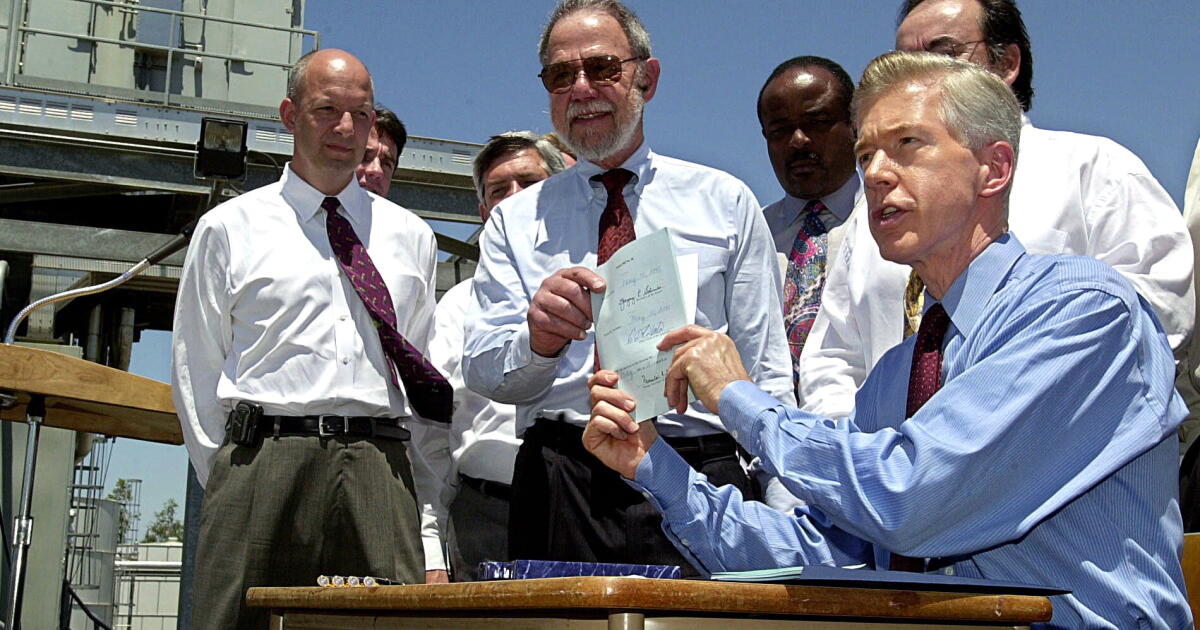
Byron Sher, a Stanford law professor-turned California legislator who wrote some of the state’s most far-reaching environmental laws, died Saturday. He was 98.
Cerebral and soft-spoken, Sher was the antithesis of politicians nowadays. He rarely issued press releases, didn’t convene news conferences, and disliked raising campaign money.
But he left an indelible mark on the environment, authoring legislation offering incentives to recycle, limiting advertisers’ inflated claims about products’ environmental benefits and combating water and air pollution.
He helped lead the effort to preserve ancient redwoods in Headwaters Forest in Humboldt County in 1999, pushing the state and federal government to buy it from Texas financier Charles Hurwitz, who owned Pacific Lumber Co. and was preparing to log it.
A decade earlier, in 1988, Sher authored legislation requiring that California take stock of the sources of greenhouse gases. It was the first time the legislature in California — or any other state — embedded the term “global warming” into a state law, and became the foundation for bills in later decades to combat climate change.
“The heat is on,’’ Sher said presciently, as quoted by the Sacramento Bee on May 5, 1989. “The state can either ignore what science is telling us, or we can respond to this challenge in a responsible way.’’
Because of his legislation, manufacturers today sell more products in spray bottles rather than aerosol cans, people can more easily dispose of televisions and other electronic waste, and underground gasoline storage tanks rarely leak and foul groundwater.
“Byron Sher built the legal and research foundation for California’s climate change regime and by extension helped shape how the world has tried to handle climate change,” said Joe Mathews, a Berggruen Institute fellow who is working on a book about the state’s legislative efforts to confront global warming.
Today, Sher’s 1989 legislation creating state wild and scenic rivers is a barrier to President Trump’s proposal to raise Shasta Dam north of Redding to increase water storage, an idea backed by Central Valley farming interests. His legislation protects the McCloud River, which feeds Shasta Reservoir. Raising the dam would inundate habitat along the McCloud.
That Sher placed such ideas into law reflected his ability to persuade and compromise. Gov. George Deukmejian, a Republican, signed the wild rivers legislation, and Sher’s Clean Air Act, which helped shape federal clean air legislation signed in 1990 by President George H.W. Bush.
Their partisan differences aside, Deukmejian viewed Sher as having “great personal integrity,” said Steve Merksamer, who was Deukmejian’s chief of staff.
“When Byron Sher wanted to come into the office and had the bill, would he get in? Absolutely. Would the governor listen to him? Yes,” Merksamer said.
Sher did fall short of convincing Deukmejian to sign one of his bills — a whimsical measure inspired by a Camp Fire girls and boys troop to proclaim the banana slug to be the official state mollusk. Deukmejian vetoed the bill, though Gov. Gavin Newsom signed legislation in 2024 designating the slimy yellow creature as the official state slug.
Sher was born in St. Louis in 1928, graduated from Harvard Law School in 1952, and joined the Stanford Law School faculty in 1957. He served on the Palo Alto City Council in the 1960s, got recalled in 1967 over his opposition to development and won back his seat in the 1970s. Sher was Palo Alto mayor in 1980 when he won an Assembly seat. He remained in the Assembly until 1996 when he was elected to the state Senate, serving until 2004 when term limits forced him to step aside.
Among the students who passed through his Stanford classrooms was Newsom’s father, William Newsom, who became a state court of appeals justice.
Sher and his aide and friend Kip Lipper attended a 2010 banquet in San Francisco at which the California League of Conservation Voters honored Justice Newsom with the Byron Sher Lifetime Achievement Award. In his acceptance speech, Newsom recalled that Sher was the only Sanford professor who gave him a C. When Lipper asked whether the story was true, Sher deadpanned, “He deserved it.”
“There aren’t a lot of tales to tell about Byron Sher,” said Bill Lockyer, who was Senate leader when Sher won a state seat in 1996. “He went home at night and tended not to get into the Capitol gossip.”
In 1996, Lockyer entrusted Sher to serve on a joint Assembly-Senate conference committee that produced landmark legislation that sought to deregulate California’s electricity system.
Sher added provisions expanding requirements that the state use renewable sources of electricity and called the legislation “an extraordinary result” given the issue’s complexity. Lockyer said Sher’s additions, while important, were “the cherry on top of the toxic sundae.”
The legislation was blamed for California’s electricity crisis in 2000 and 2001 when swashbuckling energy traders manipulated the markets, causing prices to spike, resulting in rolling blackouts, and fueling the 2003 recall of Gov. Gray Davis.
Sher was notable for measures he refused to support. With a few other liberal Democrats, nicknamed the Grizzlies, Sher would pick through turgid language of legislation looking for provisions that reflected the undue influence of special interests.
Sher voted against 1986 legislation that purported to open the way for a shrimp processing facility in West Sacramento. The bill turned out to be part of an elaborate FBI sting that resulted in 14 legislators, lobbyists and others being sent to prison.
“He wasn’t a comfortable politician,” said San Mateo County Supervisor Jackie Speier, a former Democratic congresswoman who served in the Legislature with Sher. “He didn’t speak up a lot. So, when he did, people listened.”
He displayed partisan side in 1994 when Republicans took a 41-seat majority in the 80-seat Assembly, and Republican Assemblyman Jim Brulte was in line to be elected speaker. But Democratic Speaker Willie Brown had a Republican supporter, Paul Horcher, who voted to retain Brown as speaker, plunging the two parties into a yearlong fight for control.
To wrest control from Republicans, Brown asked the professorial Sher to challenge one Republican’s right to remain in the Assembly. That Republican, Richard Mountjoy of the San Gabriel Valley, won two elections that November — one to the Assembly and the other in a special state Senate election to fill the seat vacated when the incumbent, Frank Hill, was sentenced to prison in the corruption scandal.
Sher reasoned that Mountjoy had to make up his mind — stay in the Assembly or move to the Senate. Facing term limits in the Assembly, Mountjoy joined the Senate in January 1995. The partisan battle went on all that year.
Brulte, who never did become speaker, was elected to the Senate in 1996, as was Sher. On Sunday, he called Sher “a wonderful man.”
“Everything in politics today is personal. It wasn’t personal,” Brulte said of Sher’s role in the speakership battle. “Somebody may have taken it personally, but I certainly didn’t.”
Sher retired to a pear orchard in the Sierra Nevada foothills and served on Tahoe Regional Planning Agency and Sierra Nevada Conservancy.
His wife of 62 years, Linda Bowser Sher, died in 2014. He is survived by three children, five grandchildren and a great-granddaughter.
Morain is a former Los Angeles Times reporter.