politically

After Palisades, Boyle Heights fire may cost Mayor Bass politically

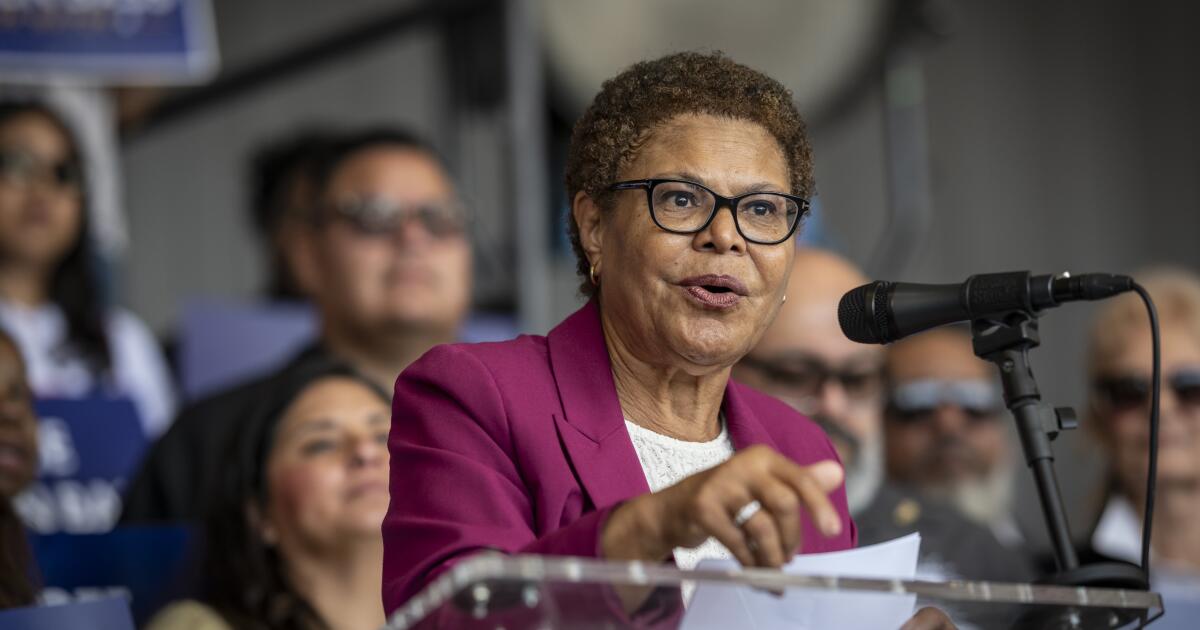
Los Angeles Mayor Karen Bass is once again dealing with blowback for being out of town when a massive fire ignited.

The fire at a cold storage facility in Boyle Heights began burning Wednesday, hours after Bass departed for the dedication of the Barack Obama Presidential Center in Chicago.

Since arriving back in Los Angeles around 6 p.m. Thursday, Bass has been to the scene of the fire numerous times, declared a local emergency, hosted five press conferences, met with local leaders and families affected by the fire, and distributed masks and air purifiers.

But her quick return and public appearances have not stopped some from drawing parallels to last year’s Palisades fire. Bass was in Ghana on a diplomatic trip when the deadly inferno spread amid extraordinarily high Santa Ana winds that forecasters had warned about for days.

While the scale of the destruction in Boyle Heights doesn’t compare to the 12 lives and thousands of homes lost in the Palisades fire, Angelenos are having flashbacks as toxic smoke hovers over parts of the region.

Bass, who is running for reelection, said in an interview that she rarely travels and always worries about what could happen when she does — whether it’s a fire or a big car accident. She also said she chose Chief Jaime Moore to lead the Los Angeles Fire Department because she trusts him to handle a crisis like this fire.

“I was in Chicago three hours away, and I was there 24 hours,” Bass said, noting that she was in constant communication with the chief during her brief trip.

Bass’ handling of the Palisades fire, beginning with her absence from the city, has had a long-lasting, negative impact on voters’ opinions of her, with polls repeatedly showing high unfavorability ratings.

A May poll by the UC Berkeley Institute of Governmental Studies, which was co-sponsored by The Times, found that 57% of likely Los Angeles voters had unfavorable views of Bass, while 35% had favorable views.

Bass, who served in Congress for more than a decade, was designated by then-President Biden to be part of his official delegation to attend the inauguration of Ghanaian President John Dramani Mahama. She was captured in photos at an embassy cocktail party in Accra as the Palisades fire exploded Jan. 7, 2025.

Last week, there was no warning that anything was amiss when she left the city. But any echoes of the Palisades fire could damage Bass’ image as she campaigns against City Councilmember Nithya Raman in the November runoff election.

“We’re talking about a fire, and she’s out of town, so it completely and totally reinforces that narrative of January 2025, and that’s not helpful,” said Fernando Guerra, director of the Center for the Study of Los Angeles at Loyola Marymount University.

Guerra said while Bass can do much of her job from another city for a day, a mayor is often faulted for not being front and center during an emergency.

“With today’s tech and instant communication, is it really that different that she’s in Chicago making calls than at City Hall?” he said. “But it has always been the case for executives that, symbolically, it is their job to be at the point of the crisis to assure those that are impacted directly, and the city as a whole, that they have the situation under control.”

Guerra said it didn’t help that Kevin Marchetti, the owner of the cold storage facility operating in the burning building, contributed the maximum, $1,800, to Bass’ reelection campaign last year.

Raman declined to comment on Bass’ handling of the Boyle Heights fire.

The blaze ignited Wednesday at the nearly 500,000-square-foot cold storage facility run by a company called Lineage, beginning on the roof, which caused a partial collapse and moved the flames into the building, where 85 million pounds of food are stored.

Firefighters have been battling the flames for seven days now, and smoke has made air dangerous to breathe in neighborhoods across the Los Angeles region.

Bass’ absence from the city soon caught the eye of right-wingers, with Spencer Pratt, who ran against her in the nonpartisan primary election, and Steve Hilton, who is running for governor, among those critiquing her.

“I don’t know what’s wrong with Karen Bass that she seems to keep leaving the city every time something happens,” Hilton said at a Monday press conference in Boyle Heights.

Pratt, who lost his house in the Palisades fire and came in third in the primary, drew the comparison directly.

“Karen was sipping cocktails in Chicago when the Boyle Heights Fire erupted, just as she was sipping cocktails in Ghana when our Palisades Fire erupted. I warned you all … what happened to us will happen to all of LA,” he posted on X on Sunday.

As she flew back to L.A. from Ghana, Bass repeatedly reminded her staff that she could make calls from the military flight, her text messages showed. But during one call or Zoom with her staffers, she had technical problems, texting, “I am listening don’t know why you can’t [hear] me.”

During the Palisades fire, then-Fire Chief Kristin Crowley publicly accused city leaders of failing to give her department the resources it needed. Bass ultimately removed Crowley from her post over her handling of the fire.

Moore, the new chief, has appeared to be in lockstep with the mayor during the Boyle Heights fire, saying she has been an active partner.

About 30 minutes after the fire began, Moore was on the scene. Ten minutes after he arrived, he was on the phone with Bass, he said.

Over the next day, while Bass was in Chicago, Moore estimated that they spoke six times over the phone.

Moore said her absence was a non-issue.

“Until Mayor Bass goes through our 20-week drill tower, and she learns to fight a fire and she can stand next to me on a hose line, I don’t need her in this city,” Moore told The Times on Tuesday.

“She’s our mayor. She was doing exactly what she needed to do,” he added. “She answered the phone. She provided me exactly what I needed, and that was, ‘Whatever you need to do, you do it.’”

Source link

Should California secede? How the state is politically out of step with the rest of the country

Not since 2010 has California felt itself politically so out of step with the times. That year the state resisted the nationwide wave of anti-incumbent, anti-regulation and anti-big government voting to elect Jerry Brown as governor, ease the passage of big-money state budgets and turn away a challenge to its pioneering greenhouse gas regulations.

This election day, California voters tightened gun control, extended taxes on the rich, hiked cigarette taxes, legalized marijuana, boosted multilingual education — and of course provided Hillary Clinton with all of her winning margin of 2 million popular votes, and then some, in her losing campaign for president.

It’s impossible to look at the Trump campaign and not see a direct threat to the civil liberties and dignity of California citizens.

— Billionaire activist Tom Steyer

No wonder the election has inspired talk of California’s seceding from the United States. The nascent campaign, organized under the banner of the Yes California Independence Campaign and heralded by the Twitter hashtag #Calexit, has been energized by remarks by Brown, and others, that a Trump election would necessitate “building a wall around California” to preserve its forward-looking policies against a reactionary federal regime. And why not, the argument goes. After all, with a gross domestic product of $2.5 trillion, the state’s economy ranks sixth in the world, sandwiched between Britain and France.

Secession talk is more valuable as a pointer to all the ways that California and federal policies are likely to come into conflict during the next few years than as a formula for practical politics.

“It’s impossible to look at the Trump campaign and not see a direct threat to the civil liberties and dignity of California citizens,” says Tom Steyer, the progressive billionaire who in recent years has focused his energy on combating climate change via his organization NextGen Climate.

To dispense with the prospect of California’s seceding from the union: On the gonna-happen scale, it’s a Not. “We’d either have to win the ensuing civil war or have Congress kiss us goodbye,” says Joel D. Aberbach, director of the Center for American Politics and Public Policy at UCLA. “There isn’t a procedure for seceding” in the Constitution. The very notion of the U.S. as a divisible entity was settled by the Civil War.

A constitutional amendment is the longest of long shots. It must be approved by a two-thirds majority in each house of Congress and ratified by three-fourths of the states (38 of the 50).

But the conflicts between state and federal policy will be serious. Here’s a look at what may be some of the most important.

Climate change: California has been among the national leaders in reducing greenhouse gas emissions, and as recently as September strengthened its policies with a law mandating the reduction of climatologically harmful emissions to 40% below 1990 levels by 2030. Its auto emission rules traditionally have set a benchmark for the auto industry and federal regulators.

During his campaign, Trump dismissed climate change as a Chinese hoax and pledged to withdraw the U.S. from the Paris agreement to reduce greenhouse gas emissions, which already has been ratified by 113 of the 197 signatory countries. The U.S. ratified the agreement by presidential order on Sept. 3.

“The single biggest achievement of the Obama administration in energy and climate was to get those countries to agree,” Steyer said. “It was an example of the best kind of American leadership — moral, technical, financial.”

Since the election, Trump has backed off his assertions about climate change and his promise to withdraw from the Paris pact. If he makes good on his threat, however, American leadership on climate change will pass to the states. Brown has pledged to keep California in the forefront of that movement, and earlier this month sent a state delegation to a U.N. climate change conference in Marrakech, Morocco.

That just continues the sort of state-level leadership that has emerged in recent years. “Over the past decade, Congress has not passed a single bill that takes direct aim at climate change,” former New York Mayor Michael Bloomberg observed in a recent speech. “Yet at the same time, the U.S. has led the world in reducing emissions.”

Trump could stifle federal funding for crucial research on climate change. One of his science advisors says he plans to eliminate NASA spending on earth science, calling it “politically correct environmental monitoring” and refocusing the agency exclusively on space research. That mirrors congressional Republicans’ approach to NASA, whose role in climate monitoring they disdain even though it has made crucial contributions to understanding of global warming.

Immigration: Trump campaigned on a pledge to cut off federal funding to “sanctuary cities” as part of his crackdown on illegal immigration. His chief of staff-designate, Reince Priebus, reiterated the policy in an interview after the election.

These are cities whose police departments aren’t required to check the immigration status of people they stop or arrest or to notify U.S. immigration officials of the status of undocumented persons they release from custody. The roster of sanctuary cities includes Los Angeles, San Francisco, Sacramento and Oakland; an estimated 1 million of the nation’s 11 million immigrants without legal status, many of whom Trump has threatened to deport, live in L.A. County.

Leaders of those cities have pledged to keep protecting immigrants and fight Trump’s proposed cuts in federal funding cuts, which would require congressional action. The stakes are high: Los Angeles receives about $500 million a year in federal funding for such municipal services as port security and homeless shelters. But there are practical as well as moral reasons for cities to steer clear of immigration enforcement. Complicity with immigration agents shatters trust in police in immigrant-rich communities, complicating street-level patrolling. And with undocumented immigrants part of the fabric of diverse communities, rigorous enforcement can have bad economic consequences.

Trump’s anti-immigrant stance has spurred calls to action to protect potential deportees. The Los Angeles Unified School District says it will rebuff any federal request for students’ immigration status. Cal State University Chancellor Timothy P. White, whose system includes as many as 10,000 students without legal documentation, has said that campus police won’t honor federal requests for deportation holds. Last week University of California President Janet Napolitano stated that UC campus police departments would not involve themselves in investigations of the immigration status of individuals on campus and ruled out “joint efforts” on immigration with federal, state, or local law enforcement agencies. She said the university aimed to “vigorously protect the privacy and civil rights of the undocumented members of the UC community.”

An estimated one in three of the 742,000 “Dreamers” — young people who were brought to this country by their parents without documentation and granted protection from deportation under the Obama administration’s Deferred Action for Childhood Arrivals program, or DACA — lives in California. Trump has pledged to shut down the program.

Healthcare: Few states gave the Affordable Care Act, which Trump and congressional Republicans pledge to repeal, support as full-throated as California. The state has enrolled about 1.4 million people in Obamacare health plans via its statewide individual insurance exchange, Covered California, and added about 3 million low-income residents to Medicaid rolls via the law’s Medicaid expansion, the cost of which has been 100% paid by the federal government.

It’s doubtful that this record could be maintained if Trump and congressional Republicans repeal the ACA. Repeal would eliminate the federal tax credits that reduce premiums on Covered California plans and other costs for about 90% of enrollees. That would drive many of them off coverage. The state would surely be unable to make up those subsidies. California would also suffer from the loss of the ACA’s consumer protection elements, including a ban on exclusions for preexisting conditions and on annual or lifetime benefit limits. A study published last June by the Robert Wood Johnson Foundation forecast that without the ACA, the ranks of the uninsured in California would soar by 2021 to 7.5 million, compared with only 3.4 million if the ACA remains in place.

Among the dangers in the GOP plans is uncertainty. The party has promised to “replace” the ACA with something that works better, yet has never coalesced around an alternative in more than six years of trying. But doubts that Covered California and other ACA marketplaces will eventually stabilize could drive more big insurers out of the market and force prices higher.

The prospects of disastrous tampering with healthcare were heightened Monday with Trump’s nomination of Rep. Tom Price (R-Ga.) as secretary of Health and Human Services. Price, an orthopedic surgeon, is a sworn enemy of the Affordable Care Act. He’s the author of an alternative law that could throw older and sicker patients out of the insurance pool and make insurance all but unaffordable for women of child-bearing age. The Price plan would repeal Obamacare and replace it with something resembling the pre-2010 individual insurance market, when overpriced, low-benefit plans were the norm for anyone except young, healthy males.

Republican proposals to convert Medicaid to a block-granted program—almost certainly a prelude to cutting the federal share of its budget—could pose a particular problem for House Majority Leader Kevin McCarthy, R-Bakersfield. In his district, which largely spans Kern and Tulare counties, roughly half of all residents are enrolled in Medi-Cal, the state’s Medicaid program. Efforts to trim the program would have a direct effect on them.

Gun control and marijuana: Voters on election day flouted federal policy in both areas. Proposition 63 mandates background checks for ammunition sales and outlaws high-capacity ammo magazines. Proposition 64 legalizes marijuana.

Trump established himself as an ally of the National Rifle Assn. during the campaign, but White House policy may not be the biggest problem for the state’s firearms policy: the courts would be. In rulings in 2008 and 2010, the Supreme Court extended the reach of the 2nd Amendment’s protection of the right to bear arms. Within a day of the election, the NRA was talking about challenging Proposition 63 and related state laws before the courts.

Trump hasn’t expressed strong objections to the legalization of marijuana, but as the biggest state to legalize pot, California could find itself in the crosshairs of revived anti-marijuana enforcement by his administration. Obama’s Justice Department took an indulgent approach to the wave of state legalizations of the drug, declaring in 2013 that although it was still illegal under federal law, its prosecutors would focus chiefly on preventing sales to minors and to keeping profits out of the hands of criminal gangs.

But Trump’s attorney general-designate, Sen. Jeff Sessions (R-Ala.), stated in April that “marijuana is not the kind of thing that ought to be legalized, it ought not to be minimized, that it’s in fact a very real danger.” One anti-pot activist described him to the Washington Post as “by far the single most outspoken opponent of marijuana legalization in the U.S. Senate.” How he plans to enforce federal law in a legalization state as big as California is still a mystery.

Keep up to date with Michael Hiltzik. Follow @hiltzikm on Twitter, see his Facebook page, or email michael.hiltzik@latimes.com.

Return to Michael Hiltzik’s blog.

ALSO

Trump speaks with Taiwan’s president, which could provoke China

For 11 years, he’d never felt like he’d been targeted for the way he looked. Donald Trump’s victory changed that

California lawmakers want to reform a bail system they say ‘punishes the poor for being poor’

Orange County’s new ‘homegrown’ congressman plans to bring an immigrant’s perspective to Washington


Source link