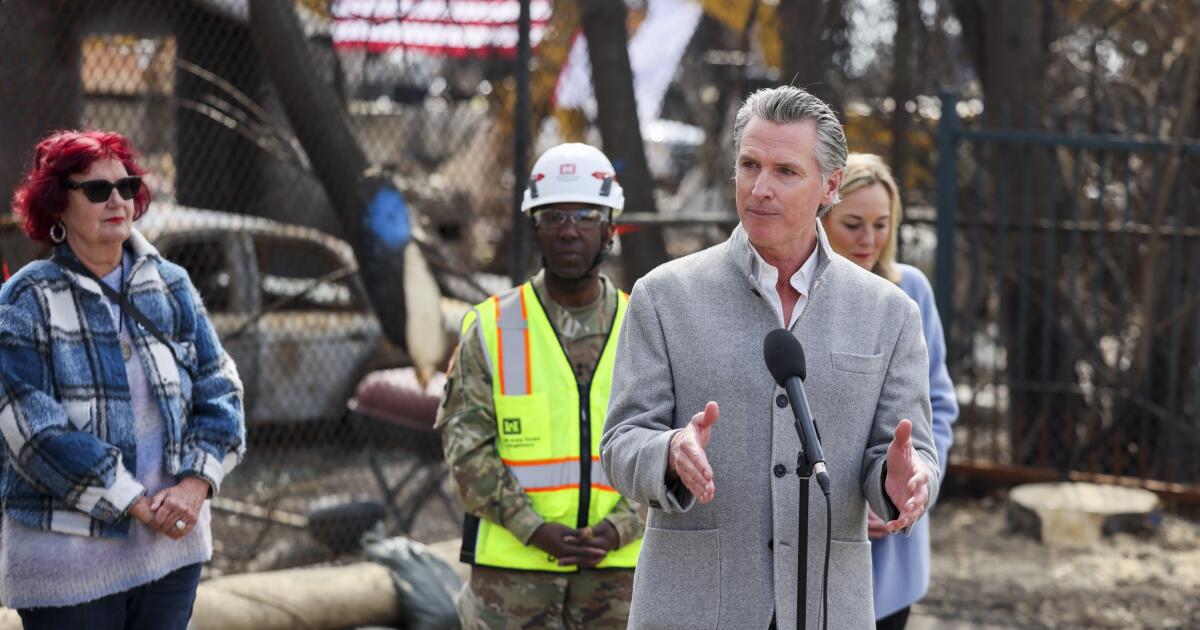
California’s political watchdog commission on Thursday finalized a $31,500 fine against Gov. Gavin Newsom, alleging that the Democratic leader failed to report three dozen behested payments totaling $5.5 million mostly to support wildfire recovery by the deadline under state law.
The Political Reform Act requires elected officials to disclose payments of $5,000 or more that they solicit or direct others to give to a charitable, legislative or governmental purpose within 30 days.
The California Fair Political Practices Commission said 34 of the violations were for failing to report on time that Newsom and his staff directed outreach from companies and foundations that wanted to help after the Los Angeles wildfires to the California Fire Foundation. The nonprofit was started in 1987 by the California Professional Firefighters to support the families of fallen firefighters and communities impacted by fire.
The donations include $1 million from the Chuck Lorre Foundation and $500,000 apiece from Lockheed Martin, the Anthem Blue Cross Foundation and BlackRock, among others gifts.
The governor also failed in 2024 to report on time two behested payments, totaling $100,000 from the Schmidt Family Foundation and Schwab Charitable Funds to the Institute for Local Government, a nonprofit within the League of California Cities.
The commission said the governor reported all of the payments “prior to public discovery” or contact from its enforcement division, which it considered a mitigating factor. Newsom also signed the stipulation and agreed to the fine.
Tara Gallegos, a spokesperson for Newsom’s office, said the issue involved late paperwork at a time when the governor’s staff was focused on emergency response and supporting survivors. She also underscored the fact that the reports were filed before he was contact by the FPPC.
Gallegos said the fine is unrelated to an alleged investigation into the governor and his wife by the Department of Justice, which Newsom announced this week.
Newsom alleged Monday that Trump is using the government as political weapon to target him and his wife, Jennifer Siebel Newsom. Newsom announced the investigation after he learned that the FBI and Internal Revenue Service asked his associates questions about nonprofits and businesses related to the couple.
The governor’s office characterized the investigation as a fishing expedition. The Trump administration declined to comment.
A source familiar with the matter, who requested anonymity because they were not authorized to discuss it publicly, said two federal probes have been going on for about a year, and that they originated not from Washington, D.C., but from conversations between whistleblowers and federal prosecutors based in Sacramento. The probes are linked to Newsom’s former chief-of-staff, Dana Williamson, and Siebel Newsom’s taxes, the source said.
The FPPC violations mark the second time Newsom has reported payments late, which increased his penalty for the new infractions. The commission fined Newsom in 2024 for failing to timely report 18 payments totaling $14.4 million.
Los Angeles is often nicknamed “Tehrangeles” – a fact that drew smiles from both player and manager when it was mentioned at the news conference.
Many Iranian-Americans will be heading to SoFi Stadium on Monday where Iran will open their World Cup campaign against New Zealand.
Many will not be there to cheer, but to protest.
Fifa has banned the pre-revolutionary Lion and Sun flag – a powerful symbol for many Iranians living abroad.
The decision has angered parts of the diaspora.
“You don’t come to Los Angeles and tell us we can’t fly the Lion and Sun flag,” said activist Arezo Rashidian, who is helping organise demonstrations outside the stadium.
“This is the largest Iranian community outside Iran. Many of us came here after the revolution. We’re opposing Fifa’s ban and standing in solidarity with the people of Iran.”
Many members of the diaspora are hostile towards Iran’s regime, and some see the squad as an extension of the Islamic Republic.
“It’s unfortunate that the regime turns athletes into mouthpieces.” said Rashidian. “We want athletes to remain athletes.”
Despite that, she and many others still plan to attend the match.
“We understand the pressure they’re under,” she said. “We’ll carry our colours. We’ll cheer for Iran – the country – held captive by the Islamic Republic.”
But while protesters prepare to make their voices heard outside the stadium, Iran’s players say their focus remains on football.
“As players of the national team, we play for every single Iranian, whether in the diaspora or in Iran,” Taremi said.
“In every country people have different opinions. We are here to unite people and bring joy. Everyone is entitled to their opinion. We don’t get involved in politics.”
That may be the ideal.
But for Iran’s team, keeping politics outside the stadium could prove difficult in a tournament where football has often felt like a sideshow for this squad.
“There is no winning for Iran’s team,” investigative football journalist Samindra Kunti said.
“Given the circumstances, the political pressure, the location of the matches and the diaspora in Los Angeles, they’re under enormous pressure.”
“It’s impossible to avoid the politics.
“Everything becomes a reminder of their situation.”
The players face pressure from home, pressure from the host nation and pressure from a diaspora determined to make its voice heard.
WASHINGTON — President Trump planned to mark his 80th birthday on Sunday with a celebration that once would have seemed unfathomable: a cage-fighting show on the storied South Lawn of the White House.
In the week ahead, some hard realities of the office have threatened to overshadow the ostentatious UFC mixed martial arts extravaganza, where combatants sealed inside a wire-mesh octagon try to punch, kick, chop and pummel each other into submission.
Trump has found himself boxed into an unpopular and costly war he helped start in Iran. An agreement to end the conflict could be close, but the crucial details are still to be negotiated. Meanwhile, about a mile from Trump’s birthday bash, crews pried the president’s name off the John F. Kennedy Center for the Performing Arts facade after a judge ruled that renaming it to include Trump was not allowed.
Regardless, the president will walk out of the White House and be surrounded by Cabinet leaders, top administration officials, Republican lawmakers and 4,000-plus spectators screaming themselves hoarse in a temporary arena under “The Claw,” a spaceship-like metal arch fitted with lighting, sound equipment and large screens. Thousands more will be watching on big screens from the nearby Ellipse.
“This event is a one-of-one event, incredible event. I love it,” said UFC chief Dana White, a close friend of Trump, during a Friday night hype session at the Lincoln Memorial where pairs of fighters shoved and scuffled for the cameras under the stoic gaze of Honest Abe’s marble likeness.
Trump has sought to tie Sunday’s event — which features seven fights running past midnight — to larger, months-long celebrations of the 250th anniversary of the signing of the Declaration of Independence.
But it is much more geared toward feting himself, so much so that the Group of 7 summit for leaders of industrialized nations pushed back their get-together so that the president could attend his cage-match party and then fly straight to France for the meetings.
The weather, though, could put a damper on things. Strong thunderstorms and heavy lightning disrupted Friday’s Lincoln Memorial event, and the forecast for Sunday evening also looked threatening.
“I’m sick and tired of hearing about the weather,” White declared Friday, before conceding that he’d prefer to hold future UFC events inside arenas only.
A very different 80th birthday celebration
When Trump’s predecessor, President Biden, turned 80 in November 2022, he celebrated with a private family brunch at the White House, a reminder of just how much and how quickly things have changed.
Asked about the contrast, White House spokesperson Allison Schuster said that the fight “will be one of the most entertaining nights in American history” and said that the timing was appropriate. “Having this spectacle take place at the people’s house on Flag Day during our nations’ semiquincentennial anniversary is a fitting tribute,” Schuster said in a statement, apparently including a punctuation error in referring to “nation’s.”
When he turned 80, Biden was the oldest president in U.S. history, and was months away from launching a reelection bid that he would ultimately abandon after a disastrous debate against Trump and mutiny among Democrats concerned that voters would perceive him as too old to handle a second term.
Trump has now supplanted Biden as the oldest person to be elected U.S. president. He’s constitutionally barred from running again, yet constantly toys with the notion publicly. That’s despite polls showing rising public skepticism about Trump’s mental and physical health — recalling concerns Biden faced as he turned 80.
A Washington Post/ABC News/Ipsos poll conducted in April found that less than half of U.S. adults think Trump has the mental sharpness or physical health to serve effectively as president.
The White House countered with a lengthy statement from Trump’s former White House physician, Republican Rep. Ronny Jackson of Texas, saying that Trump’s “stamina, focus, and strength are exceptional and on display every day. Claims to the contrary are pure fiction.” Jackson added that polling concerns were “being propagated by the same biased, liberal, Trump-hating press that completely ignored the absolute cognitive and physical disaster that was President Biden.”
Trump has nonetheless undergone four publicly announced physical examinations this term alone, with White House physician Dr. Sean Barbabella recently declaring him in “excellent health.”
‘Bread and circuses’ — Trump-style
The UFC event is an apt metaphor for Trump’s pugilistic political style. He has also long been a practitioner of political misdirection, purposely presenting people with something other than his presidency to focus on when things aren’t going well.
With the war in Iran grinding on despite weeks of assurances from Trump that its end is nigh, gas prices staying high, renewed concerns about inflation and plummeting job approval ratings for Trump — a White House birthday party unlike anything America has ever seen is definitely a diversion.
“This is all distraction,” said Mike Fontaine, a classics professor at Cornell University, who likened it to the gladiatorial games of Imperial Rome, when combatants brutalized each other for public entertainment meant to bolster rulers’ popularity and quell potential unrest.
“This is a classic strategy,” Fontaine said. “In ancient Rome, the phrase would be ‘bread and circuses.’”
Trump says the UFC is paying for the event, and though its full cost hasn’t been divulged, the National Park Service said in a court filing that $60-plus million and tens of thousands of hours of labor have gone into it, while seven government agencies have “allocated significant resources and manpower.”
UFC also announced Friday that it was adding as an official partner for the event World Liberty Financial to create a $250,000 athlete bonus pool for Sunday night’s winners. The cryptocurrency company is co-owned by the Trump family, founded with the president’s special envoy Steve Witkoff and run by the diplomat’s son Zach. The arrangement further blurs lines between the Trump family’s financial interests and the events and construction projects the president has prioritized and used government resources to pull off, which many critics and political analysts have labeled corrupt.
Still, Fontaine said that when it comes to a personal flair for pageantry, Trump’s second-term tendency to lean into “hardcore masculinity and brute fighting” is marrying the UFC’s blood sport with Trump’s distinctive sense of humor and enduring sense of showmanship.
“President Trump has a once-in-a-generation talent for this stuff,” he said.
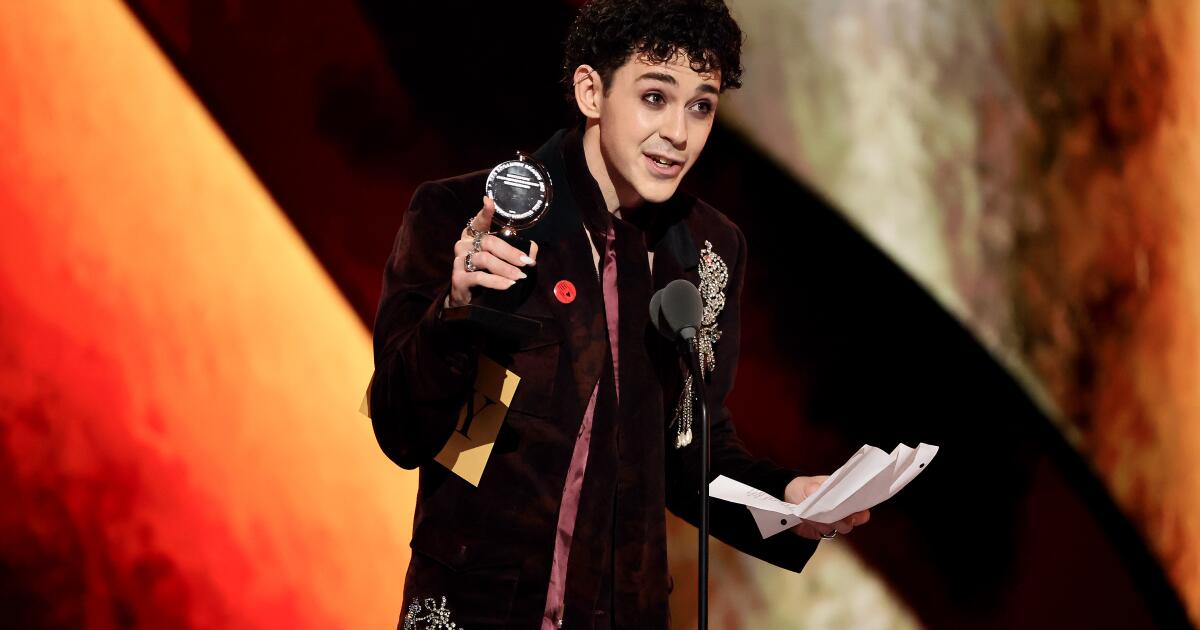
Ali Louis Bourzgui scored an upset win for performance by an actor in a featured role in a musical for originating the role of David in the musical adaptation of the cult vampire horror film, “The Lost Boys.”
As viewers scrambled to keep their score cards straight — André De Shields was favored to take the trophy for his work in “Cats: The Jellicle Ball” — the 26-year-old Bourzgui went on to deliver the night’s most impassioned, and pointedly political speech.
He began by noting that, “Vampires represent those who have shunned their own humanity in order to achieve a non-existent sense of superiority. The billionaires will never find happiness from their money. The colonizers will never find fulfillment from the land and lives they steal. The fascists will never find meaning from their conformity, not in this lifetime or eternity.”
Through the cheers of an invigorated audience, Bourzgui went on to talk about how “theater is one of the last places people can come to worship the power of true collective human presence.”
At its best, he said, theater helps us see ourselves in a stranger’s story.
“This is dedicated to the beautiful tapestry of immigrant families who make this country really special. May you one day not have to audition for the empathy that should be freely given by this country that benefits from your beauty, for the queer and trans communities who will exist, no matter what people in power try to take away from them.”
Bourzgui, whose father immigrated to America from Morocco, went on to pay tribute to Palestine and his own Arab heritage.
“For the people of Palestine, who deserve a free life, a full life without occupation, for Arabs and their makers and artists, may we continue to tell our stories and show our faces. Our humanity becomes undeniable, and our families can no longer be written off as merely collateral damage, may they know the beauty of our kisses upon his cheek and the romance of a language rooted in passion for love and life itself.”
He wrapped up this speech with a plea for love and empathy.
“If there’s one thing we can learn from vampires, it’s that life is short, but that’s it’s a gift. Find beauty in the ephemeral and gratitude in what is not promised, and always invest in the people that want to see you blossom into your truest self, and hold that space for them in return.”
1 of 2 | Pope Leo XIV blesses infants on his visit to the Caritas Charity Centrer in the Lucero neighborhood of Madrid Saturday. The pontiff is visiting Spain from from June 6 through June 12, with stops in Madrid, Barcelona and the Canary Islands. Photo by Ciro Fusco/EPA
June 6 (UPI) — Pope Leo XIV landed in Madrid Saturday to begin his one-week papal visit to the country, the first in 15 years.
Leo was greeted at the airport by King Felipe VI and his wife Queen Letizia, then addressed them at the Royal Palace along with politicians and diplomats.
He acknowledged political polarization and called for an end to it in Spain and elsewhere in the West.
“I come among you to affirm, encourage and instill a renewed fidelity to the Gospel among believers, as well as a deeper reconciliation and collaboration among the various elements of this nation,” the first American pope said.
“In reality, the message of peace, which at present unfortunately strikes some as naive and others as confrontational, is welcomed by those who do not shut themselves off in preconceived ideologies, but are rather open to the truth,” Leo said.
Spanish Deputy Prime Minister Yolanda Díaz told the Washington Post that the left in Spain embraces the pope.
“The [left’s] alignment with Pope Francis was immediate: He defended Spain’s labor reform and the Episcopal Conference also supported it, something that would have seemed unthinkable 20 years ago,” she said. “With Leo XIV, that alignment deepens.”
The Spanish far-right are battling the Church, which they believed an ally. They are particularly upset over the church’s advocacy for migrants, The Washington Post reported. The left once saw the Church as complicit in the Franco dictatorship.
“The far right in Spain wants to copy the far right in the United States,” Bishop José Mazuelos Pérez, who heads a Canary Islands diocese providing shelter, food, blankets and medical care for arriving migrants, told The Post. “To go to war with the bishops over the issue of migration.”
On Monday, Leo will address the Spanish parliament, which is gridlocked. He’s expected to discuss that type of polarization, and his other visits around the country highlight differing segments of the Church.
He will have a prayer vigil with young people Saturday, then march Sunday in a traditional Spanish street procession.
On Thursday, Leo plans to visit the Canary Islands, a landing for Latin American migrants and for those arriving by sea from the African coast. He is planning to visit Lampedusa on July 4, an Italian island where migrants from Africa and beyond land.
On his flight to Spain, Leo acknowledged that he would be competing popular with Puerto Rican singer Bad Bunny, who played the Super Bowl halftime show this year, for Spanish attention. Bad Bunny is scheduled to perform in Madrid Saturday night.
Leo said that more young people are turning to the Church, looking for something more.
“If they are confronted with the question: do they want to see Bad Bunny or do they want to see the pope, I think many will see Bad Bunny,” Leo said. “But I think there will also be a few here to see the pope. And that says something.”
On Sunday, the pope will celebrate mass on the feast of Corpus Christi in the Plaza de Cibeles. There will be a Corpus Christi procession, the Vatican said. He will also meet privately with members of the Order of St. Augustine to which he belongs.
Later, he will go to a gathering of representatives of culture, arts, business and sports at Madrid’s Movistar Arena.
The Vatican spokesperson Matteo Bruni said, “Leo XIV’s trip to Spain is a sign that, despite the secularization of society, the pope still has something to say in many areas, in Spain and in Europe, where he can play a constructive role in public debate,” Euro News reported.
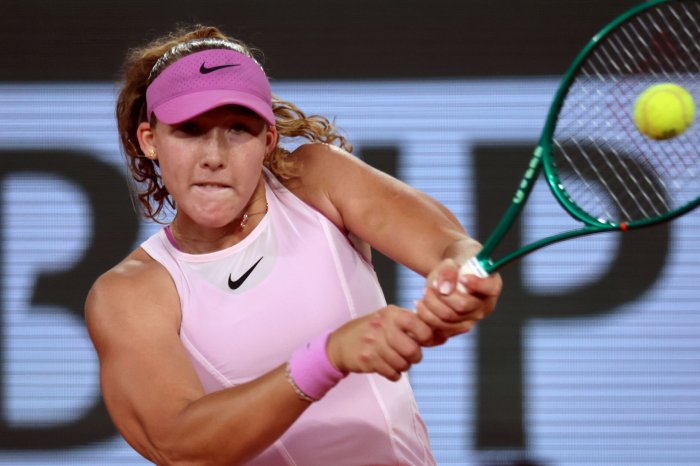
Russian Mirra Andreeva plays against Ukrainian Marta Kostyuk in their semi-final match during the 2026 French Open in Paris on June 4, 2026. Andreeva won 6-1, 6-3. Photo by Maya Vidon-White/UPI | License Photo
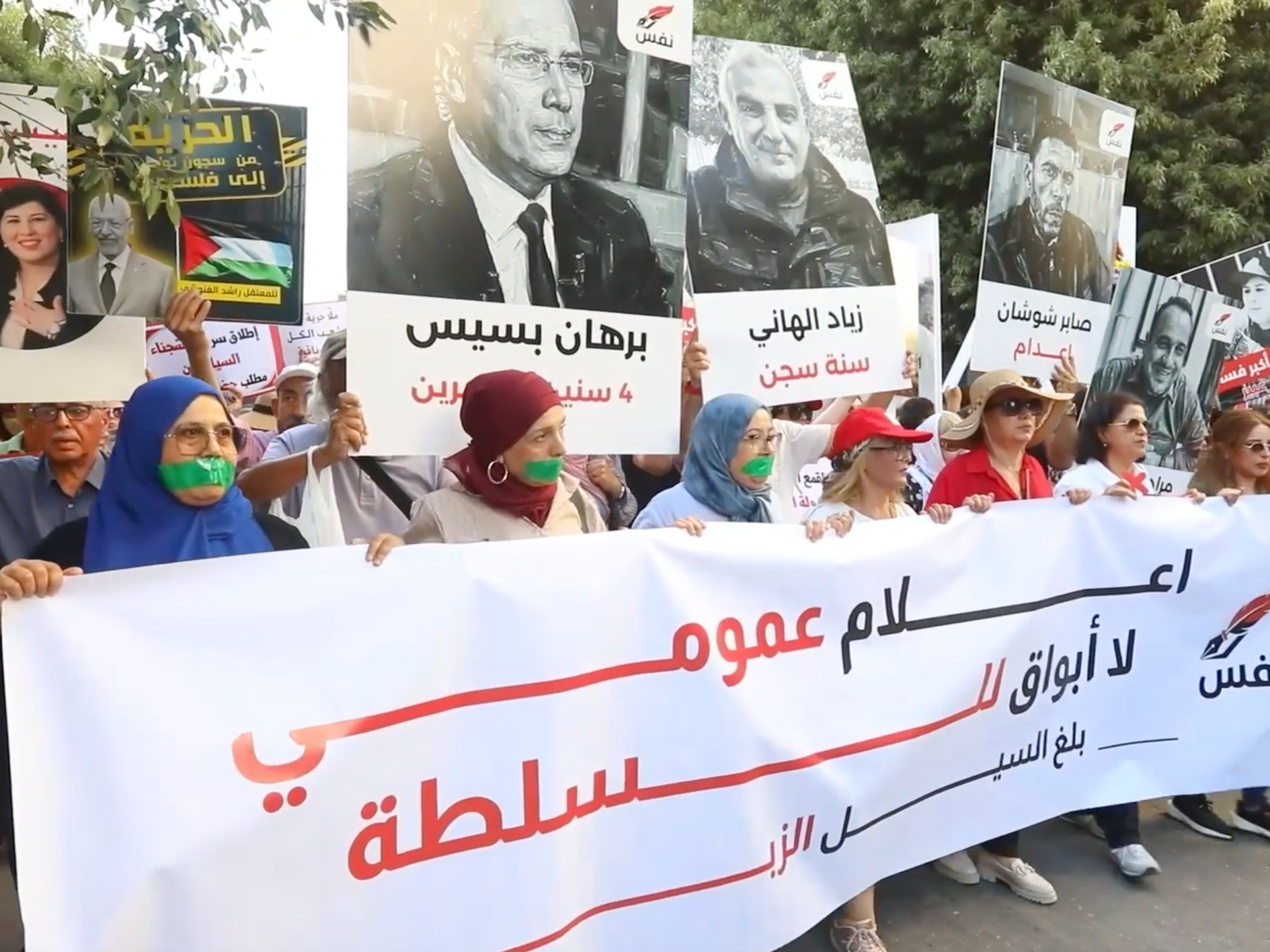
Hundreds marched in Tunisia’s capital demanding press freedom and the release of political prisoners detained during President Kais Saied’s crackdown on dissent, which has jailed opposition figures including Ennahda party leader Rached Ghannouchi.
Mogadishu, Somalia – Mustafa, 33, dreads election time in Somalia. He drives a bajaj — a three-wheeled taxi — and says that when tensions rise, as they always do when polls are near, the whole city feels it, and drivers like him are among the first.
On Wednesday, he was passing through the Hawl Wadaag district when heavy gunfire between government and opposition forces erupted all around him.
Recommended Stories
list of 2 itemsend of list
“I couldn’t even think. Everyone was shouting and running for their lives, and we all fled from the bullets,” he told Al Jazeera. “We haven’t seen fighting this bad in years.”
The shooting that began that afternoon around the homes of former Prime Minister Hassan Ali Khaire and, later, former President Sheikh Sharif Sheikh Ahmed, came as opposition figures were planning to organise protests against what they describe as an illegal term extension by incumbent President Hassan Sheikh Mohamud.
Khaire and Sharif Sheikh Ahmed were among opposition leaders spreadheading the planned protests amid rising tensions with the federal government.
The government said the planned protests would undermine security in a city still grappling with persistent armed violence.
Hundreds of families fled neighbourhoods near the fighting, and by the next day, many of the capital’s central areas had emptied. The sudden eruption of violence ended a period of improving security in Mogadishu, shattering the perception that the city had begun turning a corner.
“The most frustrating thing is that we have nothing to do with it, and it impacts so many of us,” Mustafa said. “We make our living in this city”.
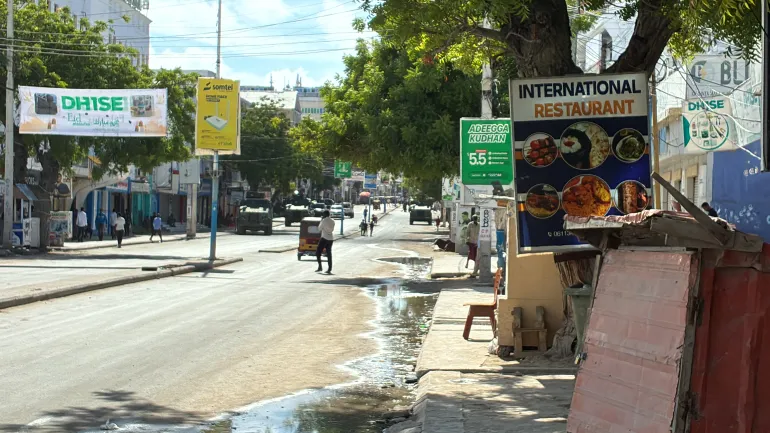
Security forces sealed Maka al-Mukarama Road, one of Mogadishu’s main arteries, while Bakara market, the largest commercial hub in the city, was effectively closed for business.
Maka al-Mukarama Road, Mogadishu’s main thoroughfare, is usually a bustling commercial hub, but recently, it has been largely empty, with the exception of military vehicles [Faisal Ali/Al Jazeera]
“Look, it’s midday, and there’s almost no one here, shops are closed, and usually by this time the place is jammed,” Ahmed, a street vendor at Bakara market, told Al Jazeera, gesturing at shuttered stalls.
Ali Wardheere, the deputy central bank governor, estimated the direct cost to businesses and services at $3.8m, though he stressed the figure was a model-based projection, not an official or final tally.
Like most Somalis, Mustafa has never voted for a president or a member of parliament. The country has not held a direct election for national leadership since the late 1960s.
Since the state was re-established in 2012 after its 1991 collapse, leaders have been selected through an indirect system negotiated by clan elders and political elites.
As presidential terms near their end, low trust among political actors often leads to intense competition over power — and at times violence — as disputes over the electoral timetable come to a head.
At a press conference in late May, Sharif warned that the political deadlock could turn violent if negotiations failed.
“Where do things stand? [We say] Leave, and [you say] I won’t leave. What comes next? Bullets.”
The warning echoed events in 2021, when then-President Mohamed Abdullahi Farmaajo remained in office more than a year beyond the end of his term, triggering clashes in Mogadishu before a political agreement was reached.
Higher stakes this election
This time, the political standoff carries higher stakes.
President Hassan Sheikh Mohamud says that constitutional amendments approved by parliament extended his mandate by an additional year from May 15. The opposition rejects that and has begun referring to him as a “former president”.
Two of Somalia’s most influential federal states also reject the amendments, leaving the country divided over the constitutional framework governing the next election, with no constitutional court to resolve the dispute.
After parliament approved the changes, Mohamud declared that the “provisional constitution, and the provisional era, was a sun which set yesterday,” signalling that his administration would press ahead despite objections from its opponents.
Tensions had been building for days. Ahead of a protest planned for Thursday, opposition leaders left the heavily fortified “green zone” near Mogadishu’s airport and returned to their residences across the city.
Some opposition figures said they would deploy their own armed guards at the demonstration, a proposal Mohamud rejected. The dispute heightened fears of a confrontation before fighting eventually broke out.
Both sides blame the other for starting the clashes. Khaire accused Mohamud of directing a “sustained and indiscriminate military assault” that lasted more than 20 hours, a claim Sharif echoed after fighting reached his own residence.
Ahmed Moalim Fiqi, the defence minister, accused the opposition of militarising the standoff, likening it to Sudan’s Rapid Support Forces and alleging that opposition figures had “distributed mortars and artillery across the capital”.
“Force and militias,” he said, would no longer be allowed to “seize power or block the state.”
How it came to this
The roots of the crisis run back to the 2012 provisional constitution, which set up a federal, parliamentary system built on broad consensus and clan-based power-sharing, which every government since has promised to achieve and failed to attain.
This year, after a long review, parliament amended the constitution through a disputed process that split the political class. The government has insisted that the new constitution advances the statebuilding process and that the Somali public should be allowed to directly elect its representatives.
For Ahmed Abdi Koshin, a federal MP who boycotted the draft, the danger is that the whole settlement comes apart. The process, he said, “clearly doesn’t have buy-in,” and the original constitution, for all its faults — “an imperfect product of compromise” — was the “only glue holding Somalia together”.
Koshin is not against a direct vote in principle, he said, but does not believe the country is ready for one. “We don’t have legislation for a direct vote; censuses and the security situation remains compromised. It really is up to the president to either reach a deal and save Somalia, or watch it fall apart,” he said.
The opposition, organised as a coalition known as the Somali Future Council and including two serving federal-state presidents, former prime ministers and a former president, has pressed Mohamud to accept that his mandate has ended and negotiate a new electoral framework, as in past transitions.
It alleges that his push for a direct vote is a pretext for extending his term and potentially securing another.
The government rejects that, casting a national one-person, one-vote election — the first since the 1960s — as essential to a drawn-out state-building project. When electoral talks collapsed on May 15, the Ministry of Information accused the opposition of bringing demands that ran counter to “the citizen’s fundamental right to vote and to be voted for”, and vowed to press ahead.
Mohamed Ibrahim Moalimuu, a lower-house MP who backed the amendments, said further delay could not be justified. “We’ve waited for more than 12 years,” he told Al Jazeera.
“If they had arguments against them, they should have taken part in the process and raised their issues. A constitution isn’t a Quran, and they should come back and work through parliament to make their views clear.”
A whole generation of Somalis, he noted, have never cast a ballot, and a real election “would be a major milestone and would bring some hope”.
The old indirect system, he added, was notoriously corrupt, with parliamentary seats changing hands for anywhere from $100,000 to as much as $1.3m. “This system is too dirty and keeps people out,” said Maliumuu. “It needs to be changed.”
A deeper problem
A regional official, speaking on condition of anonymity because he was not authorised to talk to the media, described an elite “divided strategically over what type of country they want, whether a strong centralised state or a weak decentralised one, and tactically over who the right candidate is to take them there”.
Mohamud, the official said, had moved from a decentralised vision for Somalia that embraces federalism towards a stronger executive, and his early, promising relationships with the federal-state leaders had since soured.
Those fractures have opened on several fronts at once.
Somaliland, which declared independence in 1991 and has stayed out of the constitutional review entirely, was recognised by Israel late last year after earlier courting Ethiopia.
Puntland and Jubaland, two of Somalia’s six federal states, have withdrawn from the federal system over the new constitution, while more than 100 MPs and senators from both boycotted the final vote.
Broader regional crises, from Sudan’s civil war to disease outbreaks elsewhere on the continent, have pushed Somalia further down the list of international priorities, leaving international engagement more fragmented and inconsistent.
The country is also grappling with a deepening humanitarian crisis and aid cuts, prompting famine monitors to warn of a heightened risk of hunger in parts of Somalia.
Yusuf Aynte, a veteran religious leader and former MP, said Somalia’s leaders needed to build consensus rather than push through changes that risk deepening divisions.
“The president says what he is doing is good, and that may be so,” he told Al Jazeera. “But the most important thing is what everyone can agree on.
“At the moment, Somalia has too many problems, and can’t afford to be distracted like this.”
Jamal Shiil, a youth activist, told Al Jazeera that Somalia’s large youth population would ultimately bear the cost of the persistent instability.
“Young people want to make a living here, for Somalia to be peaceful and not to have to leave because of the problems,” he said. “But if things don’t change it won’t leave them much of a choice”.
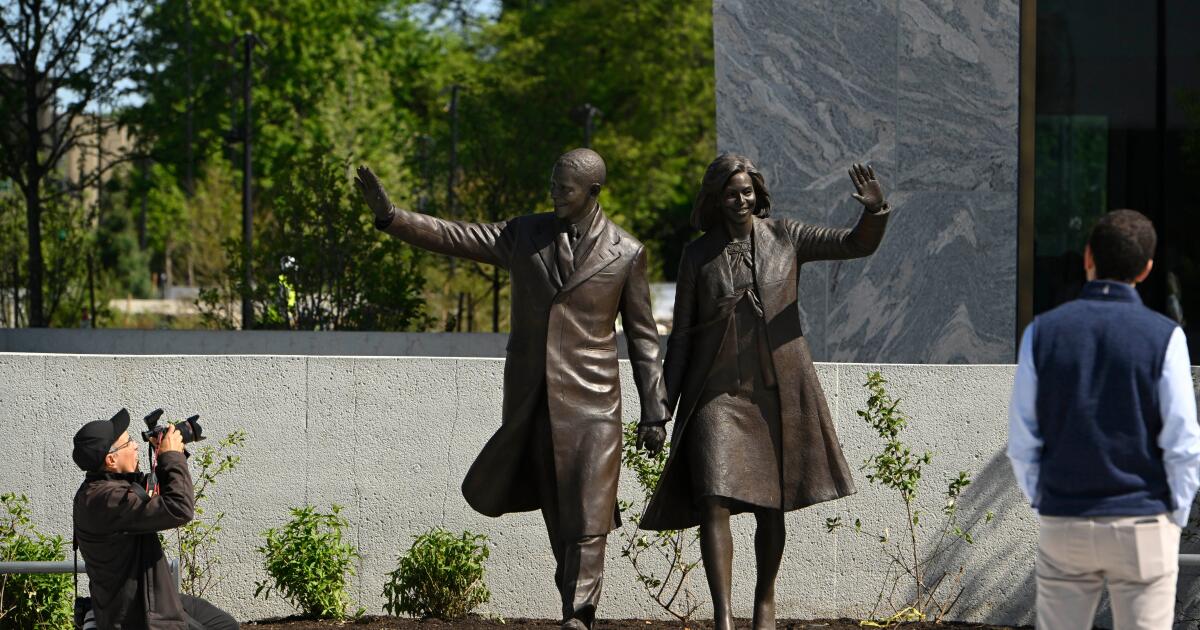
CHICAGO — Former President Obama’s influence in his presidential museum runs deep, from the location on Chicago’s South Side to textured stone adorning its dramatic tower to striped reading chairs that resemble ones in his own home.
The Obama Presidential Center opens to the general public on Juneteenth after a celebratory dedication in Chicago with dignitaries. But tens of thousands of people — friends and family of museum staff, students and journalists — have already been offered a sneak peek of the nearly 20-acre campus as crews finish final art installations and landscaping.
The roughly $850 million project covers the political and personal realms of the nation’s first Black president. Campaign memorabilia and presidential artifacts are displayed in the admission-based museum tower while public spaces of the sprawling campus feature other things important to Obama: a new library, basketball court and picnic area with grills.
“This is a safe space for people to come and, yes, reflect on the historic moments of this presidency and the campaigns, but also to come together as a community to think about what change you can bring to your own neighborhood,” Josh Harris, the Obama Foundation’s vice president of public engagement, said during a recent tour with The Associated Press.
Here’s a closer look at the top attractions of the campus that is expected to draw as many as 1 million visitors annually.
President for a day
Obama’s presidential museum will be the first fully digital museum of its kind. There will be no official papers on display. Instead, visitors will experience high-tech and hands-on exhibits spanning the campaigns, key moments of Obama’s presidency and life at the White House.
One of the largest attractions is a life-sized replica of the Oval Office.
On a recent day, a stream of visitors, including schoolchildren, walked through the circular room, stopping to sit behind the desk and pose for pictures. The top drawer holds a copy of a handwritten letter from his predecessor, President George W. Bush, and Obama’s beloved BlackBerry phone.
“We want to make sure that people from all walks of life have the opportunity sit behind the Resolute Desk,” said Harris. “You think about the possibilities that if a young organizer from the South Side of Chicago can be president, you can be president too.”
Other sections of the museum detail the Affordable Care Act, immigration policies, and smaller moments such as when Obama unexpectedly sang during a 2015 eulogy for those killed in a South Carolina church shooting. A large television screen plays a clip of Obama singing “Amazing Grace.”
Peppered throughout are areas for personal reflection, which museum organizers say is key.
“We’re passing that baton and inviting people to bring change home, however change may be defined, both small or large,” said Louise Bernard, the museum’s director.
Touching iconic ballgowns
When Obama touted the museum’s contents at its groundbreaking in 2021, he predicted one of the top draws.
“We want this center to be more than a static museum or a source of archival research,” Obama joked at the site. “It won’t just be a collection of campaign memorabilia or Michelle’s ballgowns, although I know everybody will come see those.”
Roughly a dozen outfits on mannequins are behind glass, including a black and red dress designed by Narciso Rodriguez that the former first lady wore on Election Night in 2008 in Chicago.
Visitors will also get a chance to touch swatches of the fabrics, including the rose gold chain mail Atelier Versace evening gown she wore at her final state dinner in 2016.
Obama’s personal touches
The museum’s location is near where Barack Obama started his political career, taught law at the University of Chicago and where the family lived. Michelle Obama also grew up on the South Side.
A lifelong basketball lover, Obama requested a glass-paneled, professional grade basketball court to be used for community programs.
The former first lady designed a garden, where lettuce and strawberry plants are sprouting. There are also charcoal grills available for public use — an element that Obama envisioned when he pitched the plan in community meetings nearly a decade ago.
“President Obama always talked about his feelings of being in Chicago and one of his memorable moments was grilling in the park,” Harris said.
The Obamas’ design tastes and love of history are also evident.
The museum campus features dozens of commissioned works of art while different parts of the campus are named after prominent figures. The central “John Lewis Plaza,” named for the late congressman and Civil Rights leader, is designed as a public gathering spot.
Inside a new Chicago Public Library branch, a 70-foot mural depicts literary figures, including Walt Whitman and James Baldwin. At the center, Toni Morrison reads to a boy wearing orange shirt, representing a young Obama.
The presidential reading room features thousands of books chosen by the Obamas, ranging from presidential biographies to best-selling fiction. One of Obama’s favorite parts are two high-backed chairs with blue, yellow and black stripes. They were selected by the former president as top-notch reading chairs similar to ones he has at home.
Pricey admission with free options
Tickets are $30, the highest of any U.S. presidential museum or library. Next on the list is the Richard Nixon Presidential Library and Museum in California, where tickets are $29.
Obama Foundation leaders say the prices are justified for the state-of-the-art facility.
Tickets at the adjacent Griffin Museum of Science and Industry are $25.95. In downstate Illinois, tickets to the Abraham Lincoln Presidential Library and Museum in Springfield cost $15.
Along with free days and discounts for Illinois residents, Obama Foundation officials also argue that most of the campus is free, with only four floors of the museum tower requiring tickets.
Anyone can walk the campus, use the playground, library, sledding hill or grilling area. The tower’s top floor, which feature panoramic views of the nation’s third-largest city, is also free.
“The idea behind this institution, this campus, was to make it accessible to as many people as possible,” Harris said.
Even on her way out, Rep. Nancy Pelosi (D-San Francisco) — 86 and retiring — held sway.
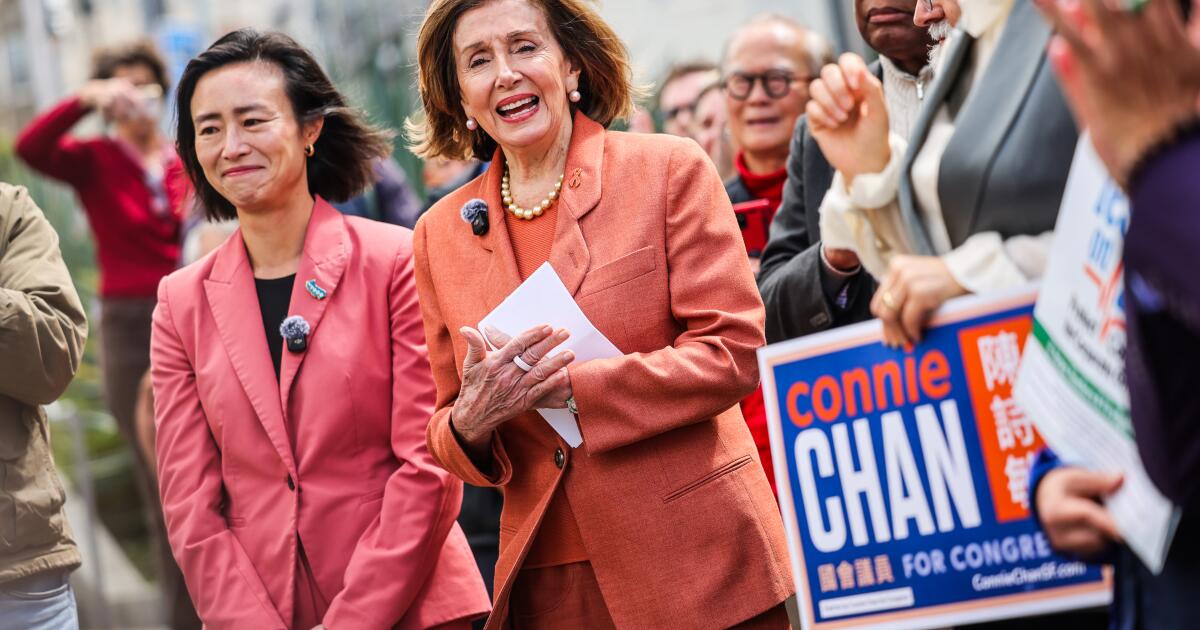
Last month, in the final stretch of the race to replace her, Pelosi endorsed Connie Chan, a member of the San Francisco board of supervisors and a candidate who had until then struggled to gain traction. The move clearly had an effect, with Chan advancing out of Tuesday’s primary to the general election in November, according to the Associated Press.
Political observers were quick to note that Pelosi’s famed political influence was alive and well, as made clear as of Wednesday morning by Chan’s bounding past the third-place finisher, tech millionaire and Democratic political operative Saikat Chakrabarti, who self-funded his campaign to the tune of nearly $10 million.
But cast another way, the race’s early results also showed the limits of Pelosi’s influence — in the form of state Sen. Scott Wiener, who as of Wednesday morning was clearly the race’s front-runner, holding a double-digit lead over both Chan and Chakrabarti.
Wiener — an ambitious and prolific state lawmaker with a strong base in San Francisco, particularly in the liberal bastion’s LGBTQ+ community — has long eyed the seat but held off from running for years in deference to Pelosi, a trailblazing politician and one of the most powerful of her generation. She was the first woman ever elected House Speaker in 2007 and oversaw both of President Trump’s first-term impeachments.
However, that changed in late October, when Wiener, 56, announced he couldn’t wait any longer and would be running this year. His announcement came before Pelosi had announced her own plans, amid broader party backlash against gerontocracy and elderly incumbents holding on within the aging Democratic establishment, and it appeared to irk her.
In early November, shortly after California voters passed Proposition 50 to allow Democrats to redraw the state’s congressional districts to better favor Democrats — an initiative she helped spearhead — the still influential Pelosi announced she would retire.
In that announcement, Pelosi thanked San Francisco voters for giving her wide latitude to be a fearless voice in Washington. She hadn’t faced a serious election challenge since the Reagan administration. In her last race, in 2024, she won reelection with 81% of the vote.
Pelosi then waited until last month to endorse Chan as her chosen successor.
Chan, 47, who was born in Hong Kong and immigrated to San Francisco with her family at age 13, was first elected to the board of supervisors in 2020, and has been chair of its budget committee since February 2023. Before winning office, she was a Chinese interpreter and then an aide for nearly 15 years to several different Democratic politicians from the Bay Area, including then-San Francisco Dist. Atty. Kamala Harris.
Other establishment figures, such as Sen. Adam Schiff (D-Calif.) and former San Francisco Mayor Willie Brown, endorsed Chan as well.
Last week, Pelosi said she’d decided to weigh in and back Chan in part because, after spending years boosting women into positions of power, she’d realized there weren’t enough around anymore.
“It’s not about women being better than men; it’s that we have to have women at the table,” she told NBC News.
At her election night party, Chan told the SF Standard that Pelosi’s endorsement “absolutely changed the tide” in the race, delivering a “fatal punch” on behalf of her campaign.
But that punch, if devastating to Chakrabarti’s campaign, had clearly not knocked out Wiener — who was ready Tuesday night with a few punches of his own in a speech to his supporters.
“Tonight, San Franciscans sent a very clear message,” he said, according to shared remarks. “San Franciscans are ready for bold leadership, real results, and a new generation of leaders that isn’t afraid to take on the toughest fights facing our country.”
Wiener, who served in the San Francisco board of supervisors himself before winning election to the state Senate in 2016, said in this political moment, “we can’t afford politics that simply preserve the status quo.”
He said, “I’m not going to Washington to sit quietly, protect the status quo, or wait my turn.”
“I’m going to fight relentlessly for Medicare for all, to build millions of homes, to make public transit more expansive and reliable, for affordable clean energy, for working families, for civil rights, and for democracy itself,” he said. “I’m going to fight to protect our immigrant neighbors, LGBTQ people, reproductive freedom, and the rule of law — and to protect them from Donald Trump and MAGA extremism.”
Others, including many in the LGBTQ+ community, also cheered the strong showing from Wiener, who is gay and has long championed LGBTQ+ rights. Kelley Robinson, president of the LGBTQ+ rights organization Human Rights Campaign, said her organization was “thrilled.”
“We need more voices like Wiener in Washington. Not only would he expand the number of openly LGBTQ+ members of Congress, he has a record of impact and delivering for his constituents,” Robinson said. “We are excited to support him on to victory in November.”
With Tuesday’s primary settled, a new head-to-head race for Pelosi’s seat begins — one that, given her endorsement of Chan and Wiener’s intentional focus on pulling San Francisco in a new direction, will be an even clearer referendum on her influence.
Somalia is entering one of the most dangerous moments in its recent history without an agreed path towards elections or a political transition. United States and United Kingdom-led talks between the government and the opposition collapsed on May 15, the date on which President Hassan Sheikh Mohamud’s original four-year term was due to expire, leaving the legitimacy of key federal institutions under serious strain.
Justin Davis, the US chargé d’affaires to Somalia, and the UK’s ambassador, Charles King, had been trying to persuade political leaders from both sides to reach an agreement on a political transition roadmap. Their failure leaves the country without an agreed way forward at the worst possible time.
Since 2008, Somalia has frequently been ranked as one of the world’s most fragile states. Under President Mohamud’s leadership, the country is now facing a political deadlock that threatens its survival. This crisis is unfolding amid insecurity, humanitarian distress, economic fragility, widespread corruption and shifting geopolitical rivalries.
At the heart of the crisis is the contested nature of the Somali state itself. Somaliland seeks independence, while Puntland and Jubbaland have broken ties with the Federal Government. Al-Shabab controls significant parts of the country and key roads. The Federal Government and at least three Federal Member States are also operating beyond their mandates. The scheduled electoral calendar has lapsed without a vote: parliament’s four-year mandate expired in April 2026, and the president’s term ran out a month later, yet no agreed roadmap for elections or political transition exists to replace them.
In a controversial process, the government unilaterally changed the constitution, passed an electoral law viewed by its opponents as self-serving, and established an election commission they reject as one-sided. Over the past four years, executive, legislative and judicial powers have become increasingly concentrated in the hands of President Mohamud.
Somalia’s national opposition, along with Puntland and Jubbaland, has characterised the government’s actions as a power grab and rejected them. They argue that the 2012 constitution, which reflects Somalia’s political settlement, remains the law of the land. As a result, Somalia is now caught between two competing claims to constitutional legitimacy. For its part, the government maintains that it is advancing a democratic goal long sought for Somalia, a move from indirect, clan-mediated selection to one-person, one-vote elections, and that the constitutional amendments extending the presidential term from four to five years were lawfully approved by parliament.
Universal suffrage and party-based politics remain a distant aspiration for Somalis. Acknowledging this reality, both the government and the opposition continue to accept the clan-based power-sharing system. However, they disagree on how members of parliament representing clans should be selected at the state and federal levels. The government seeks a one-year term extension and proposes an electoral system for clan representatives that critics say would help it maintain its hold on power. The opposition, by contrast, advocates an improved indirect election process through which clans would choose their representatives.
This political rupture is unfolding in a country already facing severe security and governance challenges. Although security in the capital has improved, widespread violence persists, particularly in south-central Somalia. According to the ACLED database, national fatalities reached a record high in 2025, and al-Shabab is responsible for the large majority of conflict deaths recorded over the past two decades. During the current administration’s four years in office, the same data points to tens of thousands of deaths nationwide, primarily concentrated in Banadir, Lower Shabelle, Lower Jubba and Hiran.
The crisis is also taking place against a worsening humanitarian and economic backdrop. Despite the arrival of rains across the country, humanitarian agencies warn that millions of Somalis are food insecure. International humanitarian efforts are struggling to raise funds to assist those affected by poverty, displacement and conflict. Foreign aid has been declining since the Trump administration dismantled USAID in 2025, while Somalia’s domestic revenue-to-GDP ratio remains in the low single digits. Concerns over the viability and affordability of the state have led many to look towards a resource-based economy, particularly as Turkiye expands its involvement in Somalia’s oil and fisheries sectors.
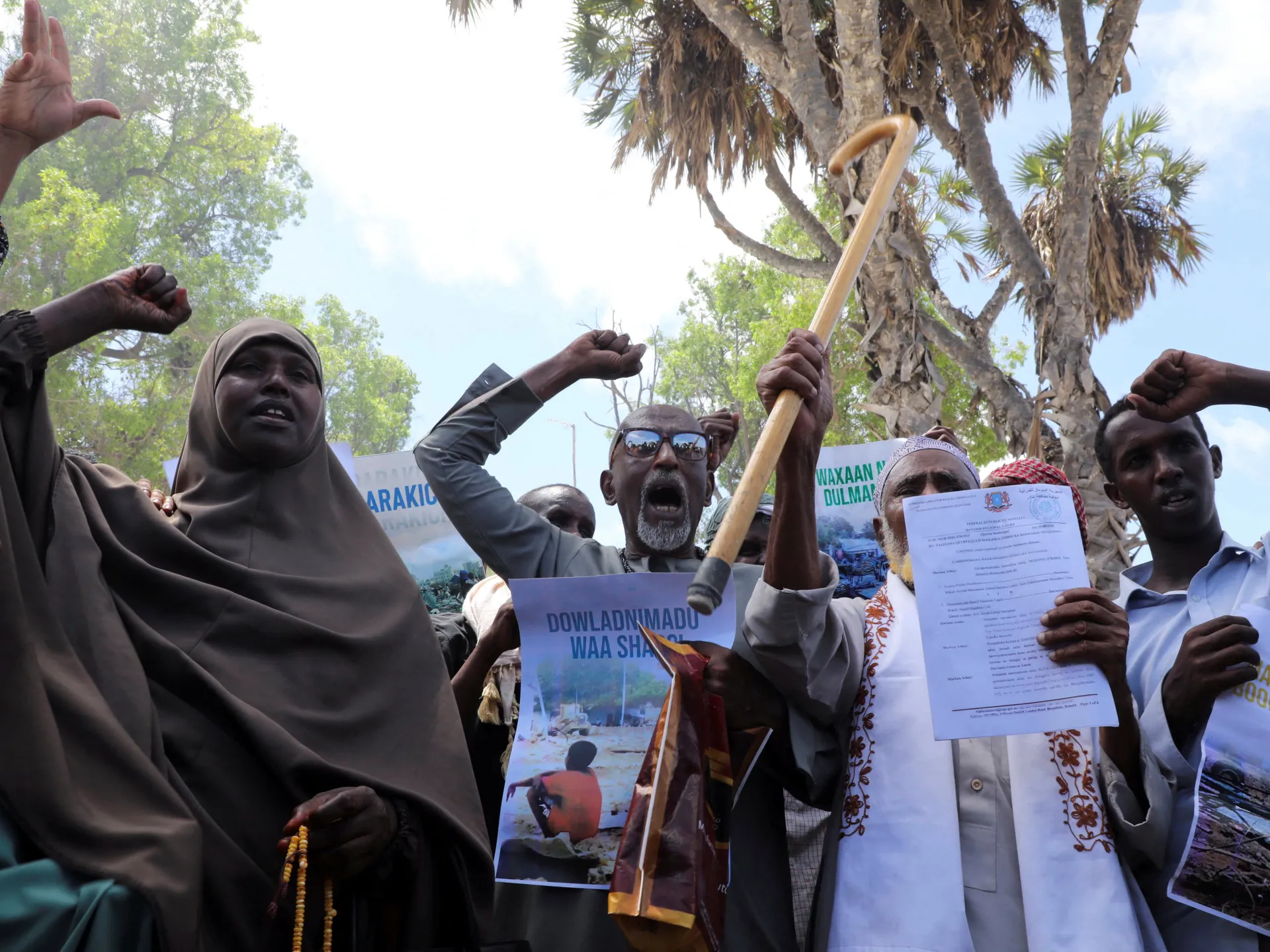
Corruption has further weakened public trust in state institutions. According to the Corruption Perceptions Index, Somalia has consistently ranked among the most corrupt countries in the world over the past decade. Widespread corruption has undermined almost every aspect of governance. The government’s approach to land management has deepened these concerns, with critics accusing it of forcibly evicting people who occupied public lands during the war and selling some of these lands to merchants without due process. Many citizens with legal documents from previous governments have also lost their homes.
These domestic pressures are being sharpened by regional and global rivalries. Somalia is struggling to navigate intensifying competition in the Horn of Africa, the Gulf of Aden, the Red Sea and the western Indian Ocean. Its divided political class is managing these challenges not as a cohesive state, but through regions, clans and rival political blocs. Different groups have aligned themselves with various regional powers and neighbouring countries.
Regional players, including Turkiye, Saudi Arabia, Israel, the United Arab Emirates, Iran and Egypt, are increasingly active in the Horn of Africa. Israel became the first country to officially recognise Somaliland late last year, intensifying competition among rival regional powers and drawing further attention to Somalia and Somaliland amid the region’s shifting geopolitics.
The political, security, economic and humanitarian pressures have also had serious implications for civic space. The government has been accused of silencing dissent by jailing journalists and civic activists. The opposition is now calling for demonstrations, while the government is openly discouraging public participation.
What should happen now
Somalia stands at a critical juncture. Timely intervention by the international community could help redirect the country away from violence and political fragmentation. In the past, traditional donors, mainly the US, the European Union and the UK, helped facilitate Somalia’s last five political transitions, in 2004, 2008, 2012, 2016 and 2022.
The American and British diplomats in Mogadishu made important efforts to bring the parties together and facilitate dialogue, although these efforts came late. A final push may now require more direct involvement from Washington and London, as well as engagement with non-traditional Gulf donors. Turkiye has also expressed interest in contributing to mediation efforts. This should be welcomed, as Ankara has influence with political actors in both the government and the opposition.
The international community should first pressure the government to negotiate a political roadmap in good faith, with a focus on a workable and timely election process. Villa Somalia should also stop using state institutions, including security forces, the aviation agency and international assistance, as tools in the political dispute.
At the same time, the opposition should be encouraged to engage constructively with the government and avoid initiating a parallel process that could lead to the formation of an alternative government. Most importantly, the international community should impose targeted sanctions on political spoilers who use extrajudicial means to destabilise the country.
Beyond the immediate political impasse, there is also a pressing need for genuine national dialogue and reconciliation. Previous peace processes in Djibouti and Kenya involved a wider range of actors in peacebuilding and helped establish the Third Republic. One lesson from those processes is that institutions built by people who have not fully reconciled cannot last. Somalis have never had the opportunity to engage in a serious and inclusive national dialogue. They need an open forum, genuine reconciliation and state institutions they collectively own.
Somalia is on the brink of political disintegration, but it remains at the prevention stage. That is precisely why the broader international community must act now, as it has in the past. There is still time to guide Somalia away from a self-destructive path and safeguard decades of investment in state-building and peacebuilding.
The views expressed in this article are the author’s own and do not necessarily reflect Al Jazeera’s editorial stance.
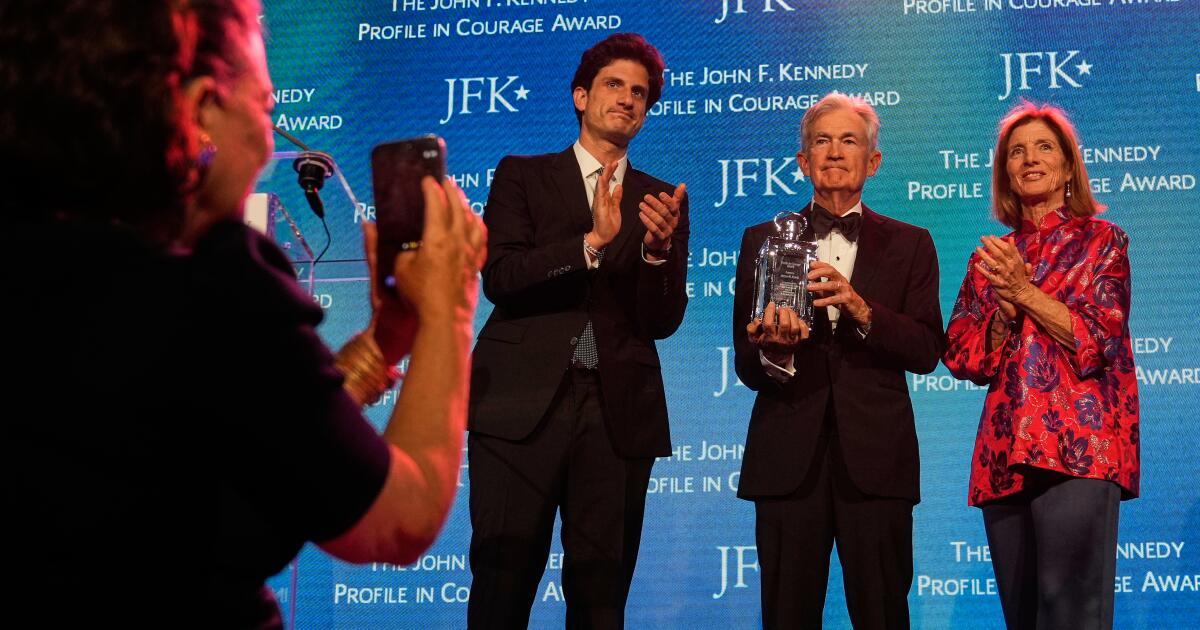
BOSTON — Former Federal Reserve Chair Jerome Powell used one of his first major public appearances since leaving office to defend independent institutions while accepting an award Sunday honoring his efforts to preserve the central bank’s independence.
Speaking at the John F. Kennedy Presidential Library overlooking Boston Harbor, Powell called universities, courts, Congress and the central bank “the foundation and the embodiment of our democracy” and argued that the Fed’s independence was a “priceless asset” that must be protected.
It was one of his most direct defenses of Fed independence, warning that a single administration’s decision to remove bank officials over policy differences would open the way for future elected officials to follow suit, ultimately undermining the credibility that the Fed has spent decades building.
Powell, who frequently clashed with President Trump during his eight years as chair, stepped down as his term expired in May. He was succeeded by Kevin Warsh, whom Trump selected to lead the central bank.
After stepping down as chair, Powell took the unusual step of keeping his seat on the Fed’s governing board, which he has until January 2028. By doing so, he has deprived the Trump administration of an opportunity to appoint another member of the board.
The Trump administration has also sought to fire Fed governor Lisa Cook, which would open an additional seat on the rate-setting committee the president could fill. Yet Cook sued and the courts have so far let her keep her seat.
While Powell never mentioned Trump by name Sunday, he repeatedly returned to the importance of protecting institutions from political pressure and preserving public trust in their independence.
“Like many other institutions, the Fed has been undergoing a stress test,” he said. “Congress wisely chose to insulate monetary policy decisions from political pressure. All other advanced economy nations have done the same.”
Since 1989, the John F. Kennedy Profile in Courage Award has recognized public servants who make what the foundation describes as courageous decisions of conscience despite personal or professional consequences.
Previous recipients include former Presidents Barack Obama and George H. W. Bush, Ukrainian President Volodymyr Zelensky and former Vice President Mike Pence.
In March, the foundation said it was awarding Powell for protecting the independence of the Federal Reserve “despite years of personal attacks and threats from the highest levels of government.”
Trump harshly criticized Powell throughout his tenure as chair, frequently attacking the Fed’s interest-rate decisions and urging the central bank to cut borrowing costs more aggressively.
Beyond the Federal Reserve, Powell defended U.S. universities and research institutions, the Constitution, Congress and the court system.
“The United States has long been the leader of the world’s freedom-seeking people — the indispensable nation. Other countries know us as a nation built on integrity, and that integrity must be maintained,” he said.
In his remarks, Powell indirectly acknowledged mistakes as chair. The Fed is legally required to seek stable prices, but inflation surged amid the pandemic’s supply chain crunch. Many economists believe the central bank should have raised interest rates more quickly in response.
“At the Fed, we are, of course, human and thus imperfect,” Powell said. “When we make mistakes, we acknowledge them and change course.”
Powell was honored alongside residents of Minnesota’s Twin Cities, who received the award for what the Kennedy Foundation described as acts of courage during a federal immigration crackdown that led to thousands of arrests and the deaths of Minneapolis mother Renée Good and nurse Alex Pretti, both of whom were killed while observing or documenting enforcement activity.
“It’s wonderful just to be invited, honoring Renée,” Good’s father, Tim Granger, said as he entered the library with family members.
Kennedy’s only surviving child, Caroline Kennedy, and her son, Jack Schlossberg, said in a statement that without people like Powell and those in Minnesota “willing to put their lives on the line to hold America to its promises, our democracy can’t survive.”
Attendee U.S. Sen. Amy Klobuchar, who is running for governor of Minnesota next year, reflected that the award was unusual because it recognized ordinary residents rather than elected officials.
“This didn’t go to an elected leader for a reason,” Klobuchar said. “It’s because the people stood up. They stood up by marching 50,000 strong. They stood by bringing kids they didn’t even know — strangers’ kids — to school, by bringing them groceries and they didn’t blink. And that’s what this award is about. It’s about courage.”
Willingham writes for the Associated Press. AP journalist Christopher Rugaber contributed to this report from Washington.
RIVERSIDE — It would not have been an easy reelection bid in any case for freshman Rep. Ken Calvert (R-Riverside), who barely made it to Congress two years ago.
But now Calvert’s biggest reelection hurdle may be his own indiscretions, which also could pose a problem in surviving even his own party’s June primary.
The reason: After months of denying it, Calvert, 40, has admitted having sex in his car one night last November with a woman who police say is a known prostitute.
Initially, Calvert–a member of a prominent Riverside County family–said he was doing nothing wrong with the woman when police saw them together on a Corona street.
Corona police said simply that the congressman was spotted sitting in his car with a female, that there was no criminal activity and that after a few words the congressman drove off.
But the Riverside Press-Enterprise newspaper went to court to press Corona for release of confidential police reports that had been prepared by officers who were sensitive to the fact that they had a street-level encounter with their local congressman.
The city was ordered to release the report, which indicated that there had been evidence of a sex act under way, and an embarrassed Calvert responded with a prepared statement.
“My conduct that evening was inappropriate,” he said–not because it was illegal, but because “it violated the values of the person I strive to be.” He admitted that he was caught in “an extremely embarrassing situation.”
He said he did not pay for the sex. He said he “panicked and tried to drive away” when the officers confronted him, but “came to my senses” and cooperated with them.
Corona Police Capt. John Dalzell said Calvert was not detained or arrested because “while the officer saw certain things, he didn’t see everything necessary to support a finding that a crime was committed.” Dalzell said there was no witness to an exchange of money for services, and neither party claimed to be a victim.
Dalzell said Calvert did not try to exert influence to avoid arrest. He said the officer’s decision not to pursue the matter “wasn’t a close call. He didn’t even call for a supervisor.”
In his explanation for his conduct that night, Calvert said he had come back from a rough week in Washington and was reeling from his father’s suicide a year earlier, as well as his wife’s request for a divorce, which had been granted just a few weeks before.
“I was feeling intensely lonely,” he said. “I realize now that this, or a similar incident, was probably inevitable.”
Calvert, who worked in commercial real estate before his election to Congress in 1992, was expected to coast to his party’s nomination this year to represent western Riverside County in Washington. His opponent in the primary, conservative Joe Khoury, 47, a professor of finance at UC Riverside, ran second behind Calvert in the primary two years ago but thinks he can prevail this time.
“I thought he was vulnerable, even before this incident,” Khoury said. “Riverside is conservative, and voters’ reaction to this is not pleasant. It plays differently here than it would in, say, Los Angeles.”
Calvert’s campaign manager, Ed Slevin, agreed that Calvert will have his hands full winning the primary because of the Corona incident. “I assume he’s more vulnerable in June among conservative Republicans than he’ll be in November,” he said. “I think that, by then, it’ll be considered old news.”
If Calvert wins the primary, his Democratic challenger is expected to be Mark Takano, a high school history and English teacher and trustee of the Riverside Community College District. Takano lost to Calvert by a little more than 500 votes in 1992, and is expected to handily win his party’s nomination in June against a single challenger.
Takano scolded Calvert for not coming clean earlier about the Corona incident. “Mr. Calvert has only himself to blame for his becoming a bigger issue than putting people back to work, fighting crime and improving our schools,” Takano said.
Democratic Party strategists said that, even before Calvert’s encounter with the woman in Corona, the 43rd Congressional District seat had been targeted for turnover because of what they characterized as Calvert’s lackluster performance in Washington during his first stint there and his vulnerability back home.
The top candidates for California governor crisscrossed the state Friday, all venturing to friendly political territory to woo voters and undermine their rivals as the June 2 primary election fast approaches.
The top Republican in the race, former Fox News host Steve Hilton, spent the day railing against transgender athletes before a high school track event in the Central Valley, an event sure to appeal to his base of President Trump supporters.
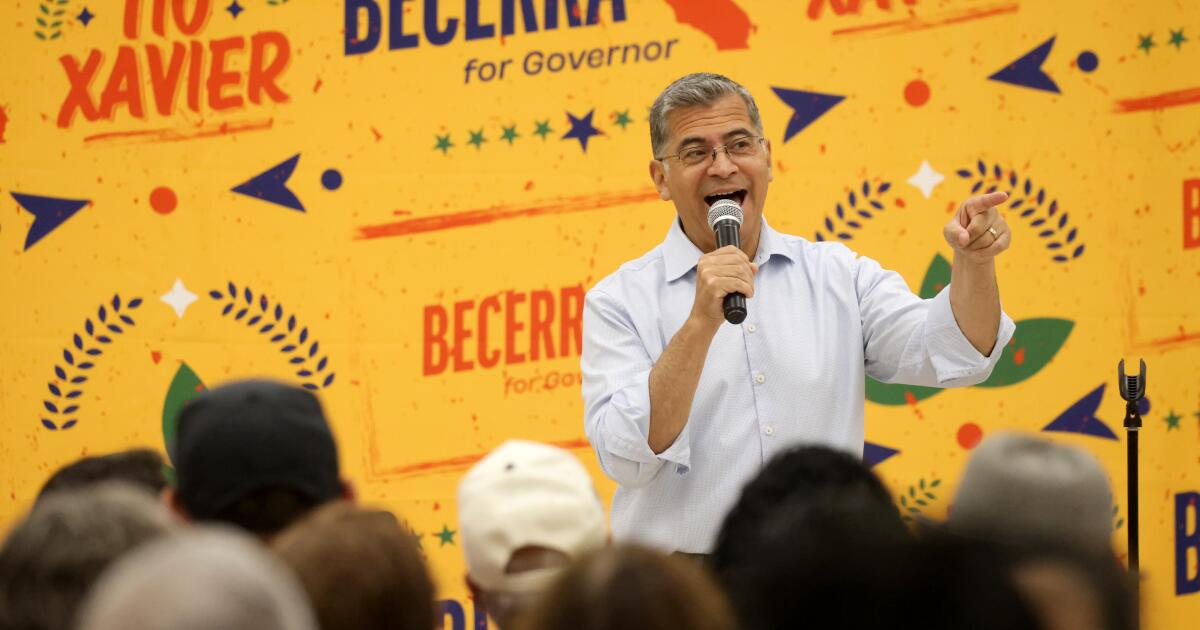
The front-running Democrats, former Biden administration Cabinet member Xavier Becerra and billionaire environmentalist Tom Steyer, rallied one of their party’s most influential constituencies: union members.
While both stuck with mostly an upbeat message and reiterated promises to lift up Californians struggling to make ends meet, Steyer afterward accused Becerra of being “a corporate Democrat who’s taking money from all these big corporations” who “doesn’t want to change things.”
Steyer’s had good reason to go after Becerra.
A new poll from the UC Berkeley Institute of Governmental Studies and co-sponsored by the Los Angeles Times showed Becerra leading the race with 25% support from likely voters, followed by Hilton at 21% and Steyer within striking distance at 19%. The two candidates who finish in first and second place in the primary will advance to the November general election, leaving the third-place finisher on the sideline.
Though he told reporters Friday morning that “I don’t pay attention to polls,” Steyer was energetic at a Northern California campaign event, where he held a private meeting with leaders of a union representing long-term caregivers. In brief remarks at the offices of SEIU Local 2015, Steyer described the race as a choice between a billionaire champion of working people and the corporate-backed Becerra.
“Does California work for Californians or does California work for corporations? The corporations think it works for them. They want it to continue to work for them and they’re putting up tens of millions of dollars to make sure they continue to make record profits,” he told dozens of home-care workers, teachers, construction workers and nurses at the West Sacramento gathering.
Groups including PG&E, the California Assn. of Realtors and the California Chamber of Commerce have spent more than $34 million opposing Steyer’s candidacy. The former hedge fund manager has pledged to lower energy bills by breaking up large electric utility monopolies.
As a billionaire who has so far poured $216 million of his own money into his gubernatorial campaign, Steyer has faced skepticism from some left-wing and working-class voters. But he is endorsed by progressives, including Rep. Ro Khanna (D-San Jose), and unions including the California Nurses Assn. and both major teachers unions.
“I voted for Tom. I was looking for a change,” said Alvenia Scott, a union board member who works as an in-home caregiver to her disabled sister.
“He really has some good ideas,” she said, adding that she had more qualms about Steyer’s lack of government experience than his wealth. “He made his way in life, more power to him.”
Hundreds of miles south in the Inland Empire, Becerra pledged to be on the side of unions if he is elected governor and urged voters to turn in their ballots in what has so far been a remarkably low-turnout election.
“I am with you. When I become governor and I sit behind that desk, you’ll have a union man sitting at that desk,” Becerra told about 500 people at the United Food and Commercial Workers hall in Bloomington.
He asked the crowd if they had cast their ballots and noted that not everyone raised their hand.
“Less than one in five Californians have actually cast their vote so far. We got to get that number way, way up,” he said, arguing that the election is about “sending a message all across the country that California will be counted, that California cannot be neglected, and that California will not take a knee to anyone in Washington, D.C.”
Only 12% of the state’s registered voters have cast ballots as of Thursday evening, according to the election tracking firm Political Data Inc.
Community college counselor Diego Rodriguez, 32, said he decided to vote for Becerra in recent weeks after seeing the former U.S. Health and Human Services secretary’s momentum in the race and researching his record.
“Also just his story. As someone who works in higher education, and seeing how Xavier, being first-generation, has benefited from higher education, and how he advocates for higher education,” the Rialto resident said. “Additionally, today, him being here at a labor union and advocating for the working class and labor, I think, is very important.”
“I think that people became aware of him more because of that,” Rodriguez said. “There was a lot of conversation online regarding that, but I think it allowed the spotlight to be brought onto him and it made people aware of his record.”
At a campaign stop in Clovis in the central part of the state, Hilton marveled that his campaign had spent only about $2 million in campaign advertising but was still polling above Steyer, according to the latest Berkeley IGS survey.
“We’re feeling confident,” said Hilton, standing in a suburban stretch of the city. Still, he warned that voters need to get out to support him and avoid a “complete disaster for California” of two Democrats advancing to the November election.
Hilton, who was endorsed by Trump in April, joined other politicians and leaders in Clovis in opposing trans athletes from competing at the 2026 CIF State Track & Field Championships.
The group met near where the championship events were scheduled to take place this weekend.
Asked why he was focusing on sports and gender in the final days of the race, Hilton said it’s “one of the main issues” that come up at town halls. If elected, he said he would seek to overturn the state’s 13-year-old law that allows students to participate in school activities and use facilities such as bathrooms based on their gender identity.
Hilton argues the law violates the state Constitution and will “suspend” it while he initiates legal proceedings to overturn it.
He also praised Spencer Pratt, a Republican and former reality TV star who is running for Los Angeles mayor, saying his candidacy has brought “excitement and energy” to the state’s primary election.
“For a long time in California, there’s been this sense that it’s all inevitable — there’s nothing you can do, Democrats run this place, just the way it is,” Hilton said. “I think that that’s changing. I think there’s this sense that something’s happening.”