Faith leaders unite across religions to counter voter intimidation on Election Day
Come Election Day, a Quaker leader will travel from the nation’s capital to her home state of Ohio. A Christian minister and a Jewish rabbi will stand vigil outside a polling place in Arizona. A Buddhist nun will offer support to voters in Wisconsin.
In battleground states across the country, these faith leaders and hundreds of their colleagues will assume the role of poll chaplains for one day. They will deploy to nine states — Arizona, Michigan, Georgia, Ohio, Pennsylvania, North Carolina, Wisconsin, Virginia and Texas — where contentious races are expected to raise political tensions.
Faiths United in Saving Democracy, a nonpartisan coalition of interfaith and secular partners, is helping to train and certify this volunteer force of clergy members and lay peacekeepers in time for the Nov. 3 elections.
They’ll wear identifying hats and vests, and stay outside the poll centers, with the goal of maintaining a calm, reassuring presence to encourage more voters to exercise their rights without fear or hesitation, said co-founder Barbara Williams-Skinner. As of Oct. 19, they’ve recruited 1,235 poll chaplains and peacekeepers, she said.
A non-partisan effort to take the fear out of voting
While the idea of poll chaplains has been around for several years, Williams-Skinner said “2026 is going to be different” because there is widespread concern that the presence of federal immigration agents could create a chilling effect.
“The fear is real,” she says, worrying that it could deter eligible voters in mixed-immigration-status families and communities of color. Department of Homeland Security officials have consistently said they have no plans to send immigration agents to the polls, although DHS Secretary Markwayne Mullin said they could show up for a specific reason, such as arresting someone if they have a warrant.
The coalition has offered training online and in person. Participants get information about immigrant rights, de-escalation techniques and phone numbers to call in tight situations, Williams-Skinner said.
The initiative, strongly rooted in the Black church, has expanded to include diverse faiths as well as non-religious people, she said.
“This is a movement built by unusual coalitions,” she said. “You have white, Mainline Protestants, Quakers, traditional Baptists, Black church leaders, imams, rabbis — all kinds of people who probably would not work together or haven’t worked together in the past.”
While most participating groups are moderate or progressive, Williams-Skinner says it is a strictly nonpartisan initiative.
“We don’t get hung up on who’s moderate or who’s conservative. People just need to be able to vote, unafraid,” she said.
Concerns about voter intimidation motivate chaplains
A Pew survey following the assassination of conservative activist Charlie Kirk in September 2025 showed 85% of Americans, across political lines, believe political violence is on the rise.
Polling places have been targeted by protesters in past elections. In 2022, members of a group claiming to monitor ballot drop boxes in Arizona were ordered to stay at least 250 feet away after voters complained about intimidation. In 2020, following Election Day, a crowd stormed a vote-counting center in Detroit, many incited by online conspiracy theories about election fraud.
As the mob banged on the center’s doors and windows, the Rev. Steve Bland was among several faith leaders who put their bodies between the building and the crowd. Bland, who leads Detroit’s Liberty Temple Baptist Church, is continuing that work as a poll chaplain.
The pastor says de-escalation often involves “using the right words to calm a situation” or giving intimidated voters the moral support and reassurance that they are safe to exercise their civic right. Bland said he did precisely that for an elderly, Black woman during a prior election.
“She left and came back with two of her grandsons who also voted,” he said. “Without that intervention, three people wouldn’t have voted that day.”
The Rev. Bankole Akinbinu, senior pastor of Baptist Grove Church in Raleigh, North Carolina, said training in conflict resolution and de-escalation has given him the confidence to serve as a poll chaplain. A millennial, he has sought to engage younger people by recruiting peacekeepers from college campuses.
His motivation comes from seeing voter suppression attempts in North Carolina and other states.
“I look at our forefathers and the struggle they had to endure to afford us the privilege of voting,” Akinbinu said. “I look at my children and the nation I want to hand them.”
Steven Huefner, deputy director of the Election Law Program at The Ohio State University, says poll chaplains might be able to calm the frayed nerves of a voting public that is constantly exposed to divisive rhetoric and news about political violence. While political violence has increased, he says, it’s not widespread.
“Election workers are well-trained and can run elections quite well,” he said.
Faith leaders have historically played the role of peacekeepers, said Wendy Cadge, professor of sociology at Bryn Mawr College in Pennsylvania and founder of the think tank Chaplaincy Innovation Lab.
And now chaplaincy — beyond traditional worship spaces — is attracting more clergy.
“People are feeling called to chaplaincy because they want to be with people in difficult times,” Cadge said. “They don’t want to worry about what color the carpet is in the church or if their youth programs are attracting enough people. It’s a different kind of work.”
Chaplains find inspiration in theology
Clergy deploying on Election Day say they are heeding a strong, faith-driven calling to serve as poll chaplains.
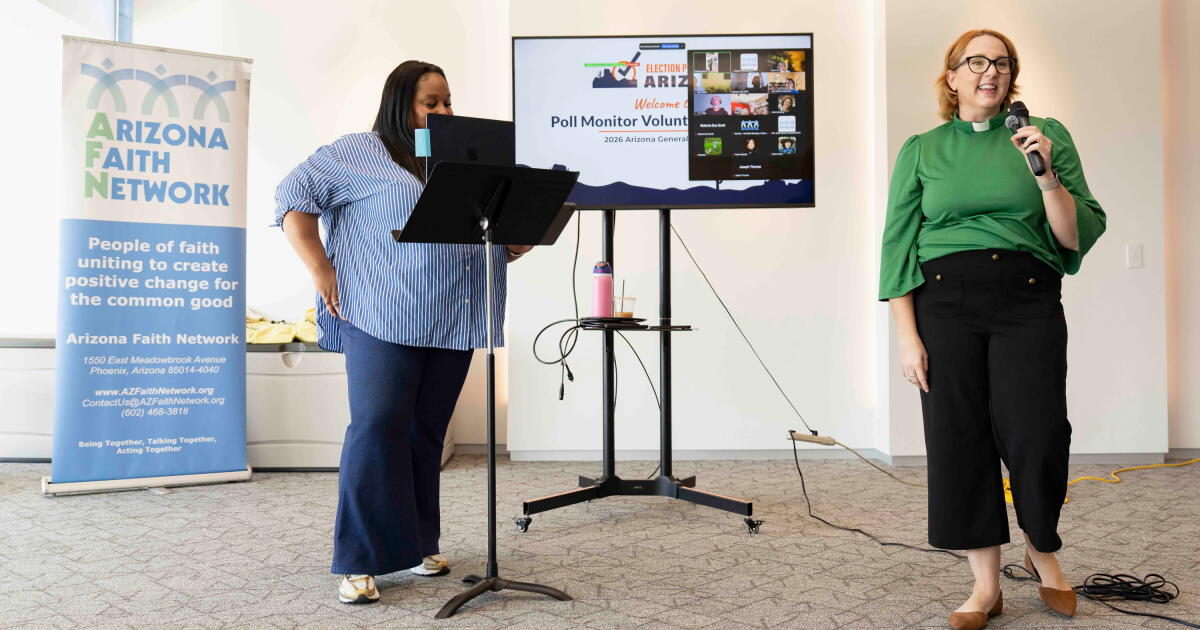
In Arizona, Rev. Katie Sexton, executive director of Arizona Faith Network, embraces the initiative as a way to reach across the political divide.
“The ballot box is a place where we’re all seen as equal,” she said, adding that it reflects the Christian belief that all humans are created in the image of God. “There is such power in that.”
On Oct. 6, Sexton and several others participated in a training session — one of the last before the midterms — at Temple Chai, a Reform synagogue in Scottsdale.
Rabbi Emily Segal, who leads the congregation, will be a poll chaplain for the first time next month. The work, she says, aligns with what the Torah and Talmud teach about a healthy and just society.
Throughout American history, interfaith coalitions have created powerful change and served as sources of inspiration, Segal said. “Any time we can come together with faith partners around our shared values for societal good is a real source of holiness for our community.”
Bridget Moix, a Quaker leader, will travel to her native Ohio on Election Day.
“In our faith tradition, we think about voting as a sacred act we want to protect,” she said.
For Reirin Gumbel, resident teacher at the Milwaukee Zen Center, it’ll be a third time, come November.
“As Buddhists, the Metta Sutra we chant says every being has the same rights, and that we should have compassion toward all,” she said.
Imam Mohammed Ali Elahi, spiritual leader of the Islamic House of Wisdom in Dearborn Heights, Michigan, is considering becoming a poll chaplain for the first time. In a highly contentious campaign in Elahi’s state, Abdul El-Sayed is the first Muslim Democratic candidate to run for a U.S. Senate seat.
The imam said he is tired of anti-Muslim vitriol that has surfaced ahead of the midterms.
“As interfaith clergy, we stand for principles not personalities,” he said. “The Quran tells us to stand for what’s right — truth, justice, peace, human rights and the dignity of human beings, whoever they may be.”
Bharath writes for the Associated Press.