political criticism

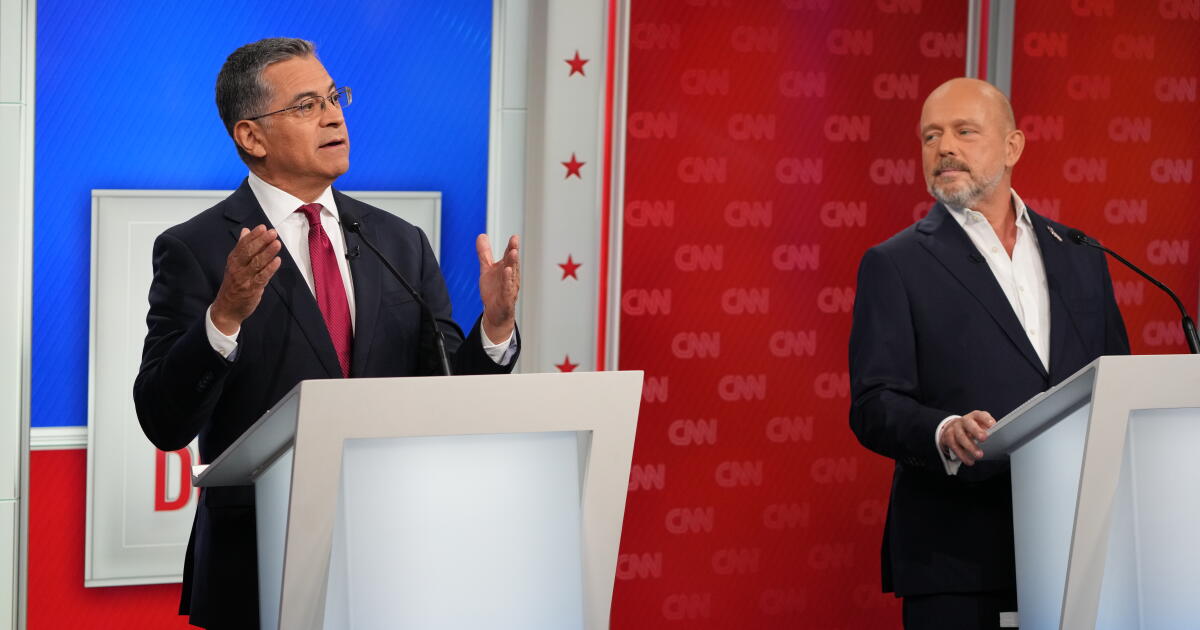
California voters deserve to see Becerra and Hilton debate

Barring some extraordinary event — a health emergency, a career-ending scandal, a killer asteroid destroying all life on earth — Xavier Becerra will be the next governor of California.

That’s not partiality or wish casting on the part of your friendly political columnist. The fact is Democrats and Democratic-leaning independents overwhelmingly outnumber Republicans in California, in both registration and inclination.

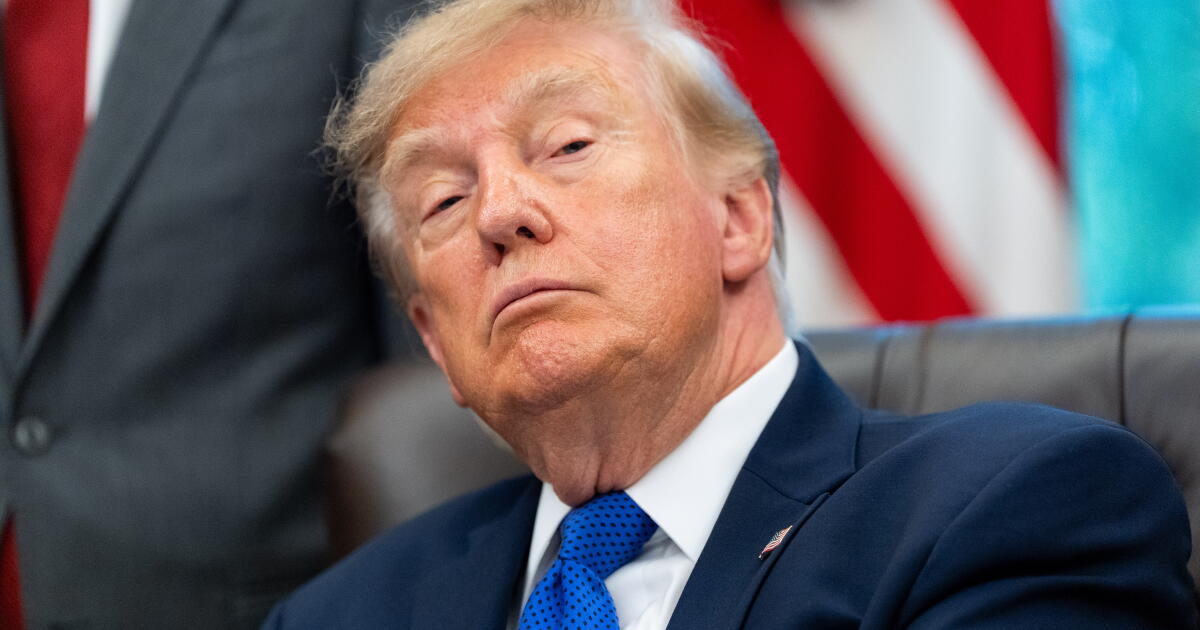
The GOP brand has been political poison in this Tahoe-blue bastion for decades now. But under Donald Trump, it’s grown even more toxic. His endorsement, which the president bestowed upon Republican Steve Hilton mid-primary, is the political equivalent of sarin; like the deadly nerve agent, it can kill on contact.

Still, give credit where due.

The gregarious and media-savvy Hilton has been waging an energetic and effervescent run for governor, with multiple appearances a day and frequent updates to his cheeky social media accounts.

“He’s going to San Francisco” — into the bowels of the liberal beast — “he’s going into schools, talking to labor groups,” said Hector Barajas, a campaign spokesman. “He’ll go everywhere.”

Becerra not so much.

You’re reading the L.A. Times Politics newsletter

George Skelton and other analysts cover the insights, legislation, players and politics you need to know. In your inbox Monday and Thursday mornings.

The Democrat has appeared here and there since finishing first in the June 2 primary, securing one of two slots in November’s runoff. He’s offered a few modest proposals, including a plan to deliver two free hours of electricity a day to low-income households and a call for stiffer regulation of artificial intelligence.

A sprint vs. a stroll

That said, if Hilton is flat-out running for a job he stands virtually no chance of winning, Becerra is embarked on more of a leisurely stroll toward his all-but-certain perch in Sacramento.

That’s not a terrible thing at this midsummer stage of the race. Once, in the blessed era before the 24/7 news cycle and the omnipresence of social media, there was a lull in the months after the primary, with campaign activities picking back up around Labor Day.

On Tuesday, during a walking tour of Los Angeles’ Little Tokyo neighborhood, Becerra pushed back on the notion he was taking his election — and California voters — for granted. “If I were trying to coast,” he told reporters, “I’d be out on the coast right now instead of here with you all.”

Becerra’s pace aside, the days between now and the Nov. 3 election offer him plenty of time to spell out what, exactly, he has to offer his home state and how, in a broad sense, he plans to tackle one of the highest profile, most vexing jobs in all of American politics.

At least one of those days should include a face-to-face debate between Hilton and Becerra. The two shared a stage multiple times during the primary season. They have not appeared together since.

More than a half-dozen news organizations have offered to host the gubernatorial rivals in a one-on-one session. Several other groups have proposed forums that would allow them to discuss their differences together in person.

Barajas, the spokesman for Hilton’s campaign, said the Republican hopeful has agreed to each and every invitation.

“He’s got absolutely no problem” appearing anytime or anywhere, Barajas said. “He will go to East L.A.. He will go to South-Central. He will go into the heart of the Central Valley. It doesn’t matter to him.”

That’s no surprise.

When a candidate is an underdog, like Hilton, they’ll typically show up at the opening of an envelope if it means appearing before a crowd. Conversely, a candidate on a seeming glide path to election, like Becerra, will often balk at giving their opponent the exposure afforded by a debate, much less risk harming themselves with a bad performance.

The Democratic front-runner said Tuesday that “there will be debates,” though he didn’t say where or when.

An obligation to voters

There’s a lot of virtue signaling that surrounds the notion of candidate debates.

Far from a high-minded discussion of policy differences, they often devolve into a stale recitation of talking points and pre-scripted zingers. After a while, debates can grow redundant and, frankly, boring as contestants repeat well-worn phrases and replow deeply furrowed ground. Such was the case by the time California’s gubernatorial hopefuls met for their sixth televised debate in the spring.

Most voters — many of whom profess to care oh-so-deeply about issues and matters of great import — don’t even bother tuning in. If they found debates that captivating, shows such as the “PBS NewsHour” would routinely outdraw the latest season of “Love Island USA.”

No matter.

There is an audience, however limited, for debates. Even if they don’t bother watching, many voters read about the encounters afterward, catch snippets online, or glean useful insights from the extensive coverage that follows.

Above all, a willingness to debate is a sign of respect — for voters as well as the political process the candidates are a part of. Minimizing direct confrontation with Hilton may play to Becerra’s inherently cautious nature. It also makes sense from a purely strategic standpoint.

But it doesn’t serve the people of California, or give voters their due. This is a campaign for governor. Not a coronation.

Becerra owes California, and Hilton, the chance to take the candidates’ measure side by side before their contest is over. The sooner Becerra commits to a time and place, the better.

What else you should be reading

The must-read: Trump turns to containing the fallout from setbacks in Iran
The deep dive: War was supposed to crush Iran’s ‘Axis of Resistance.’ Instead, it’s bloodied but unbroken
The L.A. Times Special: Xavier Becerra won’t deliver the home runs — or strikeouts — racked up by Newsom, Schwarzenegger

Until next time,
mzb

Was this newsletter forwarded to you? Sign up here to get it in your inbox.
Source link

Column: Xavier Becerra won’t deliver the home runs — or strikeouts — racked up by Newsom, Schwarzenegger

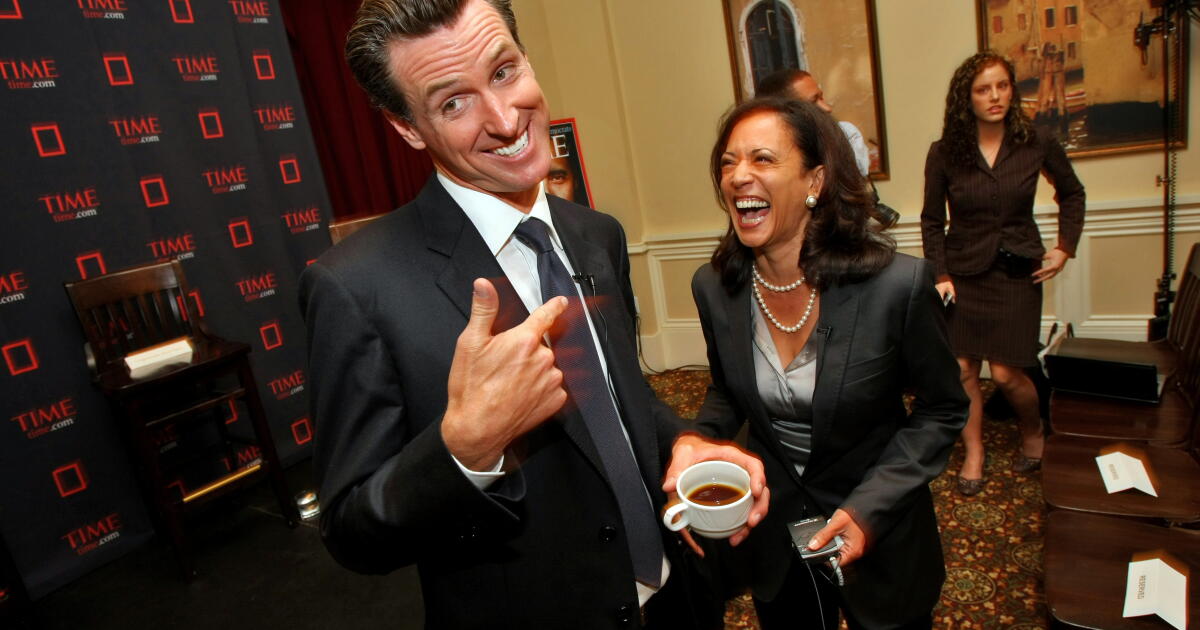
California’s next governor, Xavier Becerra, is a “small ball” player, to borrow a baseball term. He probably won’t be swinging for the fences like Govs. Gavin Newsom and Arnold Schwarzenegger.

But he also won’t be striking out a lot trying to hit home runs, like Newsom and Schwarzenegger.

Democrat Newsom has rapped some doubles, most notably streamlining the long-abused California Environmental Quality Act that has slowed housing development for decades and increased the cost of homeownership.

Republican Schwarzenegger slammed a home run when he signed Democratic legislation (AB 32) kicking off California’s nation-leading fight against climate change.

But stars Newsom and Schwarzenegger frequently fanned at the plate while overreaching.

Gov. Jerry Brown? He had the “good eye,” another baseball term referring to a batter adept at spotting a good pitch to swing at and knowing when to lay off. Brown was very choosy and strategic — a solid player in his second tenure as governor.

We don’t know for sure what type of governor Becerra, 68, will be. More like the low-profile but feisty Pete Wilson? Or the dull, but dedicated and determined George Deukmejian? Certainly not an all-star complete player like Gov. Ronald Reagan.

You’re reading the L.A. Times Politics newsletter

George Skelton and Michael Wilner cover the insights, legislation, players and politics you need to know. In your inbox Monday and Thursday mornings.

We can only surmise based on Becerra’s long record of public service — legislator, congressman, state attorney general and U.S. Health secretary in the Biden administration.

That, and how he’s approaching his election campaign — basically the same way he has performed throughout his career: slow, steady, cautious. A gradual, careful climb to the top in California.

A workhorse, not a show horse, using a tired cliche that’s applicable to Becerra.

Framed by the background of struggling, working class Mexican immigrant parents — roots the candidate never forgets and frequently mentions.

We do know one thing for sure: He’ll be elected governor in November — California’s first elected Latino governor in history.

We’ll go through the motions of watching two candidates “compete.” But there’s no way that a moderate, essentially clean Democrat can lose in California to a Republican former Fox News host whose only previous political gig was as strategist for a British prime minister and — most damning — who is endorsed by the detested, despicable President Trump.

GOP candidate Steve Hilton contends that Trump’s unpopularity in California “doesn’t matter because we’re not talking about national policies here. This is about what we can do in our state to make life better for Californians.”

One thing we can do is continue to fight back against Trump. Becerra vehemently pledges to do that and points to his successful record as attorney general blocking the president’s policies in court.

Trump’s national policies don’t matter in California? Wrong. He shrinks federal healthcare funds, attempts to drill for oil off the pristine coast, invades our cities with the National Guard and poisons protection for salmon and other endangered species.

Californians will be voting against Trump up and down the ballot in November.

Back to Becerra.

Small ball is basically about playing methodically, scoring one run at a time rather than relying on home runs and extra-base hits, moving runners with walks, bunts, stolen bases and bloop singles. Patience and careful incrementalism. That’s Becerra.

“I would prefer not to run on inflated promises that then I can’t deliver on,” Becerra told Politico reporter Melanie Mason last week at a public forum in Sacramento. “I’m not going to promise you 3 million [new housing] units because that’s where I can’t go. That’s an inflated promise. But I will tell you we will build. There will be more Californians who own a home.”

Newsom promised to build 3.5 million new housing units when he ran for election in 2018 — and dramatically struck out.

Becerra told reporters that “realistically” he could double the roughly 100,000 new units annually being built today. A bloop single.

The Democrat made a small ball proposal last week. He pledged two free hours of electricity daily for low-income households. Details will be negotiated with the state Public Utilities Commission and presumably private utilities like Edison and Pacific Gas & Electric.

Becerra envisions, for example, that a family of four earning less than $82,500 annually would get two hours of free electricity mid-day when regional demand is low and solar is generating lots of unused energy.

So, if it’s unused electricity why not make it free for practically everyone regardless of their income? Maybe that could be considered. Probably not.

One thing we can look forward to: A full-time governor who won’t be dividing his time running for president. He’ll be solely focused on the job of governing.

He’ll also fully understand and respect the process of legislating — as a former member of the U.S. House Democratic leadership — and presumably feel comfortable dealing with legislative honchos.

Becerra already has one devoted fan in the Legislature: Powerful Assembly Speaker Robert Rivas (D-Hollister).

“This is a person who is always just incredibly focused, someone who is very engaged,” Rivas told Politico’s Jeremy White last week.

“One quality about Xavier is he doesn’t wake up every morning thinking how he can make headlines or be on the front page of our newspapers.

“He’s someone [who] doesn’t ever have to speak the loudest but you can’t mistake that for being passive. … He’s intensely competitive. He’s extremely persistent. … He’s going to have an ambitious plan and an agenda.”

OK, we’re all ears. We’d like to hear about it before election day. But don’t count on it. Small ballers tend to be agonizingly cautious, even when they end up winning.

What else you should be reading

The must-read: Californians split on proposed tax on billionaires, sour on voter ID requirement, poll shows
What the … : California’s bid to outlaw ‘glow-in-the-dark rabbits’ and ‘unicorn horses’ fails
The L.A. Times Special: What’s at stake — legally and politically — in Paramount merger

Until next week,
George Skelton


Was this newsletter forwarded to you? Sign up here to get it in your inbox.
Source link

In Paramount merger, law and politics collide

It’s hard being a global titan these days, when despite beaucoup bucks spent bending government to your will, any little ant of a state attorney general can crawl up your pant leg and bite.

Just ask David Ellison.

After, well, the world seemingly fell in line with his long-planned $110-billion merger of Paramount Skydance and Warner Bros. Discovery in recent weeks, a dozen state attorneys general, led by California’s Rob Bonta, have stymied the deal with a so-far-successful lawsuit that has put the whole thing on ice.

That has Paramount, and presumably Ellison, big mad-sad. So much so that a company lawyer this week suggested Paramount could move out of California if Bonta doesn’t back down.

For those of us in the cheap seats, the whole plot of the Paramount merger has become so convoluted and nebulous it‘s hard to follow exactly what’s going on, and what it all means.

So let’s pull back, and take a big-picture look at what’s happening and what’s at stake — legally and politically.

Legally pretty good

First, the recap: Paramount and Warner Bros. Discovery have been trying to merge since 2024. European regulators, along with those in other countries, cleared the deal, with some conditions in place.

U.S. regulators also backed the deal (which was not surprising considering Paramount went out of its way to court Trump, maybe even settling a multimillion-dollar suit and canning Stephen Colbert as part of that), making it seem like it was all but done.

Then, recently, 12 state attorneys general led by Bonta sued to stop the merger on antitrust grounds and won a temporary restraining order.

So why did the states sue?

Trump’s idea of regulation seems to be to OK anything he likes, or that personally benefits him. Therefore, “the states have come in and played a really important role, since the DOJ has basically walked away from a lot of interest enforcement,” said George Hay, a professor of law and economics at Cornell University. “The states take this really seriously.”

While there have been lots of angles on this merger in the media (including concerns over foreign investments), the antitrust lawsuit is really fairly narrow — the main argument is that the merger will “kill off theaters,” Hay said, and hurt consumers and creators.

Bonta has pointed out that after the merger, the new Paramount would control about 27% of films released into theaters in the U.S., along with basic cable distribution.

David Ellison, chairman and chief executive of Paramount Skydance, speaks at a New York event in April.

David Ellison, chairman and chief executive of Paramount Skydance, speaks at a New York event in April.

(Noam Galai / Getty Images for Paramount)

On those narrow grounds, “the states have done a good job putting together a credible case, a case that a court’s likely to regard as being plausible,” said William Kovacic, a professor of law at George Washington University.

While the lawsuit is only in preliminary stages, Harry First, a professor of law emeritus at New York University and an expert in antitrust matters, said it has a “decent chance of succeeding.”

That has to worry Paramount, because a long, drawn-out court case is bad for business.

“If you go through appeals, it means that your transaction hangs suspended in the air for a couple of years,” Kovacic said. “It creates all sorts of uncertainty about the future direction of the business.”

The issues that don’t matter, but actually do

Paramount also has PR headaches involved with this deal, though they largely lie outside the scope of the legal action.

Whether or not CNN would retain its editorial independence has been a huge topic of debate. Ellison’s dad, billionaire Larry Ellison, is a huge F.O.T. (friend of Trump) with a hard-right tilt.

The younger Ellison has already been accused of destroying the integrity of “60 Minutes.” Many fear (or hope, depending on their politics) that he will do the same to CNN. But that’s not really an antitrust issue, although Ellison has tried to claim this is political persecution by liberal states.

There’s also been talk from labor unions and some politicians that the merger will hurt workers, which seems like a reasonable fear. In general, First points out, less competition leads to more power for the remaining owners to set the terms of employment.

Again, that’s not what the lawsuit is actually focused on.

Politics front and center

But both of those issues have become popular talking points, more prevalent than the actual issues in the lawsuit.

That reality is creating a political headache for some big political heads, including California Gov. Gavin Newsom and governor-in-waiting Xavier Becerra, who are increasingly receiving pressure from Paramount to make this all go away.

That thumbscrew campaign lost all subtlety this week at a Politico event in Sacramento, where Paramount’s chief legal officer Makan Delrahim said the company would consider leaving the state.

“If I was governor, I wouldn’t want to lose Hollywood from the state. I wouldn’t want to lose a major company like Paramount to another state,” Delrahim said.

Both Newsom and Becerra in recent days have indicated they would prefer some sort of settlement, avoiding a long legal battle that could kill the deal entirely.

NYU’s First sees that as “the weakness of Democrats who say they don’t like concentration and they don’t like concentration in the media and they don’t like companies getting bigger and bigger, and then they fold when the companies have political power.”

Let’s look at that power more closely, though, because if you recall, there are 11 other attorneys general in this suit, including from powerful states such as New York and Colorado.

That means “California doesn’t necessarily dictate what will happen to the case,” Hay said. “It may well be Ellison will twist Newsom’s arm to get Newsom to twist the attorney general’s arm to call off the case or take a very favorable settlement, but it doesn’t kick the other states out.”

While Bonta, at the same Politico event, said he’s had private conversations with Newsom on the issue, he also doesn’t seem interested in folding.

“In a span of weeks, Paramount agreed to halt the merger until a court decision or until June 2027, asked for a November trial, and is now back with another attempt to blackmail the state into letting an illegal deal through. Paramount has lost the plot as it continues to lose in court. It didn’t work the first time — on the eve of our July lawsuit — and it won’t work this time,” Bonta said in a recent social media post.

Don’t forget, Bonta has his own aspirations for governor, and Hay points out that AGs often see antitrust cases as “a political stepping stone” because they are popular with voters.

So what’s next?

As the lawsuit is currently written, First and other legal experts agreed this would be a hard case to settle because it doesn’t leave a lot of room for dealmaking.

That, of course, doesn’t mean a deal couldn’t be done.

But it’s unlikely Ellison will force California to crumble with so many other states in the game, no matter how many threats Paramount drops, and unlikely the merger will escape this lawsuit without concessions that the attorneys general can cite as victories.

What else you should be reading
The must-read: ICE to outfit officers with gloves that can deliver electric shocks
The California angle: Nick Reiner lay in wait before killing his parents, prosecutors allege
The L.A. Times Special: Live updates: Bob Iger, Joshua Kushner agree to buy Lakers for $12.5 billion
Stay Golden,
Anita Chabria


Was this newsletter forwarded to you? Sign up here to get it in your inbox.
Source link

Should stores be allowed to mine your data to charge you more?

Say you want a new pair of running shoes, but you just can’t make up your mind. So you spend a solid week checking them out online, coming back to one pair on a particular site again and again.

When you’re finally ready to check out, you notice something upsetting — the price you saw on day one is now 20% higher. What the heck?

Welcome to the brave new world of surveillance pricing, where some companies are not just tracking your every move online but also purchasing deep-dive data into your life for a single purpose — to figure out the maximum you will pay for an item and jack up the price accordingly to squeeze every possible dollar out of every unwitting consumer.

It’s legal, and whether it’s good or bad “depends on which side of the transaction you’re on,” said Roger White, an economics professor at Whittier College.

For those of you who are really terrible at economics, we, the little people, are on the bad end of that deal.

“It is using your own personal data and your characteristics, your demographics, information about you, to set a different price based on the perceived willingness to pay, and that is causing Californians a potential chance of being gouged,” said state Assemblymember Christopher M. Ward (D-San Diego).

Ward is trying to outlaw surveillance pricing in California with his AB 2564, which seems like a no-brainer if you actually care about affordability and your constituents. But he’s having a hard time getting his bill through the Legislature. In fact, he tried last year and failed.

This year, the bill still has a chance, but the clock is ticking, the lobbyists representing big retailers and data brokers are spending, and our state elected officials seem lukewarm on the issue.

A bad problem gets worse

But if surveillance pricing seems corrupt or unethical, get ready. Because retailers are getting ready — for artificial intelligence.

Right now, most surveillance pricing is relying on established data collection. That is about to get super-charged as AI goes further and further into sweeping up bits of information on every aspect of our lives, on and offline.

Did your car break down and you have to shop at home? Are you injured or have a medical condition that makes you desperate for comfy shoes? Did you just get a raise and maybe are in the mood to spend?

The amount of data that can be definitively known about your life is huge. The amount that can be inferred is even bigger. Imagine if artificial intelligence in real time, using every bit of information it can find, is basically working to squeeze every dime out of you, every day on every purchase — groceries, clothes, plane tickets, maybe even medicines.

“AI gives them powerful tools to do that, and they can basically use information almost instantaneously to set prices,” said Darrell M. West, a senior fellow at the Brookings Institution, a nonprofit public policy think tank.

Which makes regulating surveillance pricing now all the more important.

The big bad picture

White, the Whittier professor, sees an even bigger threat looming with surveillance pricing. He points out that income inequality in the United States has been increasing since the 1970s, and it is mostly rich people who control and own large retail endeavors.

If surveillance pricing is allowed to blossom unfettered, he’s concerned the rich will get richer by selling at higher prices, and everyone else will be paying so much to survive that the poor and middle class will suffer even further.

“This could lead to an acceleration of income inequality,” White said. “This could be a way for, sort of, the rich to benefit more,” leaving “the middle class and the poor potentially being even worse off.”

Immediate gouging, and long-term erosion of the already tenuous ability of the middle class and poorer people to survive. You’d think our state Legislature would be all over fixing this.

Other states have. In fact, about 20 states have some sort of law about “dynamic pricing,” a broader term for how retailers use data to set prices.

Just a few days ago, New Jersey Gov. Mikie Sherrill signed A4085 (the Fair Price Protection Act), which prohibits surveillance pricing for groceries.

New Jersey, New York, Connecticut and Maryland also have laws on the issue, though some won’t take effect until next year.

And this isn’t some sort of blue-state push. MAGA Republican Sen. Josh Hawley (R-Mo.) suggested last week that he might be considering federal legislation on the issue, the same week the democratic socialist mayor of Seattle proposed curbs on it.

“There are both Republicans and Democrats who are worried about these issues because they’re getting complaints from their own constituents,” West said.

But in California, the winds are blowing in favor of the big guys. While Ward is working through one colleague at a time trying to pass the measure, the lobbying pressure against it has been significant.

Retailers and others argue it could have unintended consequences, like preventing them from offering discounts to certain customers, or having loyalty programs.

C’mon. No one is coming for your coupons.

White, the economist, points out that companies are spending millions to implement surveillance pricing, and they aren’t doing it so they can slash prices and lose money.

“They won’t say this, but you know, the reality is that millions, if not billions, of dollars in inflated profit is on the line,” said Ward. “Unfortunately, that is coming at the expense of everyday Californians who are having that ripped out of their pocketbooks without them even knowing it.”

White put it even more bluntly.

“If you’re opposed to the Assembly bill, it seems that you are siding with the businesses, and if you’re in favor of it, then it seems that you’re siding with consumer protections.”

Ward is fighting an uphill battle, but he isn’t giving up. It’s about trying to “right the universe when it comes to fair pricing for consumers,” he told me.

“We need to go back to a place of a fair marketplace where you have an honest relationship between the consumer and the business and everybody is being treated the same,” he said.

What else you should be reading

The must-read: ‘Pervert glasses’: Backlash against Meta’s smart glasses grows
The California angle: L.A. shelter provider has paid CEO who lives in Hawaii $1.6 million in salary, vacation over two years
The L.A. Times Special: D.A. faces backlash after charging LAPD officer who recorded colleagues’ racist remarks

Stay Golden,
Anita Chabria


Was this newsletter forwarded to you? Sign up here to get it in your inbox.
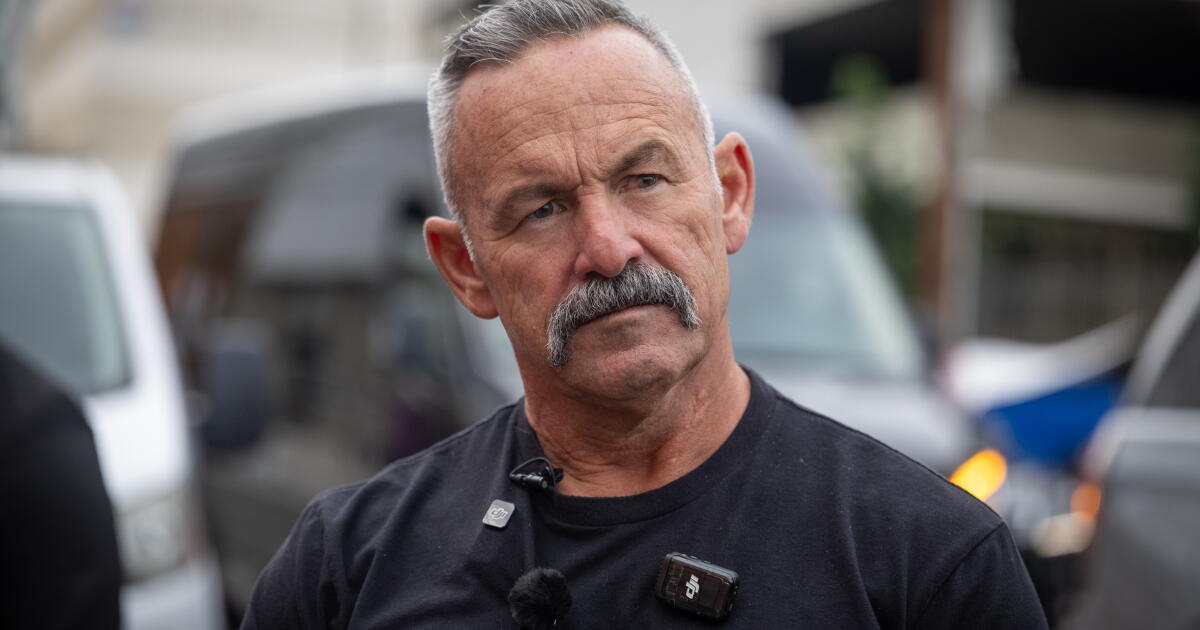
Source link

83 lawsuits that are keeping Californians safe

Eighty-three lawsuits filed against the Trump administration in 18 months, at a cost of more than $20 million.

California Atty. Gen. Rob Bonta announced those stats this week, part of an annual report to the Legislature on how we’re spending a special fund set aside to combat President Trump’s overreach.

That doesn’t include more than 120 friend of the court briefs the Golden State has written in legal matters brought by others, or the multitude of cases in which the Trump administration has sued California and Bonta’s office is defending us.

That’s a whole lot of litigation. Is it worth it? Are we huffing and puffing for political points, or do all these lawsuits actually do something positive for the average Californian?

You get what you pay for

I’m going to sound like a bus bench ad for the legal profession, but, at this point, “the courts are standing as the only barrier to the president doing anything that the president wants to do,” Hiroshi Motomura, a professor of law at UCLA, told me.

And what the president apparently wants to do is make the poor and vulnerable poorer and more vulnerable. And don’t think there’s a middle-class exemption. In his second term, Trump has attacked healthcare coverage, special education, education in general, reproductive rights, gender rights, the environment, endangered species, immigrants and more.

“The disastrous impact of Trump’s lawlessness isn’t theoretical or hypothetical. It’s not imagined. It is real. It is hurting real people,” Bonta said. “It is hurting Californians, real families, real businesses, real communities every single day.”

You name it, if it’s not rich and connected, it’s probably under attack. President Lyndon B. Johnson launched a very different war on poverty in 1964 with social programs such as Medicare, Medicaid and Head Start. This new war on poverty seems intent on increasing it, not eradicating it.

It would be nearly impossible for the people affected by these attacks on government services to fight them on their own, said Richard Abel, a professor emeritus of law at UCLA and the author of multiple books on the Trump presidency.

“They don’t know why it’s happening,” he said. “They don’t have access to lawyers. Many of them are undocumented or afraid to mobilize the legal system.”

That leaves the states, which are often the only other entities that have a legal right to sue, because they too are being harmed by the cuts.

So yeah, our $20 million is well spent. Bonta said his legal work has protected about $207 billion in funding. But I’ll argue the true return on investment is California residents who have been protected in ways they don’t even realize.

Risks we don’t even realize

Take Massachusetts vs. Department of Agriculture, one of the cases California is involved in. This is Trump’s attempt to put new rules on USDA grants for food programs including emergency food assistance, school lunches and food stamps. It would tie compliance with his right-wing, discriminatory policies on immigration, gender ideology and diversity issues to receiving those funds.

California and other states sued and won a preliminary injunction stopping them in June — meaning most recipients kept their benefits without ever realizing they were at risk.

Then there’s New York vs. Administration for Children & Families, in which Trump goes after child welfare funds; Washington vs. Department of Education, which attacks mental health grants that help hire school psychologists and counselors; and Illinois vs. Vought, which targets California and three other states run by Democrats for cuts to transportation and Centers for Disease Control and Prevention funding for no other reason than politics, the states argue.

Food benefits, access to mental health care, lead poisoning prevention. Just a few more things most of us didn’t realize could be at risk for some of us.

In each of those cases, Bonta and the other Democratic attorneys general stopped the federal actions, even if only temporarily. Some of those cases are ongoing, but with restraining orders or injunctions in place.

Then there’s United States vs. Baass, Trump’s attempt to force Michelle Baass, the director of the California Department of Health Care Services, to turn over a bunch of applications for Medi-Cal benefits for the last five years so the federal government can go on a witch hunt for undocumented folks.

Supposedly these applications, which Baass and her agency were subpoenaed for, are needed for an immigration investigation in the Central Valley. California won in court in March, when a judge denied the federal government’s petition to enforce that subpoena.

Now, the feds are appealing to the 9th Circuit — and California continues to fight to protect the privacy and maybe even safety of the residents who just needed medical care, but could see their sensitive information, including addresses, turned over to immigration authorities if Trump had his way.

How could they possibly fight that on their own?

Then there’s a lawsuit in which Trump is trying to prevent California from continuing to give in-state tuition to Dreamers — undocumented immigrants who were brought to the U.S. as youngsters.

In battles such as that one, fought because it’s the right thing to do, Motomura sees a benefit greater than just protecting funding.

It forces us to push back against the federal government’s framing that immigration is “about invaders, you know, climbing walls,” Motomura said.

“This is about people who live in our communities,” he said. “And I think that when Bonta claims that space, he’s not just pushing back. He’s saying, ‘Let’s think about this in terms of building stronger communities,’ and I think that’s a significant shift.”

The rule of law may be battered and bruised, and even at times a bit hinky. But so far, it has held — in no small part because of Democratic attorneys general like Bonta who aren’t just filing lawsuits but have built the staffs and networks to do it effectively. It’s a much larger effort than we give it credit for, but one that has fundamentally protected our everyday lives so well that many have barely noticed the wolves at the door.

I’m sure there will be losses, wolves that crawl through windows, and we will all feel the bite of that. But 83 lawsuits will soon likely be 84, 94, whatever it takes to protect Californians.

Each one is a fight worth having, because every Californian is worth fighting for.

You’re reading the L.A. Times Politics newsletter

George Skelton and Michael Wilner cover the insights, legislation, players and politics you need to know. In your inbox Monday and Thursday mornings.

What else you should be reading

The must-read: From decorated U.S. Marine to arrested at Trump golf course: What we know about Jeanine John Taele
The deep dive: The obscure financial maneuver at issue in Dodgers owner probe explained
The L.A. Times Special: New park under neglected 6th Street Bridge stirs up hope, Boyle Heights gentrification fears

Stay Golden,
Anita Chabria

Was this newsletter forwarded to you? Sign up here to get it in your inbox.

Source link

Prop. 39 would turn Trump conspiracy into California law.

Today we’re talking about California’s Proposition 39, a bid to turn Trump’s election conspiracy fantasies into California law, and a proposal so disingenuous it’s caused Democratic legislators to sue the Democratic secretary of state in an attempt to stop the misinformation surrounding it.

As these lawsuits move forward and the November election rolls closer, we’re going to hear a lot about Proposition 39 — a measure that would require in-person voters to present government-issued identification, among other provisions. I fear most if not all of this debate will revolve around the false claim that large numbers of undocumented people vote illegally in our elections.

“It’s directly a product of all of the rhetoric that Trump has been putting out there regarding election fraud and voting fraud,” said Mindy Romero, founder and director of the nonpartisan Center for Inclusive Democracy.

Romero stresses that there is not and has never been any evidence of widespread voter fraud in California, and the state already has a system that effectively checks voter eligibility.

Proposition 39 is “seeking a solution for a problem that doesn’t exist, and a solution that actually could cause additional problems,” she said. “So in and of itself, it perpetuates this false and dangerous narrative that there has been voter fraud in California.”

That lie is part of the ongoing grievance-fueled Trump campaign against non-white “replacement” Americans, meant to undermine trust in elections — you may recall he’s gone so far as to say immigrants are “poisoning the blood of our country.” It’s a venal and dark vein of partisanship aimed at keeping the far-right in power even at the expense of democracy.

But also an effective lie. Because many folks don’t know exactly how their ballots are verified but do have ID, they don’t see the full impacts of Proposition 39.

The easy ID myth

I’ll tell you more about Proposition 39, but I’m starting with a story about an all-American teenager I’ll call “Sofia.” I’ve been helping Sofia,18, attempt to get her first government-issued identification. I stress attempt.

Folks, there’s been hoops, there’s been hurdles, there’s been Kafkaesque bureaucracy.

For people like Sofia that don’t have bills or jobs or even accurate student records (she’s moved a lot), scraping up enough documentation to convince the DMV you are who you say you are is tough. First, you really need a certified birth certificate.

Sofia wasn’t born in the county where she lives (it’s county recorders that keep them), which means she had to either drive hours or go through the state’s third-party online vendor to order one, at a cost of about $30. But here’s the catch — she needed proof of identity to order it.

So to get a birth certificate to get her ID, she needed ID.

Stuck in this circular nightmare, we found, after much effort, a loophole: I could appear in front of a public notary with Sofia, to testify using my ID that she was indeed Sofia. Strange, but whatever. We did it.

That wasn’t enough for the DMV. Sofia also needed two bills or other documents verifying her address. Because they will literally give a credit card to anyone, she applied to an online company, and got her first statement. One document down.

Again, scouring the DMV rules for days, we found another weird loophole: The second document can be a letter from a nonprofit with the person signing it vouching for Sofia’s identity. We got the letter, and Sofia’s Real ID was issued.

But then she had to move before it arrived. She tried to arrange mail forwarding with the postal service, but guess what? They required ID.

So the ID was lost in transit, and we are back to square one.

Who Proposition 39 really targets

That means Sofia is one of thousands of Californians, born and raised in the Golden State, who lack official identification because its not as easy to obtain it as some want you to believe.

And because she lacks it, she could be prevented from voting if Proposition 39 is passed, even though she is a legal citizen with every right to have her ballot counted, and California already has a system in place to ensure only citizens vote.

Sofia is exactly the kind of voter that Proposition 39 is actually aimed at. This is a voter suppression law, plain and simple, and it will harm women with name changes, naturalized citizens, young people, older people and virtually anyone who cares about not returning to Jim Crow-style laws that push people out of voting with subterfuge.

Proponents of the proposition would like you to believe it’s something very different from what I just described. Their fight about how we talk about this proposal has led to two lawsuits so far — one filed by the backers of Proposition 39 because they don’t like the official title the California attorney general put on it, and one filed by the leaders of the state Legislature because they argue the statements written by proponents for official voting materials aren’t truthful.

I’ll give you a taste of both of those arguments. Right now, the state is proposing to title the measure “Prohibits citizens from voting unless they present government-issued identification.”

State Assemblymember Carl DeMaio (R-San Diego), the always-Trumper behind Proposition 39, helped lead a lawsuit claiming that is inaccurate.

DeMaio issued a statement claiming Democrats are “trying to deceive voters by putting a false ballot title on it and are now even distracting voters from their tampering of the ballot title with this frivolous lawsuit.”

That frivolous lawsuit he’s complaining about is the one where the Democratic leaders of the Legislature last week sued the Democratic secretary of state and others over the language included in the state voter guide. The Democrats aren’t really angry at each other, it’s just that Secretary of State Shirley Weber is in charge of voter materials, so she’s one of the folks they’ve got to sue to make their case.

The lawsuit alleges, among other complaints, that proponents are falsely framing Proposition 39 as making it “easier to vote” when in fact it does the opposite.

“Prop. 39 requires no burdens be placed on voters,” the materials at issue read, according to the lawsuit. “No additional documents (birth certificate, marriage license, etc.) are required.”

So I take you back to Sofia. Because while Proposition 39 might not ask her to bring her birth certificate to the polls, it would ask her to bring her ID, which required her birth certificate to get.

A distinction without a difference.

“The fact that Donald Trump has endorsed it tells you everything you need to know,” wrote the lawsuits’ plaintiffs, House speaker Robert Rivas and Senate pro Tempore Monique Limón, in a statement. “As Californians and Latinos, we will not let MAGA cronies take Constitutional rights away from voters.”

That lawsuit will likely have its first hearing in court this week. But whatever a judge decides, the ballot box is where the fate of Proposition 39 rests.

Though it seems like average Californians could see through this sham, there are big bucks backing it, and money always speaks loudly.

The donors in support read like the guest list for a White House dinner. So far, they’ve raised more than $15 million. That includes $4 million from Richard Uihlein, the Illinois billionaire and Trump supporter who often funds organizations and causes that promote election conspiracies and far-right candidates.

The crypto-billionaire Winklevoss twins, Cameron and Tyler, have each donated $250,000, along with other Silicon Valley types including former RFK Jr. running mate Nicole Shanahan, who ponied up $370,000 in support of Proposition 39.

Oh, and by the way, L.A. developer and former mayoral candidate Rick Caruso has donated $25,000 to the effort.

That’s a lot of dough being poured into stopping certain Californians from voting. If they succeed, it won’t just be an inconvenience at the polls — but instead a double victory for Trump, both suppressing the vote ahead of the presidential election and legitimizing his election lies through law.

What else you should be reading

The must-read: FBI Escalates Trump’s “Voter Fraud” Crusade With Disturbing Move
The California angle: How Trump’s Endangered Species Act rollback is roiling Northern California
The L.A. Times Special: Trump running out of options to fix inflation, economic woes before election, experts say

Stay Golden,
Anita Chabria


Was this newsletter forwarded to you? Sign up here to get it in your inbox.

Source link

Tariff war with Canada is hurting California’s wine industry

It’s hard to hate on Canada. It’s like cursing a cotton ball, or raging about tapioca.

The friendliest of neighbors, the country has fought alongside the U.S. in conflicts going back to World War I, purchased many trillions of dollars worth of American goods and blessed this country with, among other gifts, ice hockey, Drake, Joni Mitchell and Alex Trebek.

While you can question the nation’s culinary sensibility — the unofficial dish, poutine, is an abomination consisting of French fries, cheese curds and hot gravy — Canada is basically a very large, very pretty country filled with a lot of very nice, extremely polite people.

But for reasons only he can fathom, President Trump has declared economic war on our amiable northern neighbor.

After more than a year of trading tit-for-tat tariffs, Trump recently escalated the conflict by slapping a new 50% tax on a variety of Canadian exports, including cement, furniture, dairy products and, most iconically, hockey sticks. The added levy, which will further burden inflation-weary U.S. consumers, is set to take effect in mid-August.

The move makes little sense from an economic or foreign policy standpoint. It’s best to regard Trump’s trade moves as a wind gauge charts a blustery storm; his on-again, off-again tariffs are not the result of some carefully thought-out policy but, rather, a measure of the president’s shifting moods and pique toward certain foreign leaders.

And they carry a not-inconsiderable price tag — California’s struggling wine industry being just one example.

You’re reading the L.A. Times Politics newsletter

George Skelton and other analysts cover the insights, legislation, players and politics you need to know. In your inbox Monday and Thursday mornings.

For decades, the industry has been a vital and growing part of California’s agricultural economy. Recent years, however, have seen a number of setbacks.

Costs are rising. Sales are falling, as younger generations favor hard seltzers, canned cocktails or premium beers over crushed grapes. At the same time, climate change and the growing incidence of wildfire threaten the viability of some of California’s premier wine-growing regions.

A Canadian ban on alcohol imports

Then there’s the trade war with Canada, the industry’s largest export market and formerly a major customer of California wines. Until recently, the Canadian market accounted for more than a third of the state’s exports.

But last year, several provinces stopped purchasing U.S. alcohol in response to Trump’s tariffs and his threats — more slapstick than real — to annex the country and make Canada the 51st American state. While two provinces, Saskatchewan and Alberta, soon lifted their bans, the two most populous, Ontario and Quebec, have not.

As a result of this “geopolitical friction,” to use the words of University of California researchers, California wine exports to Canada fell by nearly 80% in 2025 compared with the year before. Unsurprisingly, Canadian sales of homegrown wines have soared.

Stick that in your terroir!

In response to the dramatic drop in exports, more than a dozen California members of Congress wrote last month to Quebec’s premier, Christine Fréchette, urging her to lift the retaliatory ban on U.S. wine and spirits.

“Reopening the market to American wine would restore consumer choice and signal a commitment to restoring fair and balanced trade for Québecois consumers and American wineries who have no connection to the underlying trade disputes,” the letter read.

Sen. Adam Schiff also wrote Fréchette asking her to resume the sale of California wine and U.S. spirits.

“The restriction on American wine has had damaging consequences for regional consumers, businesses, and producers who have no influence over national policies,” the California Democrat stated. “In fact, I have repeatedly voiced my opposition to and voted against the President’s harmful trade policies, including as they pertain to Canada.”

Fréchette’s response was, in a word: “Non!”

“In the context of the ongoing trade war, the premier continues to defend Quebec’s economic interests,” a spokesperson for Fréchette told CBC Radio. “This measure will remain in place as long as the United States maintains these unjustified tariffs. Our government will re-evaluate its position when the American administration reverses these measures.”

And that statement came before Trump upped the ante, along with the tariffs on Canada, which, presumably, doesn’t help matters.

Red or white?

Mike Thompson has seen the damage of Trump’s economic warfare firsthand. The St. Helena Democrat represents the heart of Wine Country and spearheaded, along with Democratic Rep. Jimmy Panetta of Carmel and Republican Rep. David Valadao of Hanford, the bipartisan overture to Quebec’s premier.

“I talked to a vintner today,” Thompson said during a drive this week through his sprawling Northern California district. “They went from an $11-million annual wine export to a $2-million annual wine export to Canada because of this.”

Thompson has introduced legislation, including a measure to reimburse wine producers for the money they’ve lost due to Trump’s tariffs, but the proposals have stalled in the House despite bipartisan support. His effort, Thompson dryly noted, “has not been warmly embraced by the administration.”

Meanwhile, the cross-border hostilities continue. Neither Trump nor Fréchette seems ready to budge, with California vintners still stuck in the middle.

So the question in Montreal and Toronto remains: What pairs best with poutine? Canadian white or red?

What else you should be reading

The must-read: Trump administration targeted California and other blue states for clean energy cuts
The deep dive: Justice Kennedy reflects on his time deciding the Constitution’s promise of liberty and equality
The L.A. Times Special: His nickname was ‘Satan.’ His political influence was immense
Until next time,
mzb

Was this newsletter forwarded to you? Sign up here to get it in your inbox.
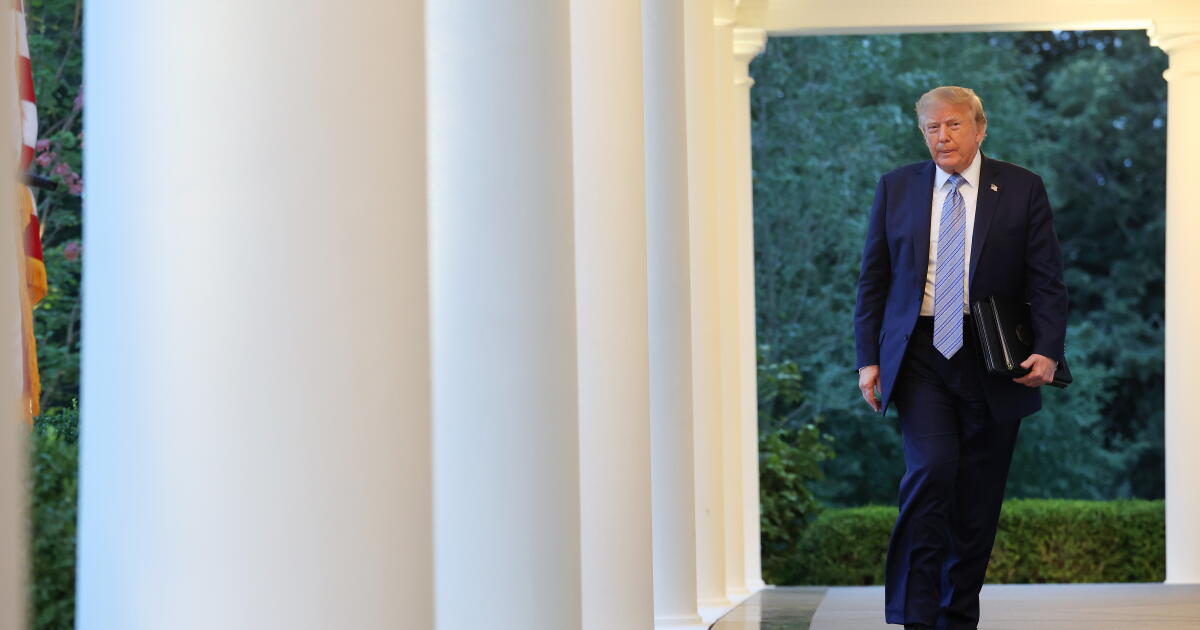
Source link

California kids still struggle in our schools. Will this change help?

Last week, news broke that an artificial intelligence thingamajig broke free from the constraints of its maker, OpenAI, and committed what could be considered a string of white-collar felonies if it were human.

Because the AI thingamajig is in fact not human, the incident raised a big kerfuffle but is largely being treated as a giant oopsie we can learn from, without needing the pesky intervention of new rules or laws to stop it from happening again.

Such is the state of AI regulation in America right now.

California Rep. Jay Obernolte (R-Big Bear Lake) would like to change that. Last week, he introduced the bipartisan Frontier Act with Rep. Lori Trahan (D-Mass.). While the bill might not make either safety advocates or big tech companies entirely happy, it offers up the most comprehensive and strongest regulations of this dangerous industry that we’ve yet seen at the federal level.

Roman Yampolskiy, an AI expert and professor at University of Louisville, called the Frontier Act a “positive step because it acknowledges that frontier AI presents risks requiring dedicated oversight.”

Now, the challenge becomes passing it, and passing it in a meaningful, not-watered-down form — no easy task in a dysfunctional Congress driven by money and Donald Trump, and paralyzed by its own sycophancy to both.

If anyone has a shot, though, it’s Obernolte, who is that rarest of birds, a legislator who understands science, and his colleagues.

Obernolte represents Inland Empire areas around San Bernardino, but grew up in Fresno back in the era when the movie “War Games” was just hitting theaters.

Those of a certain age will remember how far-fetched it seemed when Matthew Broderick’s high school genius character accidentally breaks into a military AI system to play chess, but “Joshua,” the computer, takes it too far and tries to blow up the world. Now, of course, that just sounds like a regular Tuesday.

By the time he was in high school himself, Obernolte was giving that Broderick character a run for his money. An apparent computer savant, Obernolte was competing in artificial intelligence contests as a teenager, back when most of us were still playing Pong on Atari. Then he headed off to Caltech and then UCLA for advanced AI degrees. He said AI was his “first calling,” sparked when his father bought him an Apple II computer when he was 8.

He ended up dropping out of UCLA after getting his master’s because his side hustle making video games, including “NFL ’95,” turned out to be more lucrative than being a starving student. He ended up founding his own video game company, FarSight Studios, and building up a personal net worth close to $100 million.

Not bad for a kid from Fresno. In Congress, he has stuck close to the MAGA power base and was one of seven California legislators to vote against certifying the 2020 election results, a vote he took in his first days in office. He has been endorsed by Trump multiple times, and now sits on a bunch of committees and subcommittees of relevance.

For the past few years, he has pushed hard, if unsuccessfully, to create a framework for regulating AI, combining his deep understanding of the technology with his equal understanding of MAGA distaste for intervening in business.

Now, though, we’re in a moment, thanks to more than one big oopsie by technology companies. Just a few months ago, Anthropic and the Pentagon had their own tense encounter after Anthropic questioned how its AI was being used by the military. Huffy Pete Hegseth is still huffing over that one.

The public is increasingly skeptical of allowing the AI industry to govern itself, which is pushing legislators to rethink their hands-off approach, even as AI money pours like Niagara Falls into elections. Even Trump seems more inclined to consider it, signing an executive order recently that largely called for voluntary restraints on AI companies.

The introduction of the Frontier Act “shows how far the Overton window has shifted just in the past few months,” wrote Charlie Bullock, a senior research fellow with the nonpartisan Institute for Law & AI. “Not too long ago, a bipartisan bill this good and serious would have been a pipe dream. But things change quickly.”

Obernolte said the bill has been “a long time in the making,” but he hopes to package it with other legislation and is “cautiously optimistic” he can get something passed and signed by the end of the year.

As written now, the bill would allow the federal government to set minimum safety requirements and set up a framework for licensed, independent auditors to monitor compliance. That third party verification has been a key push by safety experts.

The bill would also give the government emergency powers to pause an AI model if it has a “present or impending catastrophic risk.”

It also borrows from state laws including California’s Proposition 53 that require some (not enough) transparency on the part of AI companies when things do go wrong.

To the consternation of some, the bill still contains curbs on what states can regulate on their own — basically carving out AI regulation as federal turf. This has been a huge sticking point in the fight over AI regulation because AI companies hate state laws and want them squashed. Their argument is that a patchwork of rules across states is too complicated.

“You don’t want to have 50 different state requirements for every single product that gets sold on a market, and that is particularly true of AI,” Obernolte told me.

To some extent that’s reasonable — but the problem so far has been that states such as California and New York have been the only level of government willing to try at regulation. California in particular has created some of the most comprehensive AI regulations to date and has about 30 pending bills on this issue this legislative season. The Frontier Act threads the needle on this by creating lanes where states can still pass their own laws — such as around consumer safety that would protect children or stop pornography.

But preventing catastrophic risk would largely be dependent on the federal oversight, which is great when the federal government is up to the task. Currently, we can’t even keep measles in check. So that’s a bit worrisome.

And Obernolte’s bill isn’t the only one vying for attention. Another Californian, Rep. Ted Lieu, introduced a bipartisan measure of his own with Nathaniel Moran (R-Texas). Dubbed the AI Kill Switch Act, it would give the Department of Homeland Security the authority to shut down problematic models.

Yampolskiy, the Louisville professor, said that bill had promise as well, because it’s important for companies to have a way to “rapidly disable or contain systems that exhibit dangerous or unexpected behavior.”

But, he warns, that’s just one part of the “complete solution” we need. Regulation is going to require more than one law.

For Obernolte’s part, he’s shown a willingness to work on a practical solution, not just a political one. That alone is worthy of notice. The Frontier Act is a genuine attempt to govern a nascent industry that is too powerful and unpredictable to be left to its own devices.

“I’m hoping that this is we’ve landed somewhere that everyone can understand and be happy with,” Obernolte said. “AI is not something that needs to be a partisan issue, and I don’t think it should be.”

What else you should be reading

The must-read: How Jimothy the raccoon became the internet’s latest animal obsession
The California angle: Trump Administration Admits Canceling Grants to States That Did Not Vote for Him
The L.A. Times Special: Mayor’s press team uses disappearing WhatsApp messages, avoiding scrutiny
Stay Golden,
Anita Chabria


Was this newsletter forwarded to you? Sign up here to get it in your inbox.
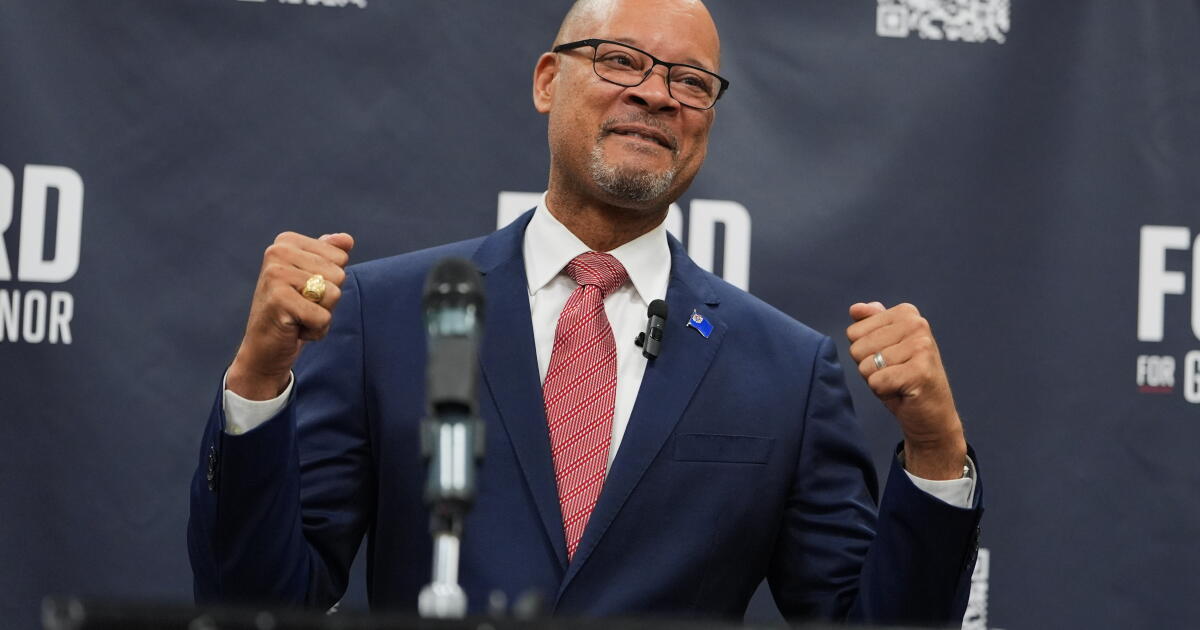
Source link

Schiff calls out Trump’s corruption, warns against complacency

There are certain truths that are self-evident to all but the willfully blind or stubbornly obtuse.

Heat is hot.

Rain is wet.

Donald Trump is the most brazenly corrupt president in the history of the United States.

The money-grubbing chief executive has raked in at least $2.2 billion during his first year back in office. He’s funneled millions of taxpayer dollars and foreign payments to his businesses. The grift, er, gift of a tricked-out Air Force One from the Qatari government — which Trump plans to keep in retirement — is only the most high-flying example of his avarice.

There’s so much more.

The notorious tax dodger filed suit against himself, allowing his complicit Department of “Justice” to engineer a flimflam settlement amounting to a get-out-of-jail free card that shields Trump and his sticky-fingered family from Internal Revenue Service oversight. He’s used his pardon power to draw contributions.

It’s so blatant and so consistent with Trump’s dodgy corporate background — a career checkered with six bankruptcies — that it’s easy to shrug off his presidential swindling as just more of the same. That’s been Trump’s political superpower: normalizing the outrageous and anesthetizing many Americans to all but the most extreme affronts. Even those have limited shock value these days.

On Thursday, California’s junior U.S. senator, Democrat Adam Schiff, will take to the floor of the chamber to assay the president’s many conflicts of interest, warn against complacency of the seen-it-all variety and offer his prescription for a cleansing once Trump slinks out of the gold-slathered Oval Office.

You’re reading the L.A. Times Politics newsletter

George Skelton and other analysts cover the insights, legislation, players and politics you need to know. In your inbox Monday and Thursday mornings.

“The scope of the corruption we’ve seen in this administration is beyond anything we have imagined in prior years or prior administrations, “ Schiff said in a preview of his speech. “It’s really novel and breathtaking.”

Schiff is, of course, one of the president’s long-standing nemeses. As a House member, he led Trump’s first impeachment trial. His frequent criticism of the president, on the cable TV circuit and beyond, earned Schiff a slug of juvenile nicknames and other Trumpian put-downs, as well as a federal investigation — which now appears dormant — into supposed mortgage fraud.

Kitchen-table talk

Trump defenders will be quick to dismiss Schiff’s floor speech as just more overripe agitation.

Birds fly. Fish swim. Schiff attacks Trump.

But the purpose of his remarks, Schiff said, goes beyond simply enumerating the abundant examples of presidential profiteering. (It was a struggle, he said, keeping the list to a top 10.) His intent, he said, is “to bring home … the real cost to ordinary people” of Trump’s egregious self-dealing. Explaining why — in a practical, feel-it-in-your-wallet sense — people should care.

“If a president approves a merger not because it’s good for consumers, not because it’s good for the economy, but because participants in the merger paid him millions, what’s the cost to them?” Schiff said, referring to the proposed marriage of Paramount and Warner Bros. Discovery and the money CBS shelled out for a flimsy lawsuit against “60 Minutes.” The settlement was widely seen as a way to smooth Paramount’s merger with Skydance Media, which is now bidding to swallow Warner Bros.

“The cost is they’re paying more for their streaming services,” Schiff said. “They’re getting laid off if they work in the industry. “

In 2024, Democrats lost the White House at least in part because they spent so much time talking about noble but abstract concepts like defending democracy and the rule of law, rather than highlighting ways they’d work to bring down the price of bacon and eggs.

Times change. Now it’s the cost of beef and gas that’s plundering paychecks.

Looking to November and beyond

Schiff insists it’s not an either/or choice. To prevail in November’s midterm elections, which means winning at least one chamber of Congress, Schiff said Democrats should discuss both affordability and Trump’s venality. He sees the two as being irrevocably entwined.

“The positive message is we are singularly focused on your cost of living,” Schiff said from his office on Capitol Hill. “We want to build more housing and bring down the cost of housing. We want to attack anti-competitive mergers of grocery stores and food companies to bring down the cost of food. We have a whole agenda that is designed to make your life more affordable.

“Why isn’t the administration doing this?” he said. “And the answer is, they’re corrupt. They’re focused on their own economic well-being. They’re doing great for themselves. They could care less about you.”

Schiff plans to introduce a number of proposed remedies. They include legislation to ban corporate executives from serving in the executive branch if they’ve been convicted of corruption or financial crimes, and a requirement that government employees recuse themselves from matters affecting the financial interests of any employer they’d worked for within the previous four years.

Although the measures stand no chance of passing in the current Congress, Schiff said “it’s important to show the American people, ‘Hey, this is what we intend to do if you give us the majority.’”

He acknowledged that the depth of presidential dishonesty, its constancy and deep weave in the fabric of this administration, can have a deadening effect: “When the guy working the teleprompter at the White House, betting on how many times the president will use a certain word in his speech, is a blip in the corruption…”

But Schiff said it’s important not to turn away or shrink from the malodor rising from Trump’s swampy Washington.

“You just have to take the time to break it down for people,” Schiff said. “I think putting things in context, trying to snap people out of the norm-shattering numbness of this administration, is a daily challenge. But it’s one that we have to undertake.”

There’s no certainly no harm in stating the truth. It’s worth trying, over and over.

What else you should be reading

The must-read: Trump, long a critic of ‘forever wars,’ may be stumbling into one with Iran
The deep dive: Unhappy with Kaiser’s medical dispute process, some patients push for state reform
The L.A. Times Special: Chabria: Newsom pushes California to crack down on sex trafficking — fast

Until next time,
mzb

Was this newsletter forwarded to you? Sign up here to get it in your inbox.

Source link

Column: Californians sour on Newsom’s push to ban gas-powered cars

Gov. Gavin Newsom will soon leave office without gaining the support of fellow Californians for his most ambitious climate project: the banning of new gas-burning car sales by 2035.

Newsom issued an executive order in 2020 taking new fossil-fueled passenger vehicles off the California market nine years from now.

But roughly two-thirds of Californians think that’s a lousy idea, according to a poll released last week by the nonpartisan Public Policy Institute of California.

Among likely voters, 65% oppose the termed-out governor’s edict and just 34% support it. The opposition among infrequent or nonvoters is even stronger.

Negative attitudes are especially stiff in inland California — particularly the Central Valley — and among middle-class people with incomes between $40,000 and $100,000, those over age 55 and Republicans.

Opposition to being denied new gas vehicles has grown substantially since 2021, when Californians were evenly divided over the issue.

But the state’s anticipated next governor, moderate Democrat Xavier Becerra, is more in line with Californians’ thinking on gas cars than is Newsom.

Becerra told me during his primary election campaign that Newsom’s 2035 goal is not realistic.

“We can’t make it by ‘35,” he said. “But we can make it.” Sometime in the future.

The fact is lots of people can’t afford electric vehicles because they tend to cost more than cars fueled by gas.

Besides, there’s an inconvenience of having to pull off the road for a 40-minute recharging stop on a long trip — if you can find a vacant recharger.

And “electricity is not cheap. It often depends on the time of day,” notes PPIC Polling Director Mark Baldassare, who owns an electric vehicle and says he likes it.

Newsom has been hawking electric vehicles since he came into office, like some slick TV pitchman — his goal being to greatly reduce climate-warming greenhouse gas emissions.

The governor and the Legislature recently appropriated $135 million to motivate Californians to buy new or used electric vehicles.

First-time EV buyers will receive $3,500 rebates on vehicles with manufacturer’s suggested retail prices of $50,000 or less. Used car buyers will get $1,750 off if the sale price is $25,000 or less.

You’re reading the L.A. Times Politics newsletter

George Skelton and Michael Wilner cover the insights, legislation, players and politics you need to know. In your inbox Monday and Thursday mornings.

Automakers will pay for half the incentive costs — obstensibly, at least, if they don’t just secretly add their tab to the vehicle price.

This smacks of a huge taxpayer giveaway to manufacturers if the state isn’t careful. Is it really the state’s job to sell cars? Shouldn’t it be the automakers’ responsibility to offer competitive prices? Whatever.

Newsom’s plan partially replaces a $7,500 federal tax incentive for new EVs that President Trump and the Republican-led Congress allowed to expire last year.

California already leads the nation in EV ownership, with around 1.3 million vehicles registered. That’s more than five times the No. 2 state, Florida. And it’s not just because California’s population is much larger. We also lead in per capita ownership.

There’s plenty of contradiction and hypocrisy in the divided minds of Californians, as highlighted in the lengthy PPIC survey into their views on environmental policies.

People strongly favor fighting climate change — at least in concept — until it adversely affects them directly. That’s just human nature.

Asked what they consider the most important environmental issue facing California, those surveyed placed wildfires first, followed closely by global warming.

Baldassare says what struck him in the poll was “the disconnect between what people support in policies and what they’re prepared to do.”

“Two things are going on in California now,” the pollster continues. “People have their long-standing concerns about the environment. But they also have immediate concerns about affordability.

“When it comes to what people are willing to do, they’re worried about living costs and particularly the cost of energy. It’s something we’ve noticed even more this year. It affects the political and economic landscape.”

Nearly two-thirds of those surveyed support Newsom’s goal of reducing greenhouse gas emissions to zero “as soon as possible, but no later than 2045.”

And there’s overwhelming support for taxing corporations based on the amount of carbon emissions they produce.

Roughly 60% favor requiring all electricity to be generated with renewable energy — such as wind and solar — by 2045, although support for that state edict has dropped by 15 percentage points in the last six years.

Paradoxically, people aren’t willing to pay more for electricity produced by renewable sources. Roughly 60% reject that idea. Ten years ago, almost that many told PPIC pollsters they were willing to pay extra.

And today they’re not nearly ready to surrender their option of buying a new gas-fueled automobile.

For one thing, they’re not convinced there’ll be enough charging stations to handle a lot more EVs. Twice as many people are not confident of that as are confident, the poll found.

The California Energy Commission reported in January that there were more than 200,000 public and private EV charging stations in the state, plus 800,000 chargers in homes. The state is helping to add more along highways.

Becerra has pledged to take a fresh look at several controversial Newsom projects, including the pokey bullet train. There’s much uncertainty about the pending new governor.

But there’s one pretty good bet: In 2035, sales of new gas cars will still be getting a green light.

What else you should be reading

The must-read: Trump escalates election attacks, threatens California over voter data
Bringing back competition: Too many congressional races are over before they start. Here’s a remedy
The L.A. Times Special: Trump’s voter fraud speech was bait. Stop biting

Until next week,
George Skelton


Was this newsletter forwarded to you? Sign up here to get it in your inbox.

Source link

Nationwide redistricting war fuels congressional reform effort

Imagine if Sunday’s World Cup final were played under rules that blatantly favored one side over the other. Let’s say Argentina was spotted four goals against Spain.

Spain could, conceivably, overcome that 4-0 deficit. But it would be awfully hard and something of a miracle if the Spanish team prevailed.

Fans the world over would be rightly outraged. Why bother holding the tournament? What’s the point if one team is saddled with near-insurmountable odds?

Increasingly, that’s what elections for the House of Representatives look like.

As recently as the late 1990s, around 4 in 10 congressional districts were considered competitive, meaning Democratic and Republican candidates each had a plausible shot at winning. Today, per the nonpartisan handicappers at the Cook Political Report, only 18 of 435 House districts are considered toss-ups.

Another 20 districts are rated as either leaning Democratic or Republican, meaning candidates from one party or the other enjoy a noteworthy advantage, but aren’t necessarily a lock to win in November.

In sum, that means fewer than a tenth of all House seats are even somewhat competitive.

You’re reading the L.A. Times Politics newsletter

George Skelton and other analysts cover the insights, legislation, players and politics you need to know. In your inbox Monday and Thursday mornings.

That’s hardly an accident, as lawmakers have increasingly manipulated the election process to suit themselves, rejiggering congressional districts to sideline voters and boost their political parties.

It’s undemocratic, and it stinks.

Stifling competition, rewarding extremes

“Every voter has a stake in making sure that these elections are fair and that the process is transparent,” said Rep. Jeff Hurd, a Republican who represents a large, mostly rural swath of western and southern Colorado. “Gerrymandering undermines representative democracy … by preventing voters and communities from having cohesive representation.

“It unfortunately rewards political extremes,” he went on. “It reduces competition and contributes to the polarization and dysfunction that prevents Congress from effectively addressing the issues that our constituents care about.”

Hurd is a member of the Problem Solvers Caucus, a bipartisan group of 44 House members dedicated to working through their ideological and political differences to — lordy! — try to get stuff done.

Recently, to mark Independence Day, the caucus announced a framework for legislation aimed at bringing competition back to many congressional races, in part by limiting the redrawing of political maps to once every 10 years, following the census. Among other reforms, the bipartisan group also called for establishing a uniform, national standard requiring that congressional districts be drawn “using clear, objective criteria while rejecting partisan advantage and incumbent protection as legitimate goals.”

The effort is, of course, too late for this election. The hope is Congress will enact the changes in time for the next scheduled round of redistricting, which is due to take place after the 2030 census. The rules would be in place starting in 2032.

The chances of passage are not strong. As Hurd noted: “Any reform that asks politicians to give up political leverage is going to be challenging.” But if ever there was a time for a badly needed systemic fix, it’s now.

A race to the bottom

Gerrymandering has been around for more than 200 years. The term derives from the efforts of Massachusetts Gov. Elbridge Gerry to skew state Senate races in the election of 1812. The portmanteau, which appeared in the Boston Gazette, described one politically engineered, misshapen district that resembled a salamander.

The practice reached new heights of creativity (or deviousness, depending on your perspective) in the modern age, when ever-more sophisticated computers allowed for ever-finer slicing and dicing of the electorate.

In 2019, the Supreme Court effectively greenlighted the practice in a 5-4 decision by the conservative majority, decreeing that partisan gerrymandering was beyond the purview of federal courts. In other words, have at it! And lawmakers did.

But this last year, in particular, has broken new, insidious ground.

Pressured by President Trump — who fears losing the GOP’s whisper-thin House majoritylawmakers in Texas tore up their political map mid-decade and redrew the state’s congressional districts in hopes of nabbing five additional seats this November. California responded in kind, with passage of Proposition 50, a measure that shelved the work of a nonpartisan redistricting commission in favor of a map aimed at handing Democrats five additional seats.

More than half a dozen other states — most of them Republican-run — have jumped into the fight, gerrymandering their congressional districts to gain a partisan edge. Lawmakers in several Democratic-run states are now looking at the prospect of retaliatory gerrymandering ahead of the 2028 election.

There’s not much upside to all this self-dealing — if, that is, you care about political competition and allowing the electorate a genuine say. But all that manipulation and maneuvering has, at least, made voters much more aware of the once-obscure practice of congressional line drawing. And that offers reformers a flicker of hope.

One ally, improbable though it may seem, is Paul Mitchell. He’s the Sacramento political guru who drew the gerrymandered map that California voters approved with passage of Proposition 50. (California, he said, was left no choice but to respond after Texas made its move.)

Mitchell said he has long favored a national redistricting standard that would apply to all 50 states and put the much-abused process on an even footing. “I really believe that redistricting should … serve the public, not serve the politicians,” Mitchell said.

Still looking on that bright side, he suggested perhaps the current redistricting war will prove so odious and have “done so much harm” that combatants will reach a point where they “put down [their] arms and embrace a kind of nonpartisan, non-politicized, public-oriented redistricting.”

It seems far-fetched. But miracles do happen.

What else you should be reading

The must-read: Californians rallied to save the coast 50 years ago. Trump is spoiling the celebration
The deep dive: On birthright citizenship, the Supreme Court originalists split on history and Trump
The L.A. Times Special: Inside the states’ case to block the Paramount-Warner Bros. merger: ‘Each side is taking risks’

Until next time,
mzb

Was this newsletter forwarded to you? Sign up here to get it in your inbox.
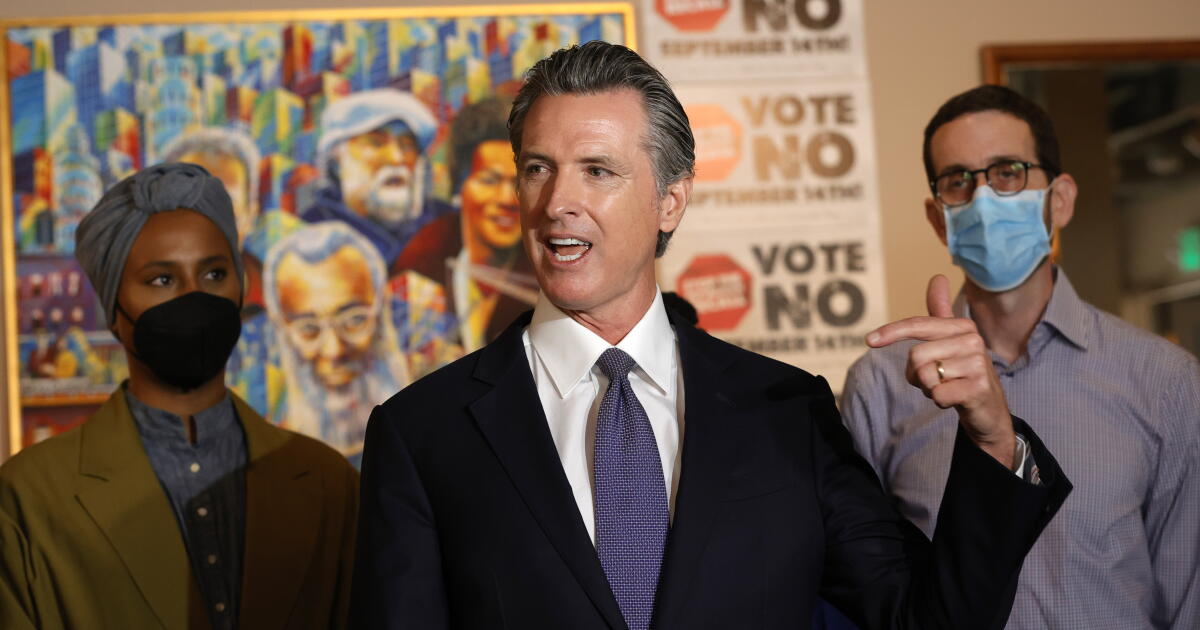
Source link

California kids still struggle in our schools. Will this change help?

Recent news about literacy, education and general smarts in California and across the country has been somewhat distressing.

Along with claims that Americans are becoming illiterate, here in the Golden State there are worries that even the highest-achieving students aren’t prepared for our universities, and a study shows backsliding in civil rights protections in the vacuum created by federal changes under the Trump administration.

Despite being close to terming out of office, and also otherwise occupied with his ever-emerging presidential run, Gov. Gavin Newsom last week found time to announce a consequential, if controversial, move that has the potential to vastly improve educational outcomes for California kids: switching out an independent, voter-chosen leader for a hired gun.

In legislation signed last week, Newsom basically eviscerated the role of the elected superintendent of public instruction and instead shifted oversight of our K-12 schools to a newly created education commissioner — to be appointed by the governor.

The change, set to happen early next year, has been described as a “power grab” by some, and on its surface could be seen that way. The conservative candidate for state superintendent — Sonja Shaw, who says she is running to stop “political ideologies being shoved down everybody’s throats” — quickly claimed Newsom’s move was all about stopping her.

In reality, power grab or not, it’s the kind of reform we should all support — a long-overdue push to create accountability in a hot-mess system where there are too many people almost-sorta in charge of too many conflicting priorities.

‘A’ for accountability

It’s to Newsom’s credit that he’s setting up his successor to helm a system that at least has a chance at coherence, even if it raises the stakes for the next governor to deliver.

For years — decades, really — streamlining the governing structure of schools “has been proposed by Republicans and Democrats and bipartisan and nonpartisan commissions,” Linda Darling-Hammond told me. She’s a professor emeritus at Stanford University, an advisor to the governor and, by any measure, one of the preeminent education policy experts in the country.

“It’s not at all political. It is really about making the system run well,” she said. “The world is changing, the economy is changing. There’s just a need to be very efficient and effective in making policy and then implementing that policy.”

“Run well” is the key there. California operates the biggest and most diverse school system in the country. We’ve got roughly 10,000 regular schools (depending on how you count), including about 1,200 charter schools, around 1,00 school districts and 58 counties, each with their own slice of local control over those schools, according to the Department of Education.

That’s about 5.7 million students, nearly 300,000 teachers and $150 billion in costs (counting the new funding in the next budget).

To be kind, this system does not always run well. That’s in no small part because oversight and control are fragmented, overlapping and confusing. Currently, the State Board of Education sets policies, but the elected superintendent implements them through the Department of Education. Then control runs downhill to individual school districts, filtering through local school boards and even principals.

The board can’t control how the superintendent does their job, and vice versa. In fact, they don’t always agree, despite (or because of) the shotgun wedding nature of their relationship. At times, it can feel like they are working against each other. Never mind the complexities of local control.

This has been especially true in recent years as Newsom and the Legislature have pushed through big changes, such as the new prekindergarten grade, that have required massive coordination and effort. At the local level, administrators often complain there is little clarity on what is expected of them and, too often, outright conflict.

“The idea of having policy in one place and implementation in the other is really crazy,” Michael Kirst told me. He’s professor emeritus of education at Stanford and the longest-serving president of California’s State Board of Education, serving under both of Jerry Brown’s gubernatorial stints.

Newsom’s proposed system promises “much clearer, cleaner accountability,” Kirst said.

Expertise counts

It also has the benefit of putting an actual education expert in charge of schools. Because the superintendent role is elected, it has too often been coveted by career politicians looking for a landing spot. Its incumbent, Tony Thurmond, had a background in social work before running for various offices, but that kind of experience isn’t always the case. Neither is experience running a major organization with thousands of employees.

While Newsom’s plan leaves many, if not most, of the details to be ironed out later (a frustrating strategy he’s used more than once to keep the ball rolling on policy without having the drag of actual detail), it does promise to put in someone with the kind of high-level educational policy experience that should be required when managing this vast and important endeavor.

Kirst points out that this will be a “powerful position” charged with making sure our schools are indeed run well, and at the end of the day, it gives us one person to blame if they don’t: the governor.

So if schools don’t improve and our kids don’t learn, voters will know exactly who failed.

You’re reading the L.A. Times Politics newsletter

George Skelton and Michael Wilner cover the insights, legislation, players and politics you need to know. In your inbox Monday and Thursday mornings.

What else you should be reading

The must-read: Trump ousts members of bipartisan election commission ahead of midterms
The California edge: The Work of Helping A.I. Destroy Work
The L.A. Times Special: In bed 23 at Adelanto ICE detention center, a terrified teenager missed his mom

Stay Golden,
Anita Chabria


Was this newsletter forwarded to you? Sign up here to get it in your inbox.
Source link

Jared Huffman is one of few nonreligious members of Congress

Jared Huffman was unstinting and unbowed as he raised an arm heavenward. Not for fear of a thunderbolt hurtling through the blue sky and, punitively, creasing his skull. Rather, he was illustrating a point.

“I believe in a lot of things,” he said over a tuna melt at a small Marin County cafe. “I just don’t believe in magic and a sky god that looks like an old bearded man sitting just beyond the clouds.”

Huffman is the rare American — one of only about 10% or so — who flatly state they do not believe in God, or any higher power for that matter. What makes him rarer still is his place in Congress. Huffman, who represents a sprawling slice of Northern California, reaching from the Bay Area to the Oregon border, is one of just four members (out of more than 500) who are openly agnostic or religiously unaffiliated.

He is, by far, the most outspoken.

Huffman, who publicly revealed his nonreligious status in 2017, helped form the Congressional Freethought Caucus, which consists of about three dozen members of various religious stripe, each dedicated to the proposition that church and state should be distinct. He’s written a book, due out next month, raising an alarm and summoning Americans to fight the rising tide of Christian nationalism roiling our divided land.

You’re reading the L.A. Times Politics newsletter

George Skelton and other analysts cover the insights, legislation, players and politics you need to know. In your inbox Monday and Thursday mornings.

An overwhelming favorite to win an eighth congressional term in November, Huffman, a Democrat, calls himself a humanist and described it this way:

“To me, it means good without God. It means you don’t need the inducement or fear of an afterlife to have a moral framework and to know your place in the universe. You’re sort of at peace with the reality that, as far as we know, this is it. You get one time around.

Rep. Jared Huffman, right, shaking hands with Marin County Executive Derek Johnson.

Rep. Jared Huffman, right, greets Marin County Executive Derek Johnson during the opening of a housing community in Point Reyes Station, Calif., on Wednesday.

(Godofredo A. Vasquez / For The Times)

“There are people of faith who sometimes think, well, that must be sad, that must be incomplete,” Huffman went on. “I find it’s just the opposite. It makes this world and our opportunity to be part of it more sacred.”

Growing up in the Mormon faith

Huffman, 62, grew up in a religious household in Independence, Mo. His family practiced an offshoot of the Mormon faith; as a youth, Huffman served in the priesthood.

He began to question the church and its teachings when his father died of lung cancer at age 56. Huffman was 19 and enrolled at UC Santa Barbara on a full-ride volleyball scholarship. (A lean 6-foot-3, Huffman was a three-time NCAA All-American and is a member of the school’s athletic hall of fame.)

“I think in hindsight ignorant faith kept me from coming to terms with the fact that he was dying, and it made it way more traumatic than it should have been,” Huffman said of his father’s passing. “I didn’t really own up to the reality of what was happening, because I was this person of faith who thought rotten things would never happen to me and my father.”

  • Share via

Shaken, Huffman spent years in a period of reflection and deep study — of various religions, spirituality, the Bible, which he can cite chapter and verse — before landing in his place of humanism and nonconformity.

After earning a law degree at Boston College, Huffman moved to the Bay Area and served as a senior attorney for the Natural Resources Defense Council, the environmental group. His political career began in 1994 with his election to the Marin Municipal Water District. Huffman served for 12 years, until his election to the state Assembly. He won his congressional seat in 2012.

Huffman’s secularism never came up, he said, until his arrival in Washington, where religiosity, God-fearing and worship of a higher power are taken as articles of faith.

“All of a sudden, religion is all around you and everyone wants to know your religion,” Huffman said. “I knew that I was a nonbeliever. I knew that I was a humanist. But that was a very private thing and I had kind of intended to keep it that way.”

Losing his religion

Two things changed.

First, Huffman’s mother died at age 87. She was fervently religious, Huffman said, and “I didn’t really want to break her heart and tell her how deep my nonbelief actually was.” (In his book, Huffman recounts an awkward scene where he takes the congressional oath of office for the first time on a hastily borrowed Bible, to please his proud mom.)

The second factor was the ascent of Trump, riding a wave of ardent evangelical support.

Huffman was put off by the hypocrisy of such a blasphemous president surrounding himself with extremists using the language and symbols of religious faith to enact what he perceived, and perceives, as a distinctly antidemocratic, un-American agenda.

“I was always uncomfortable with the way I saw religion encroaching into government in Washington,” Huffman said. “My previous concerns were heightened by an order of magnitude because of what he did.”

Ignoring the counsel of family, friends and political advisors who, to a person, warned against it, Huffman revealed his religious disbelief in a series of statements and interviews in November 2017. At the time, the only member of Congress to ever publicly come out as an atheist was Rep. Pete Stark, who announced his sentiments in 2007; though the Fremont Democrat was reelected twice, he was eventually defeated by a Democratic rival who turned his lack of faith against him.

That rival was Eric Swalwell; make of it what you will.

Huffman braced for political blowback. There was none, though he’s gotten death threats and plenty of admonishments he’s bound for Hell.

(Meantime, the congressional ranks of the religiously unaffiliated have grown to include Democratic Reps. Yassamin Ansari of Arizona and Emily Randall of Washington and Republican Rep. Abraham Hamadeh of Arizona.)

In the first election after his announcement, Huffman was returned to Washington with 77% of the vote. He’s won reelection three times since, with never less than 72% support. “It turns out [constituents] don’t much care what my religion is if I’m doing good work,” Huffman said, “and that’s pretty great in my opinion.”

He underscored the sentiment with a hearty bite of his tuna melt.

The book Huffman has coming out next month — with chapters that include “Breaking Faith,” “Christian Privilege” and “Christian Zionism” — is a work that explains his personal evolution and expresses a dire fear the country is headed, if unchecked, toward a system of authoritarian theocracy.

He describes the Christian nationalism that informed the attempted coup on Jan. 6, 2021, and explains the biblical prophecies behind the messianic support among some Trumpian true-believers.

“The book is not so much about humanism,” Huffman said. “It is about the fight to protect our secular democracy, which, I think, is the bedrock of America as we know it.”

The dedication reads, “For everyone who refuses to bow.”

What else you should be reading

The must-read: 14 propositions that could remake California taxes, housing, healthcare and elections
The deep dive: Even without birthright citizenship, Supreme Court co-signs much of Trump’s immigration agenda
The L.A. Times Special: The right and left need to control the radicals in their own parties

Until next time,
mzb

Was this newsletter forwarded to you? Sign up here to get it in your inbox.

Source link

Column: The Founding Fathers pledged their fortunes to the cause of liberty. Trump enriches himself

Could the Declaration of Independence be signed today by this crop of political leaders, particularly the one who occupies and defaces the White House?

Not just sign, but sincerely mean it.

Especially the guy who bangs a wrecking ball against the historic East Wing to make room for an incongruous ballroom monstrosity, who mars the sacred Oval Office with gold glitter and paves over the lovely Rose Garden.

But never mind these displays of egotism and tackiness that currently blemish landmarks throughout the nation’s capital, including the National Mall, traditional site of the annual July Fourth fireworks.

Back to my central question: Would there be enough patriots today to affix their John Hancocks to a rebellious document that bravely concludes:

“For the support of this Declaration, with a firm reliance on the protection of Divine Providence, we mutually pledge to each other our Lives, our Fortunes and our sacred Honor.”

Political leaders would very likely sign the more famous preamble that includes this passage, widely regarded as the most important sentence in American history:

“We hold these truths to be self-evident, that all men are created equal, that they are endowed by their Creator with certain unalienable Rights, that among these are Life, Liberty and the pursuit of Happiness.”

Those words probably would poll well and make salable talking points in local town halls. Even if the notion that all people are created equal would be recognized, as it was 250 years ago, as merely a lofty, hypocritical pie-in-the-sky goal. After all, the eloquent document’s principal author, Thomas Jefferson, owned 600 slaves.

You’re reading the L.A. Times Politics newsletter

George Skelton and Michael Wilner cover the insights, legislation, players and politics you need to know. In your inbox Monday and Thursday mornings.

We’ve made a world of progress since then on equality. But clearly President Trump and much of America today don’t agree that all people are created equal and guaranteed the same right, for example, of due process in court. People such as undocumented immigrants — the tired, the poor and the “huddled masses yearning to breathe free.”

But that’s a heated and politicized 250-year-old debate that will continue indefinitely.

For me, the most striking and sincere sentence in the Declaration of Independence is the last one, in which 56 delegates to the Second Continental Congress in Philadelphia on July 4, 1776, unanimously pledged “our Lives, our Fortunes, and our Sacred Honor.”

“It was not a throwaway line,” notes UC Berkeley Law School Dean Erwin Chemerinsky, a constitutional scholar. “It was an acknowledgment that they were committing treason. It showed how deeply committed they were.”

The nation’s founders understood that in British King George III’s view, they were traitors. And if their rebellion failed, they’d be targets for execution.

“We must indeed all hang together or most assuredly we shall all hang separately,” Benjamin Franklin supposedly told delegates.

In fact, nine of the signers died during the Revolutionary War from disease, prison hardships or combat wounds.

An estimated 6,800 U.S. soldiers died in combat and more than 8,500 were wounded. An additional 17,000 Americans perished.

Several signers sacrificed their fortunes, some to help pay for the war.

Gen. George Washington — an immensely rich Virginia planter — refused to accept a salary as commander in chief of the Continental Army. He bought much of the ammunition and fighting gear himself, then was reimbursed after the war.

Sacred honor? That meant what it said back then. The revolutionary leaders proved their character with sacrifice and bravery.

The nation’s first president, Washington, could not tell a lie, according to myth. Of course, he routinely lied during the war to deceive the British. But our 47th president, Donald Trump, is a pathological liar who seems to prevaricate daily.

Would Trump pledge his fortune to the cause of liberty?

That’s hard to imagine of a president who uses the office to promote and prosper from his own brand name. And whose income ballooned to $2.2 billion in 2025, his first year back in the White House after being booted by voters in 2020, a humiliation he still doesn’t have the integrity to acknowledge.

“President Trump is using the office to enrich himself and his family in ways we’ve never seen before,” Chemerinsky asserts.

Pledge his life? Please!

This is a man who once faked bone spurs to avoid the military draft. OK, he wasn’t the only young fellow who dodged combat in the unnecessary Vietnam War, which claimed the lives of 58,000 Americans.

But Trump has called America’s war dead “suckers” and “losers,” according to former aides. He denies it.

There’s no question he expressed contempt for the late Sen. John McCain, who spent more than five years as a North Vietnamese prisoner. “He’s not a war hero,” Trump said. “I like people who weren’t captured.”

The Declaration of Independence was about severing the chains of a British monarchy and creating a government powered by the people with checks and balances.

Trump has attempted — often successfully — to govern as a monarch, ignoring the checks and balances of Congress and the judiciary. He has gotten away with it because bullied Republican congressional leaders have mostly rolled over like lapdogs.

But we may be seeing the early signs of a mild revolt against the king as Trump sinks further in the polls and we draw closer to the November elections.

That’s sort of what the founders had in mind: a government deriving its power “from the consent of the governed.” And when citizens are subjected to “absolute Despotism, it is their right, it is their duty, to throw off such Government.”

So could the Declaration be signed today? Hard to say. There’s no King George hovering over us. Only a wannabe king.

But, yes, I suspect there’d be a signing. Independence is a dominant gene in America’s DNA.

What else you should be reading

The must-read: What you should know about the $351.7-billion state budget Newsom just signed
Go your own way: Facing setbacks and resistance, Trump presses bid to reshape elections on multiple fronts
The L.A. Times Special: More money and patience could help California’s vote count

Until next week,
George Skelton


Was this newsletter forwarded to you? Sign up here to get it in your inbox.

Source link

California puts more money toward speeding its election count

Chances are, right about now, you’re considering how you’d like to spend this upcoming Fourth of July weekend. At the beach, maybe, at a barbecue or whatever place sets fireworks pinwheeling through your holiday-happy mind.

Which makes it a perfectly excellent time to talk about elections and vote counting.

Every two years, in the spring and fall, California holds an election. Every two years the state faces an outraged chorus, voices raised nationwide, decrying the length of time it takes to tally the millions of ballots cast and, in a handful of races, determine the winner.

  • Share via

Then, just as suddenly, the din fades away, the focus shifts and the election process is forgotten until the next round of howling protest.

Just that word, process, can throttle and snuff the life out of the subject.

You’re reading the L.A. Times Politics newsletter

George Skelton and other analysts cover the insights, legislation, players and politics you need to know. In your inbox Monday and Thursday mornings.

So it’s good news that lawmakers in Sacramento have used this inattentive time to address the biennial hullabaloo and perhaps shut some people up.

The budget that Gov. Gavin Newsom signed into law Monday includes an additional $40 million aimed at speeding up California’s vote count, and even if the sum is less than half the $90 million sought by reform-minded advocates, it’s something.

Most of the money will go toward staffing, technology and equipment upgrades. Another $10 million will pay for voter education and outreach. A further $750,000 will be used to combat election misinformation. (A $3.50 roll of duct tape would be a far more economical way to address the latter were it applied to the inciteful mouth of America’s election-denier-in-chief. More about him in a moment.)

“While the amount budgeted is less than we had recommended, it still represents a sizable investment that prioritizes timely election results,” said Kim Alexander, head of the nonpartisan California Voter Foundation, which has been at the forefront of election reform efforts in the state.

A surprise Supreme Court decision

As it happens, the budgetary infusion came the same day the U.S. Supreme Court upheld the right of states to count mail ballots that are postmarked by election day, even if they arrive days afterward. In California, where most voters mail their ballots, that lag time can be up to a week.

It was a surprise decision from this most Trump-obeisant court, a setback for the petulant president and a ruling that will have very little effect on California’s prolonged vote counting.

That’s because those late-arriving ballots have very little to do with the time it takes to complete the count. My colleague Kevin Rector reported that in 2024 California tallied more than 406,000 late-arriving mail ballots — which represents only about 2.5% of the more than 16 million ballots cast. The long count is a result of the huge number of ballots placed in drop boxes or arriving at processing facilities on or just before election day — and, really, is it such a bad thing for voters to watch for late developments before letting go of their ballot?

(Does the name Eric Swalwell ring any bells?)

Lawmakers in California made a purposeful decision that voting should be convenient and not a chore, as a way to to encourage the greatest turnout possible. That’s a good thing if you believe in our system of representative democracy. The voice of the people, and all that.

There wasn’t much hue or cry — especially about mail balloting, which has exploded in popularity and introduces all sorts of time-consuming steps, such as signature verification — until Trump cried fraud and made other specious claims. That’s what happens when you have a sore, whiny loser astride the bully pulpit; Trump is perfectly willing to torch people of good faith and burn working systems to the ground if it salves his eggshell ego.

An election, not a soccer match

Many political commentators are complicit in Trump’s arson.

Awaiting California’s election results, they act like pouty birthday children forced to leave their presents unopened until all the kids have had their cake. They speak of voters losing faith in the election process without explaining the commendable reason for the delay — seeking maximum voter participation — or acknowledging how their impatience contributes to the sense that something wrong is afoot.

At bottom, the push for instant results, and instant gratification, is much more about sating the curiosity of pundits and political junkies than some widespread agita among voters glued to the ballot-counting as if it were a World Cup match.

Is there a soul out there who feels there’s insufficient time between June 8, when the Associated Press called the Los Angeles mayoral race, and June 9, when the call came in the gubernatorial contest, for candidates to present their cases and voters — who haven’t already decided — to make up their minds?

Hang out with family and friends. Enjoy some barbecue. Watch fireworks paint the night sky. There’s plenty of time for speechifying, TV ads and campaign mailers to blitz the state between now and the election on Nov. 3.

Frankly, most Californians welcome the break.

What else you should be reading

The must-read: What you should know about the $351.7 billion state budget Newsom just signed
The deep dive: Costs of Iran war will linger despite conflict’s end, experts say
The L.A. Times Special: This California bill is so bad it has me agreeing with a Trump Republican

Until next time,
mzb

Was this newsletter forwarded to you? Sign up here to get it in your inbox.

Source link

Column: California pushes for affordable housing while Trump plays games

President Trump was handed a golden opportunity to upstage Gov. Gavin Newsom in Newsom’s own state on an issue of critical importance to Americans everywhere. But Trump naturally blew it.

The governor and the Democratic-led state Legislature shined.

Trump was victimized by his own self-centered obstinance and inhumanity. And Republican congressional leaders were left looking embarrassed and wimpy.

The issue was housing affordability — the lack of it that is stifling the American dream of homeownership everywhere, not just in California.

In Sacramento, the Legislature lopsidedly passed an $11.25-billion bond proposal aimed primarily at providing government subsidies for building affordable housing. Newsom immediately signed the measure last week, just beating the deadline for getting it on the Nov. 3 election ballot.

“In California, we don’t turn away from the needs of our people,” Newsom boasted in a prepared statement, taking a veiled shot at Trump, his favorite political target.

This came just after both houses of Congress, with members working collaboratively in a rare bipartisan manner, overwhelmingly passed a landmark bill aimed at boosting housing supply. The measure removed regulatory barriers, upgraded federal programs and incentivized new home building.

A Trump “promise kept,” the White House proclaimed.

Whoops! The president then suddenly flip-flopped. He canceled a planned bill-signing ceremony, torpedoing the legislation, an opportunity to gain sorely-needed points for the GOP heading into the fall elections and a chance to outboast Newsom, arguably his most annoying political antagonist.

Trump said he wouldn’t sign the housing bill unless Congress approved his unrelated voter ID legislation, which has practically no chance of passage. The least of his concerns seemed to be struggling homebuyers and renters.

As of this writing, it wasn’t clear what Trump would ultimately do. Nothing ever is certain with him. Shocked and confused GOP congressional leaders even held back sending the president the bill, then ducked out on holiday recess.

At the California state Capitol, by contrast, the governor and legislative leaders were united, working off the same page and successfully negotiating a final agreement on housing help.

You’re reading the L.A. Times Politics newsletter

George Skelton and Michael Wilner cover the insights, legislation, players and politics you need to know. In your inbox Monday and Thursday mornings.

As icing on the cake for voters, $1.25 billion was added for the popular CalVet loan program for military veterans. Their home loans are repaid through mortgages, costing the state nothing.

But the remaining $10 billion would need to be paid off by taxpayers over 30 years — at an estimated $580 million annually, bringing the total bond cost to about $17.4 billion, including interest.

Putting this in perspective, the Legislature just passed a $352-billion state budget for the fiscal year starting July 1. Of that, $7.5 billion will go for retiring debt on $73 billion in bonds. And the state has voter authorization to sell $38 billion more in bonds.

During legislative floor debates, some Republicans objected to the additional borrowing.

“We’ve got record revenue, why do we need to borrow money?” asked Assemblyman David Tangipa (R-Fresno).

That was answered during the Senate debate by Sen. Christopher Cabaldon (D-West Sacramento), one of the measure’s principal jockeys.

Building affordable housing “simply is impossible, it can’t be done without this bond” to finance government subsidies, Cabaldon told colleagues.

Developers are subsidized so they can build at a cost that will result in affordable consumer prices, mainly rents in this case.

Some Republicans also objected to inserting the CalVet money for voter appeal. Assemblyman Carl DeMaio called it “window dressing.”

CalVet funds normally are acquired through very small, separate bond measures.

But in the end, only a few Republicans voted against the big bond, which was officially authored by the Assembly Speaker and the Senate leader to display political muscle.

To their credit, the Legislature and governor in recent years have been whittling away at regulatory obstacles to home building. But many cities still balk at rezoning residential neighborhoods to make room for new multifamily dwellings.

The bond proposal is mainly designed to generate affordable rentals for poor people. More money was added at the end for affordable student and farmworker housing.

There’ll be a separate bond proposal on the November ballot that goes in a different direction but doesn’t conflict. It would help middle class homebuyers. And that measure wouldn’t cost taxpayers a cent.

“Housing supply is not just about poor people. It’s not just about homelessness,” says the middle class initiative’s originator, former legislative leader Bob Hertzberg, a Los Angeles County Democrat.

His proposal would authorize $25 billion in revenue bonds. Like the CalVet program, those bonds would be repaid by homebuyers through mortgages — not costing the state anything.

Under the plan, a homebuyer could borrow most of the money needed for a down payment on a newly constructed single-family home or condo. Typically, a 20% down payment is required. Under Hertzberg’s proposal, 17% could be borrowed. Regular lending institutions would arrange the second mortgage.

To be eligible, a homebuyer’s income could not exceed 200% of the area’s median income. In L.A. County, that would be around $213,000 for a family of four, Hertzberg figures. The home would need to be the owner’s primary residence.

The November ballot will be bursting with state propositions — 14 in all, mostly very complex, running the gamut. Besides housing, there’ll be proposals for a billionaires tax, voter ID requirement, local tax limitations and fast-tracking of public works.

Voters could just throw up their hands and reject everything.

“At some point, voters are just gonna say, ‘I don’t know about all this stuff. There’s a lot of stuff,’” says Dan Dunmoyer, who heads the California Building Industry Assn.

California’s housing affordability crunch won’t be solved by just two bond packages. But they’d help.

We and all of America could also use some help from our seemingly unconcerned president, who enjoys free public housing.

What else you should be reading

The must-read: Newsom, California Legislature reach $351.7-billion budget deal
Money (That’s what I want): Controversial billionaire tax proposal will appear on November ballot
The L.A. Times Special: Here’s a clue about these mystery books: ‘Papa’ may be California’s next governor

Until next week,
George Skelton


Was this newsletter forwarded to you? Sign up here to get it in your inbox.

Source link

Before governor’s race, Xavier Becerra was depicted in kids novels

For years, Kitty Felde was a familiar voice on public radio in Southern California. Reporting from Capitol Hill, it was her job, she felt, to explain government to the grown-ups living thousands of miles away.

It could be frustrating, given how little many listeners seemed to know or understand about even the basics of Washington and how the place works. (Or, at least, how it’s supposed to work.)

“They don’t remember this stuff from fifth grade,” Felde said.

Worse, a lot of people didn’t seem to care.

So Felde wondered: What if her insights and expertise were aimed at a younger audience?

You’re reading the L.A. Times Politics newsletter

George Skelton and other political analysts cover the insights, legislation, players and politics you need to know. In your inbox Monday and Thursday mornings.

With her career in radio winding down, Felde set off in a new direction, writing a novel for young adults that combined sleuthing with civics; a blend of “Nancy Drew” and “The West Wing,” as Felde’s website described the result.

Set in Washington, the book’s main character was Fina Mendoza, a 10-year-old girl modeled after someone whom Felde, a Southern California native, mentored years ago while living and reporting in Los Angeles.

“She was fierce, smart, quiet, driven, even persuading her non-English-speaking mother to help her transfer to a better high school where she graduated with honors,” Felde told an interviewer when the book was published in 2019. In creating Fina Mendoza, “I imagined what [Felde’s mentee] must have been like when she was younger.”

For Mendoza’s father, or “Papa,” Felde envisioned someone she had gotten to know over the years covering California’s congressional delegation. Someone genial and soft-spoken who, lately, has been in the news quite a bit.

Xavier Becerra.

“He’s a widower,” Felde said of the fictional Arturo Mendoza, a Democratic congressman representing Los Angeles, as Becerra did for nearly a quarter of a century. “Xavier, obviously, is not. But I met his daughters, I met his wife. And so that image … I could see him being the father.”

She did not, Felde confessed, see Becerra as a California governor-in-waiting.

When she conceived Arturo Mendoza, Felde said, “nobody knew who [Becerra] was” — which is only a slight exaggeration. Even now, many Californians are just becoming familiar with the Democrat, who is heavily favored to beat Republican Steve Hilton in November, given the state’s strong Democratic tilt.

A five-part series

That first novel about Fina and her exploits on Capitol Hill has expanded into a multi-volume series, published in English and Spanish, featuring the young detective and her roman à clef Papa. The fourth installment comes out next month. Felde is currently working on the fifth and, she expects, final volume.

Collectively, the works do not purport to offer “The Xavier Becerra Story.” Rather, each centers on a mystery — a bird that poops on the president during his State of the Union speech; a culprit placing snakes in the gym bags of lawmakers; a series of break-ins, fires and vandalism in the Montecito Heights neighborhood of Los Angeles, where Fina is home for the summer. The protagonist unravels each knot and, along the way, delivers readers a goodly dose of Government 101.

A shelf-load of books written by Kitty Felde

Felde has written four books in the Fina Mendoza Mystery Series and is working on the fifth and, she believes, final volume.

(Gina Ferazzi/Los Angeles Times)

Unlike Becerra, Papa continues serving in the House. His real-life model left Congress in January 2017 after Gov. Jerry Brown appointed him California attorney general, replacing Kamala Harris upon her departure for the U.S. Senate. Becerra was elected to the job the following year, served in the Biden administration as Health and Human Services secretary and finished atop the field in California’s crowded June 2 gubernatorial primary.

Speaking via Zoom from her home office in Baldwin Hills, Felde ventured a few thoughts on how Becerra would do as governor. (Which, of course, is also a mystery; at this point one can only guess.)

“We’re a big state with a lot of problems,” Felde said with a small shake of her head. “I think he’ll have a good time fighting the current administration. And I think, because he does have contacts both in Sacramento and in Washington … that can help because that’s where money’s coming from.”

The great divide

Returning to Fina Mendoza, Felde said part of her intent in writing the series was closing the yawning physical and psychic gaps that exists between California and Washington.

“We think we are the center of the universe because we are isolated in a lot of ways from the rest of the country,” Felde said of her fellow Californians. In Washington, “they think the same thing, but they’re the ones with the money and the power…. There is a dependency there.”

For that reason alone, she suggested, people should pay closer attention to what’s happening back East, notwithstanding the distance and the sometimes confounding, oftentimes arcane ways and means of the nation’s capital.

“It’s our government,” she said. “If you want to change the world, it’s not just City Hall. It’s not just whoever is making the HOA rules. It’s on Capitol Hill. It’s the White House. It’s the Supreme Court.”

Apart from the Fina Mendoza novels, Felde has written several other books and plays related to government and history, set in and around Washington. She also hosts several podcasts, including a book club for kids.

What does Becerra think of his artistic rendering?

Felde’s husband caught up with the gubernatorial hopeful a few months ago outside a candidates forum in Santa Monica. He presented Becerra with a copy of the first book in the series, “Welcome to Washington Fina Mendoza.” Becerra’s eyes brightened at the mention of Felde and he sent his warm regards.

Otherwise, she has yet to hear back.

What else you should be reading:

The must-read: Politician behind ‘top two’ primary has second thoughts
The deep dive: ‘I got crushed’: AI giants are funding ad wars in races across the country
The L.A. Times Special: Federal probe of Newsom creates lots of smoke. Is there any fire?

Until next time,
-mzb

Was this newsletter forwarded to you? Sign up here to get it in your inbox.

Source link

Politician behind ‘top two’ primary has second thoughts

The man who brought California the top-two open primary now thinks it needs a drastic overhaul. In fact, he says the “top-two” part should be trashed.

Former state Sen. Abel Maldonado advocates returning to a “top-one” system where the winning vote-getter in each recognized political party — major or minor — qualifies for the November general election.

But he’d keep the “open” part that allows citizens to vote for any candidate on the state ballot, regardless of party.

Maldonado says he crafted the current system 16 years ago believing it would produce “pragmatic and commonsense” officeholders. But that has failed, he acknowledges.

The ex-politician, a Republican centrist who runs a Santa Maria farm operation, is one of several people from both major parties who contend the top-two system should be significantly altered or eliminated.

The movement gained momentum during the recent California primary. And I’ve got some other suggestions for reform that sprang from that election experience:

  • We shouldn’t allow 61 people to “run” for governor. That many people, the vast majority of them on a laughable lark, clog the ballot and create a nuisance for voters. Just so they can tell a grandkid or a guy on the next barstool, “I once was a candidate for California governor.” Each got roughly 0% of the vote.

A solution: Quadruple both the current $4,900 candidate filing fee and the alternative collection of 6,000 voter signatures. That might dissuade frivolous “candidacies.”

You’re reading the L.A. Times Politics newsletter

George Skelton and Michael Wilner cover the insights, legislation, players and politics you need to know. In your inbox Monday and Thursday mornings.

  • Hate language should be banned from the state’s Official Voter Information Guide. One so-called gubernatorial contender got a blatantly antisemitic “candidate statement” inserted into the information guide that was mailed to all voter households.

“It was disgusting. Horrible,” said Assemblymember Gail Pellerin (D-Santa Cruz), chairwoman of the Assembly Elections Committee and a member of the Legislative Jewish Caucus. She’s pushing legislation to prohibit such language in the guide.

You’d think that the secretary of state’s office would have burned the crud without needing a new law, but somebody dropped the ball.

  • This has nothing to do with the primary, but the office of lieutenant governor should be abolished. It’s a non-job. The only real purpose is to wait for the governor to vacate the office by resignation or death. The last time that happened was 73 years ago when Gov. Earl Warren left to become a Supreme Court chief justice.

If another governor did ever depart — many fantasize about being elected president — the job could be assumed by, perhaps, the attorney general.

  • Two other elective state offices should also be scratched: superintendent of public instruction and insurance commissioner. Those posts should be appointed by the governor, who is the logical person to be held accountable for education and insurance policies.
  • And the state board of equalization. Junk that too. Hardly anyone knows what it does. Not much, after the scandal-plagued board was stripped of most of its tax duties a decade ago. They were shifted to two entities that report directly to the governor, rendering the board essentially superfluous.

But don’t expect any elective office ever to be eliminated by politicians. They desperately protect them as potential landing spots.

Back to the top-two open primary.

Maldonado jockeyed California’s oft-called jungle primary system onto the 2010 ballot as part of a late-night budget and tax deal. The senator agreed to vote for a gridlocked state budget and a hefty tax hike in exchange for legislative approval of the ballot measure.

Gov. Arnold Schwarzenegger pushed hard for the proposition and voters passed it.

Voters, regardless of party affiliation, can vote for any candidate. And the top two vote-getters, regardless of their party, advance to the general election.

The idea was that candidates would be forced to appeal to centrist voters — not just party idealogues — and more moderates would be elected.

“Can you seriously say that the top-two system has led to more moderation? No, that’s asinine,” asserts Republican Assemblymember Carl DeMaio of San Diego, who strongly supports returning to party nominations.

A few additional moderates have been elected to the Legislature, and some districts have become more competitive. But that’s mainly because of independent, nonpartisan redistricting, according to Eric McGhee, an elections expert at the Public Policy Institute of California.

Actually, the electorate has become so polarized in recent years — particularly during the Trump era — that very few centrist voters seem to be left.

The move toward abolishing or severely reshaping the primary system is nonpartisan.

Democrat Lorena Gonzalez, president of the California Federation of Labor Unions, favors dumping the top-two.

For one thing, she says, there was too much focus this spring on whether any Democratic gubernatorial candidate would qualify for the November ballot. Fear spread that so many Democrats were running that they’d splinter the party vote and two Republicans would finish first and second.

She wanted to hear less talk about the horse race and more debate over substantive issues.

“People were obsessing about a Democratic shutout,” Gonzalez said. “And people were waiting until the last minute to fill out their ballot because they wanted to vote for the candidate who was ahead to make sure someone made the top two. We didn’t have a policy discussion.”

A top-two problem from the beginning has been that one party, usually the GOP, always gets locked out of some legislative or congressional elections.

In November, there’ll be eight congressional races with only Democrats running and one contest with just Republican candidates. And no general election write-ins are allowed.

That’s unfair to voters. They deserve a clear ideological choice.

Democratic consultant Steve Maviglio is pushing a proposed ballot initiative to wipe out the top-two. “It hasn’t delivered what it promised,” he argues.

Agreed. We gave it a try and it didn’t work out. Time to try something new–like Maldonado’s hybrid idea.

What else you should be reading

The must-read: Behested payments aren’t illegal, but they are a problem. Especially for Newsom
Money for nothing: Billionaire tax proposal faces hurdles as it moves closer to November ballot
The L.A. Times Special: People are betting on elections in prediction markets. Congress is watching

Until next week,
George Skelton


Was this newsletter forwarded to you? Sign up here to get it in your inbox.

Source link

Rubio lets Vance take the fall as Iran deal questions mount

Secretary of State Marco Rubio stood silent and stone-faced behind Donald Trump on Wednesday as the president joked of passing the buck if his deal with Iran, under increasingly withering criticism and scrutiny, ultimately falls apart.

The blame, Trump said, would likely fall on his vice president, JD Vance, who led the negotiations toward a memorandum of understanding with Iran and will sign the agreement this week in Switzerland — a ceremony that will generate indelible images for a politician openly considering a run for the White House.

The controversial diplomatic breakthrough poses a quandary for Vance, whose aides see Rubio as his most viable challenger for the Republican presidential nomination should the secretary choose to run.

“If it works out, I’m going to take the credit,” Trump said of the Iran deal, with Rubio by his side.

“If it doesn’t work out, I’m blaming JD,” he joked. “You better be careful, JD!”

Silent secretary

Rubio, who also serves as the president’s national security advisor, has remained effectively mum since news of a preliminary peace deal was announced by the administration on Sunday.

His absence has drawn notice across foreign policy circles — not only because Rubio has served as chief architect of the administration’s global strategy thus far, but also because he has become one of the president’s most effective communicators, both at home and abroad.

By contrast, Vance, on a scheduled press tour promoting his new book, has emerged as the face of an agreement that appears to be fracturing a Republican Party already divided over America’s role in the world.

The administration’s internal divide over Iran extends beyond the war to broader U.S. support for its historic allies, including Israel in the Middle East, Canada and Mexico in this hemisphere, and Ukraine and Europe against a revanchist Russia.

“Rubio has always been a hawk on Iran, and Vance has always been an appeaser,” said Danielle Pletka, a senior fellow at the American Enterprise Institute, describing the vice president as positioning himself “as Trump without the flaws.”

“Rubio has a harder job because he’s more of a traditional Republican,” she said, adding that a competitive presidential run by the secretary might require him to pitch “a return to normalcy.”

No guarantee of success

Behind closed doors, Rubio advocated against the deal in its current form, citing intelligence reports that found it highly unlikely Tehran would give up its nuclear ambitions, according to two sources familiar with the matter. Rubio’s internal skepticism was first reported by Axios.

The deal kicks down the road highly technical discussions over the mechanics of unwinding Iran’s nuclear program — with no guarantee of success — while granting Tehran immediate relief, lifting a U.S. naval blockade of Iranian ports that will allow Iranian imports and exports to resume.

In exchange, Iran has only agreed in principle not to pursue nuclear weapons — a vow it has made multiple times before — and to do its “best” to return commercial shipping traffic through the Strait of Hormuz back to prewar levels. It commits in the deal to refrain from implementing a toll system in the strait, according to U.S. officials, for a mere 60-day period.

“This agreement is a road map for Iran to become a rising, stronger power in the [Persian] Gulf — stronger than it is even today,” said Robert Pape, a political science professor at the University of Chicago.

“That is going to be an issue for the balance of power with Israel, which before the Iran war was the rising power. Now it’s lost that paradigm,” Pape said. “And this is going to be an issue with the future disposition of American forces in the region, because the [memorandum of understanding] states quite clearly that Iran is expecting those forces to withdraw.”

Positioning by the vice president

Despite mounting skepticism, Vance has embraced his role in ending a war that a powerful faction of Trump’s base aggressively opposed from the start.

“I think there are some people who just want the bombing to continue, regardless of whether it accomplishes anything for Americans,” Vance told CBS News on Wednesday.

“I do think there are people,” he added, “who sometimes confuse the ends with the means.”

Because the preliminary Iran deal leaves key details unresolved, further negotiations virtually ensure the agreement remains in flux through the election season — potentially thrusting the talks into the center of the presidential primary campaign.

“Given the distance between the parties on the core nuclear issues, as well as the Trump administration’s poor track record with coercive diplomacy, I fully expect the 60-day window for talks to be extended, as the [memorandum of understanding] text permits, taking this issue to the heart of the midterms and beyond,” said Reid Pauly, a professor of nuclear security and policy at Brown University.

“There will be a lot of incentive in the administration,” Pauly added, “to distance oneself from this fiasco.”

As a guest on Megyn Kelly’s podcast this week, Vance acknowledged the political realities of Trump’s base splintering over the Iran war, noting that a coalition of isolationists — as well as those advocating what he called a more “aggressive” foreign policy — had together swept Trump back into office.

The war may be breaking that coalition apart, he said.

“We have a constituency right now that is saying, we’re going to send boots on the ground — they want Donald Trump to send hundreds of thousands of ground troops into Iran,” Vance told the former Fox News host.

“Those are Republicans,” Kelly said.

“We need people to be pushing back from inside the tent,” Vance replied.

What else you should be reading

The must-read: He graduated high school with honors. ICE detained him the next day
The deep dive: What we know about two SoCal men arrested in alleged plot to attack White House UFC fight
The L.A. Times Special: L.A. defies the skeptics for a World Cup marked by unity, mutual respect, fearlessness

More to come,
Michael Wilner

Was this newsletter forwarded to you? Sign up here to get it in your inbox.

Source link

Hasten California vote counting to quash MAGA conspiracy

If Gov. Gavin Newsom and the Legislature truly believe that slow vote counting is a horrible problem — which it’s not — right now is the time to fix it.

They’re crafting a new state budget. And they could choose to spend the money needed to help counties hire more temporary election workers, buy more sophisticated vote-counting machines and add space for all of it.

That’s the only way to significantly speed up vote counting and mute the MAGA drivel about California being a national “laughingstock.”

How much money?

“We’ve suggested $55.5 million,” says Kim Alexander, president of the nonpartisan California Voter Foundation, which pushes to improve the election process.

“That’s not a lot in the big scheme of the state budget.”

She’s right. It’s essentially pocket change in a proposed budget still being negotiated that tentatively totals $356 billion.

But don’t bet on much of it being allotted for swifter vote counting.

Regardless of all the potshots at California from cable news panelists about our “embarrassing” elections, faster vote tallying doesn’t seem to be a high priority for the Legislature.

Democrats are justifiably much more concerned about protecting poor people’s healthcare, in-home services for seniors and the unraveling safety net as the Trump administration and GOP Congress slash federal funding.

Federal cutbacks aside, the state for years has been spending more money than it takes in despite tax revenue exceeding expectations. Sacramento has a severe deficit spending problem that is projected to last for a while.

So, allocating more money to speed up vote counting by a few days isn’t very high on the governor’s and legislative leaders’ to-do lists.

“The reality is elections currently are underfunded,” says Assembly Elections Committee Chairwoman Gail Pellerin, a Democrat who was Santa Cruz County’s chief elections official for 27 years.

She also says, referring to demands for faster counting: “The media outlets want to call the races and be the first. And that’s what this is all about.”

I don’t disagree. By our nature, we journalists are anxious to report fresh news, including the outcomes of elections. And we become impatient when vote counts roll in seemingly at a snail’s pace.

But come on, it’s not a horrendous burden on the public to wait a few days for an accurate vote count.

It does, however, provide an excuse for President Trump and MAGA Republicans to regurgitate unfounded accusations that elections won by Democrats are “stolen” from the GOP.

“Look what’s happening in California … it’s a rigged election,” Trump bellowed in a June 7 interview on NBC’s “Meet the Press” with Kristen Welker. “They’re cheating on the election.”

When Welker challenged him for evidence, Trump heatedly replied: “They’re crooked just like you’re crooked. Your press is crooked. And ‘Meet the Press’ is crooked. … You’re either crooked, or you’re stupid.”

To put this in context, the Trump diatribe came immediately after he called police officers attacked by Jan. 6 Capitol invaders “a bunch of dirty cops” and “crooked cops.” The Trump-inspired rioters were trying to prevent Congress from certifying President Biden’s “rigged” election.

It’s constantly puzzling why millions of Americans take this unhinged man’s blatherings so seriously. But they do.

And when the president lies about ballot fraud, it erodes public confidence in the integrity of our election system and undermines democracy. Americans become even more cynical and polarized.

So, the governor, Legislature and counties would do everyone a favor by investing in a faster vote count.

“It’s a problem,” Alexander asserts. “The slow vote count has become the norm in California, but it’s not normal for a democracy. It opens the door for false fraud claims.”

Much of the slow count results from tallying mail ballots, which amount to at least 80% of votes cast. They take longer to process, largely because each voter’s signature on the ballot’s envelope needs to be checked against one on file.

So, California could speed up counting by mailing out fewer ballots. Now, every registered voter gets one. We could go back to requiring voters to request an “absentee” ballot.

But forget that. We’re right to make it easy for people to participate in democracy — as long as safeguards are maintained to prevent fraud.

Some counties have taken advantage of a new law that allows a voter to drop off a filled-in mail ballot inside a voting center. There, it’s handled like an old-fashioned ballot that’s filled out at a booth. This significantly reduces processing time. But many counties say they need more state money to implement the program. I have no idea why.

Counting also is slow, of course, because lots of voters wait until election day — or near it — to cast their mail ballot. That clogs the system.

If the ballot is postmarked by election day, it’s allowed seven days to reach vote processors. Trump and fraud conspirators want to trash all ballots arriving after election day. That would speed up counting. But it’s un-American.

California election officials also try to pressure voters into mailing their ballots early. Rubbish.

Election day should mean something. It’s a day citizens are allowed to vote — whether they hand their ballot to a clerk at a voting center or drop it in the mail. They’ve got a right to take their sweet time in concluding what the wisest voting decisions are.

After all, the government allows us to drop our tax return in the mail on April 15 each year — and is very happy to receive our check a few days later. They process that check plenty fast.

“There’s nothing wrong with a slow count,” says Rick Hasen, a UCLA law professor who specializes in election law. “But it‘s a major problem because, unfortunately, it’s a manufactured crisis that can undermine public confidence. And it has gotten worse.”

So, Sacramento needs to undermine the demagogic manufacturers by stepping up vote counting while keeping elections virtually fraud-free.

You’re reading the L.A. Times Politics newsletter

George Skelton and Michael Wilner cover the insights, legislation, players and politics you need to know. In your inbox Monday and Thursday mornings.

What else you should be reading

The must-read: Trump prosecutor in L.A. pushing unusual public search for voter fraud during ongoing count
California love: From the scene of South L.A.’s erupting sidewalks, 5 questions for Bass and Raman
The L.A. Times Special: Who loved Bass, Raman and Pratt the most? A district-by-district breakdown

Until next week,
George Skelton


Was this newsletter forwarded to you? Sign up here to get it in your inbox.

Source link

Voter rolls are a scam. Just not the scam you think

Thank you, Steve Hilton, for calling out President Trump for the liar he is.

Hilton on Tuesday addressed the president’s unfounded but vociferous claims that Democrats have massively cheated in our recent election.

“We’ve got teams standing by, we’ve got lawyers standing by, very focused on that,” Hilton told reporters, including my colleague Seema Mehta, outside the L.A. elections headquarters. “We don’t want to let anyone down, we don’t want to let anything slip away, and we’ve seen nothing.”

We’ve. Seen. Nothing.

How refreshing to have a MAGA insider repudiate the lies.

If only more RITOs (Republicans in Trump Only) would follow suit. But, alas, the conspiracies rage on, aided and abetted by L.A.’s own First Assistant U.S. Atty. Bill Essayli, who recently told right-wing commentator Glenn Beck (among others) that he expected his office to charge people in voter fraud cases in coming months.

“But we need a wide-scale audit of the California voter roll,” Essayli told Beck.

Voter rolls are a huge refrain in conspiracy theories and the subject of numerous (mostly unsucessful) lawsuits by Trump‘s Department of Justice. Trump is demanding that the federal government “audit” the voter rolls to ensure ballots go only to legal voters, which is one of those scary and ill-conceived ideas that sounds reasonable on the surface.

Trump’s lawyers, some of whom made careers out of civil lawsuits around voter conspiracy allegations before being appointed to office, claim untold thousands of ballots are sent out erroneously, then somehow, via Democrats, land in the hands of undocumented immigrants and others who use them to vote illegally.

It is nonsense, but also now government-backed nonsense.

“It certainly is a new level of danger that the people who spent unlimited amounts of time and money trying to prove that the 2020 election was stolen are now leading and staffing the Department of Justice,” Eileen O’Connor told me. She’s a senior counsel at the Brennan Center’s Voting Rights and Elections Program, a nonpartisan effort to protect democracy.

“There have just been people who have spent every waking moment of their lives, practically for decades now, searching for all of this voter fraud that they claim is happening and not finding it,” O’Connor said. “And they’re still failing to find it.”

So what’s the deal with voter rolls? Are they really the dark heart of a Democratic scam to rig elections? Or is the scam that Trump and MAGA are attempting to use the boring and bureaucratic nature of voting rolls to do the very thing they claim to be fighting — undermine of free and fair elections?

What the heck is a voter roll?

Voter rolls are the lists of eligible voters kept by each state.

States run elections, because, well, the Constitution. But that structure is also a good idea because states keep closer track of who is a legal resident and where they are than the federal government.

Those like O’Connor who care about democracy and fair elections point out federal meddling with an “audit” of these lists is vastly overstepping federal power — and likely will knock of numerous voters who have a right to cast a ballot.

Part of that is because voter rolls are “loose,” according to Chris Fowler, a professor of geography and demographics at Penn State who specializes in voting rights. Most states have laws that strive to be inclusive and are slow to remove people from the lists, precisely because we want as many people to vote as we can get.

Some people in California are added when they get a driver’s license. Some people move and ask the postal service to update their voter registration. Some people register once, move dozens of times and never think to tell their secretary of state.

Some people die. Some people get married and change their name. Some people don’t vote for 10 years, then do. You get the idea. Life happens, and updating voter registration is rarely our first thought.

And yes, there are cases of folks illegally getting onto voter rolls, such as one Essayli recently pointed to in which a signature gatherer was paying folks on Skid Row to register to vote. The key there being register, not actually vote.

One-off cases like this should be and are prosecuted, but the inclusive nature of the rolls is by design, not a flaw.

“They’re imperfect,” Fowler said.

Why not audit?

Fowler added, though, if someone wants to make a big stink about fraud without any actual evidence, that inaccuracy is the perfect sleight of hand. To the average person, it sounds bad that we can’t keep a clean list of eligible voters.

But here’s what the conspiracy folks leave out: Being on the voter roll doesn’t automatically mean a vote will be counted or even that a ballot will be sent. It’s just the starting point of everyone who might be invited to the party.

There are numerous safeguards, such as signature verification, that cast ballots go through before the vote is considered legitimate. When there is doubt, the vote is “cured,” which is an unnecessarily convoluted way of saying local election officials may go as far as tracking down the actual voter and making sure they are legit. Yes, if there is a question, actual people contact an actual voter. If they can’t get in contact, the vote is usually set aside.

The MAGA demand to audit voter rolls ignores all this reality and is instead based on the false idea that voter rolls translate directly into counted votes.

The game MAGA is running with voter roll audits is that it was never about election integrity. It’s about suppressing the vote of Black people, brown people, young people and others who tend to vote Democratic and also tend to have more unsettled lives that would lead them to have inaccurate information, such as conflicting addresses, on the voter rolls.

Federal audits would, instead of protecting elections, allow a conspiracy theory to be weaponized into a way to keep legal voters from casting their ballot. Call it the new Jim Crow — a disingenuous way to suppress certain votes all gussied up as safety.

But the effort creates a win-win for Trump. If his Department of Justice is successful in getting state voter rolls — which it has been in more than a dozen states that have voluntarily turned them over — they can demand as many names as they want be removed.

The federal government has not said what criteria it will use to “clean” these rolls, who will be in charge, how the information will be used or kept, or how people will even know they’ve been knocked off until they try to vote. There is even concern the information gathered from audits will be used for other purposes, such as immigration enforcement or surveillance activities.

And for the many states such as California who are fighting the demand in courts — the DOJ lost its California case and has appealed to the 9th U.S. Circuit Court of Appeals — MAGA is simply screaming that the mere fact of protecting these lists from federal interference is proof that we’re covering up this vast conspiracy.

“It is part of laying the groundwork to just be able to say either we have all these voter rolls and we’ve analyzed them and they’re full of errors, or to be able to say, ‘Oh, you didn’t hand over the voter rolls. What are you hiding?’ O’Connor said.

None of that is actually good for elections, or democracy. That’s the real scam with voter roll audits.

They are a Trumped-up attempt to make us doubt a system that is working just as designed, imperfectly and inclusively, protecting democracy while encouraging legal voters to participate.

What else you should be reading

The must-read: Trump Previews Fall Strategy With Baseless Claims of California Vote Fraud
The deep dive: Spencer Pratt could have been a real contender. His greatest enemy was himself
The L.A. Times Special: Why the L.A. mayoral runoff is about to be a ‘knife fight’

Stay Golden,
Anita Chabria

Was this newsletter forwarded to you? Sign up here to get it in your inbox.

Source link

Column: The secret to Xavier Becerra’s success

Winning elections — or achieving any success — often is about being in the right spot at the right moment. Getting lucky and capitalizing. Xavier Becerra is a textbook example.

Becerra’s moribund campaign for California governor was flatlining in early April when he got a shocking break. Five women publicly accused the Democratic front-runner, Rep. Eric Swalwell, of sexual misconduct, including rape. He denied the allegations but quickly quit the race and Congress.

And Becerra surged, leaping from his political deathbed to Democratic front-runner in the contest to replace Gov. Gavin Newsom, ultimately earning one of two gubernatorial slots on the November ballot.

That’s assuming the agonizingly slow vote count in last week’s primary election holds up, and it’s virtually inconceivable that it won’t.

But Becerra didn’t suddenly just get lucky with Swalwell’s demise. He has capitalized on life-altering sudden good fortune much of his life.

There was a fortuitous incident in high school that substantially upgraded Becerra’s higher education and undoubtedly his career.

You’re reading the L.A. Times Politics newsletter

George Skelton and Michael Wilner cover the insights, legislation, players and politics you need to know. In your inbox Monday and Thursday mornings.

Becerra, the son of Mexican immigrants whose construction worker father didn’t go past the sixth grade, was pulling down good grades at McClatchy High in Sacramento when he was invited to a summer program at UC Davis for promising students of color.

One day he saw a classmate toss some wadded paper into a waste basket.

“What’s that?” Becerra asked.

“I was going to apply to this college, but now I’m not,” the kid replied. He had screwed up on a final exam.

“Give it to me,” Becerra said.

It was an application form for Stanford University. Becerra filled it out and “got it in the mail at the last moment,” he recalled to me years later.

He was accepted. His working-class family was able to send him to the pricey, private university thanks to scholarships, federal aid and after-school work.

“I didn’t know where Stanford was until I rode there with my mom,” Becerra told me.

Becerra got a B.A. in economics at Stanford, then earned a law degree there. That ultimately landed him a job as a deputy state attorney general.

He eventually was elected to Congress, filling a vacant central Los Angeles seat when longtime Rep. Edward Roybal retired. He served 12 terms, rising to the No. 4 Democratic leadership position as party caucus chairman.

A big career break came just before the 2016 election. Becerra was back in Sacramento campaigning for two congressional candidates and was invited to a nonpolitical reception. Also attending by chance was Gov. Jerry Brown’s top aide, Nancy McFadden.

McFadden was impressed. They wound up having a long private talk in a corner. Atty. Gen. Kamala Harris was about to win a U.S. Senate seat and Brown would be appointing her replacement as AG.

“What about Xavier?” McFadden thought to herself, she later told me.

McFadden suggested Becerra to Brown, who didn’t really know the guy. But Becerra’s resume stood out and Brown phoned him. There was an instant liking.

“It wasn’t a hard decision,” McFadden recalled. “It just made sense.”

So, Becerra became California’s so-called top cop, a post he really hadn’t been seeking.

But it was the perfect job for Becerra because goofy Donald Trump became president at the same time. Becerra — often with other Democratic state attorneys general — filed 123 lawsuits against the Trump administration and won the vast majority.

The suits ran the gamut of issues, and one was particularly highlighted: Trump’s efforts to kill the Affordable Care Act, or Obamacare.

Fast-forward to Joe Biden’s ouster of Trump in 2020 and the newly elected president’s search for Cabinet members.

Biden needed a health secretary and was drawn to Becerra partly because he had helped jockey Obamacare through the U.S. House as a congressional leader and had staunchly defended it in court as California attorney general.

Without being appointed AG, Becerra might be running for House reelection in November instead of now seemingly having an easy shot at becoming California’s first elected Latino governor.

Becerra got a huge break in the gubernatorial race when two potential heavyweight contenders concluded the job wasn’t worth running for. Either person would have been heavily favored to win.

Former Vice President Harris decided to retain the option of seeking the presidency for a third time in 2028.

Sen. Alex Padilla opted to keep his comfy job, which opens lots of doors to national cable news sets and doesn’t require running vast, nerdy state bureaucracies.

But “if it hadn’t been for Swalwell’s demise, Becerra never would have made the top two” list of vote-getters in the primary, veteran Democratic strategist Garry South says.

Why did Swalwell’s collapse benefit the mild-mannered, low-key Becerra much more than any other Democrat?

“People are looking for something stable,” he told me several weeks ago. “Everybody likes pizzazz and glitter. Then all of a sudden their hero falls from grace. And they look for who they can trust.”

That trust is built on an impressive resume and likability.

Billionaire hedge fund founder Tom Steyer, who has never held public office, spent tens of millions of dollars attacking rival Becerra in TV ads. But it apparently didn’t work because he lacked credibility. Steyer came across to many voters, I suspect, as a wild-eyed meanie.

He would have been better off spending his negative ad money on positive spots promoting himself and becoming more likable.

Likability is a candidate’s No. 1 asset. We learn that as grammar schoolers in class president elections. It beats a billion dollars every time — at least in California.

Now Becerra is on the verge of another break — facing Republican former Fox news commentator Steve Hilton in a lopsided fall contest. Californians haven’t elected a Republican to statewide office in 20 years.

Becerra merely needs to remind voters that Hilton is endorsed by Trump — a nice break gifted by the president.

What else you should be reading

The must-read: Becerra advances to November, moves closer to becoming California’s first elected Latino governor
This just in: 2026 live primary election results
The L.A. Times Special: How a simple mix-up fueled false conspiracies about L.A. vote count

Until next week,
George Skelton


Was this newsletter forwarded to you? Sign up here to get it in your inbox.

Source link