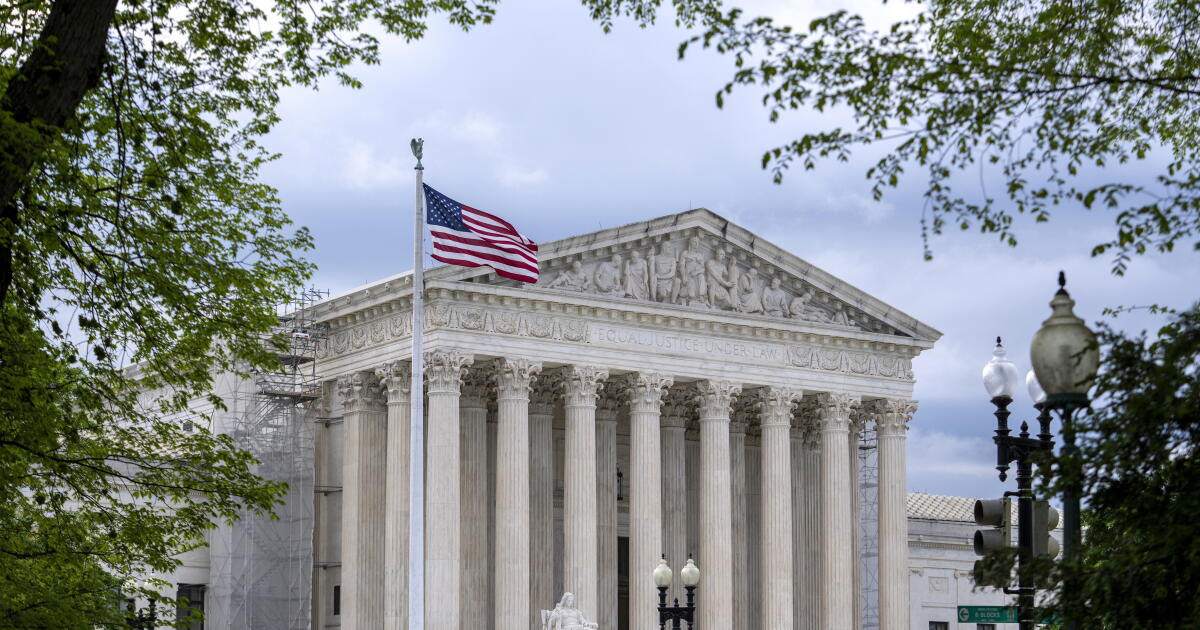
Supreme Court may strike down school policies that limit Asian students
WASHINGTON — The Supreme Court agreed Monday to consider outlawing school diversity policies that limit Asian American students at magnet programs and selective high schools.
Three years ago, the court ruled that Harvard and other universities may not discriminate on whom they admit based on the race of their applicants. Evidence in that case showed that Asian applicants with very high test scores were often turned down.
But the justices have been divided over admissions rules for highly selective high schools in Boston, New York and Fairfax County, Va., as well as magnet programs for gifted middle school students.
In most instances, judges have said school officials may use “race-neutral” policies to achieve racial diversity. For example, giving an automatic admission to the top 5% of the students in all of a big city’s high schools or its middle schools could achieve greater racial and ethnic diversity.
But the court’s conservatives, led by Justices Clarence Thomas and Samuel A. Alito, have condemned such policies as thinly disguised racial discrimination.
Magnet programs exist across the country, including in California and Los Angeles, and were conceived as a form of voluntary integration — a way to get white students to attend the same schools as nonwhite students, without having to resort to forced busing.
The idea was that a special school program would be attractive enough to serve as a “magnet” for white students to enroll at a school they might not otherwise attend. A mix of white and nonwhite students was seen as a benefit to the nonwhite students, because white students would be sharing the fate of the nonwhite students.
Asian students were frequently part of that original equation on the nonwhite side of the ledger and counted with other students classified as nonwhite, such as Black or Latino students. But in terms of student achievement, Asian students have performed more like white students, frequently surpassing white students academically.
One subset of magnet schools requires a selective admissions process, and these are at the center of the current dispute.
The court agreed to hear an appeal from parents in Montgomery County, Md., who were upset by a sharp drop in Asian students at its four magnet schools for gifted students.
For a decade, the school board had been troubled that fewer than 15% of the students at its magnet schools were Black or Latino, even though they made up about half of the student population.
In contrast, Asian students were less than 15% of the county’s student population but made up about half of the enrolees at the magnet programs.
After several years of debate, school officials dropped the use of a countywide competitive test and chose top performing students at all of its middle schools using a lottery.
That prompted a lawsuit that reached the U.S. 4th Circuit Court of Appeals.
Fairfax County in northern Virginia had adopted a somewhat similar policy for the Thomas Jefferson High School for Science & Technology. A federal judge ruled for Asian parents and said their students had been deprived of a “level playing field” in competing for admission.
But the 4th Circuit, by a 2-1 vote, disagreed and said Asian American students were still winning more seats than their percentage of the school population.
The Assn. for Education Fairness, the parents group in Montgomery County, lost for the same reason in the 4th Circuit. The number of admitted Asian students had declined, but their percentage remained well above their share of school population.
They appealed and urged the Supreme Court to rule on their case and to clarify the law.
“School districts across the country have overhauled admissions criteria for competitive public schools after concluding that existing systems produced undesirable racial enrollment patterns,” they said.
They said the court should end this type of racial discrimination against Asian students.
However, a longtime champion of admissions policies that rely on social and economic fairness said he hoped the court would side with Montgomery County.
“The Supreme Court has long disfavored racial preferences and pointed to race-neutral programs that look at factors like socioeconomic disadvantage as the right way to do affirmative action,” said Richard D. Kahlenberg, director of the American Identity Project at the Progressive Policy Institute.
He said the Maryland school board followed that rule.
“It essentially provided an admissions break to students based not on race, but on the economic disadvantage of the elementary school they attended. The question now opened is whether the court will stand by precedent or move the goal posts. Is the court opposed to racial preferences, or to racial diversity itself?”
Los Angeles Unified, the nation’s second-largest school system, has an extensive magnet system, with 66 whole-school magnets and 268 magnet centers within a larger campus.
At this point, many of the magnets provide no discernible integration benefit and are viewed instead as inducements for any student to enroll. Many magnets are nearly all students of color because few white students apply.
A few schools, however, have more applicants than spaces, and the district relies on “the Magnet Priority Point System and the need to maintain a racially balanced enrollment, and by available space.”
Parents must mark one federally recognized race or ethnicity on the application, or it won’t be processed. A family gets points, for example, if a student applied unsuccessfully for a magnet in the past.
In L.A. Unified, 53 schools are designated for students rated as “gifted,” and there are four campuses with programs for highly gifted students, typically identified by a professional evaluator.
Available recent data for the highly gifted program at North Hollywood High indicated that the largest percentage of students, about 38%, were Asian. Overall, the district’s enrollment is about 3.5% Asian.
The justices will hear arguments in the case early next year.
Savage reported from Washington and Blume from Los Angeles.

