points

Family-friendly halfway points between Orange and L.A. counties

My husband and I live in Mission Viejo. Our older son, his wife and two children (ages 5 and nearly 4) live in Newhall. We love spending time together, but it’s quite a trek on the 5 Freeway. Last year, we went to the aquarium in Long Beach, which was great fun. Another day, we enjoyed a day of hiking and a picnic at Placerita Canyon Nature Center near my son’s home. We would love some suggestions about other places to visit which would maybe be a little more centrally located and fun for the whole family. Thanks
— Cathy McCoy

Looking for things to do in L.A.? Ask us your questions and our expert guides will share highly specific recommendations.

Here’s what we suggest:

Cathy, I understand your pain. Driving 80 miles can feel like an odyssey, especially in SoCal. Thankfully, there are loads of fun places where your family can meet in the middle (or close to it). I’ve rounded up some solid options. By the way, the driving times mentioned here are a rough estimate for a weekend day without traffic, but as you probably know, your actual time may vary.

Since you all enjoyed the Aquarium of the Pacific in Long Beach, how about switching it up and spending the day with a different set of animals at the Montebello Barnyard Zoo for your next outing? That would be about a 40- to 50-minute drive for both of you. Open since 1968, the zoo is home to horses, goats, sheep and donkeys that you can pet (and feed them for an extra $3). If you’re feeling adventurous, you can ride a pony or take a leisurely trip on a John Deere tractor train. “It’s a great place for young ones to learn that animals outside the home need and deserve the same kind of care that we show our pets,” Etan Rosenbloom writes in a Times guide to things to do with kids around L.A. General admission is $11, and you can sometimes find deals on Groupon as well. Afterward, head to Blvd Mrkt, a food hall in Downtown Montebello that sells a variety of food so everyone can get what they want.

Another great option is the South Coast Botanic Garden on the Palos Verdes Peninsula, which might be about an hour drive for both of you. I learned about this spot from my dear late colleague, Jeanette Marantos, who was a gardening expert in her own right. The garden, which has more than 2,500 species of plants and five miles of trails, also features a kids area, which features “a nursery rhyme theme with a large dollhouse, a charming bridge and plants matched to the stories,” Marantos writes. My editor Michelle Woo also loves this garden. “You can take a leisurely walk along the accessible loop trail or get really into the nooks and crannies of the place, discovering trees with giant roots that kids love to climb on and koi fish swimming in a shaded pond,” she says, adding that she’s excited for Thomas Dambo’s trolls exhibit that opens in March. If you get hungry, you can stop by Dottie’s at the Koi Pond, which sells food, beer, wine and specialty cocktails on Saturdays and Sundays. Carry-in food is permitted if pre-prepared.

If you’re interested in space travel, then you should definitely visit the Columbia Memorial Space Center, which is the ultimate cosmic playground. Located in Downey (known as “home of the Apollo”) — about a 40-minute drive for you and a 50-minute drive for your son’s family — the recently renovated museum features a play area, robotics lab and interactive exhibits on space exploration including a shuttle landing simulator. Admission is $5 for adults and kids, $3 for seniors ages 65 and up and free for children ages 3 and under.

Speaking of aviation, another spot that is worth checking out is the Proud Bird in El Segundo, about a 45- to 50-minute drive for both of you. Here, you can enjoy delicious bites as you watch planes take off from Los Angeles International Airport, which is just a couple of miles away. Woo calls it “the perfect spot for a multi-generation gathering.” “Our extended family once celebrated Christmas there when everyone was too tired to cook,” she adds. “You can order solid barbecue from Bludso’s, have a drink by a bonfire pit and let the kids play on the playground as planes fly by.” She also suggests the Point in El Segundo. It’s an open-air shopping and dining center that has a large lawn where the kids can play and the grownups can grab a drink from Lil’ Simmzy’s.

I hope these recommendations are useful as you plan your next family outing (and that they also save you some gas money). Whatever you end up doing together, I’m sure that your family, especially the little ones, will just be grateful to spend quality time with you. Have fun!

Source link

Slumping Clippers get 37 points from Kawhi Leonard but fall to the Magic.

Desmond Bane scored 36 points and Paolo Banchero added 16 points and eight assists as the Orlando Magic held on for a 111-109 victory over the Clippers on Sunday night at Intuit Dome.

Wendell Carter Jr. had 15 points and 14 rebounds and Tristan da Silva scored 13 for the Magic, who improved to 5-2 since Feb. 5.

Kawhi Leonard shrugged off an ankle injury to score 37 points and Bennedict Mathurin added 21 points and nine rebounds off the bench for the Clippers, who are 4-5 since Feb. 2. Mathurin missed a three-point attempt to win the game at the buzzer.

Jordan Miller had 14 points for the Clippers (27-30).

Leonard exited Friday’s loss against the Lakers with an ankle sprain. Mathurin was playing in his fifth game for the Clippers after he was acquired at the trade deadline from the Indiana Pacers.

Orlando won despite going eight of 23 from three-point range, two games after setting a franchise record with 27 three-pointers in a victory at Sacramento. Jalen Suggs missed his second consecutive game for the Magic with back spasms.

In a tight game throughout, Leonard gave the Clippers a 107-105 lead with 3:03 remaining on a jumper from the top of the key. The Magic took charge from there as Bane hit a jumper to tie the score and then made a layup with 1:28 left for a 109-107 advantage.

As the Clippers missed four consecutive shots, Orlando went up 111-107 on a fast-break dunk from Banchero with 40 seconds left.

Bane tried to pad the Magic’s lead with eight seconds remaining but had his shot blocked inside by rookie Yanic Konan Niederhauser. Mathurin then raced down the floor only to miss a 25-footer as time expired.

Source link

The Stress Points Delcy Rodríguez Must Worry About

An interesting debate about the past two months centers on the extent to which Delcy Rodríguez is finding her new seat comfortable. There are areas where she feels like a smooth operator (or a yes-woman for Rubio and Trump) and levers she can’t yet pull without finding resistance from her old comrades.

One can sense she isn’t too bothered driving Trump’s energy agenda. As Maduro’s economic vice president and oil minister, the last few years saw Delcy spend serious amounts of energy lobbying for sanctions relief, engaging with consecutive US governments, and maneuvering to bring in new players to the oil industry. Experts still cast doubt on her  ability to reinvigorate an economy and energy sector that still requires an institutional revamp much broader than a single piece of legislation. 

The issue is not the written rules themselves, but that the chefs in Washington DC are currently rebuilding the restaurant with the same cooks who, no matter how new the pots and pans, will sooner or later revert to the habits that made the kitchen a pigsty to begin with.

Sure, steps are being taken to move on the economic trajectory the US has imposed. In the first 50 days of the so-called “new political moment,” we have a new energy law, a US Treasury account holding Venezuela’s oil revenues, and dollar auctions for private banks at a free exchange rate. Last week, Trump’s Energy Secretary Chris Wright visited the country. In front of him, Chevron boasted of its crown jewels. The US followed up with further sanctions relief, albeit limited and subject to specific authorizations.

In the opposite end, the country still lacks clarity over political trajectory. The puzzle of democratization has hundreds of missing pieces. It’s not just a matter of whether elections will be held and results enforced, with the opposition choosing its candidate, with competitors sitting down to discuss the day after the vote, etc. Every question about freedoms and human rights has come attached to the ifs, buts and maybes of a regime that can’t even agree on the degree of control it gives up or whether politicians will be allowed to behave like politicians. The Guanipa incident suggests the answer is still no. So does the fact that Miguelangel Suárez, the Universidad Central student leader, was chased and spied on hours after last week’s Youth Day protest.

It’s still early, but in the sphere of political liberalization, the mantra from Jorge and Delcy Rodríguez seems to be: raise expectations and fall short.

Big headlines, slow progress

As noted by Camila González in our latest post, the Rodríguez siblings are trying to convey the idea that they’re true political reformers rather than the alleged traitors of the revolución that foreign newspapers obsessed with after January 3. Their messages are simple: we know how bad things are, though we can’t always admit it, we will empty the country’s prisons, we’d like to overhaul the courts.

Delcy’s speech at the Supreme Tribunal on January 30th is a prime example. Not only did she order the creation of an amnesty statute covering chavismo’s lifespan and the shutdown of El Helicoide. She invoked a “great national consultation” for a new justice system (which likely points at behind-the-scenes discussion the ruling elite and the military are having) before naming some of the issues that make the system so dysfunctional: lacking access to justice, procedural delays, and corruption across the country’s tribunals and prosecutors’ offices. Jorge, more adept at improvising to manipulate different audiences, later said that guys like him need to both “forgive and ask for forgiveness” before describing political prisoners as necessary, “due to the realities, circumstances and the concrete situation of a society.” Three weeks after his remarks, 444 political prisoners have been released. Six hundred are still behind bars.

In theory, the amnesty law should also entail the release of the so-called historic, Chávez-era political prisoners.

These performances seem to align with the tendencies of the biggest external stakeholder in the process, Donald Trump, who has publicly praised Delcy Rodríguez and releases as a powerful humanitarian gesture. But in Venezuelan cliques, the implementation and discourses around these initiatives (brought about under a careful management to shield domestic stakeholders from further pressures) underscore the internal resistance and tensions playing inside chavismo.

The amnesty law, a key landmark of any political transition, would open the door to the return of political figures that includes many of chavismo’s longtime enemies, and perhaps more crucially, confrontation with the consequences of years of having imprisoned military officers subjected to the worst kind of punishments under the high command’s oversight. Foro Penal reports that 185 FANB personnel are still imprisoned. Venezuelan journalist Hernán Lugo Galicia affirms that most of them are National Guards and Army officers, and that only a handful have been released since the process began on January 8.

An amnesty in handcuffs

In theory, this policy should also entail the release of the so-called historic, Chávez-era political prisoners: public officials convicted in trials riddled with irregularities. This group includes Héctor Rovaín, Erasmo Bolívar, and Luis Molina—former officers of the now-defunct Caracas Metropolitan Police accused of shooting demonstrators and supplying weapons to coup participants during the massive anti-Chávez protest of April 11, 2002 (the narrative chavismo used to shield armed colectivos and party leaders from legal responsibility). It also includes Otoniel, Juan Bautista, and Rolando Guevara, three police agents convicted for the murder of Danilo Anderson, the prosecutor investigating the planning of the 2002 coup.

These cases are deeply symbolic for the regime: the conviction of the Metropolitan Police officers helped cast blame on a handful of supposedly putschist cops while insulating the Chávez government from responsibility for the violent deaths. The Guevara case, meanwhile, appears designed to silence the controversy and corruption that surfaced during investigations into the events of 2002.

Releasing the históricos (who go back to a time where Delcy and Jorge Rodríguez were not in politics) would be an admission that chavismo engaged in political persecution early on, tearing down the myth of one of its martyrs in Anderson and the Policías Metropolitanos as the sole rotten apples of 2002. Releasing FANB members, many in terrible shape because of mistreatment and prolonged isolation, would of course add another layer of pressure to a military high command embarrassed by the American incursion that killed dozens of subordinates and captured the commander-in-chief, not to mention the array of testimonies and revelations that a decision like that could start to induce. Interior Minister Cabello is well aware of that, and sounds resolute in his opposition to the release of those accused of plotting or rebelling in arms.

The amnesty bill is now stuck. Chavista lawmakers don’t yet agree on the contents of Article 7, which commands dissidents charged with relevant crimes, many of which went in hiding or fled the country, to turn themselves in in order to become amnesty beneficiaries.

Reality suggests that supposed moderates still fall short, unable to break from the dominant logic of  fear and control.

“They said they didn’t do anything. Not lobbying for sanctions, not cheering at the (US) intervention. The amnesty is about acknowledging mistakes,” Iris Varela recently said in a pro-chavista podcast. “If you want both an amnesty and to return to the country, then come over here, prove you were under persecution, and get the amnesty.”

Varela is one of the lawmakers in charge of the amnesty project, but she is known as a radical chavista for more than 20 years. After her intervention in the National Assembly last week, Jorge Rodriguez decided to adjourn the discussion arguing that the minority bloc led by Henrique Capriles had requested further amendments.

Therein lies another distinction in the official choreography surrounding the amnesty saga. Even if all chavista voices ultimately recycle the same talking points about sovereignty, malign NGOs, and chavismo as the guarantor of peace, their performances differ in tone and posture. While figures such as Diosdado Cabello and Iris Varela maintain an unyielding stance toward traditional opponents, more civilian-facing chavista actors are attempting to stage a process in which civil society groups ostensibly have a say in shaping the amnesty bill.

Representatives from leading human rights organizations such as Provea and Foro Penal attended a meeting with the parliamentary Domestic Policy Committee, shortly after Professors Guillermo Aveledo (Universidad Metropolitana) and Juan Carlos Apitz (Universidad Central de Venezuela) were allowed to criticize and question the extent to which reforms are actually in motion, while in the same room as Jorge Rodríguez and Nicolás Maduro Guerra.

These meetings may well be cosmetic, and are unlikely to determine the final legal outcome, but they appear designed to position certain chavista officials within a “moderate” camp: figures supposedly willing to build bridges with the opposition and entertain uncomfortable truths, even if their broader script remains unchanged.

Reality suggests that supposed moderates still fall short, unable to break from the dominant logic of  fear and control. After what appeared to be a staged embrace with relatives of political prisoners, the promise by Jorge Rodríguez to release all detainees held at the PNB jail in Boleíta, eastern Caracas, is yet to materialize. Meanwhile, Jorge Arreaza, who heads the Internal Policy Committee, recently offered little beyond justifying Guanipa’s re-arrest as relatives of victims and journalists pressed him for answers about the release process.

Scenes like these—Rodríguez, however calculated the gesture, appearing outside a political prison, and Arreaza being publicly challenged and scrutinized in the streets—would have been inconceivable just a year ago. They are a novelty in the politics of late-stage chavismo. But novelty is not reform. Such gestures are unlikely to persuade a skeptical public that a genuine shift is underway. Again, emphasis appears to rest more on optics than on tangible results.

Perfume and polish for the security sector

The Interior Ministry is still in Cabello’s hands, with top cops and allies running the main security agencies: Douglas Rico at CICPC, his cousin Alexis Rodriguez Cabello at SEBIN, and his old pal Gustavo González López now commanding both Delcy’s security ring and the fearsome DGCIM (his predecessor was fired after the US captured Maduro and Cilia Flores). Colonel Alexander Granko, who became the face of state violence in the 2020s, remains DGCIM’s special ops star, but has kept a low profile in recent weeks.

Having said that, recent moves suggest that Delcy Rodríguez retains an interest in the structure and functions of a security apparatus she does not fully control—and is willing to upgrade and trim it where possible. On February 9, the government officially dissolved the Strategic Center for Security and Protection of the Homeland (CESSPA), the intelligence body tasked with monitoring “foreign and domestic enemy activity” by centralizing data from all state security organs. Its shutdown came with the elimination of six social missions dating back to the Chávez and Maduro periods.

Senior politicians close to the opposition leader—Guanipa, Perkins Rocha, and Freddy Superlano—remain under house arrest. The amnesty law, scheduled for discussion tonight, would be entirely incompatible with that fact.

Earlier, flanked by senior chavista leaders and military generals, Rodríguez announced the creation of a new intelligence body: the National Office for Defense and Cybersecurity, conceived as a hub “where Venezuela’s scientists and technology experts should come together to defend our cyberspace.” She appointed Gabriela Jiménez to lead it, a biologist who previously served as Science and Technology Minister and was part of chavismo’s delegation during the Mexico negotiations. In August 2024, Jiménez had already alleged that the National Electoral Council (CNE) and dozens of Venezuelan institutions were the target of cyberattacks in the context of the July 28 presidential vote.

Delcy may have already taken a step toward the state goal of reforming the judicial system. This month, the National Assembly approved an amendment to the statute governing the CICPC, emphasizing clearer chains of command and defining officers’ roles in criminal investigations. In a country where the scientific police (whether the CICPC or its predecessor, the Policía Técnica Judicial) has long exercised outsized influence over the justice system, the reform does sound interesting. It doesn’t undo Chávez-era decrees that subordinate judges and prosecutors to intelligence bodies rather than positioning them as institutional checks. Whether this marks the beginning of deeper changes with chavismo in power also remains to be seen.

Information remains scarce and, now more than ever, the country’s future is being discussed behind closed doors, with few listening in—such as yesterday’s meeting between Southern Command chief Francis Donovan and Delcy Rodríguez, Cabello, and Vladimir Padrino López. Our latest Political Risk Report indicates that María Corina Machado’s return to Venezuela featured prominently in conversations between Secretary Wright and Delcy last week. That development would not only deepen tensions within chavismo, but also test the resilience of the supposed transition now being pursued.

Senior politicians close to the opposition leader—Guanipa, Perkins Rocha, and Freddy Superlano—remain under house arrest. The amnesty law, scheduled for discussion tonight, would be entirely incompatible with that fact. We will soon see how far the so-called moderate lawmakers are willing (or able) to push it.

Source link

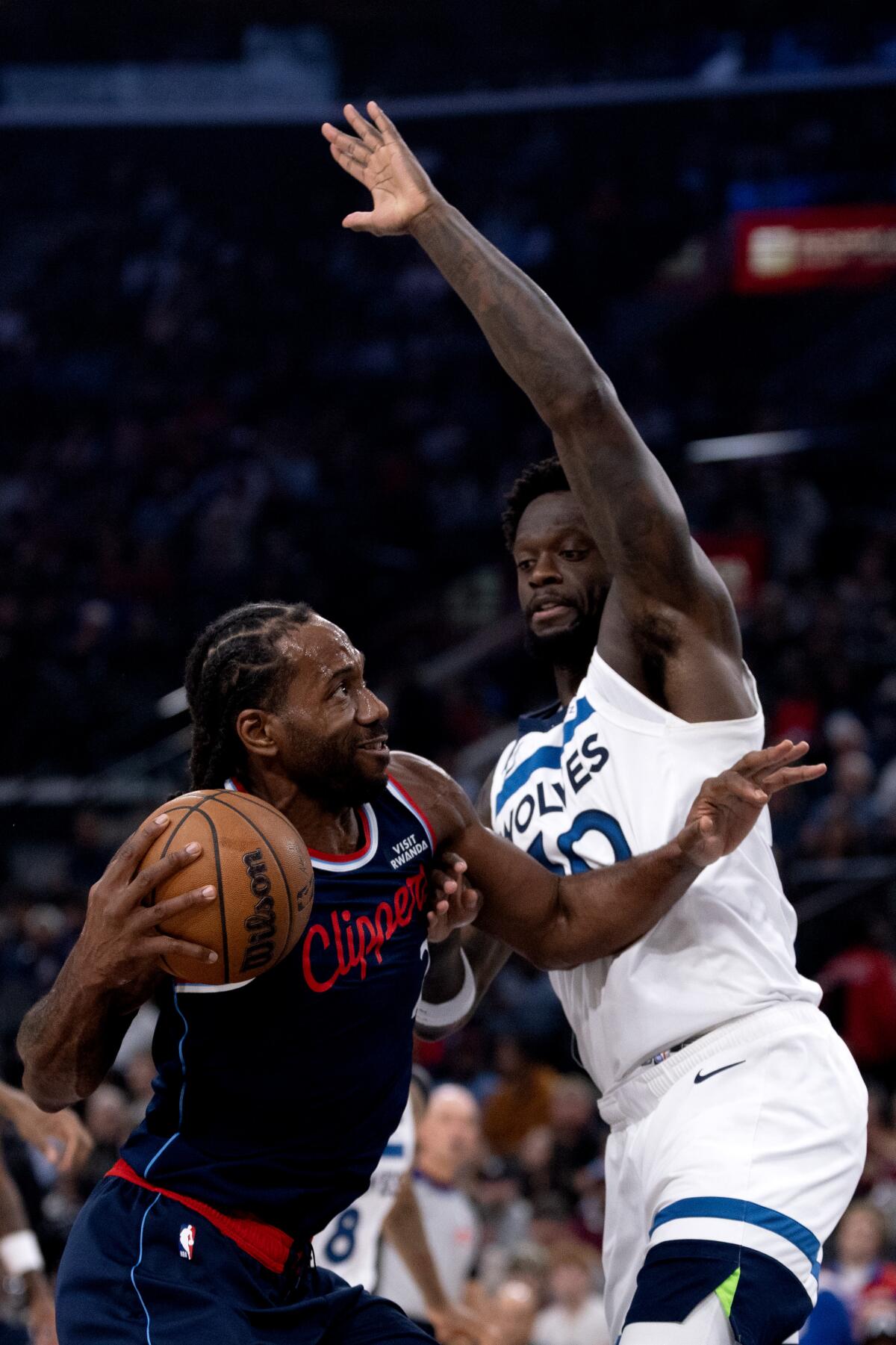
Kawhi Leonard scores 41 points as Clippers beat Timberwolves

Kawhi Leonard had 41 points and eight rebounds and the Clippers beat the slumping Minnesota Timberwolves 115-96 on Sunday.

John Collins had 15 points on six-of-nine shooting, and Yanic Konan Niederhauser also scored 15 points. The Clippers took command with a 17-3 run closing out the third quarter.

Anthony Edwards led Minnesota with 23 points, and Julius Randle had 17. The Timberwolves have lost three of their last four, all to sub-.500 opponents. Minnesota made just eight of 33 three-point attempts and committed 20 turnovers while being held under 100 points for just the second time this season.

Ayo Dosunmu, making his Timberwolves debut after being acquired in a trade with Chicago, had 11 points and two steals.

The Timberwolves were coming off one of their most frustrating losses of the season, when they blew an 18-point third-quarter lead in a home loss to the lowly New Orleans Pelicans.

The first half was more of the same for Minnesota. Leonard scored 24 points and helped key an 18-2 run late in the second quarter that give the Clippers a 54-42 lead.

The Clippers played without their two key trade deadline acquisitions. Darius Garland, who arrived from Cleveland in the James Harden trade, remained sidelined with a sprained big toe on his right foot. The Clippers had already said wingman Bennedict Mathurin, picked up in a swap with the Pacers, wouldn’t join his new team until Tuesday in Houston.

Source link

Lauren Betts has 16 points, 16 rebounds as No. 2 UCLA beats No. 8 Michigan

Lauren Betts had 16 points, 16 rebounds, five assists and three blocks to help No. 2 UCLA hold off No. 8 Michigan for a 69-66 win on Sunday.

The Wolverines trailed by 11 points with less than two minutes left and ended the game with a chance to tie the score, Syla Swords shot an airball on a three-pointer with 2.2 seconds left.

UCLA (23-1, 13-0 Big Ten) took a two-game lead over Michigan (20-4, 11-2) in the conference with its 17th straight victory since losing to No. 4 Texas in November.

The Bruins outscored Michigan by 14 over the second and third quarters and finished with their NCAA-best ninth win over an AP Top 25 team.

The Wolverines’ school-record nine-game winning streak in Big Ten games was snapped by a big and experienced team that plays stifling defense and is led by a 6-foot-7 preseason All-America center who does it all.

UCLA players wear pink basketball shoes to support Breast Cancer Awareness on Sunday.

UCLA players wear pink basketball shoes to support Breast Cancer Awareness on Sunday.

(Lon Horwedel / Associated Press)

Betts was eight of 17 from the field, grabbed rebounds at both ends of the court, set up teammates for shots after drawing double teams and used her size to block or alter shots.

Her surrounding cast is talented, too.

UCLA’s Kiki Rice scored 20, Gabriela Jaquez had 13 and Gianna Kneepkens scored 12.

Michigan’s Olivia Olson had 20 points, Mila Holloway had 15 and Te’Yala Delfosse added 10. Swords was limited to eight points, missing 10 of 13 shots.

The highly anticipated matchup drew a season-high 6,108 crowd to Crisler Center a few hours before the Super Bowl.

Source link

Kawhi Leonard scores 31 points during Clippers’ win over Kings

Kawhi Leonard scored 31 points, grabbed nine rebounds and had seven assists to lead the Clippers to a 114-111 victory over Sacramento on Friday night, sending the Kings to their 11th straight loss.

John Collins added 22 points and Brook Lopez and Kris Dunn each had 15 for the Clippers, who ended a two-game skid.

Darius Garland, acquired from Cleveland earlier in the week, remained out. He hasn’t played since Jan. 14 because of a sprained big toe on his right foot.

Malik Monk had 18 points to lead Sacramento, which hasn’t won since beating Washington at home on Jan. 16. Nique Clifford had 16 points and Dylan Cardwell and Devin Carter each had 14 for the Kings. De’Andre Hunter, also acquired from the Cavaliers this week, had six points in his second game for Sacramento.

The Clippers went into halftime trailing 49-48, but took the lead for good with 9:50 left in the fourth quarter on a 3-pointer from Lopez to make it 86-84.

Up next

Clippers: At Minnesota on Sunday.

Kings: Host Cleveland on Saturday night.

Source link

LIV Golf hits out despite being awarded world ranking points by OWGR amid ‘changing landscape’

LIV Golf has hit out at what it calls an “unprecedented” ruling that will see only the top 10 finishers at its events awarded world ranking points.

The Official World Golf Rankings (OWGR) board revealed on Tuesday its decision to award LIV players points for the first time.

However, while the Saudi Arabia-funded circuit, which starts its fifth season in Riyadh this week, has called the news a “long-overdue moment of recognition”, it is unhappy at the limits put on the rankings points for its 57-man fields.

In all 24 other men’s professional golf tours that are part of the OWGR, all players who make the cut earn points.

In a statement, LIV said “this outcome is unprecedented”, adding “no other competitive tour or league in OWGR history has been subjected to such a restriction”.

“Under these rules, a player finishing 11th in a LIV Golf event is treated the same as a player finishing 57th. Limiting points to only the top 10 finishers disproportionately harms players who consistently perform at a high level but finish just outside that threshold.”

In its statement, the OWGR board said it was awarding points to LIV “in an effort to reflect the changing landscape of the men’s professional game”.

However, it added that the points were being restricted to the top 10 finishers because it “recognises there are a number of areas where LIV Golf does not meet the eligibility standards set out by OWGR”.

The size of a LIV field, at 57, is well below the 75 set out in OWGR ranking criteria, while the lack of a cut was also a contributing factor.

LIV is evolving though, with each of its 14 events in 2026 being played over 72 holes, up from 54 in previous years.

“We expect this is merely a first step toward a structure that fully and fairly serves the players, the fans and the future of the sport,” added LIV in its statement.

“We entered this process in good faith and will continue to advocate for a ranking system that reflects performance over affiliation.

“The game deserves transparency. The fans deserve credibility. And the players deserve a system that treats them equally.”

Source link

Tyler Bilodeau has 18 points as Bruins are too much for shorthanded Ducks

Tyler Bilodeau had 18 points, Eric Daily Jr. had his second double-double this season, and UCLA beat shorthanded Oregon 73-57 on Wednesday night to extend the Ducks’ losing streak to seven games.

Dailey finished with 14 points and a career-high tying 11 rebounds. Donovan Dent scored 11 of his 15 in the second half for UCLA (15-6, 7-3 Big Ten) and Trent Perry, who was scoreless on 0-for-5 shooting before halftime, added 12 points.

The Bruins have won three in a row and five of their last six.

Kwame Evans Jr. led Oregon (8-13, 1-9) with 24 points, which included four three-pointers, and nine rebounds. Nate Bittle, Jackson Shelstad and Takai Simpkins — who are first (16.3 per game), second (15.6) and fourth (12.4), respectively, on the team in scoring this season — did not play for the Ducks due to injuries.

Evans made a layup to open the scoring 10 seconds into the game but UCLA scored the next eight points to take the lead for good. Bilodeau scored seven points in a 13-2 run that made it 26-13 with 7:08 left in the first half.

The Ducks, who started one-of-11 shooting, shot just 25% (eight of 32) from the field, four of 17 (24%) from three-point range, in the first half.

UCLA has won four straight in the series and is 98-42 against the Ducks.

Dailey threw down an alley-oop dunk that gave UCLA its biggest lead at 44-24 with 16:46 left in the game. Evans scored the Ducks’ first seven points in a 12-2 run that trimmed the deficit to 10 about 3 1/2 minutes later, but Oregon got no closer.

UCLA made 20 of 23 from the free-throw line, where the Ducks went six of nine.

Source link

Ontario Christian’s Kaleena Smith is averaging 32.8 points, No. 2 in state

Junior Kaleena Smith of Ontario Christian has upped her scoring average this season. She’s No. 2 in the state with an average of 32.8 points a game. Virtually any college team in the country would welcome her with open arms.

There’s others making an impact in the scoring department this season, according to stats posted on MaxPreps.com.

Aryanna Reyes of Whittier Pioneer is at 30.1 points for 14 games.

Leqi Zhen of L.A. Lincoln is averaging 28.9 points in 10 games.

Rancho Christian freshman Addison Archer is averaging 27.0 points in 22 games.

Darby Dunn of Canyon Country Canyon has had some big scoring nights and is at 26.2 points over 25 games. Tatyana Aubry of Leuzinger is averaging 24.8 points over 25 games.

Ventura’s Kailee Staniland is averaging 23.3 points. Savannah Myles of Westchester is at 22.2 points through 19 games.

This is a daily look at the positive happenings in high school sports. To submit any news, please email eric.sondheimer@latimes.com.

Source link

Luka Doncic scores 46 points, makes eight threes as Lakers beat Bulls

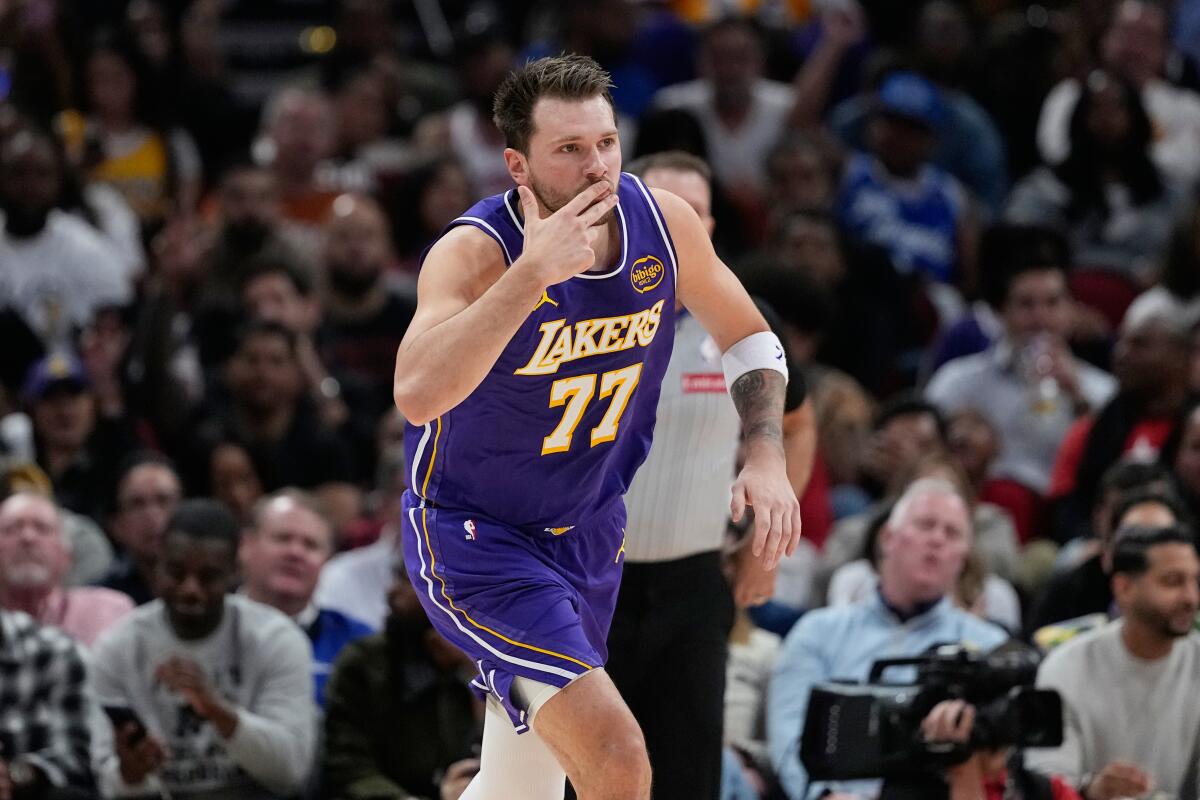
Luka Doncic skipped, shimmied and shot. The Lakers dunked, hollered and won.

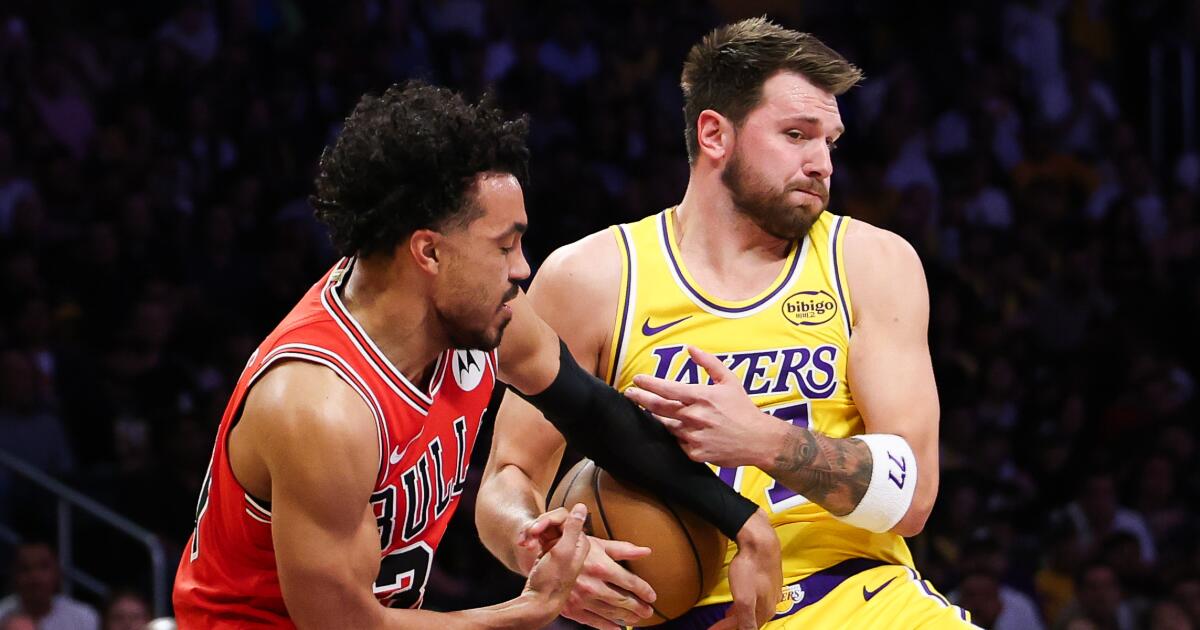
Doncic dazzled yet again with 46 points, 11 assists and seven rebounds in the Lakers’ 129-118 win over the Chicago Bulls on Monday. The Lakers (28-17) notched their fourth win in five games. It was his third game in the last four with at least 10 assists — all wins.

The Lakers are less than two weeks removed from losing five of six games, a skid that prompted coach JJ Redick to challenge Doncic and LeBron James during a team meeting to look for their teammates more. The Lakers weren’t “trusting the pass” Redick said last week after the team’s loss to the Clippers.

Doncic has responded with 11 assists in back-to-back games since the loss to the Clippers and the Lakers have had 26 assists in each of their previous two wins. James, in addition to 24 points, had three assists Monday.

“They took it in a good way and that’s what they’ve been doing,” forward Rui Hachimura said of James’ and Doncic’s response to Redick’s message. “And then, we’re winning. And then everybody gets touches and everybody shares a ball. It’s fun. That’s how basketball should be.”

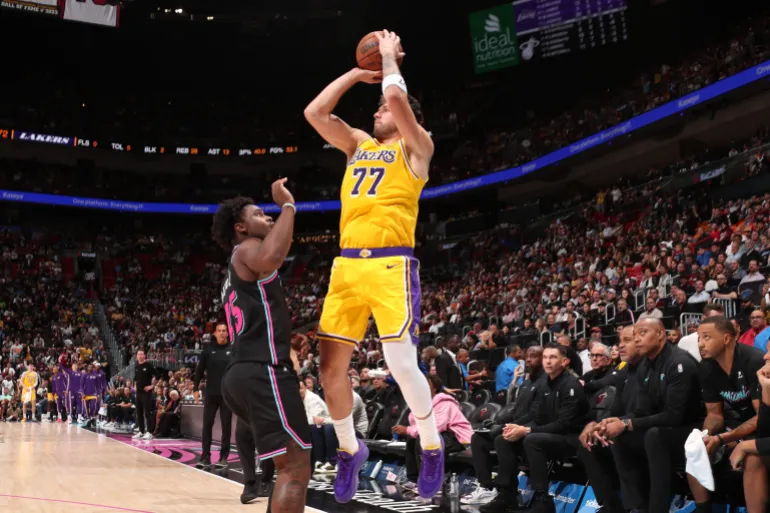
Hachimura was one of the main beneficiaries, scoring 23 points off the bench on nine-for-11 shooting with four three-pointers. Two weeks removed from a calf injury that kept him sidelined for six games, Hachimura has returned to his early season form, shooting 57.1% from the field in the last three games.

He hit consecutive threes to hold off a charge from the Bulls (23-23), who cut a 20-point Lakers lead to one with 6:42 left in the third quarter. Doncic played a role in both clutch shots, first whipping a one-handed pass behind his back across the court to Gabe Vincent, who shoveled the ball with one hand to Hachimura. Less than a minute later, Doncic drove into a crowd of three defenders in the paint, jumped and fired a two-handed pass to Hachimura on the wing. The Lakers were safely ahead by nine points again.

Lakers forward Rui Hachimura shoots over Chicago Bulls forward Dalen Terry during the first half Monday.

Lakers forward Rui Hachimura shoots over Chicago Bulls forward Dalen Terry during the first half Monday.

(Nam Y. Huh / Associated Press)

Redick praised Doncic’s and James’ ability to make “simple” plays Monday, helping the team keep its turnovers to just eight. But when the Slovenian point guard is at his best, he’s also making the spectacular plays that fire up his teammates.

“He’s an engine that’s fully on,” Redick said. “And he likes to create out there, and that’s a part of what makes him a great player. … Not to say it doesn’t test your patience at times, but you have to be willing to live with some of the stuff that he tries, because more often than not, you’re going to get a great result.”

Doncic, who only took 25 shots, scored 29 points in the second half after dishing eight of his 11 assists in the first. He made six of 11 three-point attempts after halftime, growing in confidence each time he snapped another early shot-clock heat check through the net. In the third, he mimicked shooting pistols after he laced one three-pointer. After another, late in the fourth, he skipped backward on defense away from the Bulls’ bench.

Lakers star LeBron James dunks in front of Chicago Bulls guard Coby White in the first half Monday.

Lakers star LeBron James dunks in front of Chicago Bulls guard Coby White in the first half Monday.

(Nam Y. Huh / Associated Press)

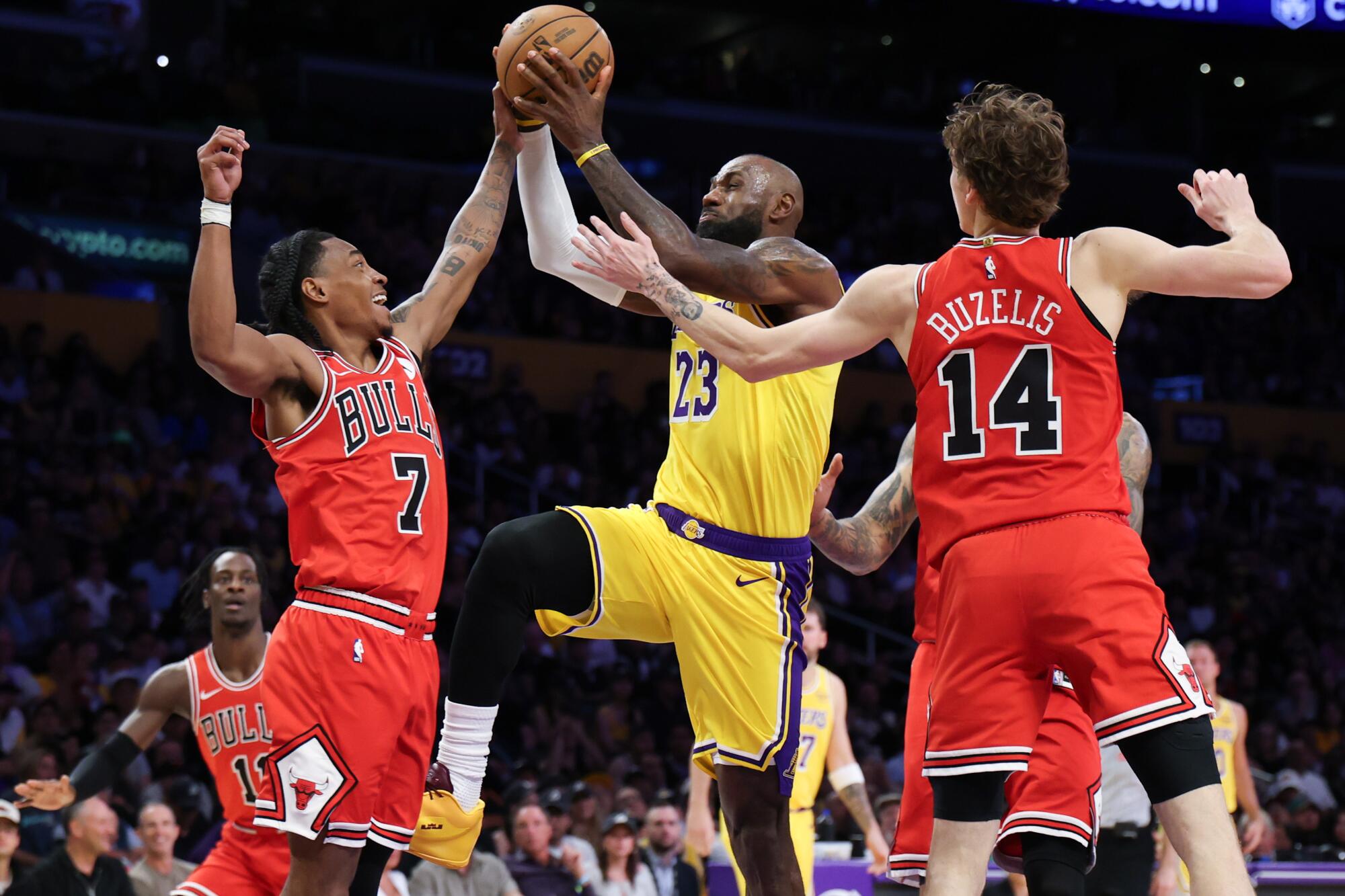
Doncic’s energy transferred to his teammates. James threw down two one-handed tomahawk dunks in the first half. Jaxson Hayes, not to be outdone by the 41-year-old, stole the ball and drove coast-to-coast for a between-the-legs dunk with 2:55 left to put a final exclamation point on the win.

The play left Doncic holding his hands together in front of his chest and exhaling in relief. Hachimura, trailing the play to Hayes’ right, was yelling, “Go Jax! Go Jax!”

But upon further review, teammates didn’t seem particularly impressed with Hayes’ dunk. Hachimura said he’s seen Hayes perform his signature dunk much higher. Even the 7-foot center said he was scared he was going to get stuck on the rim. Sitting at his locker after the game, Doncic attested he could pull it off when he was a teenager.

Just another one of his show-stopping tricks.

Source link