Barrow pledges new power infrastructure, including a 24-megawatt plant, to tackle The Gambia’s worsening electricity crisis.
Published On 9 Sep 20269 Sep 2026
Gambian President Adama Barrow has said the country will boost energy supplies by next month, hoping to quell violent protests over prolonged power outages as the premier stands for re-election.
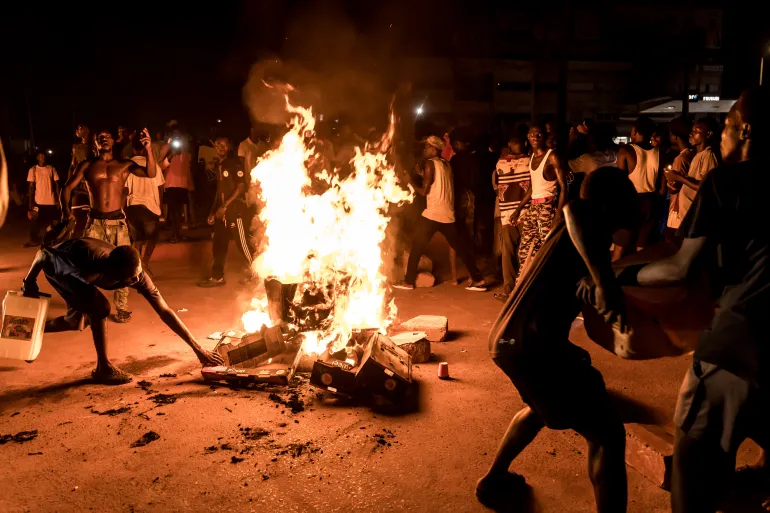
Protesters burned tyres and built barricades blocking traffic, demanding that Barrow resign, in The Gambia’s capital, Banjul, and nearby cities on Monday and Tuesday.
Police used tear gas to disperse crowds who gathered in multiple locations, including near Barrow’s residence and the National Water and Electricity Corporation (NAWEC) headquarters, which supplies the country’s electricity.
Demonstrators burn tyres and block a road during a protest over the country’s ongoing electricity crisis and persistent power outages in Brusubi on September 8, 2026. [AFP]
Barrow declared the outages an emergency and a “national security issue” during a visit to a NAWEC power station. In a national address, he announced that the government would install a 24-megawatt generation machine by the end of October.
“I know that the fans have stopped turning, children work in the dark, mothers throw away stale food, and the heat is unbearable by day and by night,” Barrow said.
The rolling blackouts are taking place during the West African country’s hot season and have lasted up to 48 hours in some places.
The Gambian president also announced an additional 50-megawatt solar power plant that would begin construction soon.
NAWEC Managing Director Gallo said the prolonged electricity cuts were in part due to climate change and the US-Israel war on Iran. The electricity provider, in a statement released in August, also claimed that it was experiencing an “unforeseen surge” in demand due to high temperatures.
The blackouts come just months ahead of the December presidential election, in which Barrow is running for a third term.
Aug. 24 (UPI) — On his first visit to Ukraine as British Prime Minister Andy Burnham promised Monday to share Anglo-French long-range cruise missile technology with Kyiv in its fight with Russia, saying Britain would stand with Ukraine until there was “a just and lasting peace.”
Burnham said European defense contractor MBDA would be authorized to declassify blueprints for the parts of the Storm Shadow/Scalp missiles that are made by Britain to help Ukraine build its own version of the weapon that Britain has for the past three years been giving to Kyiv.
The Storm Shadow enables Ukrainian forces to hit targets 150 miles inside Russia.
Burnham said Britain would join forces with France to build production plants in Ukraine following a similar pledge of help by President Emmanuel Macron, who also told Zelensky at the weekend that France would supply Kyiv with more anti-missile interceptors in the wake of a series of deadly ballistic missile strikes.
“On Ukraine’s 35th anniversary of independence, the Ukrainian people should be in no doubt: the U.K. is behind you today and for as long as it takes. I am proud of the contribution our country has made to Ukraine and I want the Ukrainian people to hear it directly from me that our support will not waver. After all, Ukraine’s security is our security,” Burnham said in a statement issued Sunday night.
“The friendship between our two countries will long outlast Russia’s illegal war. In both the fight and in the rebuilding to come, we will stand with Ukraine and deliver opportunities for people across both our countries. Russia should be in no doubt of our resolve. We will not back down until there is a just and lasting peace,” said Burnham.
Kremlin spokesman Dmitry Peskov likened the missile plan to pouring gasoline on relations with Russia and warned Britain over “participating in this war” on Ukraine’s side, saying that the Russian military was actively collecting data to uncover and destroy any missile production sites.
“Britain is methodically and regularly adding fuel to the fire and methodically and regularly plotting to prevent any progress in the peace process,” said Peskov.
Burnham’s high-profile, public backing for Zelensky came as he faces challenges both from nightly Russian ballistic missile strikes and to his authority, amid calls for elections which have been suspended for more than four years since Russia’s full-scale invasion in 2022.
As well joining Ukrainian President Volodymyr Zelensky for Independence Day celebrations in Kyiv, Burnham was also scheduled to chair a meeting of the U.K.-France-led Coalition of the Willing for talks on providing more help to Ukraine.
Established in 2025, the focus of the 34 country plus Ukraine partnership is to provide security guarantees in the event a cease-fire agreement is reached, including providing a multinational force to support and monitor it from day 1, though not necessarily in the format of a traditional peace-keeping force.
The stand by Burnham, coincided with a similar pledge from from Brussels, backed up by a multi-billion dollar package of fresh European Union military aid.
“On Ukraine’s Independence Day, we show our unfaltering support. Today, we approved $7.1 billion for the air and missile defense systems, missiles, ammunition and radars that Ukraine urgently needs. Europe stands with you today, tomorrow, and for as long as it takes,” European Commission President Ursula von der Leyen said in a post on X.
The package is in addition to $18.7 billion already approved by the 27-country bloc, $9.7 billion of which has already been provided to Kyiv.
Martin Luther King Jr. delivers his famed “I Have a Dream” speech from the steps of the Lincoln Memorial in Washington on August 28, 1963. The speech galvanized the nation’s civil rights movements and led to the passage of the 1964 Civil Rights Act, the 1965 Voting Rights Act and the 1968 Fair Housing Act. File photo by UPI | License Photo
Canada official condemns Israel’s ‘invasion’ of Lebanon, calls for sovereignty as aid pledged to the crisis-hit nation.
Published On 19 Aug 202619 Aug 2026
Canada’s secretary of state for international development, Randeep Sarai, visited Lebanon to announce new humanitarian aid, condemning what he called Israel’s “unlawful invasion” of Lebanon.
During his visit, Sarai stated that Beirut should govern its own space. He also announced new programmes Canada is launching to support Lebanese families affected by the conflict, raising its total assistance to Lebanon this year to more than $50m.
Recommended Stories
list of 4 itemsend of list
“Our commitment is long-term, and we’re there for Lebanon,” said Sarai, who visited shelters housing people displaced by the war and Syrian refugees during his visit.
Amid the escalation between Israel and Lebanon in March, Canada warned on March 25 that Lebanese sovereignty and territorial integrity “must not be violated” and strongly condemned plans by Israeli forces to occupy southern Lebanon.
As part of the US-mediated framework agreement signed in late June, “pilot zones” were designed to return small areas in southern Lebanon from Israeli forces to the Lebanese army.
Buildings hit by Israeli strikes lie in ruins in Zawtar al-Sharqiyah, Lebanon as seen from Zawtar al-Gharbiya, one of the designated pilot zones under the ceasefire agreement between Lebanon and Israel, from which Israeli forces have withdrawn, August 5, 2026 [Stringer/EPA]
In late July, the Lebanese Armed Forces accused Israel of obstructing its efforts to take over control of security in southern Lebanon.
The war has killed more than 4,000 people and has caused widespread destruction across Lebanon. The United Nations says that about 360,000 people are displaced as a result of the latest conflict.
Home to a large Lebanese diaspora, Canada has given Lebanon about $575m in assistance in the past 10 years, Sarai said.
Sarai also met Lebanese President Joseph Aoun and Prime Minister Nawaf Salam, who promised to reinstate state authority across Lebanon and to implement reforms to fight corruption.
Israeli officials said they will not pull out of Lebanon until Hezbollah is disarmed.
Democrat Xavier Becerra pledged on Tuesday to participate in more than one debate against Steve Hilton, his GOP rival in the California governor’s race.
“We will have debates, and between now and Nov. 3, we will continue to go out there and meet with folks to make sure they have an opportunity to see the candidates,” Becerra told reporters after greeting business owners, community leaders and voters in a walking tour of Little Tokyo. “Voters need to have good information. We’ll make sure they have it, and there will be debates.”
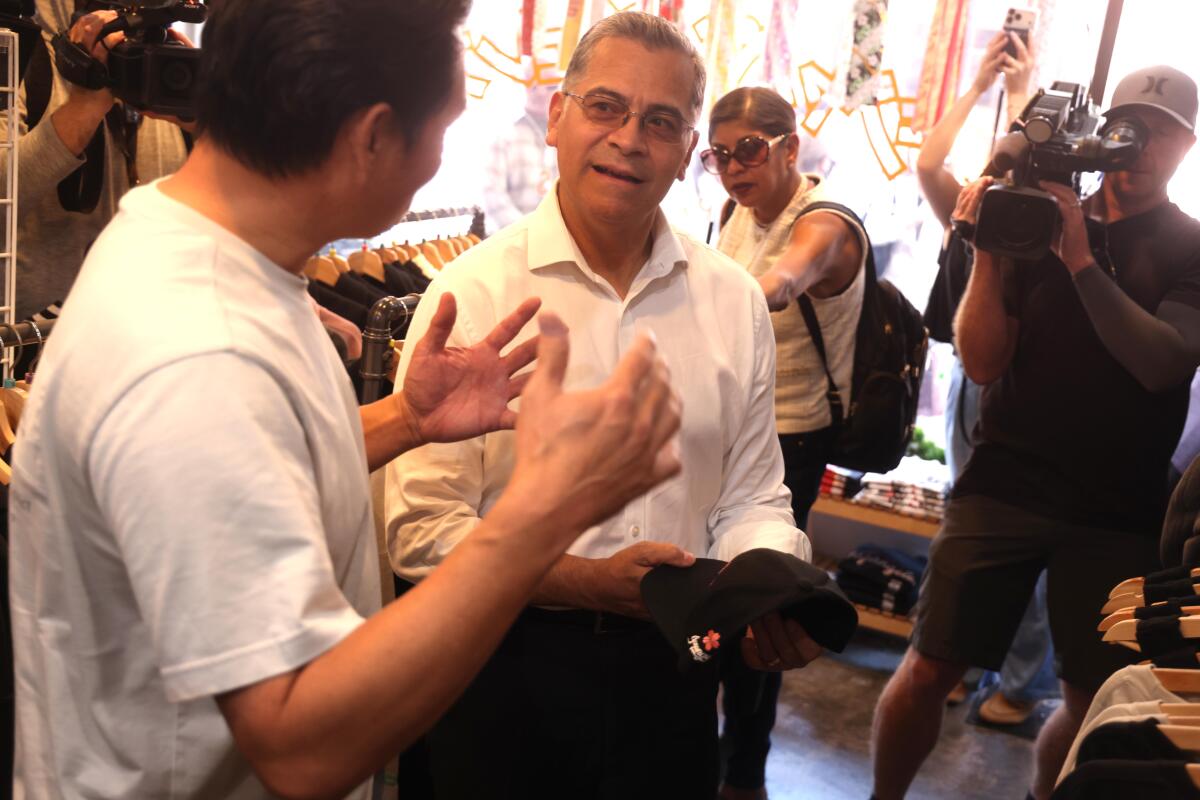
Xavier Becerra, center, who is running for governor of California, talks with Roy Kuroyawagi, owner of Japangeles in Little Tokyo on Tuesday.
(Genaro Molina / Los Angeles Times)
Hilton has been needling Becerra for not being as publicly visible on the campaign trail since the two men advanced in the June primary. The British-born conservative strategist and political commentator raises chickens at his Silicon Valley home and has said he named one of them “Xavier.”
“Xavier Becerra wants to be governor while dodging questions from the press and a debate with me,” Hilton posted on the social media platform X earlier this month.”What else do you expect from a lazy, arrogant, entitled ‘empty suit’ 36-year machine politician.”
Becerra held a 55% to 37% lead over Hilton in a UC Berkeley/L.A. Times poll released Thursday. The margin is unsurprising given the edge that Democrats have in voter registration over Republicans in a state that last elected GOP politicians to statewide office in 2006.
“Well, if I were trying to coast, I’d be out on the coast right now instead of here with you all and making a nice visit to Little Tokyo,” he said outside of an Asian-fusion gastropub on an oppressively hot, muggy afternoon. “Listen, this is all about making sure voters have a choice. We’ll get out there and make sure we’re front and center with them … even if it’s a little hot.”
Becerra spoke with reporters after visiting Little Tokyo businesses and chatting with locals and visitors.
When a group of young women pledged to vote for him in the gubernatorial race, Becerra urged them to vote against Proposition 39, a ballot measure that would require Californians to provide government-issued identification when voting and election officials to verify registered voters are U.S. citizens.
“Please vote against that. That would deter people from voting,” Becerra said, making a thumbs-down gesture. “I’m not joking.”
Becerra later told reporters that the proposition, which likely California voters oppose, according to polls, is a direct attack on the state’s elections by President Trump.
“The president has insisted on trying to disrupt elections. When he can’t do it in Washington, D.C., he’s trying to do it in our state directly,” Becerra said. “Prop. 39 is President Trump’s effort to try to interfere in our election. We have to resist it. We have to oppose it. And I hope people know that Prop. 39 is just a prop for Donald Trump. And anyone who believes that we have to see more people vote, we have to see robust elections, should be voting against Prop. 39.”
Becerra also enjoyed a little shopping.
At Japangeles, he purchased a ball cap with “L.A.” superimposed over Japanese characters for “Nihon,” what the Japanese call their own country; at Cafe Dulce, he picked up a fruit tart; and at a 123-year-old Japanese confectionery, he bought sweet mango mochi wrapped in a thin, fluffy pancake.
His visit Tuesday came during the community’s annual Nisei Week festival, which celebrates Japanese American culture and history. Becerra represented the area during his time in Congress. He ran into several people he had known over his long political career, including former Los Angeles City Councilmember Jan Perry, and Brian Kito, the third-generation owner of the Fugetsu-Do Bakery.
Kito showed Becerra a picture of the then-congressman swearing him in as a neighborhood council president more than a decade ago.
“It was a nice reunion,” Kito said. “He’s a true gentleman. … I’m hoping nothing but success for him.”
In his first address to the Disney faithful as chief executive, Josh D’Amaro pledged that Walt Disney Co. would create new stories and experiences at the D23 fan event Wednesday night in Anaheim.
D’Amaro was greeted like a rock star during the Burbank media giant’s film and TV presentation as the assembled crowd of more than 12,000 Disney super fans at the Honda Center gave him a rousing round of applause and cheers. He beamed at the audience, while clasping his hands together in front of him.
“I believe that in order to lead this company, you have to understand what it actually feels like to be a fan,” he said onstage. “And, I do. ”
D’Amaro is no stranger to the D23 stage; in his past role as parks chief, he would give updates on the latest news for the experiences division.
But now, as CEO, he said the company would deepen its connection with fans by continuing to develop fresh stories and new experiences.
“We are not here waiting for the future,” he said. “We’re building it … we’re actually building it right now.”
While Disney unveiled several upcoming original stories, including an animated supernatural flick from Pixar called “Ghost Market” set for release in spring 2028 and “Clay,” a Disney Animation film coming later that year about a mentor-mentee relationship, many of its projects are related to existing franchises.
The company unveiled details about Pixar’s “Coco 2” and “Incredibles 3,” both of which got huge applause from the audience, as well as a live-action “Lilo & Stitch 2.” Fans cheered for the return of the Jonas Brothers reprising their original Disney roles in “Camp Rock 3.” Even a teaser from “The Bluey Movie” elicited screams from the largely adult audience.
Earlier in the day, Disney executives revealed additional plans about its streaming strategy during a series of panels.
The company plans to lean more on creators with its new Verts vertical video feed on Disney+, a new feature designed to increase engagement. So far, it has grown in popularity among users, said Erin Teague, executive vice president of product management at Disney Entertainment and ESPN.
“What we’re seeing is as users are engaging with their vertical video experience, they are actually engaging in the overall product experience, double the amount of time,” she said onstage. “That means that we’re meeting users where we are.”
The company also plans to invest more in local international content to help grow the Disney+ service around the world. Disney has seen its local Korean shows perform well in Asia, as well as Brazil, executives said. And shows that do well in one country can often be remade in other regions.
Over the next three years, Disney plans to roughly triple the number of local original series on Disney+.
![Demonstrators burn tyres and block a road during a protest over the country's ongoing electricity crisis and persistent power outages in Brusubi on September 8, 2026. [AFP]](https://i0.wp.com/occasionaldigest.com/wp-content/uploads/2026/09/afp_6aa0b264c94c-1788916324.jpg?w=640&ssl=1)