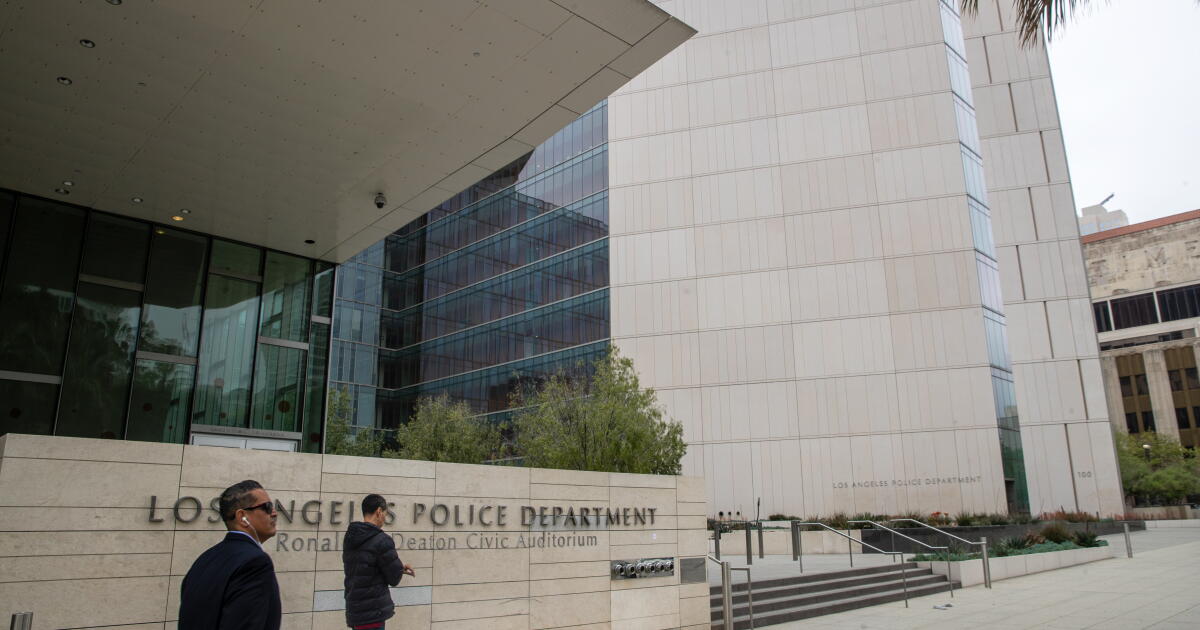
City Council puts $235-million LAPD license plate reader deal on hold
Citing lingering concerns about the potential misuse of police license plate readers, the Los Angeles City Council voted Tuesday to delay an agreement that would enable the deployment of hundreds of the controversial devices until officials are satisfied that the technology will be wielded responsibly.
By a 10-4 vote, the council opted to overrule approval of the 10-year, $235-million contract between the Los Angeles Police Department and Axon Enterprise, halting a deal that had previously been signed off on by the Board of Police Commissioners.
Axon is seeking to outfit hundreds of LAPD patrol squads with plate scanners, which track the movements of vehicles around the city. Under the agreement, the company would also replace thousands of body-worn cameras, supply new Tasers, provide cloud video storage, and roll out a program that uses artificial intelligence to assist officers in writing police reports.
In addition, Axon is seeking to launch a pilot program that would attach plate scanners to streetlights around Los Angeles, offering the LAPD a souped-up version of its current systems by using AI to identify vehicles, license plates, pedestrians and objects that appear on streets and sidewalks.
The council’s decision — which was preceded by several fiery comments from members of the public who oppose the use of license plate readers — sends the contract back to the Police Commission for reconsideration.
A commission spokesperson said that the board’s members weren’t immediately available for comment.
Several council members voiced unease about proceeding without a better sense of the LAPD’s internal policy on license plate reader use. Delaying the contract, Councilmember Hugo Soto-Martínez said, would give the public and city leaders more time to review the safeguards and policies written into the LAPD’s proposed memorandum of understanding with Axon.
Councilmember Traci Park, a staunch supporter of plate reader technology, said there is an urgent need to get the devices “up and running.”
Councilmember Eunisses Hernandez shot back that it would be irresponsible to deploy the technology, citing news reports about officers misusing plate readers to stalk romantic partners and track women seeking reproductive health services.
Earlier this year, the LAPD allowed its agreement with one of Axon’s chief competitors, Flock Safety, to lapse over concerns that the Trump administration is using the data it collects to locate immigrants targeted for deportation. Police officials say they no longer have access to the company’s cameras, many of which are owned by homeowners associations and other private groups.
LAPD Chief Jim McDonnell and other department leaders have pushed to expand the use of license plate readers, saying they are a valuable tool for solving crimes, enabling investigators to more easily locate stolen vehicles and fugitives.
Hernandez noted that other police technologies, such as a robot dog used in situations involving barricaded suspects, had quietly moved from a pilot to a full-fledged program without input from the council.
Council President Marqueece Harris-Dawson said he still had privacy concerns about license plate readers, while noting that their deployment along the Figueroa corridor had assisted in the rescue of dozens of juvenile sex trafficking victims.
“Now having said that, if I’m honest I don’t know what else the cameras are doing,” he said.
Councilmember Monica Rodriguez said that as the license plate reader technology is adopted by other, non-police agencies such as sanitation and street services, the city needs a universal policy governing its use.
The matter will next be heard by the public safety committee — likely at its Oct. 20 meeting — before being taken up by the full council later that week.
In a presentation to the Police Commission last month, the LAPD’s technology czar, Dean Gialamas, said that the department understood the privacy and civil liberty concerns raised about companies such as Flock. This summer, the department announced it was pausing its relationship with the Atlanta-based firm, but police officials have said they are still hopeful to negotiate a new deal with the company that would include more data-sharing safeguards.
Much like the initial debate over the use of forensic DNA testing, Gialamas said, the answer wasn’t to abandon the technology but to create safeguards to “ensure responsible and trusted use.”
Gialamas told commissioners that Axon had agreed to terms that would give the LAPD complete ownership of the data captured and bar the sharing of data with federal authorities. The proposed deal, he said, would also limit the use of plate readers to criminal investigations, missing persons cases and other “serious public safety matters.” Investigators, for instance, would not be able to conduct searches based solely on protests or other 1st Amendment-protected activities, he said.
Under the proposed contract, investigators would no longer be given “unfettered access” to license plate data and the retention period would be significantly cut down, he said. The department would also be permitted to conduct regular audits to flag officers who use the system frequently or conduct unusual searches.
A report issued last month by the LAPD inspector general’s office found numerous “limitations” in the department’s existing agreements with its three plate reader vendors — Flock, Axon and Motorola — including a lack of clear language about how long data are retained and how they are shared with third parties or other law enforcement agencies.
The inspector general recommended that the department update its current license plate reader contracts to address data security and privacy concerns, conduct regular audits and develop standardized rules for traffic stops based on plate reader hits.