This story contains spoilers for “The Super Mario Galaxy Movie.”
Everybody’s favorite fearless and super capable princess is back for another adventure — along with the denizens of her kingdom and a pair of New York plumber brothers — in “The Super Mario Galaxy Movie.”
Now in theaters, the follow-up to the 2023 blockbuster “The Super Mario Bros. Movie” sees Princess Peach, Mario, Luigi and Toad joined by some new yet also very familiar faces as they try to thwart yet another evil plan by a member of the Bowser clan. The result is some intergalactic travel and family-friendly action.
Directed by Aaron Horvath and Michael Jelenic, who also helmed the first film, “The Super Mario Galaxy Movie” formally introduces into Nintendo’s movie universe the cosmically powerful Rosalina and her flock of star-shaped Lumas, Bowser’s ambitious mini-me, Bowser Jr., the insatiable dinosaur-like Yoshi, ace pilot Fox McCloud and more video game fan favorites. (That includes Mr. Game & Watch, one of Nintendo’s earliest playable characters.)
These introductions, of course, don’t stop when the film’s main story ends.
Much like the first installment, “The Super Mario Galaxy Movie” features a couple of bonus scenes that are shown after the credits begin to roll. The first is a mid-credits scene that involves a breakout character from “The Super Mario Bros. Movie,” and the second, shown after the credits end, introduces another Nintendo royal.
Many Lumas appear in “The Super Mario Galaxy Movie.”
(Nintendo and Illumination)
The mid-credits scene is justice for Lumalee
Lumalee quickly won audiences over in “The Super Mario Bros. Movie” with his cheerfully nihilistic one-liners while imprisoned by Bowser. The blue Luma doesn’t appear during the main story of “The Super Mario Galaxy Movie,” but the star-shaped creature steals the mid-credits scene.
The bonus scene takes place sometime after the movie’s main story ends at the prison where Bowser and Bowser Jr. have been locked up. After Fox teases a possible sequel or “Star Fox” spin-off by mentioning he is finally “heading home” as he approaches his ship, audiences get a glimpse of what’s in store for the Bowser duo’s foreseeable future.
Peace may not be an option, because their prison guard is former Bowser captive Lumalee. And the role reversal — complete with uniform — doesn’t appear to have changed Lumalee’s outlook on life in any way.
The blue Luma said it best in the first “Mario” movie: “Life is sad, prison is sad, life in prison is very, very sad.” Just how sad things might get for the Bowsers will be up to Lumalee.
Peach fights off some Ninjis in “The Super Mario Galaxy Movie.”
(Nintendo and Illumination)
The second post-credits scene introduces a new princess
The final bonus scene in “The Super Mario Galaxy Movie” is more of a teaser for what could come in a future “Mario” installment.
This stinger takes place back at the hub known as the Gateway Galaxy. The mischievous thieving monkey Ukiki is once again trying to make off with the belongings of a passerby when he is stopped by another traveler: Princess Daisy.
Daisy is a character that first appeared in the 1989 Game Boy game “Super Mario Land.” Much like Peach in the first “Super Mario Bros.” video game, Daisy was the princess players were trying to rescue. She has since become a Nintendo regular, being featured as a playable character in “Mario”-related titles including in the “Mario Kart,” “Mario Party” and “Super Smash Bros.” series of games as well as the latest main series installment, “Super Mario Wonder.”
Although Daisy does not have any lines in the film, the video game incarnation of her is known to be energetic and feisty.
This brief glimpse of Daisy is another indication that there is more to come in the Mario movie franchise. Audiences will have to wait to see if (or when) a third movie is officially announced.
Jordan Pickford: Japan’s opening goal was the first time Pickford had conceded for England in 922 minutes. He had to produce a smart save in the second half to keep the hosts in the game. 6
Ben White: Beaten once early on but showed the consistency he has done for Arsenal after that. A constant hard-working presence down the right-hand side. One particularly good overlapping run in the first half. 6
Ezri Konsa: In with a big chance of starting the first game at the World Cup. One crucial block to deny Ayase Ueda with the shot hitting the bar and going over. 6
Marc Guehi: Given the armband by Tuchel for the first time. A couple of shaky moments early on but after that as dependable as ever. 6
Nico O’Reilly: Another important game for O’Reilly as he makes the left-back position his own before the summer. He showed his ability on the ball and moved into midfield whenever he could. 7
Kobbie Mainoo: A bright start and some nice footwork when moving the ball around midfield. Beaten a couple of times on Japan attacks when trying to defend. 6
Elliot Anderson: A certain starter at the World Cup. Assured in midfield, provided a drive to England’s play and tried to make things happen. One of the better performers on the night and clipped the crossbar with a good effort. 7
Cole Palmer: The Chelsea attacker was given the nod as the number 10 over Phil Foden who played as a false nine. There was always a sense that something could happen when Palmer was on the ball. However, he was caught on the ball and punished for Japan’s opener. Came off just before the hour mark. 6
Morgan Rogers: Started on the right wing and asked to provide a threat through the middle with no natural striker in the starting line-up. Not his best position but did the job that was asked of him. 6
Anthony Gordon: Put in another energetic performance with lots of hard work but not many moments to threaten the Japan defence. 5
Phil Foden: The Man City forward started as a false nine as Tuchel looks for a position for him in England’s squad. It was not a good night for Foden who will be worried about his place on the plane for the World Cup. Replaced in the 59th minute. 5
An uprising typically has a long parentage and, if effective enough, can leave behind many like-minded descendants. Such is the bracing air that Palestinian filmmaker Annemarie Jacir breathes into her historical drama “Palestine ’36” as she dramatizes the 1936-1939 Arab Revolt against occupying Britain’s increasingly punitive, underhanded rule, offering up a multifaceted rebellion tale with plenty of contemporary resonance.
That being said, Jacir’s fourth feature — packed as it is with storylines — could stand a bit more context and fewer of the expositional traps that big-cast sagas easily fall into. But the key element that grounds Jacir’s version of an old-fashioned epic (and helps it withstand its faults) is that we’re seeing a place rarely depicted with such sweep, detail and scope outside of biblical epics. It’s as if a long-disused history book’s pages have finally been opened, dust giving way to color and purpose.
Some of that breadth is seen at the beginning in some astonishing newsreel footage from the era, which segues into Jacir’s establishing story threads. We meet village-born Yusuf (newcomer Karim Daoud Anaya), an ambitious young man who moves restlessly between bustling Jerusalem, where he works for a wealthy, British-friendly Palestinian businessman (Dhafer L’Abidine) and his journalist wife (Yasmine Al Massri), and his rural home where villagers are routinely targeted by British authorities. If it isn’t vicious Capt. Wingate (Robert Aramayo) violently rooting out rebels and putting locals in pens, it’s outwardly friendly officials like the secretary who oversees new policies kinder to the increasing numbers of Jewish settlers than to those who have been farming the hills for ages.
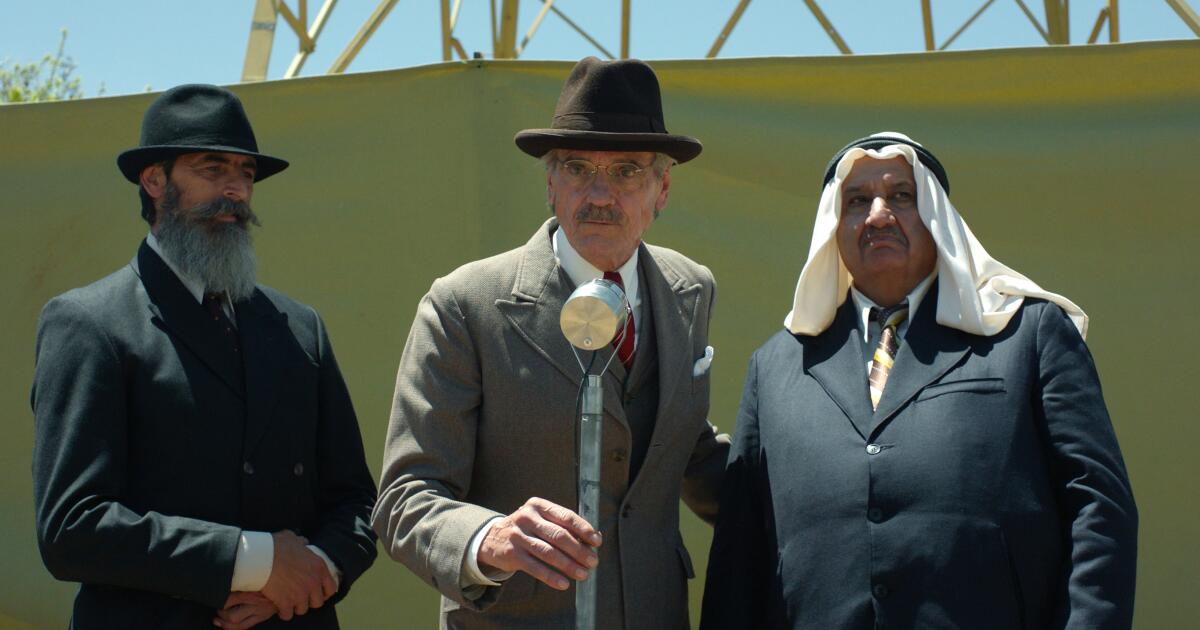
The split widens when a labor strike becomes an armed revolt, with Jacir gamely tracking the hardening or shifting loyalties of both her peasant and well-to-do characters. The British, represented at the top by the casually imperious High Commissioner Wauchope (a perfectly cast Jeremy Irons), are decidedly the villains here as a colonial force quick to brutalize Palestinians for speaking up for themselves. Still, by forgoing any Jewish characters when there was already a burgeoning transplanted minority — all we see is a kibbutz being erected in the far distance — seems like too careful an avoidance of contextual reality.
As “Palestine ’36” eventually sacrifices focus on the many characters it has, one wishes Jacir had had the luxury of a classic epic’s standard third hour to build that complexity into a vivid resistance narrative. Wanting more from this material, though, feels better than not getting the opportunity to see it at all. As overdue tales of history go, “Palestine ‘36” (currently one of the last films with access to its real-world locations) is certainly more of a blunt instrument than a novelistic endeavor. But its broad strokes and rooted passions easily earn their place, and deserve to inspire more such stories.
‘Palestine ’36’
In Arabic and English, with subtitles
Not rated
Running time: 1 hour, 59 minutes
Playing: Opens Friday, March 27 at Laemmle Royal and Laemmle NoHo 7
The framed photo of César Chávez and Dolores Huerta sits in my personal office on a bookshelf crammed with volumes about California and the American West.
The two are at a 1973 United Farm Workers convention, presiding over the union they co-founded. After years of victories in the name of campesinos, the group and its charismatic leaders seem ready for what’s next.
A UFW banner emblazoned with the group’s famous black Aztec eagle logo hangs in the center of the picture, making Chávez and Huerta look like equals.
But they’re not.
He’s speaking from a podium, looking down and appearing cast in darkness due to Chávez blue vest melding into his black hair and brown skin. She’s by his side clasping her hands, wearing a colorful blouse that pales in radiance to Huerta’s hopeful face as she looks at the crowd before them.
It’s the only picture of historical figures that I display at home, and it’s in a place where I’m guaranteed to look at it. It has long served as my secular version of a prayer card, a daily reminder to fight for the good in the world and a reminder that giants before me faced challenges far more daunting than mine. It was also a testament to teamwork — when I acquired the photo a few years ago, it called to me in a way a solo Chávez never would have because I always knew el movimento was more than just one man.
Their portrait can never mean just those things ever again after the New York Times reported last week Chávez sexually assaulted two teenage girls in the 1970s and Huerta in the 1960s.
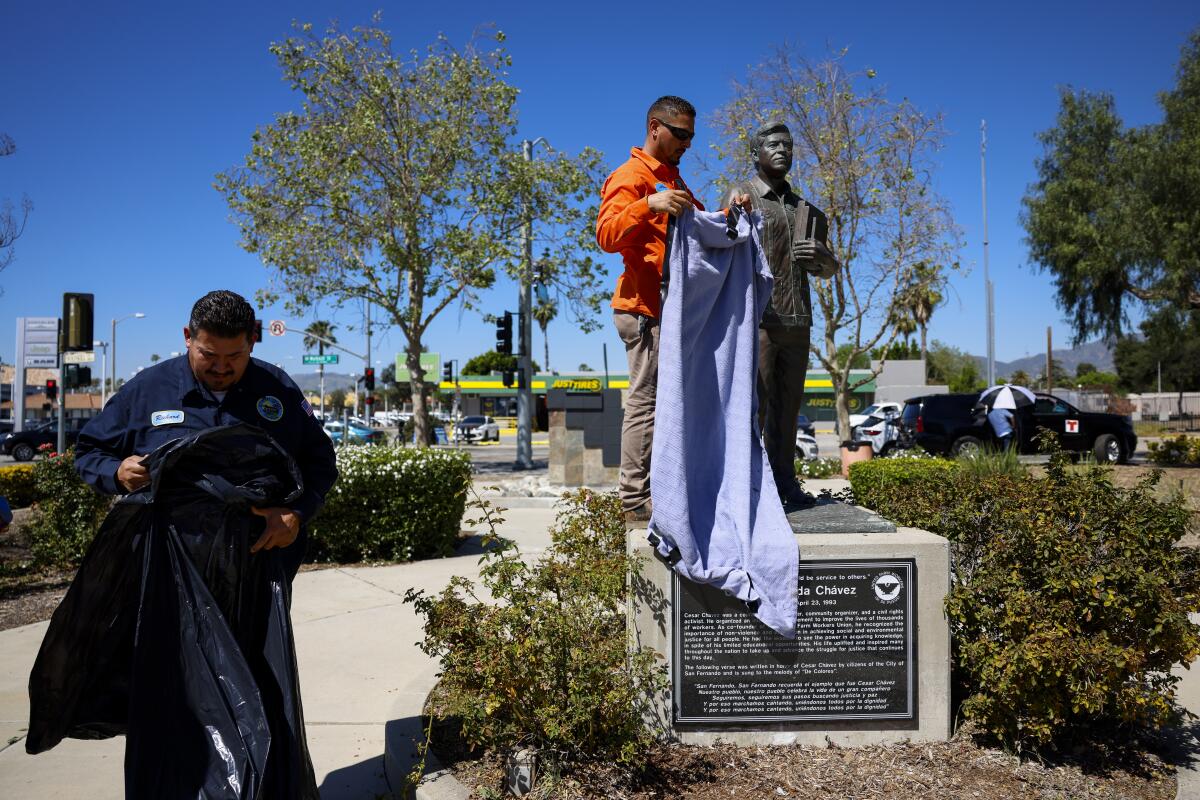
Places left and right — colleges, cities, classrooms, even states that mark Chávez’s birthday as a holiday — are now deleting his name and image from the public sphere. It’s not going to be a quick, easy task even if the cancellation is starting to take place with startling speed: Chávez’s presence is as ubiquitous in Mexican American life as the Virgin of Guadalupe.
Just this weekend, a friend acknowledged that he and his wife had just started reading a book about him to their 5-year-old daughter, a book they now plan to trash.
I thought of doing the same to my photo of Chávez and Huerta. But I’ve decided not to.
I don’t fault folks for wanting to scrub any hint of Chávez from their daily lives and neither does the Cesar Chavez Foundation, the nonprofit headed by his descendants that recently announced in a statement, “We support and respect whatever decision[s]” may come in the weeks and months to come. Communities are entitled to decide whom they should and shouldn’t publicly honor.
But to eradicate Chávez’s civic presence so fast — to tear down his statues, relabel streets and parks named in his honor, paint over his image on old and new murals, to throw away artwork that has adorned homes and offices for decades — doesn’t remove the fact that millions largely saw him as a champion of the downtrodden until last week. It can’t rescind the positive influence Chávez had on generations of Latinos and non-Latinos who saw in him the hopes of a people and now must reconcile their memories with his horrible deeds.
Historians, educators, activists and politicians for far too long elevated Chávez above Huerta in the name of a simplistic narrative that should’ve never been constructed. The public at large bought into those efforts with little skepticism in the understandable desire to have Latinos star in the American story. It’s a culpability we should all interrogate, not immediately purge.
That’s why not only am I keeping up my photo of Chávez and Huerta, I’m going to put it in a more prominent place from where I can’t look away.
Workers for the city of San Fernando cover the statue at Cesar E. Chavez Memorial Park on Thursday.
(Kayla Bartkowski / Los Angeles Times)
It will serve as a memory of a tragic, tremendous moment in the history of Latinos in the United States, where we should be focusing our attention on a presidential administration that wants most of us gone but instead must deal with the fallout from the downfall of one of our own. It will challenge me anew to look past the big names of the past and highlight those whose stories aren’t nearly as known by the mainstream.
Seeing Huerta next to her abuser will forever remind me about how the now-95-year-old sacrificed her own mental health and safety in the name of something bigger than the two of them — a choice no one should ever have to make but one that she nevertheless did.
The photo will stand as the manifestation of the old newspaper adage that if your mom tells you she loves you, go check it out. No one should ever be above skepticism no matter how sanctified and righteous they may seem — that’s why the New York Times investigation crashed into the Chicano collective sense of self like a meteor. No one could’ve imagined that Chávez could’ve possibly done things so monstrous, but maybe we shouldn’t have built him up so much while he was alive and after his death in the first place.
My framed Chávez-Huerta memento will make me think of how the stories of sexual abuse survivors are still not heard enough or even believed. Even now, some Chávez defenders are casting doubt on the claims of Huerta and the three other women named in the New York Times story, questioning their motivations to come forward after decades of silence and decrying how their decision to do so has permanently tarnished the reputation of one the few nationally known Chicano heroes. In Huerta’s case, critics just don’t buy how someone who carried Chávez’s torch decades after his death could all of a sudden supposedly turn on him.
But as a Catholic who has long covered the Catholic Church sex abuse scandal, I know that every sexual assault survivor has their own journey of recovery. I also know that we must always seek the truth instead of living a lie.
And turning Chávez into a historical footnote is a lie. He long served as a moral exemplar; he should now serve as a cautionary tale known to all.
Erasing historic figures from the public sphere is an exercise in power going back to the pharaohs, a way rulers ensured future generations couldn’t learn about their enemies. The push to nix Chávez comes from the trend in recent years by progressive activists to remove monuments that hail problematic figures under the pretense that someone’s sins trump any good they might have done no matter how influential they were.
Again, all communities have that right to reexamine the past. But we can’t and shouldn’t disappear the full story of Chávez, as painful as it is. It’s the easy way out — and remedying wrongs is never easy.
If the photo in my book shelf was only of Chávez, I’d still keep it up. The good he did was really good — the bad he committed was as terrible as it gets.
If you find yourself surrounded by towering palms, mod furniture, vintage-looking neon signs, a 26-foot Marilyn Monroe statue and a backdrop of bare desert mountains, chances are you’ve landed in Palm Springs.
Look, I get it: Palm Springs doesn’t exactly scream Gen Z. It’s long been known — and still functions — as a retirement haven. A place where older adults trade in puffer jackets for gallery strolls, pool lounging and taco sampling under cloudless skies.
But I, a Gen Z reporter, am here to say Palm Springs can be really fun, and it actually aligns with my generation more than you might expect.
“If you’re going to Palm Springs and you’re our age, you’re looking for spots that are content-creatable,” said Ava Bostock, a 25-year-old L.A.-based public relations professional who researches the intersection of media and youth consumer behavior. “We need the picture to prove we were there.”
Palm Springs doesn’t shy away from its past, and that’s exactly what makes it feel so current.
Gen Z, which covers those who are 14 to 29 years old, is fluent in the digital world, but we romanticize the analog: the grainy film photo, the thrifted wardrobe, the rotary-phone energy of another era. Palm Springs leans into that fantasy: sun-faded signage, bubblegum-colored motels, midcentury homes with breeze blocks and Old Hollywood flair. It’s a time capsule built for our aesthetic eye and our camera roll.
“When I revisit the past, the ’60s were so focused on the future and space age and what comes next,” Bostock said. “I don’t think our generation has that. It feels like we’re walking into the future backwards — like we’re so enchanted with the past.”
That fixation shows up in our Pinterest boards, photo filters and travel decisions. “The most iconic images of decades past are at your fingertips,” she said.
In a place like Palm Springs, where roadside signs, retro motels and Old Hollywood architecture are preserved like set pieces, Gen Z can find a slowed-down, stylized version of the past we’ve only ever seen online.
It’s not just about visuals. “The way we consume and vacation and travel is really dictated by content,” Bostock said.
That’s part of what makes Palm Springs feel uniquely Gen Z. It satisfies a generational paradox: a destination that’s hyper-photogenic yet relaxed and immersive. It’s a place where you can stage the perfect coffee photo, then put your phone down and just be.
So whether you’re tagging along with your desert-retreating parents or planning a weekend getaway with friends, here’s your Gen Z-approved guide to Palm Springs, from where to caffeinate and vintage shop to the best spots for dancing, wellness walks and content-worthy photo ops.
Time Out has ranked the 51 most beautiful places in the world, and the top spot goes to Spain’s Picos de Europa mountain range that’s just a two-hour flight from the UK with Ryanair
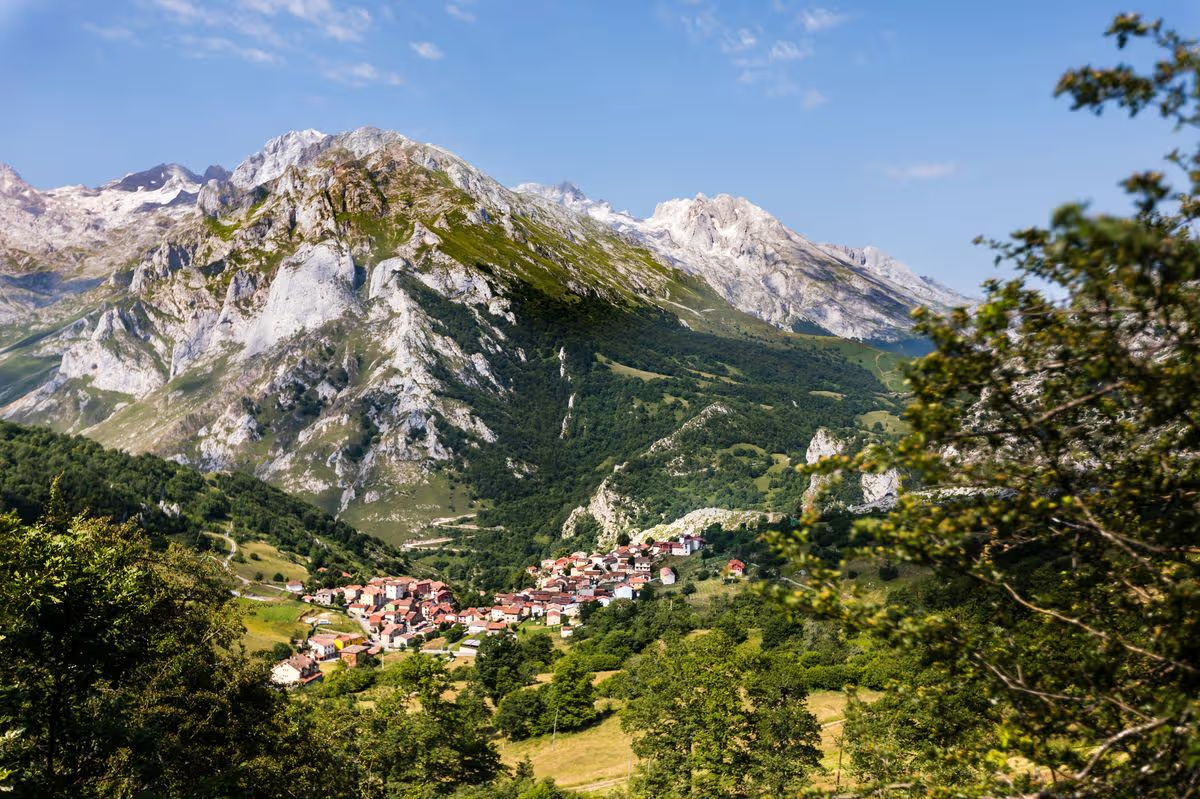
The Picos de Europa is in Spain and located just over 12 miles from the coastline(Image: Manuel ROMARIS via Getty Images)
The world is brimming with extraordinary destinations to discover, and pinpointing the most stunning is no easy feat, but Time Out has tackled the task.
The publication recently unveiled a list of the 51 most beautiful places in the world, featuring everything from lakes to beaches, National Parks, libraries, vineyards, and historic towns. Yet, claiming the number one position is a breathtaking mountain range that provides remarkable hiking opportunities, and it’s merely a two-hour flight from the UK.
The Picos de Europa in Spain is a striking, rugged limestone mountain range that soars to a height of 2,650 metres. Located just over 12 miles from the coastline, the mountains ascend steeply, forming deep gorges to discover, reports Express.
One route, the Cares Trail, ranks among the most sought-after walks in Spain, tracing a canyon and passing through craggy peaks and cascading waterfalls.
Spanning 13 miles in total, it’s not suitable for novices, though its gentle inclines make it achievable for walkers who can manage the distance. A straightforward choice is to board the Fuente Dé cable car, whisking you up the mountainside in moments and letting you relax and admire the verdant landscape below.
Upon reaching the summit, you can also explore additional hiking trails, including some demanding, steep climbs that provide spectacular vistas.
The mountains form part of the broader Picos de Europa National Park, and this region features the Lakes of Covadonga. These glistening blue waters are encircled by peaks and vegetation and resemble landscapes you’d encounter in Scotland or the Lake District, making it difficult to believe you’re in Spain.
This protected national park is abundant with wildlife, including brown bears, wolves, vultures, and eagles, and you’ll probably encounter mountain goats and vibrant butterflies amongst the limestone surroundings.
At the foot of the mountains, you can discover towns like the medieval Potes, brimming with centuries-old stone and half-timbered buildings and cobbled streets that lend it a rustic allure.
The town’s centrepiece is the Torre del Infantado, a 15th-century tower once the residence of medieval royalty, now a museum with a rooftop terrace providing sweeping views of the town.
Arenas de Cabrales on the park’s periphery is another favoured spot to stay. It’s renowned for producing Cabrales cheese, and has evolved into a gastronomic hotspot due to its plethora of acclaimed restaurants serving Northern Spanish cuisine.
Don’t expect to find paella on the menu. In this region, the dishes are hearty and rustic, such as bean stews and grilled meat, with ingredients sourced locally from the mountains.
The Picos de Europa is just under two hours from Santander Airport, and is serviced by airlines including Ryanair. Routes from the UK to Santander operate year-round from Edinburgh and London-Stansted, and seasonal flights operate from Birmingham and Manchester. Flights start from just £15 one-way and take 2 hours from the UK.
Got a story you’d like to share? Drop us an email at webtravel@reachplc.com
JUNEAU, Alaska — The tiny Alaska Native village of Beaver is about 40 minutes — by plane — from the nearest city. Its roughly 50 residents rely on weekday flights for mail and many of their basic supplies, including groceries and Amazon deliveries of everyday household items.
Air service plays an outsize role in the nation’s most expansive state, where most communities rely on flights for year-round access. Planes also play a crucial role in elections, getting voting materials and ballots to and from rural precincts such as Beaver and delivering ballots for thousands of Alaskans who vote by mail — some in places where in-person voting is not available.
The vast distances and relative isolation of so many communities make Alaska unique and are why its residents have a significant interest in arguments taking place Monday before the U.S. Supreme Court.
Many here worry that a case from Mississippi challenging whether ballots received after election day can be counted in federal elections could end Alaska’s practice of accepting late-arriving ballots. Alaska counts ballots if they are postmarked by election day and received within 10 days, or 15 days for overseas voters in general elections.
“These processes have been in place for a long time just to ensure that our ballots are counted,” said Rhonda Pitka, a poll worker and first chief in Beaver, which sits along the Yukon River 110 miles north of Fairbanks.
If the court decides ballots in all states must be received by election day, she said, “they’ll be disenfranchising thousands of people — thousands of people in these rural communities. It’s just basically saying that their votes don’t count, and that’s a real shame.”
The Supreme Court will hear arguments as the U.S. Senate is debating legislation being pushed by President Trump that would require people to show proof of citizenship to register to vote — an onerous burden for many — and a photo ID to cast a ballot.
Most Republicans argue that the bill is necessary to shore up voting integrity, but Democrats and voting rights advocates — and Alaska Republican U.S. Sen. Lisa Murkowski — contend that it amounts to voter suppression. Studies have consistently shown that voting fraud is exceedingly rare in the U.S., and courts have struck down similar measures after finding they prevented eligible voters from casting ballots.
Some ballots already arrive late
Alaska is one of 14 states that allow all mailed ballots postmarked by election day to arrive days or weeks later and be counted, according to the National Conference of State Legislatures and the Voting Rights Lab. An additional 15 provide grace periods for military and overseas ballots.
But Alaska’s geography, weather and great distances between communities — Alaska is more than twice the size of Texas, the nation’s second-largest state — raise the stakes for voters. The unusual way the state counts its votes also makes a grace period important, advocates say.
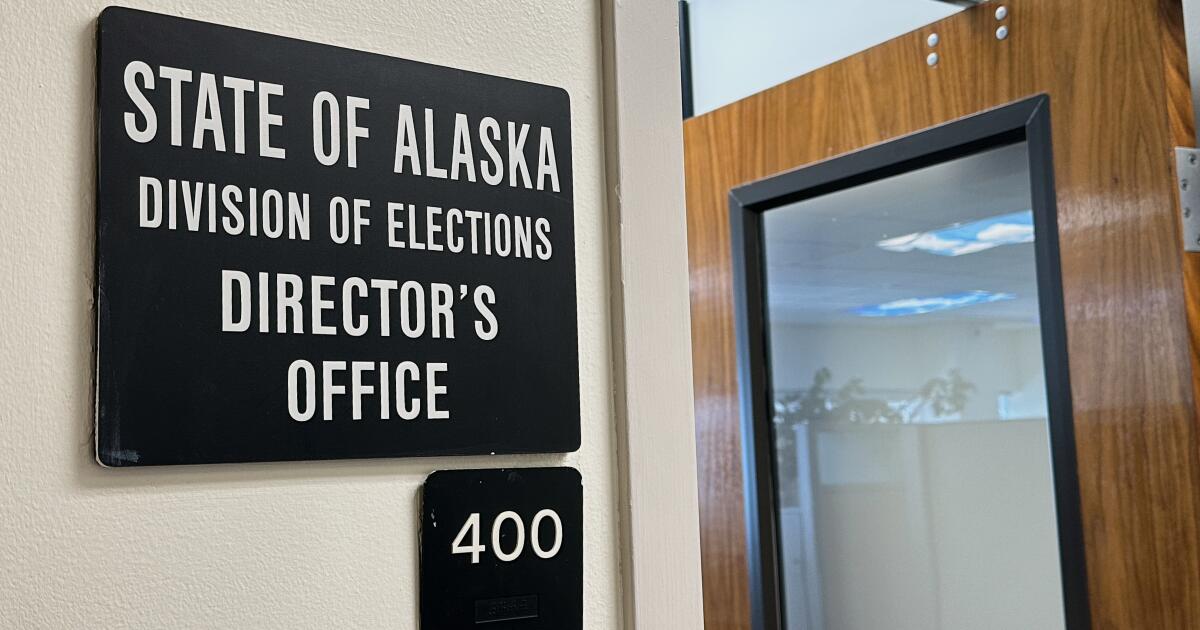
Under Alaska’s ranked-choice system for general elections, workers in small rural precincts call in voters’ first choices to a regional election office. All ballots, however, ultimately are flown to the state Division of Elections in the capital, Juneau. There, the races not won outright are tabulated to determine a winner.
Even with Alaska’s current 10-day grace period, ballots from some villages in 2022 were not fully counted because of mail delays. They arrived too late for tabulations in Juneau, 15 days after election day.
If the Supreme Court rules that ballots cannot be counted if they arrive at election offices after election day, many Alaska voters could be affected. About 50,000 Alaskans voted by mail in the 2024 presidential election.
“I think there’s probably no other state where this ruling could have a more detrimental impact than ours,” Murkowski, her state’s senior senator, said in an interview.
Murkowski sees the case — a challenge by the Republican National Committee and others to Mississippi’s allowance of late-arriving ballots — as an effort to end voting by mail nationwide.
‘Seeing a level of voter intimidation’
The RNC argues that such grace periods improperly extend elections for federal office, but Mississippi responded that no voting occurs after election day — only the delivery and counting of already completed ballots.
Taken together, Murkowski said, the Trump-backed voting bill and the Supreme Court case could discourage people from voting.
“I think we’re seeing a level of voter intimidation, I’ll just say it,” she said. “I feel very, very strongly that the effort that we should be making at the federal level is to do all that we can to make our elections accessible, fair and transparent for every lawful voter out there.”
Alaska’s other congressional members, Rep. Nick Begich and Sen. Dan Sullivan, both Republican allies of Trump who are seeking reelection this year, support the SAVE America Act now before the Senate. But they also said they want to ensure that ballots properly cast on or before election day get counted.
“We’ll see what the courts choose to do on that issue, but I do think that we need to allow for time for ballots to come in from the rural parts of our state,” Begich said during a recent visit to Juneau.
Alaska officials highlight challenges to the court
A court filing in the Mississippi case by Alaska Atty. Gen. Stephen Cox and Solicitor Gen. Jenna Lorence did not take sides but outlined geographic and logistical challenges to holding elections in Alaska.
In Atqasuk, on Alaska’s North Slope, poll workers counted votes on election night in 2024, tallies they would normally relay by phone to election division officials. But the filing said they could not get through and “chose what they saw as the next best solution — they placed the ballots and tally sheets into a secure package and mailed them to the Division, who did not receive them until nine days later.”
The filing seeks clarity from the Supreme Court, particularly around what it means for ballots to be received by election day.
While it is clear when a ballot is cast, “when certain ballots are actually ‘received’ is open to different interpretations, especially given the connectivity challenges for Alaska’s far-flung boroughs,” Cox and Lorence wrote.
Effect on Alaska Native voters
Lawyers with the Native American Rights Fund and Great Lakes Indigenous Law Center said in filings with the court that limited postal service in rural areas means that some ballots might not be postmarked until they reach Anchorage or Juneau, which can take days.
In the 2022 general election, between 55% and 78% of absentee ballots from the state House districts spanning from the Aleutian Islands up the western coast to the vast North Slope arrived at an election office after election day, they wrote. Statewide, about 20% of all absentee ballots in that election were received after election day.
Requiring ballots to be received by election day, they warned, would “disproportionately disenfranchise” Alaska Native voters. The lawyers represent the National Congress of American Indians, Native Vote Washington and the Alaska Federation of Natives.
Michelle Sparck, director of Get Out the Native Vote, a nonpartisan voting rights advocacy group affiliated with the Alaska Federation of Natives, worries about creating confusion and fear among voters.
She sees the case before the Supreme Court and the Republican SAVE Act as “a multipronged attempt to take control or wrest control of elections away from states.” Alaska, she said, already has enough inherent barriers for many voters.
“There is a minute record of election fraud — not at the rate that requires this heavy-handed response through the legislature and the Supreme Court,” she said.
Shai Gilgeous-Alexander enjoyed another 40-point night as the Oklahoma City Thunder beat the Orlando Magic 113-108 to become the first NBA team to secure a play-off berth.
The 27-year-old Canadian went 14 from 27 from the field as he extended his record of most 20-point games in a row to 129.
Chet Holmgren added 20 points and 12 rebounds as the Western Conference leaders claimed a ninth straight win to improve to 54-15 for the season.
“We got off to a good start but then the car kind of came off the road for a little bit,” reigning NBA Most Valuable Player Gilgeous-Alexander said.
“But that’s what great teams do – they figure out a way to get the car back on the road, they figure out a way to go into a building and win a game when the chips are stacked against you, and we did that tonight.”
San Antonio Spurs remain second in the West after a comfortable 132-104 win over the Sacramento Kings, while the Minnesota Timberwolves beat the Phoenix Suns 116-104.
In the Eastern Conference, the Detroit Pistons handed the Washington Wizards a 13th straight loss to strengthen their position at the top.
But the 130-117 triumph was marred by an injury to star point guard Cade Cunningham, who had to leave the game in the first quarter with a back issue.
The New York Knicks stay third in the East after a thumping 136-110 win over the Indiana Pacers, a 14th consecutive loss leaving last year’s NBA Finals runners-up 15-54 this term.
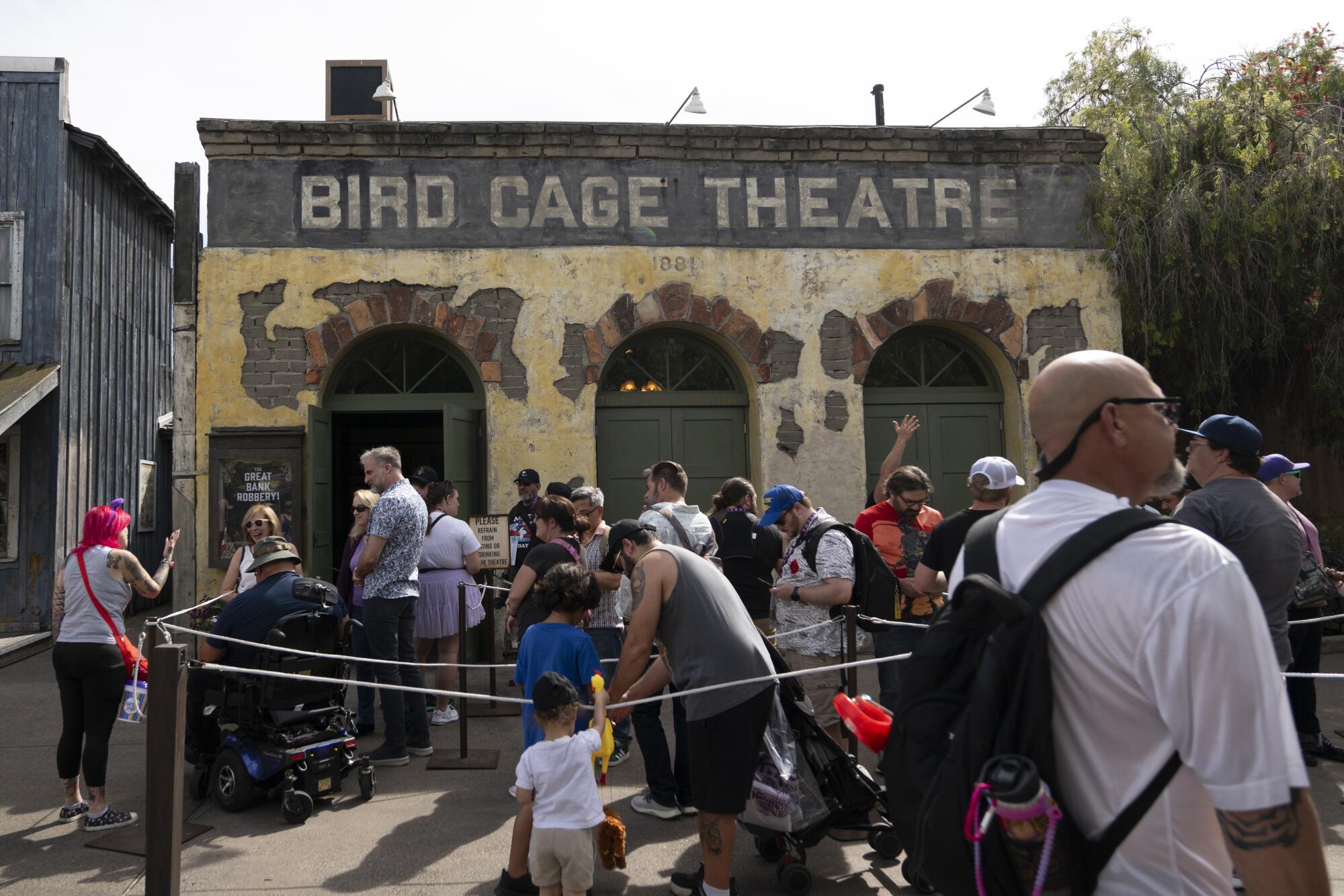
The Bird Cage Theatre has stood inside Knott’s Berry Farm for 72 years — albeit not always soundly. Long framed by a tin roof and a tent, the theater had a reputation for discomfort, as it was a source of punishing heat and the occasional mouse sighting.
“It was hot, it stunk and it was dirty,” says Payden Adams, the park’s VP of entertainment.
Still, though it has long felt like an endangered species, the Bird Cage Theatre is one of Southern California’s most historic revival houses, a place for vaudeville-style, fourth-wall-breaking shows that deviate from the expected theme park fare. To quote the theater’s most recent production, its entertainment can be “flirtatious and a little bit saucy.”
Knott’s Berry Farm’s Bird Cage Theatre is modeled after a historic venue in Tombstone, Ariz.
(Kyusung Gong / For The Times)
Opened in 1954, the Bird Cage Theatre has specialized in vaudeville-style melodramas.
(Knott’s Berry Farm)
And now, against all odds, the Bird Cage is getting a second life. Knott’s Berry Farm recently completed a renovation designed to keep it thriving for another 72 years. Gone is the tarpaulin roof: The Bird Cage is now a fully enclosed, soundstage-like structure. And blessedly, it has modern air conditioning.
The theater reopened this past weekend with “The Great Bank Robbery,” a 30-minute-plus show in which audiences are encouraged to boo, hiss and swoon over the characters, a Bird Cage tradition since 1954. Characters are caricatures, be it a villain that feels plucked from a cartoon western, complete with a purring raccoon for a sidekick, to a greedy wannabe politician of a bank manager. Though set in Ghost Town with period garb, there are modern flourishes, such as tongue-in-cheek nods to the theme park’s attractions and a damsel in distress who ultimately proves to be anything but.
Though it once operated as a daily theater, the Bird Cage is today most active during holidays and seasonal events, such as the park’s annual Boysenberry Festival, which also began this weekend. Popular summer show “Miss Cameo Kate’s Western Burle-Q- Revue” is a 20-minute cabaret-style performance, complete with a torch song and a slightly risqué cancan finale.
When it’s running, the Bird Cage is a must-see attraction. Live theater in theme parks can feel like a moving target, as conventional wisdom often argues that today’s smartphone-addled guests are after thrills and more attention-grabbing, interactive experiences. But when it works, such as during the over-the-top silliness of “The Great Bank Robbery,” or at Universal Studios’ “Waterworld”-themed stunt show, it can offer guests some of the most memorable, personal moments at the parks.
The Bird Cage Theatre reopened this past weekend with the show “The Great Bank Robbery.”
(Kyusung Gong / For The Times)
“You’re not wrong, especially when it comes to attention spans. We experience that,” says Adams, who oversaw the theater’s restoration. “The way we’ve pivoted and navigated is just ensuring our shows are tight and clean. It might be a little over 30 minutes, but audiences are engaged. In melodramas, we ask the audience to participate, and we can train them how to participate beforehand. When you see characters, even when they’re heightened or over-the-top, people still connect with them.”
The Bird Cage Theatre first opened in the summer of 1954, its facade a near-replica of the original Bird Cage in Tombstone, Ariz. That the family-focused Knott’s would nod to the Arizona locale is an oddity in and of itself, as the actual theater had a bawdy reputation. Stories today speak of a place that initially opened with grand ambitions but eventually succumbed to gambling and prostitution.
At Knott’s, the theater was built around existing structures, although park founder Walter Knott, according to the book “Knott’s Preserved” by Chrstopher Merritt and J. Eric Lynxwiler, often talked about completing it as a full tribute to the Arizona space. That never really happened.
Knott’s re-created the original wallpaper of the Bird Cage Theatre for its remodeling.
(Kyusung Gong / For The Times)
And yet over the years the Bird Cage won over audiences thanks to programming from Vaudeville veterans. Early on, students from nearby colleges would appear at the space, including Steve Martin, whose signed photograph graces a celebrity wall in the Bird Cage’s introductory hall. Donna Mills and singer Rick Nelson have graced the Bird Cage’s horseshoe-shaped stage, as have Dean Jones and Skip Young.
It was, to say the least, a quirky place to perform. “Knott’s Preserved” tells of a show in which a mouse once sat at the base of the stage, and quotes Martin as reminiscing over performances affected by the weather. “When it rained, no one could hear each other because the rain was beating so hard on that tarp,” Martin said.
None of that should be a problem anymore, although returning guests will likely feel they’re in a familiar space. Though the Bird Cage has been outfitted with modern lighting capable of new theme park tricks and projections, the rig is hidden among curtains designed to re-create the look of the original tent. Lights, in bird cage enclosures, still hang above the audience seating area, which has room for about 250 guests.
The Bird Cage Theatre at Knott’s Berry Farm now has a properly enclosed roof and air conditioning.
(Kyusung Gong / For The Times)
And along the way a few discoveries were made. Adams says that when they began stripping away wooden walls added sometime in the 1970s, they found the Bird Cage’s original wallpaper, a scarlet-red strip that surrounds the space with flower-adorned bird cages. Not all of it could be salvaged, so Knott’s meticulously re-created the look. With the new-old wallpaper intact, Adams estimates that guests can count about 11,055 bird cages throughout the theater.
The original pieces will be preserved in the park and gifted to important Bird Cage players. Adams jokes, “If you have a mailing address for Mr. Steve Martin, I have a gift to send him.”
Go out? In this economy? We get it, and we’re with you. But the city’s vibrant offerings still beckon — and many of them can be experienced for less than an Erewhon Malibu Mango Smoothie.
AUSTIN, Texas — “The Sun Never Sets” is filmmaker Joe Swanberg’s 10th indie to premiere at SXSW but his first to play the event since 2017. The astonishing pace with which he made his early work — loose, idiosyncratic stories that were progenitors of the emergent style known as mumblecore — has slowed significantly, but also given way to a newfound maturity as both a person and an artist.
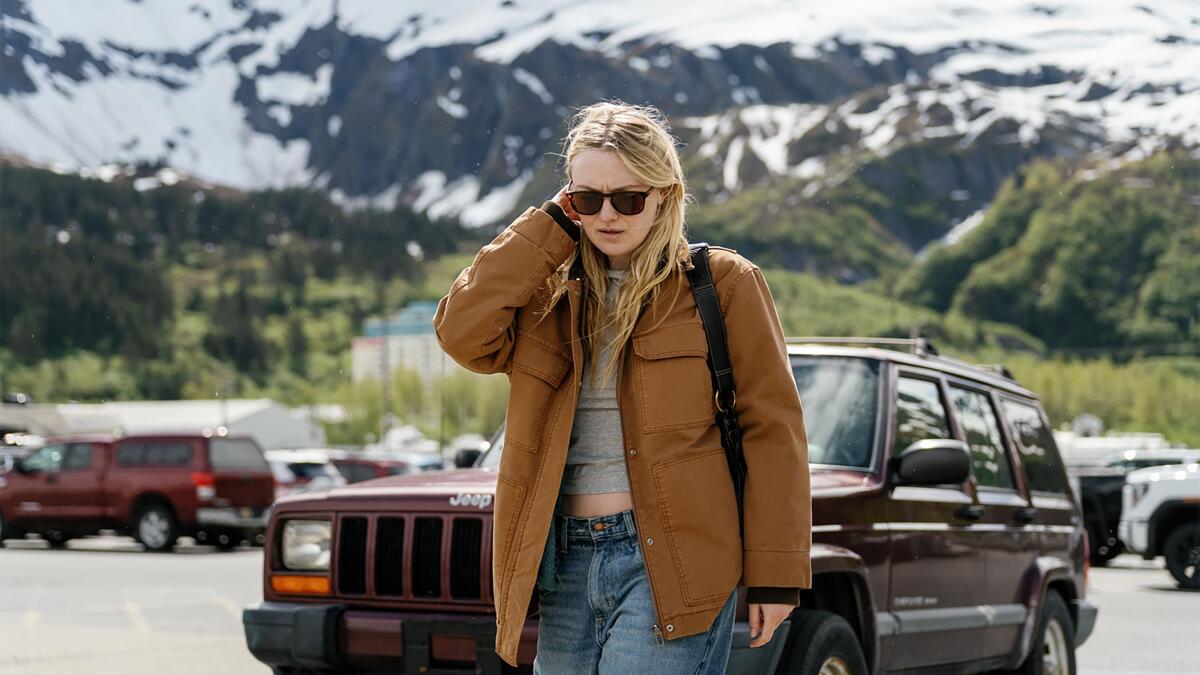
Introducing “The Sun Never Sets” at its world premiere on Friday night to a sold-out crowd at the Zach Theater, Swanberg called his latest “my favorite film I’ve ever made.” Shot on 35mm in Anchorage, the movie follows a 30-ish woman, Wendy (Dakota Fanning in a vibrant turn), torn between pursuing a fresh romance with a reckless old flame (Cory Michael Smith) or continuing on with the settled-in-his-ways divorced father of two (Jake Johnson) she’s been seeing for a few years.
Dakota Fanning in Joe Swanberg’s “The Sun Never Sets,” filmed in Alaska.
(SXSW)
“I guess this is what they tell you about getting older and doing this job longer,” said a thoughtful Swanberg in a video interview from his home in Chicago shortly before the South by Southwest festival. “You get better at it and you sort of mature and all of this.”
The film marks Swanberg’s fourth collaboration with Johnson, a partnership that goes back to 2013’s “Drinking Buddies.” (The actor partly financed the new project along with his brother.) Following completion of the third season of the Netflix anthology series “Easy” in 2019, for which he wrote and directed all the episodes, Swanberg was planning to take a break. A divorce and the pandemic caused that pause to grow even longer.
In the intervening years Swanberg produced a number of projects for other filmmakers, did some acting and opened a small video store in Chicago. Swanberg knew Anchorage-based producer Ashleigh Snead, who encouraged him to consider shooting something there. The scenic location would give Swanberg the opportunity to expand his visual style from his usual couches, bars and apartments of much of his work. (There still are a surprising number of scenes on couches and in bars.)
“Joe’s a real filmmaker,” says Johnson in a separate interview. “And I think sometimes he doesn’t get that credit because he can make movies with nothing. This is a real adult movie. This is a film about how complicated breakups are and how messy they get. And it’s in beautiful Alaska.”
Swanberg, center, on the set of “The Sun Never Sets.”
(SXSW)
Swanberg has now gone from someone making talky, provocative and at times controversial films about the lives of post-collegiate 20-somethings to exploring the nuances and specifics of being a 44-year-old divorced father of two still trying to figure out his place in the world. His original cohort of SXSW-affiliated filmmakers, many of whom also fell under the rubric of mumblecore — nobody much liked the name, but no one ever came up with anything better, so it stuck — included Greta Gerwig, Lena Dunham, Barry Jenkins, Ti West and others who have gone on to more conventional mainstream success.
But Swanberg doesn’t seem to feel left behind. Rather, he only sees doors opening.
“It’s gone so much better than I thought it was going to go for me,” he says. “I mean, when I was making these really tiny, sexually explicit 71-minute movies, I was like, I’m just grateful to be here. I can’t even believe these festivals are showing this work and it’s so cool that there’s a space for me in this ecosystem.
“And so to watch my friends go off to do these giant movies, to see Greta doing ‘Barbie’ and stuff like that, to me it just opens up the possibilities,” he adds. “Each time a friend of mine sets some new record or moves into some new space, I’m kind of like: Oh, that just opened up for all of us now.”
His earlier work often featured raw sex scenes, sometimes featuring Swanberg himself. From practically the start of his career, well predating the #MeToo-era reckoning that began in 2017, Swanberg weathered accusations that he was exploitative and manipulative of his female performers. His stepback from productivity coincided with a moment when his explorations of sexual power dynamics fell out of favor. It would be easy to interpret that Swanberg preemptively soft-canceled himself to avoid a broader scandal. He doesn’t see it that way.
“Certainly in Chicago, where I’ve spent the last five years, I’m not unwelcome places,” he says, drawing a distinction between himself and “people who lose jobs or are capital-C canceled. But also my work has always pushed those boundaries and always attracted some amount of positive and negative attention.”
Though “The Sun Never Sets” has numerous kissing scenes, it doesn’t go too much further than that.
“I won’t do it,” Johnson says of more graphic scenes. “When I worked with Joe early on, I was like, ‘I love you, man — I’m not doing this.’”
For her part, Fanning had no reservations about working with Swanberg. He offered both Fanning and Smith the opportunity to work with an intimacy coordinator, but neither felt it was necessary.
“There was no planet where you’d ever be asked to do anything you were uncomfortable with,” Fanning says. “If there was ever a moment like, ‘I don’t want to do that,’ he’d be like, ‘Oh, then let’s not.’ There was a day where there was a scene and it was pouring rain outside. And we both looked at each other and he was like, ‘We’re not going to do it. The scene’s cut.’ He’s just open. And I just trusted him implicitly.”
Jake Johnson and Dakota Fanning in the movie “The Sun Never Sets.”
(SXSW)
Swanberg has long worked in an unusual style in which the script is essentially a detailed outline and the actors work to come up with their own dialogue during rehearsals. For “The Sun Never Sets,” Swanberg and Johnson developed the longest, most complete outline Swanberg has ever used, including some dialogue exchanges. Then the actors were allowed to make it their own.
Fanning recalled an early Zoom call with Swanberg and Johnson on which they explained the process.
“It’s still made like a real film,” Fanning says. “And Jake and Joe promised it’s not like we’re just flying by the seat of our pants: ‘You will know what to say, I promise.’ And then friends that know me asked, ‘Are you so nervous?’ And I was, but for some reason, I don’t know why, I just knew that it was going to be fine. And that just proved to be true.”
Even though it takes places in Anchorage, Swanberg calls “The Sun Never Sets” “extremely personal.”
“I was definitely writing a movie about a divorced mid-40s guy dating a younger person,” he says. “The questions of marriage and having children were sort of an amalgam of two real relationships that I merged into one onscreen.” He describes the material as “questions that I had and have about what my own relationships are going to look like post-divorce.”
That comes through in Fanning’s rich, layered performance, which might rank among the best of her already lengthy career. Swanberg’s style draws both an ease and an intensity from Fanning, who captures a woman at a pivotal moment of figuring out what she wants amid the emotional whirlwind she is going through. (At the film’s premiere, Fanning said, “I’ve never put so much of myself into a role before.”)
“I think the goal of Joe’s films, and I think at least my goal with this film, is trying to make everything feel real,” she says. “Things are just a mess some of the time.”
Dakota Fanning and Cory Michael Smith in “The Sun Never Sets.”
(SXSW)
Swanberg himself appears in a small role as the new husband of the ex-wife of Johnson’s character. And the characters of the two kids in the movie are named after the director’s own children. With a newfound maturity and emotional depth, Swanberg is continuing to make movies that are part diary, part generational markers.
“It’d be really cool in my 40s to make movies about characters in their 40s,” he says, “and in my 50s, 60s and 70s. It’d be neat to be making sexually explicit movies about 70-year-olds in their dating lives and sex lives and stuff. It’s really exciting to have movies about characters at this phase of their life, whether they’re finally settling down in their 40s or whether they’re getting out of relationships and reexamining their life. It’s where my head is at.” .
Bruno Fernandes reaches 100 assists in all competitions after setting up two goals in crucial 3-1 win over Villa.
Manchester United bolstered their bid to qualify for the Champions League with a vital 3-1 win against top-four rivals Aston Villa.
Michael Carrick’s side took the lead through Casemiro’s second-half opener at Old Trafford on Sunday before Ross Barkley hauled Villa level.
Recommended Stories
list of 4 itemsend of list
United finished strongly with Matheus Cunha and Benjamin Sesko scoring in the closing stages to seal Carrick’s seventh win in nine games since taking over as interim boss.
Sitting third in the Premier League, United are three points clear of fourth-placed Villa in the race to reach the Champions League via a top-four finish.
United co-owner Jim Ratcliffe this week praised Carrick’s “excellent” work but stopped short of committing to the former Old Trafford star on a long-term basis.
However, Carrick is making a strong case to earn the job on a permanent basis after stabilising United after Ruben Amorim’s sacking.
United’s latest victory came after an 11-day break since the first defeat of his reign at Newcastle, and Carrick celebrated with a jig of delight on the touchline after Sesko wrapped up the points.
Spluttering Villa have lost their last three league games and have just one win in seven top-flight matches, leaving them three points above fifth-placed Chelsea with eight games left in the battle for European places.
After a lethargic first half, United finally prised open the Villa defence in the 53rd minute.
Bryan Mbeumo’s stinging strike was palmed away by Emiliano Martinez, earning a corner that brought the opener.
Bruno Fernandes curled a corner to the near post, and Casemiro made a perfectly timed run to glance a header past Martinez.
With Casemiro likely to leave when his contract expires at the end of the season, United fans serenaded the Brazilian midfielder with chants of “one more year”.
United lost focus and surrendered the lead in the 64th minute.
In his first Premier League start for 14 months, Barkley slammed a superb strike past Senne Lammens from 11 metres (12 yards) after United failed to clear the danger.
But Cunha netted in the 71st minute to ensure Carrick’s men did not pay for their stumble.
Bursting onto Fernandes’s sublime pass into the Villa area, the Brazilian forward slotted a fine finish into the far corner.
It was Fernandes’s 16th Premier League assist this term, moving the United captain past David Beckham’s previous club record of 15 in 1999-2000.
He has 100 assists for United in all competitions since signing from Sporting Lisbon in 2020.
Sesko came off the bench to prove a point to Carrick after being dropped, and the Slovenian striker fired home with a deflected effort in the 81st minute.
Fernandes said he was delighted to provide two assists for his teammates to move past Beckham’s record.
“I’m more proud and pleased because I did it serving my teammates. Giving joy to others is also very good,” he said.
“When you play in the position I play, I’m very happy I can help them to score and be happy in that moment. It’s a huge achievement for me, but the main achievement would be in the top spot at the end of the season.”
Elsewhere, Nottingham Forest climbed out of the relegation zone after a 0-0 draw against Fulham at the City Ground.
Still waiting for their first win under Vitor Pereira, fourth-bottom Forest, who have had four managers this term, are above third-bottom West Ham on goal difference.
Ten-man Leeds held on for a 0-0 draw at Crystal Palace despite Dominic Calvert-Lewin’s missed penalty and a red card for Gabriel Gudmundsson.
Later on Sunday, troubled Tottenham head to Liverpool with only goal difference keeping them outside the relegation zone.
I SKULK swiftly through the labyrinth of shrubs. The grass is so tall it strokes my shoulders with each stride.
Fresh dung and paw prints in the sandy pastures point to South Africa’s most famous mammals lurking nearby — but they stay hidden.
Sign up for the Travel newsletter
Thank you!
Spot the ‘big five’ of lions, leopards, buffalo, rhino and elephantsCredit: SuppliedWe had to pull to a halt for a lion sleeping in the roadCredit: Supplied
Suddenly, among the chorus of bird call, a rustle and a huff from the nearby shrubs sends adrenaline surging through me.
My feet spring into action before my brain, as I pelt in the opposite direction, following the urgent calls of my rifle-carrying guide.
We had found ourselves mere metres from two wild buffalo, part of the elusive Big Five and one of Kruger National Park’s deadliest animals.
In the east of South Africa and arguably the most famous park for safari in the world, Kruger is celebrating its 100th anniversary this year.
That’s in part thanks to the committed rangers, who are continually working on the park’s infrastructure and a fierce anti-poaching programme.
And their work meant my chances of spotting wildlife hadn’t been diminished.
In fact, within 24 hours of checking into Rhino Walking Safaris’ Plains camp, I ticked off the Big Five — lions, leopards, buffalo, rhino and elephants — almost twice over.
Lounge area at Rhino Walking Safaris’ Plains CampCredit: Photo: Roger de la Harpe/Africa ImageryMdluli Safari Lodge tents have aircon and wifiCredit: mdlulisafarilodge.co.za
Full credit goes to the guides accompanying me, James and Orance, who know precisely how to spot clues, including claw marks on trees, with their hawk-like eyes.
Earlier that day, we had pulled to a halt for a lion sleeping in the road.
He was within touching distance.
Not that you’d risk extending an arm beyond the truck.
You have a greater chance of a lion fleeing than attacking, though.
Out in the bush with guidesCredit: Photo: Roger de la Harpe/AfricaThe Sun’s Sophie on safariCredit: Supplied
Guide James tells me the Kruger lions are used to seeing trucks of humans.
They’re still very much wild, but they generally feel safe in our presence, which makes for spectacular observing — that’s if you manage to spot one (more tips on that).
Next it was hippos braving dry land after the blistering heat had subsided, an agile leopard creeping through the long grass, then elephants shaking the last of the green fruit from the branches of a Marula tree.
Smiling broadly, I returned to my luxury safari tent, which featured wooden twin beds, a private bathroom with a shower head that dangles from a tree branch and a large decking area from which you can lazily watch wildlife, beyond the small electric fence.
Rhino Walking Safaris owns a 12,000 hectare private concession within Kruger and its Plains camp is near a popular watering hole, so the chances of spotting creatures even during downtime is high.
Buffalos, a wildebeest named Steve, baboons, and even a duo of young rhinos called by.
With only four tents and no wifi, strangers become friends and you’re wholly immersed in the experience.
The real highlight for me, however, was the morning walks.
A 4.45am alarm may sting, but observing the misty pink sunrise from beyond a buffalo’s resting place makes it all worthwhile.
There’s something magical about safaris on foot, treading the same path as the animal you’re tracking, away from all things man-made and with the exhilaration of imminent danger.
Guides carry rifles, although they’re so knowledgeable about the creatures around us, they’ve never had to fire them.
Morning walks come with snacks and coffee, followed by a brunch feast at camp, a few hours of downtime and high tea.
Then it’s the afternoon game drive with sundowners (in my case a healthy pouring of gin), an 8.30pm three-course dinner back at camp and 10pm stargazing — or bedtime for those whose eyes are too weary.
A leopard spotted in Kruger National ParkCredit: GettyGiraffes take a stroll in the parkCredit: Getty
Exhaustion is combatted by sheer adrenaline, but there are also plenty of less rural camps offering more laid-back itineraries where lazy mornings can be enhanced by spa treatments or dips in the pool.
Mdluli Safari Lodge, on the western periphery of Kruger, has a spectacular infinity pool overlooking a watering hole.
The very large safari tents, of which there are 50, are raised on stilts and come with greater levels of creature comforts such as aircon, plugs in rooms, internet access and a swinging egg chair on the decking.
Choice of game drives is plentiful. You can head out at pretty much any time of day, on short sunset safaris or day-long drives.
We even managed to squeeze in a final early sunrise ride before our transfer to the airport, admiring a mob of dwarf mongoose rustling at the edge of the road.
Before heading home or ahead of your safari, a day in Johannesburg is worthwhile.
Holidaymakers travelling from the UK will fly into this city and it’s a poignant area for delving into South Africa’s troubled past.
June 2026 marks 50 years since the brutal killing of Hector Pieterson, a 12-year-old schoolboy, who was shot by police during the Soweto student uprising.
You can learn all about this tale, and the apartheid regime, on a tuktuk tour with Lebo’s Soweto Backpackers (£35pp, sowetobackpackers.com).
We rolled through modern-day communities and old hostels, before passing Nelson Mandela’s former home, now a museum.
It’s a humbling experience.
Top it with a ride through untrodden pastures with the Big Five for an adventure of a lifetime.
Watching a David Attenborough documentary back in the UK, I feel a little smug.
A TV screen can’t quite capture that magic.
GO: KRUGER, S AFRICA
GETTING THERE: British Airways flies from Heathrow to Johannesburg from £598pp return.
STAYING THERE: Two-person tents at Rhino Walking Safaris Plains Camp start from about £422pp per night, with a minimum stay of two nights, including all meals, walking safaris and game drives.
1. BRING LOTS OF CLOTHES: You’ll sweat a lot and clothes get grubby on both walks and game drives because of the dust. I often changed outfits twice a day.
2. EARTHY COLOURS: When you’re in the truck, it really doesn’t matter what you wear – although bring a fleece or jacket, even in summer, as it gets chilly. On walks you should wear neutral, earthy tones like beige, green or brown – no whites or brights. And don’t worry about buying chic or stylish garments for walks; comfort is key.
3. WAKE UP FOR THE EARLY SAFARIS: Even if you’re knackered and desperate to stay in bed, those early-morning game drives or walks are some of the most spectacular. This is when a lot of animals come out and some of the sunrises were even more impressive than the sunsets.
4. IGNORE THE WEATHER FORECAST: The Met Office and BBC Weather forecast rain for every day I was in Kruger. Yet it didn’t rain once. It’s best to come prepared for all eventualities – rain jacket, shorts, trousers and binoculars.
5. CASH FOR TIPS: Bring more than you think you’ll need. If you run out of money, it’ll be a struggle to get more and gratuities, although not always expected, are very common. We tipped our guides 200-250 rand per day. You’ll likely want to tip other staff too, such as cooks, cleaners and waiters.
6. BRING THE RIGHT EQUIPMENT: Worldwide adaptors rarely work in South Africa – the sockets aren’t common. So order one online before you go and make sure to pack a battery pack if you plan to use your phone to take pictures and videos.
7. DON’T SELF-DRIVE: Self-drives are popular in Kruger and do give you a greater level of independence, but if you’re going for the first time, you’ll see heaps more with the help of a guide. These guides are experts and are connected with all the other guides in the area so will be first to hear of a sighting. They live on site so know exactly where certain herds rest.
8. BRING EARPLUGS: Remember, you’re in the wild, so if you’re a light sleeper, ear plugs are a must. I thought it would be sleep-inducing listening to the hum of animals at night. They were much louder than expected and I was woken up several times by a relentless owl.
9. DON’T JUST CHASE THE BIG FIVE: Everyone likes to say they’ve seen them, but some of my most magical experiences were with creatures I’d never heard of. Even the trees and flora we spotted were fascinating, as were the birds.
10. CHOOSE YOUR STAY WISELY: Camps have their own guides – and each guide or ranger varies in skill and expertise. Do your research and try to book a camp where two guides accompany you on safari as opposed to one – double the people means double your chances of spotting wildlife. We’d met people who were yet to spot a single one of the Big Five in a week, but we’d seen them all in a day and that’s thanks to our guides.
Despite morale-sapping staff layoffs, bizarre executive orders and a 43-day federal government shutdown last fall, the grandeur and serenity of national parks in California remain irresistible to outdoors lovers looking to unwind.
The nine national parks in the Golden State — including Yosemite, Death Valley and Joshua Tree — attracted nearly 12 million recreational visits in 2025, according to statistics from the National Park Service.
That’s up more than 800,000 visits from 2024 and up more than 300,000 from the previous record set in 2019, according to the data, which stretches back to 1979.
Nationally, visits were high, at 323 million, but down a couple of percentage points from the record set in 2024, according to a park service press release.
“America’s national parks continue to be places where people come to experience our country’s history, landscapes and shared heritage,” said Jessica Bowron, acting director of the NPS.
“We are committed to keeping parks open, accessible and well-managed so visitors can safely enjoy these extraordinary places today and for generations to come,” Bowron added.
President Trump’s critics beg to differ.
Since Trump resumed office in January 2025, his administration has slashed the NPS workforce by nearly a quarter, buying out or laying off hundreds of rangers, maintenance workers, scientists and administrative staff across the country.
And last year, as part of his war on “woke,” Trump instructed the park service to scrub all signs and presentations of language he would deem negative, unpatriotic or smacking of “improper partisan ideology.”
He also ordered administrators to remove any content that “inappropriately disparages Americans” living or dead, and replace it with language that celebrates the nation’s greatness.
That gets tricky at places such as Manzanar National Historic Site in the high desert of eastern California — one of 10 camps where the U.S. government imprisoned more than 120,000 Japanese American civilians during World War II.
It’s also hard to dance around disparaging details at Fort Sumter National Monument, where Confederates fired the first shots of the Civil War; Ford’s Theater National Historic Site in Washington, D.C., where Abraham Lincoln was assassinated; and Martin Luther King Jr. National Historic Park, which commemorates the assassination of the country’s best known civil rights leader.
“This administration is actively erasing the history, science and culture that our national parks protect,” said Emily Douce, deputy vice president for government affairs for the nonprofit National Parks Conservation Assn.
Douce argued that morale among staff at the parks — a string of 63 federally protected natural wonders often described as “America’s best idea” — has never been lower.
But the fact that employees still showed up, including without pay during last year’s federal government shutdown, demonstrates their commitment to keeping the beloved parks flourishing.
“The enduring popularity of America’s national parks is not surprising,” Douce added. “What’s shocking is this administration’s relentless attacks on these places and their caretakers, which threatens their future.”
The White House did not immediately respond to a request for comment.
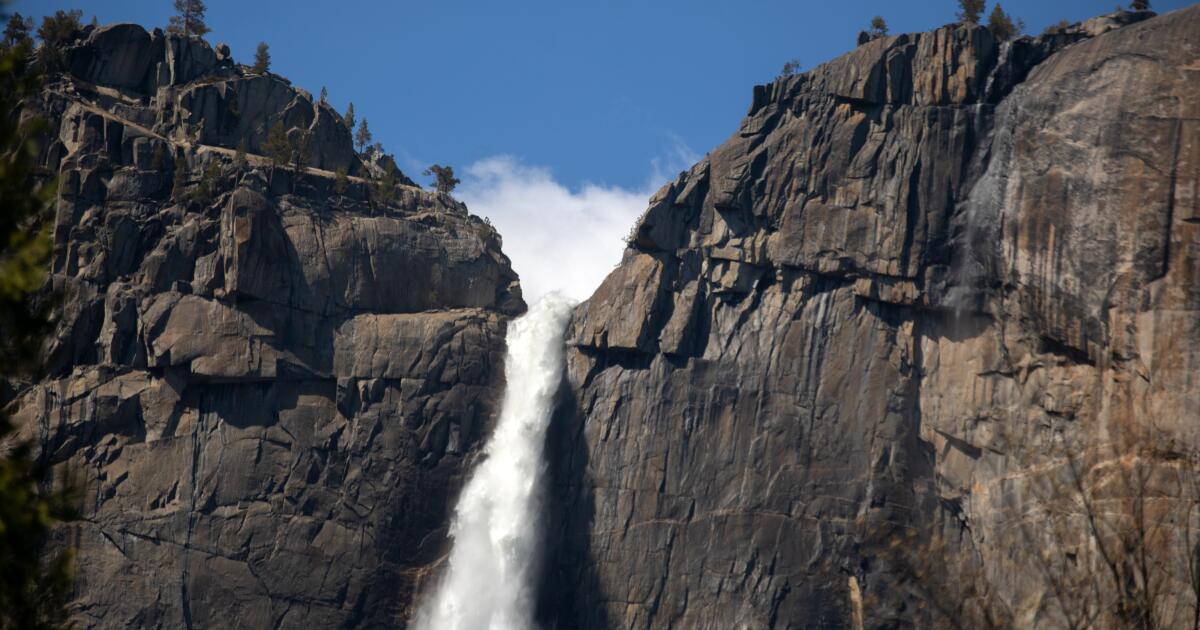
The National Park Service is routinely ranked among the most admired branches of the large and sprawling federal government. Even Americans who have never watched a minute of C-SPAN, or get a little lost in the alphabet soup of other agencies, will probably never forget standing in Yosemite Valley and admiring a towering waterfall.
There were 4.3 million visits to Yosemite in 2025, 2.9 million to Joshua Tree and 1.3 million to Death Valley, according to the data.
The 323 million visits to America’s national parks in 2025 are more than twice the attendance — 135 million — at professional football, baseball, basketball and hockey games combined.
Of course, it’s a lot cheaper to get into a park. U.S. residents pay between $20 and $35 per vehicle for a day pass, or $80 for an annual pass. The Trump administration recently raised the annual fee to $250 for foreign visitors.
National Park Service officials did not respond to emails requesting comment on California’s 2025 attendance.
The UK’s most beautiful places have been ranked and one English spot has particularly impressed thanks to its enchanting scenery and quaint villages
16:30, 13 Mar 2026Updated 16:30, 13 Mar 2026
This article contains affiliate links, we will receive a commission on any sales we generate from it. Learn more
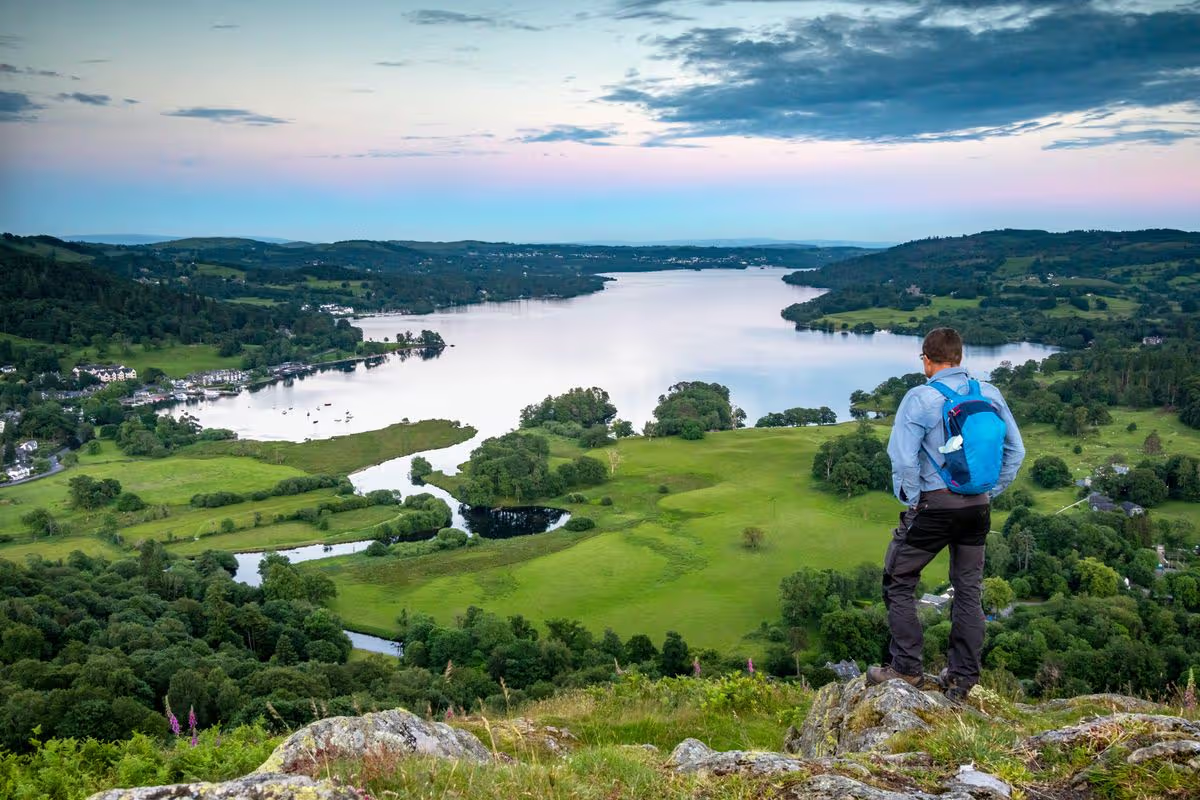
The Lake District is one of the destinations in the top 10 rankings(Image: Getty Images)
A beautiful region full of rolling green hills, lakes with azure waters and charming villages that are the stuff of fairytales has been named England’s most beautiful place for 2026.
The Lake District has long been attracting visitors from around the world, often featuring on rankings of the more scenic spots and picturesque landmarks across Britain. Now, it’s been named one of the UK’s most beautiful places, taking the silver medal in new rankings from Big 7 Travel.
“England’s largest national park, the Lake District, is surely one of the UK’s most beautiful areas,” the team behind the research explained. “Whether it’s grass-covered fells, England’s highest mountain (Scafell Pike), beautiful lakes such as Ullswater and Windermere or quaint towns like Grasmere and Keswick, the Lake District has it all. Perfect for everyone from hikers to swimmers, photographers to artists and more, the Lake District is easily one of the most beautiful places in the UK.”
While it’s hardly a hidden gem, it’s not difficult to see why the Lake District is so popular with tourists. There are plenty of breathtaking lakes to explore in the region – 16 in fact – with popular highlights including the likes of Lake Windemere, Derwentwater and Ullswater which boast a host of water sports facilities and attractions. (Families may particularly want to bookmark the World of Beatrix Potter which brings the stories of Peter Rabbit and his friends to life).
Then of course that lush green landscape is packed with everything from scenic strolls to epic hiking trails, depending on how far you want to cover in your hiking boots. Oh, and the region is renowned for the many, many brilliant pubs where you can warm up by a fire, tuck into a hearty roast and enjoy a well-deserved drink after a busy day of exploring.
As for where to stay, there’s a plethora of accommodation to choose from, with the likes of Sykes Holiday Cottages and Holidaycottages.co.uk both offering up some brilliant options that look like the stuff of storybooks, or if you fancy treating yourself to a hotel stay, TripAdvisor has a handy guide to some of the best cheap Lake District hotels you’ll want on your radar.
Meanwhile, if you’re after more staycation inspiration then you could of course head to the UK’s most beautiful destination in the rankings. That accolade went to the Queen’s View in the Scottish Highlands, a picturesque viewing point that overlooks Loch Tummel. One of its most famous visitors, Queen Victoria, arrived at the site in 1866 and reportedly assumed that the location was named after her. (In reality, It is thought that it was named after Isabella, Robert the Bruce’s first wife, who lived more than 500 years before Victoria’s visit).
Iran’s sports minister said his nation will not participate in this summer’s World Cup following the attacks on the country by the U.S., one of the tournament’s hosts.
The U.S. bombing campaign against Iran, which began two weeks ago, has triggered a region-wide conflict and killed more than 1,300 Iranians including Ayatollah Ali Khamenei, the country’s supreme leader, according to Iran’s U.N. ambassador Amir Saeid Iravani.
“Considering that this corrupt regime has assassinated our leader, under no circumstances can we participate in the World Cup,” sports minister Ahmad Donyamali said on state television Wednesday.
“Our players do not have security, and fundamentally the conditions for participation do not exist.”
Donyamali’s statement came just hours after FIFA president Gianni Infantino said he had received assurances from President Trump that Iran would be allowed to participate in the tournament, which will be played in the U.S., Mexico and Canada.
“President Trump reiterated that the Iranian team is, of course, welcome to compete in the tournament in the United States,” Infantino wrote in an Instagram post. “We need an event like the FIFA World Cup to bring people together now more than ever, and I sincerely thank the President of the United States for his support.”
Last year President Trump signed an executive order suspending visa issurance to nationals of 19 countries, including Iran, although the State Department can make exceptions for “participants in certain major sporting events” such as the World Cup.
Iran, which has played in the last three World Cups, earned its place in this summer’s tournament by dominating its group in the Asian confederation tournament. However it did not send a representation to a World Cup planning summit last week in Atlanta.
Iran was drawn into Group G for the World Cup and is scheduled to begin play June 15 against New Zealand at SoFi Stadium in Inglewood. Iran’s second group-stage game, against Belgium, is also scheduled for SoFi Stadium before the team finishes the first stage of the tournament against Egypt in Seattle.
According to The Athletic, no country has withdrawn from a World Cup after qualifying since the 1950 tournament in Brazil, when India, Scotland, France and Turkey pulled out, mostly over costs and logistical issues.
Donyamali did not say whether he has begun the formal process or withdrawing Iran from the World Cup but FIFA could be facing a time crunch if it had to replace Iran in the 48-team field. Article 6.7 of FIFA’s 2026 World Cup regulations states: ‘If any Participating Member Association withdraws and/or is excluded from the FIFA World Cup 26, FIFA shall decide on the matter at its sole discretion and take whatever action is deemed necessary. FIFA may decide to replace the Participating Member Association in question with another association.”
The most likely replacement scenario would have Iraq, the top non-qualifier from the Asian confederation, taking Iran’s place. Iraq is scheduled to play the winner of a Suriname-Bolivia playoff in Mexico later this month for a final World Cup berth but with airspace over the Middle East closed because of the war, the Iraqis are unsure how they will get to Mexico. Giving them Iran’s berth would solve that problem but it would create another; who would replace Iraq in the playoff against the Suriname-Bolivia winner? Based on the Asian qualifying tournament, the UAE would be the most likely candidate but it, too, would face travel concerns in getting to Mexico.
FIFA could leave those playoffs untouched and give Iran’s spot to Italy, which is ranked 13th in the world but must win a four-team UEFA playoff later this month to qualify for the World Cup. Basically FIFA can do whatever it wants.
FIFA regulations say that any team that withdraws from the tournament “no later than 30 days before the first match” will be fined and could face other “disciplinary sanctions” including expulsion from subsequent FIFA competitions. This summer’s World Cup kicked off June 11 in Mexico City and Toronto. The U.S. opener is scheduled for June 12 in Inglewood.
Earlier this week six members of Iran’s delegation to the Women’s Asian Cup were granted humanitarian visas and allowed to remain in Australia rather than return to Iran where they feared persecution for not singing the national anthem during the tournament.
“undertone,” a muted, personal and static microbudget horror debut by Ian Tuason, takes place in the writer-director’s actual childhood home where he tended to both of his parents before they died. Both hospice and inspiration, it’s a stifling place decorated with floral wallpaper and crucifixes. The pain and exhaustion and grief are so real and oppressive, the camera never dares set a foot outside.
Upstairs, Evy (Nina Kiri), watches over her own terminally ill mother (Michèle Duquet). Tuason funneled his emotional gloom into this movie; Evy co-hosts a horror podcast with her overseas best friend Justin (voiced by Adam DiMarco). “This is the only thing keeping me sane right now,” she says. They’re words she’ll regret within the week.
Kiri and DiMarco have the comfortable, convincing chemistry of two old pals who have done a show for a while. One snippet seems to be an episode on Elisa Lam, the real-life tourist found dead in the rooftop water tank of Los Angeles’ Cecil Hotel. There’s also a reference to a website with a red-faced ghoul who hypnotizes victims into cutting off their ears. The latter may be Tuason seeding his idea for a sequel.
Here the central story is that Justin, who lives in London, has received an email with 10 audio files recorded by a couple named Mike and Jessa (Jeff Yung and Keana Lyn Bastidas) who are trying to understand what she’s saying in her sleep. The sender is unknown. (Possibly an evil spirit hoping for the exposure of a mattress ad?) Justin, the believer, is instantly alarmed by how these eerie tapes escalate from cute banter to ghostly crying babies and backward incantations. Evy is the skeptic who dismisses the noises as either an online hoax or bad plumbing.
Due to the time zone differential, Evy and Justin record their show just before he heads out to work in the morning, which for her is 3 a.m. Most of the movie takes place in that witching-hour window, an airlessly silent time where an at-home podcaster doesn’t worry about being interrupted by a leaf blower, an ice cream truck or a dog. Sound-designed by David Gertsman, “undertone” is so quiet that a tea kettle sounds like a fire alarm. Story-wise, it’s equally inert. One of the biggest action shots in the first hour comes when — eek! — a sink turns on.
I’d love to understand why horror films that I find excruciatingly dull give others the heebie-jeebies. My working theory is that they tap into audiences with a preexisting suspicion that the world is wicked — they prove paranoia to be well-founded. My mental default is that the world is neutral-good, and that may be why I prefer movies with active villains scaring me out of my complacency. I spent “Paranormal Activity” and “Skinamarink” restlessly admiring the production design; here, my main thrill came from the soundscape, like when a vibrating cellphone made my chair rattle like it was a tractor, or a noise that can only be described as death-rattle ASMR.
When Evy slips her on headphones, she’s so focused making sense of the latest scary tape, playing it forward, reversed and slowed-down, that she’s oblivious to the bumps in the night in her own house, upstairs near her comatose mother’s bedroom. I suspect Tuason deeply relates to Evy, to the disassociation of living with death every day, and uses her resistance to explore denial. She refuses to admit that the supernatural is real, even as she repeatedly takes a break to steady herself and, as she puts it, “get back into character.” Her stifled panic makes it obvious that fear is taking over.
The screenplay also has a passing reference to Evy’s useless, off-screen boyfriend Darren (voiced by Ryan Turner). Their miserable dynamic is compelling but overall comes off like a plot point Tuason stuffed in his pocket and never got around to using. Our one peek into it comes when Darren phones Evy to pressure her to ditch her mom and come to a party. He claims he’s throwing a kegger to cheer her up. (A frozen lasagna on the doorstep would be better, dude.)
Evy does reluctantly leave the house — we don’t follow her there — and that one moment says as much about crossed-signals communication as anything else in the movie. It’s bullseye-accurate about how isolating it is to lose a parent earlier than your peers.
The film is so committed to its rigors — the two-person cast, the glacial camera pivots, the moody lighting — that it teeters on the line of becoming monotonous. When Tuason eases up a bit, say in a scene in which Evy pops on a sleep podcast that begins by describing a babbling brook and rapidly becomes a nightmare tale of bobbing corpses, he finally shows you that he has the potential for range.
But “undertone” is rooted in that slow-and-still horror discipline that holds its breath waiting for something to happen. It requires the audience to bring their own bad vibes to shots of religious icons on the wall and long takes of Evy clacking on her laptop, unaware of a flickering light behind her. (Rumor is Tuason has already signed on to shoot the next “Paranormal Activity” sequel.)
Mostly it puts the audience in the position of watching a protagonist so passive that chunks of the running time are watching her sit at a table waiting for Justin to look up things for her on Wikipedia. Like amateur detectives, we learn alongside them as they click around pages about Sumerian devils, Catholic saints and the origin of the nursery rhymes “London Bridge” and “Baa, Baa, Black Sheep.”
As visuals go, “undertone” is so far removed from anything resembling the cinematic experience that I left with a fresh appreciation for campfire storytelling. At least then the listener gets to use their own imagination. But production designer Mercedes Coyle does dig up two satisfyingly creepy props: one, an antique speaking doll, the other, a small white statue that appears to be the Virgin Mary until we get a better look at her mouth, deformed by a hungry scream.
Despite my quibbles with how her character reacts when things really go awry, Kiri’s Evy has a clarity of purpose that holds our attention despite not having that much to do. In her strongest sequence, she and Justin take a few live callers on their podcast, some of whom bear bad news about Mike and Jessa, and another who phones up in the middle of a crisis that’s too big for these self-positioned experts to handle. Real violence is coming and these armchair ghosthunters are totally out of their depth. Yes, everyone is into podcasts. Maybe they shouldn’t be.
WINNIPEG, Canada — Ryan Poehling had a goal and an assist to lead the Ducks to a 4-1 victory over the Winnipeg Jets on Tuesday night.
Alex Killorn and Jackson LaCombe also registered a goal and an assist. Tim Washe also scored for Anaheim. Lukas Dostal made 12 saves for the Ducks, who extended their lead in the Pacific Division to three points over Vegas.
Morgan Barron scored for Winnipeg. Connor Hellebuyck had 30 saves for the Jets, who saw their three-game win streak and six-game point streak halted.
After a scoreless first period in which Anaheim outshot Winnipeg 8-2, the Jets opened the scoring at 5:04 of the second when Barron notched his 10th of the season, assisted by Elias Salomonsson and Cole Perfetti.
The Ducks quickly flipped the script, scoring three times in less than two minutes. Washe tied it at 6:24 and Poehling gave Anaheim the lead just 14 seconds later. Killorn added the insurance marker at 8:08 to give the visitors a two-goal lead.
The Ducks outscored the Jets 12-6 in three games this year. Dostal has won 13 of his past 15 games.