Alaska Senate race pits Sullivan vs. Sullivan. Is it a plot?
As the fight for control of the U.S. Senate grows increasingly competitive, eyes are turning north to Alaska and a contest pitting, among its contestants, Dan Sullivan vs. Dan Sullivan — and, no, it’s not about a candidate living a double life or wrestling demons within himself.
Confused?
That may be the point.
Daniel S. Sullivan is Alaska’s two-term Republican senator. He’s seeking reelection in November.
Daniel J. Sullivan is a retired school teacher and political novice. He calls himself an independent Republican cut from the same polar-fleece lining as the state’s maverick GOP senator, Lisa Murkowski.
Political handicappers give Daniel J. Sullivan little chance of winning the highly competitive race. So is there some other reason he’s running? Is his presence on the ballot intended to draw enough befuddled voters away from the incumbent to elect his Democratic challenger, former Rep. Mary Peltola?
That’s what Republicans think. And you don’t have to be standing on the banks of the Kenai River to smell something fishy.
When Daniel J. Sullivan launched his campaign in May, he did so as plain old “Dan Sullivan,” with a website closely resembling that of the incumbent. The press release announcing his candidacy was written by one “Amber Lee.” There is an Alaska political strategist named Amber Lee who has supported Peltola in the past.
(For such a sparsely populated state, there sure are a lot of doppelgangers in this political saga.)
Election officials say Daniel J. Sullivan asked to appear on the ballot as a Republican, even though he hadn’t previously been affiliated with the party. In fact, over the years he’d contributed money to Democrats, including Peltola. He also asked to be identified on the ballot as “Dan S. Sullivan” before changing his mind, an attorney for the state told Alaska’s Supreme Court, which took up the matter late last month.
“That’s not an innocent mistake, or random mistake,” Chris Murray told the justices. “There’s a lot of other letters in the alphabet that could have been a typo.”
The political consultant Amber Lee declined to comment when reached by the Anchorage Daily News. She did not respond to an email from your friendly political columnist.
For his part, Daniel J. Sullivan denied any malice or mischievous intent.
“This is my choice,” he told the Associated Press. He said he had no contact with Peltola’s campaign — “zero, none, zilch” — and denied anyone from the state Democratic Party or any national Democratic operatives had contacted him to run.
Peltola’s campaign has adamantly denied any involvement. So, too, have the Alaska Democratic Party and the Democrat’s national Senate campaign committee.
After an investigation, Daniel J. Sullivan was removed from the Aug. 18 primary ballot. Carol Beecher, head of Alaska’s Division of Elections, said his candidacy was intended to “confuse or mislead” voters.

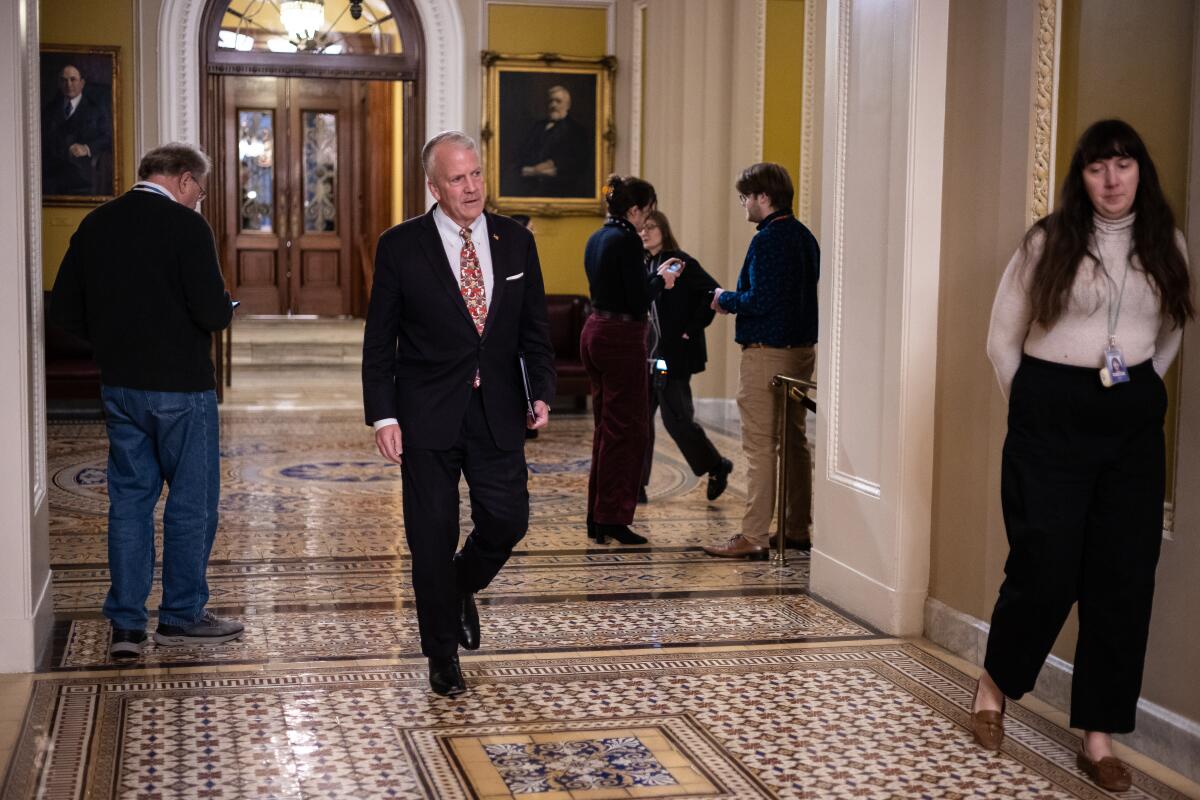
Sen. Dan Sullivan (R-Alaska) attends meetings at the U.S. Capitol in 2025.
(Francis Chung / Politico via Associated Press)
But the state’s high court overturned that decision, instructing elections officials to figure out a way to keep Daniel J. Sullivan’s name on the ballot “within the confines of existing Alaska ballot design law.”
It’s been nearly 20 years since the state sent a Democrat to the U.S. Senate, but this election looks to offer the party its best shot in years, thanks to Peltola.
Jessica Taylor, of the nonpartisan Cook Political Report, called her “the ideal recruit,” given Peltola’s fundraising prowess and her ability to outperform other Democrats by avoiding the toxic taint of the national party. (Peltola’s slogan —”Fish, family and freedom” — is about as far removed from the Whole Foods-shopping, Prius-driving Democratic image as it gets.)
Democrats need to win four seats in November to take control of the Senate, from a menu that includes Alaska, Iowa, Maine, North Carolina, Ohio and Texas while, at the same time, hanging on to contested Senate seats in Georgia, Michigan, Minnesota and New Hampshire. The Cook Political Report rates Alaska as one of the few toss-up races in the bunch.
The state has a ranked-choice election system in which the top four vote-getters advance to November. Ivan Moore, who does nonpartisan polling in Alaska, said that system virtually ensures Sullivan and Sullivan will face off against each other in a runoff that includes Peltola. At that point, Moore suggested, the choice to most voters will be clear.
Under the solution devised by state election officials, the senator will be listed as “Sullivan, Dan S.” and as “(Registered Republican) Incumbent.” His challenger will be identified as “Sullivan, Daniel J. Jr.” with no party affiliation.
“I imagine there’s some people out there who don’t know what the word ‘incumbent’ means,” Moore said. “But I find it pretty hard to believe that people who are dead set on voting for Dan S. Sullivan, the senator, are going to go in the voting booth and vote for the wrong person when Dan S. has the word ‘incumbent’ next to his name and Dan J. doesn’t have any party affiliation.”
Political hijinks are nothing new. But the level of partisan gamesmanship seems to be growing as the old saying about all being far in love and war is increasingly applied to campaigns and elections.
It was something of a novelty in 2002 when Democrats meddled in the California Republican primary to promote their preferred candidate. Now it’s common practice.
Redistricting, or redrawing the nation’s congressional lines to reflect changes in population, used to occur once a decade following the national census. But spurred by President Trump, the last year has seen an arms race among states, including California, which gerrymandered their political maps to boost a preferred party and, essentially, decide House races before a single ballot is cast.
Politics, another old saying goes, ain’t beanbag.
But it doesn’t have to be this slanted and cynical. There’s no need for fishy-smelling candidates like Daniel J. Sullivan.