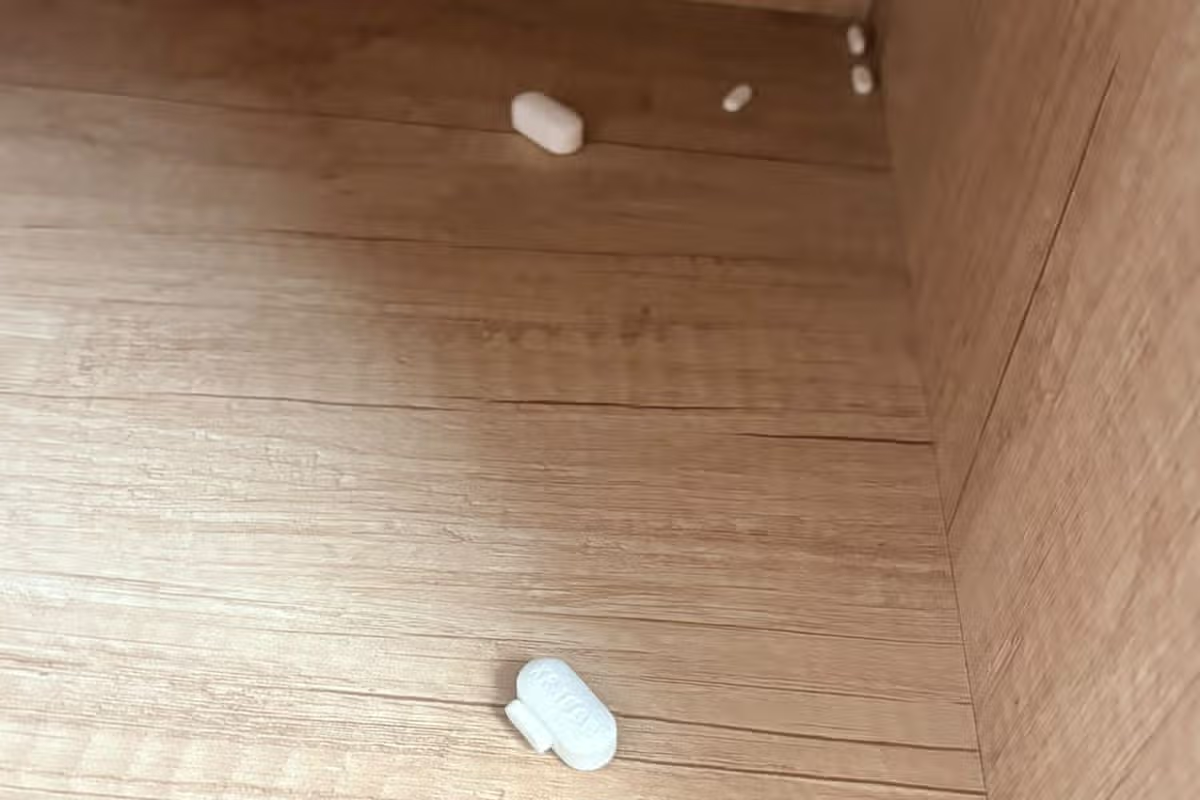
pills

Supreme Court, over two dissents, upholds abortion pills sent by mail, for now

The Supreme Court on Thursday rejected an antiabortion challenge to federal regulations that permit sending pills through the mail once a patient has consulted a doctor online.

The justices granted an emergency appeal from the makers of mifepristone and set aside an order from a U.S. appeals court in Louisiana that would have made it illegal to send or receive the medication by mail.

Justices Clarence Thomas and Samuel A. Alito Jr. dissented.

“The court’s unreasoned order granting stays in this case is remarkable,” Alito wrote. “What is at stake is the perpetration of a scheme to undermine our decision in Dobbs v. Jackson Women’s Health Organization, which restored the right of each State to decide how to regulate abortions within its borders.”

The decision is a setback for abortion opponents, including Louisiana Atty. Gen. Liz Murrill, who sued and argued that her state’s ban on abortion has been thwarted by abortion pills sent by mail.

Thursday’s order preserves access to the medication under the current rules, but it is not a final decision.

The case will now return to the 5th Circuit Court in New Orleans for further review.

“Today’s ruling buys time, but no peace of mind,” said Nancy Northup, president of the Center for Reproductive Rights. “Mifepristone access remains highly at risk as this case moves forward and the Trump administration conducts a politically motivated review of this pill with the hardly disguised aim of making it harder to get.”

National Right to Life expressed deep disappointment.

“Women facing unexpected pregnancies deserve real medical care and support, not a one-size-fits-all mail-order abortion system that minimizes risks and leaves women isolated during medical emergencies,” said Carol Tobias, the group’s president.

The legal dispute has put the Trump administration in a politically awkward spot.

Critics of abortion, including Republican attorneys general from 23 states, argued that the regulations adopted during the Biden administration have thwarted their state laws and allowed patients to obtain medication from doctors in California and New York.

But the Trump administration has shown no urgency to change the regulations that allow for dispensing the pills by mail.

Alito, who spoke at the 5th Circuit a week ago, said he agreed with the state’s argument.

“Louisiana’s efforts have been thwarted by certain medical providers, private organizations, and States that abhor laws like Louisiana’s and seek to undermine their enforcement,” he wrote. “These medical providers and private organizations have developed an operation enabling women in Louisiana and other States that restrict abortions to place an online order for a pill called mifepristone that induces abortion.”

Thomas said abortion is a crime in Louisiana.

The makers of the abortion pills have no grounds to sue “based on lost profits from their criminal enterprise. They cannot, in any legally relevant sense, be irreparably harmed by a court order that makes it more difficult for them to commit crimes.”

But most of the court’s conservatives refused to go along, even though they had voted to overturn the constitutional right to abortion.

Chief Justice John G. Roberts and Justices Neil M. Gorsuch, Brett M. Kavanaugh and Amy Coney Barrett refused to block the current regulations on a fast-track appeal.

Two years ago, the court handed down a similar decision involving abortion pills and the 5th Circuit Court.

The justices overturned a 5th Circuit ruling on the grounds that the antiabortion doctors who sued had no standing because they did not prescribe or use the medication.

In 2000, the FDA approved the use of mifepristone as safe and effective for ending an early pregnancy or treating a miscarriage. It is used in combination with a second drug misoprostol, which induces cramping.

Since 2016, the FDA has relaxed regulations on its use. They include a requirement that women obtain the pills directly from a doctor or a medical clinic. However, it was understood the medication would be taken later at home.

The agency temporarily suspended this rule in 2021 in response to the COVID-19 pandemic, then lifted it entirely in 2023.

Medication abortions now account for almost two-thirds of abortions in the United States, and telehealth is used in 27% of abortions nationwide. Last year, in response to abortion opponents, the Trump administration agreed to review the safety record of mifepristone.

“Mifepristone is one of the safest and most well-studied drugs on the market,” said Dr. Camille A. Clare, president of the American College of Obstetricians & Gynecologists. “The FDA removed the in-person dispensing requirement after careful evaluation of the data because mifepristone is safe and effective even when distributed by mail.”

But the Louisiana attorney general decided to sue in federal court without waiting for the FDA.

She argued that the mailing of abortion medication, which was approved under the Biden administration, was undermining her state’s strict ban on abortions.

A federal judge in Louisiana said the state appeared to have a strong claim, but he decided not to rule on it until the FDA completed its review.

The 5th Circuit Court of Appeals responded a few days later by ruling the FDA erred by relaxing its regulations to allow for dispensing the pills by mail. The three-judge panel then put its ruling into effect immediately on May 1.

Abortion law experts called out the decision as extreme and unusual.

“To our knowledge, no court has ever ordered the FDA to reimpose on a drug a safety rule the agency has thoroughly studied and deemed unnecessary,” said Melissa Goodman, executive director of UCLA’s Center for Reproductive Health, Law and Policy.

Source link

Louisiana urges Supreme Court to block abortion pills sent by mail

Louisiana’s state attorneys on Thursday urged the Supreme Court to stand aside for now and to uphold an appeals court ruling that would stop the mailing of abortion pills nationwide.

They blamed former President Biden for undermining the state’s strict bans on abortion and the Trump administration for slow-walking a study on the federal regulations that permit sending the pills through the mail.

The justices are likely to act soon on emergency appeals filed by two makers of mifepristone. They argued the pills have been shown to be safe and effective for ending an early pregnancy.

But last week, the conservative 5th Circuit Court of Appeals in New Orleans ruled for Louisiana and revived an earlier regulation that would require women to obtain the pills in person from a doctor.

The three-judge panel also took the unusual step for putting its order into effect immediately. On Monday, Justice Samuel A. Alito, who oversees the 5th Circuit, issued an administrative stay that will keep the case on hold through Monday.

The justices have to decide whether Louisiana had standing to sue over the federal drug regulations, and if so, whether judges have the authority to overrule the Food and Drug Administration.

Two years ago, the Supreme Court by a 9-0 vote dismissed a similar challenge to the abortion pills that came from the 5th Circuit. And Chief Justice John G. Roberts has said in the past that judges should usually defer to the federal agency that is responsible fo regulating drugs.

In response to anti-abortion advocates, Trump’s Health and Human Services Secretary Robert F. Kennedy Jr. agreed to have the FDA review the safety record of mifepristone.

It was approved in 2000 as safe and effective for ending early pregnancies. And in the past decade, the agency had relaxed earlier restrictions, including a requirement that pregnant women visit a doctor’s office to obtain the pills.

But the FDA said last month its review is far from complete.

In October, Louisiana Atty. Gen. Liz Murrill decided to bypass the FDA review and went to federal court seeking a ruling that would prevent the pills being sent by mail.

A federal judge refused to decide on the issue while the FDA was undertaking its review. But the 5th Circuit chose to act now. The Louisiana state attorney put the focus on the Biden administration.

When the Supreme Court was considering the Dobbs case, which overruled Roe vs. Wade and the right to abortion, “the Biden Administration was preparing a plan that predictably would undermine that decision,” she wrote in Thursday’s response.

“Although Louisiana law generally prohibits abortion and the dispensing of mifepristone to pregnant women, out-of-state prescribers—freed from the in-person dispensing requirement — are causing approximately 1,000 illegal abortions in Louisiana each month by mailing FDA-approved mifepristone into the state,” she said.

The Trump administration has yet to tell the court of its views on this case.

Source link

Supreme Court puts hold on ruling that would block mailing of abortion pills

The Supreme Court took a first step on Monday to consider anti-abortion challenges to medication that has been commonly used to end early pregnancies for 25 years.

The justices moved quickly to put on hold an appeals court ruling that would block the mailing of abortion pills nationwide. Justice Samuel A. Alito issued a temporary “administrative stay” until May 11.

Three years ago, the court blocked a similar challenge to abortion pills, ruling that anti-abortion doctors had no grounds to sue over medication they did not use or prescribe.

Last year, Louisiana’s state lawyers sued and argued their state ban on abortions is thwarted if women can receive abortion pills through the mail after consulting a doctor online.

They questioned the federal regulation that permits doctors to prescribe the medication without seeing patients in person.

On Friday evening, the conservative U.S. 5th Circuit Court of Appeals in New Orleans jolted abortion rights advocates, first by ruling this claim is likely to succeed and then by putting their order into effect immediately.

Judge Kyle Duncan, a President Trump appointee, said the Food and Drug Administration had “failed to adequately study whether remotely prescribing mifepristone is safe.”

Moreover, women may suffer “irreparable harm” if these mail-order prescriptions are allowed to continue, he said.

If upheld, the order would go far beyond Louisiana and make it illegal for women in California and other states to obtain the pills through a pharmacy or by mail if they did not see a doctor first.

The legal dispute may put the Trump administration in an uncomfortable spot. In response to the abortion critics, the FDA agreed to review the safety of prescribing these commonly used pills without a required trip to a doctor’s office.

Its review is not likely to be completed until after the November elections.

The 5th Circuit judges said they were not prepared to wait for the outcome of that review.

On Saturday, two makers of mifepristone — Danco Laboratories and GenBioPro — filed emergency appeals asking the justices to block the 5th Circuit’s order.

“Never before has a federal court” rejected a long-standing drug approval by the FDA, they said, and restricted its distribution based on claims the agency had rejected.

The justices asked for a response from Louisiana by Thursday.

Mifepristone was approved in 2000 as a safe and effective way to an early pregnancy. It is typically used in combination with a second drug — misoprostol — which is not affected by the court’s decision.

If mifepristone becomes unavailable, women may use misoprostol alone, abortion rights advocates say.

In recent years, the majority of abortions in this country result from the use of medication.

Alito is responsible for emergency appeals from the 5th Circuit, and Monday’s order does not signal what the court will decide.

“This ruling is not final — keep watching,” said Nancy Northup, president of the Center for Reproductive Rights. “Getting abortion pills through telehealth has been a lifeline for women since Roe v. Wade was overturned. Louisiana’s attempt to restrict access is political and not based in science or medicine. Americans deserve access to this critical drug that has been FDA approved for 25 years.”

Carol Tobias, president of National Right to Life, agreed the court’s order did not resolve anything.

“It is a temporary procedural step that leaves unresolved the very real concerns about the safety of these drugs and the decision under the Biden administration’s FDA to recklessly remove longstanding safeguards,” she said.

California Atty. Gen. Rob Bonta joined with 21 other state attorneys in urging the court to block the 5th Circuit’s decision.

“Telehealth has made it easier for women — especially in rural, low-income, and underserved communities — to access mifepristone and obtain reproductive health care,” he said. “We should be guided by science, not politics. The in-person dispensing requirement was eliminated because it was medically unnecessary, and there is still no basis for reinstating it.”

Source link

Court blocks abortion pills prescribed through the mail

A federal appeals court on Friday night blocked the nationwide sale of mifepristone, also known as the abortion pill, after the state of Louisiana sued the federal government for allowing it to be sold during telehealth appointments and mailed to patients. File Photo by Bill Greenblatt/UPI | License Photo

May 1 (UPI) — A federal appeals court on Friday night issued a ruling that enacts a nationwide block on the prescription of the abortion pills in telehealth appointments and mailing them to patients.

A three-judge panel on the 5th Circuit Court of Appeals ruled in favor of the state of Louisiana, which had used to end a Food and Drug Administration rule that allows doctors to prescribe mifepristone without having an in-person visit, ABC News, Politico and The New York Times reported.

Mifepristone was first approved by the FDA in 2000 for medical termination of pregnancy, and until the COVID-19 global pandemic required that the drug be prescribed to patients during in-person doctor’s appointments.

After enacting a strict abortion ban in 2022, Louisiana then moved to reclassify mifepristone as a controlled substance and criminalized its possession, effectively making it illegal in the state.

Although Louisiana had made it illegal to prescribe or possess in the state, people could obtain prescriptions from out-of-state doctors have virtual telehealth visits, with the mails mailed to people’s homes.

As the COVID-19 pandemic spread across the country in spring 2020 and forced much of in-person life to stop, doctors sued the FDA for an exception to the in-person requirement to prescribe mifepristone.

The agency in 2021 announced that it would exercise “enforcement discretion” because of the COVID-19 public health emergency.

After Roe v. Wade was struck down by the U.S. Supreme Court, several states across the country moved to outlaw most abortions, but mifepristone continued to be available through telehealth appointments and the mail.

Louisiana told the court that it needed relief because of an alleged influx of abortion pills to the state, making the argument that mail-delivered abortion pills endanger the safety of women there.

“We are alarmed by this Court’s decision to ignore the FDA’s rigorous science and decades of safe use of mifepristone in a case pursued by extremist abortion opponents,” Evan Masingill, CEO of GenBioPort, which manufacturers the drug, told Politico in a statement.

“We remain committed to taking any actions necessary to make mifepristone available and remain accessible to as many people as possible,” Masingill said.

Source link