‘Remake’ review: Ross McElwee returns with heartbreaker
“Remake” has a tragic tale to tell and director Ross McElwee wastes no time revealing its grieving heart. Near the start of this funereal documentary, the filmmaker addresses his subject directly: “It’s been seven years since you died,” he says to his late son Adrian through voice-over, “and I still miss you every day.”
Across McElwee’s 50-year career, he has worked intimately without a crew to make sense of his own life by diligently recording it. In the process, he turned his friends and loved ones into the unlikely stars of his acclaimed independent documentaries.
With “Remake,” he looks back at that footage, concentrating on the images he shot of Adrian since his birth in 1989. Adrian died on Christmas Eve 2016 of a drug overdose and McElwee clearly remains shattered. For a documentarian who specializes in personal movies, “Remake” feels especially revealing — both in terms of the glimpses we get of this father-son relationship and of unsolved mysteries that linger just outside the frame.
The film’s title ostensibly refers to a surprising phone call McElwee received about 20 years ago, when he was approached by Steve Carr, the director of broad comedies like “Paul Blart: Mall Cop,” who was eager to adapt McElwee’s 1986 documentary “Sherman’s March” into a movie. That landmark picture features McElwee, then in his mid-30s, as he tries to chronicle the exploits of Union Gen. William Tecumseh Sherman, who laid siege to the South during the Civil War. Except, in the midst of that project, McElwee’s focus shifts, delightfully, to his disastrous love life and the fascinating women he meets in his travels, becoming a deeply humane examination of modern courtship.
Carr doesn’t seem like an obvious choice to oversee a narrative remake, but McElwee decides to sell him the rights anyway. Soon in “Remake,” though, it becomes apparent that this is just one chapter of the story — and hardly the most essential. McElwee’s last film, 2011’s “Photographic Memory,” dealt with his increasingly frayed connection to Adrian, who was already fighting substance-abuse issues. “Remake” retraces Adrian’s childhood while filling in the details of the director’s life after “Photographic Memory,” including brain surgery and the dissolution of his 24-year marriage.
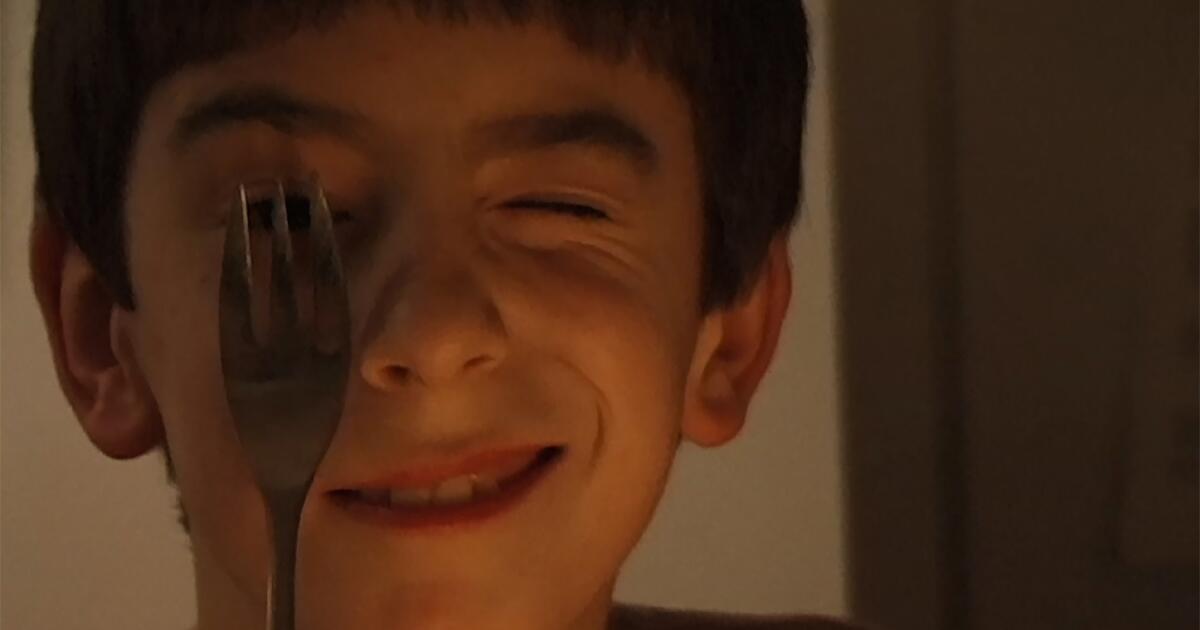
But Adrian is never far from his thoughts or absent from the screen: this smiling, happy boy slowly transforming into an edgy, troubled young man whose sweetness still occasionally shines through.
The passage of time is central to McElwee’s work, but he’s rarely scrutinized the topic as aggressively as he does here. It’s not simply that we watch Adrian age or revisit some of McElwee’s “Sherman’s March” subjects. (“Sherman’s March” is now screening in a new 4K restoration at the Laemmle Royal with “Remake.”) It’s also in the way that McElwee’s formerly wry narration now sounds far more resigned, his voice grown froggy and hushed as he nears 80. McElwee has often pondered the downside of essentially treating himself like a human camera, observing the world rather than fully engaging in it. But in “Remake,” he openly questions his artistic approach and, fittingly, he lets his son be his loudest critic.
As a boy, Adrian is enchanted by McElwee’s filming. In childhood, he paints an abstract picture of God in which the Almighty eerily resembles a movie camera. But although Adrian soon picks up a camera as well, increasingly interested in being a filmmaker himself, he resents how his father intrudes on their time together by constantly shooting their conversations. McElwee’s scenes of them at the Venice Film Festival for the “Photographic Memory” premiere are especially fraught, Adrian’s prickly reaction to a movie about his drug abuse creating tension between the two men at the subsequent press conference.
In “Remake,” McElwee laments that he didn’t do enough to help him navigate addiction and the mental-health issues that exacerbated it. (Adrian was diagnosed with bipolar disorder.) Was McElwee too consumed with his own career to be there for his son? The question haunts “Remake” — he includes an indelible sequence from “Sherman’s March” in which his longtime friend Charleen upbraids him for always having the camera out. “This isn’t art,” she hollers. “This is life!” Did McElwee never come to appreciate the difference?
A eulogy that also serves as an apology, a reckoning and a confession, “Remake” is filled with moments that are crushing because of how understated they are, none more brutal than when McElwee visits Adrian near the end of his life, when he’d moved to Colorado to get a fresh start. “He seemed to be doing OK,” McElwee recalls thinking. “But I always leave knowing I’m probably not seeing the whole picture.”
Even now, poring through his footage, desperately looking for clues, McElwee pines for that larger view — the one that might somehow bring the boy back to his inconsolable father.
‘Remake’
Not rated
Running time: 1 hour, 54 minutes
Playing: Opens Friday, July 17, at Laemmle Royal