A bystander has filmed residents of a condemned building in Peru’s Huancayo throwing flaming gasoline on officials trying to evict them. Nine workers suffered severe burns in the attack.
The Battle of Angamos (Combate naval de Angamos) was a naval battle fought on October 8th 1879, during the War of the Pacific (1879-1883). Also known as the Saltpeter War, the war began as a dispute between Chile and Bolivia over control of the Atacama Desert a region rich in valuable minerals. Peru became involved when Bolivia declared war on Chile and invoked Peru to fight on their side as part of a secret mutual agreement.
The Battle of Angamos took place off the coast of what was then Bolivia (the are is now part of present-day Chile), between the Chilean navy and the Peruvian navy.
The Chilean Navy, under the command of Captains Galvarino Riveros and Juan Jose Latorre surrounded and captured the ironclad steam-propelled warship Huáscar. The captain of the Huáscar was Admiral Miguel Grau Seminario, who was killed by the Chileans.
The defeat in the battle was seen as key turning point in the war and the Peruvian forces were unable to prevent the subsequent invasions into its territory by Chile.
Admiral Grau is considered a hero in Peru and today many streets, parks and other landmarks are named in honour of him and his warship.
Leopardus tilcayo is the first new living cat species named and described in more than a century.
Published On 18 Sep 202618 Sep 2026
A tiny wild cat that lives in Bolivia’s lush cloud forests has been identified as a previously unknown species, marking the first time in more than a century that a new living feline species has been formally named and described.
Called “tilcayo” by local communities, the cat is part of a group called tiger cats, which are found across much of South America.
Recommended Stories
list of 2 itemsend of list
It was discovered in the Yungas forest, a mountainous region where forests are often covered by clouds and surrounded by high humidity, according to the researchers.
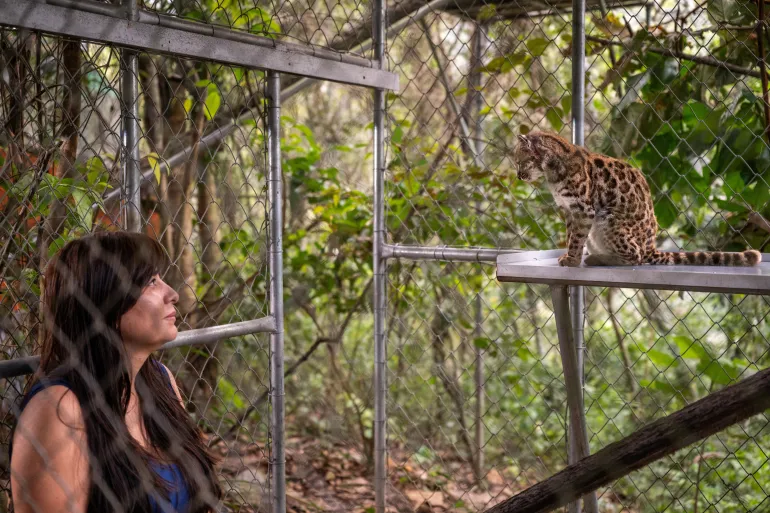
Given the scientific name Leopardus tilcayo, the cat measures 46cm (18 inches) long and weighs about 1.4kg (3 pounds), making it smaller than an average domestic cat.
“Its fur is light brown … with irregularly shaped rosettes across its body,” according to Paola Nogales-Ascarrunz, a National Geographic Explorer and one of the authors of the study describing the newly identified species published on Thursday in the journal Current Biology.
Little is known about the cat’s biology and lifestyle. Remains of small rodents in scat samples suggest they may form part of its diet, while camera-trap evidence indicates it could be more active at night, Nogales-Ascarrunz said.
Tiger cats are so-called cryptic species, meaning they cannot easily be distinguished merely by appearance, evolutionary biologist and study co-lead author Jonas Lescroart of the University of Antwerp in Belgium said.
National Geographic Explorer Paola Nogales Ascarrunz, who led the research that identified Leopardus tilcayo as a new species, observes the cat at the Senda Verde animal refuge in the Yungas region, in Bolivia, September 1, 2026 [Handout/Fernando Faciole/Reuters]
Observing the Bolivian cat drew interest because “its characteristics did not match the descriptions, most of them based on Brazilian cats”, Nogales-Ascarrunz said. “This made us wonder, what tiger cat do we actually have in Bolivia?”
The team analysed DNA from 38 cats sampled across several South American countries, including eight museum specimens. The study found that tiger cats are in fact five genetically distinct species.
“We never expected this Bolivian tiger cat to be a separate species, and no one had ever proposed it as a different animal, subspecies or otherwise,” Jonas Lescroart said.
Genetic analysis suggested that the tilcayo lineage separated from other tiger cats about 1.4 million years ago.
The research team also described a new tiger cat subspecies in Peru’s Yungas, naming it Leopardus tigrinus antisuyo, after Antisuyu, the region of the old Inca Empire that included the area it inhabits.


![National Geographic Explorer Paola Nogales Ascarrunz, who led the research that identified Leopardus tilcayo as a new species, observes the cat at the Senda Verde animal refuge in the Yungas region, in Bolivia, September 1, 2026 [Fernando Faciole/Handout via Reuters]](https://i0.wp.com/occasionaldigest.com/wp-content/uploads/2026/09/2026-09-17T154150Z_381273466_RC2N9NAU7NUJ_RTRMADP_3_SCIENCE-CAT-1789702964.jpg?w=640&ssl=1)