She wasn’t even aware to begin with

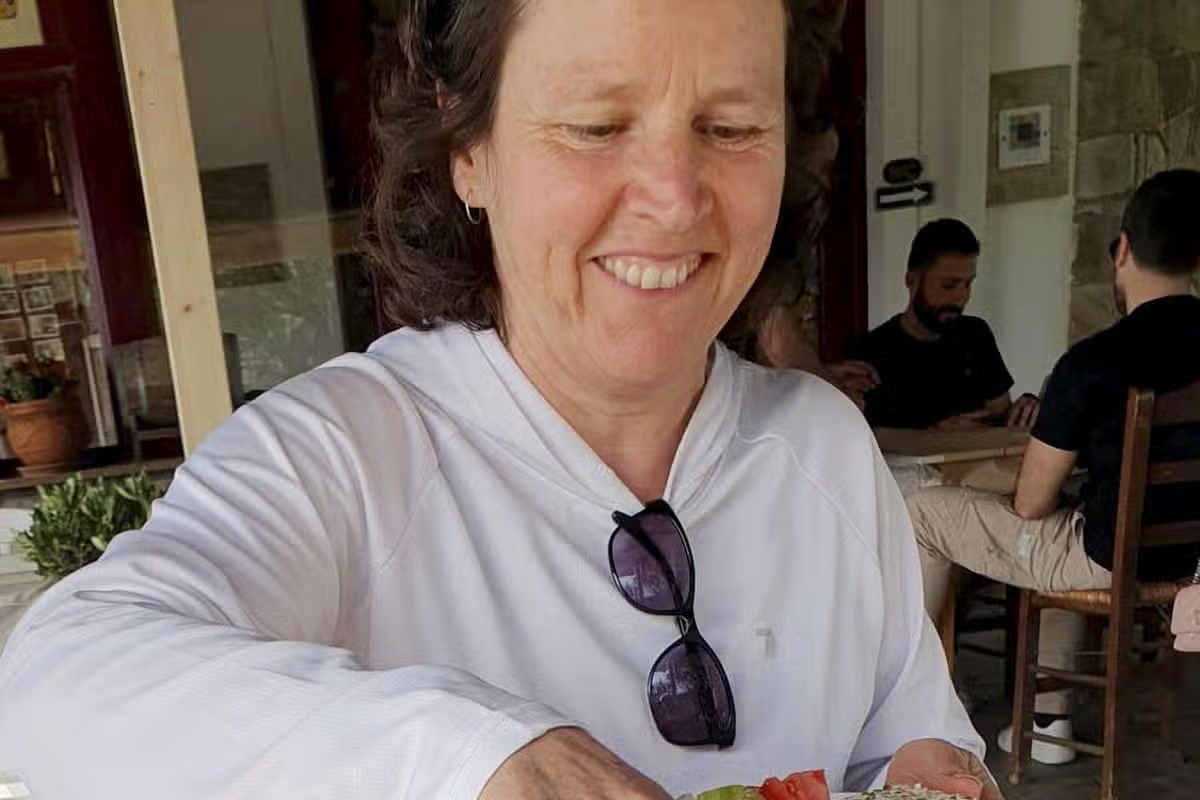
Laura Horton on holiday in Greece(Image: Laura Horton/SWNS)
A woman was bitten by a bat on holiday and ended up seeking rabies treatment thanks to AI.
Laura Horton, 53, was on a two-week birthday trip to Lesbos, Greece, in May 2026 when she found a bat drowning in the swimming pool at the apartment complex where she was visiting a friend. She grabbed the animal from the water and let it sit in her hand for 10 minutes to “dry off” – unaware it had bitten her before flying away.
Laura wanted to know what type of bat she had rescued, so she uploaded a photo of it sitting in the palm of her hand to Google Lens. As well as identifying it as a pipistrelle bat, the AI programme alerted her to seek medical treatment immediately due to the risk of contracting rabies from handling the animal.
She also claimed Google Lens warned her that she would be unable to feel a bat bite as their teeth are too small, and on closer inspection, Laura noticed two tiny pin-prick bite marks. According to the NHS website, rabies is a rare but serious infection that is usually caught from an infected animal’s bite or scratch, and it is almost always fatal once symptoms appear.
Laura went to the Hospital of Mytilene, Lesbos, the following day, May 8, where she started a course of preventative rabies post-exposure vaccines. She had a total of three jabs in Greece, followed by her fourth and final jab when she returned to the UK on June 1 at the School of Tropical Medicine, Liverpool.
Laura, a personal trainer from Mossley Hill, Liverpool, who spoke to Talk to the Press, said: “I had no idea you could catch rabies from a bat. I grabbed it from the water on instinct because it was drowning – I had no idea of the risks.
“It sat on my hand for about 10 minutes, drying off. We all thought it looked cute, so I took a photo of it.”
After uploading the image to Google Lens to determine the species of bat, Laura was met with a series of questions from the AI tool.
She said: “It started asking questions like, ‘are those your hands?’ and ‘have you washed your hands for 15 minutes after handling it?’ It warned me of the risk of rabies and said I wouldn’t feel a bite, as their teeth are too small.
“I thought it was all a bit dramatic. But when I took a photo of my hand, I saw two tiny bite marks.”
Laura was four days into her two-week holiday in Petra, a village on the Greek island of Lesbos, with friends when she was bitten. She rang her insurance company the following day, May 8, which confirmed she should seek medical attention.
She needed to undergo a course of rabies post-exposure prophylaxis (PEP) – a life-saving treatment given immediately after a potential bite or scratch from a rabid animal. Later that day, Laura went to the hospital, but claims a language barrier nearly prevented her from getting the correct treatment.
“At first, they tried to send me away with antibiotics,” she said. “I’m not sure they understood what happened.
“I was sent to a travel clinic and a nurse was furious I hadn’t been given the first dose yet. I went back to the hospital and found the infectious diseases department – they were brilliant.”
She returned on May 11 and May 15 for two more jabs while in Greece and had a fourth when she returned to the UK on June 1.
She said: “My GP didn’t actually know what to do. Luckily, we have the School of Tropical Medicine in Liverpool and I was able to get my fourth injection arranged with them very easily.
“I later found out there is a dedicated rabies hotline in the UK that would have delivered it to my doctor’s surgery. It was lucky Google Lens told me to go to hospital – who knows what might have happened.
“I read the tragic case about the boy in Canada who died after a bat landed on his face. A lot of people aren’t aware of the dangers of these wild animals and the risks. Hopefully I can help raise awareness.”