percentage point

Scandals haven’t stopped Ken Paxton. Can James Talarico change that?

Eight years ago, during a campaign for Texas attorney general, Justin Nelson ran television advertisements with security camera footage of Ken Paxton pocketing an expensive pen that didn’t belong to him.

Four years ago, George P. Bush went after Paxton by putting up billboards that said “he’s a crook” next to his mugshot from when he was charged with securities fraud.

And this year, U.S. Sen. John Cornyn said “judgment day is coming” as he tried to fend off a Republican primary challenge from Paxton.

All of them lost. Now the question is whether James Talarico, who topped Rep. Jasmine Crockett in an expensive and fiercely contested Democratic primary, will have any more luck as he faces off against Paxton in one of the country’s most closely watched U.S. Senate races.

“The guy’s ability to take shots and just keep moving on and stay in elected office is unlike anything I’ve ever seen in my career, in 25 years of running campaigns,” said Ash Wright, who worked as a senior adviser to Bush.

Paxton never has been convicted and he’s survived by championing conservative legal battles over immigration, abortion and transgender issues in a Republican-dominated state. Much like President Trump, he’s long portrayed himself as the victim of political persecution.

Democratic Senate candidate James Talarico

Democratic Senate candidate James Talarico speaks at a rally in Houston in May.

(Danielle Villasana / Getty Images)

Former Paxton challengers and a half-dozen campaign strategists who worked against him warned that Texans may tune out any attempt to revive scandals that they’ve heard about for years, especially when rigid partisanship has convinced voters to be extraordinarily forgiving of candidates’ trespasses.

However, Talarico’s team has studied the previous races and is attempting its own version of the playbook by trying to paint Paxton as part of a broader culture of corruption that has failed to improve people’s lives.

Paxton’s campaign suggested Talarico’s claims were aimed at distracting voters from a record of “out-of-touch views.”

“Every time a fighter, like President Donald Trump and now Ken Paxton, stands up to the permanent political class, even after they are completely acquitted of wrongdoing, people like James Talarico continue pushing the same accusations and claiming corruption,” Paxton campaign spokesperson Madison Cercy said.

Paxton won first reelection despite indictment

Paxton was first elected as Texas attorney general in 2014, and Nelson ran against him in 2018. A Democratic lawyer from Austin, Nelson made Paxton’s indictment on charges of securities fraud central to his campaign, and poked fun at him for picking up another lawyer’s $1,000 pen after finding it at a courthouse security checkpoint.

“Vote Justin Nelson for Texas attorney general,” the narrator said. “He will fight on behalf of all Texans. And he won’t steal your pen.”

Nelson argued that his approach was effective, reflected in Paxton’s narrow margin of 3.6 percentage points in a year when Republican Greg Abbott was reelected as Texas governor by more than 13 percentage points. Nelson’s campaign spent roughly $6.5 million, about half of what Paxton’s campaign spent.

“My message was working,” Nelson said. “I just needed to go louder and longer.”

In 2022, Paxton faced a Republican primary challenge from George P. Bush, the Texas land commissioner and the grandson and nephew of two former presidents from the state.

The securities fraud case was ongoing, and Paxton also was under federal investigation over accusations that he abused his position to benefit an Austin real estate developer, took bribes and retaliated against whistleblower employees.

Paxton responded by portraying himself as a Trump-era Republican and Bush as the heir to a privileged political legacy.

Pro-Paxton organizations spent more than $20 million, about twice as much as Bush and his allies. The race went to a runoff, in which Paxton defeated Bush by 34 percentage points.

Paxton ran against Rochelle Garza, a Democratic civil rights lawyer from Brownsville, in the general election. She said her campaign had a 300-page opposition research file on Paxton but it was difficult to figure out how to approach his past because voters had heard about it for years.

“The amount of potential hits on Paxton can make message discipline challenging,” Garza said.

Paxton ran as the leading legal opponent of President Biden, promoting a string of lawsuits against Biden’s Democratic administration on immigration, abortion and gender policy.

Overwhelmingly outspent, Garza lost by roughly 10 percentage points.

Some supporters see Paxton as a ‘flawed’ fighter

There was more trouble ahead for Paxton.

He split with his wife, who later filed for divorce “on biblical grounds.” He also was impeached by the Texas House, although the Senate acquitted him in 2023 and allowed him to remain in office. The securities fraud case ended in 2024, and Paxton was directed to pay nearly $300,000 in restitution.

Throughout the years, he’s maintained strong support from Republican voters like David and Nancy Lapp, a retired couple from the small town of Wolfforth. They described him as a conservative warrior who has been a victim of persecution.

“He’s had his share of scandals, and almost all of them have, so it’s not necessarily disqualifying anymore,” said David Lapp, 76. “He’s a flawed person, no doubt about it, but he fights for traditional American ideals.”

He added that “nowadays, as long as you’re not in jail, they’ll elect you.”

Beaumont writes for the Associated Press. Associated Press reporters Jesse Bedayn in Del Rio, Texas, and Marc Levy in Wolfforth, Texas, contributed to this report.

Source link

California voters are eager to know who won. Here’s the holdup

After the 2022 Los Angeles mayoral primary, developer Rick Caruso looked to have a surprising, and sizable, lead over then-U.S. Rep. Karen Bass.

The morning after the polls closed, Caruso was ahead by 5 percentage points — 42% to Bass’ 37% — and the former Republican called the early results “a victory story.”

But that lead did not last as the vote count continued. By the time all votes were tabulated two weeks after election day, Bass had come out on top, with 43% of the vote compared with Caruso’s 36%.

Welcome to the postelection vote-count slog in California, where tight races are often impossible to call even when the initial results seem clear-cut.

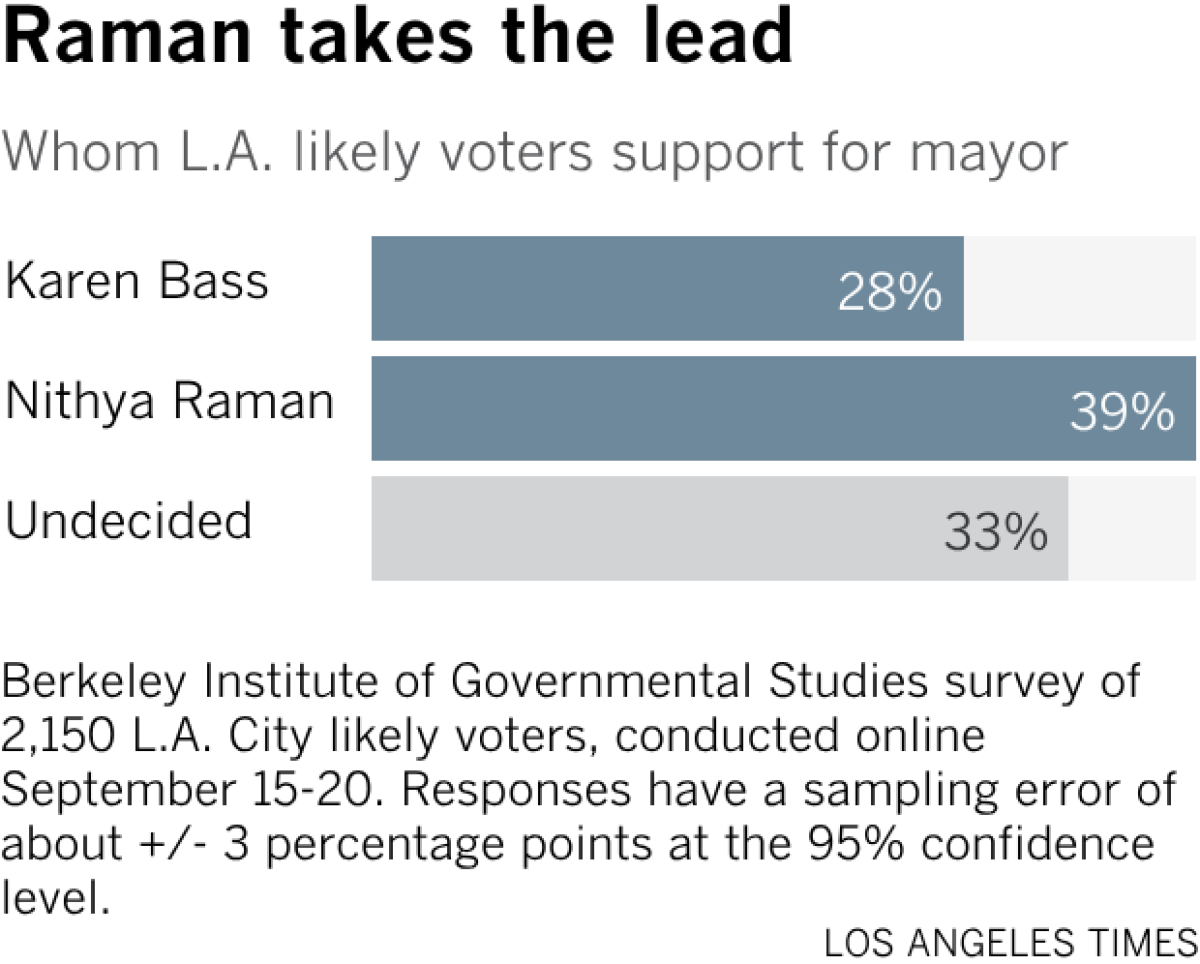
The California governor’s race still has not been called even though Republican Steve Hilton has been the top voter-getter and Democrat Xavier Becerra has been in second place since election night. The same is true in the battle over who will face Bass in the mayoral election: reality TV personality Spencer Pratt, who is now in second place, or L.A. City Councilmember Nithya Raman, who is in third place.

At this point in the vote tally, “everybody has an opinion and very few facts” about what the results will be, said Mike Murphy, a Republican strategist.

“Nobody in politics wants to be patient,” Murphy said, adding that California has “adopted a system that’s slow and deliberate.”

It’s not just the L.A. mayor’s race where mail-in ballots have swung election outcomes. Other contests, including those for highly competitive Orange County congressional districts and L.A. City Council seats, have come down to extremely narrow margins that have shifted long after election day.

On election night in November 2024, just over 1,000 votes separated Democrat Dave Min and Republican Scott Baugh in their bid for the 47th Congressional District, with Baugh enjoying a slight lead.

But, ultimately, as more ballots were counted, Min pulled ahead. He ended up winning by about 10,000 votes.

Similarly, in the race between Democrat Derek Tran and then-incumbent Michelle Steel to represent Congressional District 45, it took until Nov. 27 to determine that Tran had won the contest by just over 650 votes.

In 2022, the race between then-incumbent Gil Cedillo and community activist Eunisses Hernandez for L.A. City Council was similarly unsettled. On election day, Cedillo had a comfortable lead with 56% of the vote. But two weeks later, Hernandez ended up in the lead with 54% of the vote to Cedillo’s 46%.

Experts say confirming the final spot in the mayor’s race could still take several more days, depending on how close the contest becomes and how many ballots still need to be counted. Only an estimated 62% of ballots from the city of Los Angeles had been counted as of Thursday morning.

“Of the 40% remaining, or outstanding, there could still be a chance that there would be a significant return of more left-leaning votes, which would certainly benefit Raman,” said Pete Peterson, dean of the School of Public Policy at Pepperdine University.

Late results tend to favor Democrats — as seen in the 2022 Bass-Caruso contest — as Democrats tend to be more likely to vote by mail, a system that accepts ballots up to seven days after election day as long as they are postmarked by that Tuesday. And this year, Democratic voters held on to their ballots longer amid an unsettled governor’s race, which could further boost that phenomenon.

“The major difference between ’26 and ‘22, you had two candidates versus three,” Peterson said. “Mathematically, it’s a different situation.”

Three experts The Times interviewed said Raman still had a chance to pass Pratt, but it seemed more likely at this point that Pratt would survive and challenge Bass in November.

The remaining ballots to count, even if they are overwhelmingly left-leaning, will probably be split between Raman and Bass, which means Raman needs to outperform not just Pratt but Bass to make such a comeback possible, Peterson said.

He called her chances of ousting Pratt “dastardly remote … but it’s not impossible.”

In L.A. County, the registrar of voters reported late Wednesday that officials estimate they still have about 713,000 ballots to process and count, which primarily includes vote-by-mail ballots postmarked by election day but not yet received, as well as ballots returned to drop boxes and vote centers on election day. The registrar only made countywide estimations, which includes a much larger pool than L.A. city voters who will decide the mayor’s race.

Kamy Akhavan, the managing director at the USC Dornsife Center for the Political Future, said there’s a theory circulating among pundits that ballots submitted later are going to break more progressive, meaning they’ll be more friendly to Raman.

“Whether there is enough of them to tilt the outcome in favor of Raman taking a second place position, right now, it seems unlikely,” he said.

Pratt is pulling from the same electorate in Los Angeles that voted for President Trump and could snag a few more voters who are angry about the state of the city. But his lead very well could shrink a bit as more Democrats’ ballots are counted, Murphy said.

“Nithya, she’ll probably go up because there’s going to be a fair amount of Democratic votes and she’ll get her chunk, but will she catch Pratt? You can extrapolate it either way,” Murphy said.

A similar left-leaning shift also occurred as more ballots were counted in November 2022 when Bass and Caruso faced off in the general election. Results on election night wavered between the two candidates, but by the following morning Caruso had a thin lead with 51.25% of the counted votes. Bass sat at 48.75%.

Caruso remained in the lead — though it continued to shrink — as the week dragged on, but by Saturday, Bass had pulled ahead with 50.78% of the counted vote. Caruso had fallen to 49.22%.

Her momentum continued to grow as more ballots were processed. Eight days after polls closed the following week, the Associated Press called the race for Bass. At that point, she led Caruso by six points with 53% of the vote.

The final tally would have her winning almost 55% of the vote.

California officials have worked to dispel rumors and falsehoods about slow election results — explaining that it’s part of the process to accurately count and confirm ballots, especially those mailed in — though there has been a growing push to expedite results to build voter trust.

The process has been particularly slow in L.A. County, though experts say that is mostly a result of the county’s massive voter base. Mail-in ballots are also heavily scrutinized with workers verifying signatures and giving voters a chance to remedy the situation if their signature doesn’t match, a process that takes time.

“They’re using that level of care because they’re supposed to — that’s their protocol — and also because it could make a big difference,” Akhavan said. “We’ve seen some elections in Southern California decided by single digits. And that just means this is going to take time. That can be very frustrating, even annoying, to Angelenos.”

Source link